Trip report
Kamchatka 2000. The road through the clouds
Alexander Simo and Tanya Simo
12–13 July. A short night on the plane
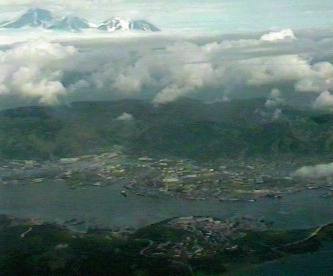
Even after we boarded, we weren't entirely sure they wouldn't turn us back at the airport for venturing into a restricted border zone. We'd put this trip together on the spur of the moment, in a week. The original plan was to paddle around Sakhalin. The Sochavas, who usually came with us, dropped out at the last minute, so off we went somewhere even farther away and more intriguing. I'd dreamed since childhood of getting on this very plane and flying to Petropavlovsk-Kamchatsky. It was the farthest you could fly from Saint Petersburg. I even used to go to the airport to see the people coming off that flight. There was something special about them, or so I thought. I'd travelled over a million kilometres since then, and I'd still never flown that route. And there below us was the Saint Petersburg region, which I'd travelled the length and breadth of, with its familiar roads, villages and rivers. Unfortunately, I didn't get to see the Veps country. The ground disappeared beneath the clouds. The next thing we saw was the Urals giving way to the West Siberian marshes, where a brief night caught up with us, broken by a landing in Novosibirsk. We met the dawn over Baikal. Strange to see in one sweep a journey that had taken us weeks by kayak in 1997. The first rays of sunlight touched the summits of the Barguzin Range, and thick fog spread along the valleys. The black ribbon of the Vitim carried its waters north. The fog closed in after that, and we didn't see the ground again until a minute before landing in Khabarovsk. It was a wonder they'd attempted the landing at all in that visibility. In Khabarovsk we met Yevgeny Ivanov, a pensioner and survivor of the siege of Saint Petersburg who'd used his free travel vouchers to get a ticket to Kamchatka. He was travelling alone. We compared notes and decided to go on together. After Khabarovsk, the clouds first parted over the middle of the Sea of Okhotsk. A storm was blowing, and we could see huge rollers even from the plane. Before long the black cone of Alaid rose at the horizon, on Atlasov Island. Then came Paramushir and Cape Lopatka. Now we were over the swampy west coast south of Bolsheretsk. The rest of Kamchatka was lost in the fog, with only the snowy cones floating above the white blanket. They announced 13 degrees at the airport. A little on the cool side. Coming in from the ocean, we had a fine view of Petropavlovsk, hills, wharves and all. Passport control met us on landing, a relic of the old restricted zone. They still check everyone's passport right there on the plane, but they let everybody in, even foreigners. You could tell that Moscow and the bosses were a long way away. The airport reminded me of Soviet times, when things were simple, you could unload your own bags and the guards were ordinary people, rather than commandos with shiny killers' mugs. Nobody had poured money into giving the place a glossy Western makeover, and it felt oddly like home. It was clearly warmer than the advertised 13 degrees. The sun was behind clouds, but it hadn't rained for a while. The tarmac was dry.
13–15 July. Avacha. A night on the summit
We walked round the airport, studied every timetable we could find and went looking for the bus to Yelizovo.
The airport is near Yelizovo, but there's a fair way to go to town, so you're better off on the bus. If you walk, aim for the tall aerial masts. The bus station is the centre of town. Petropavlovsk is much bigger, but it's at the end of the road. All the roads in Kamchatka converge on the bus station in Yelizovo.
We had no fixed plans for when or where to go. We'd find out soon enough. One thing was clear: the Valley of Geysers came first. I didn't fancy carrying large sums of money around for a month. It would also be nice to know what we had left afterwards, so we could cut our coat according to our cloth.
Yevgeny took us to a travel agency called Fokus. Tourism in Kamchatka was growing and there were agencies everywhere. We had a pleasant chat there about what to see and how to get to it. It was nice to meet people who felt like our sort, instead of polished young men and women who knew the price list by heart. Of course, like any package-tour outfit, the people at Fokus couldn't imagine hitchhiking with a tent and no guide, so they didn't know much about ways of getting out on your own.
We heard a delightful piece of news: Mutnovsky was erupting. You couldn't go near it, let alone climb down into the crater. We knew at once where we were going just as soon as we'd seen the Valley of Geysers. The only legal way into the valley was by helicopter with Krechet, though any of the agencies could sell you a ticket. They only had space on the 16th, at 4,200 roubles per person for six hours there. We handed over the money and got our tickets. That left us two days free. There was no sense going to Mutnovsky for two days, so we decided to spend them on Avacha, the nearest volcano.
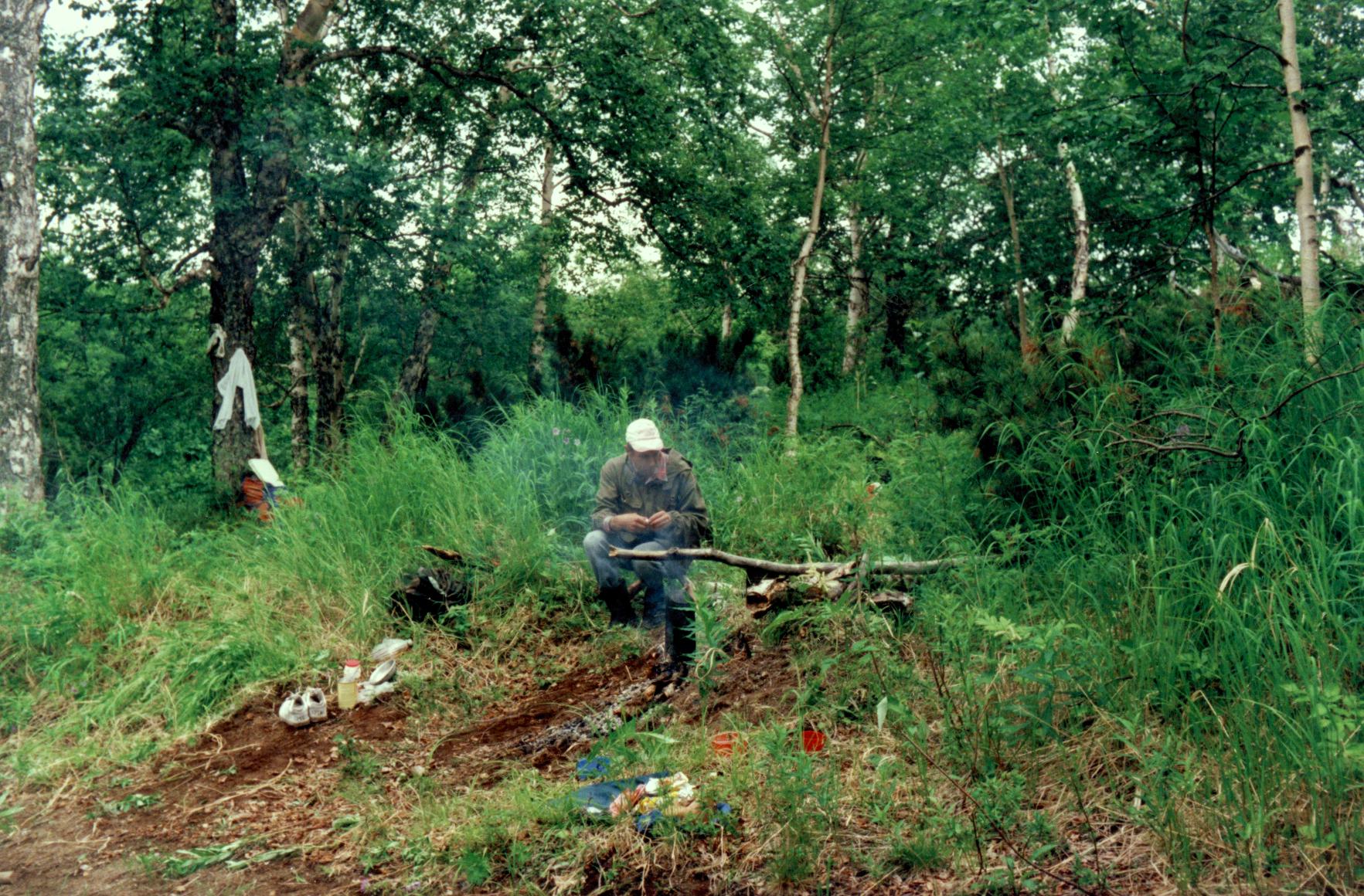
Yevgeny came with us. We took a minibus out of Yelizovo and continued on foot, looking for the road that followed the dry riverbed. The locals had absolutely no idea how to get to the climbing base at the foot of the volcanoes. We eventually found the bridge near Mutny (53°11.419′N, 158°29.2712′E), where the road begins. We got a lift as far as the end of the tarmac. It was our first encounter with the good-natured people of Kamchatka, who'll give a traveller a free lift, a meal and a place to sleep for coming to see their beautiful corner of the world. The man suggested following the power lines. They'd built them all the way to the base, then promptly scavenged them for scrap metal and firewood. There was a road along the line, but it was clearly impassable. The air was warm and humid. There were a few mosquitoes. Astonishingly, though it had plainly rained recently, there was no drinking water anywhere. All around was the famous Kamchatka birch forest: short, thick, gnarled trees about ten metres apart, with tall grass between them. It felt like an abandoned park. It was getting dark, we were desperately thirsty, and the snow patches were still a long way off. In almost total darkness we at last found a little brook. After the long walk we ate quickly and fell asleep. A bear walked round us in the night. In the morning there were tracks everywhere.
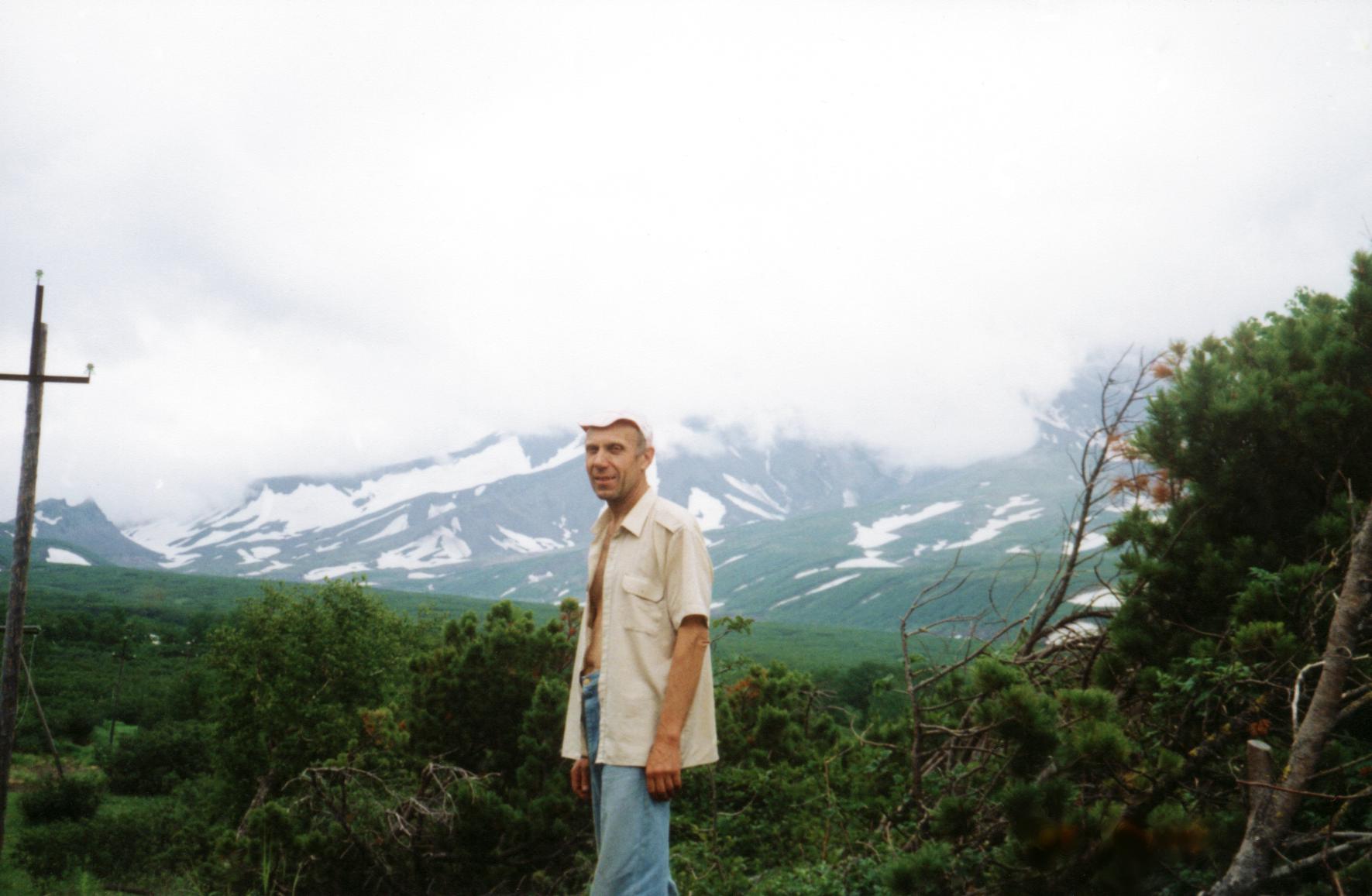
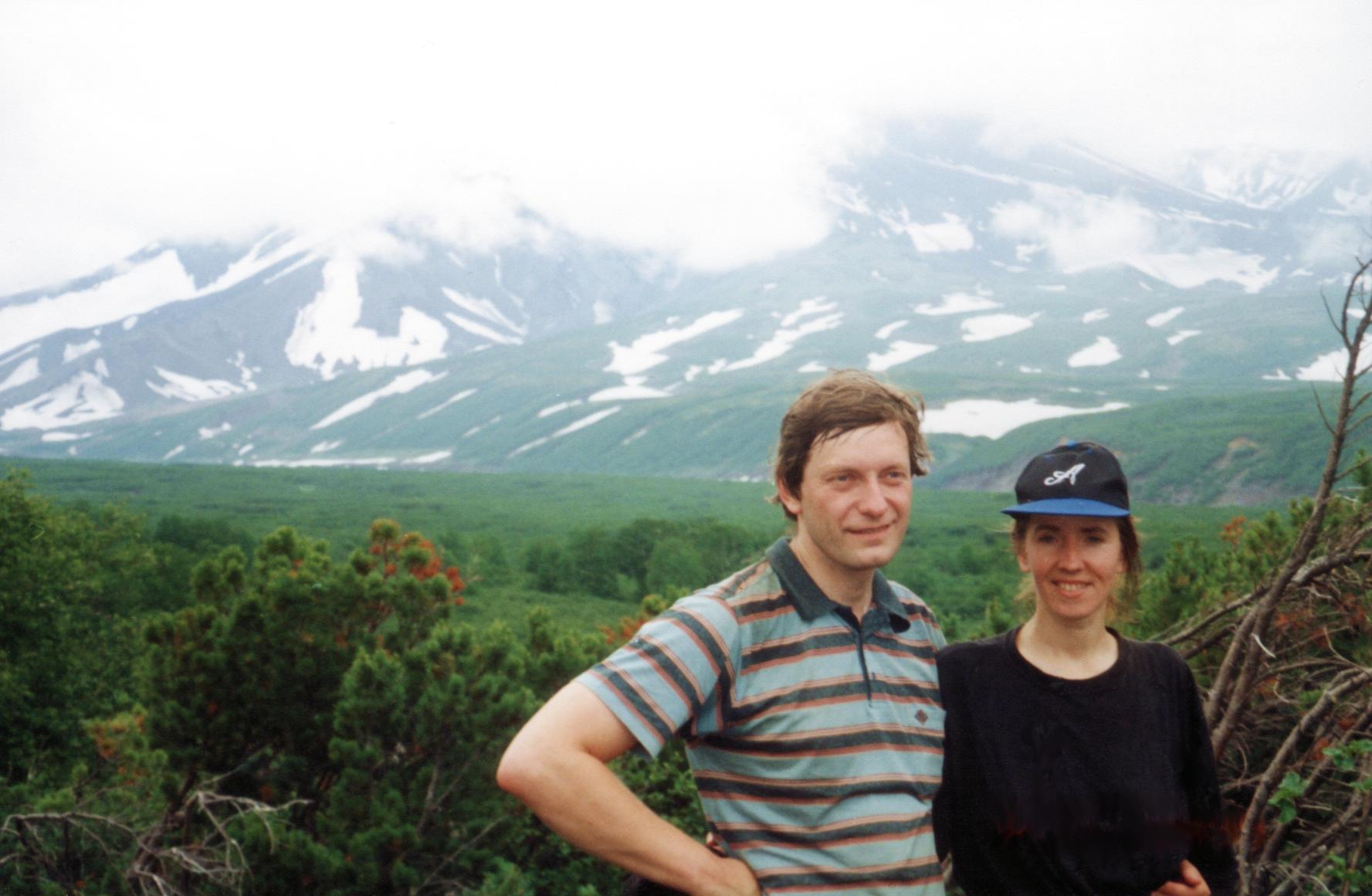
It rained while we slept. By morning all the surrounding mountains were wreathed in mist. We got up at nine. We'd have to hurry, as we were flying to the Valley of Geysers the day after tomorrow. Before long we reached the first patches of old snow. Little rodents the locals call yevrazhki scurried across the road. After a while the power line came out beside the Sukhaya River, the dry river we'd failed to find the night before. The road along it was fairly busy, but we couldn't flag anyone down. Big vehicles drove by, packed with tour groups. We walked the remaining few kilometres to the base before anyone picked us up. The road crossed several patches of snow where vehicles got bogged down for ages. A permit was officially required, but anyone who felt like it drove up anyway. The volcanoes were in the Three Volcanoes National Park, where, as usual, everything was forbidden. There were cabins at the climbing base, but the welcome wasn't warm. They get plenty of tourists and are used to them paying. We were uninvited guests who'd managed perfectly well without the services they were so eager to sell us. The dry river at the base is still wet, running straight out of the snow. This is the last place to find firewood in the form of dwarf alder twigs, and there's any amount of water. We ate and had a coffee. It was still the middle of the night back in Saint Petersburg, and our bodies weren't at all in favour of climbing a mountain. At three in the afternoon we started up.

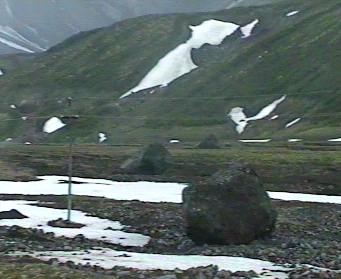
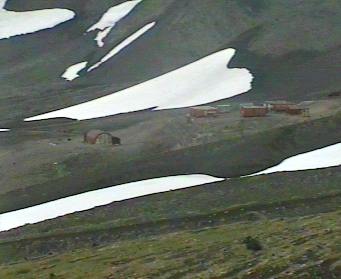
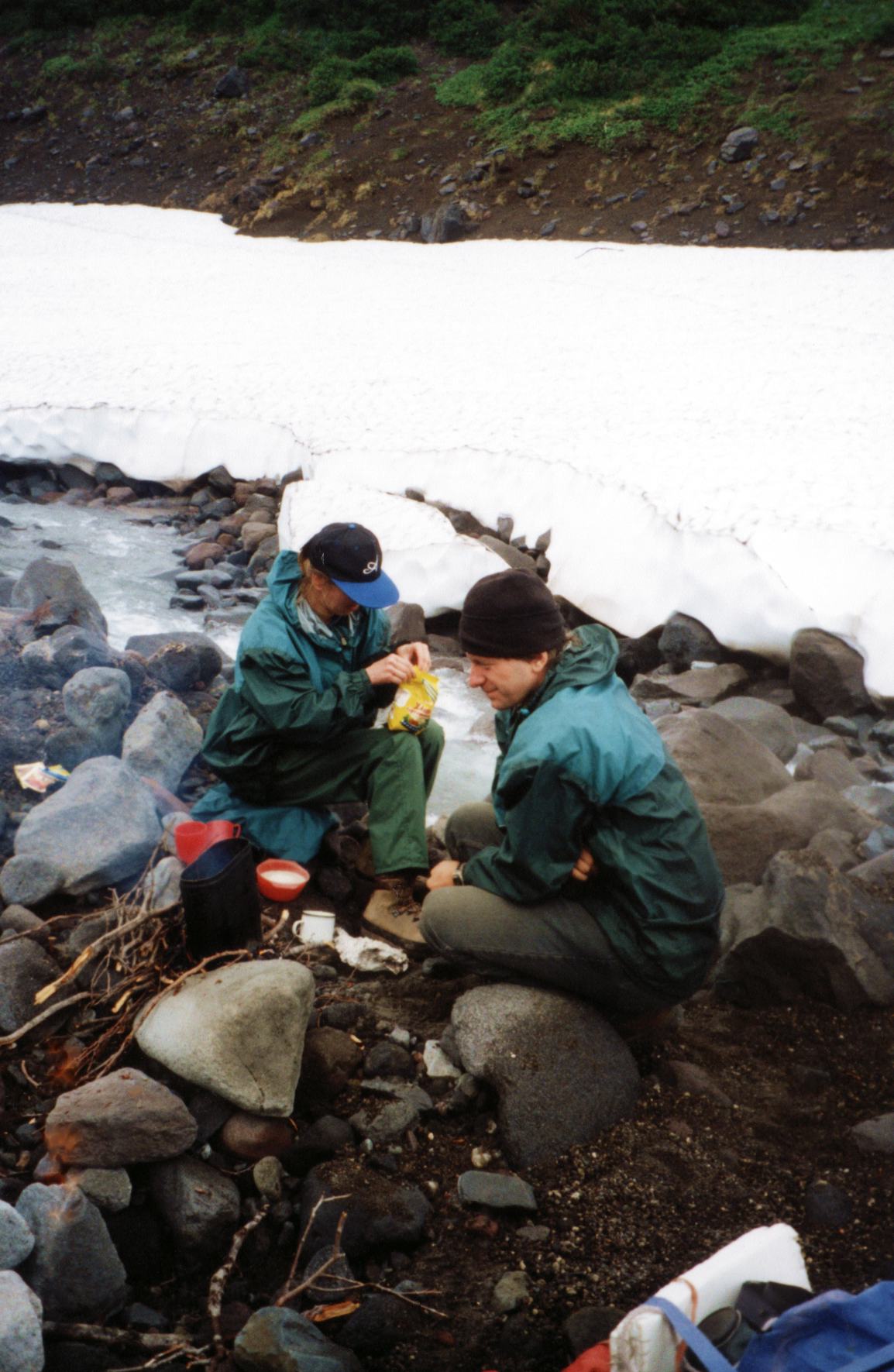
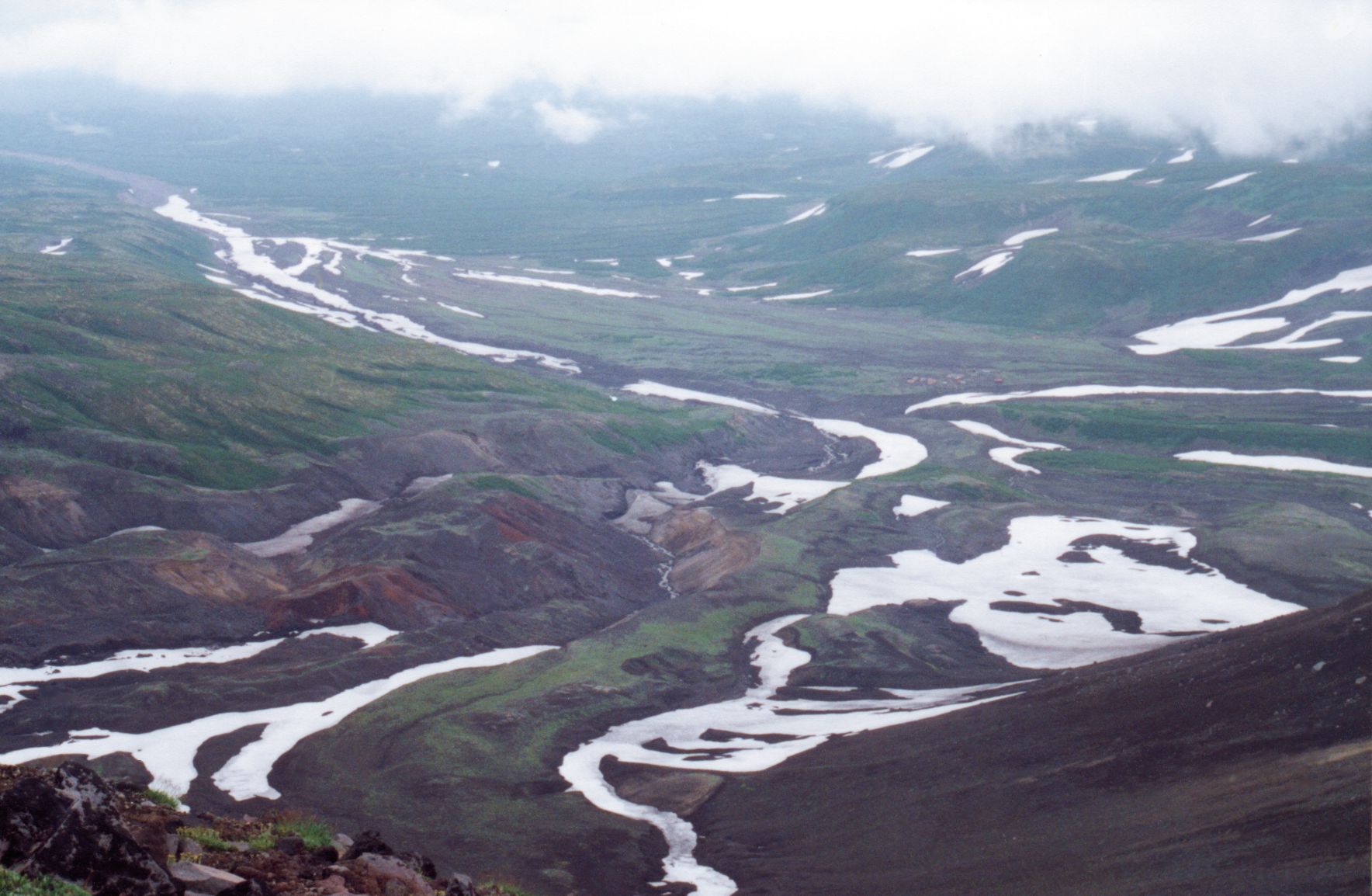
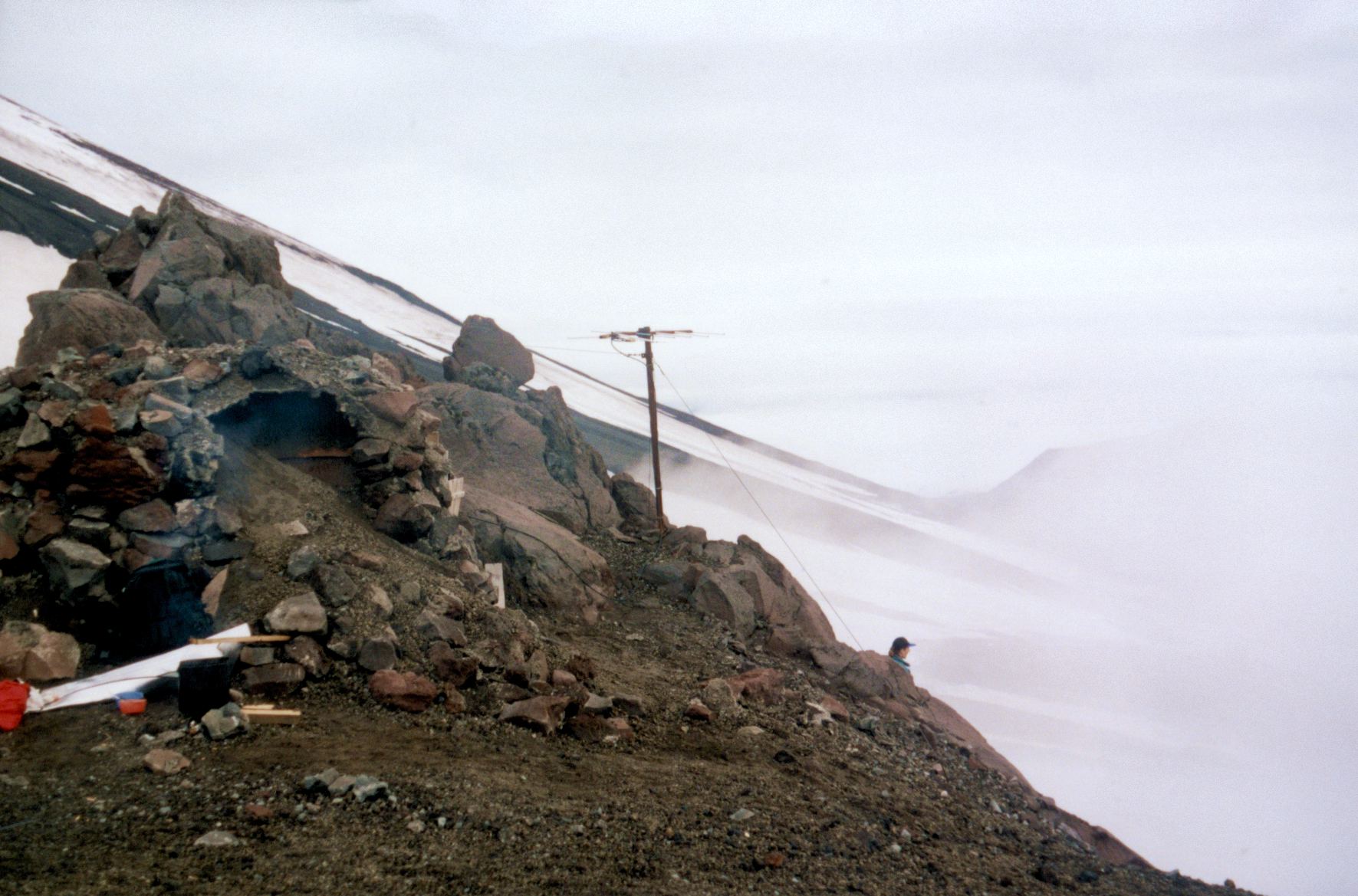
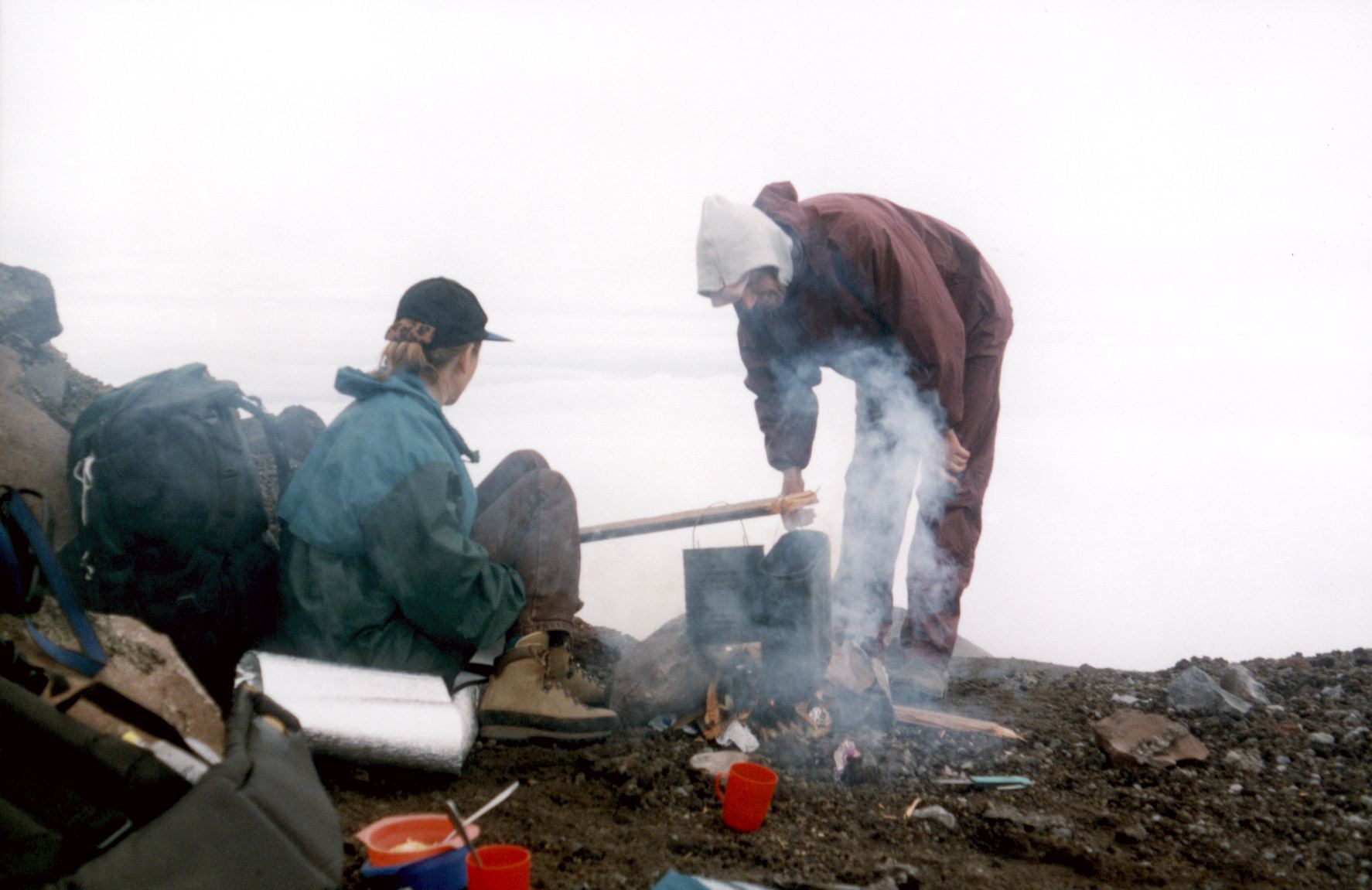
The climb begins right at the river. The path is worn in by thousands of hikers and marked with poles. You can't lose it. After an hour and a half we walked into a cloud and met a party of Americans who took us for Americans too. For some reason everyone did. It made even me wonder what the hell I was still doing in this country. They were from Baltimore and generally quite happy. We never did work out which of them were American and which were their Russian escorts. Afterwards we couldn't even remember which language we'd spoken to whom. One of them, a man of about sixty, could barely walk because of a bad meniscus in his knee. They hadn't reached the top. They had a guide who called in adjustments to the menu and the expected time of dinner as they went. He rather took the wind out of our sails by telling us it was pouring above. We soon found out for ourselves. There was a strong wind too, and the temperature was near freezing. By half past five we'd reached Avacha's old summit. An explosion once destroyed the old cone, and a new one grew to its northeast. The slope eases here. There are a lot of rock pinnacles, some of them with names of their own, the best known being the Gendarmes. Just before them, on a small shelf, there's a seismic station with an aerial pointing towards the Institute of Volcanology (53°15.974′N, 158°48.704′E). Unlike similar stations on other volcanoes, this one is locked. Too many people wander up here. We found a little firewood beside it and decided to cook dinner. We had a very cosy little fire, with the clouds already racing past just beneath us. We made mashed potatoes with soya and tucked our spare bottle of soya under the roof of the dugout. We forgot it there, by the way. If you're passing, have a look on the side opposite the door.
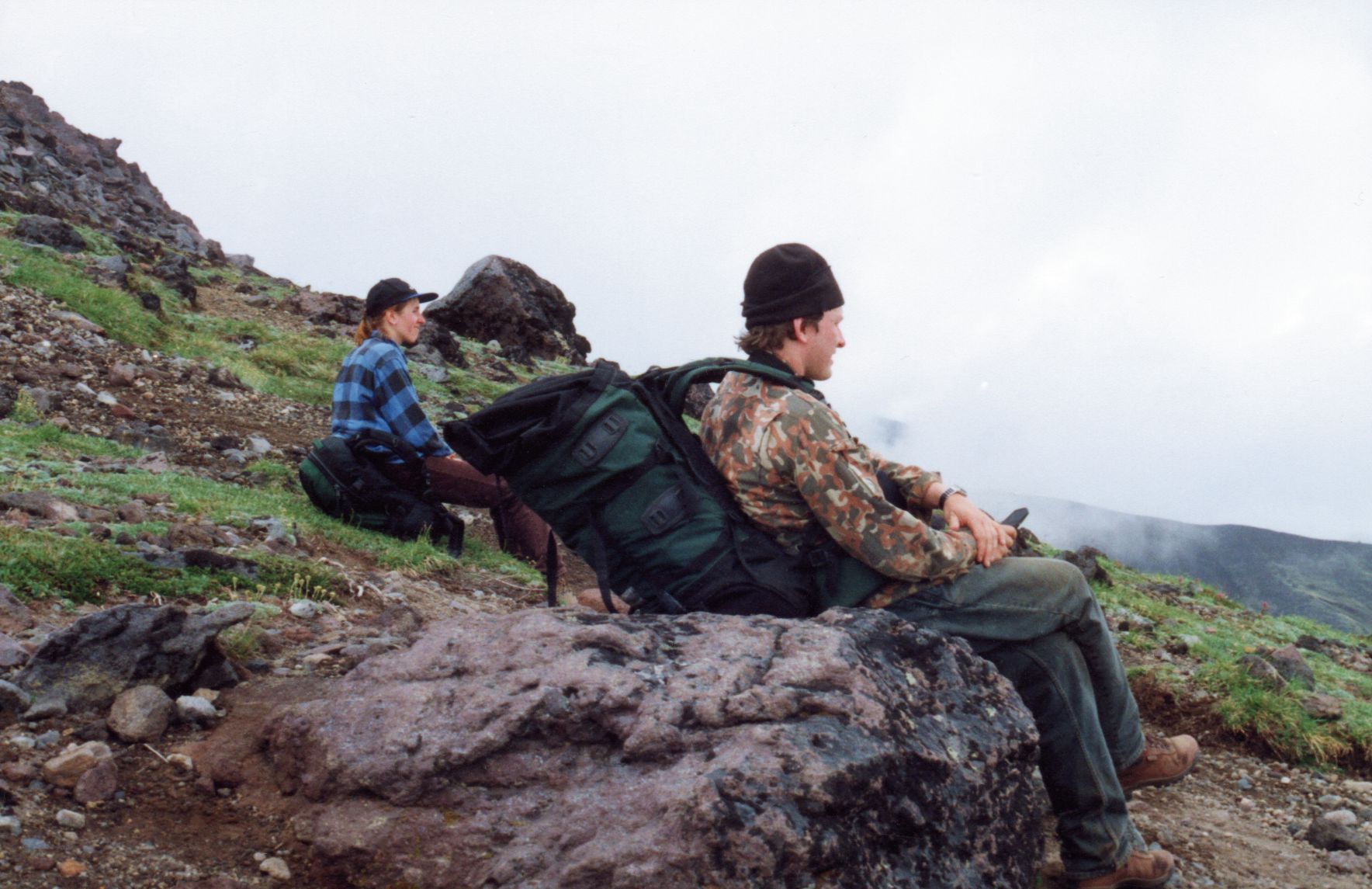

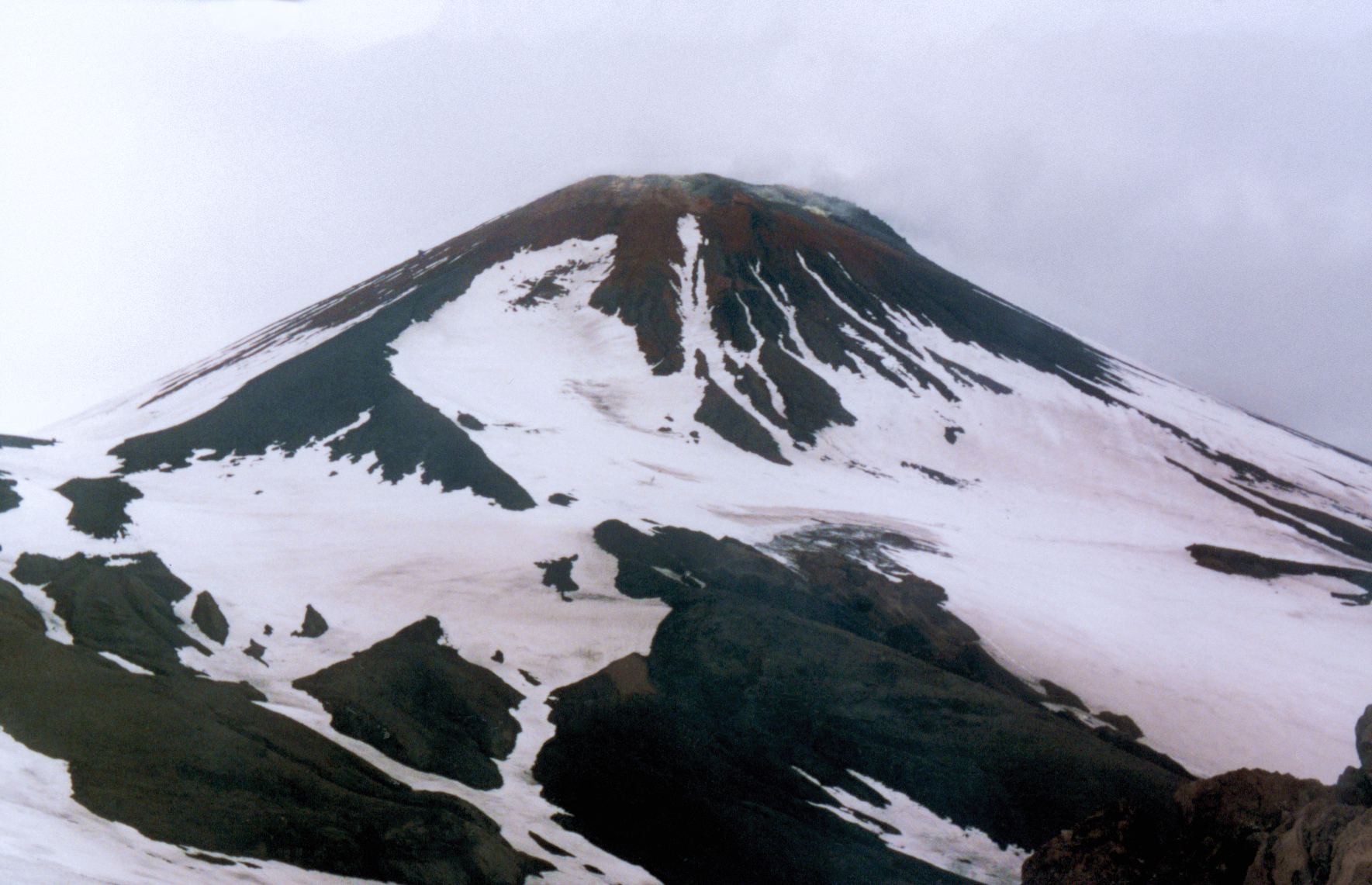
As we ate, the mist cleared, and the summit of Avacha and Koryaksky appeared before us. The sight put fresh heart into us and we made a dash uphill. We had our full packs on because we wanted to spend the night on the summit. Well, I was the one who wanted to. Yevgeny left his pack at the foot of the climb, and Tanya came along grumbling at me. She climbs faster than I do. We were halfway up the cone in no time, but the upper part, laid down during the 1991 eruption, was hard going. The scree had been churned up by all the people who'd climbed to the top. The last hundred metres were particularly tough. Luckily there are ropes tied to the rocks at the very top. We were terribly tired. It quite upset me to see how out of shape I'd got from sitting at home. I hadn't been in the mountains for three years. Yevgeny took a look in the crater and went down. We pitched our tent almost on the rim (53°15.478′N, 158°49.965′E, elevation 2,695 m) and went straight to sleep. We didn't sleep for long, though. For one thing, we'd pitched on rather uneven ground. For another, Tanya got cold. And I meant to photograph the dawn, which was only five hours away. I woke in the night to a perfect starry sky with a moon. A pity I didn't have the strength to run about with the camera and capture it all.

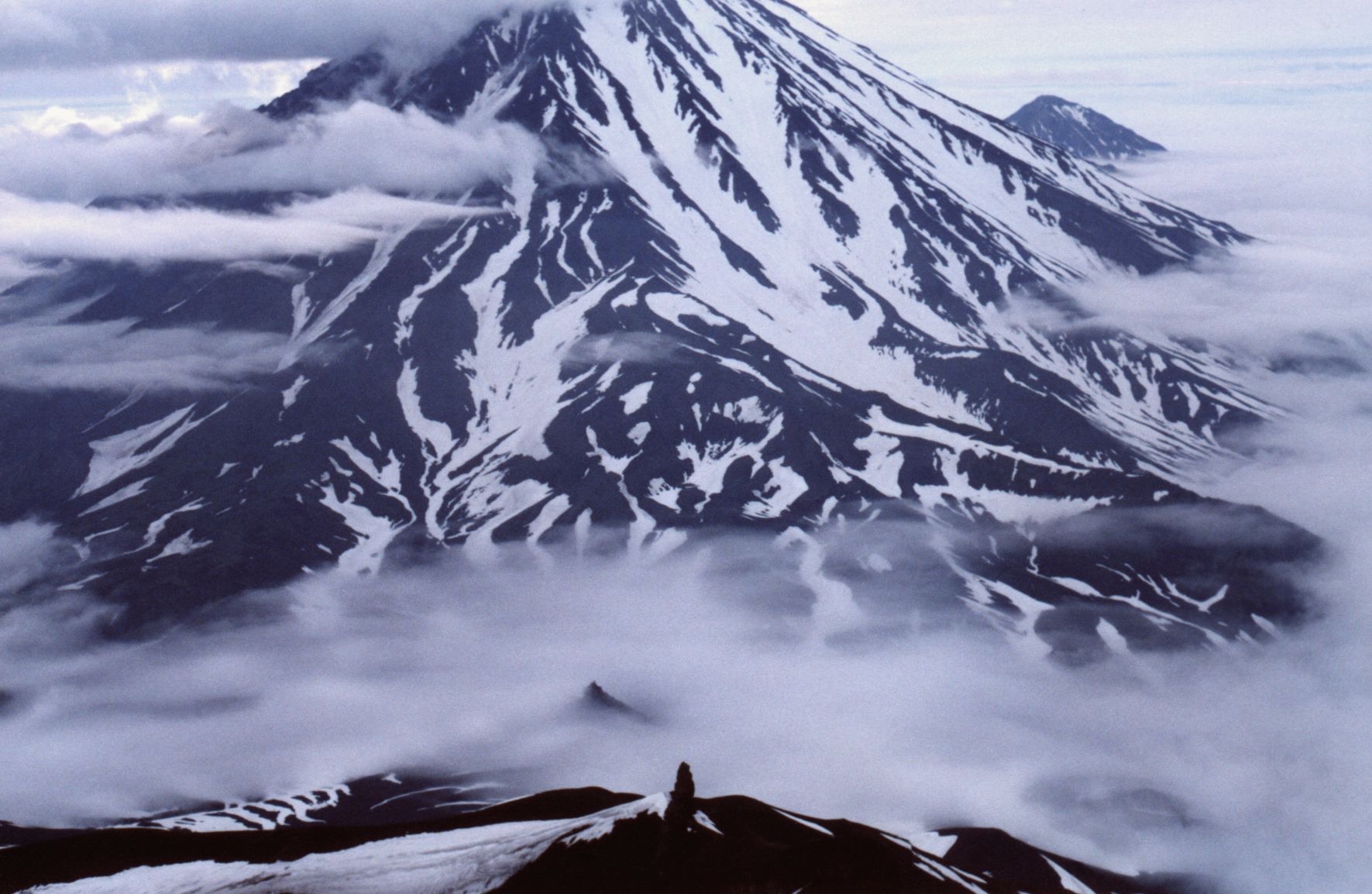

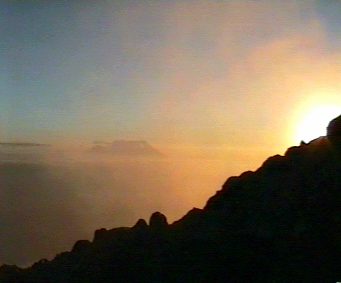
At dawn, the thermometer read minus two. Everything around us was rimed with frost. The sun rose from a blanket of cloud that covered everything we could see to the north, and cast a red glow over the colourful volcanic cone. I forgot how tired I was and ran about photographing the wonder of it. Moments like that are worth living for. What a beautiful, glorious world this is.


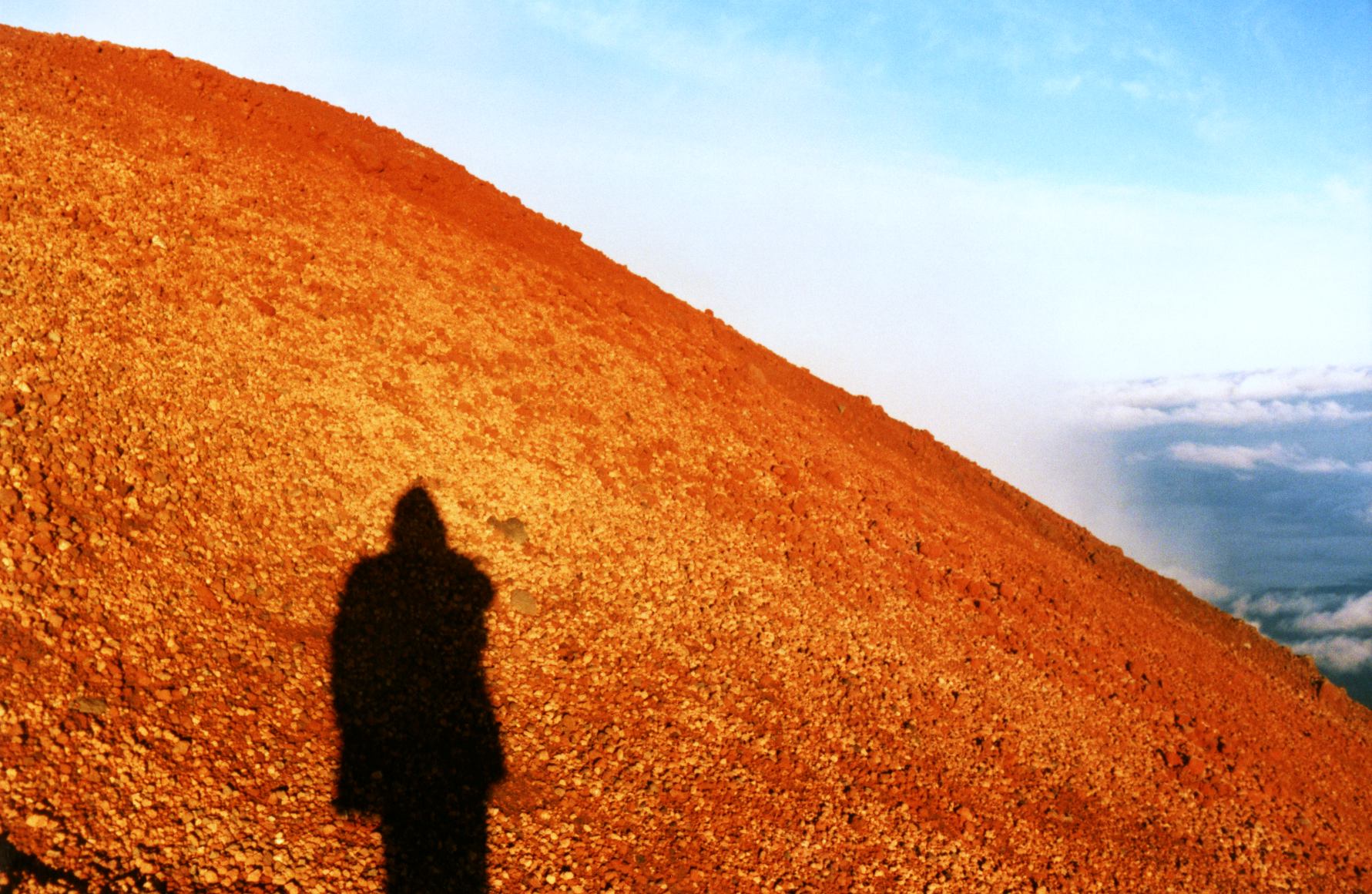

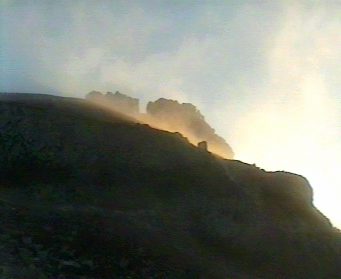
The last eruption filled Avacha's crater to the brim with lava, so strictly speaking there isn't a crater now. Around the edges there are fissures that belch sulphurous gas, but no pretty sulphur cones have formed. On the whole, there's little to see inside the crater.
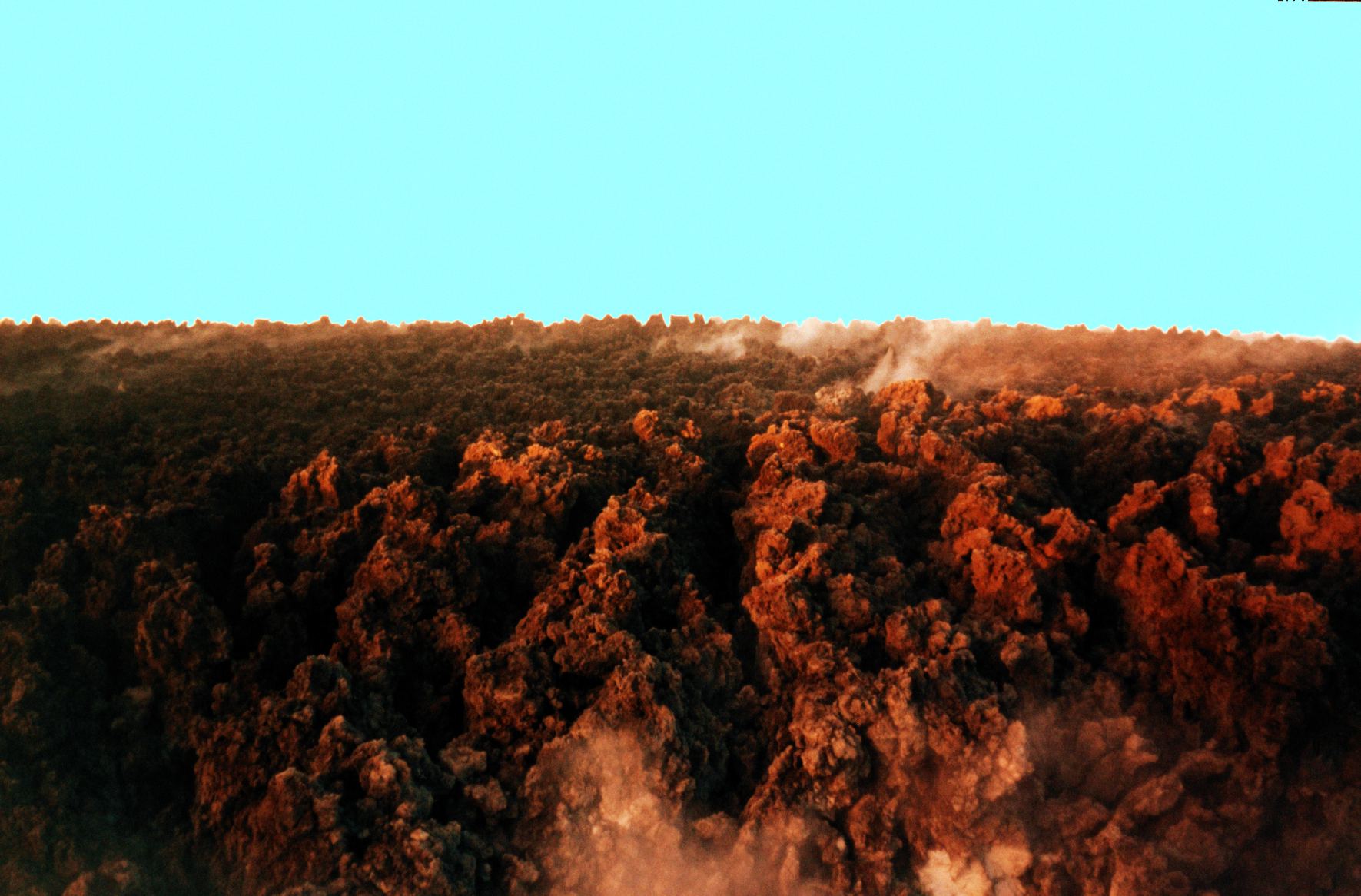


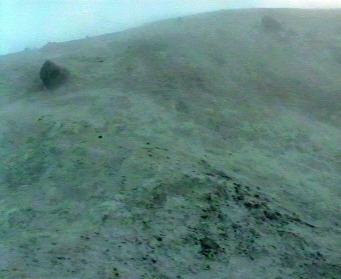
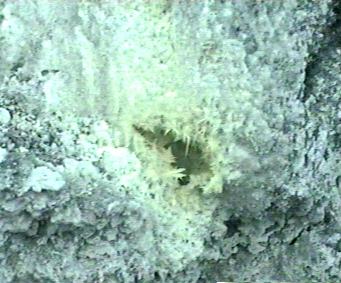
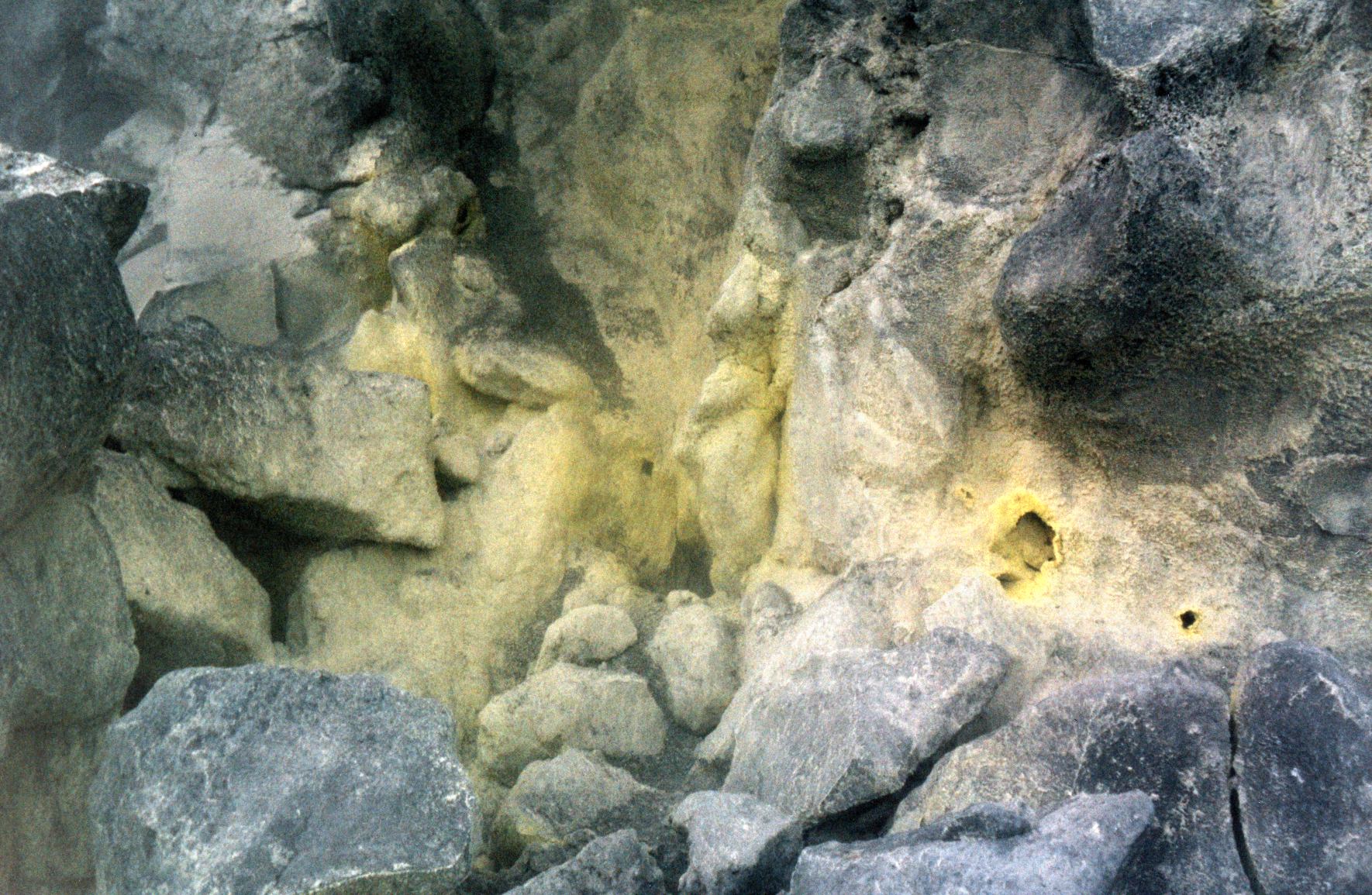
The locals are nervously awaiting the next eruption. You'd think a crater plugged like that would blow its top and send millions of tonnes of rock flying in all directions. Volcanologists, however, reckon Petropavlovsk and Yelizovo are in no danger.
You can see evidence of all the people who've been up before: champagne bottles, inscriptions, bits of firewood. The story goes that years ago some general wanted a look at the summit of Avacha, so a little wooden hut was brought up by helicopter for him. Later it was pulled apart for firewood. You really can light a fire in the crater, though it's much simpler to boil water on the volcano itself by setting a lidded billy on a fumarole.
We picked up a few stones as souvenirs and started down. Coming down a volcanic cone is a pleasure. We dropped 600 metres in half an hour, to Yevgeny's camp. He was going to walk round the volcano, while we were heading for Yelizovo, so that was where we parted ways. We said goodbye, stopped for a bite at the seismic station and carried on down. Hundreds of hikers were coming up in canvas shoes and T-shirts. It was hard to picture them making it right to the top. How glad we were we'd gone up for the night and hadn't had to jostle with that crowd on the summit.
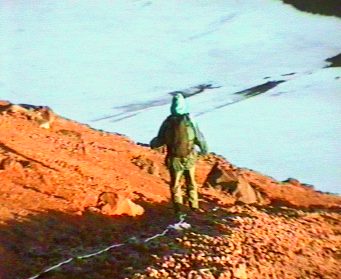


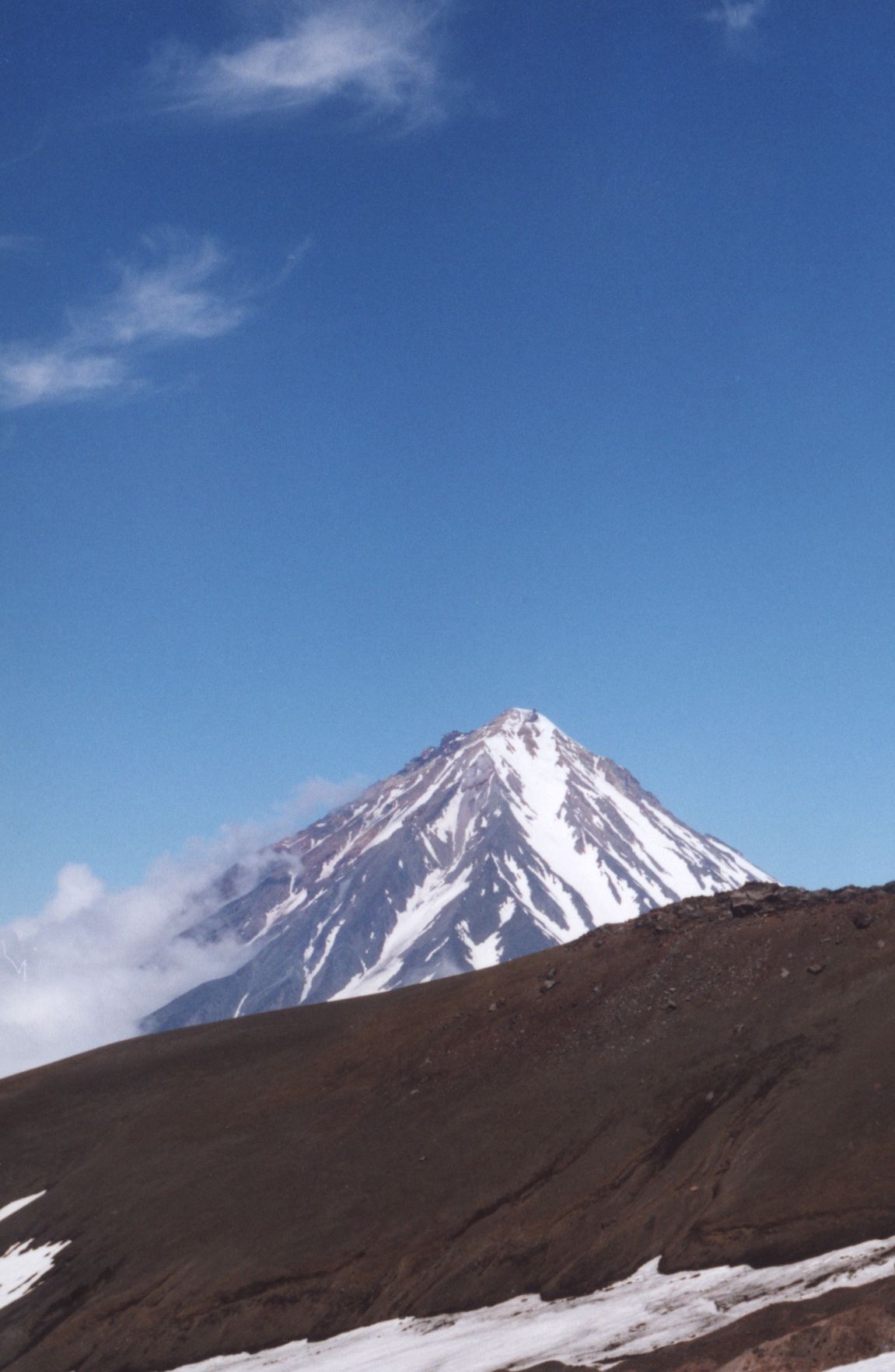
We got as far as the climbing base. There was no sign of a lift, so we walked on. We'd left some things we didn't need at our first camp. Now we had to get back to them, which meant leaving the level riverbed for the power line. It does run straight, but it takes no notice whatsoever of the shape of the land. In fact, we managed to follow the dry riverbed most of the way and then use the GPS to head straight for our belongings. There were bear tracks all around the camp, and what particularly worried us was that some of them were cub tracks. A Kamchatka bear won't ordinarily eat something as unappetising as a tourist, but a mother bear is another matter. She'll simply tear you to pieces.
We were dying for sleep, so we put up the tent and slept till evening. The alarm woke us to a surprise. The little stream that had been flowing past us only a few hours earlier had vanished altogether. We barely managed to find a little pool to cook a meal and wash our hair.
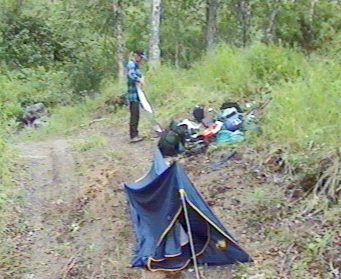
Back in the dry riverbed, we headed for Yelizovo. Every vehicle we saw was going the other way. We'd reached the tarmac and stopped to repack when a four-wheel drive came along in the right direction. We didn't even try to flag it down, but Kamchatka is a special place. It stopped of its own accord. A family with a small child were coming back from an outing and offered us a ride. They took us right into Yelizovo, a ten-kilometre detour for them. The driver was delighted to have had a chance to talk to us.
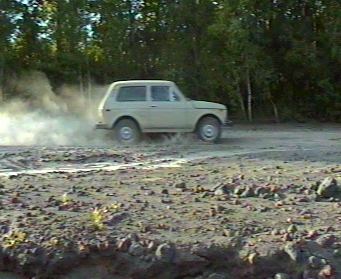
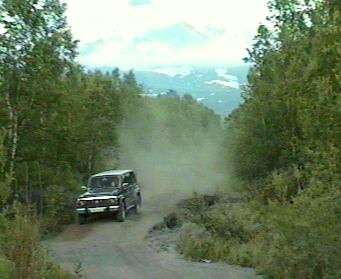
In Yelizovo we went into a café, where we were greeted by two drunk young women.
- Hi! You are from America?
- No, we are from Saint-Petersburg!
We spent about an hour chatting with them.
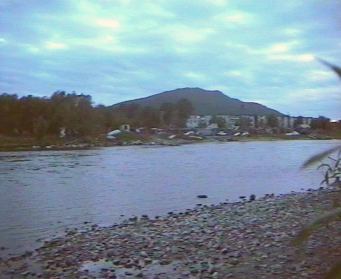
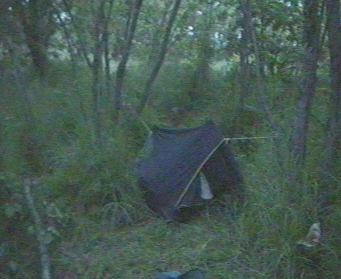
We picked a spot for the night in the bushes on the bank of the Avacha. Our little tent was quite invisible in the grass, and there was hardly anyone about. As soon as it got dark and we fell asleep, the people of Yelizovo came out fishing with nets and motorboats. Crowds tramped around us all night, swearing at the tops of their voices. They weren't catching anything. Luckily nobody stepped on us.
16 July. The Valley of Geysers. Lukomorye is no more
The Krechet company had claimed a monopoly on taking tourists into the valley.
A taxi in Yelizovo cost 25 to 35 roubles, but the moment we mentioned Krechet's helipad the price went up to 50. Anyone who'd just handed over 8,400 roubles was obviously drowning in money, so it was practically a duty to take a little more off them. We were already running late and had to go. Of course, there was no need to hurry. Everyone spent another hour milling about. We left our packs in the Krechet office and took only the still and video cameras. The flight is just over an hour. You get the feeling they don't look too closely at the tickets and you could sneak aboard without one. When choosing a seat, bear in mind that some of the windows in the Mi-8 open. Those are the ones you want. The rules say you must sit belted in and mustn't open a window, but no one tells you off for doing it. You can stick a still or video camera out of the open window and shoot without glass in the way.
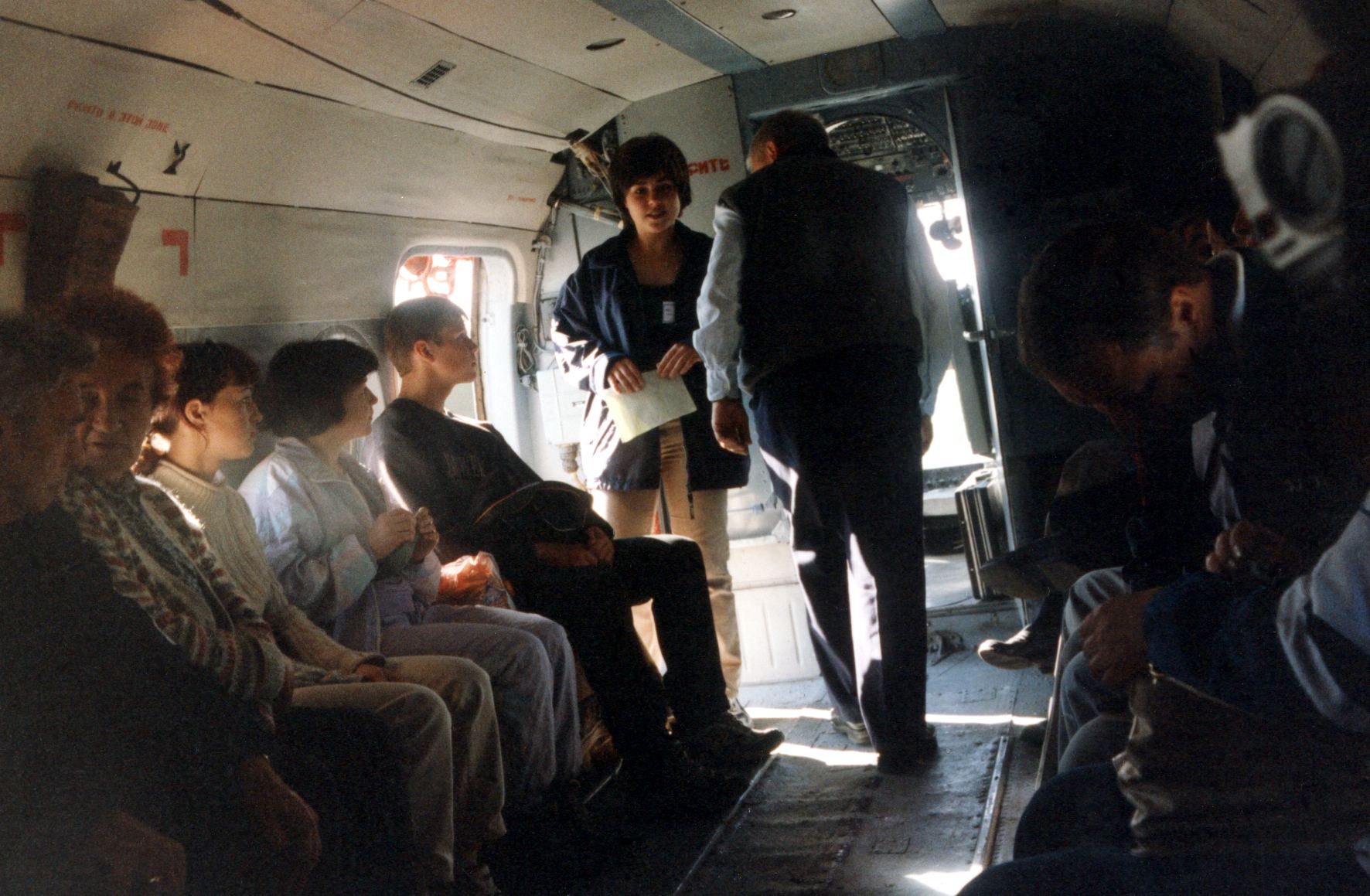
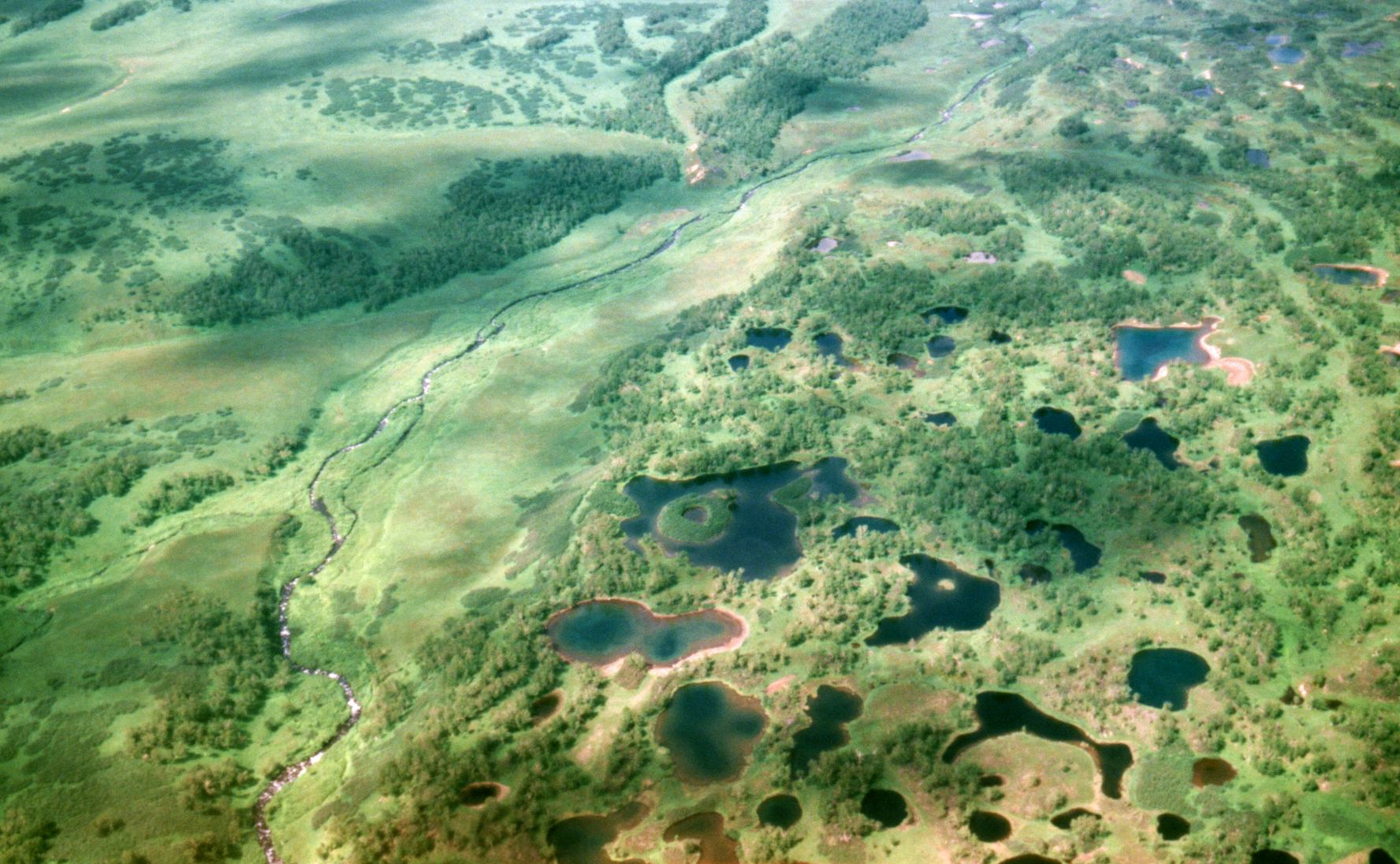
As soon as we took off, the helicopter headed up the Avacha, then gradually veered east towards Karymsky volcano. It had been erupting in 1999, when they could show visitors a volcano at work. The eruption was all but over, but they still flew up to it, and for good reason. From the helicopter you could see the different-coloured layers of ash beautifully. Karymskoye Lake glittered in the sun nearby. The pilot flew past with each side of the helicopter facing the volcano in turn, so people on both sides could look down its throat. You could see it twice if you hopped across the aisle, ignoring the emphatic request not to.
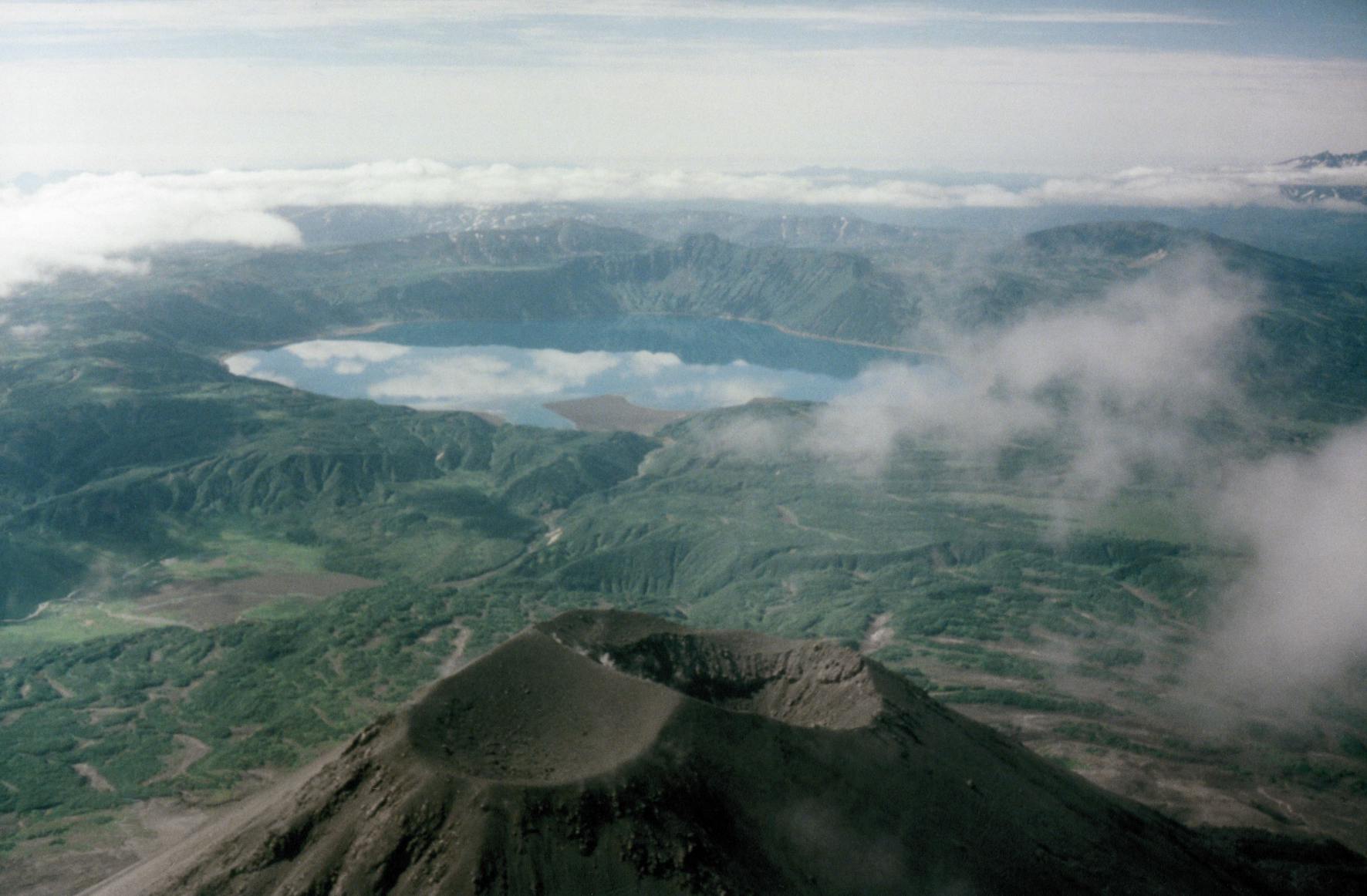
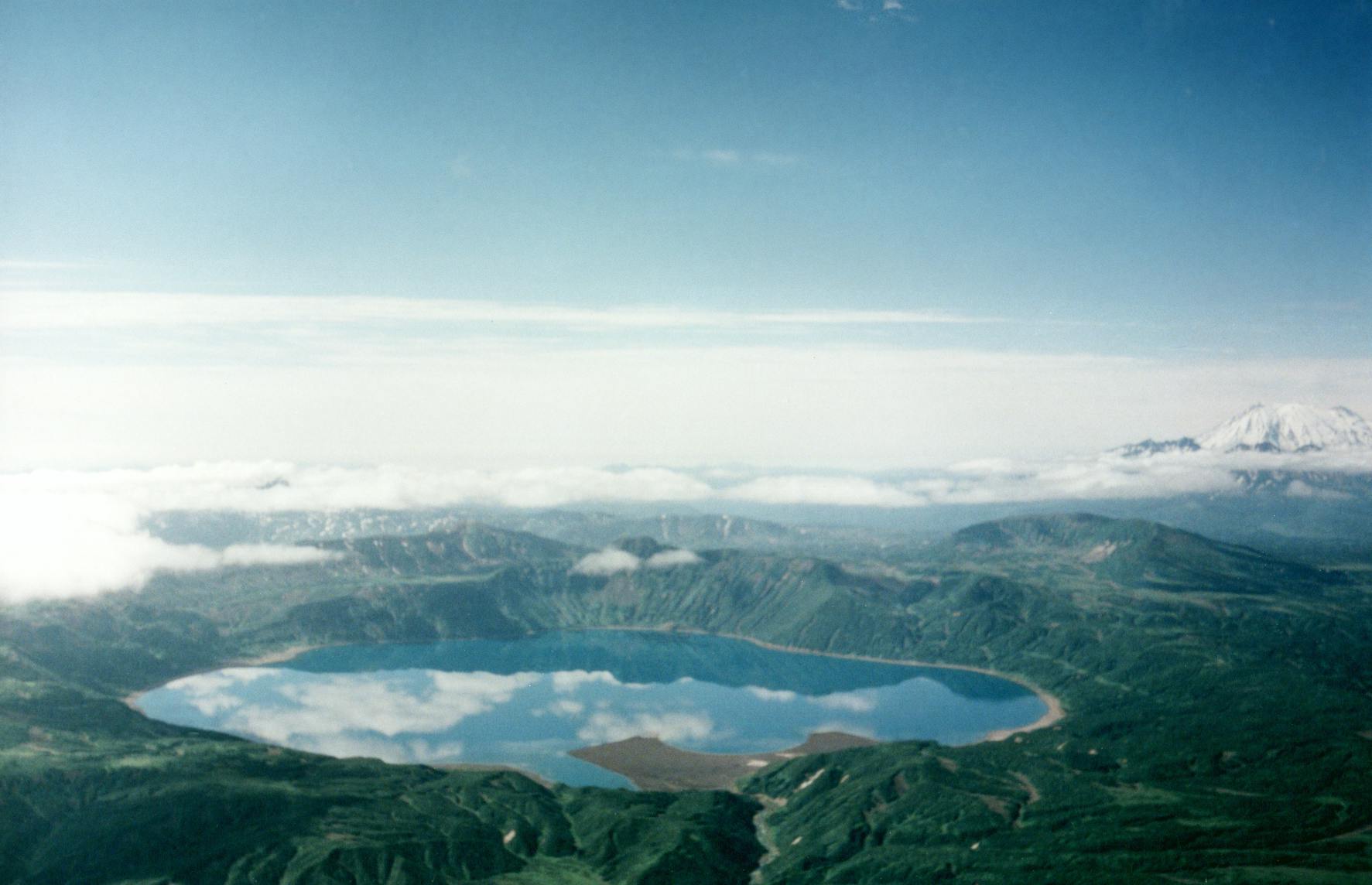
Next they show you Maly Semyachik. Its crater holds an acid lake that can contain up to 30 per cent sulphuric acid. The acidity and temperature of the lake depend on how long it's been since the last eruption. The acid concentration was dropping, and the temperature was down to 18 degrees. At times it had been around 40.
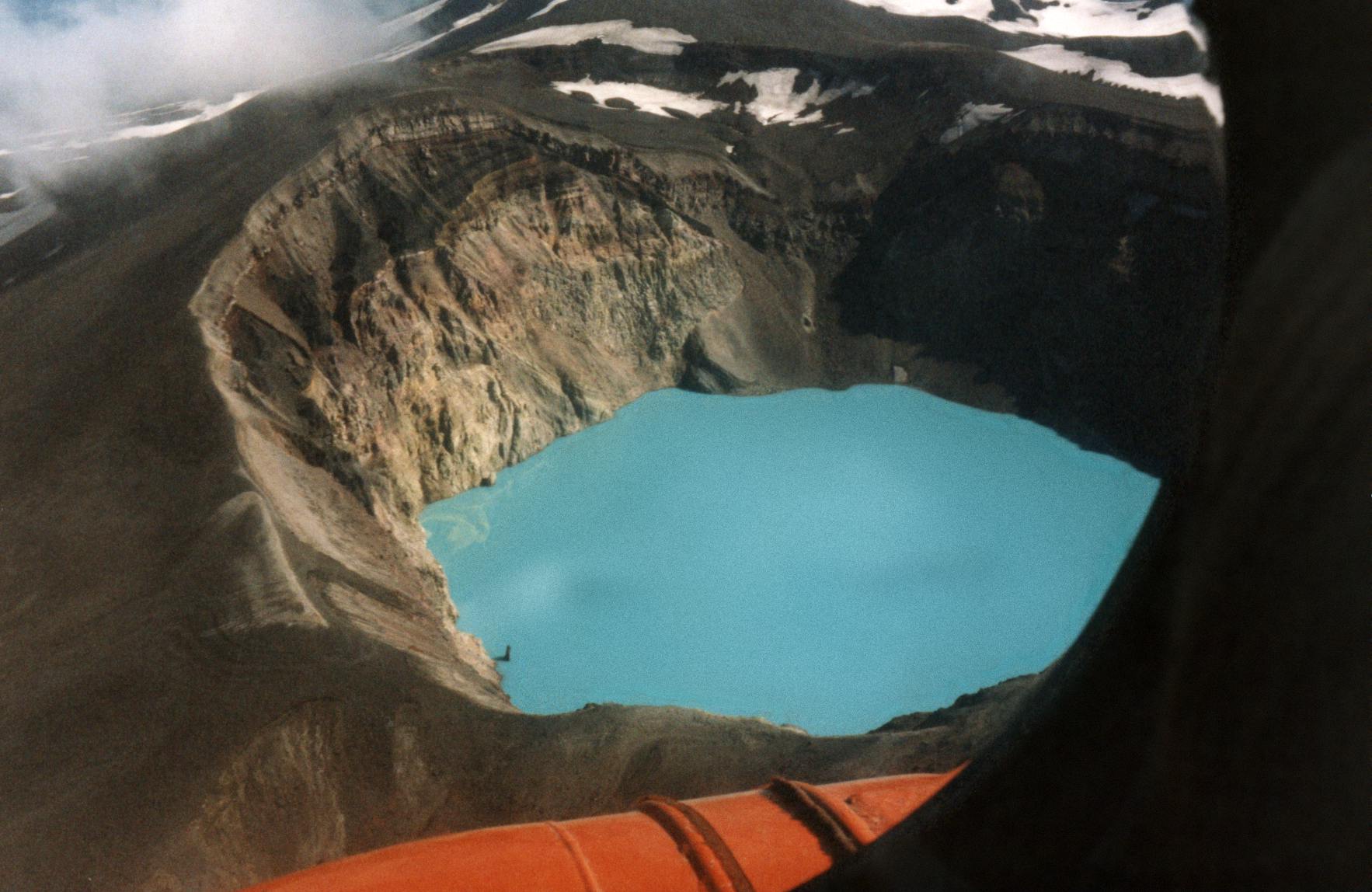

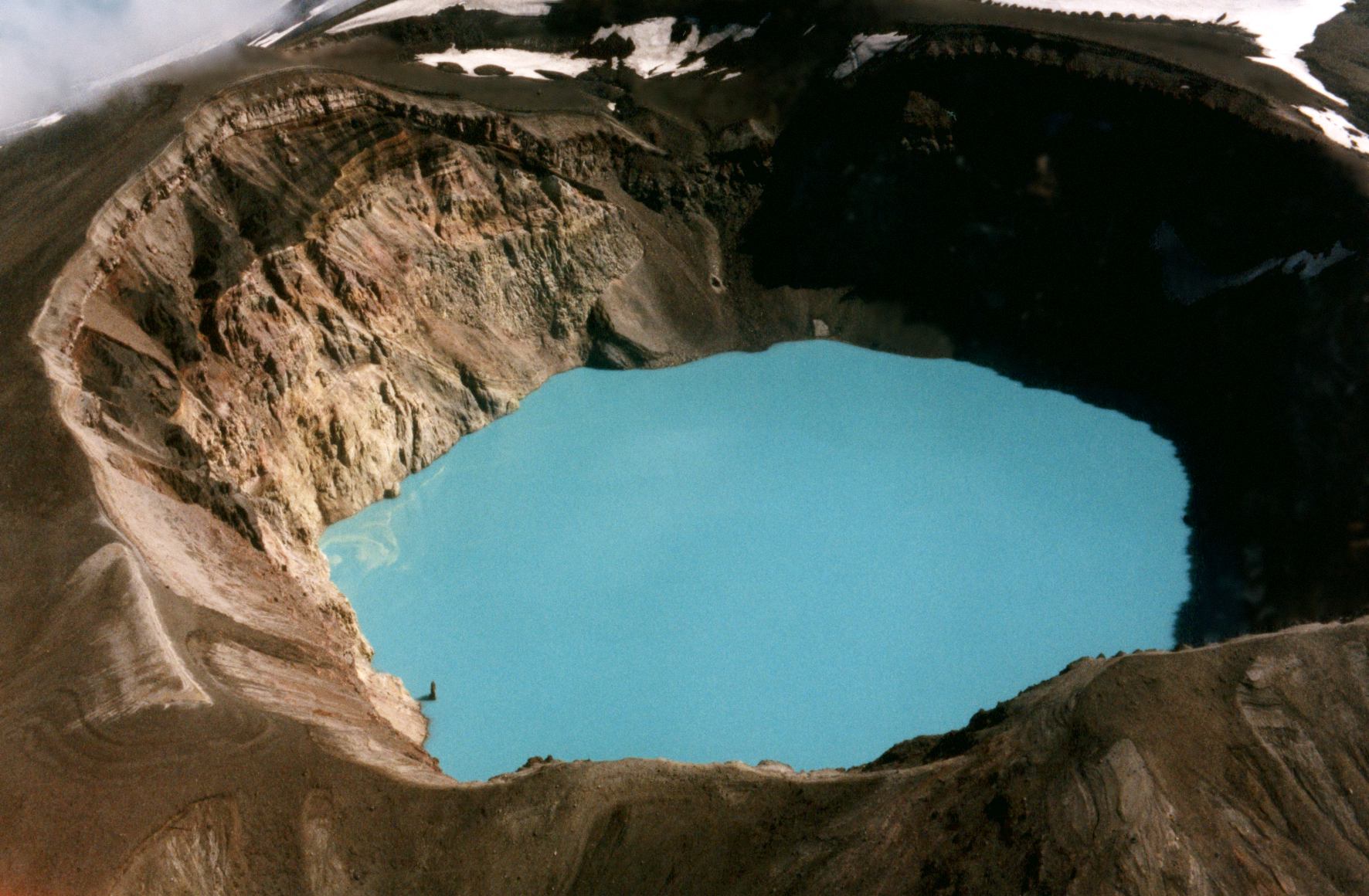
The lake is a brilliant blue-green. From the air it looks quite extraordinary. I badly wanted to go down there. You could see a way to the water down the scree, though they say you'd need a rope.
There was nothing else of much interest to see from the helicopter. The Semyachik springs are hidden behind mountains, so all you can see is a cloud of steam. The helicopter doesn't fly down the Valley of Geysers. It lands on the southeast bank of the Geyzernaya River. There is a metal landing pad on the grass and wooden boardwalks you're allowed to walk on. Beside them are three recently built huts of turned logs, in the appalling taste of the nouveau riche. Every bit of material had come in by helicopter. There used to be a hut in the valley, but it burned down. Given the general air of gangsterism about the place, it may have had a bit of help.
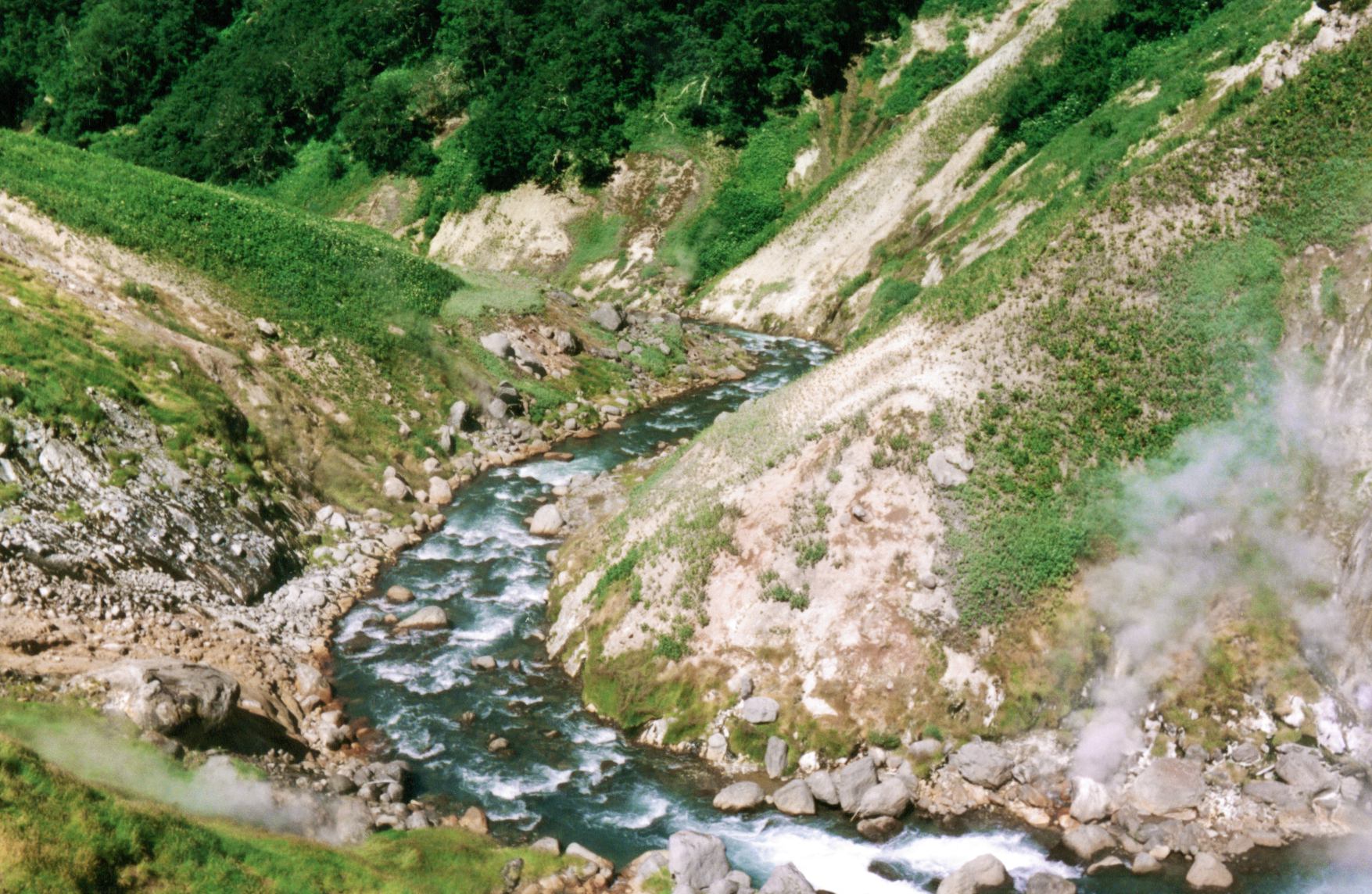
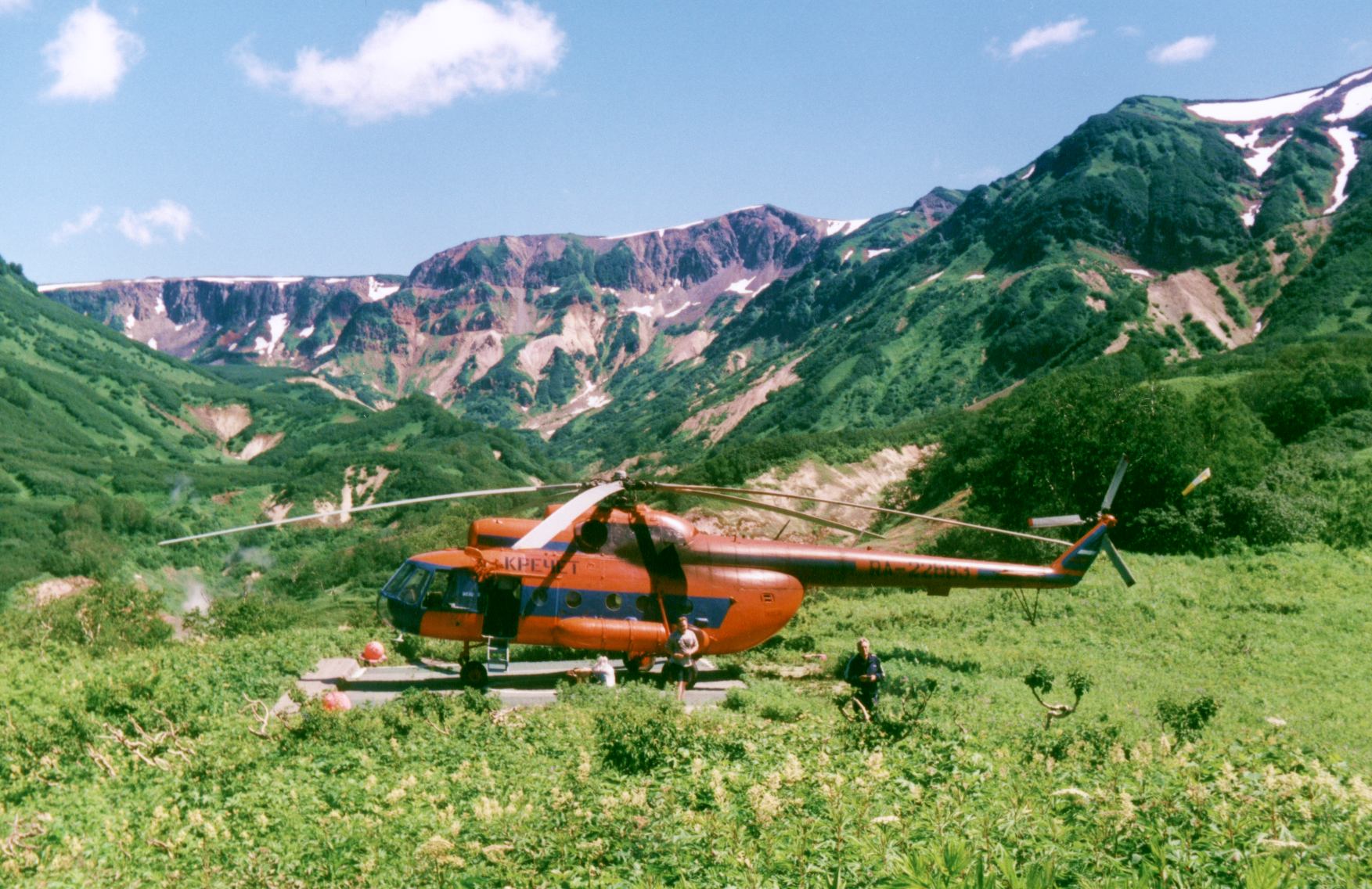
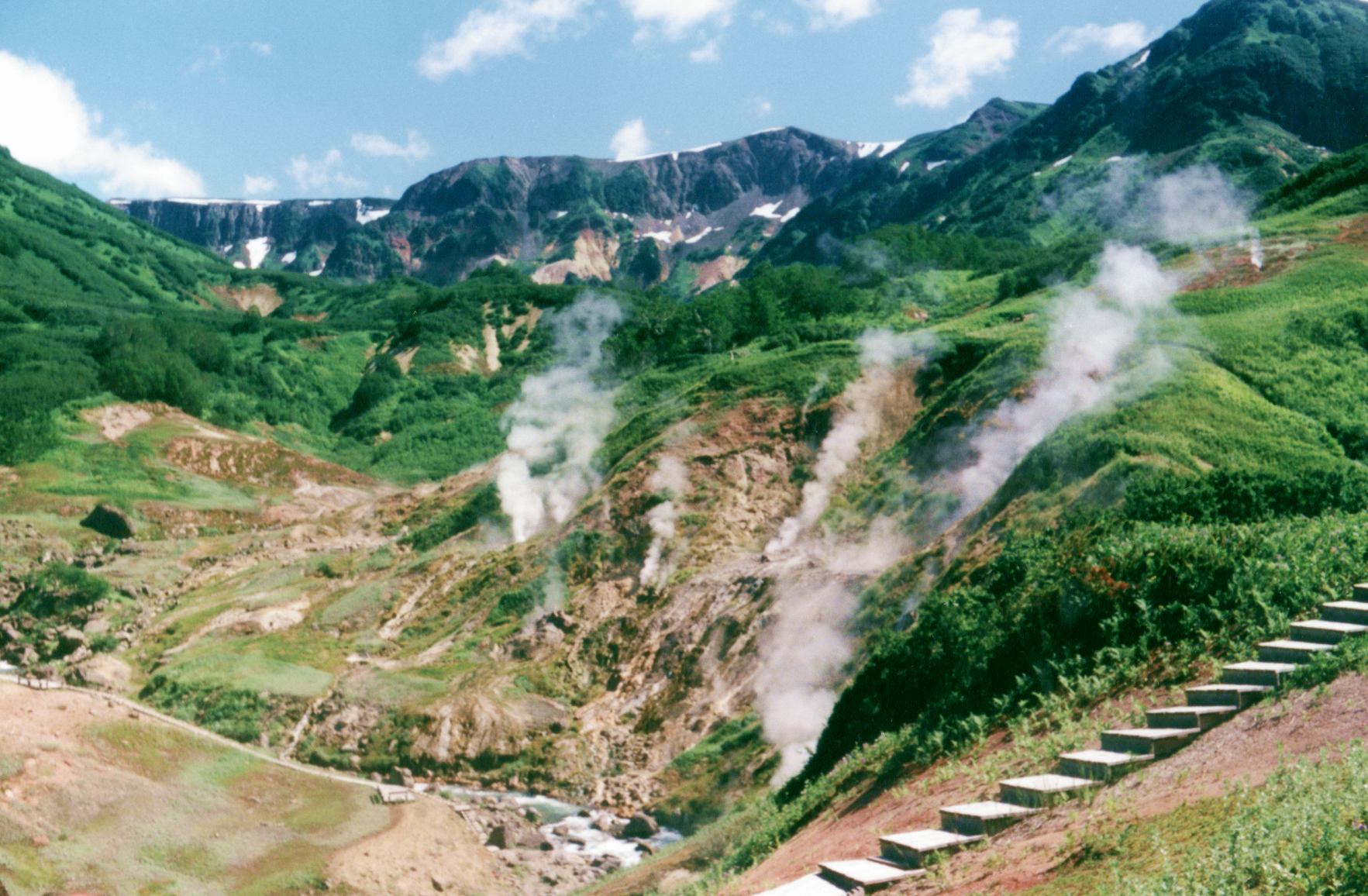
They read out the usual list of things you mustn't do and assigned us a beefy reserve guard with a pen for writing out fines. One man asked, “Can we at least smoke?” No, as it turned out. “Can we kill mosquitoes?” Yes, thank goodness. The guide and the guard herded us round in a group. The big geysers erupt at set intervals of one to six hours. We spent five hours in the valley. If Krechet had bothered to time the tour, we'd have been able to see nearly all the geysers. Instead we got the standard route, with a compulsory lunch taking up half our stay. They won't let you skip lunch and go looking on your own. So the only geyser they showed us erupting was Maly, the Little One. They couldn't find time for Bolshoy, the Big One (54°26.259′N, 160°08.202′E), which erupts every hour and a half. It went off while we were in the valley wasting our time over lunch. Velikan, the Giant, probably went off too. Its interval is five hours. The boardwalks don't go everywhere, by any means. They cover just one bend of the Geyzernaya. Pervenets, the Firstborn, and the other geysers upstream are out of bounds, as is the waterfall. As if that weren't enough, our splendid guides didn't bother to take us along all the boardwalks there were. They said there was nothing interesting to see there.
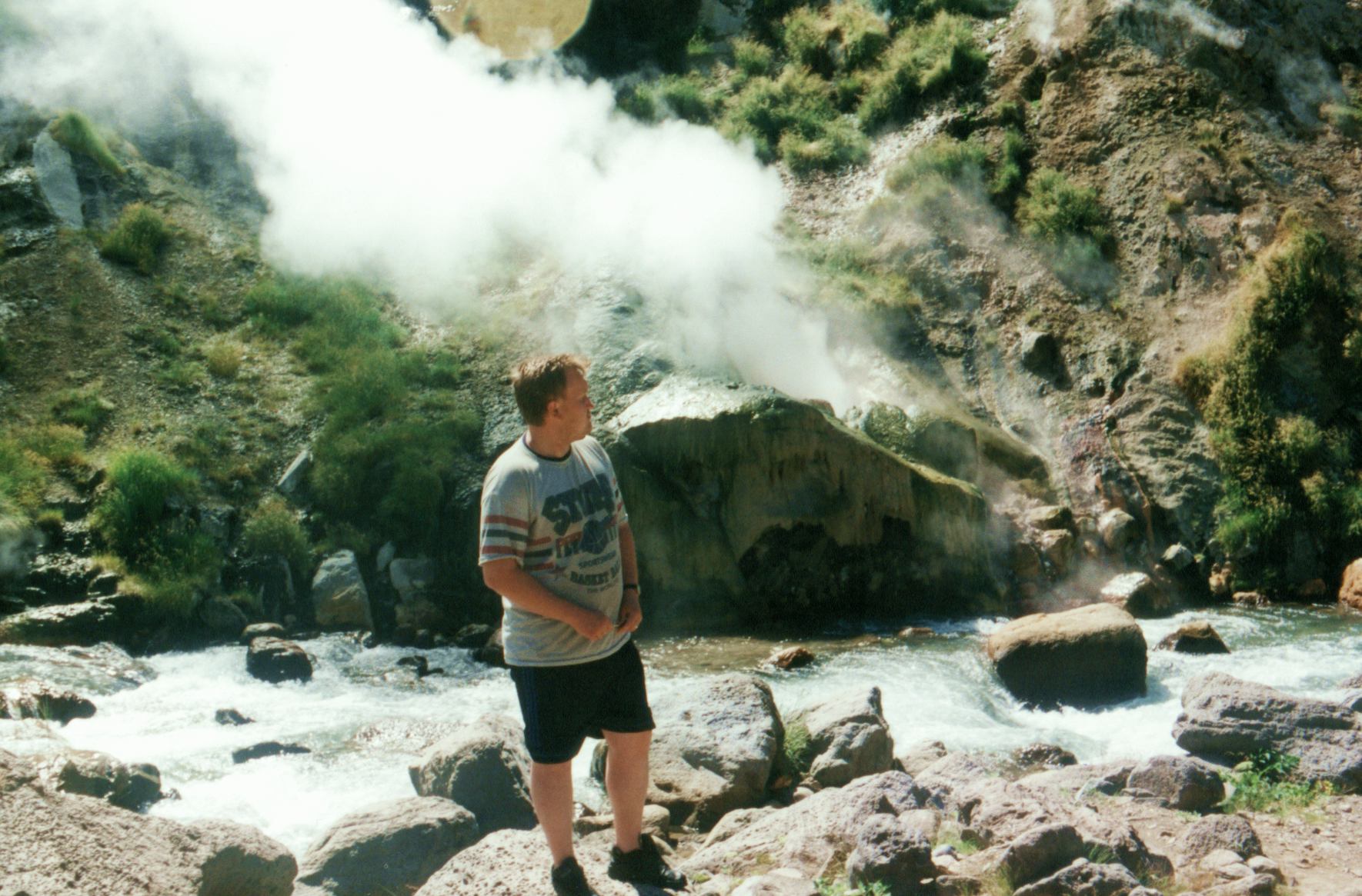
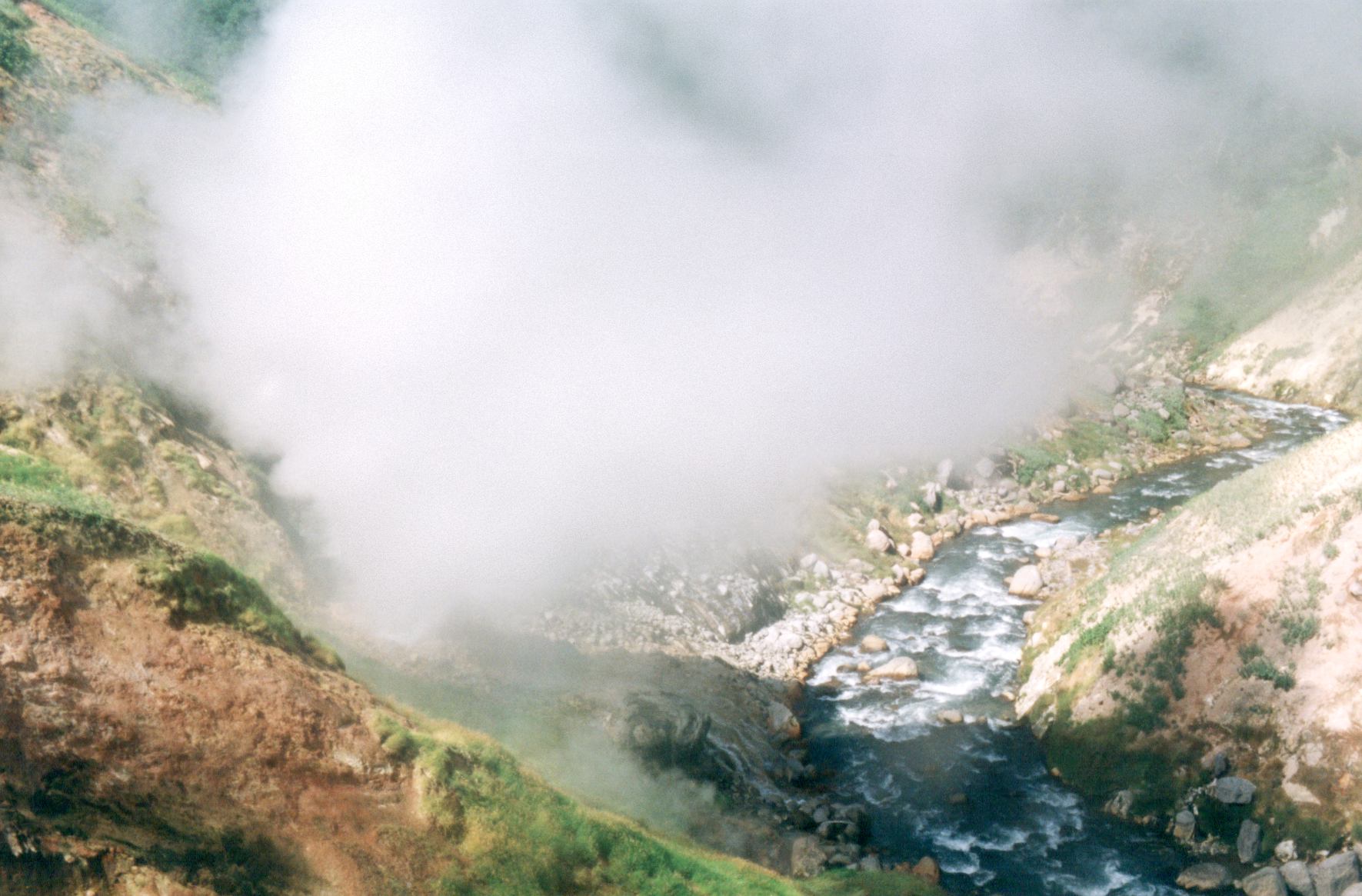

We spent most of the time having lunch. It was an excellent lunch. The cooks were the first people I saw in the valley who felt like our sort. They clearly cared about their work.
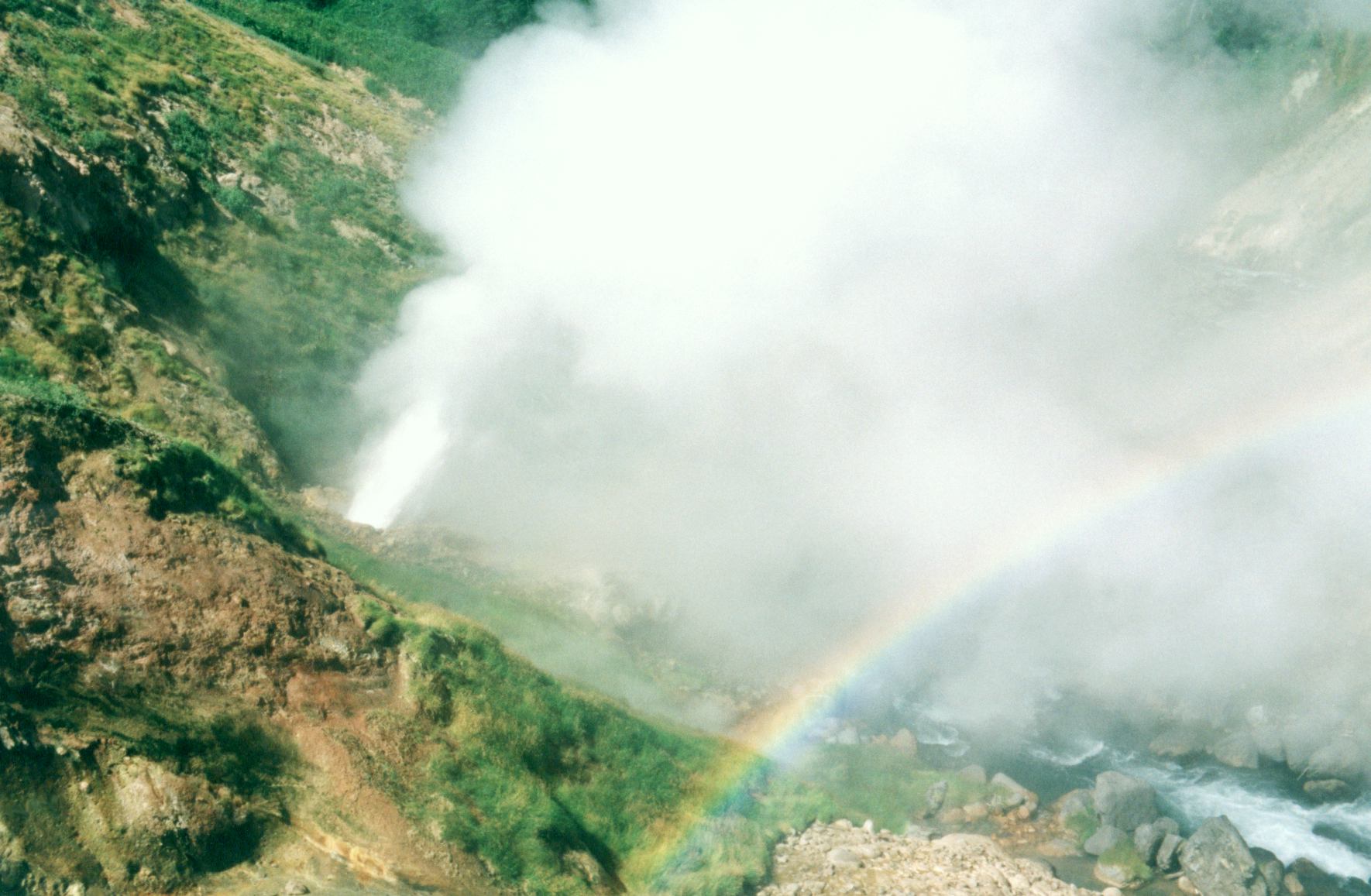
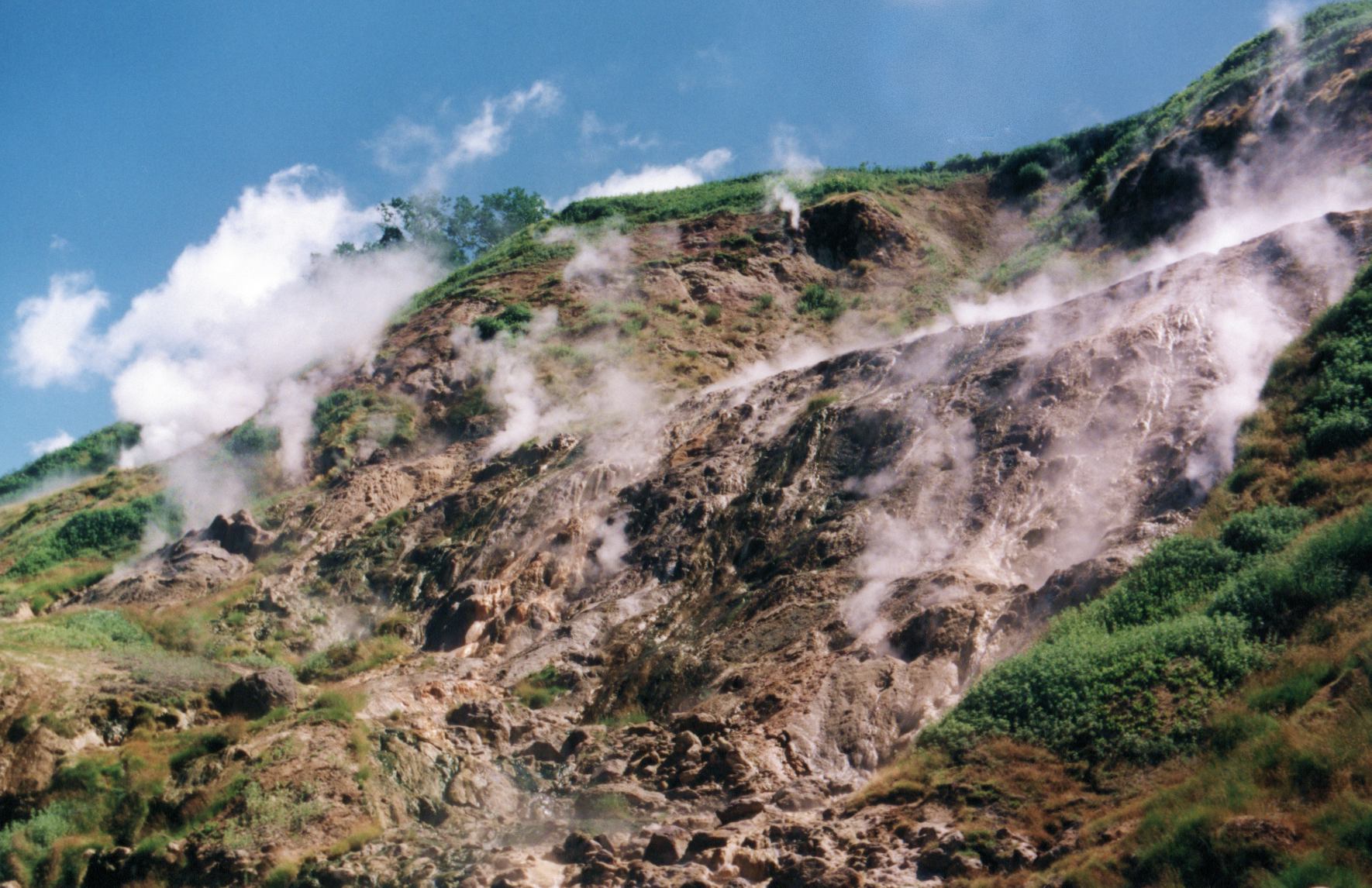
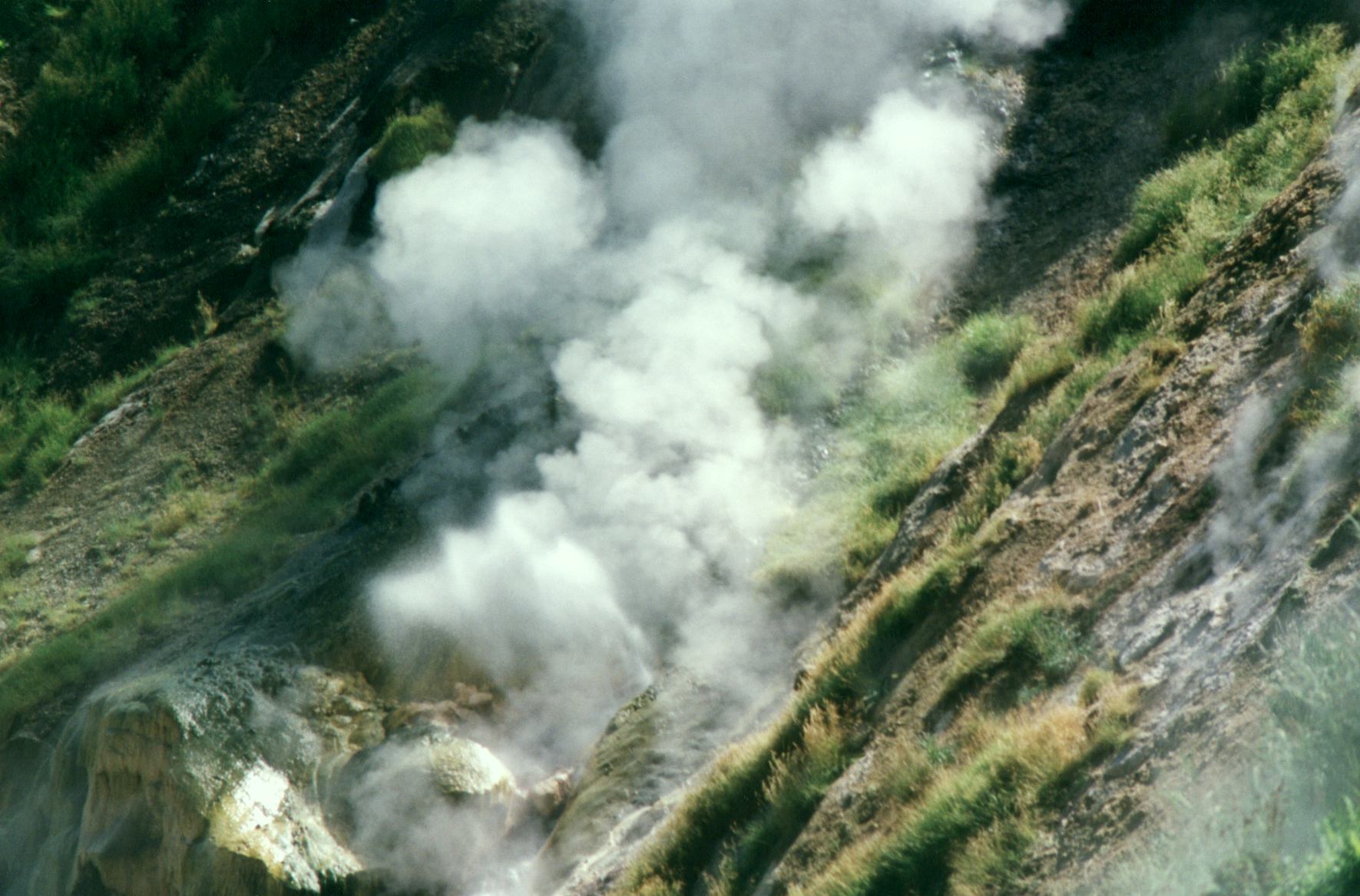
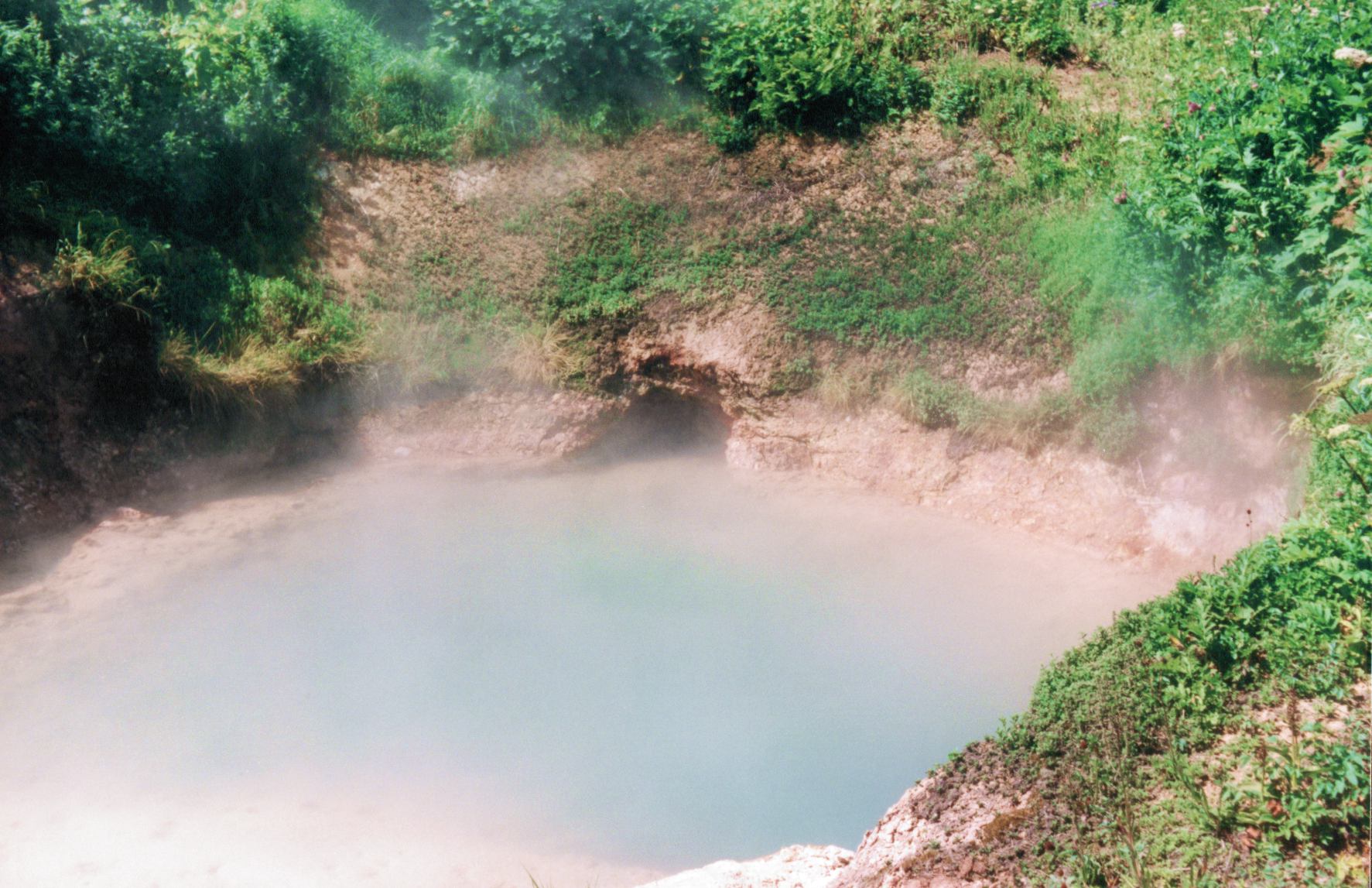
Even so, we could see that the valley was magnificent. Every hole bubbled and gurgled. There are plenty of places to see that in Kamchatka, but here it all goes bigger and higher. In fact, there are no big geysers anywhere else in Kamchatka. As far as we knew, there were only three other places in the world with them: Iceland, Yellowstone in America, and New Zealand. There are isolated geysers elsewhere, but the water only rises a few tens of centimetres at best. Maly was the only one we saw go through a full eruption at close quarters, but it gave us the idea. One bubbling pool starts shooting higher and higher until it looks as though someone's turned on a fire hose full of boiling water. Steam billows all around, and there's a rainbow in the spray. Many of the little geysers erupt every few minutes, so you can see them several times even in the little time you're allowed. The mud volcanoes are very pretty in photos, and interesting in motion too, but their plops are rather feeble. All the springs drain into the Geyzernaya, which doesn't freeze even in winter. The water is at least 18 degrees, coolest in early summer when the snow melts. They wouldn't even let us touch it. Beautiful, but what a waste of money. The crowning touch was the certificate they gave us, attesting that we really had been to the Valley of Geysers. On the plus side, for $210 you can stay the night and at least walk the boardwalks freely, though I have my doubts about that too.




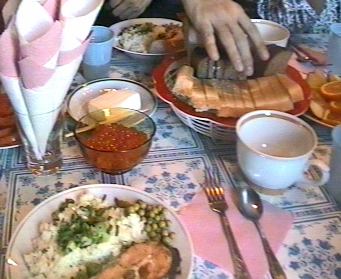
The interesting thing was that the other passengers were generally quite satisfied. They didn't need any more. Their first questions were “When's lunch?” and “When are they bringing out the beer?” An hour and a half had worn them out so thoroughly that they didn't want to walk any farther. Lunch impressed them more than anything else. There was sockeye salmon, bowls of red caviar and plenty of Kamchatka beer. It lasted an hour and a half, and meanwhile we weren't allowed to leave the little restaurant grounds.
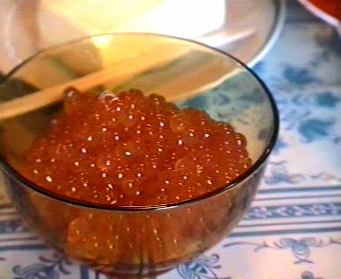
The sad thing is that there's no changing the situation. The Valley of Geysers had been publicised all over the country in the seventies. Then it was closed, and forbidden fruit is sweet. Big money swept aside every obstacle. The helicopter brings in twenty people a day, just two thousand a year. It isn't hard to find that many in the whole world. They charge astronomical sums and no nature reserve can stand up to it. Only the very wealthy can fly in, so they call the tune. They don't want much, and if you turned them loose they'd strip the place for souvenirs. The independent traveller simply doesn't fit into this arrangement. It's hard to blame the reserve administration: it gave up the bare minimum of the valley, which took the heat out of the dispute. Ninety-nine per cent of visitors are happy.
Still, now that Krechet has monopolised the Valley of Geysers, it could think about how to show people more. Put the money into picking up cigarette ends instead of lunch. Once a week at least, put on a different programme for those who come to look rather than eat. Get rid of the guard, or teach him some manners. Boardwalks do more damage to nature than footpaths, and I'd sooner look at a tin can than the guard's fat mug. It would also be useful to remember we have an antimonopoly committee, and it's supposed to deal with precisely this sort of outfit. Competition would put things in their proper place. Though what can you expect from a firm that named itself after a relation of the vulture?
Fellow travellers, going to the valley with Krechet is not for you. Make do with the other thermal areas or find someone in Tayozhny or Lazo who knows the back ways in. They say it's still possible. Look for other routes. For the nouveau riche, Iceland is cheaper and more civilised. It's all free there. Look as long as you like. Every spring has a road, parking and a free toilet. There are ropes, but only to warn you of danger, and boardwalks so you don't get your feet dirty. If you're not worried, you can walk where you please. In New Zealand you can see geysers for US$5–10. Even a day tour of Yellowstone costs $49, a quarter of the price. http://www.yellowstonepark.com//
17–20 July. Mutnovka. Spring and freedom
As soon as we got back, we walked to the bus station and caught a minibus straight to Termalny. The Paratunka basin teems with warm springs. Many have been developed. There are swimming pools, and some of the springs have simply been privatised. A cottage with a private hot lake and a Rottweiler to guard it. Every gangster's dream. You can find a free pool, but the valley is boggy and we didn't feel like floundering about in it. The Paratunka itself is cold, and doesn't tempt you in. Having failed to find a private hot spring, we camped in a little trampled clearing amid the rampant Kamchatka vegetation. Many lowland rivers are overgrown with greenery that looks positively tropical. Kamchatka meadowsweet, hogweed and several other plants stand over three metres high. It was threatening rain by evening, so we turned in early and slept twelve hours, finally getting all the sleep we needed. It rained all night but stopped in the morning. The clouds were still hanging low. We went back to Termalny first thing to buy food. Tanya and I were celebrating ten years since we met, so we got the makings of a celebration: champagne, cheese, chocolate and tomatoes.
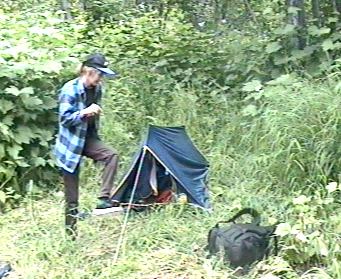
There's no scheduled transport past Termalny towards the Mutnovsky geothermal power station.
Thanks to the construction work, the road to Mutnovsk is in fairly good shape. Any car can get through. The road bypasses Termalny, so you have to walk about a kilometre towards the mountains to reach it.
We settled down by the roadside and started hitching. Mutnovsk was nearly sixty kilometres away, and there was no sense in walking it if we didn't have to. A geologist came by on foot. He was going fifteen kilometres to Nadezhda and didn't bother looking for a lift. We had a chat.
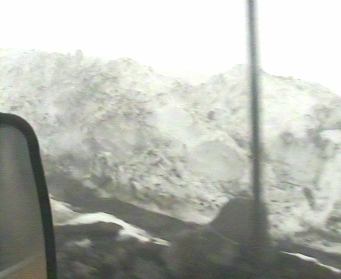
Soon a KamAZ truck loaded with gravel came by and we climbed aboard. The road began on the flat along the Paratunka, then near Vilyuychik it started zigzagging up to the pass. We drove into cloud and visibility dropped to nothing. As we gained height, we began to see patches of snow all round us, merging into a continuous snow cover several metres thick. Southern Kamchatka gets up to twenty metres of snow over the winter, and it doesn't melt until August. The little knolls had thawed, of course, and stood in flower amid the snowfields. Ten-metre poles along the road mark it out in winter. At the highest point on the pass there's a geologists' camp where you can spend the night. In winter they keep track of the vehicles, and if one goes missing they go looking for it. After the pass the road drops a little, but the snow beside it continues all the way to Mutnovsk, at 800 metres. They dropped us right by the barracks (52°32.033′N, 158°11.868′E). It was cold and drizzling.
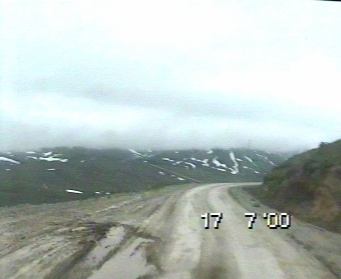
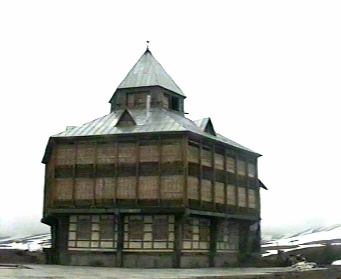
Mutnovsk is a camp for workers on rotation. Work on the geothermal power station began back under socialism. They drilled lots of boreholes in the surrounding hills and built a few barracks for the workers. Construction was abandoned in the early years of perestroika and only recently resumed. It was going full tilt. The building closest to completion was an enormous three-storey hexagonal palace with swimming pools and saunas for the bosses. They even worked weekends, though on the rotation system there were no weekends as such. The workers had nicknamed this building the synagogue. Apart from the old barracks, all you could see in the settlement was the groundwork. The first phase of the plant had been built four kilometres to the south and at that point supplied electricity only to the building site. It broke down soon after it started up because there was no inlet steam filter, and they were putting it right. An immense power line had been built towards Yelizovo. The station was supposed to solve all the energy problems. For the time being it was solving the problem of what to do with spare money in the budget. Everyone seemed to have forgotten Kamchatka had oil and coal of its own, though neither was being extracted yet.
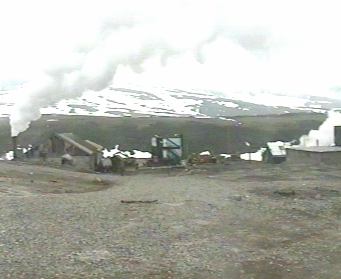
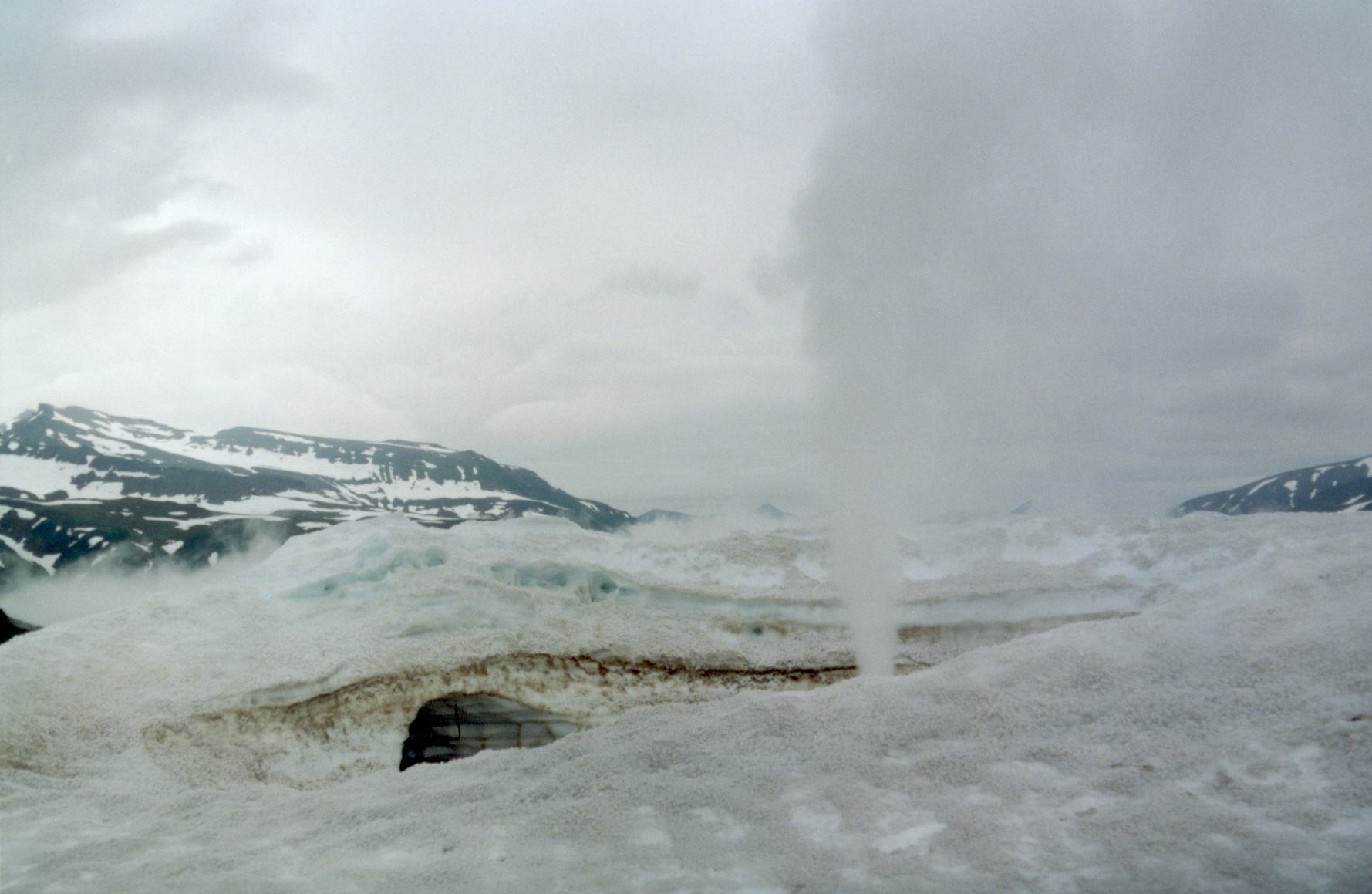
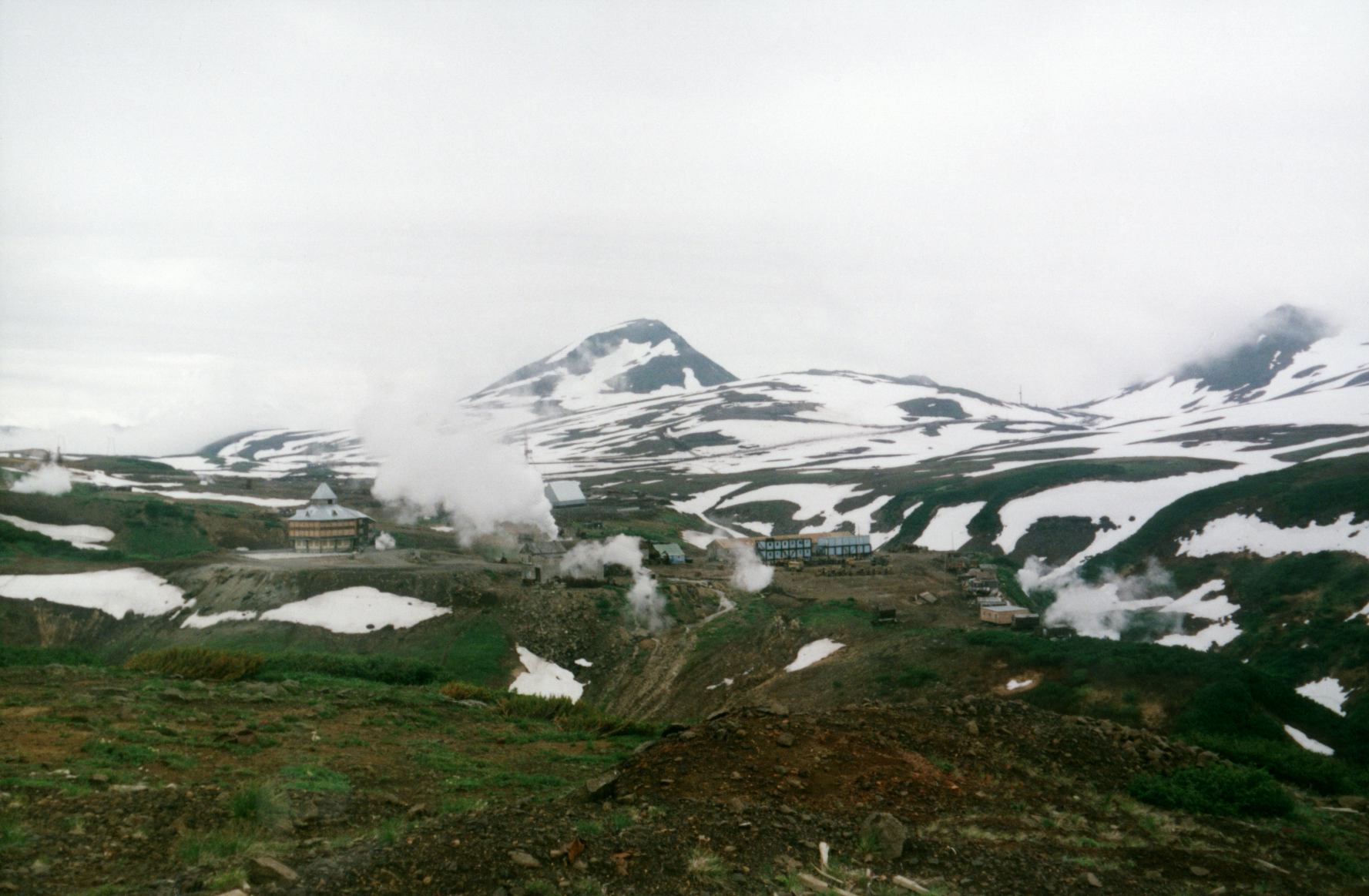
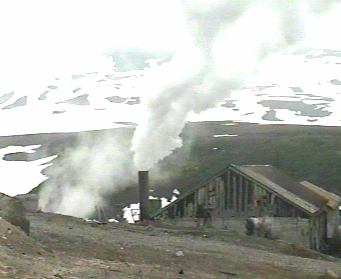
You can see the valley of the Dachnye Springs from the building site. It's a little fumarole valley a few hundred metres to the north. Naturally it's smaller than the Valley of Geysers, but it's open and you can go where you like. There's a building site next door and no shortage of workers or tourists, yet it looks every bit as good as the Valley of Geysers. When we arrived, three young women were bathing in the pool without swimsuits. They didn't seem especially put out to see us. People are free here in more ways than one.
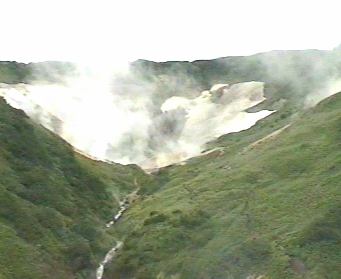
I spent about an hour running round, looking at and photographing the countless springs, fumaroles and little mud volcanoes. It was marvellous. I was quite happy. The hot springs were overgrown with colourful algae, and the grass along their banks, green all year, was an astonishingly vivid colour. The women went on their way and we got in for a soak. Boiling water comes out of the springs and ice water runs off the snow. The locals move little stones about to divert the flows, making baths to suit every taste. The hotter the weather, the cooler the baths. The snow melts faster and floods everything with cold water. That day it was cold and the baths were hot. We lay in there for three hours. You're not supposed to stay in a sulphur spring that long, but we really didn't want to get out into the cold.


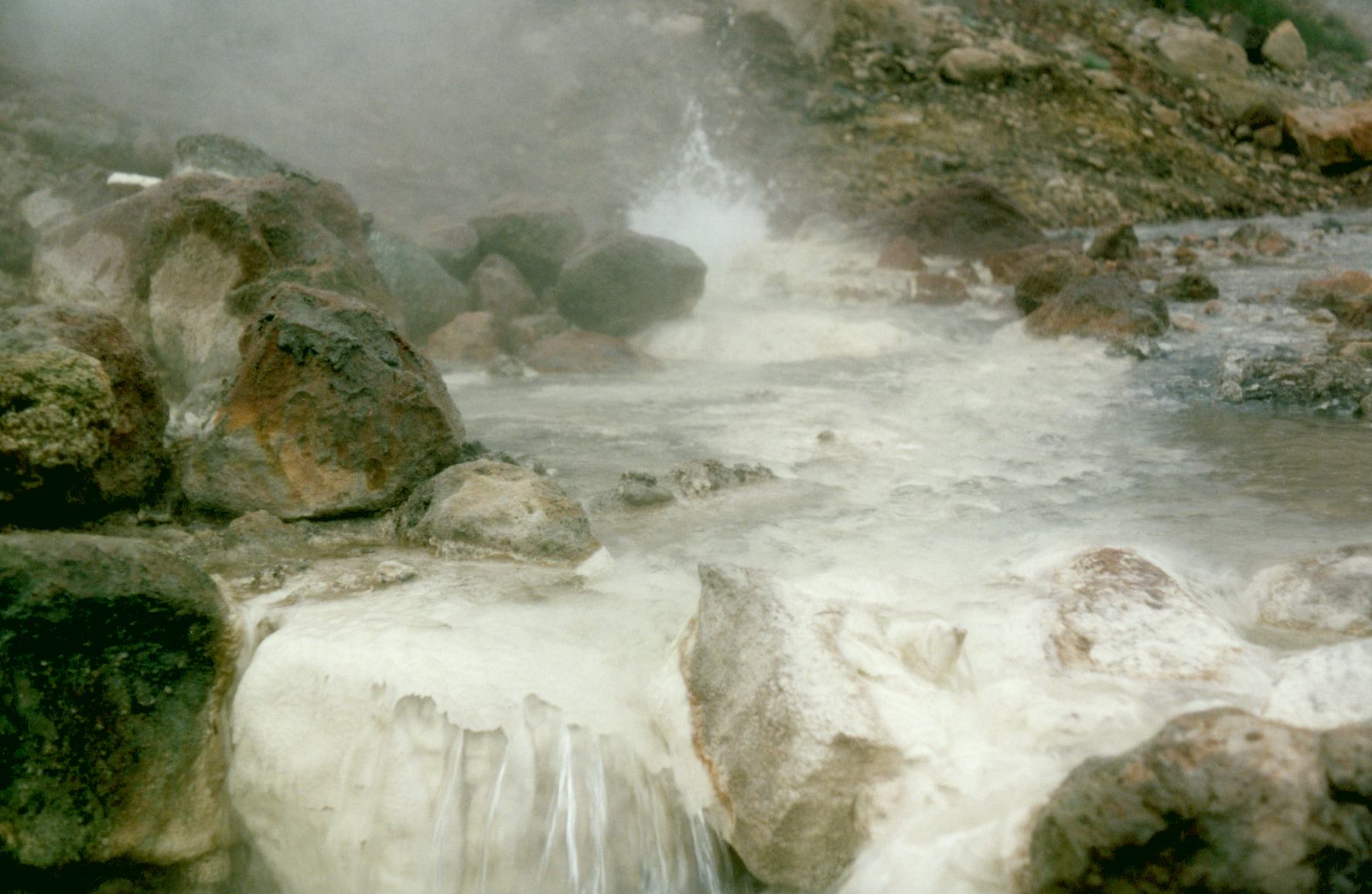
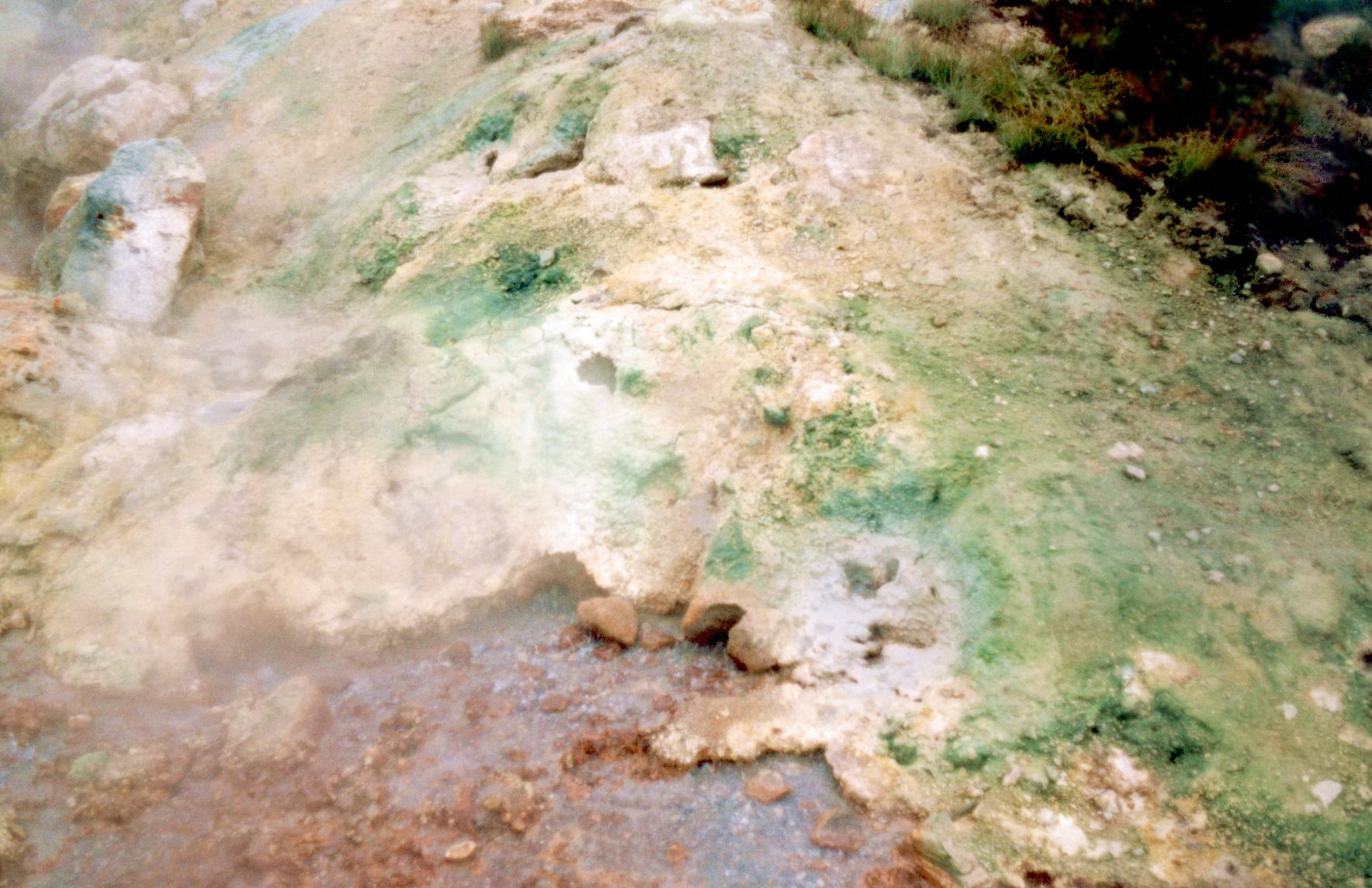
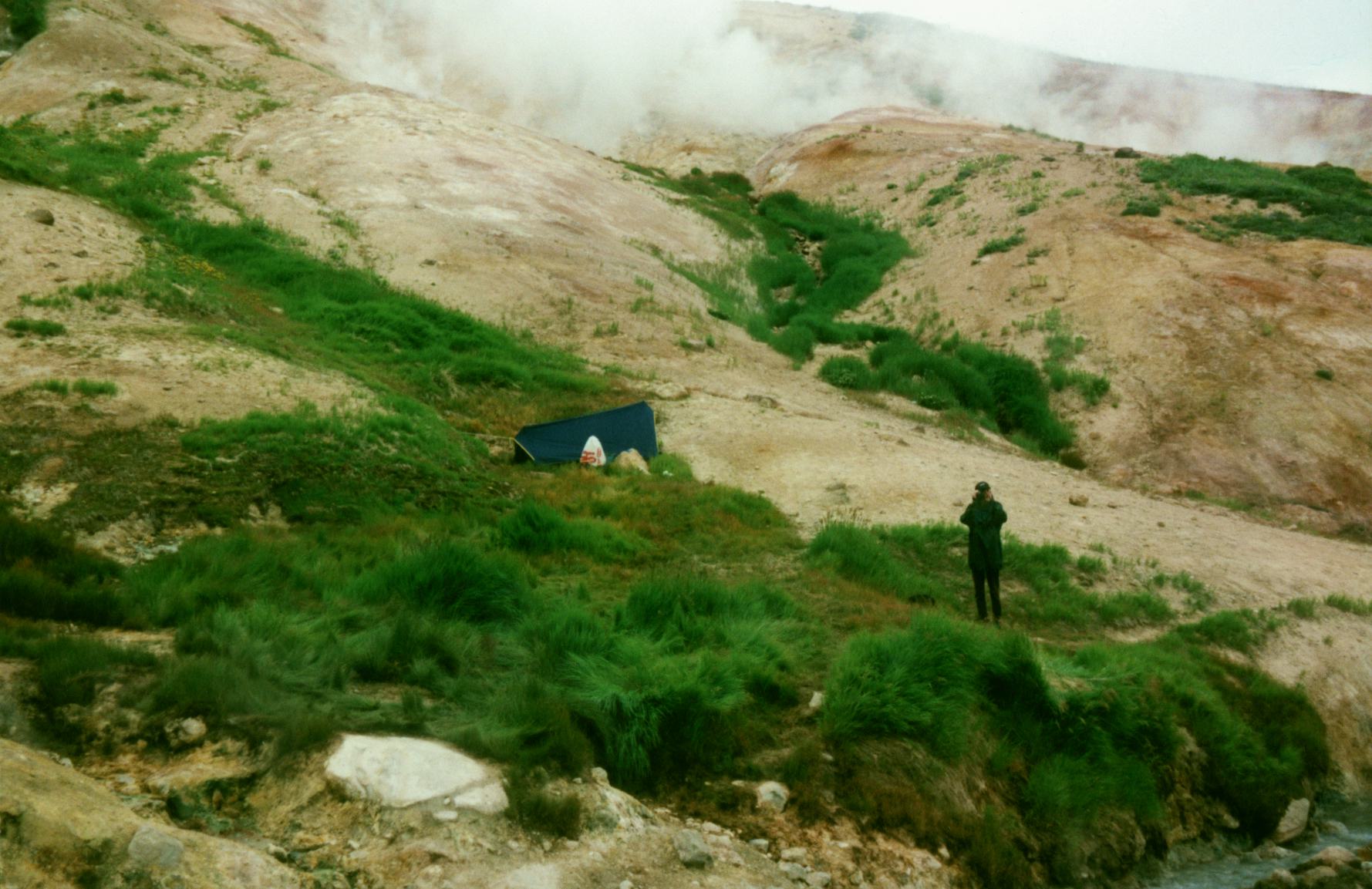
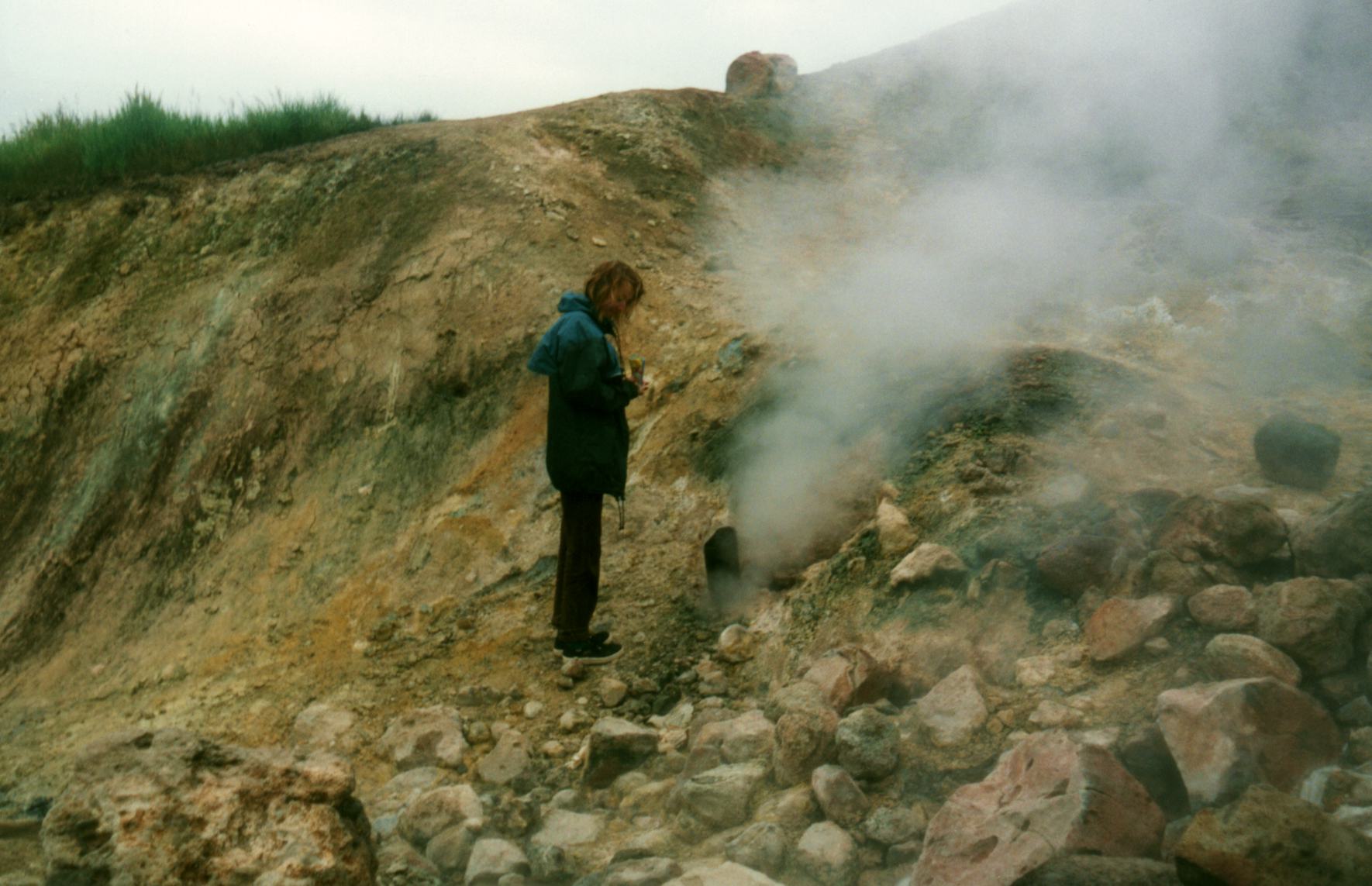
We cooked Gallina Blanca soup right on a fumarole. Our “Gallina Blanca, bubble bubble” came out splendidly. We ought to send it to the company and get a lifetime supply of soup. A fumarole is very handy for cooking. Ice-cold water gets almost to boiling point in ten minutes. You can cook in it as you would in boiling water.
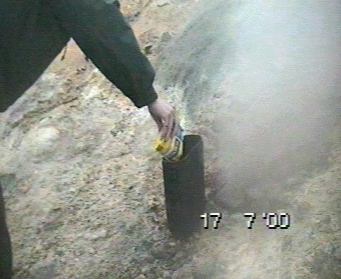
We pitched right in the valley (52°31.819′N, 158°11.513′E), on ground that felt slightly warm. Tanya and I celebrate the day we met, 19 July, every year. Since we didn't know where we'd be three days from then, we decided to celebrate early and save ourselves lugging a bottle of champagne around the mountains. We started at nine in the evening, when it was clear no one else would come to bathe. We made ourselves comfortable in the bath itself and celebrated until it was quite dark. When we crawled into the tent we found the ground under us was roasting. The heat coming out of the ground hadn't changed, but the tent had stopped it dissipating. Once we'd put down mats and sleeping bags, the heat had nowhere to go and the ground warmed up. At first the sleeping bags protected us from the worst of it, but in the middle of the night it grew unbearable. We were getting worried about the groundsheet, too. What would we do if it melted? We had to move the tent. And you'd barely felt the warmth to begin with.
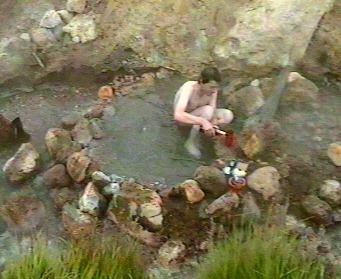
It was raining again in the morning. Visibility was zero, and the thought of climbing into the mountains was uninviting. We decided to try the coast instead. To our surprise the locals didn't know anything about the way. The road that turns into a footpath on the map was nowhere to be seen. While looking for it we wandered into the completed part of the power station on the upper Mutnovka. It's a huge tangle of metal with steam shooting out of every opening. The steam condenses in the air and comes down in jets more powerful than any rain. One such jet soaked us on the spot, and worse still it soaked our packs and everything in them. With all that water, the road was a sea of mud. We got filthy before realising the local people walked along the steam pipes without so much as setting foot on the ground. The road ended in a steep drop to a stream. No path in sight. Rain was coming down in buckets. We took shelter in a wrecked site hut, ate something and decided to turn back. We got to Mutnovsk in time for lunch. The canteen is for workers, who get a set meal with vouchers. If you come to an arrangement with the woman in charge and show up near the end of lunch, about three o'clock, you can eat for 25 roubles. The food is good. It brought back fond memories of canteens on student building jobs and state farms, right down to the dried-fruit compote. The difference was that these patties were made of meat, not bread. Delicious! After lunch we went back to looking for the road, this time along the stream. We looked at the waterfall on the warm stream flowing out of the Dachnye Springs. There was still no path, and the wall of dwarf alder made us think better of charging straight through. By then the rain had stopped and we'd come to the foot of Mutnovsky. The fog was solid, but there were tracks heading towards the volcano, so we followed them. They went over the snow, only occasionally coming out on little ridges. The ridges were muddy and walking on snow was easier. Tanya was tired and put the things she didn't need in a bag under a stone. The fog was so thick you couldn't see twenty metres, but with the GPS we could keep some track of where we were going. The map out of the atlas didn't have a coordinate grid, which was only half the trouble. Mutnovsk was in the wrong place on it. That mistake nearly had us climbing Dvugorbaya instead of Mutnovka. The tracks skirted it on the southeast. On the way we met a lemming running across the snow. At first it tried to hide, but when it realised every line of retreat was cut off it went on the offensive, hissing and biting. Seeing that I still hadn't eaten it, it got so carried away it began chasing us and throwing itself at our boots. Then the little rodent came to its senses and bolted, its backside swinging wildly because its front legs couldn't keep up with its hind legs.
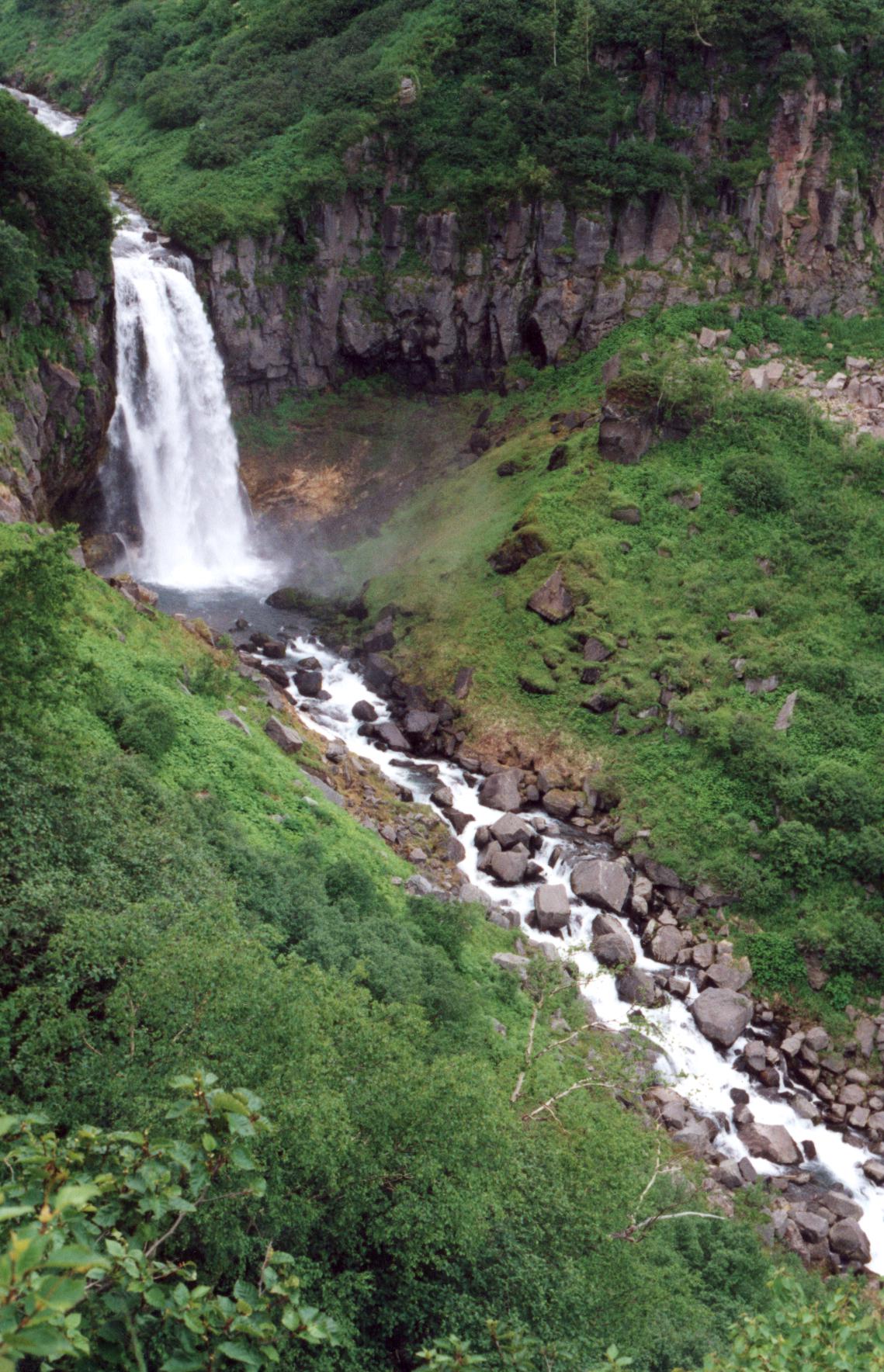
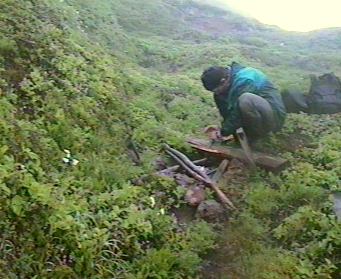
It was growing dark and time to find a camp. As luck would have it, there was a small, flat knoll (52°31.038′N, 158°03.762′E) covered in low scrub, with a level spot for the tent. In the grass we found some half-rotten boards still good enough for a fire. Who knows what they were doing there? Had someone flown them in by helicopter? The fire was very welcome. We'd been walking in the rain all day and were soaked. It turned out to be a lovely camp. We dried off and cooked twice as much dinner as usual. In the evening we sat by the fire for a long time, watching the mist break up and reveal, bit by bit, a magnificent view of Mutnovsky volcano. A wolf ran across the next little hill. They say wolves live farther north, but that was no house dog.
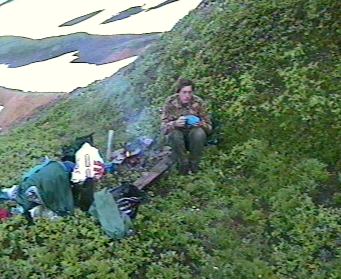
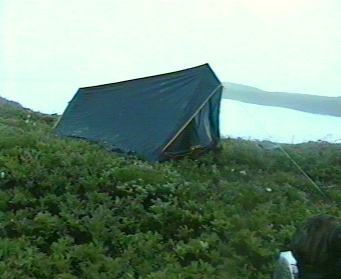
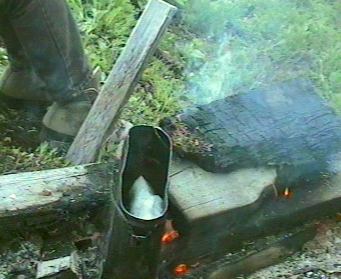
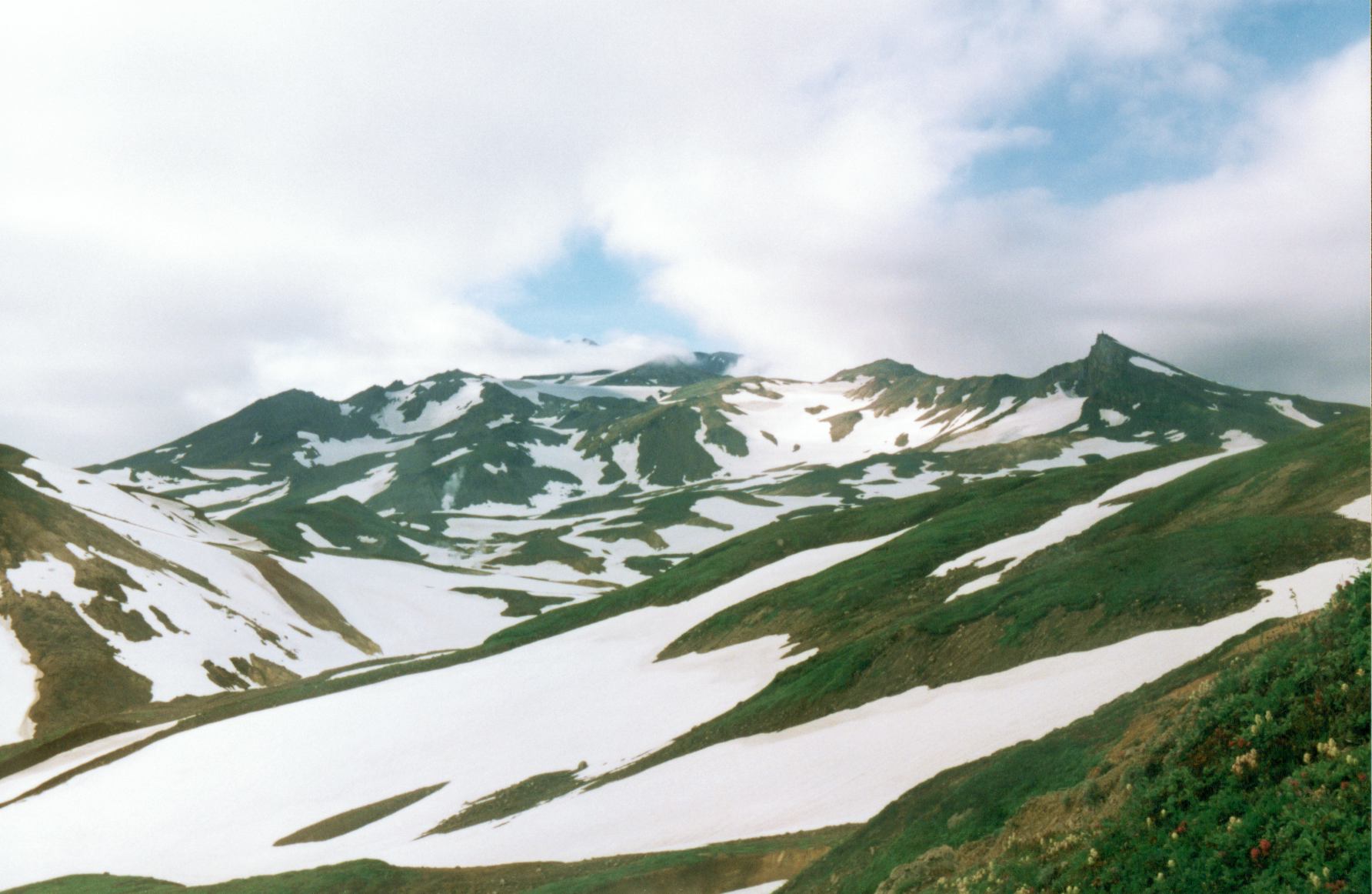
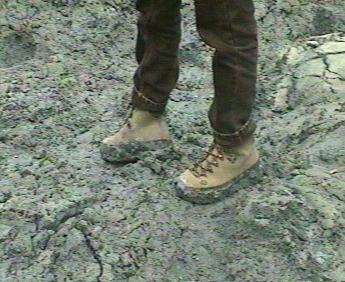
We slept well. In the morning the sun came out and it grew warm. Yesterday's black-and-white world turned into a riot of colour in the alpine meadows. The side of the volcano smoked with billows of steam jetting high out of the ground. Eager to see the great fumarole fields, we made straight for the nearest fountain of steam, which turned out to be another abandoned borehole with its valve left open. The sun began to beat down and the climb got hot. We took our time, stopping often, and climbed to a finger-shaped rock on the eastern slope, then followed the ridge towards the crater rim (52°29.124′N, 158°09.584′E, 1,627 m). By then fog was rolling in and flooding the foothills, but that didn't trouble us. We were a few hundred metres above it. We meant to get to the edge and have a look from above first, work out what we were getting into and then go down. Holding our breath in anticipation, we all but ran to the rim of what is said to be the most beautiful crater of all (52°28.238′N, 158°10.045′E, 1,649 m). It didn't disappoint. The blue glacier, fractured in the eruption, stood in columns that looked like avant-garde sculpture. Fresh ash in different colours lay over it. The rocks were yellow and red. The fumaroles glinted with brilliant yellow fresh sulphur. The colours were extraordinary. The glacier had slid onto the fumaroles, and the escaping steam had melted enormous caverns into the ice, with little streams running out of them. They all fell over cliffs in waterfalls to join in one river, the Opasnaya, which had cut through the crater on the west. There it had carved a gigantic canyon with sheer walls. Its floor was covered in snow riven by huge crevasses. This canyon was the easiest way down into the crater. The crater is up to 400 metres deep, and it's hard to imagine getting down any other way without ropes. We descended to the glacier in the canyon. The ice was covered in fresh ash. Here and there lay newly landed volcanic bombs of all sizes, splattered with yellow blobs of sulphur. The ash had got wet and become a layer of sticky mud from a few centimetres to a metre deep. In places it had dried into a cracked grey, yellow and green crust shaped into many-sided pyramids. An entirely unearthly scene. You could film another planet here. Walking wasn't easy. The mud stuck to our feet in heavy lumps and steadily climbed up our clothes. The layer of mud got deeper and deeper.


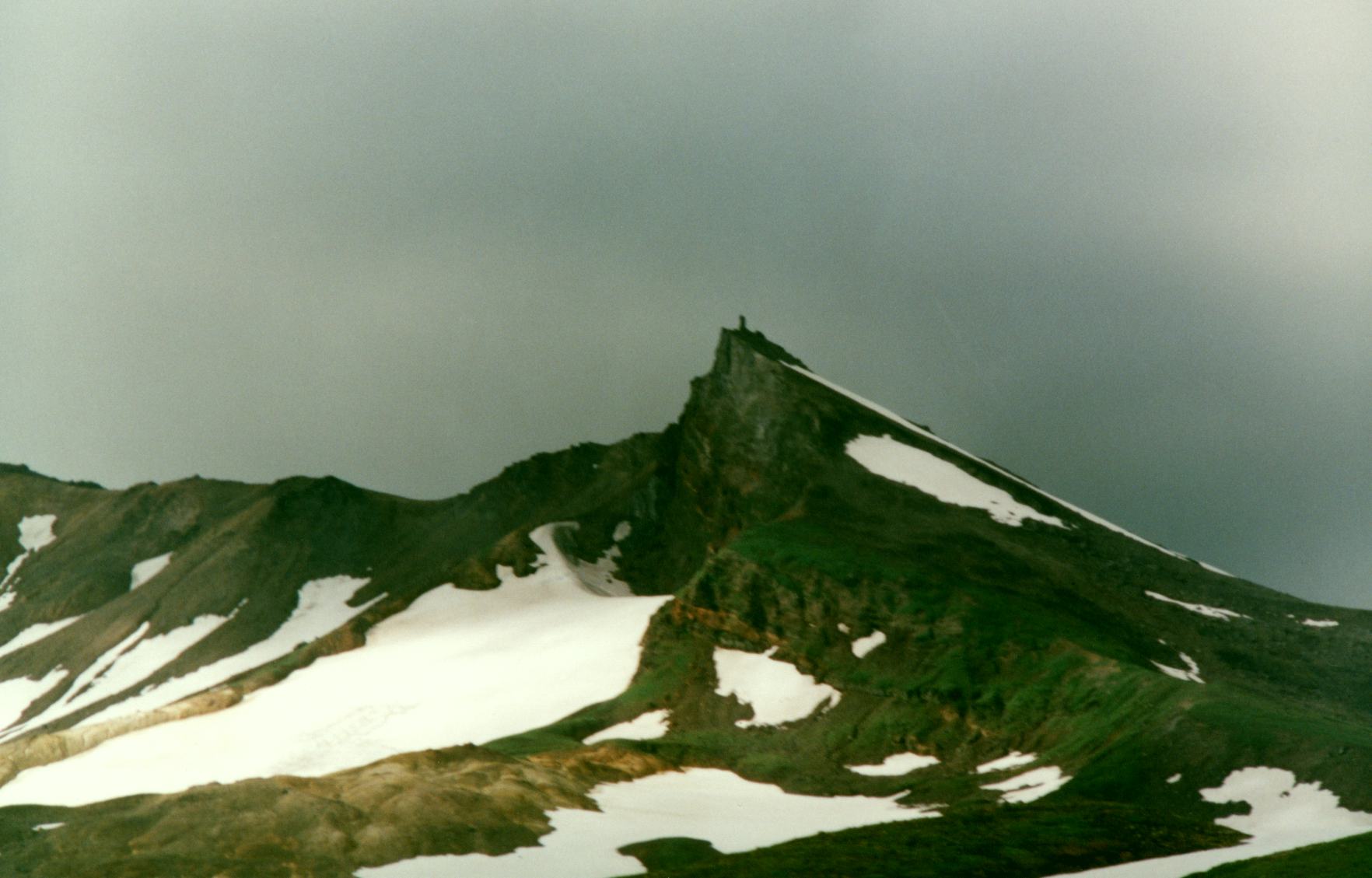

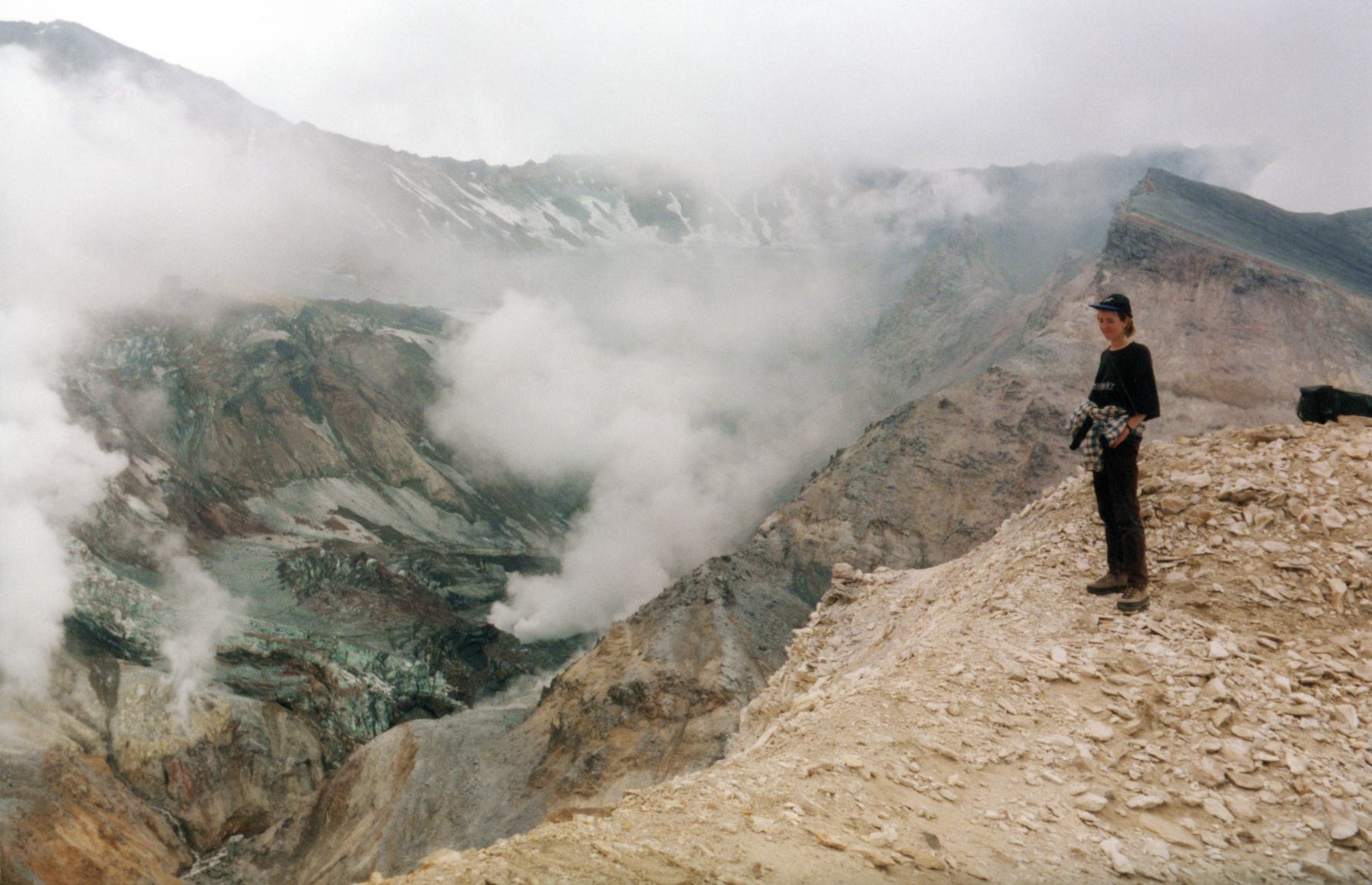
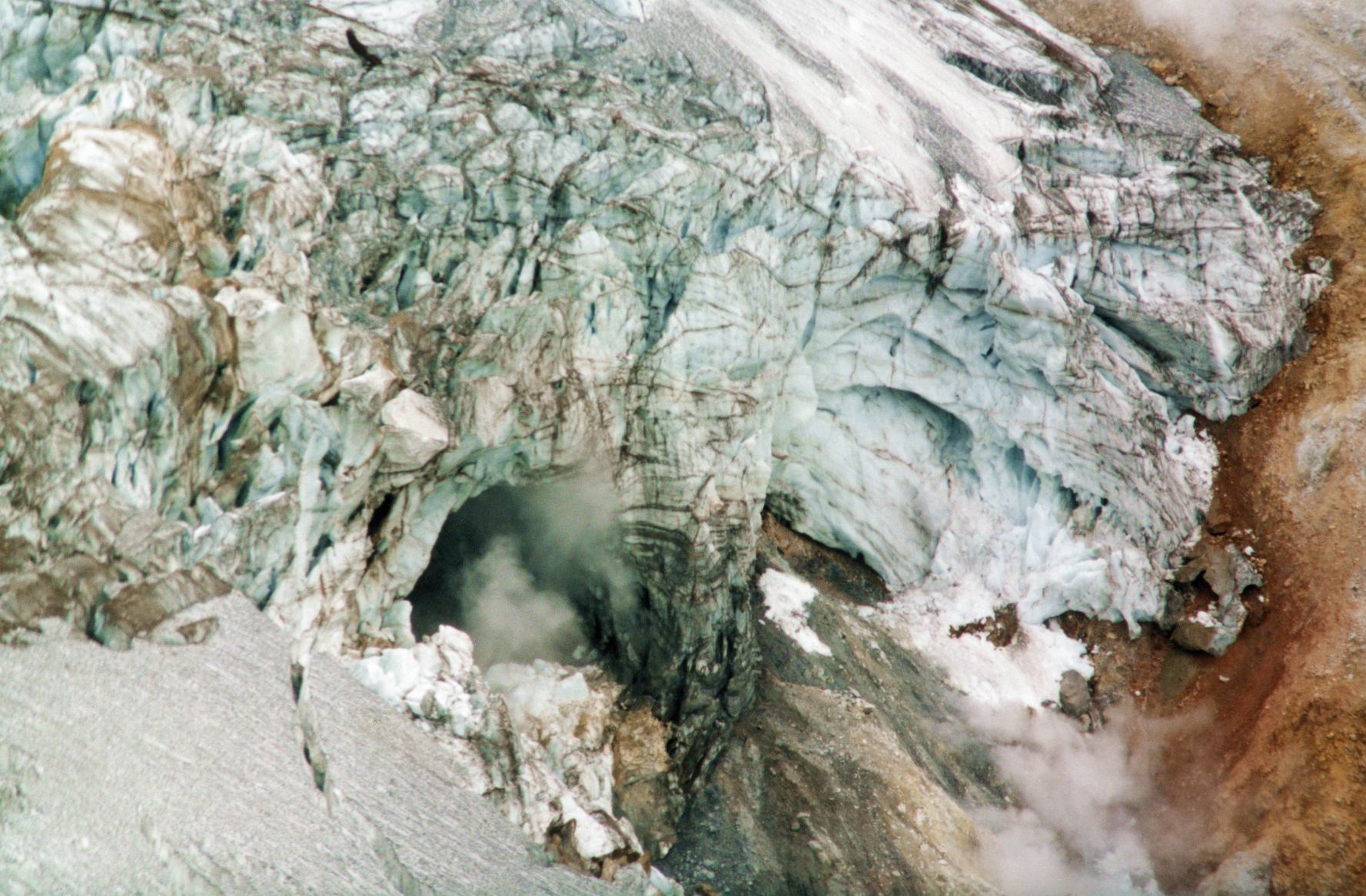

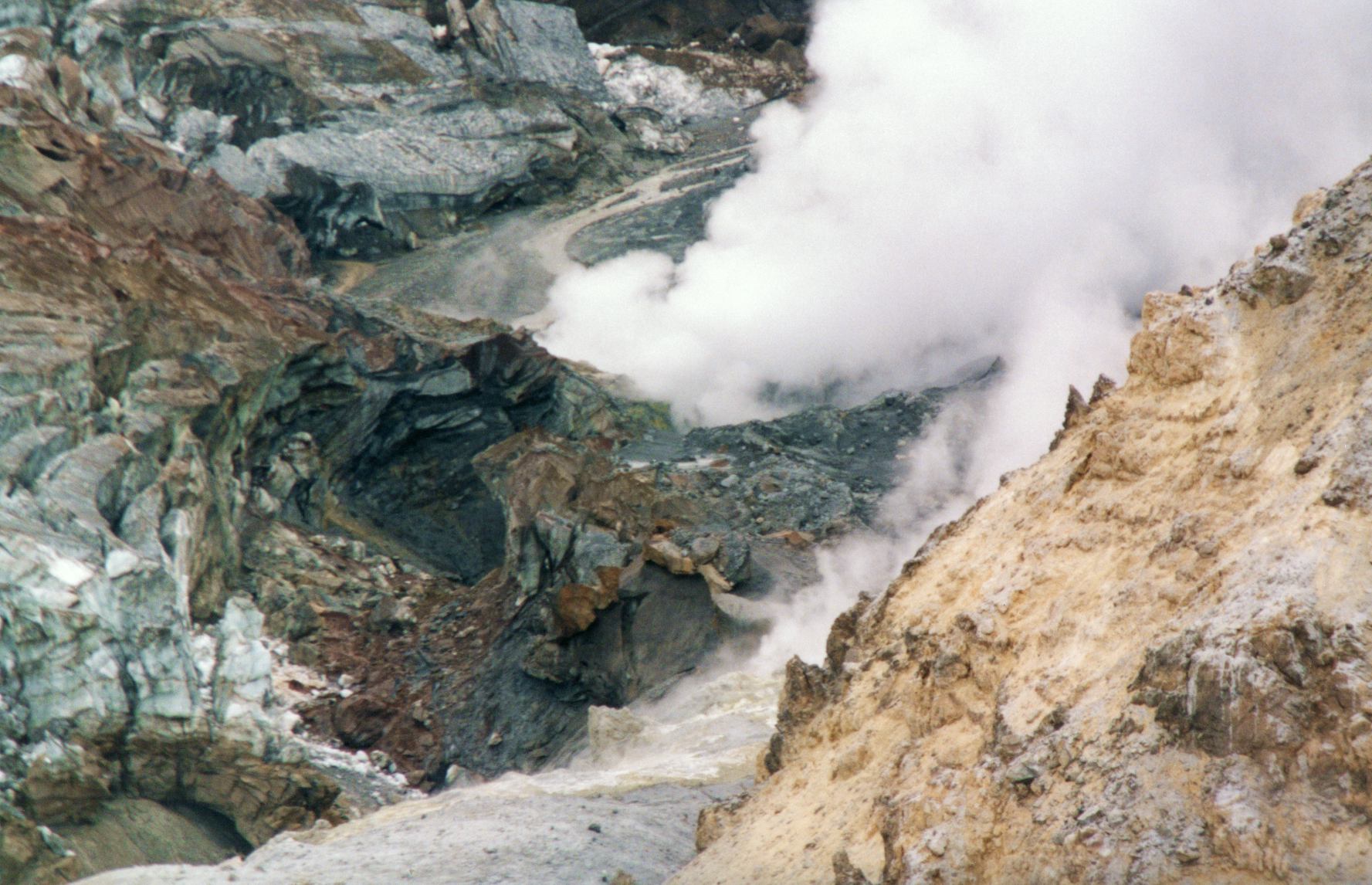
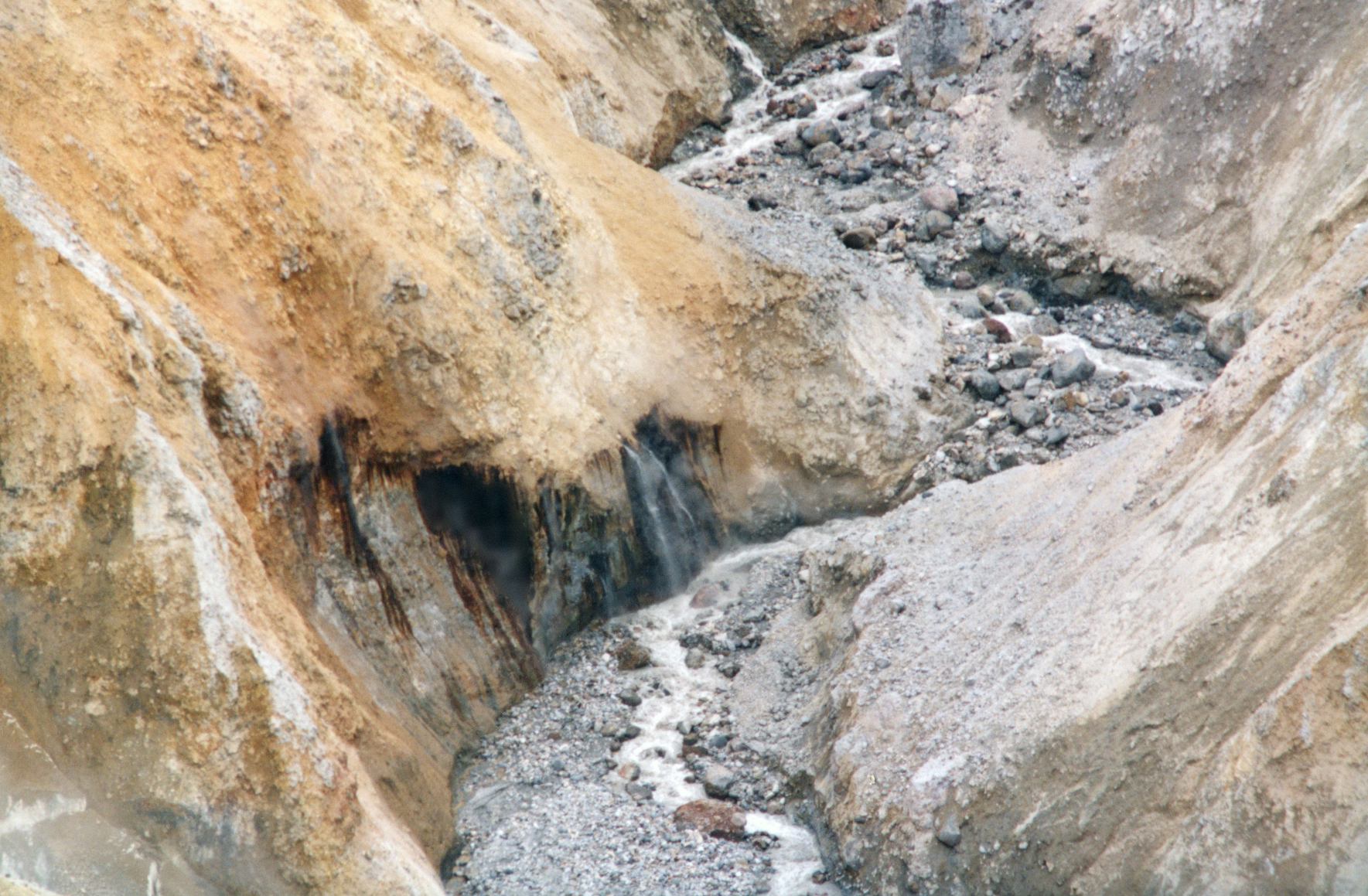
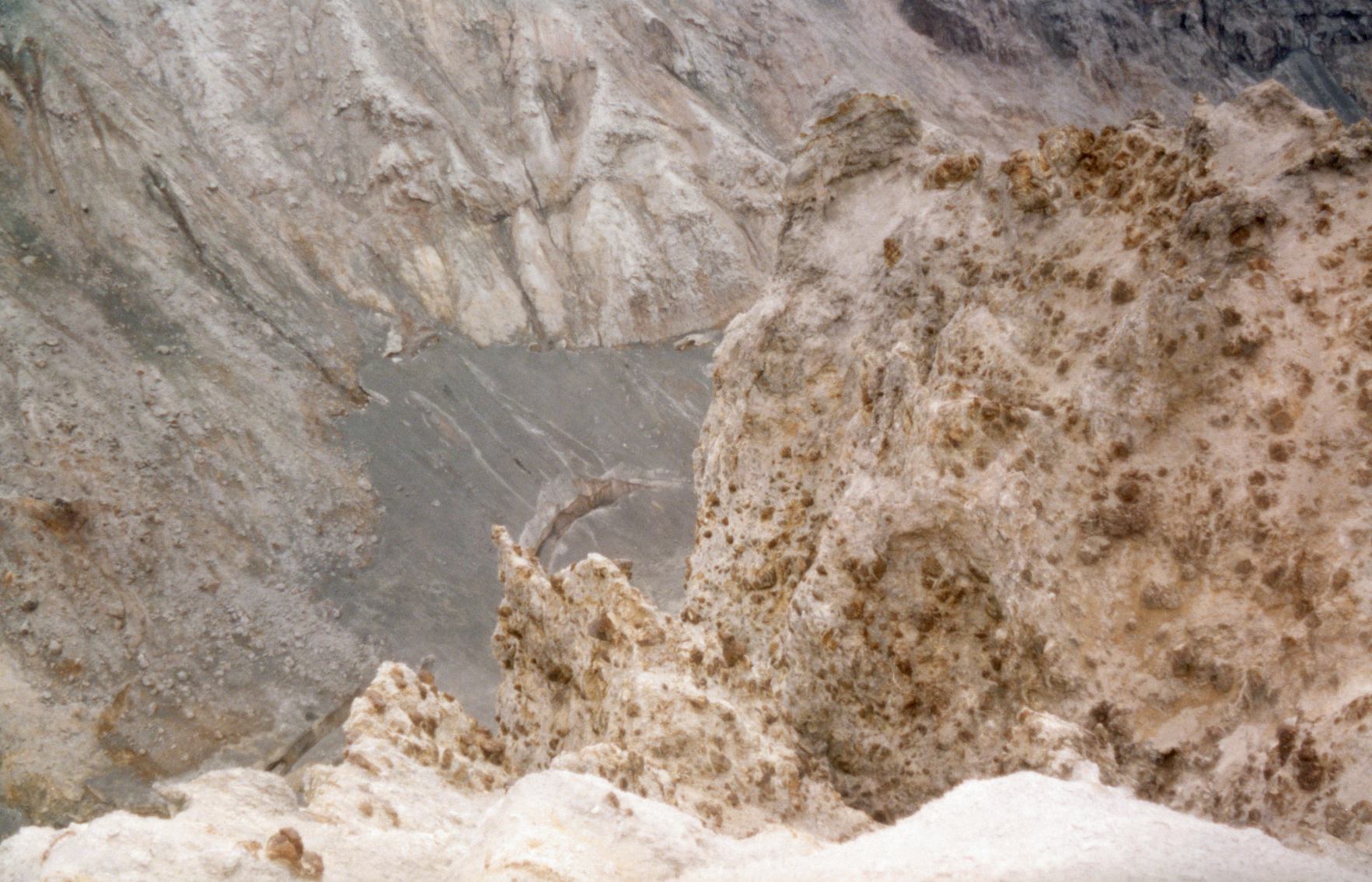
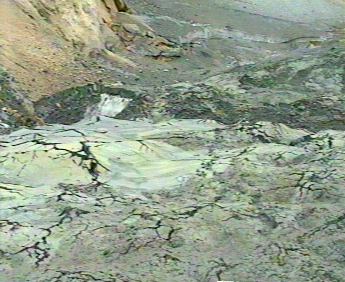
Coming the other way we met Vladimir Glazkov, a wonderful photographer of Kamchatka's landscapes and wildlife and a man remarkably absorbed in his work. We talked, and he told us how to go on from there and invited us to visit him at the volcanologist's hut, where he meant to spend the night. Delighted at the prospect of interesting company, we agreed to meet at the hut that evening.
Enormous crevasses, tens of metres deep, bar the way to the centre of the crater. The hot river below melts the ice ten or twenty metres back from the water, leaving an immense arch over it. Fortunately all the crevasses were easy to get around. Soon the canyon opened into the crater and there we were among yellow sulphur cones and fumarole caves. At the end of the flat area (52°27.877′N, 158°10.067′E, 1,436 m) there was a huge mud cauldron and a little pool of poisonous green acid. The cauldron was going at a furious rate. You could feel the immense power underneath it. The green-grey slop rose a metre high, like the ocean in Solaris. Steam billowed up around us with sulphurous gas. There was nothing left to breathe. Tanya felt it, took fright and silently turned tail to take shelter among some far-off crags.


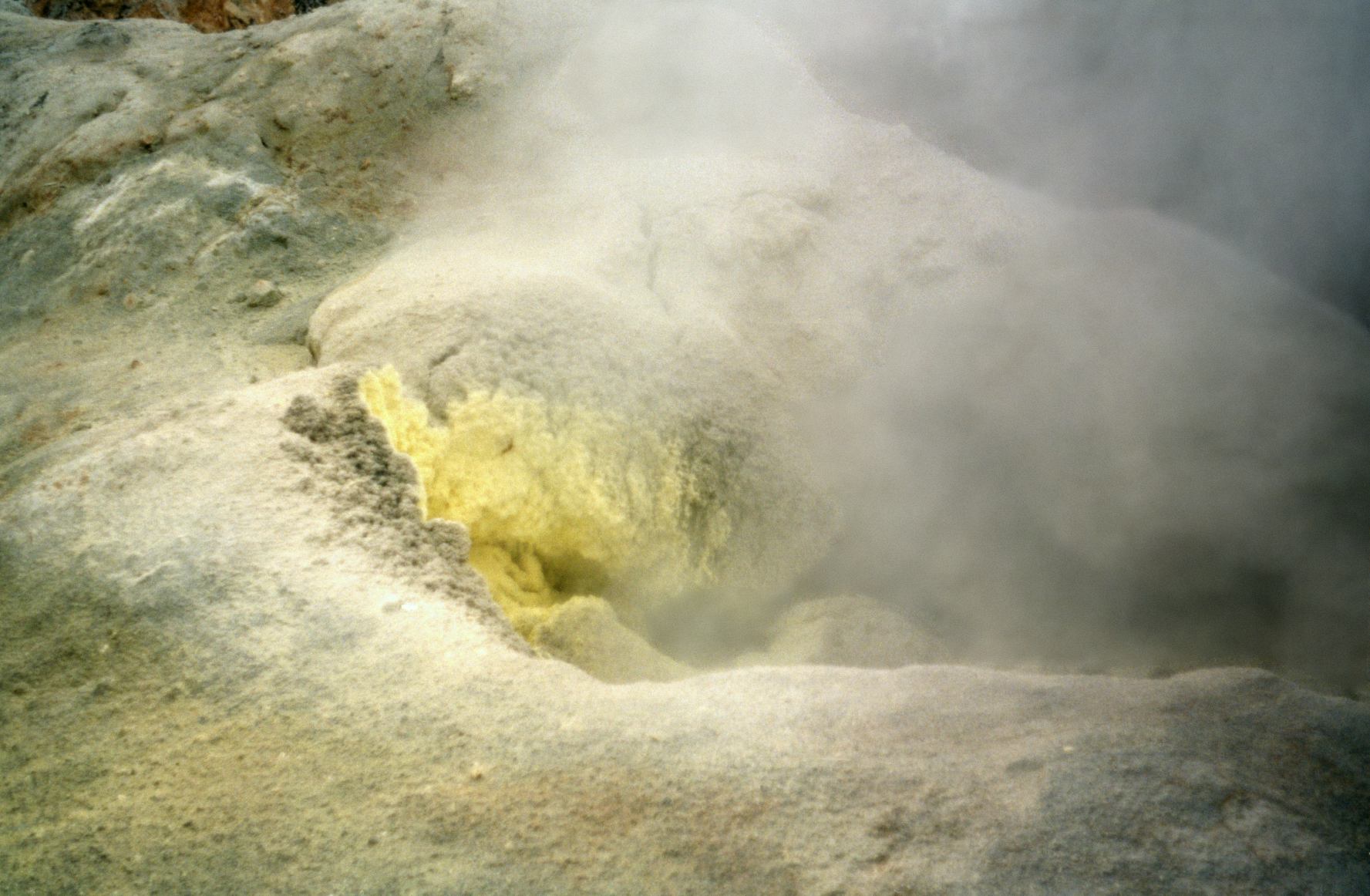
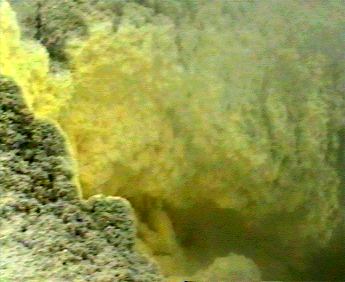
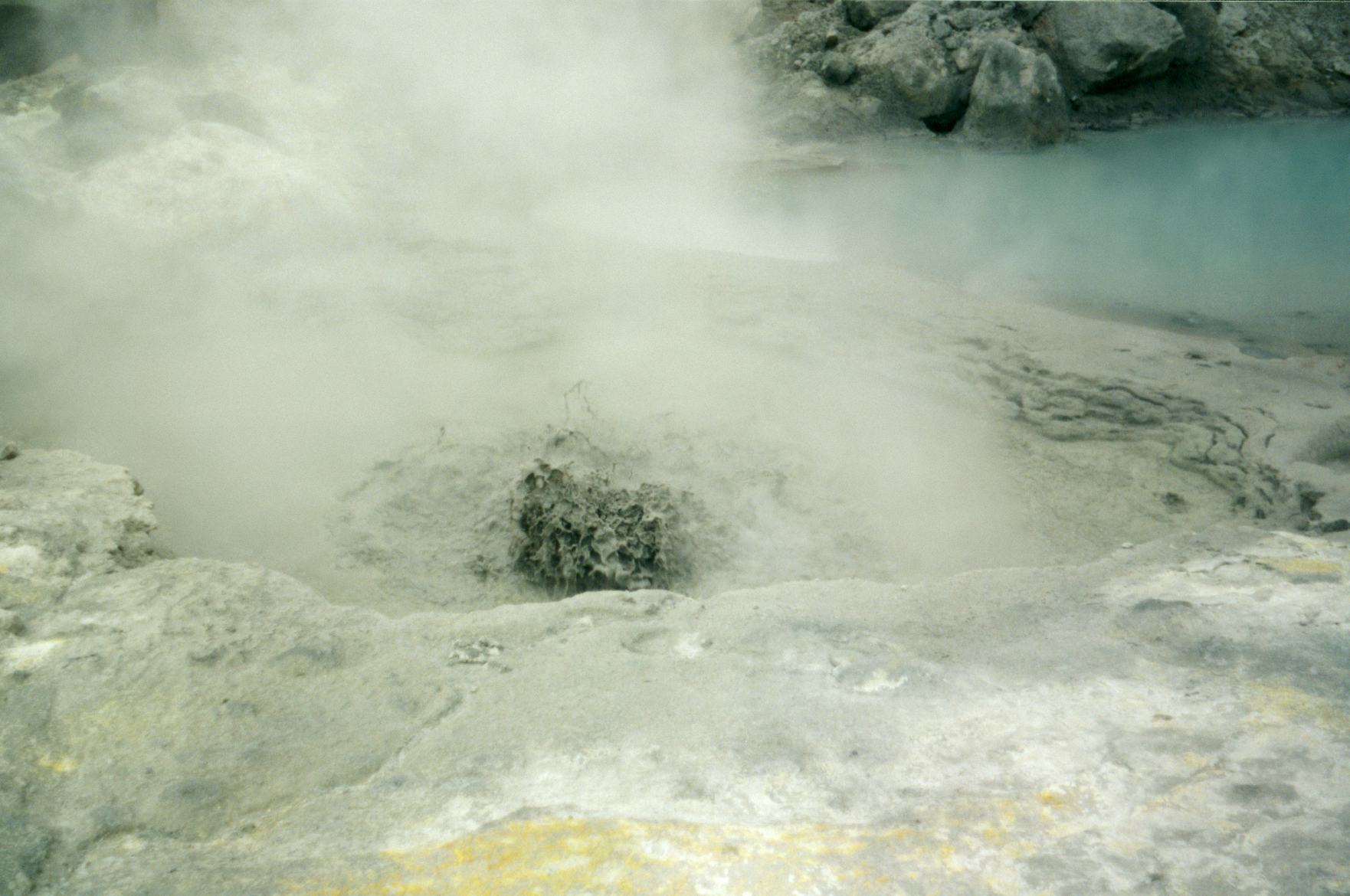
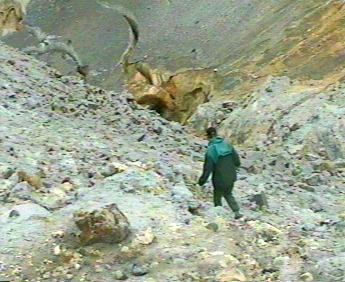
Fresh scree blocked the way to the acid lake that had formed in April. Higher up was an active funnel belching thick steam. I didn't dare climb up to it, which I deeply regretted afterwards. I went back to Tanya and we had a little celebration. Today was ten years to the day since we'd met. We'd already celebrated with champagne, who knew we'd end up somewhere just as worthy on the actual day? But we did have supplies with us: cheese, chocolate and cranberry wine. How very good it all was!
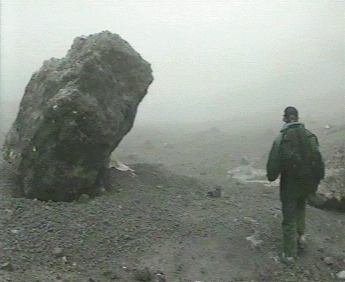
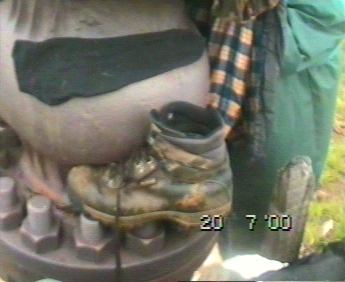
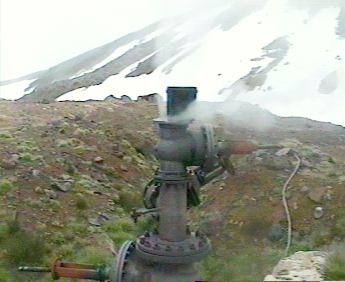
We didn't get long to celebrate. Evening had come. The fog was steadily advancing, pouring out of the gorge and flooding the crater. Time to go. We realised we hadn't asked exactly enough about where the volcanologists' hut was. We were to turn at a grave with a little cross, but there was no seeing it in the fog. The tracks had run out as well. We didn't fancy climbing back up the way we'd come. We thought we'd turn off at the first opportunity, but the farther we went the steeper the walls on either side became, and the river dropped down a seventy-metre waterfall. We got around it on the north bank, only to hit another waterfall shortly afterwards. This time we had to scramble a long way up a steep bank. The last few dozen metres were up a steep snow slope. How we wished for an ice axe! There were a lot of tracks on the plateau where we emerged and no way to know where any of them went. By then the fog had thickened and turned into heavy rain with a howling wind. We went down towards the valley between Gorely and Mutnovsky. You couldn't see farther than fifty metres and the hut would be easy to miss. At the bottom of the valley we found the road, but the hut stayed out of sight in the fog. It was getting dark and there was nowhere to camp. Snow and rock all around, rain in buckets, wind of at least twenty or thirty metres a second, and cold, about freezing. It felt like snow would start any minute. We decided to cross the pass to the borehole on the slope of Mutnovsky. We'd find firewood there for certain and get warm. We didn't even need the wood all that much. The borehole was every bit as good as a fire. We climbed for a long time, the wind in our faces, and made very slow progress. At last we gained a ridge. Nothing was quite as obvious as we'd expected. There were several ridges and gullies, and soon we were racing downhill. I turned on the GPS. The batteries were nearly done and I'd been saving them. What a nightmare! In the thick fog we'd turned a full 180 degrees on the crest. Of course the wind was at our backs now. How had I failed to notice? It's easy to miss a change for the better. We'd lost an hour of climbing. It was dark now and there was no time to scramble up the pass again. In almost complete darkness we stopped at a little stream (52°30.211′N, 158°06.965′E). The pegs wouldn't go into the loose volcanic cinders. Or rather, they went in perfectly well and came out even better, and the gale left us no hope. We had to move. One failed attempt to pitch and our sleeping bags and everything else were wet. Our next try, in a narrow cleft between rocks, went better. There were plenty of stones to anchor the tent, by now in total darkness. The next surprise awaited us inside. Every time the wind shook the tent, it drove fine droplets through it and sprinkled us where we lay. There was no keeping dry now. Maybe it's in our nature as paddlers to get wet. Still, things weren't as bad as they might have been. A layer of fleece and a DuPont Thermolite sleeping bag kept us warm even soaked through. It was wet and cold and hard to sleep, of course, but you could get through a night like that. About six in the morning we'd had enough and went to find a warmer, drier place in the world. It was only ten kilometres to the Dachnye hot springs. We climbed into the wind again, without a hitch this time. An hour later we were at the warm borehole. Well done, GPS. It got us within a metre. We spread all our things out on the hot pipe. It was just under 100 degrees. Everything dried beautifully despite a little rain. We put a billy of soup on the mouth of the pipe to cook. It's good to be alive! We had less luck with a second billy for tea. It vibrated across to the centre and shot several metres in the air. At least it didn't come down on anyone's head. Warmed by the pipe, fed and happy, we set off towards the springs and took our time about it. With the GPS again we found the things Tanya had left on our way in. The screen showed zero metres and I saw a camouflage-coloured bag at my feet.
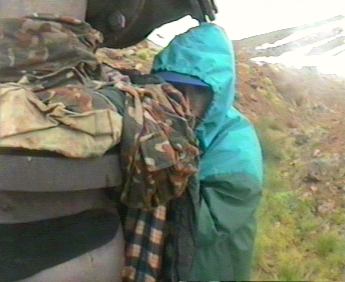
We reached Mutnovsk at lunchtime and made it to the canteen. It really was the best place in the settlement. It felt warm and comfortable in our stomachs. A party of foreign visitors hung about apprehensively beside the springs. The weather wasn't treating their pampered Californian bodies kindly. We talked with the guides and then with the Americans. The guides were explaining earnestly how dangerous it was to go into the crater, and we undermined them by saying it wasn't all that bad. Then we went bathing and the foreign visitors followed us. The snow roof over the stream was beginning to give way. You could already see a small hole, which we went around, but the people behind us weren't looking where they put their feet. One man went through. Fortunately it was two metres down, not twenty. He got away with a smashed video camera and a thorough soaking.
Meanwhile we pitched in the very spot where the heat had driven us out four days earlier. We spread out the things that hadn't got completely soaked and climbed into the hot pool. It's even nicer in foul weather. Miserable all around and lovely where you are. It's just a pity you have to get out. We got through the night on the hot spot this time, although it was hard to sleep in the tent at plus fifty. It brought back the nights we spent on the banks of the Tigris.
20–23 July. Gorely volcano. You can swim even in sulphuric acid
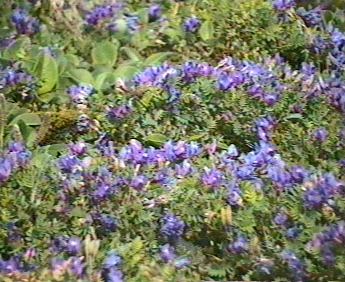
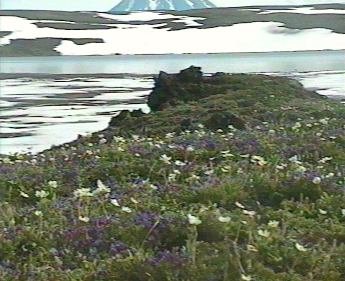
Next day we made another attempt to reach the sea. This time we decided to stay above the dwarf scrub and drop into the river valley later. The first part went splendidly. We made ten kilometres in the right direction in no time, despite the rain and bad weather, but there was no road in sight. Not even a hint of off-road vehicle tracks. The river ran down in a deep canyon full of scrub. Getting to it was another matter. The banks were steep and rocky and the growth was thick and slippery. The prospect of a day or two of battling through it didn't appeal, so we turned back. There were plenty of other places to see the sea. We got back too late for lunch and found the canteen shut. The weather was vile. Pouring again. The fire wouldn't go. Strictly speaking it went, but the pot stayed cold. The firewood was wet larch. The wrong sort of bees. They make the wrong sort of honey. Off to Gorely volcano. It has nine or eleven craters, depending how you count the little ruined ones off to the sides. There are lakes of different colours in them. First we went back along the road towards Yelizovo, about eight kilometres. We'd thought we might get a lift, but walked all the way to the turnoff without meeting a soul. Great drifts left over from the winter flanked the road. It was drizzling lightly. Even the mist down below had cleared and you could see for several kilometres. Leaving the road, we went into a valley with a little lake. V. Dinets calls it the valley of natural disasters. Anything that can happen happens here: earthquakes, eruptions, avalanches, hurricanes, tornadoes and so on. A flood and a gale were laid on for us. What hadn't been flooded lay under snow. Here and there little islands of volcanic bombs stuck up above it. Some of the bigger ones even supported vegetation: dwarf alder a few centimetres high and a profusion of flowers. We camped on one of the islands, having found a small level patch of ash among the gnarled lumps of lava (52°33.588′N, 158°06.798′E, 975 m). We'd found some birch logs in Mutnovsk and stripped plenty of bark. We were assured of a fire. As well as the birch bark, the dead twigs of the scrub came in handy. The weather was improving, and the evening sun began to shine through breaks in the cloud. Despite the harsh surroundings it was a very cosy camp. We finally got a proper rest after two sleepless nights, ate all we wanted and made cocoa.

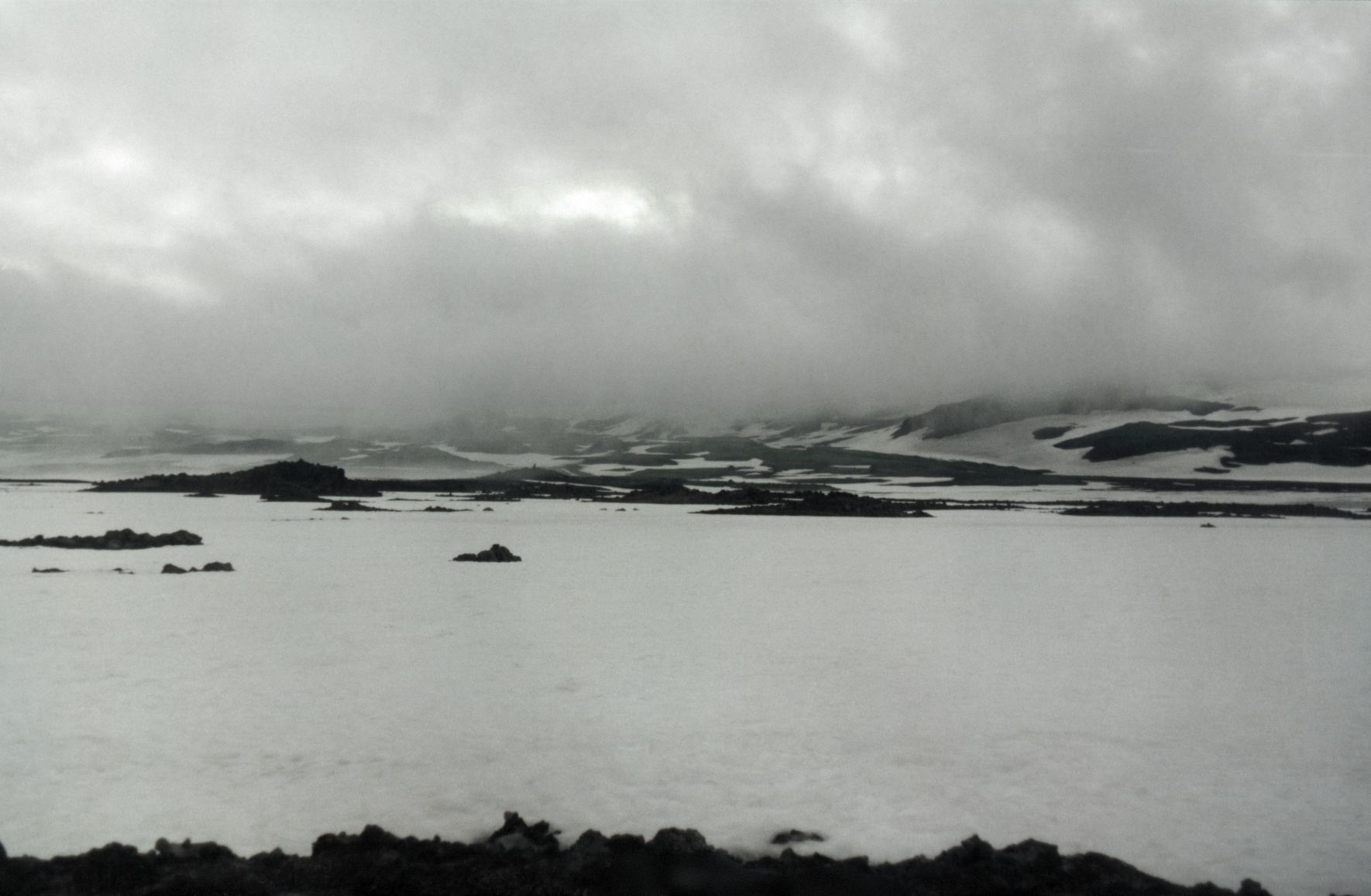
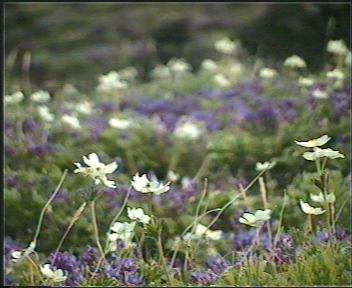
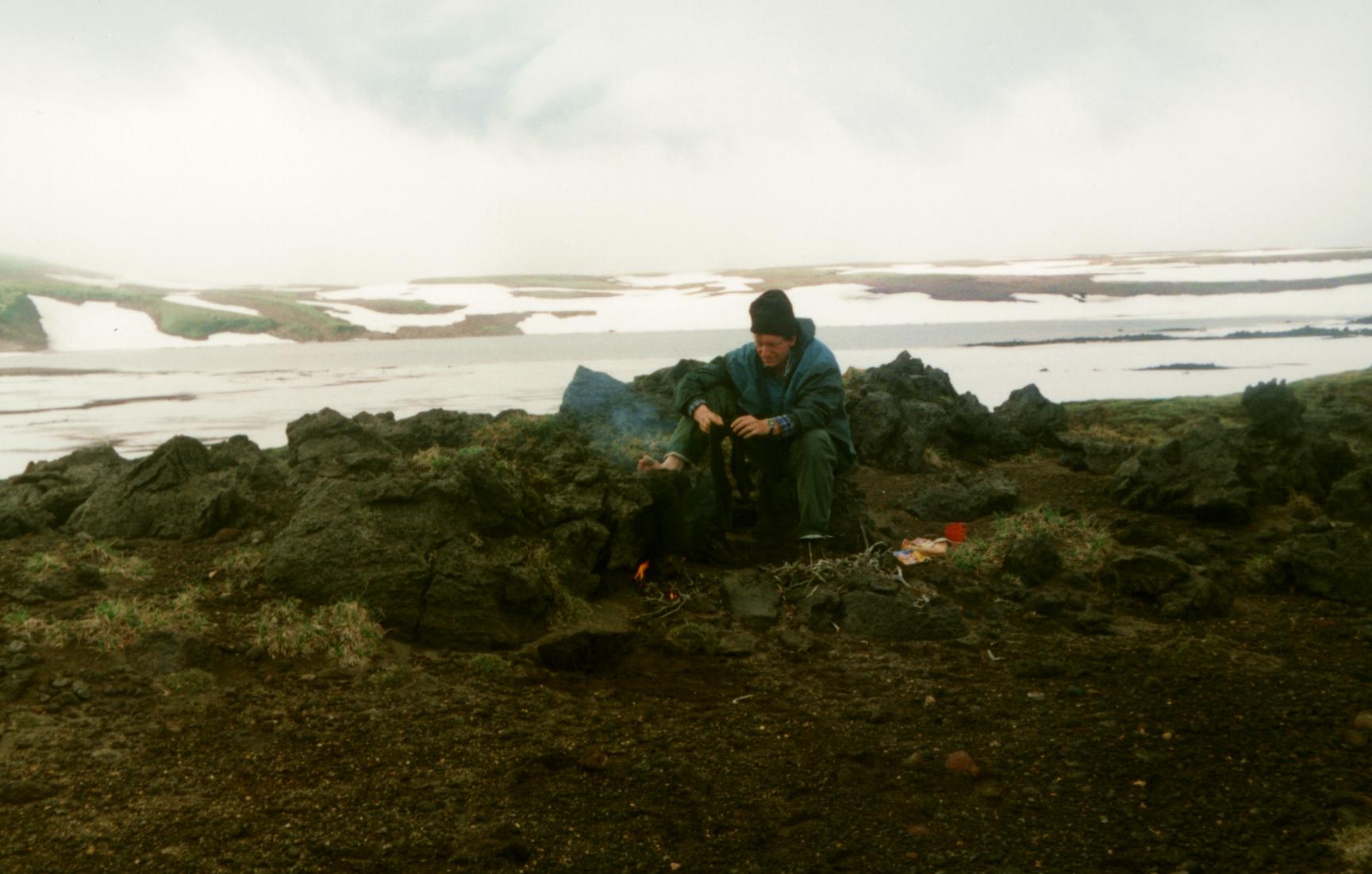
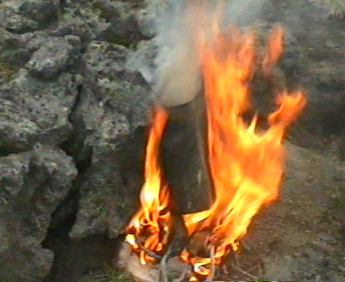
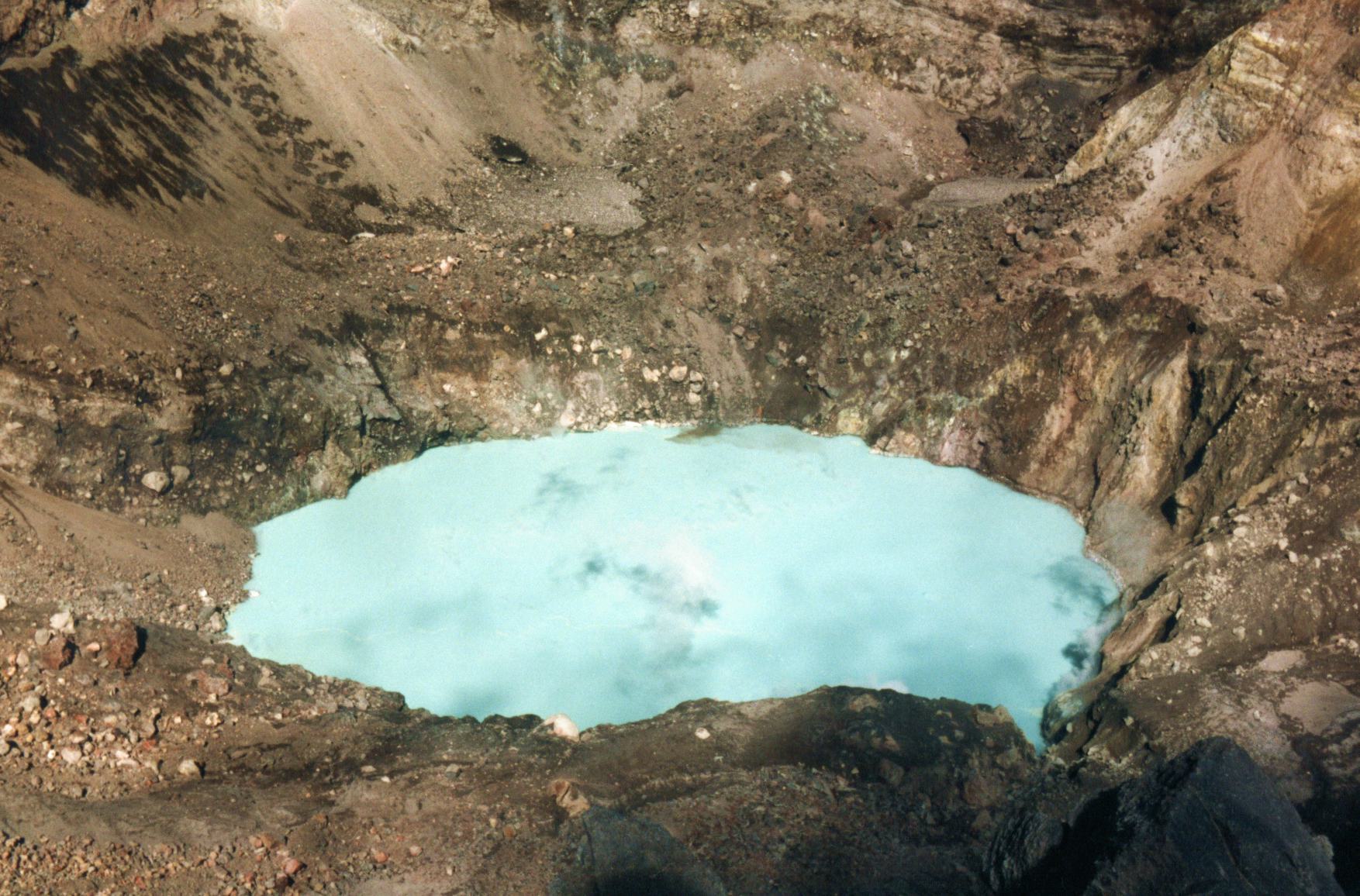
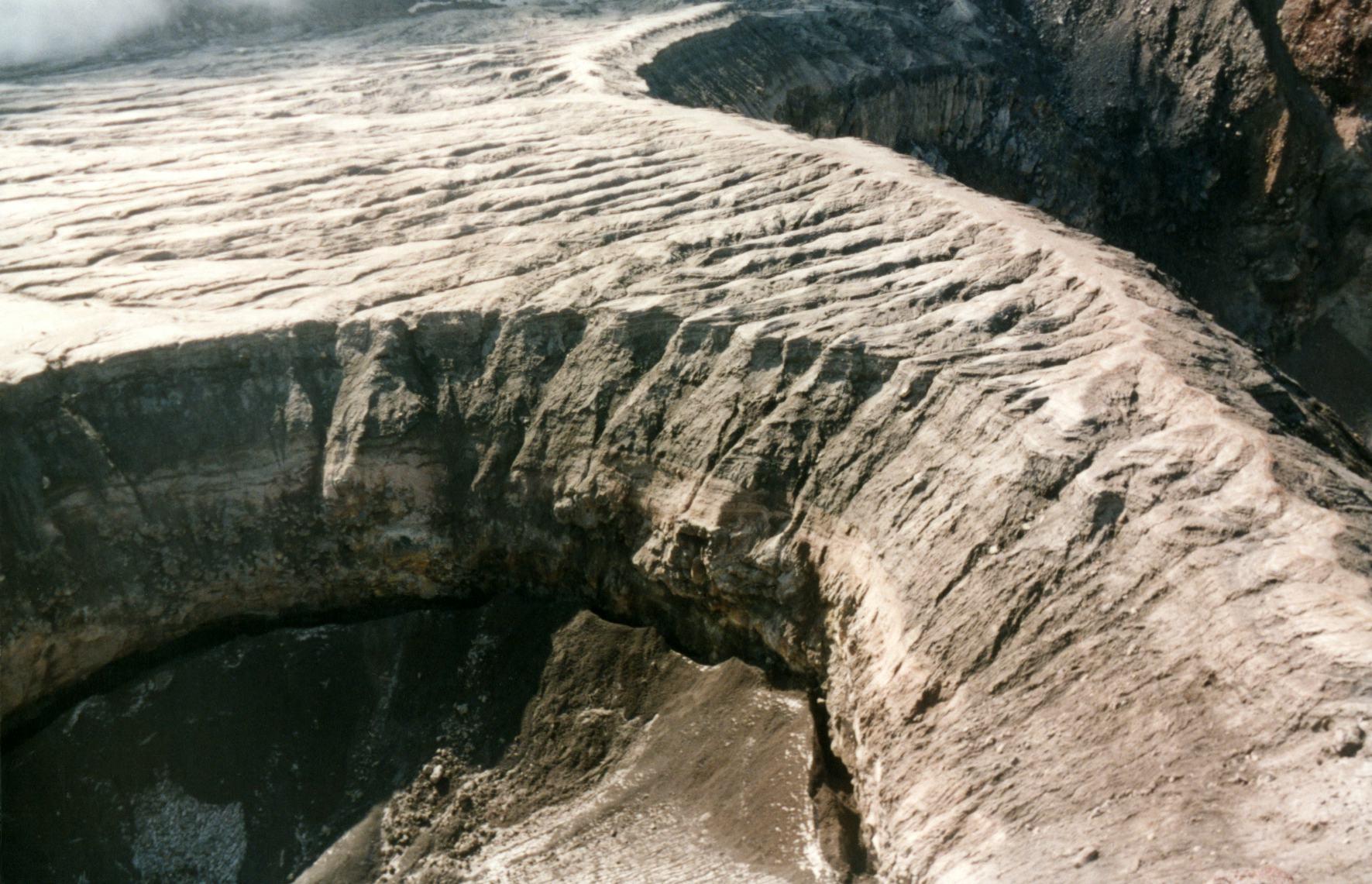
In the morning the weather had thoroughly cleared. The sun shone in a perfect blue sky. Only the ground was steaming after all those rainy days. We felt warm and lazy at once, and took our time packing and having breakfast, enjoying this unexpected gift. The climb was straightforward, but we were worn out after the last few days and somehow couldn't get going. Tanya's leg started hurting. There's a seismic station on the east side of the volcano. We didn't go inside. Gorely isn't very high, just 1,850 metres, and there's no point in climbing to the actual summit. You can see the craters from the lower rims. The first crater we saw had a bright blue lake inside. There were no signs of volcanic activity there. By then Tanya's leg really hurt so she decided to sit quietly while I climbed down to the lake. In one place there was no rock face, only steep scree, and I got down easily (western shore of the lake: 52°33.132′N, 158°02.613′E, 1,590 m). The lake was cold. Crystal-white pieces of ice floated on it. I put my finger in. My finger, trained back in my chemistry department days, detected a little acidity. Ten minutes later, having satisfied myself it was still intact, I dipped it in again and licked it. I felt no sign of impending doom. After another ten minutes I got in and went for a swim. I didn't last long among the ice, though. On the bottom I found a fine sponge-shaped lump of frothy lava and took it as a souvenir. The climb back up the scree was easy too.


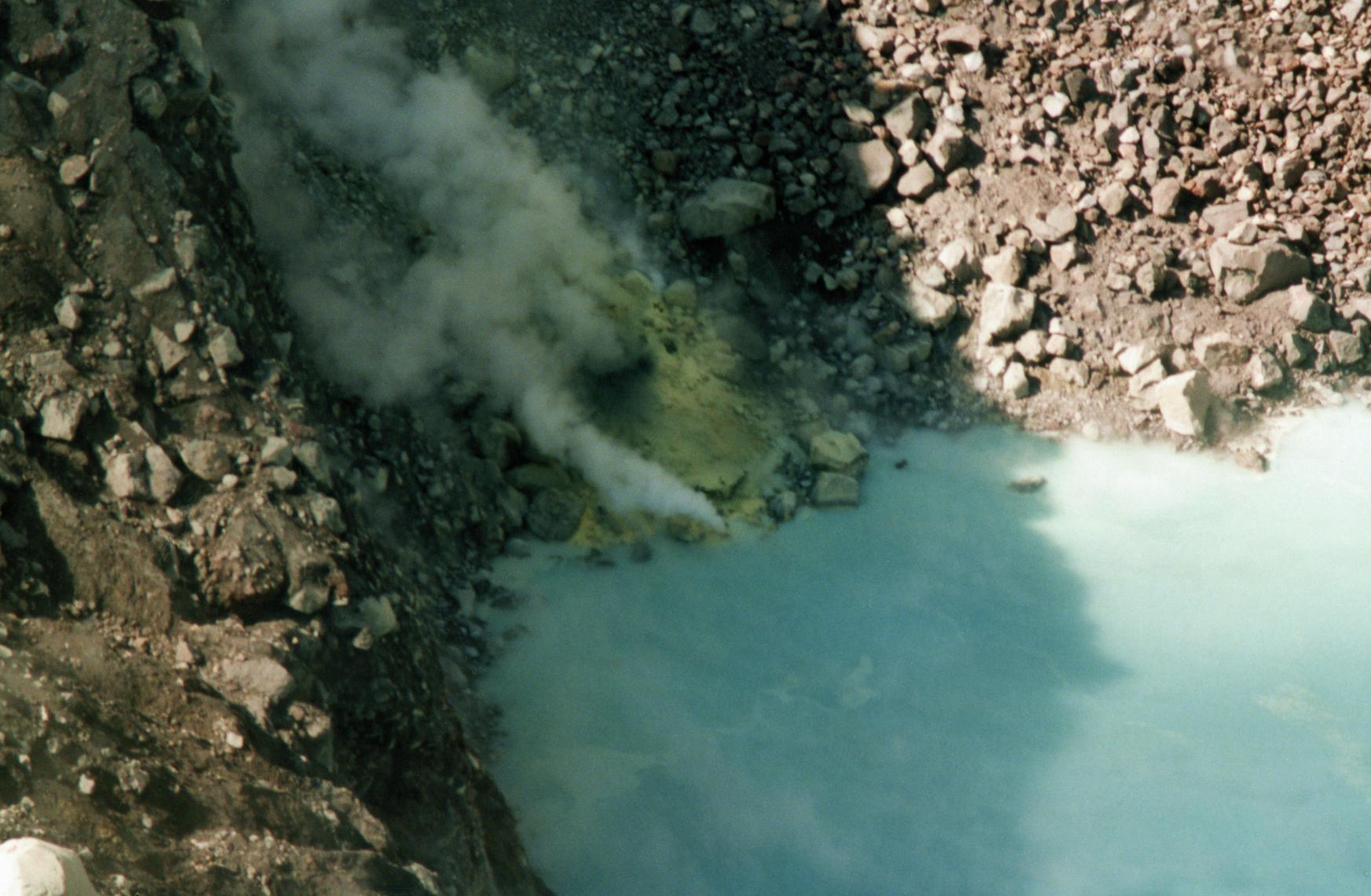
There was snow in the next crater, and steam coming up from a little fumarole. The third crater, the main one, is decidedly active. At the bottom lies a poison-green lake with fresh yellow sulphur floating on the surface. There are lots of active fumaroles, some bubbling up right through the water. You could go down to the lake, though you'd be better off with a rope. I'd already started in when the still camera broke and the video camera's battery died. I took it as a sign from above, thought better of it and went to the next crater. It held a shallow, dirty-brown little lake that wasn't worth a great deal of attention.
That rare clear day was coming to a close. On the horizon Vilyuchik gleamed, piercing the cloud, with the Pacific behind it. It was even fairly hot, you might say. At the foot of Gorely there's a little crater with a level floor and a small patch of snow. We decided to spend the night in it (52°33.766′N, 158°05.314′E, 1,226 m). The middle of the crater was sheltered from all sides and grew little bushes of dwarf alder, which gave us wood for a decent fire. We sat by it all evening, thinking about life and watching the sun set behind Gorely's smoking summit and the first stars come out. Tomorrow a new life awaited us. We were leaving the world of Mutnovka, which had grown familiar and dear.
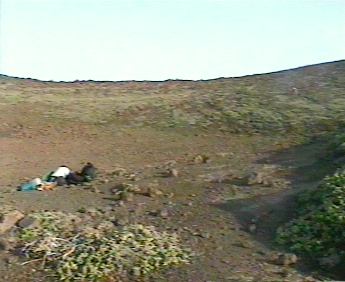
It feels very strange inside a crater. The earth, which normally lies flat as a pancake under your feet, here fills two-thirds of the space around you and stops in cliffs right beside you, instead of out at the horizon. As the sky turned black, we imagined we were on the Moon. The night gave us a perfectly black sky and the Milky Way.
In the morning we packed quickly and carried on down. The rising sun warmed the air to thirty degrees. For the first time we stripped down to T-shirts, despite the snow underfoot. We'd got thoroughly sunburnt in a few days, and the skin was already coming off every exposed bit of us.
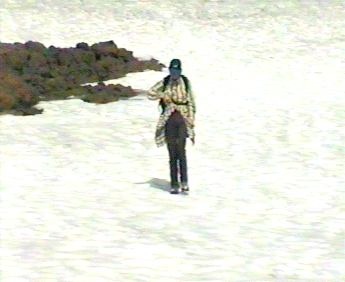
Back at the road, we decided there was little hope of hitching a lift on a Sunday and started walking towards the canteen. The weather had turned again. Fog rolled out and a drizzle began. It grew cold. We reached Mutnovsk without meeting one vehicle going our way, but we were in time for the canteen. A lot of people had come to the springs for the weekend, but it wasn't weather for cooking kebabs. We'd already started congratulating ourselves on getting a ride with some newly frozen and bedraggled bathers. No such luck. All the four-wheel drives were full of children, dogs and assorted relatives. The drivers spread their hands apologetically. No room for us. We settled in for a long wait and studied the surroundings. The hill nearby was piled with heaps of metal of all sorts. Construction had dragged on for decades. It was a veritable museum of bits of iron. On the nearest hill stood an actual pepelats spaceship out of Kin-dza-dza! The likeness was astonishing. It couldn't have been an accident. What wasn't clear was which came first. Had the filmmakers been to Mutnovsk, or had the local engineers secretly built a gravitsappa drive without the bosses knowing?
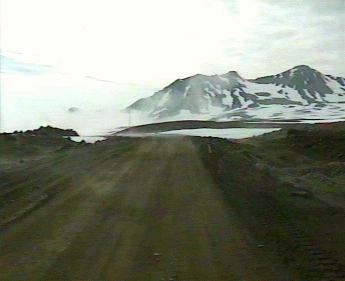
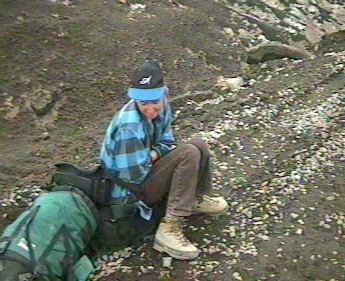
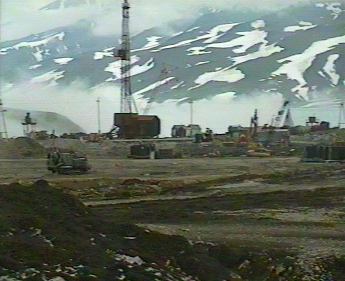
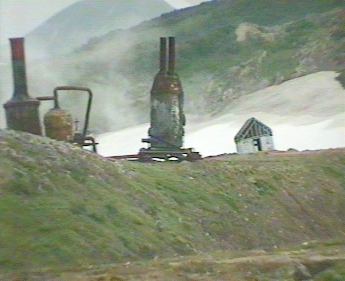
After two hours we were taken on in the back of a four-wheel drive. The tray was full of firewood and all the other gear for cooking kebabs. We joked they'd picked us up for the meat. Riding over those bumps in among the firewood is a very particular kind of leisure.
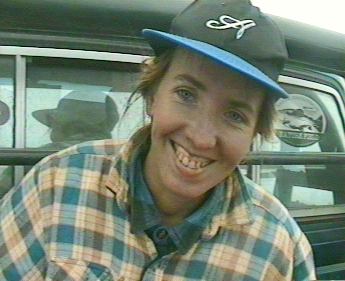
They'd offered us a lift to Vilyuchik, but in the end, with all the generosity of the Kamchatka soul, they took us right to the minibus stop in Termalny.
Termalny has one all-night shop and some grandmothers selling milk and very cheap tomatoes grown in their own greenhouses. We bought milk and went on to Petropavlovsk-Kamchatsky.
23–24 July. Petropavlovsk-Kamchatsky
Petropavlovsk met us with fog and gathering darkness. There was an advertisement for the Edelweiss Hotel at the bus station, so we headed there. It was time to get ourselves and our clothes washed. We all reeked of sulphur and looked thoroughly dishevelled. The hotel was full. Putin was expected in Petropavlovsk the next day and his entourage had taken up all the rooms. They were staying in other, more expensive hotels, but the upshot was that there was nothing free anywhere. We thought we'd head down to the port, where there's always a place for a wanderer. We'd hardly gone any distance when we saw a sign for Piip Boulevard. Ah, the Institute of Volcanology ought to be here. We might find our sort of people there. And there it stood, battered but unbeaten. A man was unloading a four-wheel drive outside. We went over for a chat and to ask where we might spend the night. He introduced himself as Alexey Ozerov, top volcanologist of the lot. I helped unload the vehicle and had a chance to wander the floors and corridors of the institute, which pleased me greatly. It's been ten years since I sat in a quiet little research shop. For ten years I've been in charge of everything under the sun, and I've walked very different corridors, smelling of the new money and the fear of losing one's place in the sun. In the early nineties those quiet institutes blew up with all their internal contradictions. Some chased money, some went West, and some went to their garden plots to keep from starving. People who were very different from one another had taken shelter in those institutes from the lies outside. The passions had settled down. The lies were all around again. Here everything was still as it had been in the late eighties. I can no longer picture myself living my old life, but I do feel nostalgic for my youth.
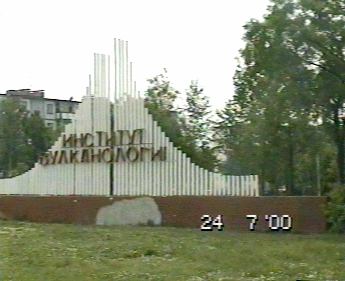
He drove us to a nearby five-storey block, told us the flat number and the password, and disappeared, saying he'd helped us out of respect for Saint Petersburg. Five geologists from Moscow were staying in the flat. They were getting ready to take an all-terrain vehicle out into the field towards Tigil.
We'd stepped into a world of kind and intelligent people. Just as in the old days, they talked about life in the kitchen at night, believed devotedly in science and despised chancers. However hard things got, they found a way to live with dignity and find the money for a Kamchatka expedition. And they weren't after oil or gold. They were studying ancient volcanism, pure basic science. Tanya and I don't know the first thing about geology, but we found plenty of interesting things to talk about. I've always wanted to get even a little grounding in geology, but never did. Maybe somebody will put out Geology for the Lazy one day, like those language-learning cassettes. You stick it on in the car and listen.
The fog hadn't lifted in the morning. The clothes we'd washed the night before refused point-blank to dry. We had to go round town wearing silver waterproof trousers. Quite a sight, but down at the port we looked so much like fishermen that the gates were no obstacle. We were looking for a boat to the Commander Islands. Petropavlovsk stretches along the coast for tens of kilometres, mostly taken up by the wharves of different companies. Getting to Vladivostok is easy, just slow: four days at least. With the right knack you could probably get there entirely free, though without a cabin, somewhere alongside the fish.
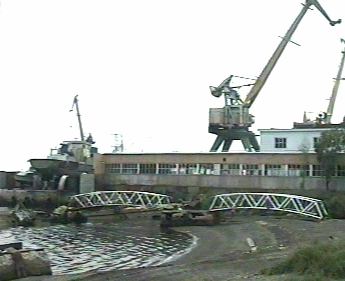
The Commanders were a different story. No one goes there. Once a year at the most. Boats pass by, and you could arrange to have one call in, but even with the best will in the world you'd have to pay for the diesel, and even a little tub eats it by the barrel. That's thousands of roubles. A boat bound in that direction had left four days before, and no one knew when there'd be another. We covered every wharf from Seroglazka to the old passenger terminal. There'd been no passenger service for years. The terminal looked as though somebody had fired at it with a tank. We finished our search at the harbourmaster's dispatch office. Despite the weight of the important work they had to do, they spoke to us very kindly, but there was no good news. Nobody had made a dedicated run to the Commanders for years. How people live there is a mystery. I said somebody must be taking them fuel and supplies for a shop. They told me the islanders had been without a shop for a long time, and didn't use fuel either. Once we understood there'd be no luck with a boat, we simply walked round town. The city was in a frenzy. They were rolling out turf along the roadsides. Thousands of police had turned the city grey. Television crews swarmed at every spot where the Great Leader and Beloved Chief might make an appearance. They filmed us, too, as your average workers from the port of Petropavlovsk. Expecting nothing good from the police, we got out of the centre as quickly as we could.
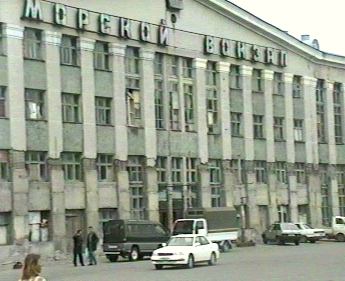
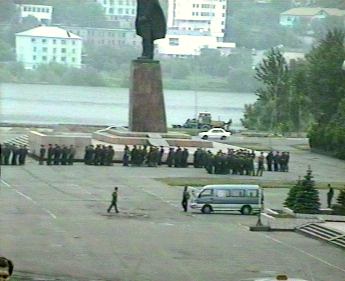
Petropavlovsk was founded in 1740. The only real spot of bother came in the nineteenth century, when an Anglo-French squadron tried to take it. They were driven off. There are many monuments in the city to those events.
Its architecture is that of any Soviet regional capital, but the setting is the loveliest I've seen. An intricate coastline at the head of Avacha Bay, and wooded hills a few hundred metres high rising in the middle. In the distance eleven volcanoes rise unperturbed. What a pity Peter didn't cut a window on America here. If he'd put his money into these cliffs instead of the marshes of the Neva, he could have built the most beautiful city in the world. Put palaces on the hot springs. A bridge straight to America…
After a good long walk we called to pick up the things we'd left with the geologists. They were hopelessly wet. We couldn't stay any longer. We'd already promised Ozerov we'd clear out early, so we gathered everything up just as it was and took a minibus to Yelizovo. We spent the night in the bushes on the left bank of the Avacha again. It rained ferociously all night. Yet another typhoon had hit the east of the country, washing away dozens of bridges and villages.
24 July–1 August. North, where a bear will eat you, or at least take a bite
The sun came out in the morning and dried our hopelessly wet washing in no time. The Commanders were out, so we headed towards the Klyuchevskoy volcano group, Esso and Ust-Kamchatsk. We took a minibus from the bus station as far as we could towards Bolsheretsk. Then we stood by the road and started hitching. Lots of cars, but they were all either on their way to a dacha or not going to stop. It was pleasant standing there in the warm sun. We waited three hours before a fisherman heading to Ust-Bolsheretsk picked us up in his Niva. He gave us a salted Chinook salmon and left us at the junction (53°12.300′N, 157°28.397′E) of the Trans-Kamchatka Highway and the road to Ust-Bolsheretsk. The tarmac ends there and both roads are unsealed, the one to Bolsheretsk and the one to Klyuchi. We got the next lift quickly, as far as Malki.
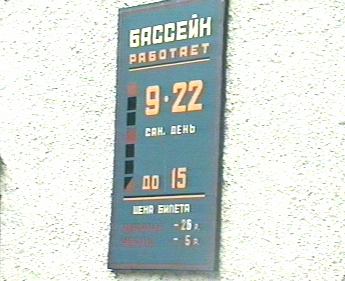
Malki is famous for its mineral springs. Malki water is sold in bottles in every shop and used to make soft drinks. There isn't any other sort of water in Kamchatka. The spring and the bottling works are on the left of the road. On the right a five-kilometre turnoff heads towards the mountains and the hot springs. It's a local resort where people come from Petropavlovsk for the weekend. It was getting towards evening, so we decided to stay the night. We walked the five kilometres. On the left of the road there was a little cluster of cottages for visitors. Paths and lamps, flowers, and best of all, an outdoor pool. Admission was twenty-five roubles, but we got there towards closing time and the man collecting the money had gone home. The pool is open until ten at night and we had our fill of swimming. A few young couples were swimming there too. It had been a hot day and the pool was just what we wanted. There was a shower in the changing room, so we got a proper wash as well.
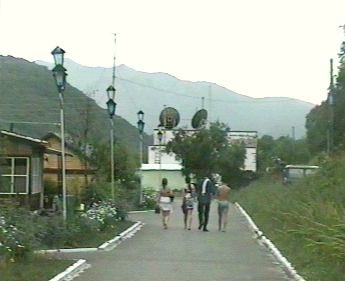
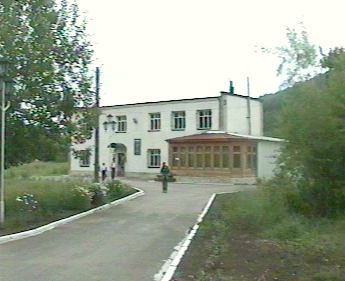
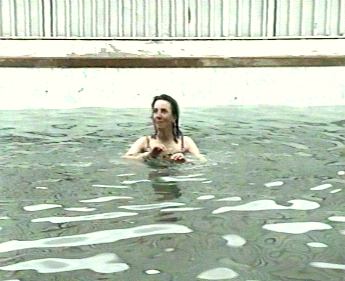
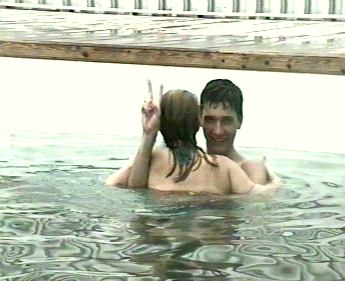
As well as the developed section there's a wild part where you can bathe for nothing (53°19.298′N, 157°32.332′E). Cars pay forty roubles to get in. The people who work here use the fees to keep the grounds clean and maintain taps from the various springs and boreholes. You can draw mineral-rich boiling water from them. Everywhere you feel the people in charge have given you a full hundred per cent value for your money. It turns out you can do an awful lot on forty roubles a car. It's nice to feel someone is looking after you and the place, instead of taking your money because they can, in the name of protecting the environment. There are plenty of those green extortionists about these days.
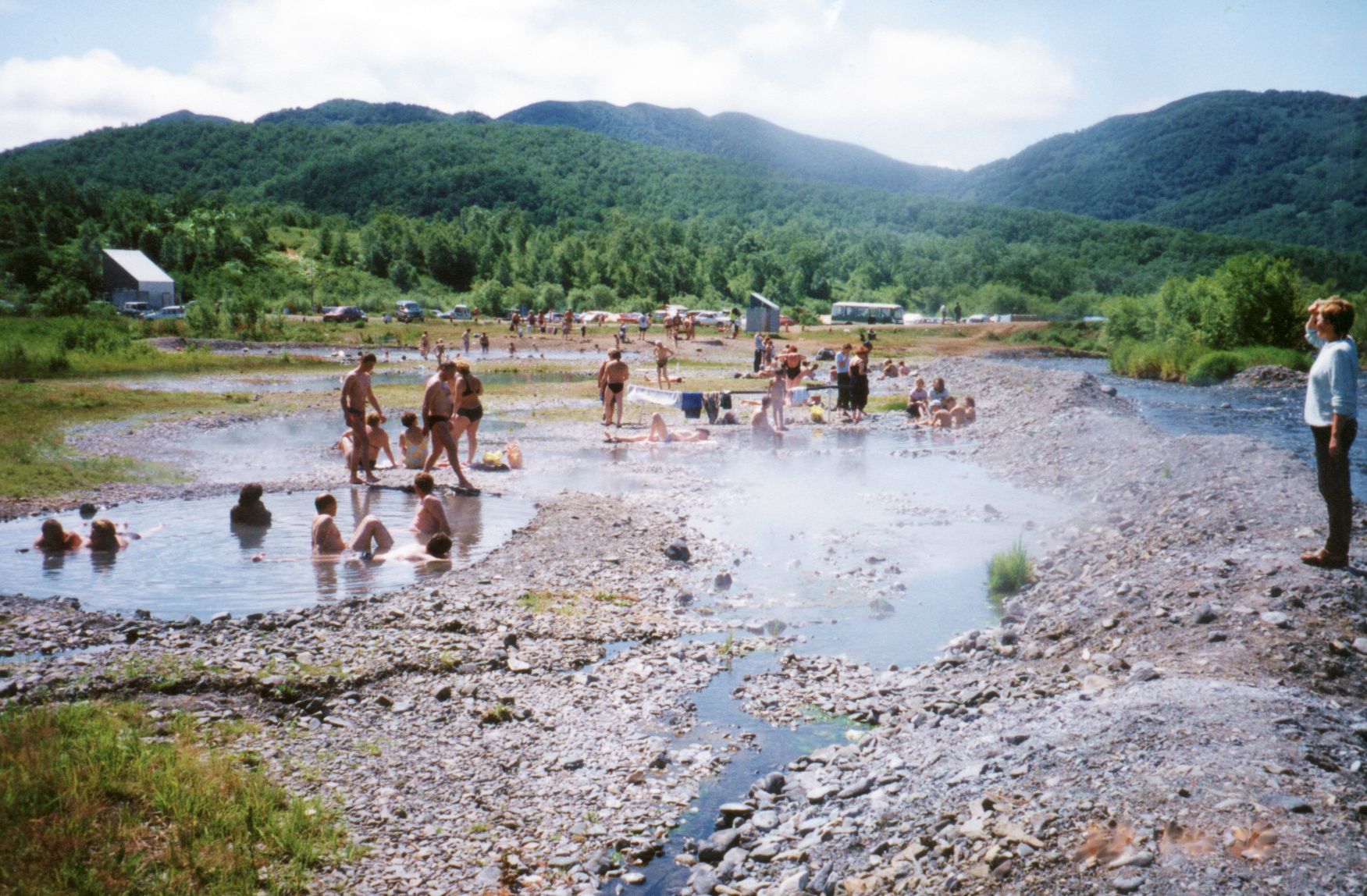
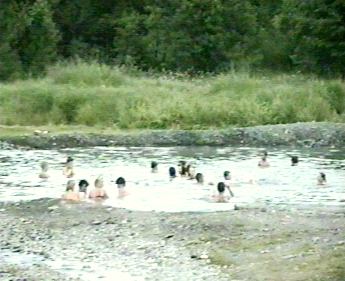
Instead of a swimming pool, there are shallow natural pools of warm water with lots of people sitting in them. Most had come by car. They were cooking kebabs and having a good time. Beside us were a long-established couple in a Toyota. I went over for a chat and to charge my video camera battery at the same time. I've got a charger that runs off a car cigarette lighter. They were dying of boredom and glad something interesting had happened at last. We bathed again in the free pool and had our Chinook salmon with milk. It was a hot, dark evening, with the mountains of the Sredinny Range all around. Laughter and music. Headlights in the bushes. It felt exactly like the Crimean coast. How far away it was.
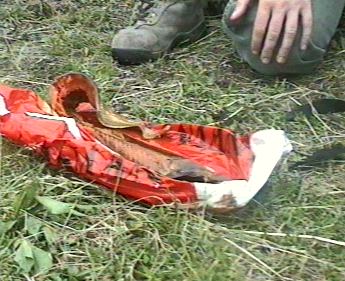
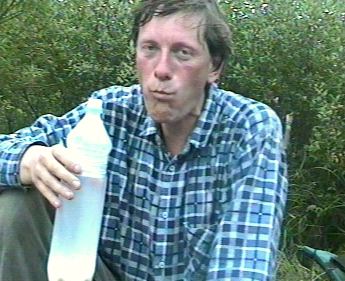
We didn't get to sleep, though. Our initially quiet neighbours had a good deal to drink, put the music on loud and started raising hell. The psychologists' line that you can do anything if you want it enough turned out to be no help. Sleep was impossible. At two in the morning we had to move camp. It was a black, warm southern night.
In the morning we didn't light a fire. We made mashed potatoes with boiling water from the nearest borehole and walked up to the highway to hitch on. Instead of a car we found a bus for Esso standing there. We aren't hitchhikers on principle, so we went over to negotiate. Looking rather apologetic, the driver said he wanted money. We didn't object.
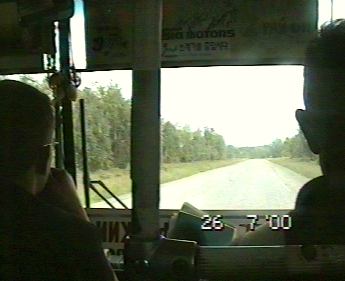
The distances in Kamchatka are enormous. It's only from over here that Russia's tail looks like a little speck on the map. Lay it alongside European Russia and it would go all the way from Saint Petersburg to the Black Sea. It was 360 kilometres to the Esso turnoff on a dirt road. The bus was in no hurry. We took a long break in Milkovo, where they drove us to the Taezhnoye Café. A perfectly respectable place with live music and a big menu. We ate till we could hardly move. Milkovo is the seat of the district of the same name, and it has an airport. The town is run down and there is nowhere for the locals to work. Fish from the nearby Kamchatka River keep them going. Gold and platinum were found nearby. There was a lot of talk about joint ventures with Canadians and a bright future, but it came to nothing. The locals boast that the road to Klyuchi is surfaced with gold ore for want of any other material.
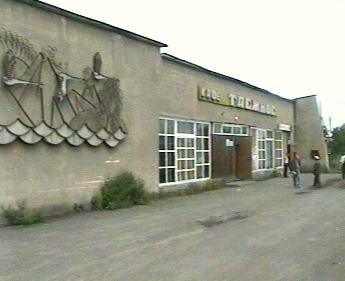
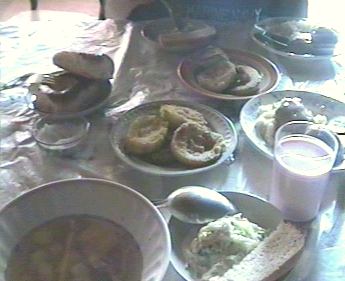
The Trans-Kamchatka Highway follows the Kamchatka River. It's been rebuilt over the past fifteen years and is now a quite decent unsealed road. The maps show the old highway, though, so it's hard to work out where you are.
The kilometre posts count from Petropavlovsk to Milkovo, then start again from Milkovo to Ust-Kamchatsk. Beyond Milkovo the posts don't say how far there is to go to Ust-Kamchatsk. When the posts were put up, it wasn't clear where the road would end up or how it would get there.
A hundred kilometres after Milkovo the bus had a puncture. Changing the wheel took at least an hour. The weather grew worse as we went north. Clouds closed in, and by the time they dropped us at the junction it was raining (coordinates 55°51.400′N, 159°28.589′E). It wasn't an inviting spot. Bushes, and no water. We settled down to wait. It was a hundred kilometres to Klyuchi, too far to walk. There was no traffic at all and little chance of getting away. There were lots of old camps around the junction. You got the feeling people spent days there waiting for a lift. A man came out of the woods and, without any hope of a lift, started walking to Esso. Sixty-six kilometres is nothing to the locals. He'd get there by morning.
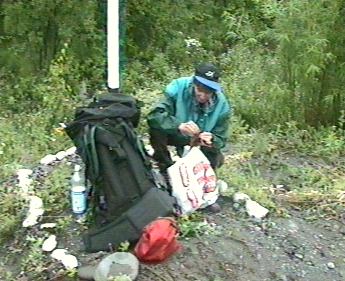
It was already getting dark when a ZIL came out of Esso. The cab was full and the back held a coffin with a dead man in it. “Cargo 200,” the driver said proudly, using the army term for a body in transit. That last circumstance didn't worry us. It was so wet and wretched outside that we happily climbed aboard and hung on to the lid of the coffin, which was knocked together from rough boards.
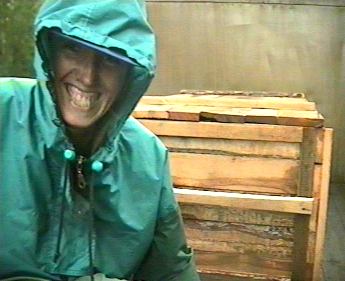
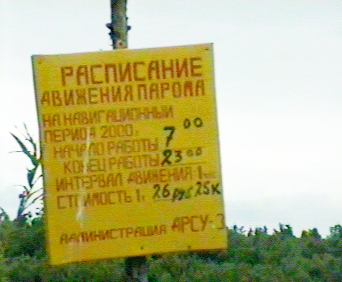
I'd never seen such a skilful driver. He went fast and smoothly over dreadful ruts and through puddles half a metre deep, skilfully missing the worst holes. He drove straight onto the ferry with millimetre precision. At kilometre 168 the highway crosses the Kamchatka River. There is no bridge and there never has been one. The ferry runs from seven in the morning to eleven at night. A father and his two sons take turns ferrying everyone across at twenty-six roubles a tonne. They're from Ust-Kamchatsk. They bought a barge and now work two shifts. Business is booming. They've each got a four-wheel drive.
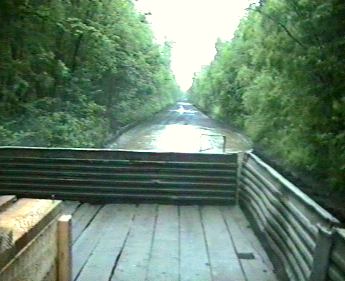
The stretch from the crossing to Klyuchi is the worst. Two bridges had washed out in the recent rains. Our driver swung straight over a ditch into the woods and then forded a raging torrent. A car can't do that on its own. They gather at the washout and hook onto a towline when a powerful vehicle comes along. We acquired a Moskvich without a windscreen. The river was so deep that water poured over the bonnet and straight into the cabin. The Moskvich driver seemed quite undisturbed. Once across, drivers stopped for repairs. Few could start up again after a crossing like that. To my surprise, there were some quite respectable imported cars on the road.
Just before Klyuchi is a traffic police checkpoint. A little trailer and a barrier that stays shut. You have to go and wake the officer, explain what you're carrying and what the hell you want there. Ways are simple here. The driver's explanation about Cargo 200 didn't make the officer want a share. Even the sight of Tanya and me riding in the open back didn't bother him.
It was dark by the time we got to Klyuchi. It turned out to be an enormous settlement. Officially it's even a town. It even has an all-night shop, where we bought food at midnight and spoke to the local men about the way up Klyuchevskaya Sopka. The local children followed us shouting, “Hello! What's your name?” Just like India. I'd never seen that in Russia before. Our attempt at getting out of the settlement, sorry, town, quickly came to nothing. You keep walking and it just goes on. The river's on one side and there are houses in every other direction. After an hour of wandering we found a path into the woods and camped in the first bushes we came to. It was raining.
When we woke the sun was trying to shine through the fog. It turned out we'd camped among honeysuckle bushes. We ate our fill of berries and went to look around Klyuchi. Fog. The summit of the mountain was invisible. It was worrying to climb in that weather, especially when you didn't know the way and had a poor map. It weighed on my mind that yesterday's ride in the back of a truck with a corpse might have been a warning from above. We decided to go to Ust-Kamchatsk first and see what happened after that.
The Klyuchi to Ust-Kamchatsk road was built recently. Vehicles began using it in 1991. Earlier attempts had tried to run it through the marshy valley of the Kamchatka, but this time the route was well to the north, close to the slopes of Shiveluch. They'd set about the road in earnest. For sixty-eight kilometres out of Ust-Kamchatsk there are excellent concrete bridges and a well-kept unsealed road along the Raduga River. They're building an asphalt plant in Ust-Kamchatsk. The rest of the road is worse. In one place there's not even a bridge, yet a regular bus runs from Petropavlovsk-Kamchatsky to Ust-Kamchatsk. It's privately run and it goes fast and fearlessly. Seven hundred and eighteen kilometres in a day, over broken dirt roads and through river fords, day after day.
First you have to cross the Kamchatka River. The ferry is at the forestry depot right in Klyuchi. There are actually two crossings, one civilian and the other military. Vehicles pay forty roubles a tonne and passengers go free. Warheads from ballistic missiles fired from European Russia come down on the slopes of Shiveluch. There are troops everywhere and you can't go just anywhere. You may come up against barbed wire. That's why, contrary to the law, the entire Ust-Kamchatsk district has been declared a restricted border zone, although even the local police don't know about it.
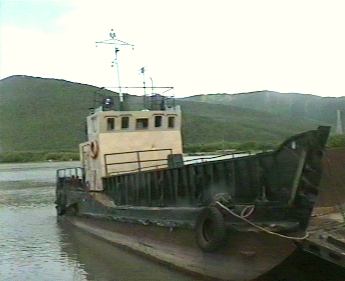
The ferry is a handy place to hitch. Everybody has to stop. A bus full of children returning from Esso turned up right away. It was packed to the roof, and furthermore it had a chaperone so vicious that even the strapping driver was under her thumb and did as he was told. When we asked for a ride, he spread his hands sheepishly and pointed to this monster of educational science. I particularly liked the way she sent the children to wash their hands and fruit in the turbid waters of the Kamchatka, right beside the ferry with diesel slicks all round it.
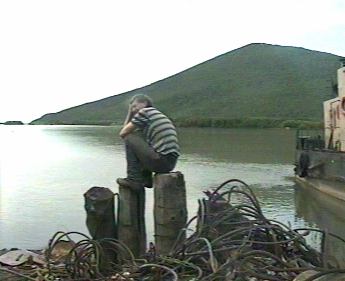
There were no more vehicles. We kept watch for six hours and didn't see one vehicle going to Ust-Kamchatsk. We sat fidgeting on a bench by the ferry, watching a kitten jumping about on the deck. Only in the evening did a man turn up hauling a bridge support to a site fifteen kilometres from Ust-Kamchatsk. The scheduled bus arrived at the same time and we took that. The ticket is expensive, 215 roubles, and you can see why. The poor little PAZ hurtles over puddles and potholes. Nothing lasts long used like that. Everything inside bounces on the seats. Hang on tight. Between Klyuchi and Ust-Kamchatsk there aren't any settlements, just two road-maintenance bases, at kilometres 313 and 380. In a winter freeze, drivers of broken-down vehicles can walk to one and get warm, though not all of them make it. There are crosses by the road for those who froze before they got there. They let us get out for a little walk at one of the bases.
We came to a river that was supposed to be dry. With the endless rain it looked quite full. A bridge wasn't considered necessary.
Twelve kilometres from Ust-Kamchatsk, at kilometre 406 of the highway, there's a traffic police checkpoint. They checked our bus by shining a torch on every face. The whole police force was out looking. Two men had escaped from the courthouse.
We got to Ust-Kamchatsk at night. A big town, all in ruins. We thought it was the tsunami, but it turned out to be simply the aftermath of Soviet rule. Right in the centre, beside the bridge over a little side channel of the Kamchatka River, we found a very cosy camp in the bushes (56°14.297′N, 162°31.020′E). Late as it was, we broke off some branches and cooked hot food for the first time in days.
In the morning we went out to see the town. It, or rather the Nizhne-Kamchatsk stockade, was founded in 1703, the same year as Saint Petersburg. How different their fortunes. Ruins as if there'd been a war. In the main square stands Lenin against a backdrop of ruins. As one man put it, where's he going to go? It's not as though he's made of bronze. And let the Aurora stay up on its post as well. One shot eighty years ago, seven thousand kilometres away, and the whole country is still in ruins. A monument to the Twentieth Party Congress. How long ago life stopped here.
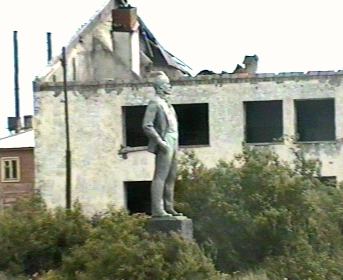
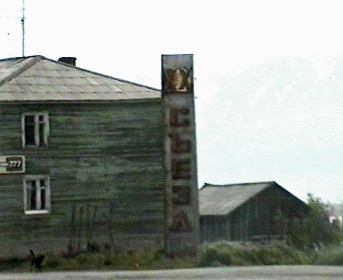
In the streets you can find tracks left by bears that come to rummage in the rubbish at night. So the Americans who think bears walk the streets of Russian towns are right after all.
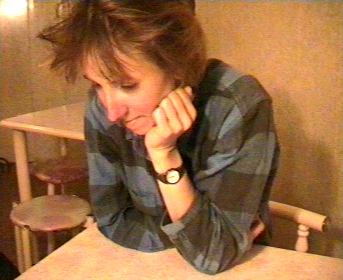
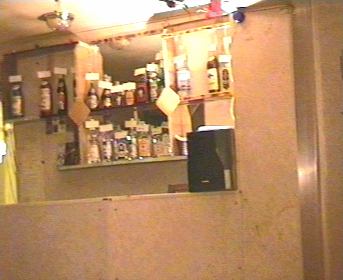
We went into a café. From outside it's a half-collapsed hut, but the inside is perfectly respectable. Music, bottles and a fake palm tree. We drank coffee and ate pelmeni while reading the local paper.
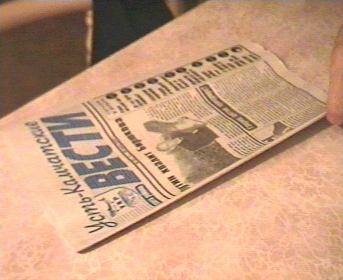
We stopped at the post office and sent a parcel of things we didn't need back home. It never arrived, as it turned out.
Ust-Kamchatsk is in three parts, separated by the Kamchatka River and the outlet from salt Lake Nerpichye. The lake is distinctly uninviting, and its namesake seals have long since gone. There's a ferry to the opposite bank, free for everyone, vehicles included. We went to talk to the local fishermen. They were quite keen on the idea of taking us and making some money, but the Commander Islands are 260 nautical miles away. A small fishing boat would burn four thousand roubles' worth of diesel alone. A day's sailing. They fish in Kronotsky Gulf and the Commanders are out of their way. We couldn't scrape up that much money. With ten of us it would have been quite a good deal.
When it was clear we had no chance, we set off for Cape Kamchatsky. Gloomy weather, a strong wind and drizzle. People in the streets were wearing coats and winter hats.
The place where the ferry crosses the side channel is called the landing stage. Three times a day there's a bus from there to the airport, twenty kilometres along a paved road. After the entire town was washed away by a tsunami in the 1950s, the airport and the new quarters were built away from the ocean. At first we walked along the road that leads to the ocean shore. A cemetery stretches along the very edge of the land. Someone put real feeling into that choice. The ocean rages beside it and ships pass in the distance. A place to think about eternity.
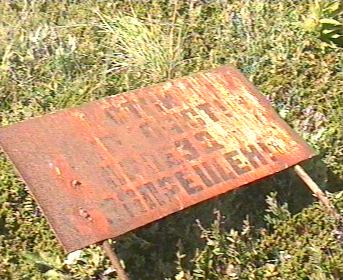
The road runs along the coast for six kilometres, and we got a lift for three of them in a Toyota. The road after that is unsealed. There are remnants of a border post, all long since ruined. Pressed into the ground is a sign: “Halt. They shoot.” It's pleasant to feel that common sense has prevailed over a hostile power.
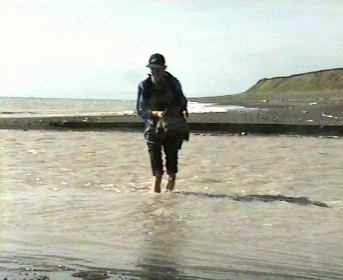
The locals warned us there were a great many bears. There were certainly more bear tracks than human ones. The entire beach was stamped with paws of every size, especially where the little freshwater streams ran into the ocean. The bears are afraid of people, though, and scattered as we came near. The decent road ends where it meets the quite substantial Mutnaya River (56°09.742′N, 162°42.501′E). We had to ford it. Farther on, the mountains of the Kamchatsky Cape range close in from the left. Here and there the scree slides straight into the ocean. You can see the erosion taking place before your eyes. One piece of rock at a time rolls down. A few minutes earlier they were part of a mountain. The wind breaks up the top of the slope and blows away the little fragments in a column of dust stretching hundreds of metres away. The sea takes the bigger pieces. At high tide you have to dash between waves. In spite of that, the locals manage to drive a Ural truck along the beach.
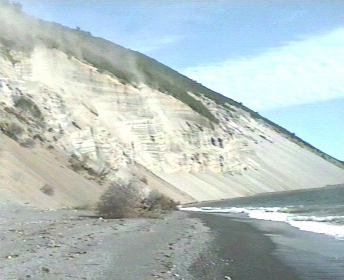
We made camp by the Olenya River (56°07.596′N, 162°45.139′E). A little stream runs down out of the mountains to the ocean and has built up an enormous alluvial spit. We had no freshwater supplies, so we stopped there for the night, despite this being another place bears like to live. There were signs they'd been there recently. The most impressive was the bones of a devoured moose.
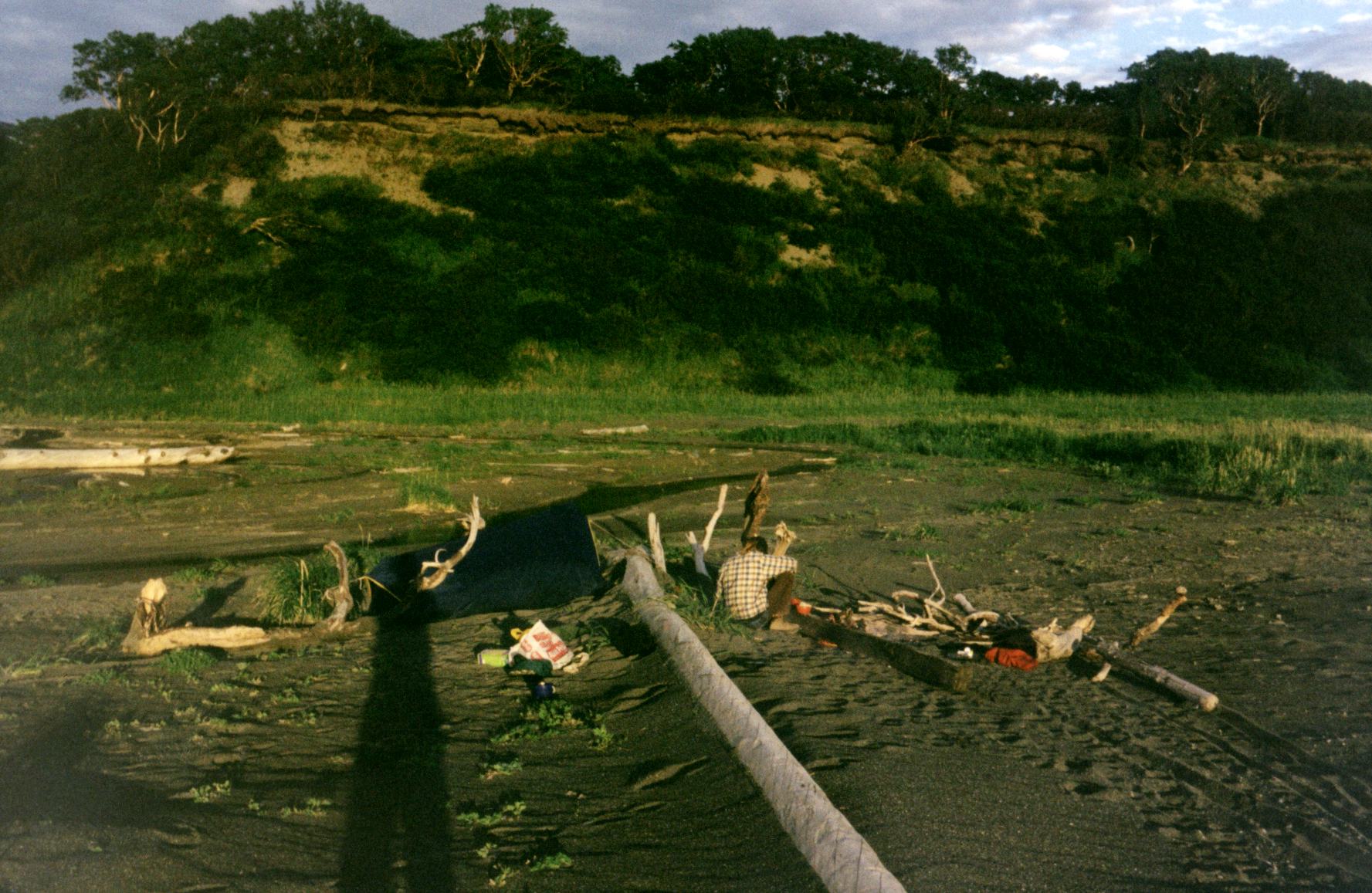

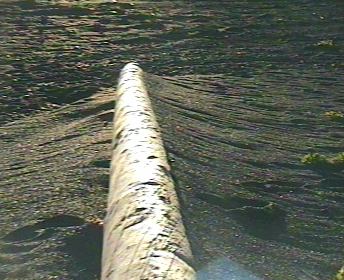
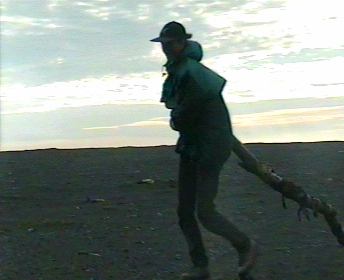
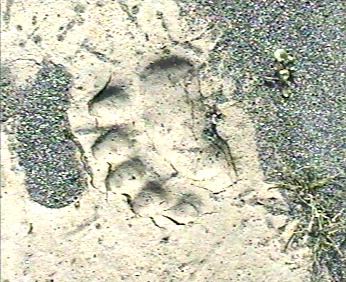
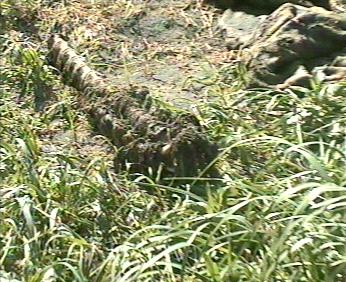
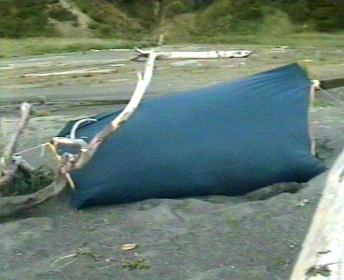
We pitched the tent on the sand and tied it to a tree washed up by the surf.
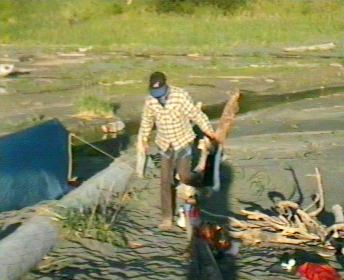
Meanwhile the weather had improved. Or rather, we'd walked out of the fog that hangs for ever over Ust-Kamchatsk.
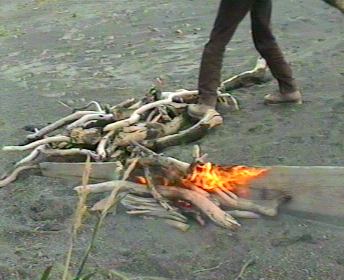
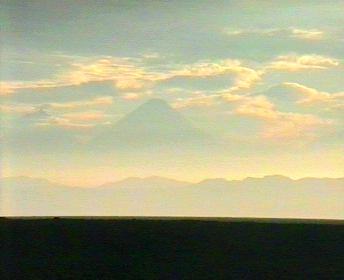
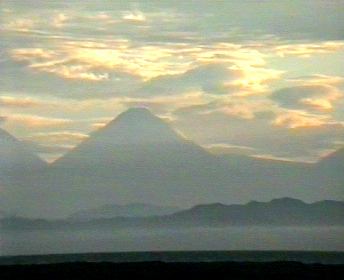
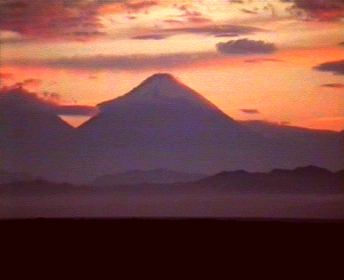
In the distance, out of the daytime haze, the cones of Klyuchevskoy, Kamen and Shiveluch began to emerge, lit by the rays of the setting sun. It turned out to be a magnificent sunset. Blood-red clouds and purple mountains against the ocean. It was dry and warm. In honour of this gift from nature, we decided to give ourselves a feast. Back in Ust-Kamchatsk we'd bought tinned borscht, chocolate and other good things. We made an enormous driftwood fire. Tanya read aloud again from V. Dinets's book on Kamchatka. We sat up late into the night until the stars had covered the last glimmer of sunset.
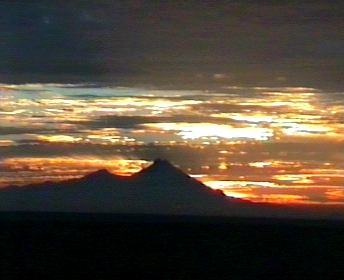
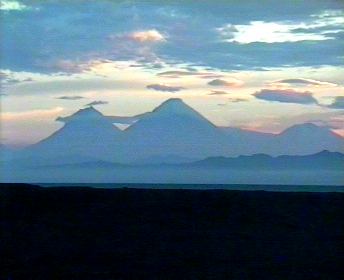
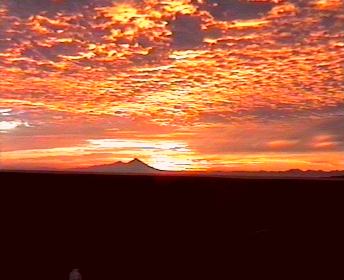


Whenever there's a bear about, I feel it's watching me. That evening there seemed to be more than one of the old fellows in the bushes. As darkness fell, snapping twigs confirmed the feeling. Before bed I left my scent in a circle twenty metres from the tent and went to sleep with a clear conscience. I set the alarm for sunrise, hoping for something as beautiful as the sunset. By morning the clouds had dispersed and the mountains were veiled in mist.
We slept our fill on the soft sand and woke at about eleven. There were fresh bear tracks right nearby at the stream. He'd prowled around the tent without daring to cross the boundaries I'd set. Why would he bother? The fish were running. He had plenty to eat. In the season a bear can put away sixty kilos of fish at one sitting.
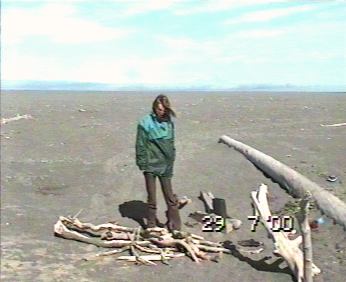
We'd hardly finished breakfast when a Ural drove up the beach with three armed men. They came at us straight away. Who were we, and how on earth had we got there? It was a restricted border zone and, generally speaking, we shouldn't be there. And a bear would eat us, or at least bite us. There were three of them with Kalashnikovs and even they were afraid. So climb in, they said, we're off to the cells.
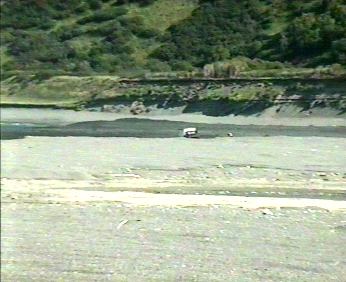
Once the bluster ran out, we got talking. It turned out they were from the local district police station. They gave our official travel orders a cursory look and said they needed a stamp from the border detachment. If the border guards caught us, we'd be in real trouble. They were amazed we'd got through. The border guards catch people coming by plane at the airport. They hadn't heard there was a bus from Petropavlovsk-Kamchatsky. After a few minutes the senior man took the young ones down a peg. If the border guards hadn't caught us yet, they could let us live.
They told the keenest of the lot to copy down our passports, to make it easier to identify our bodies once the bear had eaten us. The policeman hadn't calmed down yet and muttered something to the effect that it was all very well for us. We'd get eaten, but afterwards the bosses would make his life hell.
I asked whom a bear had actually eaten and when. None of them could name anyone apart from the much-talked-about Japanese photographer.
Our cheeky suggestion that they take us round the whole of Cape Kamchatsky didn't come off. We should probably have kept them talking a little longer, but they turned down the offer of a coffee.
They did rather spoil our mood. Yesterday's peace gave way to sad thoughts. A bear is one of us. You can understand a bear, which is more than you can say for our state.
That morning we went a bit farther towards Cape Kamchatsky. A pity we had so little time and Kamchatka is so vast.
On our way to the ocean we'd hoped to see starfish, sea urchins, crabs and, if we were lucky, some seals. Real life didn't live up to our hopes. Even the White Sea was richer. On the beach we found a few crab skeletons, small dead urchins and nothing else. The weather began to turn and we decided to go back, this time keeping out of the way of any people or cars coming towards us.
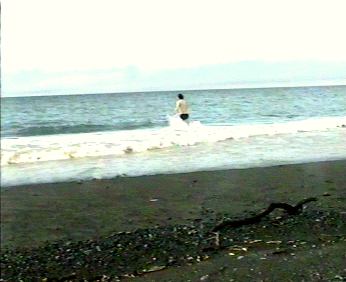
At the mouth of the Mutnaya I summoned up my strength and swam in the ocean. The water was icy, no more than five degrees.
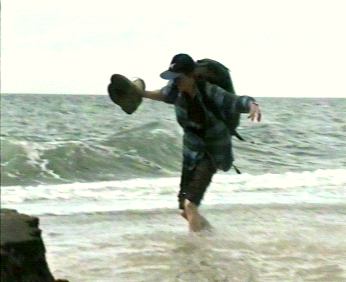
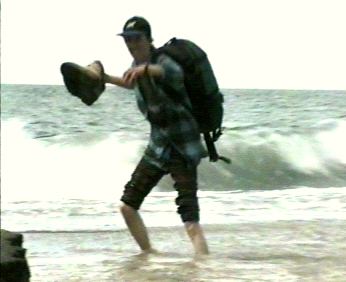
As we drew near Ust-Kamchatsk we walked back into the fog. This time there was no one to give us a lift and we had to walk all fifty kilometres. In town a crowd of local toughs surrounded us with no good intentions. Luckily we took them aback by saying we came from Saint Petersburg and got them talking. We parted on the best of terms.
The fog was so thick you couldn't see the far bank. The ferry made its hundred-metre journey with neither bank in sight. We walked across town, though we could have taken the number 4 bus, which ran a few kilometres along the highway towards Klyuchi. The road was busy, but everyone was going to or coming from a dacha. We had to walk six kilometres before we could stop and hitch in earnest.
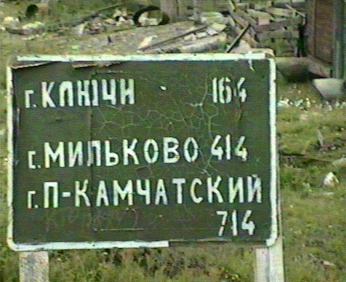
Saturday, six in the evening. Our chances were practically nil. We waited for dark and went to sleep in the nearest bushes on the bank of the Kamchatka (56°19.463′N, 160°47.171′E). In the morning we were back on the hunt. A four-wheel drive stopped at once, with a young woman at the wheel. She was going to kilometre thirty-three to pick honeysuckle berries. We turned her down and regretted it at once. Nothing else going anywhere came along for eight hours. We walked as far as kilometre twelve. A KrAZ passed without taking us in the back. I swore from the bottom of my heart and wished it would break down. It hadn't gone a kilometre before it stalled and the men set about taking the engine apart. We caught up and asked again. The truck was going to Petropavlovsk, but they flatly refused to let us ride in the back. It passed us again just before the traffic police post and stalled again. We laughed, walked past it and soon got a ride to Klyuchi in a Ural. It was a military vehicle from some old anti-aircraft system, long since stripped of its equipment. It shook us horribly on the bumps. Apparently it had no shock absorbers at all. By the time we arrived our very souls had been shaken loose.
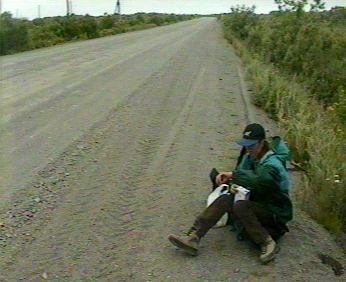
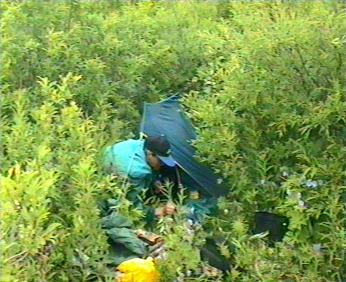
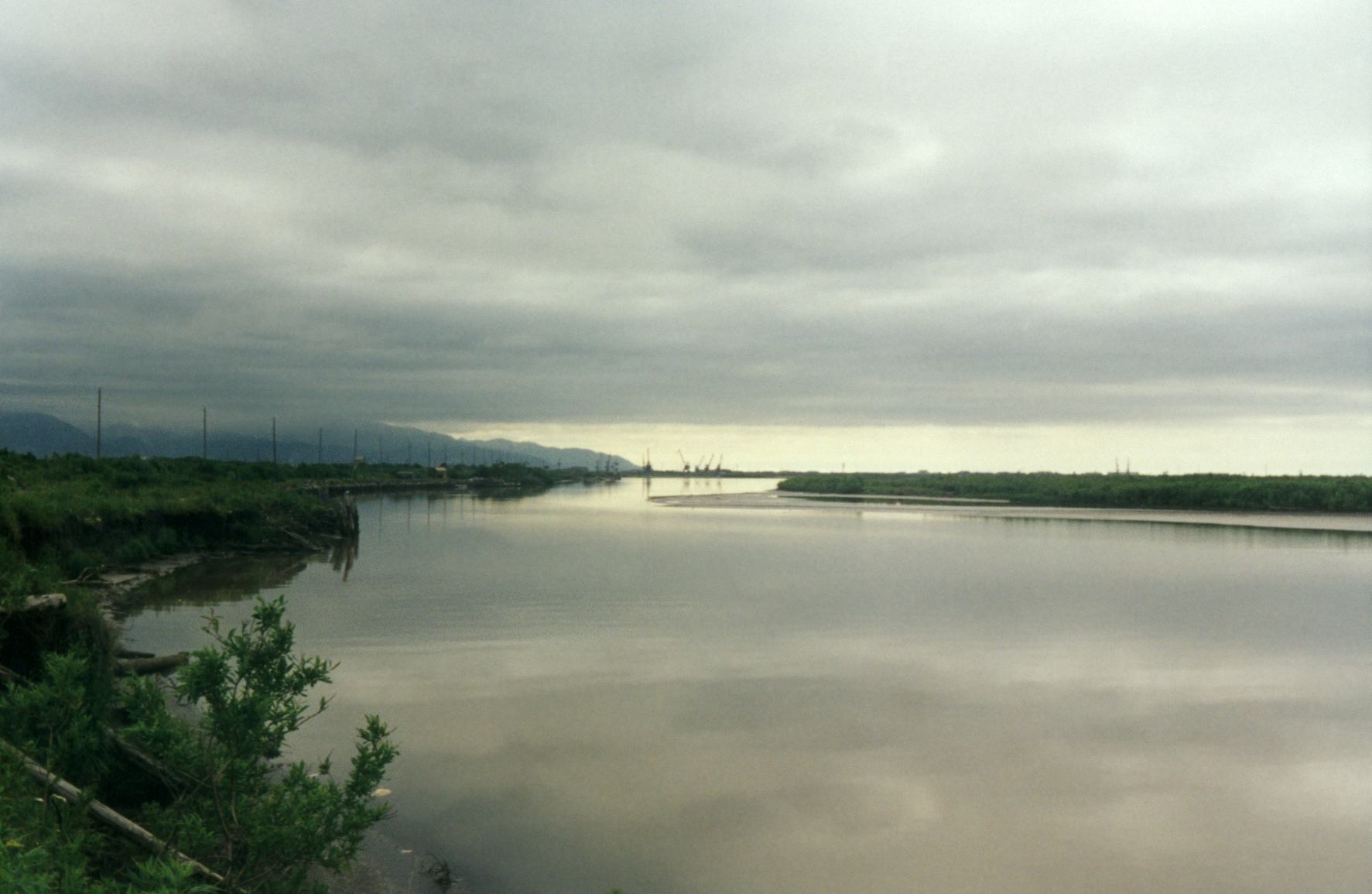
Klyuchevskaya Sopka was once again out of sight. The wind drove low, ragged clouds overhead. Rain spattered down. Another typhoon had settled over Kamchatka. We decided against Klyuchevskaya, Bezymianny and Tolbachik.
It was evening when we got to Klyuchi. We bought supplies at the all-night shop and set off to look for a camp along the road to Petropavlovsk. The barrier at the traffic police post was down. The police had vanished somewhere, and the very same KrAZ was standing at the barrier waiting. We overtook it on foot a third time and thoroughly enjoyed taking the mickey out of the drivers.
It was getting dark when we turned into the roadside bushes and camped not far from the Kamchatka River. The bushes greeted us with a cloud of mosquitoes and midges. We pitched at speed and were about to celebrate our victory when disaster struck. Unlike the midges at earlier camps, the ones here were a smaller calibre and flew through the tent netting with no trouble. We counted twenty bloodsuckers coming in each minute, multiplied by a few hours and realised there'd be nothing left of us by morning. We'd doubted the mesh size from the start. Back home we'd cut some finer netting out of a second-hand wedding dress and brought it along. We now had to sew it in from inside the tent under decidedly unsanitary conditions. Tanya stitched. I squashed midges.
It rained all night. We were up early, hoping to catch the first vehicles. As we walked, two KamAZ flatbeds went past on the highway. A shame, with all that space in the back. We came out onto the Trans-Kamchatka Highway. It was about a hundred kilometres to the turnoff for Esso, where we were headed. Obviously we couldn't walk all the way, but we walked anyway. For one thing, standing still is boring. For another, the mosquitoes don't sleep. Finally, in Kamchatka people respect those who walk and are more likely to give them a lift. A feeble tourist on the roadside waiting for nature to take pity on him doesn't inspire respect.
Our efforts paid off. The two flatbeds we'd missed were stopped round the next bend. The drivers were delighted to have company for a chat. Having cleared the traffic police post, they'd pulled up for a hair of the dog after the night before and to share a little bottle of vodka before the long drive ahead. How else are you meant to get down a road like that? They poured us some too, with salted salmon to eat. To refuse would have been offensive. We hadn't even had tea that morning, having decided to light a little fire by the next stream. We were dying of thirst, and here they were serving vodka and salty fish. We decided this was training for our planned Sahara trip. The men were in no hurry. They told tall stories and local jokes. “Fatal Kamchatka road accident. Dozed off, stalled, froze to death.” Most of their stories were about bears: how they'd run after vehicles or get tins of condensed milk out of rucksacks. The bear has firmly taken the place of the nouveau riche as the butt of the jokes.
Incidentally, local ways in Kamchatka don't tolerate ostentatious wealth. There are rich people, but it's not done to show off in a Mercedes 600 and build yourself a palace. People would stop respecting you. What matters in a person, in any case, is what he can do himself.
After an hour of curing their hangovers the men set off. They'd gone to Klyuchi from Petropavlovsk and were going back empty. They worked for a transport firm of sorts, but had long had to make their own money. They liked it better that way. They remembered communism with disgust. They made a decent living, enough to keep a family.
We didn't go far. A Kamchatka driver won't go long on one bottle. We pulled into Kozyrevsk, a little town with a working forestry enterprise. The settlement looks alive. The local shop's full of goods, including ice cream and other frozen food from Saint Petersburg. It only costs half as much again as at home. How on earth did they get it here? The shopkeeper was doing up the place rather prettily, a cross between a Russian log house and a modern Western refurbishment.
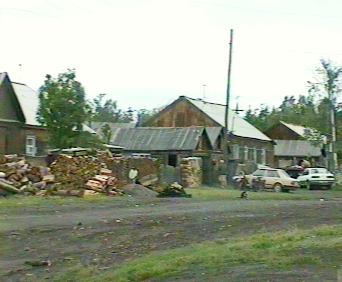
Tanya and I bought ice cream and Malki mineral water. The drivers bought beer, vodka and pelmeni. They knocked back the beer right away and kept the vodka for lunch at the crossing. There they had to back the flatbeds onto the ferry. That takes a clear head. They did it superbly. You could only admire them. Leaving us to mind the KamAZ trucks, they went to visit the ferryman. They came back an hour later scarcely able to stand.
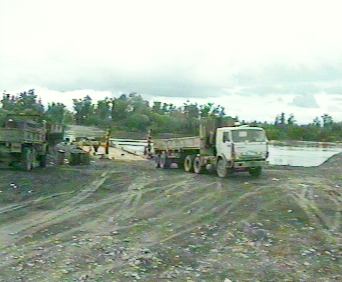
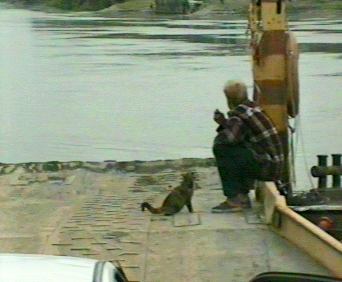
It took them more than one try to get up into the cab. I could barely imagine how they were going to drive and was ready to grab the wheel any second. I needn't have worried. Driving is nothing like walking. We flew over bumps and the ash left by Tolbachik's 1975 eruption. We needed to get off soon, at the Esso junction, but we got so deep into talking that we sat in the truck a good while longer, discussing Yakovlev and Sobchak. Interestingly, even to these Kamchatka drivers, Yakovlev was an embarrassment to Saint Petersburg: uncultured and grey.
We said goodbye at last and began hitching again, this time towards Esso. We got picked up almost immediately, but only as far as Kilometre 46. That's what people call a little holiday camp at kilometre twenty-five of the Esso road. The name survives from the old road. Finding nothing worth a look, we decided to walk. Esso was forty-one kilometres away. Quite a way, but by then we'd got into our stride. At first the road climbs, crossing the Sredinny Range. There is an ingenious power station on the stream. A pipe runs beside the stream and, a few hundred metres down, feeds a turbine supplying Kilometre 46. All very good, except they forgot it freezes in winter and the pipe bursts.
There are plenty of raspberries, honeysuckle berries and redcurrants beside the road. We ate whatever hung within reach. There were no lifts, but the walking was good and the road was lovely. We reached the pass, with nothing but downhill from there. As soon as we'd started down a bus came up behind us. We stuck out a hand and it stopped. To our surprise there was no talk of money. Apparently giving the local Evens a ride is a sacred duty.
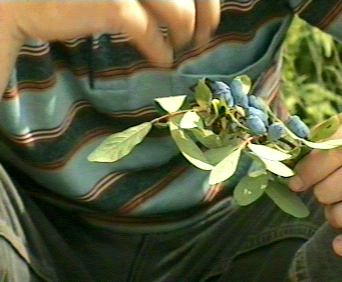
Contrary to the accepted axiom that Esso always has good weather, it was plain and simple rain. They'd drained the warm pool for its Monday cleaning. In the finest tradition of voluntary labour days, local people were scrubbing it with brushes. The pool turned out to be free, which was good, but there was no shower, which we'd been counting on to make ourselves presentable. It was wet and unwelcoming. We found a café where we had an enjoyable lunch of soup and meat and talked to the locals. Much as they see of tourists, they offered us a night at their place for nothing. Wonderful of them, of course, but we were planning to wash all our clothes. It seemed rude to turn up and do the washing instead of the proper round of talking, eating fish and drinking vodka.
A room costs fifty roubles, a hotel a hundred. We went looking for a room and found a local girl who said she'd help us. We walked around people's yards for ages, but everywhere was full. We went into the hotel. “What's your cheapest room?” “Sixty-five roubles.” “And do you have a shower?” “Yes.”
Right. We registered and paid (55°55.601′N, 158°42.255′E, 403 m).
There was a shower, it turned out, but only in the hundred-rouble suite. By then we couldn't be bothered to back out. We paid the difference and had a vast four-room suite to ourselves. Strictly speaking they'd let us one room of it, but there was nobody in the others.
The radiators were cold. We turned on the shower. The hot water was cold. Like most surviving settlements, Esso has geothermal heating. The stuff can't be switched off! How had they managed it? I studied the plumbing. The warm water went through all the radiators and ended at the shower. Ah! If you turn on the shower and wait, the radiators will fill with warm water. I tried it. It worked! Slowly, in about an hour, but the radiators did warm up and the long-awaited warmth began to come out of the shower. We washed everything, including the packs that seemed forever ingrained with the ash of Mutnovka. We hung washing on the radiators in every room. We lay down on all the beds. We got a full hundred roubles' use out of that suite.
In the morning the rain had stopped and the sun came through breaks in the clouds. We had a swim in the freshly filled pool. There was nothing more to do in Esso. They're trying to turn this little administrative centre of the Bystrinsky district into a local resort, grandly calling it the Kamchatka Alps. I don't know who thought that up, but the local hills don't bear even the most generous comparison. There are supposed to be a lot of Indigenous people here, and the idea is constantly put to work. They put on dog-sled races. The locals, incidentally, get around these hills on foot or on skis, and I've never heard of them using sled dogs. There are plenty of Evens, but hardly more than half the population. You don't hear the local language. The older generation remembers it, the young don't. Esso means open woodland, by the way. In the middle of it all, as a symbol of traditional life, they've built a museum in the Russian style. Esso is a former Cossack stockade as well.
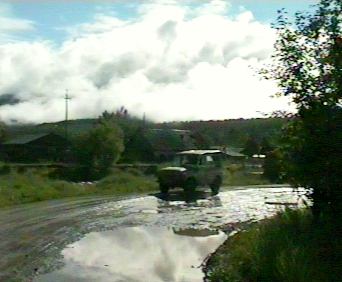
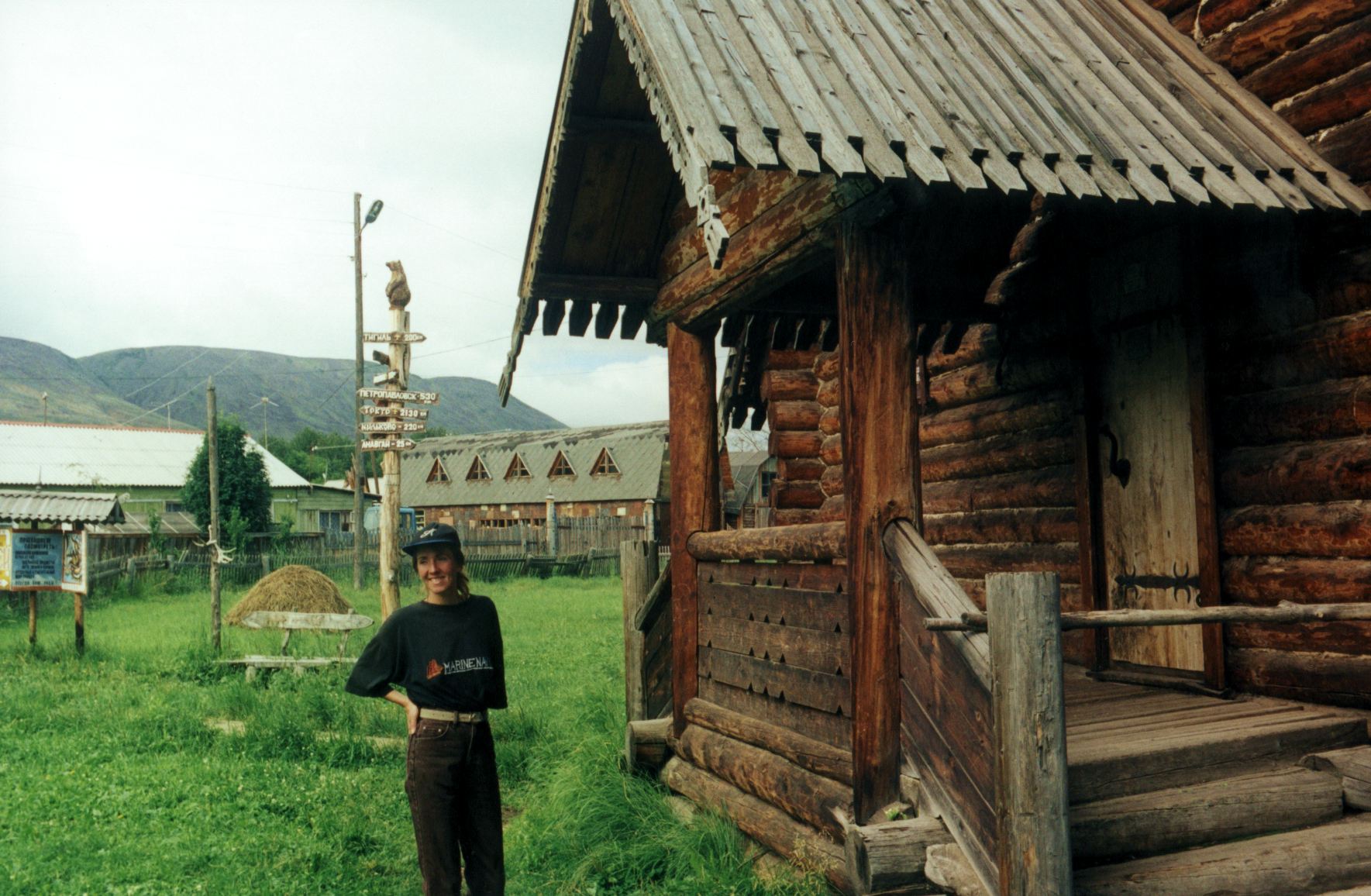
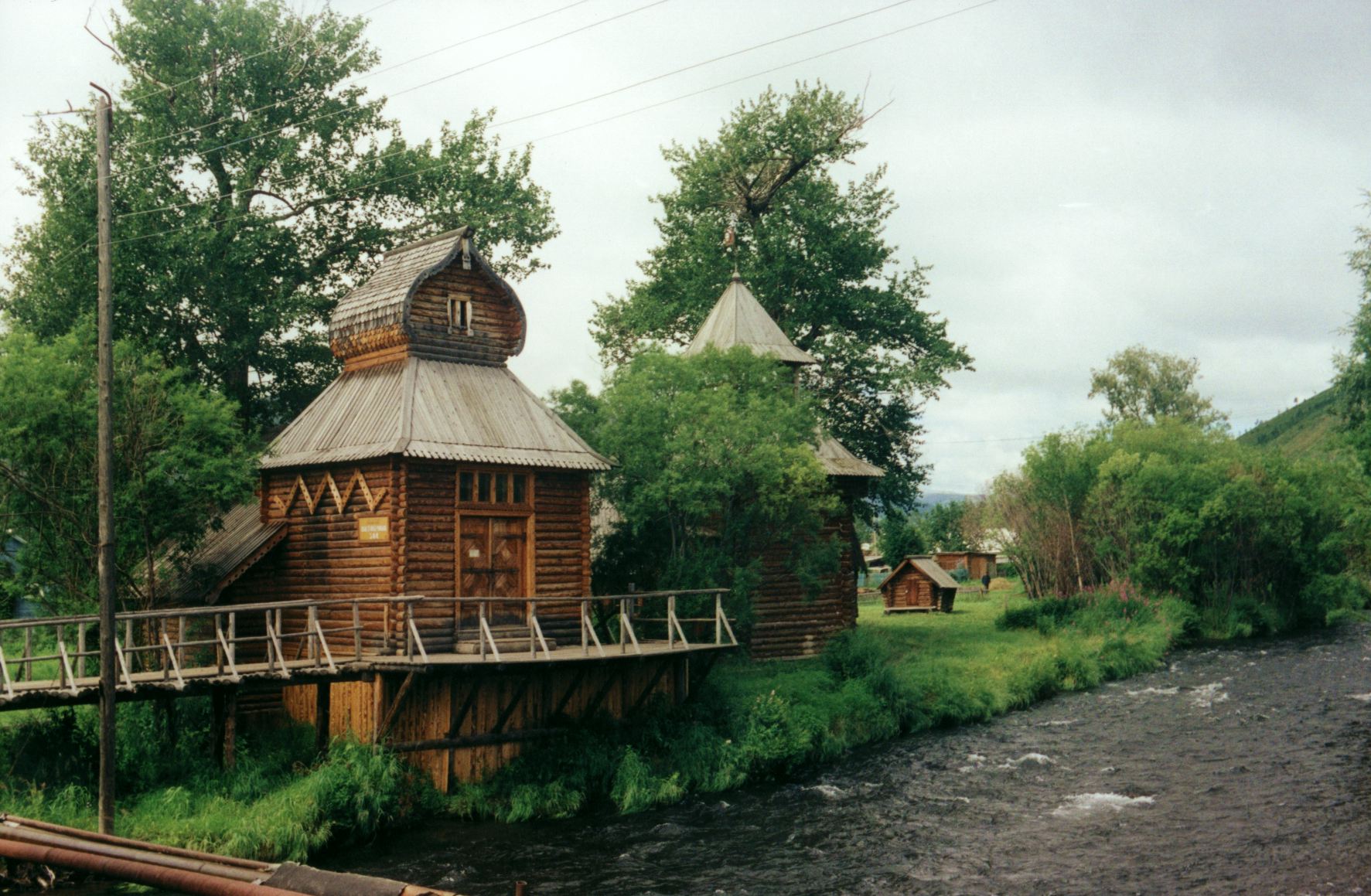
Of course it's right to make a living from tourism, and getting an ordinary settlement as much publicity as this deserves respect. But there's not much to do there for more than a day.
The men who gave us a ride in their KamAZ trucks said that the particularly fearless could already get through Esso all the way to Palana in summer in a Ural. That fired our imaginations. We learned from the locals that the road was under construction. They promised to finish all the bridges this year, or perhaps next, and then it would be a perfectly usable all-season road. For now people did go to Palana, but about once a month if it was dry, with an all-terrain vehicle on hand to help. After the recent rains there was no hope. A pity. Up there in the Koryak District, they say, people live quite another sort of life, almost primeval. Palana itself does well, mind you. It's the capital of a federal territory. All the required bodies have to be staffed, inspectorates, committees, departments, for a population of two thousand. By law it must have as many offices as Moscow, at the same salaries. There are enough senior posts for everyone. It often amazes me how much money is spent on some of these half-dead administrative units. Each district centre, for example, has a clearing office with an enormous three-metre satellite dish. The dish probably costs more than all the money that will ever be transferred over it from the central office.
We were starting to make our way back, and decided to send off the things we didn't need. The dead crabs and sea urchins we'd gathered on the ocean shore were a particular nuisance. They smelled awful. We wrapped them in plastic and sent them as a small parcel to Saint Petersburg. Perhaps postal workers had got used to even worse smells.
We left Esso at eleven. The traffic was entirely local, people going to the next field to dig potatoes. We passed a stream with the cheerful name Uboiny, meaning “deadly”. We'd walked nearly twenty kilometres when someone picked us up for Anavgay. It's a fairly large settlement hidden in the river valley. There's even a helicopter to Yelizovo. There used to be a big state farm here with twenty-five thousand reindeer, but by then they were nearly all gone. People had switched to hunting. Beyond Anavgay the road climbed again, so we hiked up to the pass over the Sredinny Range a second time.
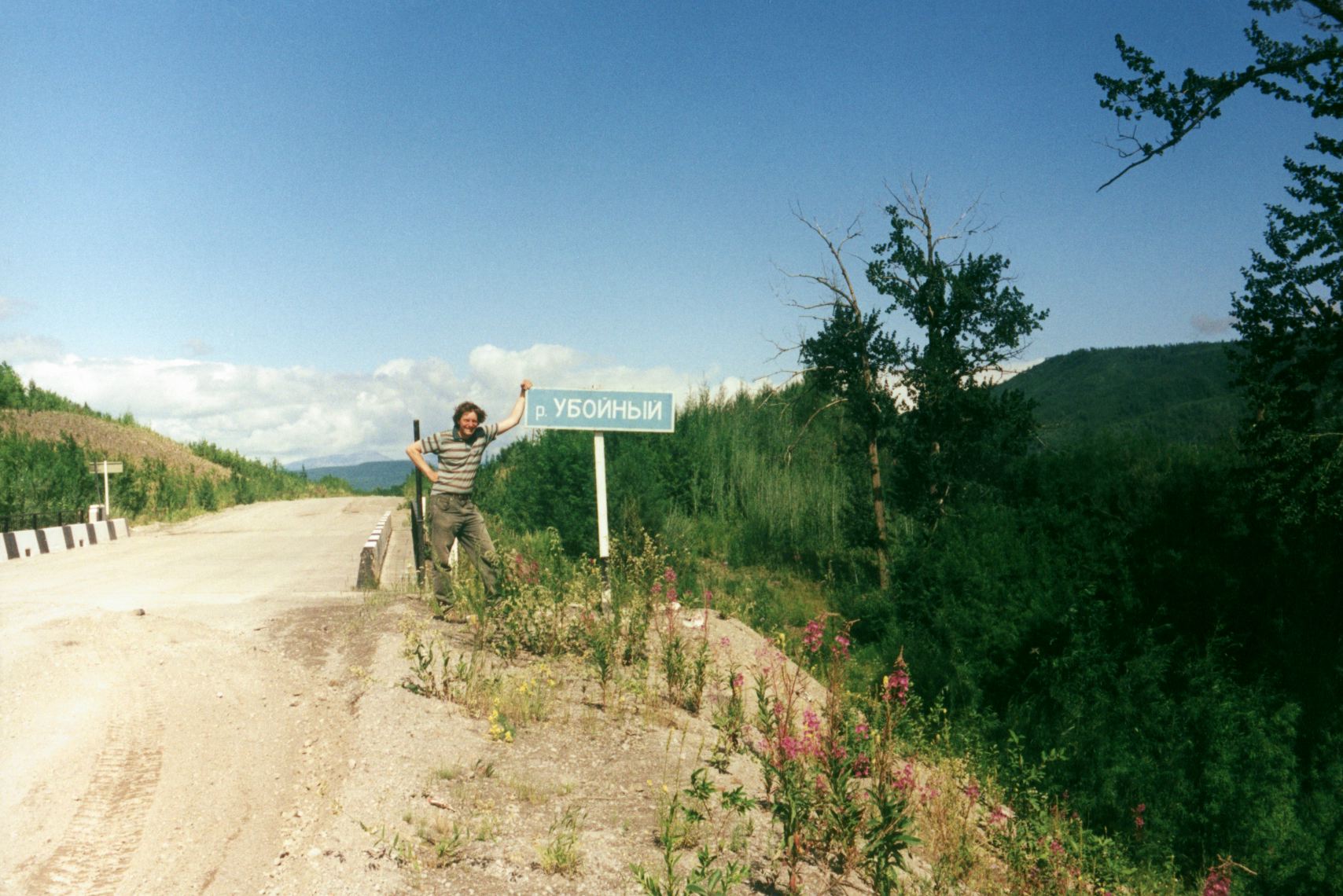
We weren't a bit surprised to be picked up at the top by a local man on his way to Petropavlovsk in a homemade jeep. He was Even and his wife was a Russian teacher who'd been posted here and stayed for good. A warm-hearted pair who'd been in love for thirty years. They celebrated their wedding anniversary with champagne on top of a mountain. Once again I was struck by the kindness, sincerity and unselfconsciousness of people in the north.
The Even man was a hunter. In winter he goes fifty kilometres north to his own hunting grounds for sable. He complained that levies imposed by various forestry people and environmental groups had risen beyond all reason. They look after the animals, but no one looks after people. Drop dead of hunger and there's nobody to protect you. He loved his country and was delighted we'd come so far to see his land. He was ready to drive us around and show us the hydro station he'd built and a spring he knew of with silver water at kilometre thirty-three of the Milkovo–Klyuchi highway. The spring is marked by a cross. In Kamchatka a cross beside the road often marks a source of water rather than a grave. A pity I couldn't remember everything he told us. We went through Taezhnoye, which he said was Viktor Tsoi's home country. I could see where his songs got all that freedom.
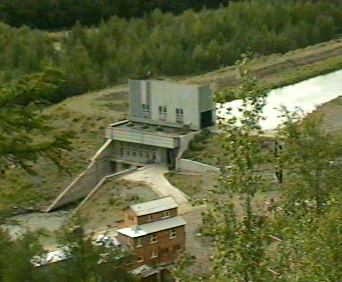
The hunter's wife was the sort of woman who was always seeing to something. That morning she'd popped out to the village for some cucumbers. Twenty-five kilometres there and twenty-five back, at fifty-five years old. When it grew dark that evening they sang to keep awake, making up songs about whatever they could see. They were on their way to visit their sons in Petropavlovsk. We covered about four hundred kilometres with them and it did the soul good. On top of that, when we parted they insisted on giving us salted fish and all the provisions they'd brought for the road.
We got out at three in the morning at the Ust-Bolsheretsk turnoff. Pitch dark. Couldn't find a camp. We slept in a thicket of Kamchatka meadowsweet and hogweed (53°12.300′N, 157°28.397′E). It took ages to clear a patch of stalks as thick as your leg.
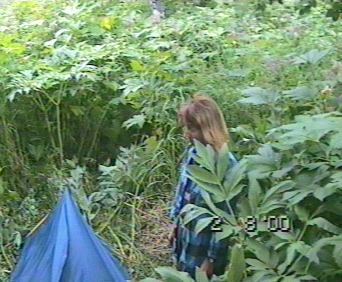
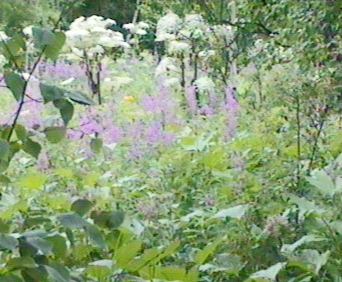
1–3 August. Ust-Bolsheretsk. Death for a fish
In the morning we went back to the junction. No luck with transport. The police took us as far as the DRSU-3 roadworks depot. A dreadful place. Flat. The dullest scenery imaginable. Mud. Rain. Absolutely no chance of a car. It's the big fishing season in Ust-Bolsheretsk and everyone's at it. Nobody wants to give a rival a lift. We raised our hand as another Volga came into sight. It stopped, and two security four-wheel drives behind it. Out stepped Biryukov, the governor of Kamchatka Oblast. Out of the other cars came deputies, television people and assorted hangers-on. They were apparently on their way somewhere closer to the fish and caviar. The governor hadn't stopped for our raised hand, of course. We were less than bugs to him. He just wanted to go behind the bushes. They filmed it. They filmed us too, either as ordinary toilers of the fields or as potential terrorists. It was funny to see everyone fawning over the boss with faces so solemn you'd think they planned on living for ever.
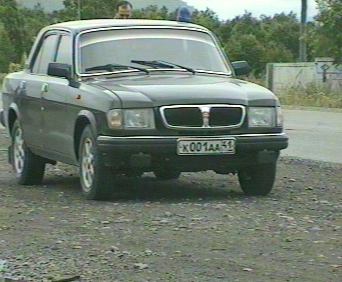
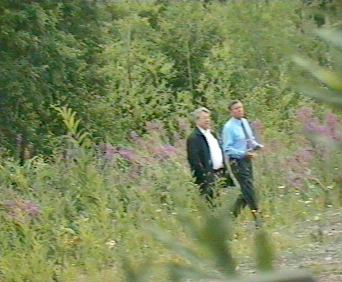
By then we were soaked through. We finally squeezed into a bus crammed with fishermen and got to Ust-Bolsheretsk. It's the administrative centre of the district of the same name. A nondescript town, with no visible decay. Everything revolves around fish. There's a standard-issue obelisk, just like the one in Ust-Kamchatsk, only with a pink salmon instead of the Aurora. A rather more dependable choice.
Having bought provisions, we tried to walk out along the spit that leads to Oktyabrsky. The road is dusty and very busy. Gutted fish lie rotting along the shoulders. What a waste. There weren't many that year. The previous year, they said, the ditches had been full. They were only issuing licences to those with the refrigeration equipment to freeze their catch by then, but even that wasn't helping. A fish without its roe can cost more to deal with than it's worth. Caviar is all anyone wants. The stink was dreadful. We couldn't stand it and flagged down a dump truck.
The driver said disapprovingly, “So you've got fish on the brain too. Everyone's gone mad.” When he heard we were going to look around and make a film, he changed at once and started showing us the fishery as best he could. He was building the road himself. The fishermen had hired someone to repair it so they could move the fish faster. The locals had nothing but contempt for the frenzy over the salmon run. For two years there had been a great surplus of fish. People had made enormous fortunes out of nothing.
They took us along the spit almost to the mouth of the Bolshaya River. There's a decent road as far as Oktyabrskoye, then nothing but ruts. Before Oktyabrskoye there is a restricted border zone sign and a checkpoint. They don't check everyone. We were in a familiar road-workers' vehicle and attracted no attention. There are no military installations on the spit. The border guards just want a source of bribes from the fishery and have fenced off the best spots for themselves. At the mouth of the river there's a ferry to the village of Bolsheretsk, small and neglected. There's a lighthouse. The ferry is irregular and costs a thousand roubles a vehicle. The road goes no farther. You can get through to Ozernovsky in an all-terrain vehicle. It can be arranged in Oktyabrskoye, and the locals can tell you the shortest way. It would be much cheaper than flying.
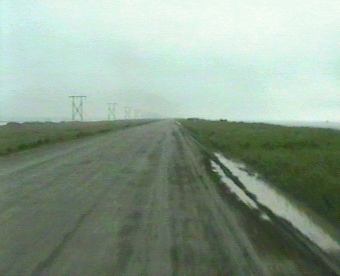
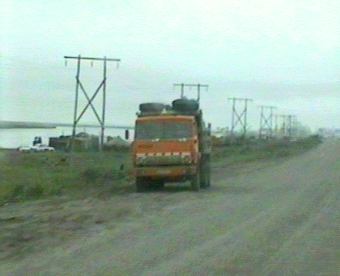
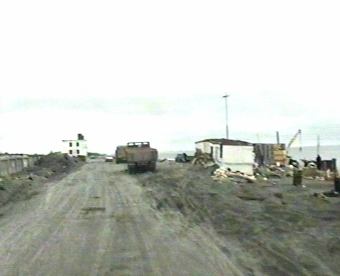
Oktyabrskoye is a big settlement with five-storey blocks of flats. The filth is incredible. The latest Japanese refrigeration systems hum in hideous rusty garages, with heaps of broken old ones next to them. Rotten fish and all the other rubbish that's accumulated over the years. Ships thrown up on the shore. There's a regular bus, but getting onto it during the fishing season is hard.
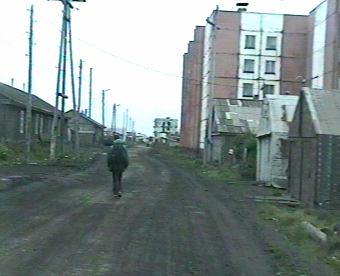
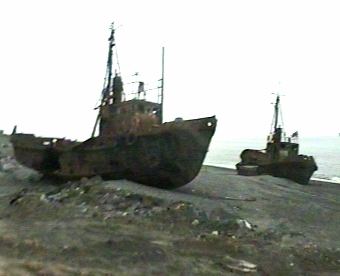
They fish at sea and in the river. At sea it's done by enormous trawlers that have come from as far away as Kaliningrad. You can see hundreds of big ships at once from the shore. They have everything they need, including floating freezers. It's all sewn up at government level. The profits aren't large but they're steady.
You can fish with a net at sea, too. That's for independent fishermen. The method is simple. First they lay the net out from the shore at right angles, then sweep it round a patch of sea or river, and draw it in to the bank. They lift the fish in a scoop net, usually with a crane, and put them in the truck. Those with more money use a fixed seine.
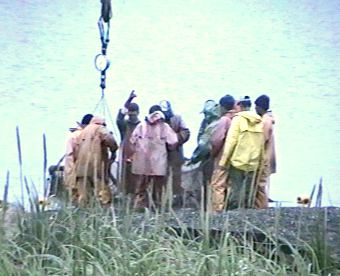
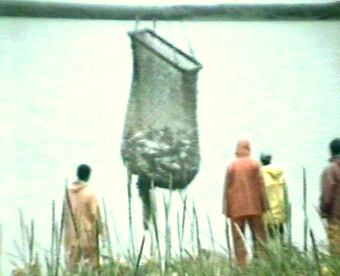
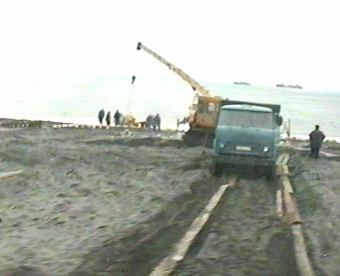
Anyone can buy a licence. There are kiosks all along the coast. Eighteen roubles buys the right to catch 120 kilos of pink salmon. A licence gives you about twenty metres of shore for the day. You can land more than the allowance in that time. Pink salmon is considered the cheapest. Sockeye is the most expensive and most highly prized, but there's much less of it, and it's caught on the east coast. Here you're meant to throw it back if you catch it. Of course nobody does.
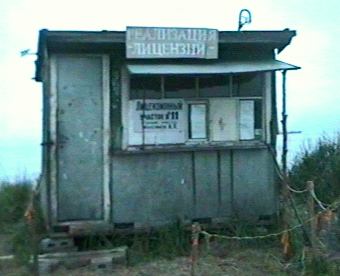
The sea is huge and it's hard to catch fish there. The concentration is low. It's a different matter when the fish run upriver. In a good year there's as much fish as water and you can just rake it in. Small firms and entrepreneurs, locals and outsiders alike, have paid vast sums for stretches of river. People have mortgaged their flats and taken on debt. It costs twenty to a hundred thousand dollars to get started, which you might triple or even multiply tenfold in a month. If there are fish, that is. This year was a disaster. The salmon didn't come up the river. The bank was lined with machinery: cranes, bulldozers to pull in nets, dump trucks to carry away fish, modular freezers, diesel generators. You couldn't get to the water. It was all standing idle. Wages still had to be paid, diesel and firewood burned, tons of food gone through. Everybody was waiting. They were mad as dogs, and you could see why. For half of them it meant certain death. Their flats would be taken away and their creditors would torture them and kill them. Some held out in case the fish still came. Others frantically drove their men from five in the morning until eleven at night in the hope of catching something. Fifty kilos of fish in two hours. Fishing at night is banned. Boats are swept away and men drown in the dark.
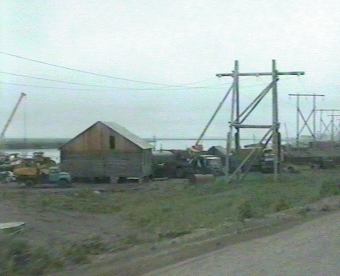
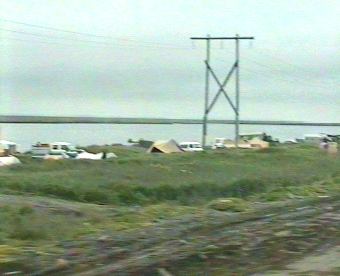
By September dozens of the people who'd bought fishing stations had been killed or had taken their own lives. The men doing the fishing didn't much care. They'd all worked for the state fishery in Oktyabrsky before and knew nothing but fishing. Now they were practically slaves. They weren't paid, and worked for enough food to keep them half hungry. Things weren't going to get any worse for them. Anyone who made trouble was blacklisted and couldn't get work anywhere. That's the contrast: against a free and proud land, vast amounts of easy money breeding slavery, fear and hunger.
Those fishing at sea had a successful season and even exceeded their quotas. The fishermen on the shore cursed them and blamed them for every sin under the sun, unfairly, I think.
The fishermen were nervous about being filmed. For my own safety and the camera's, I thought I'd leave it till morning.
Tanya and I found a secluded spot in the long grass in the middle of the spit and pitched our tent (52°38.034′N, 156°15.499′E). An enraged foreman came running up and began shouting that this was a private fishing station and we must clear off immediately. We explained we weren't going to fish and had nothing to fish with anyway. It got us nowhere. The idea that you might come here without intending to fish was quite beyond him. What helped was promising we'd leave early in the morning, before his lord and master turned up to fire the foreman and shoot us.
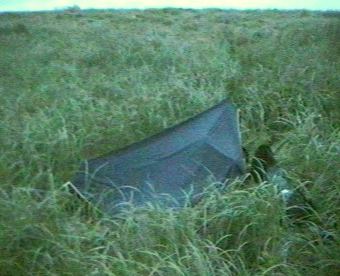
Having settled the disagreement, we went in search of caviar and fish. No luck with caviar. Selling it was supposedly not allowed. It was all spoken for and everyone was afraid. We were strangers, and suspicious ones at that. Our attempt to buy a fish ended with the nearest private fisherman wordlessly tossing two sockeye at our feet with a look of contempt. We promptly made a delicious soup out of them, and fell asleep thoroughly satisfied.
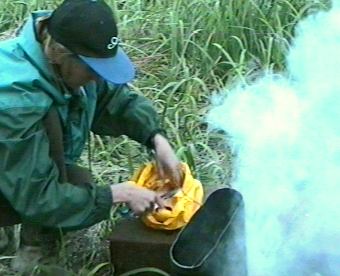
3–5 August. Back, as far as the money will take us
We were up at five, as promised. The fishermen had already started. We packed quickly and set off for the bus at Oktyabrskoye. We missed it, unfortunately, as we hadn't known the exact departure time, 7:45. We had to walk towards Ust-Bolsheretsk. A gloomy day, with a drizzle. Good weather is rare on the Sea of Okhotsk. There was nothing living in the surf zone. Fish lay about on the road. If you nudged one with your foot and it moved, it was fresh. We filled a pack with the makings of soup. Nobody gave us a ride until we got right back to the beginning of the spit, twenty kilometres on foot. They took us to Ust-Bolsheretsk, where we saw a crowd of rivals who hadn't got onto the bus.
A skilful manoeuvre got us into the car of the man who owned a shawarma place in Petropavlovsk. He was Azerbaijani. He'd gone looking for caviar and gone away empty-handed. That was a relief. If even he couldn't get hold of any, we could forgive ourselves for coming to Kamchatka without eating our fill of it. He drove like the wind, near a hundred on the dirt road and no less than a hundred and twenty on tarmac. Though originally from Baku, he'd become a local patriot too. He liked talking about life and different countries. It'd been so long since he'd met anyone who'd been to Baku, not to mention nearly all the other Turkic countries, that on the way into Yelizovo he took us into a roadside restaurant and fed us and plied us with drink with all the lavishness of the East.
Barely able to stand after what we'd been given to drink, we went to the Yelizovo market in one last hope of getting caviar. There wasn't any, as a species. Everywhere signs read “Wanted”. In the crowd we ran into Vladimir Glazkov, whom we'd met in the Mutnovsky crater. We were soon in an animated conversation about Kamchatka. Before long he invited us home to go on talking and look at his photographs, which we did. He's a professional landscape photographer and takes pictures of Kamchatka. We were astonished at their quality. I'd never seen anything like it. It turned out that the photographs we liked usually didn't sell. Commercial buyers want a volcano with ash and lava. Alas, we had neither the money to buy them nor any way of getting them to Saint Petersburg. We still had too long a road ahead of us.
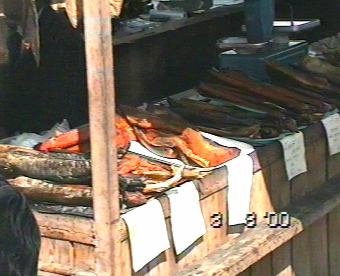
He knew so many interesting things. A pity we hadn't known them before the trip. Never mind, we'll be back: Tolbachik, Klyuchevskaya, Bezymianny, Kuril Lake, Uzon, the Commanders. So much to see. Life is short, though, and for this holiday the time was up. We left Glazkov's, got a taxi and arrived five minutes before the Saint Petersburg flight was due to depart. We got in on the last-minute sale. The plane took a long time to leave, though, and we spent another hour in the holding pen. The best entertainment was a two-year-old who squeezed through the railings and, to his mother's delight, ran loose along the runway.
Here we were in the soft seat of an airliner that would be in Saint Petersburg in a few hours, but we'd only had enough money for a ticket to Khabarovsk. The runway flashed by beneath us, then the Avacha River, the mountains of the Sredinny Range, the road to Ust-Bolsheretsk we'd travelled that day, and the Milkovo turnoff. Klyuchevskaya beckoned from its inaccessibility in the distance. A few minutes in the air and we were over the Bolshaya River delta. You could see the whole fishing fleet clearly. A little farther and cloud hid the ever-gloomy Sea of Okhotsk. We didn't see land again until Sakhalin. The plane passed to the south of Alexandrovsk-Sakhalinsky. The sky was clear over the Tatar Strait. We could see Sakhalin all the way north to Cape Elizabeth. There were ships in sight, freighters presumably out of Petropavlovsk-Kamchatsky. The ridges of the Sikhote-Alin gave way to the low valley of the Amur and the plane began its descent.
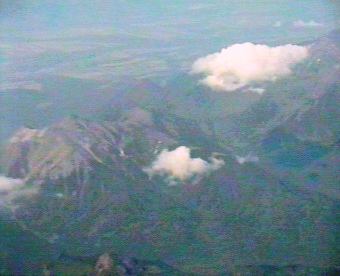
At the airport we made the mistake of taking a minibus to the railway station. In other cities we'd got used to it being no dearer than regular public transport. Not here: thirty roubles each. For two, a taxi is cheaper. Watch out for that, especially as the public transport is frequent.
At the station we saw that a train for Neryungri was leaving shortly. It was going our way. There were no tickets, true. I launched a two-pronged assault on the chief guard and the station manager. The latter did the trick, and I had two tickets for a sleeper compartment in my pocket.
The railway now goes across the Amur on the new bridge. It's a combined rail and road bridge, built in time for the New Year. Incidentally it's Khabarovsk's first road bridge over the Amur. It's boring to cross by rail, though. The tracks are completely enclosed. You might as well be in a tunnel.
The country around is flat and dull. Traces of the recent typhoon livened up the scene: everything flooded, bridges gone. It had been an exceptionally wet summer in Primorye.
We got out in Birobidzhan for a walk and some pancakes. One interesting thing: all the signs were in Hebrew, even at railway stations. By now it was getting dark. What a long day it had turned out to be. It was hard to believe we'd been on the shore of the Sea of Okhotsk that morning.
We spent the whole of the following day on the train. Our travelling companion was a Sakha man from Udachny, a hunter. I learned a lot about Yakutia from him. Unfortunately his Russian was poor, and being a nationalist he would periodically take issue with some word we'd used and have a go at Russia for having taken all the diamonds. It took some doing to draw information out of him.
The railway to Yakutsk is going up, slowly. They've nearly finished it as far as Aldan. Officially passenger service stops at Neryungri. Beyond that a passenger carriage goes on a freight train. There are no plans for a rail bridge over the Lena in Yakutsk. They're building the railway to Magadan. At the current rate it'll take two hundred years. Buses and private minibuses leave from Neryungri, at 1,200 roubles. Then there is a ferry, thirty roubles a car, eight to ten a person. They are discussing a road bridge. Twenty kilometres long. Twenty metres deep, add another fifteen at flood time. Permafrost into the bargain. It's hard to see how you'd build it. The Kolyma road is only a winter road. From Lensk to Mirny it's sealed, from Mirny to Udachny a good unsealed road. They're building Mirny to Yakutsk and promising it by New Year 2001. Twenty kilometres near Vilyuysk to go. That will just about join the European and Far Eastern road networks long before the Amur highway is finished. A dream come true for drivers who deliver cars. All that's left is the Lena–Lensk stretch, which can be done by ferry.
There is a passenger boat on the Lena from Osetrovo to Tiksi once or twice a week, taking four to seven days.
He'd heard nothing about identity checks or restrictions on entry to particular parts of Yakutia. He's a driver himself and you can take his word for it.
The Sakha man's relative was on the train too, a local actress married to a Korean businessman and returning home from Korea. She had with her a remarkably spoilt and badly brought-up child who screamed the entire way. The child's screams were periodically reinforced by cries of indignation from the neighbouring passengers.
The country outside the window was uninspiring. The bridge over the Zeya is long, but the river is muddy and flat. The Little BAM, the branch of the Baikal–Amur Mainline to Tynda, is single track and unelectrified. No tunnels or mountains. The train reached Tynda at one in the morning, and that was as far as we were going.
The capital of the BAM looks quite good. The station is handsome and well kept, and like all the BAM stations has a character of its own. Tynda was built by people from Moscow. There are sixteen-storey blocks all over town and the shops are full of expensive goods. I usually judge how civilised a settlement is by how many kinds of whole-bean coffee it has. Even one is a good sign. Tynda has five. Today was Friday, the eve of Railway Workers' Day. The town was celebrating. There was a fountain lit by coloured lights in the park, a Ferris wheel, crowds of well-dressed young people out strolling. People drive four-wheel drives. Right-hand-drive Japanese ones still predominate. Hardly surprising, as there's a good road from Tynda to Khabarovsk, and the road onwards goes to Yakutsk.
While we were out walking, a drunk driver hit someone right in front of us and took off. We very nearly got drawn in as witnesses.
We didn't have much time. I recorded the train timetable with the video camera. An hour later we were off on the Tynda–Kislovodsk train as far as Chara. We settled into the attendants' compartment. As soon as we moved, Tanya went to wash in the lavatory. We'd learned to wash from head to foot on trains. The attendant caught her doing exactly that, having decided he'd forgotten to unlock the door. He was horribly embarrassed and vanished. By then Tanya and I, washed at last, were together in the compartment and enjoying some peace and quiet alone for the first time in days. The attendant barged into the compartment out of habit. He went even redder and had to vanish for good.
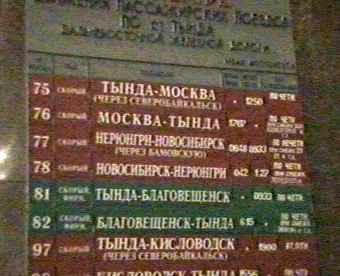
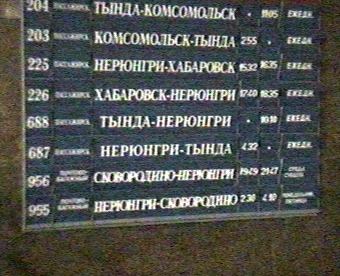
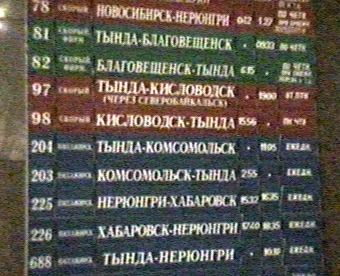
In the morning we woke before Yuktali. The line ran by the rocky banks of the Nyukzha River. We couldn't take our eyes off the view.
At nearly every Russian railway station the locals bring food out to the train. On the BAM, not a soul. We couldn't find anything to eat in Yuktali.
At the next stop, Khani, the only station in Yakutia, the train stands for over an hour. Life is hard there. The station ended up out on a limb. The BAM was divided there between the Far Eastern and East Siberian railways and the locomotive depot was closed. There's no work at all. The station lies in a steep gorge, and you can't even find a place for a patch of potatoes. Half the flats in the five-storey blocks are abandoned. On a rock as you come in someone has written, rather sadly, “Farewell, Khani”. This decline is more the exception than the rule on the BAM. The line is much more alive than you'd think from television. Khani has three shops, and we stocked up in them. The range is quite decent. The post office is at the station. There are a few private cars, one even with an L plate. The road to Tynda is passable, though the bridges are gradually rotting away. Chara is worse. They say a four-wheel drive can make it, but in an ordinary car you're better off going in the dry and taking planks. V. Dinets complained that the seats on the BAM had been replaced with ordinary ones with armrests. Well, a kind soul at Khani station has sawn them off. Sleep easy, gentlemen travellers and gentlemen without a home.
After that the line climbs the Kalar Range. There's no tunnel through it, and the train goes up to 1,200 metres. A beautiful mountain railway among clear lakes and turbulent streams.
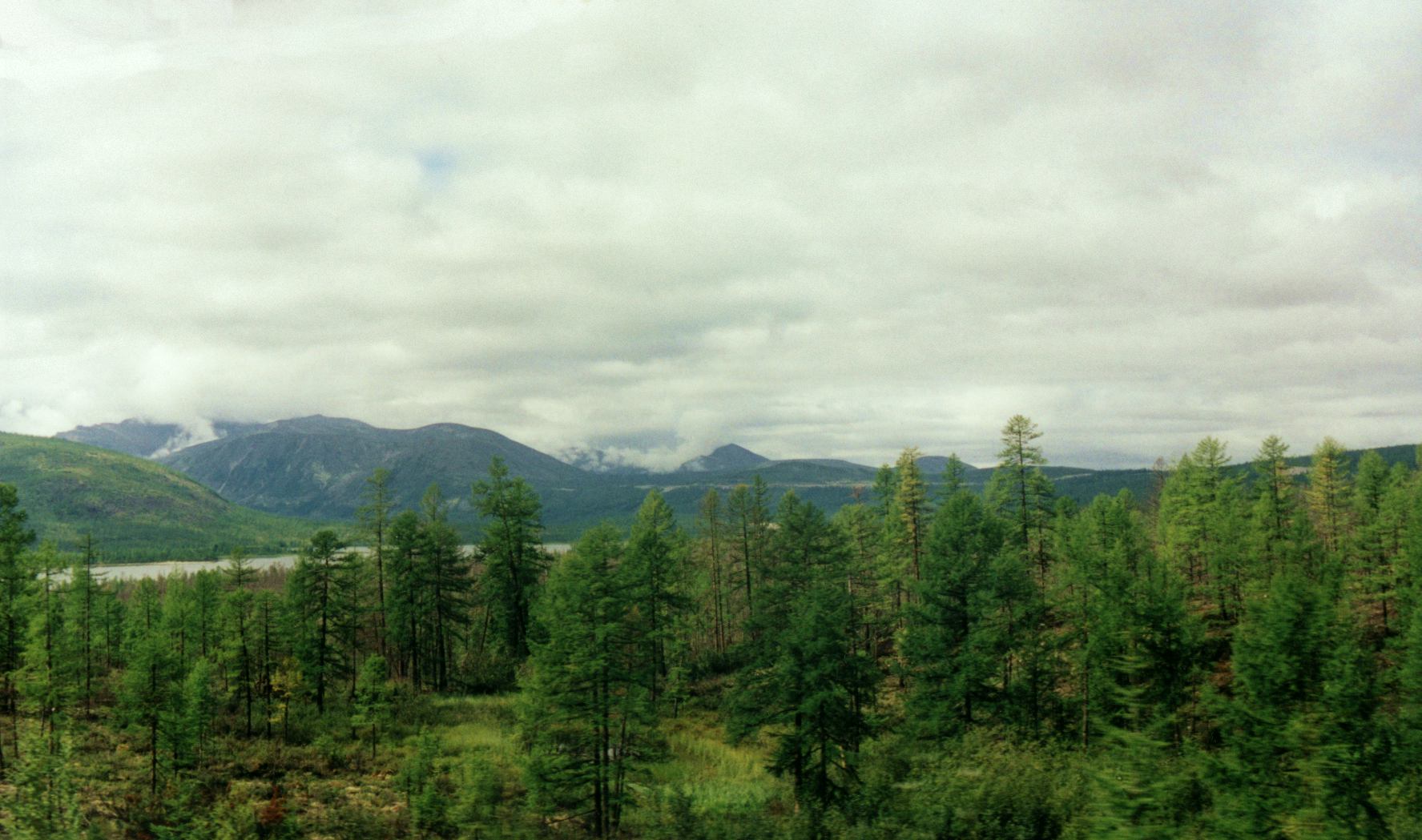
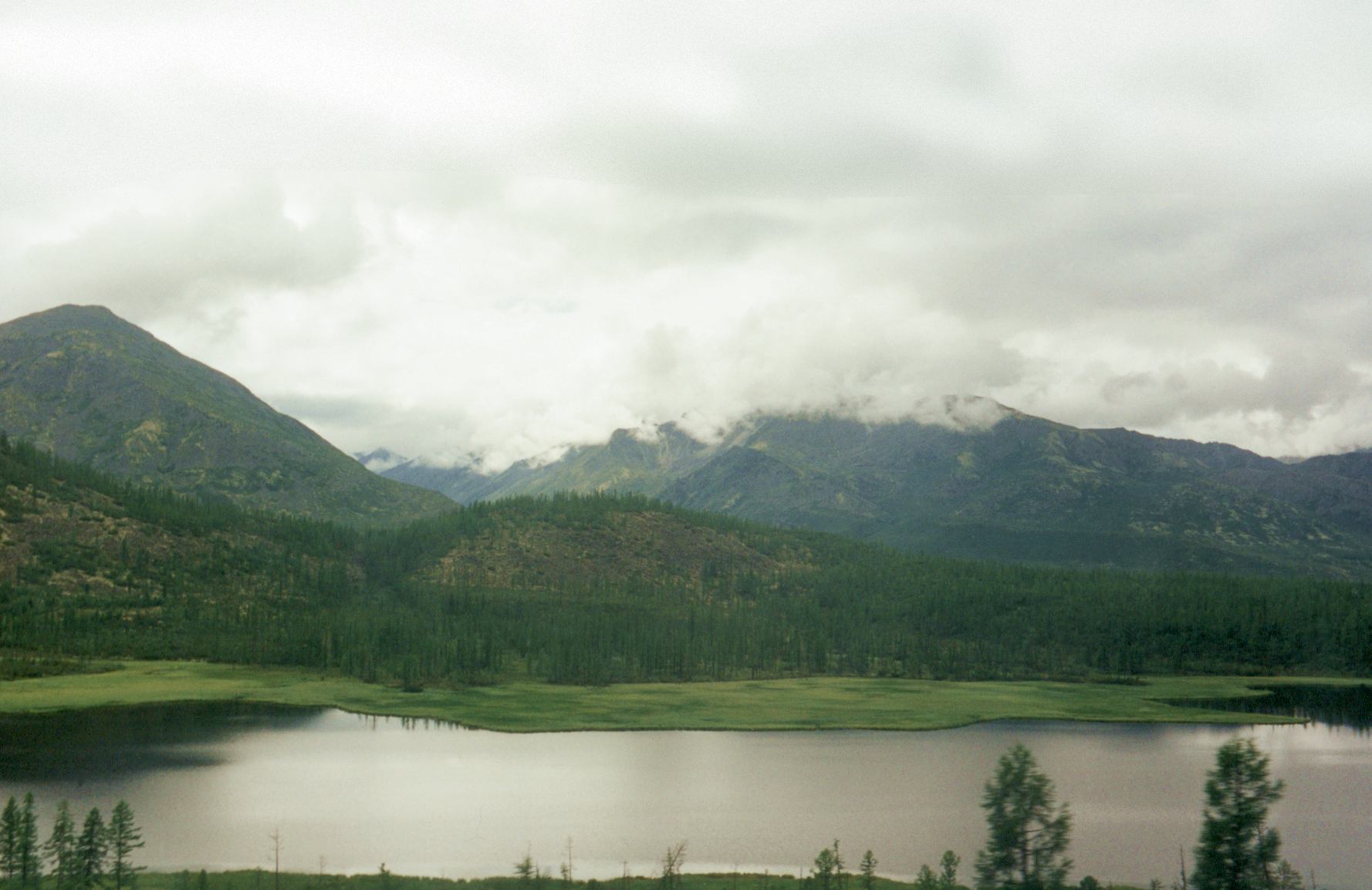
5–6 August. The Chara Sands. Chara map sheet, 1:100,000
The Chara Basin lies between the Kalar and Kodar ranges. At the foot of the Kodar Range is a unique natural wonder, the Chara Sands. A hundred-square-kilometre desert of dunes rises a hundred metres out of the bogs. Nobody can properly explain where it came from. They say it's sand weathered out of the rock and carried from the Sredny Sakukan valley onto the plain. But why, then, are the mountains made of sedimentary rock while the sand is pure quartz? There's no other desert like it in the world. We wanted to spend the night in the middle of it.
We got off at Novaya Chara railway station. The train from Moscow had just arrived and the station was full of tourists, mostly mountain hikers. The Kodar has always been popular. You can find routes of any difficulty there. Now that getting to the Kodar is easy and no war is expected in these mountains, people pour in by the hundreds every day.
Outside the station, local drivers solicit fares from tourists going to the mountains or the desert. Your taxi awaits. There are takers. It's twenty-five kilometres back the way we've come to the foot of the Kodar. If they knew that, the hikers could get off one or two stops earlier. The train stops at Kodar, Leprindo, Sallikit and Sakukan. The mountains are a stone's throw from there. We didn't believe the taxi drivers and walked west along the road that runs alongside the BAM. Ten kilometres farther on we reached the bridge across the Chara River.
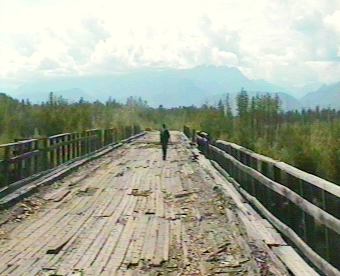
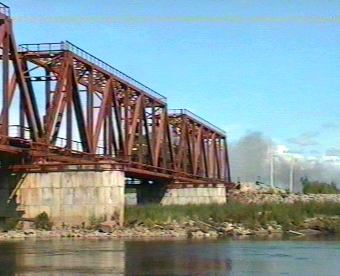
It was hot. We went for a swim. The river isn't deep, no more than a metre and a half. The water was about ten to fifteen degrees. The days when you could catch a taimen in the Chara are gone. Only a few pathetic fry swim about, with anglers lining the banks. After the bridge we carried on west. At kilometre 1711.85 (56°47.032′N, 118°09.198′E), a road branches off to the north. It starts very well, but before long you're wading through one stretch after another knee-deep. You can see a big dune right from the railway. The taxi drivers point to it and say, “It's just a little farther on.” It's a fine dune, but it's nowhere near the desert. There's still a long way to go. The main obstacle is crossing the Verkhny Sakukan, a left tributary of the Chara. After the first dune the road goes into a bog. At first we tried to keep our boots dry. An hour of struggling later we had nothing left to lose.
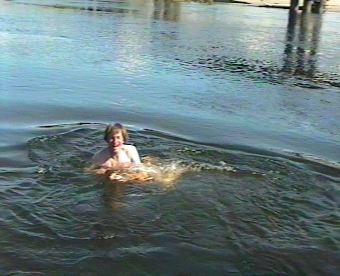
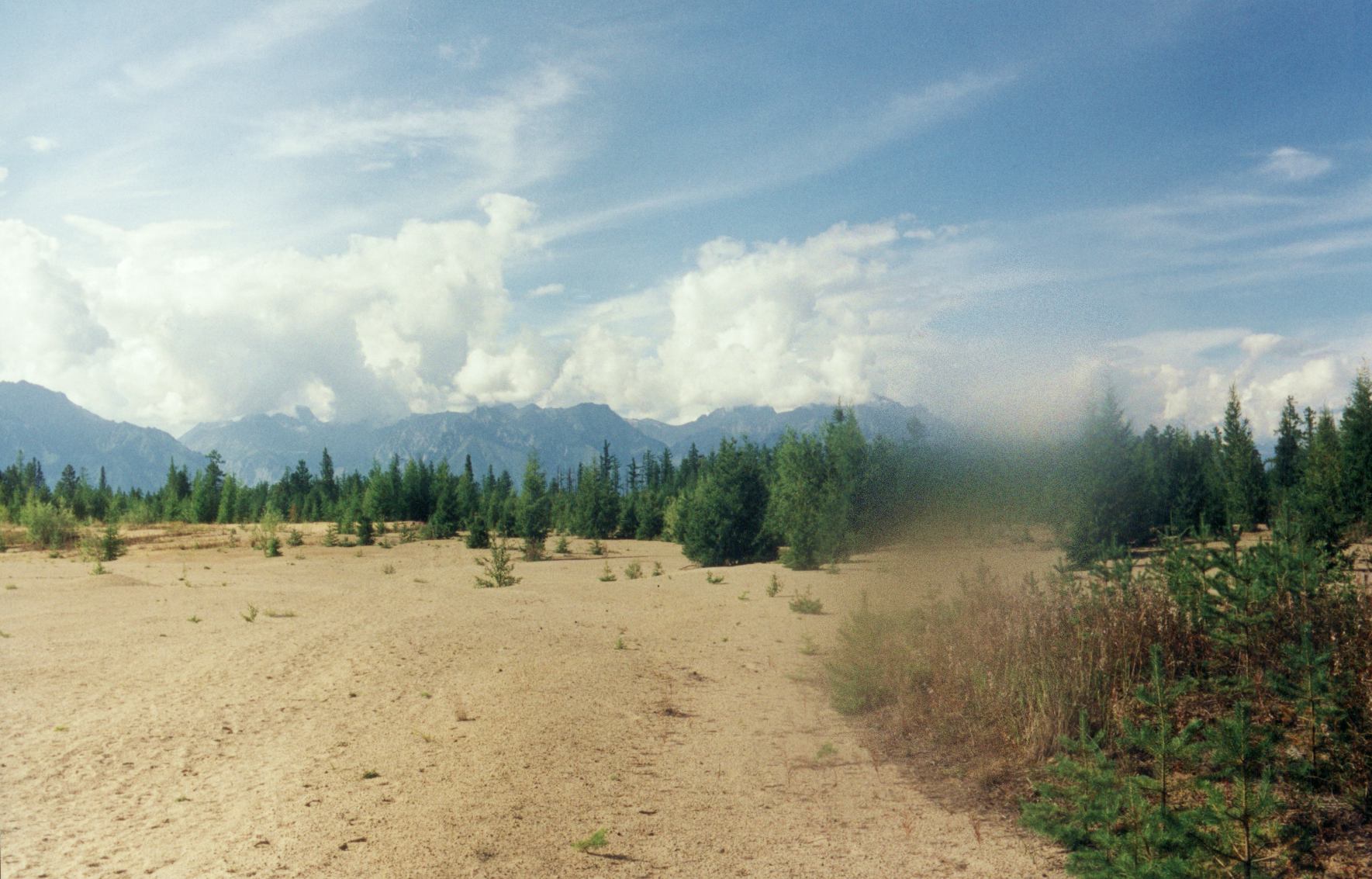
Midges, horseflies and mosquitoes usually fly separately. Here they'd joined forces in one buzzing swarm. We're used to all sorts, of course, but this was too much. They blocked out the view of the world. You couldn't stop for a minute. At first we gathered the plentiful mushrooms and berries, but then we walked without stopping. There were lots of chipmunks running around. The road rose onto little knolls from time to time, but half the walk was in swamp. After two hours it was clear at last that the road was going west and had no intention of going anywhere near the desert. Somewhere in the distance the crests of dunes showed for a moment above the treetops. We decided to go straight for them. That meant going across the bog, at a crawl. We met a reindeer, or rather a calf that sprang out of a bush right at our feet. There were no more dunes in sight. Maybe it had been a mirage. A desert, after all. The forest was wild and untrodden, full of fallen trees. An hour later we came to the bank of the Verkhny Sakukan. A wide, fast, deep stream. We looked for a ford. Heavy rain had made the crossing hard. At a broad shallow spread at the mouth of a tributary, I tried my luck. I just made it. The water was up to my waist and swept me sideways. My feet sank in the sand. The water was ice-cold. Mosquitoes and midges had found exposed skin at last, so there was no time for thinking. I took the bags across in two trips. Tanya was knocked off her feet. About a third of the way across she gave a pitiful cry, and on the third trip I had to carry her too. After the crossing we went through drier forest. It had burnt a few years before, and we were forever climbing over fallen trees. Another half-hour and a wall of sand like a freshly piled railway embankment began to show through the trunks. We clambered up and a vast expanse of sand opened before us. The fringes of the desert are overgrown with wormwood. It's more steppe than desert there, but as you go farther in all vegetation disappears.
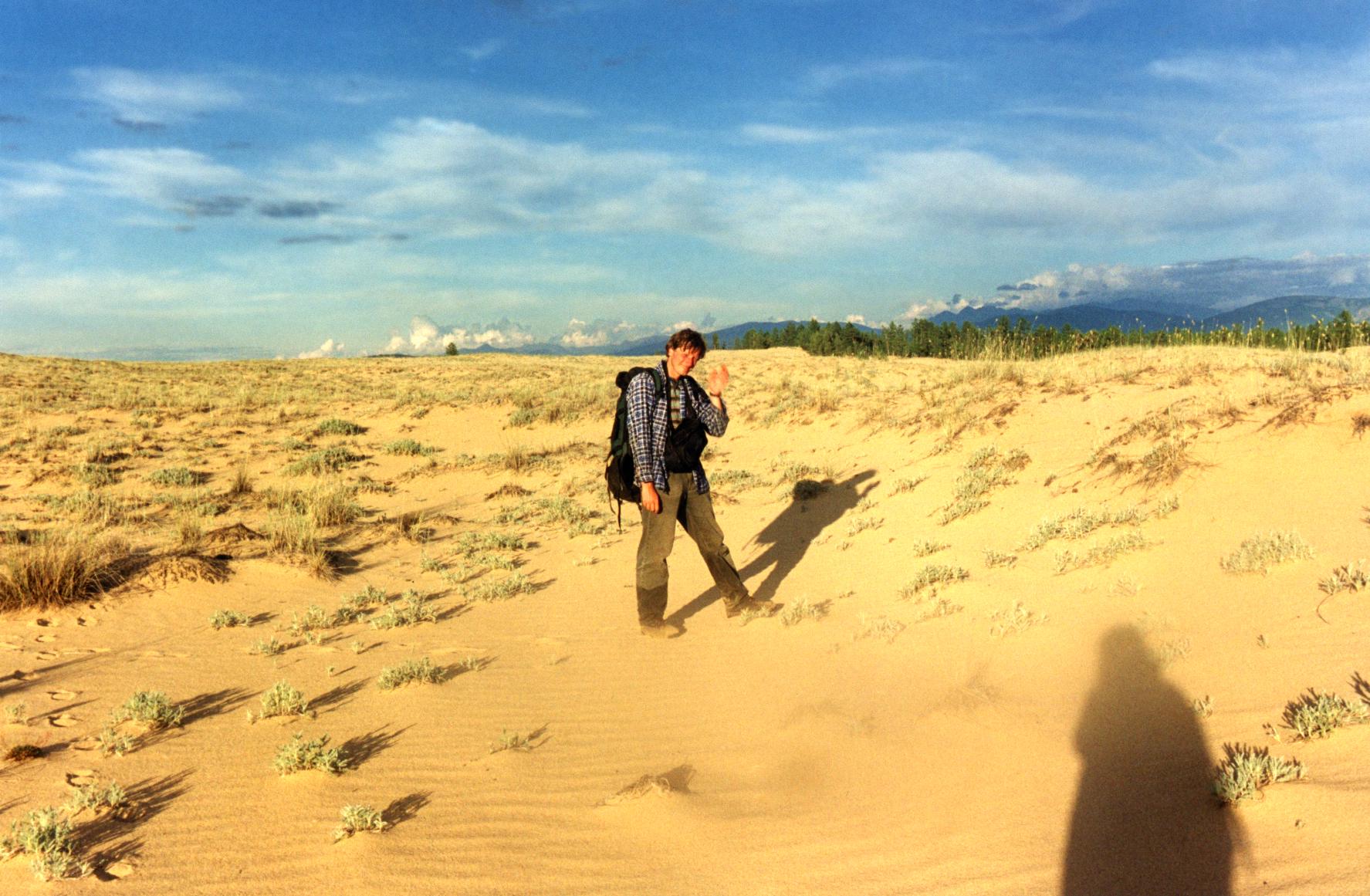
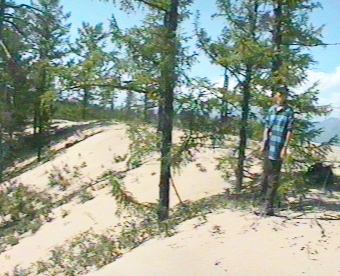
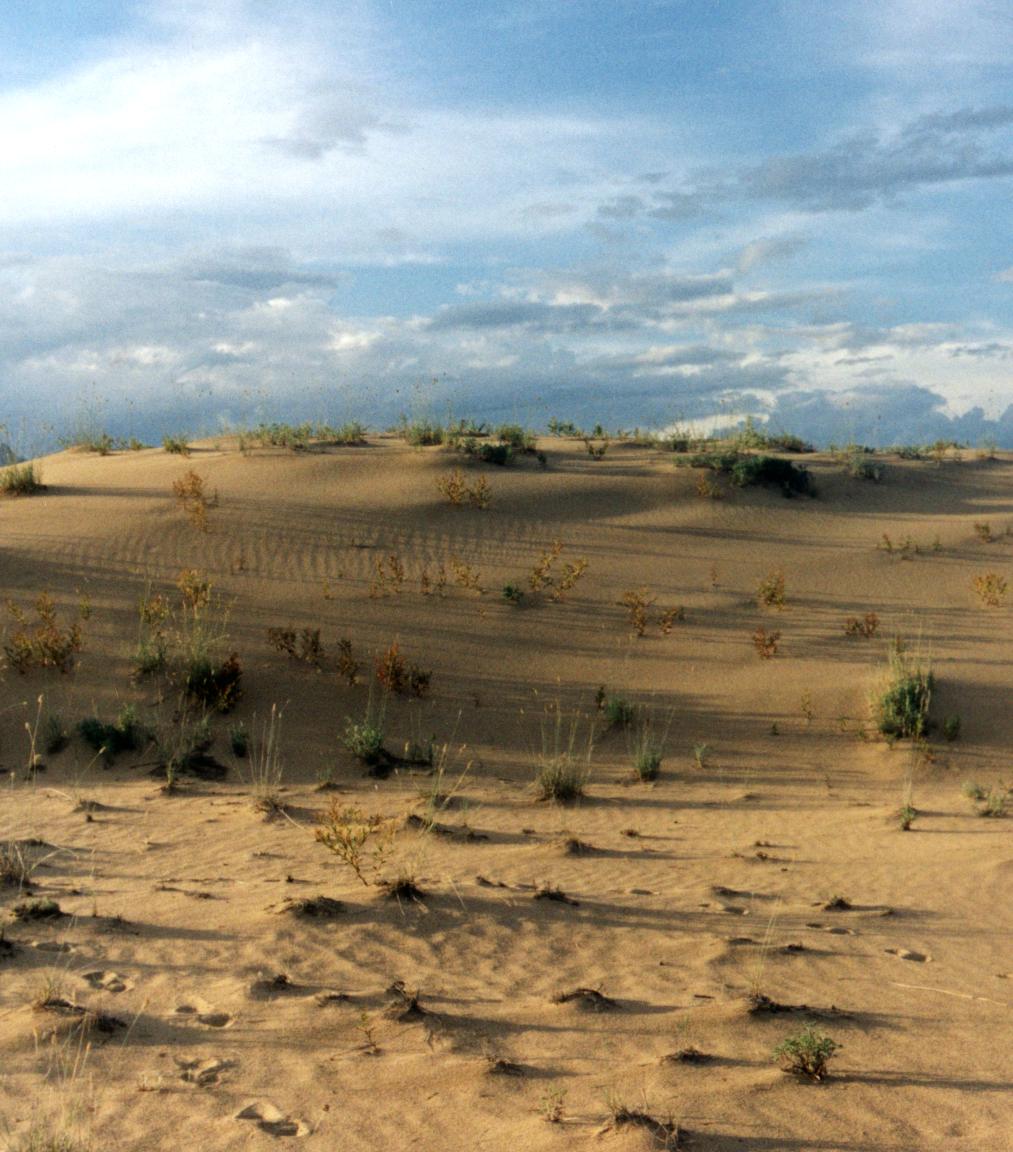
A cloud of every known kind of bloodsucker was flying around us. We were being eaten alive. They even blotted out the sky in the photographs. Where were they all coming from? Apparently we'd brought them with us. We made a fire with the sticks lying about. Midges don't like that at all and vanished. The only creatures left were enormous numbers of grasshoppers, or locusts, chirping and flying about over our heads with a buzz. We could relax and enjoy the evening.
We decided to stop in a little oasis (56°49.068′N, 118°06.194′E, 770 m). A dozen or so pines and larches grow there among the dunes. Beneath them lay heaps of cones accumulated over many years. Apparently they never rot lying on sand. Cones make excellent fuel, but water is another matter. I had to take the empty plastic bottles I'd brought for the purpose along with the cooking pots and walk two kilometres out of the desert to the nearest marshy lake.
It was a glorious evening. The sun set slowly behind the rocks of the Kodar Range, painting dunes, mountains and clouds in the colours of the sunset. Warm and cosy. It was our last camp out in the wild. Ahead lay a long, dull winter. Our mood was bittersweet and philosophical. A young crescent moon took the place of the setting sun. It was completely dark when we fell asleep.
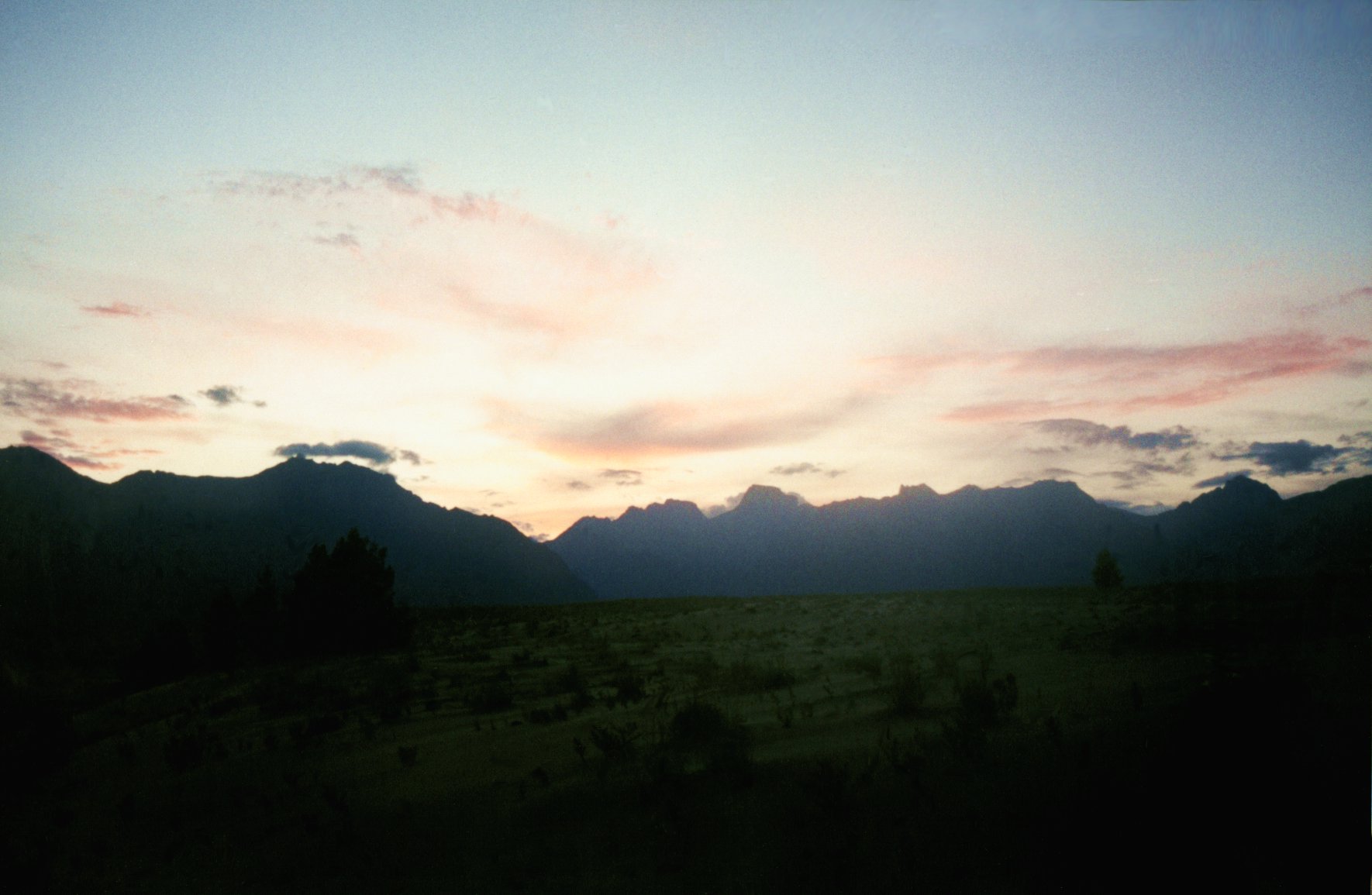
After so many nights on the train, we slept very sweetly. Sand is always comfortable to sleep on. The only trouble was the cooking pot clanging from time to time. Some brute was trying to get at our supplies. Nothing left, mate. Hard luck! Most animals rummage through food fairly quietly. For a clang like that you'd expect at least a bear. We badly wanted to sleep and had no wish to get into an argument with a bear. In the morning we found out grasshoppers had got into the tea billy and couldn't get out. We had to drink grasshopper-infused tea. After a slow and sleepy morning, we wandered about the desert and climbed the highest dune.
It stands 75 metres above the surrounding bog. The dunes are always on the move. It's the shifting sand that keeps them from being overgrown. They say not even in winter are the sands buried in snow: the sand dunes rise above the snowdrifts.
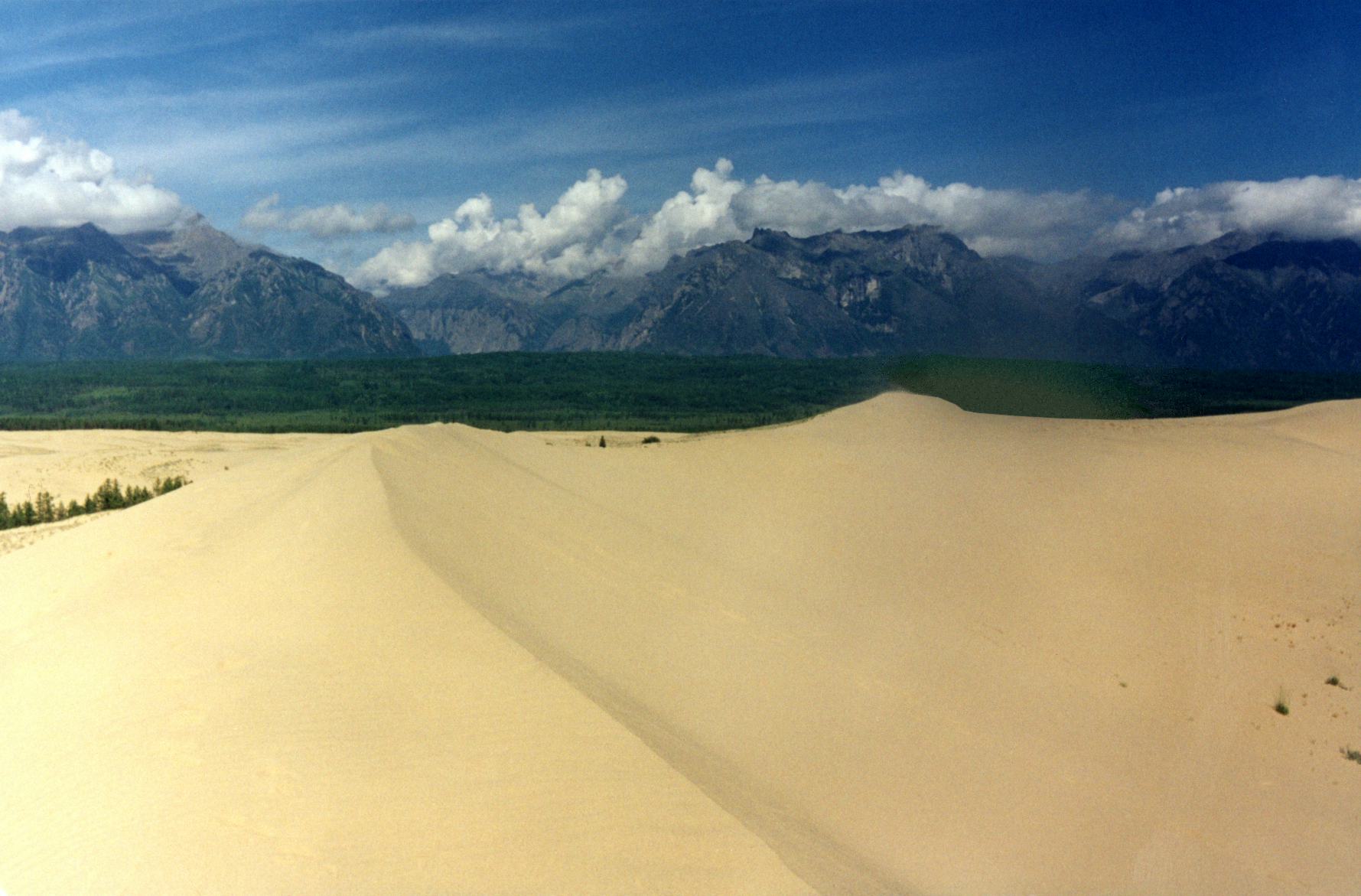
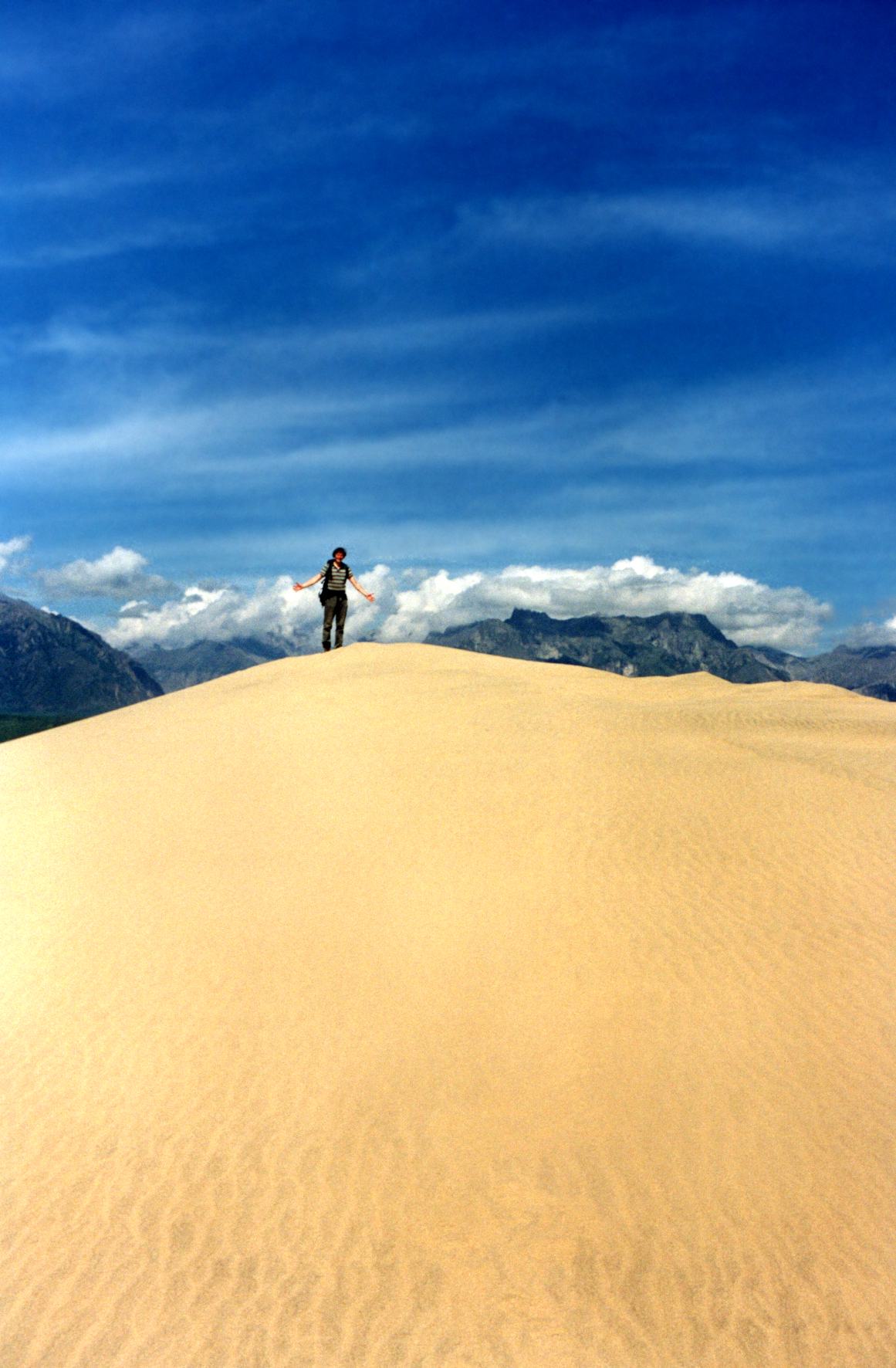
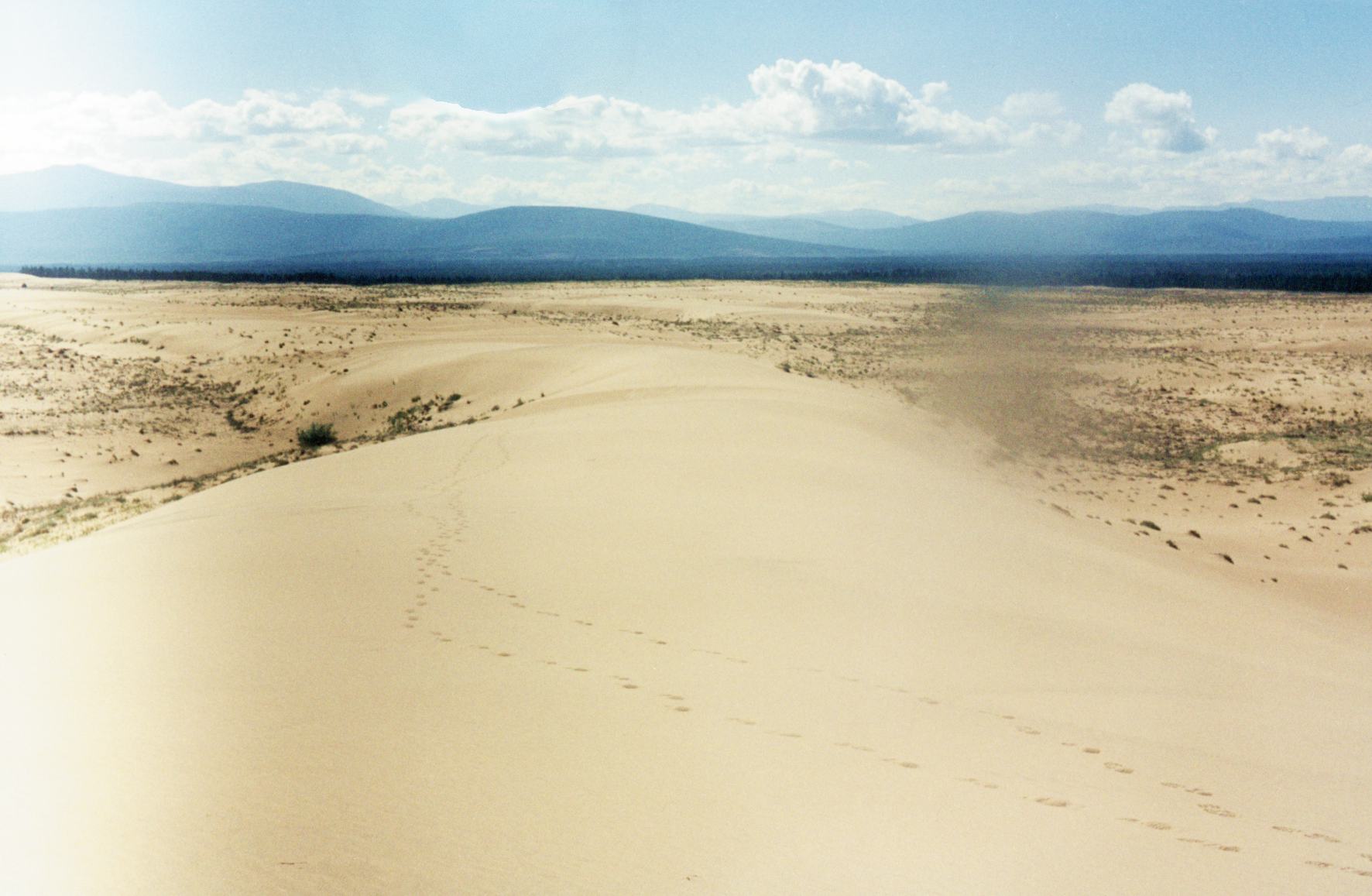
The desert runs for twenty kilometres along the Chara. Since the dunes are all much the same there's no point walking its whole length. From the top of the dune we could see Novaya Chara clearly. We decided to head straight for it. We'd find a road sooner or later. In practice we first had to cross a bog several kilometres wide. It wasn't sticky, but there were little lakes along the way. An hour later we reached a road that was wonderful to walk on. It curved gradually towards the buildings we could see on the far bank, only to head back into the forest. The road went to old Chara, it turned out, which was still twenty kilometres away, and there was no bridge here. Incidentally, in the old days people walked to the desert from old Chara. They say it's still easier. You can get to old Chara by bus. The only hitch is that the bridge over the Sredny Sakukan had washed away.
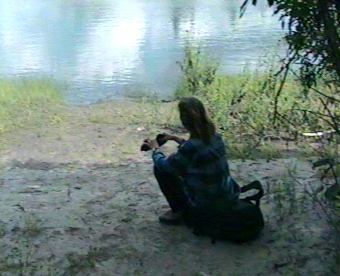
After walking up and down we established there were garden allotments on the other side of the Chara, but no bridge. I'd begun making plans for a crossing. The river was fairly deep, fast and cold for a ford. Just then we found mushroom pickers returning with enormous baskets of white milk caps. They had an inflatable boat, and we managed to hitch a ride across on the water.
From the garden allotments it's an hour's walk down an excellent unsealed road to the station.
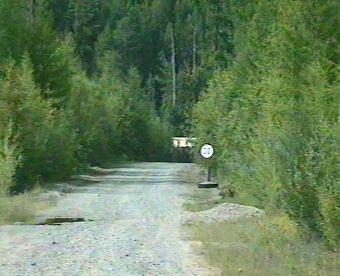
At the station we met a nice pair of mountain hikers from Irkutsk who'd been up in the Kodar. We talked about our travels. It was an unusual year in the Kodar. The heat and warm rains had melted all the snow patches and reduced the glaciers to pathetic little islands of snow.
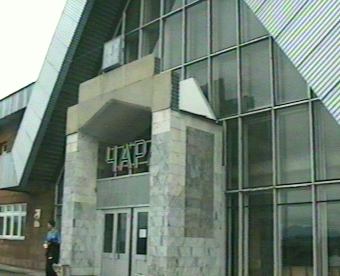
6–14 August. The long way home
When we got to the station there was an hour before the train to Severobaikalsk, which we took. It was Railway Workers' Day, so all the attendants were barely able to stand.
The line runs among picturesque mountains, crosses Lake Leprindo and makes its way through the Kodar Range by tunnel.
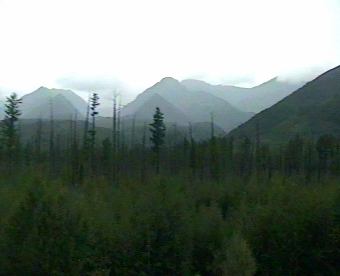
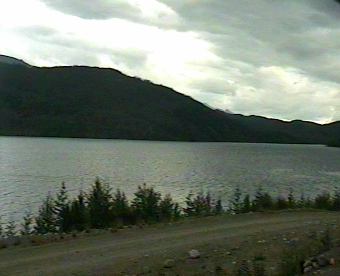
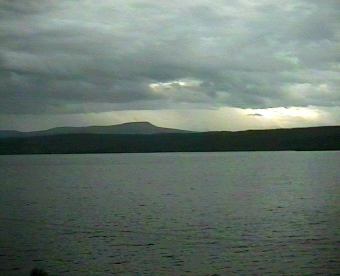
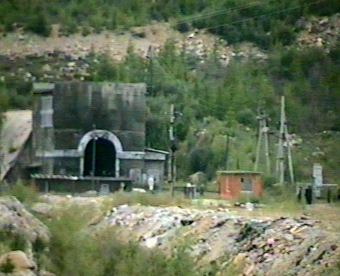
In the carriage we got talking to the chief power engineer for the construction outfit building the branch to the Udokan deposit. He lives in Severobaikalsk and was here on a job. He had dislocated his leg and was going home for treatment. He'd been building the BAM from the beginning. He loved his work and was proud of it. For ten hours straight he told us stories about the BAM.
Chara is thriving. A new line is being built in very difficult mountain country. Tens of millions of cubic metres of earthworks; tunnels opening onto bridges over hundred-metre gorges. Real work. They've started electrifying the Chara–Taksimo section. There's talk of laying a second track. The bed for it was laid in the seventies. When everything is built there'll be an enormous flow of freight. Everybody will have work. There are coal deposits they intend to develop and plans to build power stations and lines. The first priority is an iron ore deposit with an iron content of 70 per cent. There's nothing like it anywhere. To start with they'll ship the ore to the Kuzbass. They'll finish the road to Severobaikalsk too. It's unsealed at present, and the bridges are bad. Their wooden decking has rotted. Despite that, there are a lot of cars with Buryat plates in Chara. People are making it through in Zhigulis. There is traffic, and you can hitch.
The Severomuysky Tunnel will finally be finished soon. That's a story of its own. They've spent more on it than on the whole BAM. In fact, they could have done without it altogether by making a hundred-metre cutting. They didn't, because they wanted a record-breaking tunnel. They could have tunnelled somewhere else, three kilometres longer but through solid rock. Instead they started at Severomuysk, a dreadful site, right through a fault. The ground had to be frozen. Hot springs broke through it. The roof collapsed. It turned out that on the site of Severomuysk there'd been a settlement buried a hundred years before in an earthquake of intensity eleven. The tunnel faces the same prospect. Even if they finish it, it will be dangerous to send passenger trains through. A bypass meeting the grade standards was built while work on the tunnel went on. It even has a short tunnel of its own, nicknamed the Light Bulb. They're no longer allocating money to the builders, but work goes on regardless. They even announced the breakthrough, though so far it's only the pilot tunnel that has broken through. They say it'll all be done in about three years, but nobody's in a hurry. A year in the tunnel counts as three. Work for six years and you get a pension. Half the people on the railway have earned a pension in their thirties or early forties. With no funding, there's no need to take too many chances with your health. The never-ending job suits everybody.
Our next long stop was at Kuanda. This is where they drove the golden spike on the western BAM. The spike wasn't made of gold, of course.
In the evening we crossed the Vitim. An immensely wide river.
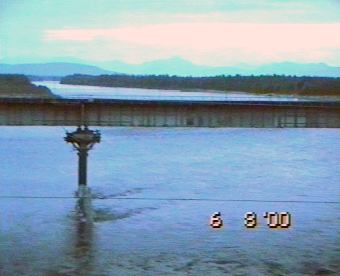
It was quite late by the time we took a walk in Taksimo. There's a big station in a Baltic style with lots of little shops. A wartime seaplane stands in the square. There was a tremendous thunderstorm in town. There's a road from Taksimo to Bodaibo. We passed Severomuysk and the bypass in complete darkness with a violent storm in the mountains.
By morning the train was running through the headland tunnels along the shores of Baikal.
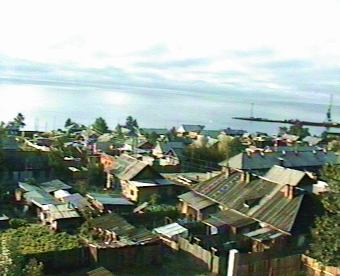
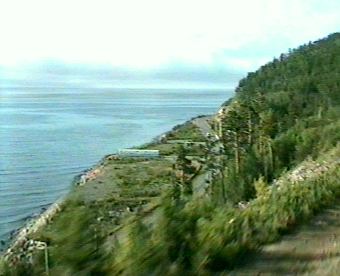
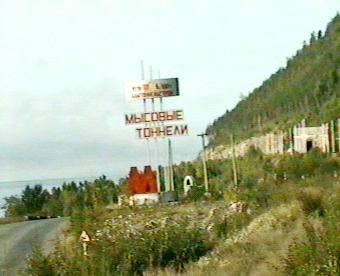
The road runs beside the railway. It's sealed here. The cars are European and left-hand-drive. The fish factory in Nizhneangarsk is working. There are still omul. The Raketa hydrofoil runs to Irkutsk for seven hundred roubles.
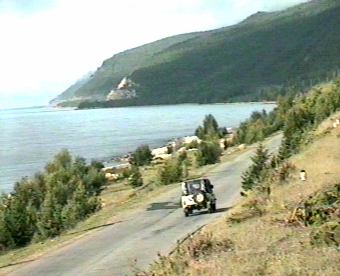
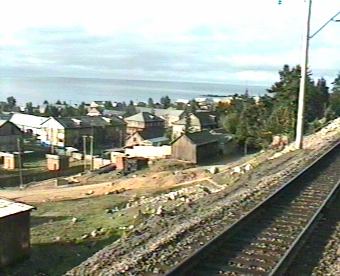
In Severobaikalsk we found that the next train west wasn't till evening.
We had barely enough money left. Tickets to Moscow cost 1,800 for the two of us and we had 2,400. We still had to get to Saint Petersburg and keep something for food. We decided on another stop in Krasnoyarsk and bought tickets as far as that. In the old timetables the train took two nights and a day, but it turned out we'd be put off in Krasnoyarsk at one in the morning. Tanya was quite upset and began muttering and swearing under her breath.
We had the whole day ahead of us. We knew Severobaikalsk well. In 1997 we'd set out from here by kayak. Now it seemed quite like home, and home itself was almost within reach, just 4,453 kilometres away. We had breakfast at the station buffet. They feed you quite well.
We went to pass the time on the beach (55°37.768′N, 109°21.002′E, 461 m).
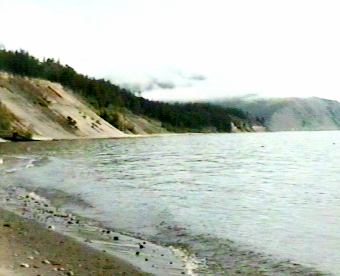
Baikal is about ten degrees in summer, but a little stretch of shallows warms to twenty and you can swim quite comfortably, which is what we did.
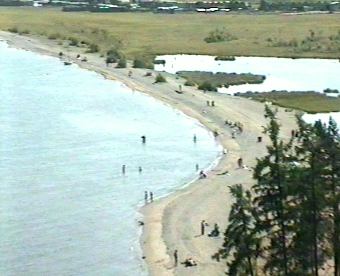
Severobaikalsk is a very pleasant town. The shore of Baikal. A mild climate compared with a place like Tynda, where it can get to sixty below zero. Hot springs nearby and a lovely forest of Siberian pines. In the early nineties they even wanted to move the management of the Baikal–Amur Railway here from Tynda. They built a seven-storey building especially for it, but the BAM fell out of favour and was divided up. The town is poorer than Tynda and even poorer than it was three years ago. Strange that this should happen with so much new construction.
Before long two kayaks coming from the Maloye More landed on our beach. Their crews were Muscovites travelling with their daughters. They'd done the route in eighteen days, which is quick. We'd taken twenty-two, though we'd gone climbing in the mountains. The talk made the wait more pleasant. I still find it astonishing that anyone can spend a whole holiday sitting on a beach.
In the evening on the shore of Baikal we cooked the last of our food and planted a Siberian pine in the cooking pot. It was a symbol of giving up food for good. We'd wanted to plant one at our place in Vyritsa for years, and there was nothing left to fill the pot with anyway. We sat lost in thought watching the evening sunset over the distant mountains of the Barguzin and Baikal ranges, and looking at Boguchany Island, where we'd had such a lovely camp. Below us some young people were having fun. A young man and seven young women. The women went swimming, putting on a striptease with squeals of “Vova, don't look this way!” Then they took him by the arms and led him in for a swim. Vova remained quite unruffled.
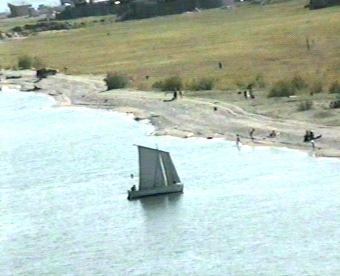
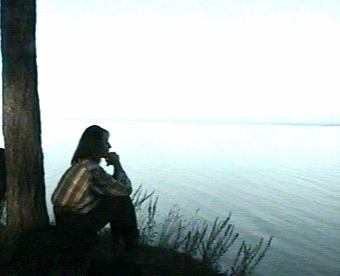
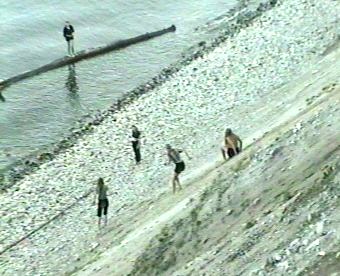
Severobaikalsk is the only station where grandmothers sell food. There's lots of omul in particular. The train was very late and we ate our way through discounted potatoes and pancakes as they went cold.
Off to Krasnoyarsk, probably the last major city in Siberia we hadn't been to. From Severobaikalsk it had seemed a very long way, and I'd been sure we'd spend two nights on the train and get some sleep. When we bought the tickets, it turned out the train took twenty-six hours and would drop us in Krasnoyarsk at one in the morning. Neither one thing nor the other: you don't get enough sleep on the train and you can't fit a tent into a big city in the middle of the night. The train was three hours late, so it was quite late at night when we left. I was dying for sleep and struggled to stay awake to see us pass through the tunnel under the Baikal Range. I managed it, though I was almost unconscious by then. In the morning my treacherous body, still on Kamchatka time, woke without anything like enough sleep. At least I didn't sleep through the Bratsk hydroelectric station. The railway runs right over the dam. An enormous sea on one side and the power station's turbines on the other.
At Bratsk the deputy head of the local DOSAAF defence-sports association joined us. He was an avid hunter and a former military pilot. He'd served with Dudayev, which had earned him the nickname “the Chechen”. Somewhere he'd got hold of a Mi-2 helicopter for free and was on his way to the bosses with the papers to be allowed to fly it on hunting trips around Chemdalsk. I'd been looking at that country for a long time: the Katun, the Podkamennaya Tunguska, the site of the Tunguska meteorite impact. He was very surprised we knew his part of the country, even if only from books. He was delighted to have a talk with us. The idea of travelling around the world appealed to him. He put a bottle on the table and we talked the whole day away, solving the problem of feeding ourselves at the same time. We must have looked very hungry, because he fed us his entire private stock.
I don't usually get to sleep after drinking, and I didn't get any rest before Krasnoyarsk. The train came in at two in the morning. A hundred metres to the left of the station we found a little park with quite thick growth and put the tent up in the long grass (56°00.387′N, 92°49.761′E). Just as we lay down, two local policemen emerged from the place next door with some young women. We were so well hidden they didn't see us from two metres away. We then witnessed a superb strip show, which we had to listen to and watch since there was no sleeping through the loud female exclamations. “Where are we going? It's too dark here.” “I won't any more. Don't open it.” “Behave yourself.” “I'm not having any more vodka.” “Do it up.” “Give me back my T-shirt. It's cold.” “Get your hands out, that hurts.” “I won't any more. Don't open it.” “Why did you take my knickers off?” “Hands off.” “It's dirty here, there are tramps and mangy dogs.” “Ow.” “You got my boob with a nettle.” “Don't!” “Ouch.” “It's dirty here.” “Aaaah, aah…” “I don't want to do it again.” “Aaah…”
It grew light just as they finally wore themselves out. We got no more than an hour's sleep. Before our long day we allowed ourselves a cheburek and coffee.
We took minibus No. 50a to Stolby. On the road to Divnogorsk and Abakan there's a turn by the Turbaza stop. The first pillars are six kilometres along the road and about three hundred metres higher up. Stolby is a nature reserve, so everything is forbidden, but lots of people come. Everything's trampled, scribbled on and stripped of berries. On the whole it's quite clean. There are benches and maps of the area all around. It was early in the morning, and there wasn't a soul about. Chipmunks and squirrels ran across the road. Tall mixed forest on either side. The pillars themselves are rocks up to a hundred metres high. With trees this tall you only see them when you get close. The pillars are heaps of individual stones with very rough faces.
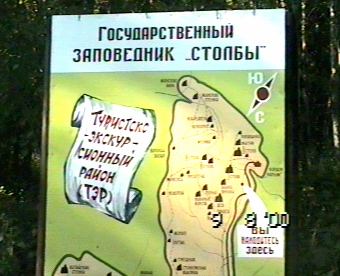
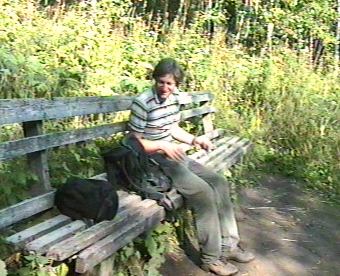
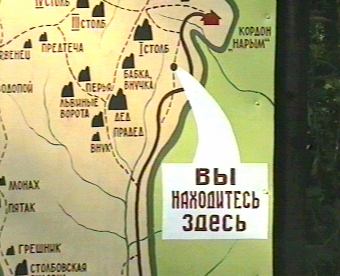
There are dedicated locals called stolbisty who like to climb the pillars in galoshes and without ropes. There's even a local newspaper called Stolbist.
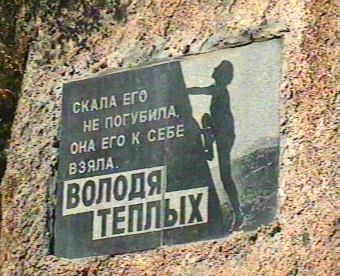
After two sleepless nights I didn't have the energy to climb all over the place, and made do with a low, easy pillar. All the pillars have names. I liked the Feathers and Grandfather best, which is the usual view. Stolby is a pleasant place on the whole and worth the walk, though there are bigger cliffs on plenty of other Siberian rivers. Compared with the volcanoes of Kamchatka they're a little heap of cobblestones, and nobody would think of them if Krasnoyarsk weren't next door. You can take a chairlift from the Bazaikha stop to gain a few hundred metres, but you still have to walk six to eight kilometres to the main pillars. We walked down beneath it. At the shop we bought a loaf and some milk. Tanya couldn't resist adding a hundred grams of sausage.
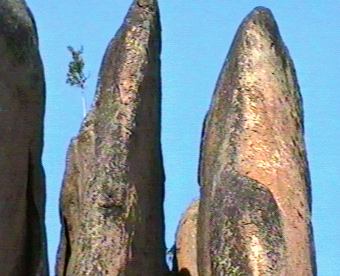
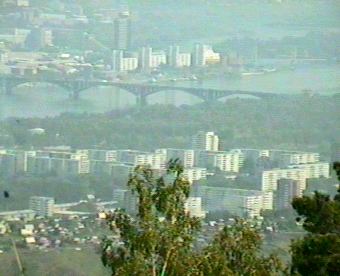
After Stolby we went back to the centre and followed the Yenisei to the river terminal. There is a passenger service on the Yenisei. Boats run upriver to Divnogorsk and downriver to Dikson. The timetable is complicated, but there are on average one or two a week. Three days to Dudinka, seven back. The cheapest ticket there is 790 roubles. I asked about the fare back and the woman at the counter smiled. “Once you get to Dudinka, you'll find out.” It was hot and we were thirsty. Tanya took our bottles to the lavatory. As she came out a man without a home said, “You've had your drink. Give me some.” We really must have looked a sight. It made an indelible impression on Tanya.
We went to see the town, but our legs wouldn't do what they were told. After a few hours of trying to wake up we found a hidden spot on a little island in the Yenisei, set the alarm for nine in the evening and fell asleep. We felt much better when we woke. We walked round the city centre and took the Lena–Moscow train as far as Vyatka. We only had enough money for the route with a change at Vyatka. We could no longer afford to go via Moscow.
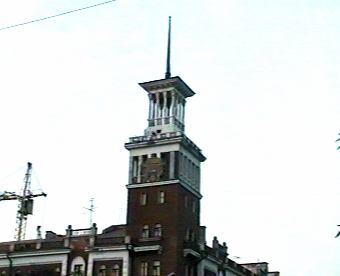
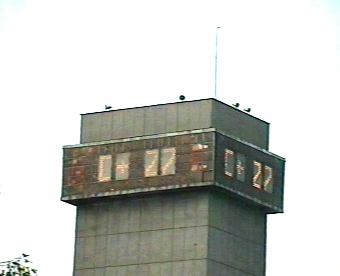
For two days we caught up on sleep and looked out at the endless, featureless West Siberian plain, with the little hills of the Urals separating it from an equally dismal plain on the European side. Our fellow passenger was a shuttle trader from Bratsk. A thrifty woman who hadn't brought much food. We had to get by on the little we had.
In Kirov we found it was altogether impossible to get away to Saint Petersburg. People with children lived at the station for weeks. One or two tickets a day were thrown to the wolves and fought over. Realising there was no point joining the fight, I found the station manager. A woman, as it turned out, and as an old hand on the railways I went to have a chat. She was a lovely lady, gave me tea, took my money and papers and went off to the ticket offices. I sat expecting to triumph over the ferocious queue, but we ended in a hard-fought draw. There were no tickets at all. It was already two in the morning, and the Perm–Vladimir mail and baggage train came in very handy. For forty roubles we got a night's sleep and moved nearly six hundred kilometres in the right direction. The woman next to us was a teacher returning from a visit. She listened to the story of Kamchatka with great interest and fed us the little parcel her hosts had given her for the journey. She takes boat trips down the Volga herself.
We got off at Nizhny Novgorod because the train would have reached Vladimir late at night. The ticket situation was just like Vyatka, and on top of that I'd never seen a more senselessly run station in Russia. The only thing easy to find was the all-night dealership selling GAZ vehicles. The train timetable was posted as a computer printout in one place in the whole station. I couldn't find a timetable or route diagram for the suburban trains. You had to pay for the waiting rooms and there wasn't any water, let alone boiling water. The information screen had an idiotic interface that took you through five levels of menus before telling you it couldn't connect to the Express ticketing system. Even the cash machine had lost contact with the outside world. Trying to take the train by storm didn't work. We could only afford the cheapest open carriage by then and there were people beside us ready to pay triple. The buses to Moscow had gone and we had enough for a bus only as far as Vladimir. Tanya, soft-hearted woman that she is, bought some sausages and a loaf. That left hitchhiking. We took bus 120 out onto Moscow Highway and stuck out our thumbs, to no avail. Nobody was going farther than Dzerzhinsk. The two of us, with packs and a pine tree, took up too much space. We looked terribly bedraggled and reeked of sulphur like a couple of devils. People here weren't like the ones in Kamchatka. Drivers thought it funny to give us a rude sign and laugh. It grew dark and we went to sleep in the bushes, deciding to get a good rest and start early. We ate our last sausage (56°18.501′N, 43°42.214′E).
In the morning Tanya began whining about suburban trains and buses, but then we had an unexpected stroke of luck. A man delivering a Sobol van on Nizhny Novgorod plates agreed to take us to Vladimir. Moscow, he said, was out of his way. He was going to Saint Petersburg. Our luck took our breath away. Twenty hours and we'd be home, and for the first time in a week we ate our fill, spending our last roubles. There was a beautiful sunset near Valdai that evening. We arrived at night to find the bridges up. We had to wait at this last water obstacle and then walk, hoping there'd be food at home and the water heater would work. Walking felt easy and it was almost a pity we were so near.
Acknowledgements
The world is beautiful. Isn't that wonderful? Many people helped us understand it, see it and hear it, and then write about it. We'd like to thank all the drivers who gave us rides, the people who shared their food with us on the way, and everyone who talked to us.
Among them were the photographer Vladimir Glazkov, who takes beautiful pictures of Kamchatka; the volcanologist Alexey Ozerov; the Even hunter and his wife, who gave us a ride from Esso; the owner of the shawarma place by the market in Petropavlovsk, who took us from Ust-Bolsheretsk; the KamAZ drivers who picked us up near Klyuchi; and many others. Thank you, all of you.
Special thanks to Vladimir Dinets for a number of corrections to our account. His wonderful books about Kamchatka (http://dinets.travel.ru) helped us prepare for the journey.