Peru
Peru 2004. Inca, Wholesale and Retail
We came to Peru by bus from Bolivia. From October 2003, Russian tourists no longer needed a visa. It was enough to show your passport and get a little stamp. We were lucky because the former socialist countries were joining the European Union. The Peruvian government issued a new list of visa-free countries and Russia somehow got on it, by mistake. They say it took quite an effort by the Peruvian ambassador to Russia. Over in Peru, they don't entirely understand the gulf that now separates Russia from the first-tier European countries. In any case, thank you!
The Peru–Bolivia border is guarded in name only, and getting your passport stamped is an entirely voluntary undertaking. Nobody else is interested in the stamp until you leave the country.


After a long stop, our bus finally got all its passengers back and set off for Puno. First impression after Bolivia: they're similar countries, but here there was more money. Better roads, street lighting, a fresh coat of paint on the houses.
There are lots of Internet cafés. The mobile network isn't very developed, though. The American TDMA standard is the basis for it, naturally, but there's also one GSM 1900 operator, TIM Perú. It covers a few big cities and a stretch of the Pan-American Highway. A local SIM isn't worth it. The SIM itself is sixty soles before you put any credit on it, and the prices are almost the same. A text to Russia is $0.28 when roaming and $0.145 with a local card.
It was already dark by the time we got to Puno. As expected, a crowd of touts rushed at the bus. A wonderful choice of offers. Standing in the middle of a circle of travel agents, we worked our way through the local accommodation market and picked the Manco Capac Inn.
The taxi cost us three soles. A US dollar bought 3.46 soles. To our surprise, the driver wanted local money, and one American greenback wouldn't do. We had to change money in a hurry at the hotel. We didn't need to arrange any of this ourselves. The lad we'd picked at the bus station, from Inka Adventure, sensed easy prey and sorted out every little problem for us. All the same we still had to fill in a form as long as your arm. For some reason Peruvians think you simply can't spend the night in a hotel without giving your maiden name and where you work. The form was in Spanish, of course, and not every hotel had bothered to translate it. Never mind, we can manage in Spanish. I especially liked the names of the professions. Tanya, for example, is a programmer, a programadora. Now I sometimes tease her and call her my little programadora. Lena is an accountant, contable. I don't call her that; fortunately, my tongue won't get round it.
We were already in our room and there seemed to be no way to shake off our escort. We told him we'd look through the available offers on our own and only then spend any money. He clearly didn't like that, but there was nothing for it. It took quite an effort to make him leave. He was lamenting his poor English and the fact that he'd failed to get across all the delights of a tour from Inka Adventure in particular.
We dumped our things and went for our first walk on Peruvian soil. The main street sparkles with attractive shop windows and everyone strolling down it seems to be a foreigner. Touts shout loudly, trying to drag in an unwary tourist or, failing that, to shine his shoes.
We stopped at an ATM for cash. A few presses on the buttons and we got five hundred American dollars. Yes, I should have paid more attention to the buttons. Who knew it didn't speak English but knew how to hand out dollars? We had another go, with more success this time, and came away with a pile of local money.
We went into the nearest little restaurant. Cosy tables and tuneful European music. An antique wood stove burned quietly right in the room; from time to time they even roasted meat in it. It was all lovely and pleasant. The staff could speak English. After Bolivia, that seemed a miracle. Peru's signature drink is the pisco sour. We ordered one, liked it and ordered another. We spent a pleasant evening talking. Peru seemed an excellent place, and how lucky we were in life! ‘And all this for us.’ The only thing was that we wanted to sleep.
Back at the hotel we finally managed to send our dirty clothes to the laundry. We had a mountain of them, everything from the jungle and the salt flats. Most of it had been wet for fifteen days and smelt like a rotten sack. A real test for the local laundry women. It cost four soles a kilo. In Bolivia you could buy a change of clothes for that money.
It was still just the two of us, but Lena Kazachenko had flown into Peru that day. Tomorrow morning she'd join us.
And join us she did! After the long journey and several sleepless nights, we were so keen to sleep that we even had the foresight to turn our phones off. It did no good. At five in the morning, still not used to the local time, eight hours behind Saint Petersburg, Lena made enquiries among the locals, worked out where we were, and ended our sweet dreams with a loud knock at the door.
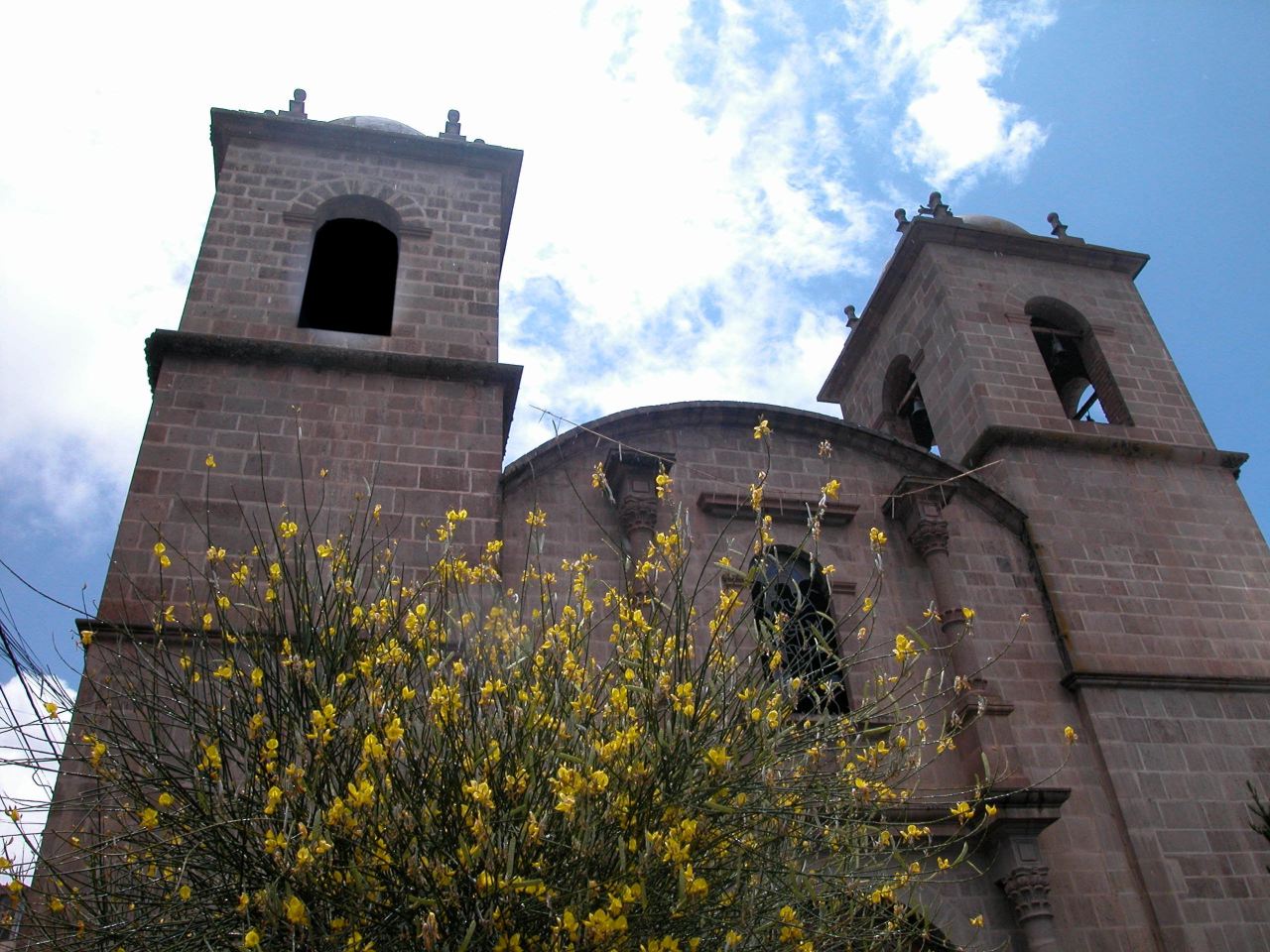
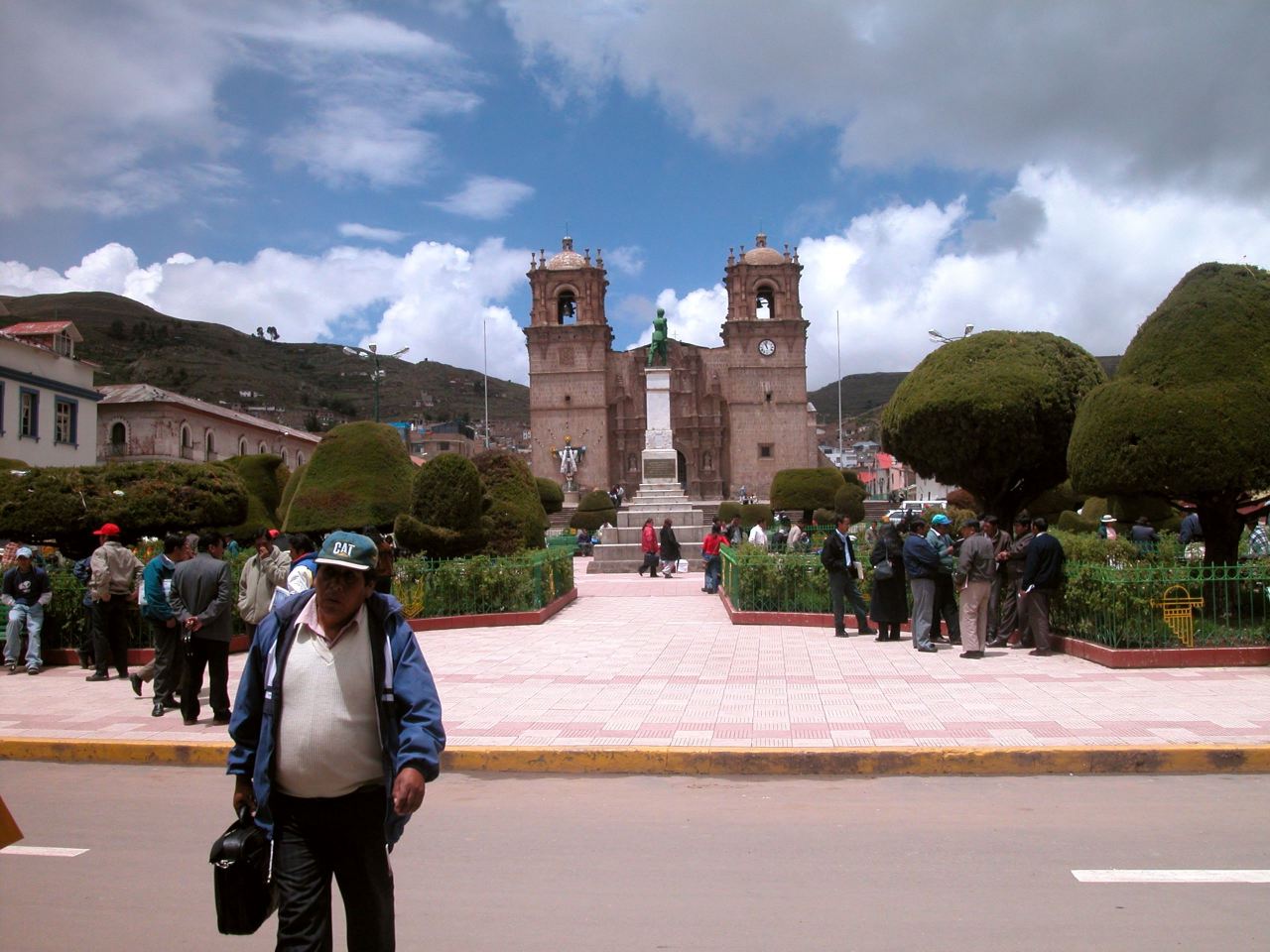
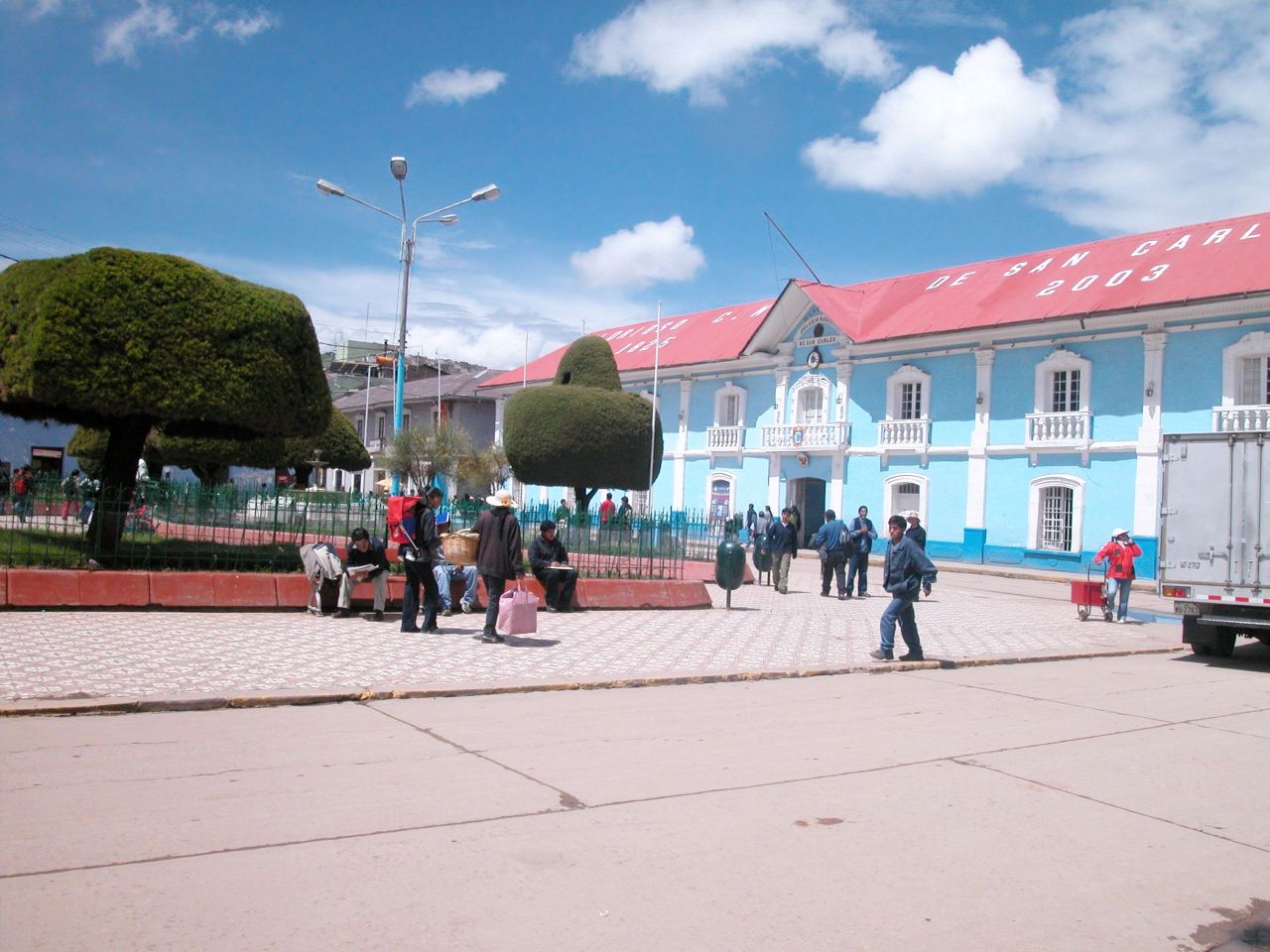
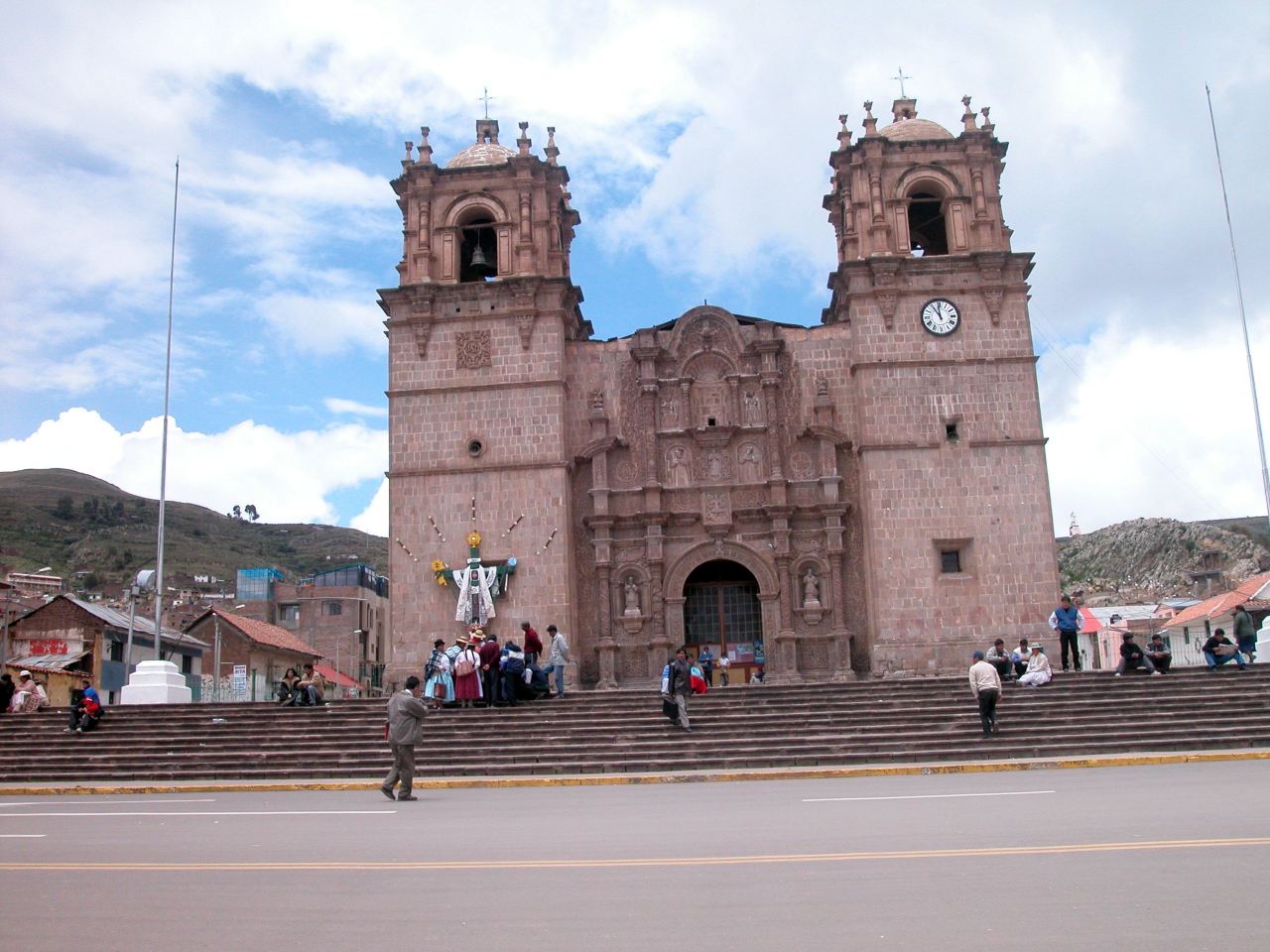
It would do her good to get used to the altitude on the first day, so we planned to take it quietly. We began the morning with a walk around Puno. It's a well-kept town, though there's nothing much to see. Out of boredom we climbed one of the little hills above town. By rights, in Latin America there ought to be a statue of Jesus on top. Puno has plenty of hills, though, and one of them also has a huge iron eagle.
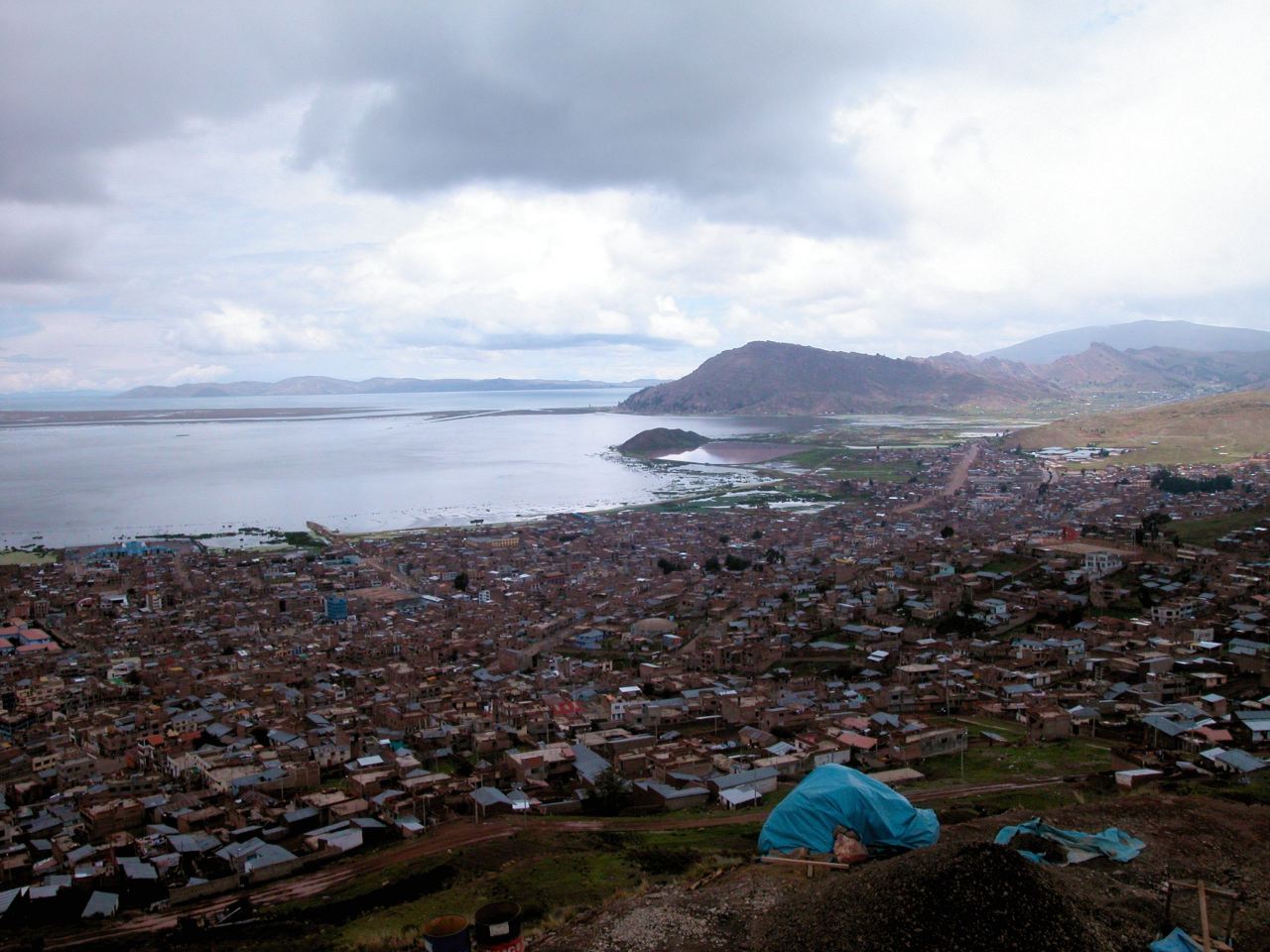
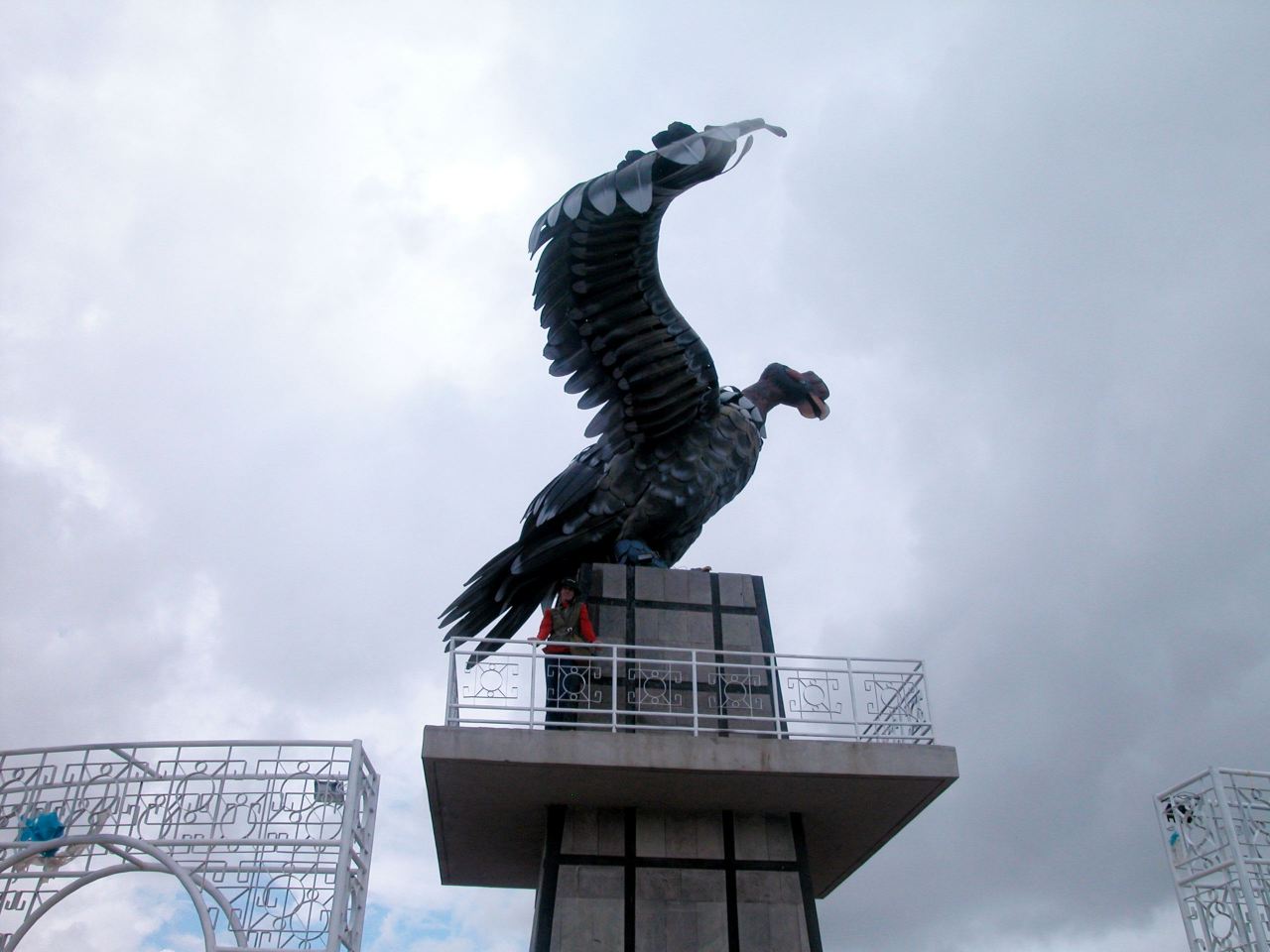
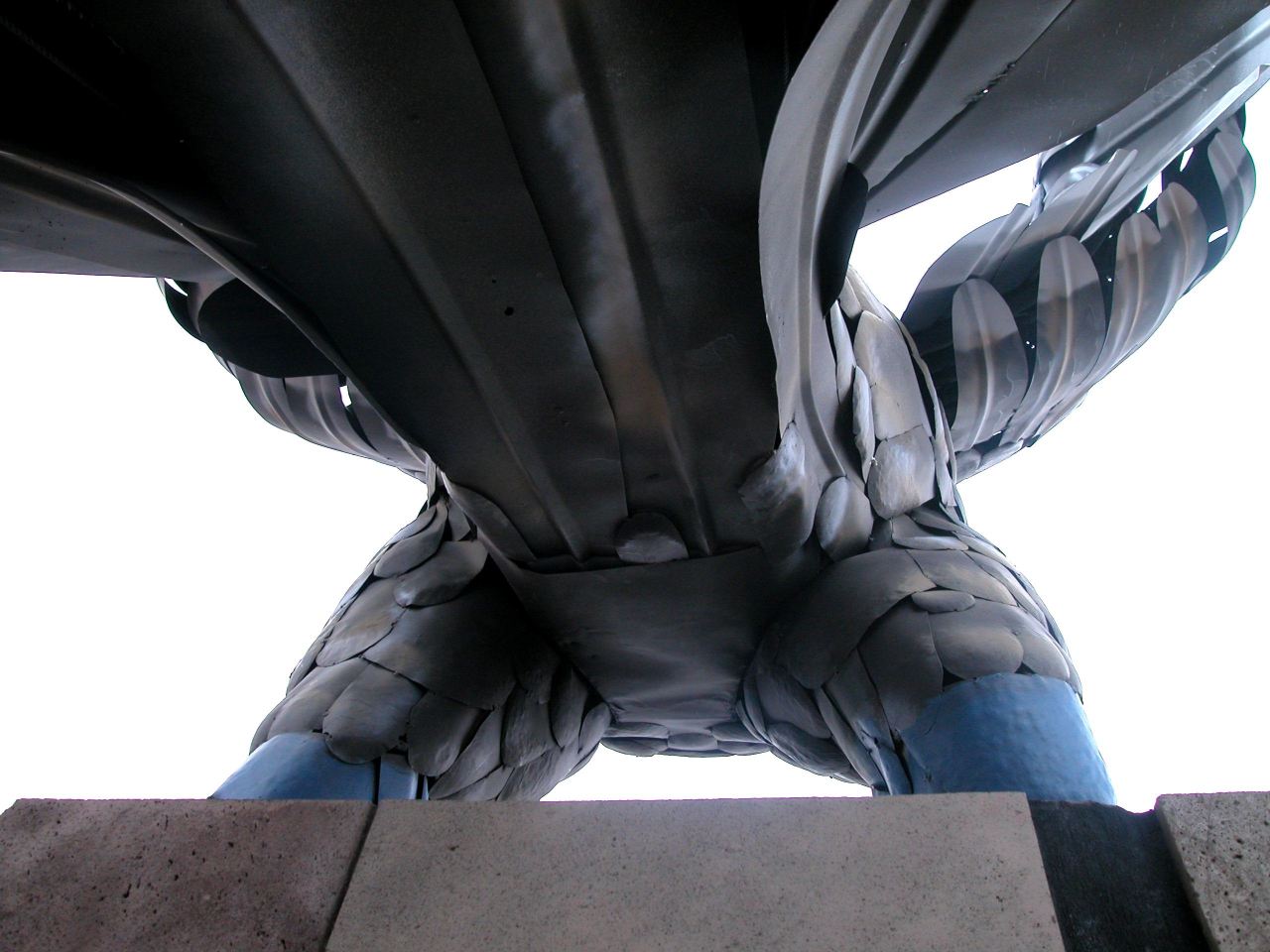
Then the women went into the shops to kill time, while I stood on my own outside, fending off offers to shine my shoes. After the salt desert and the Amazon swamps there's nothing that could help them now. I tried explaining that, in vain. They said they had a new super-technology, and there were plenty of them about. Shoe-shine men are held in some esteem today. The country's current president did start his career in their line of work, after all.
In the evening we took a tour to Sillustani, ruins of an Inca temple lying twenty kilometres north of Puno. Our guide was a perfectly phenomenal bore. He kept complaining that people were laughing too loudly and not listening to him. He tried to get us to stand next to a rock so we could feel some kind of energy. Then he asked, ‘What do you feel?’ An elderly Englishman summed it up: ‘We feel like a bunch of idiots.’ I might add that Sillustani is poorly preserved, and if you never visit it you won't have missed anything.
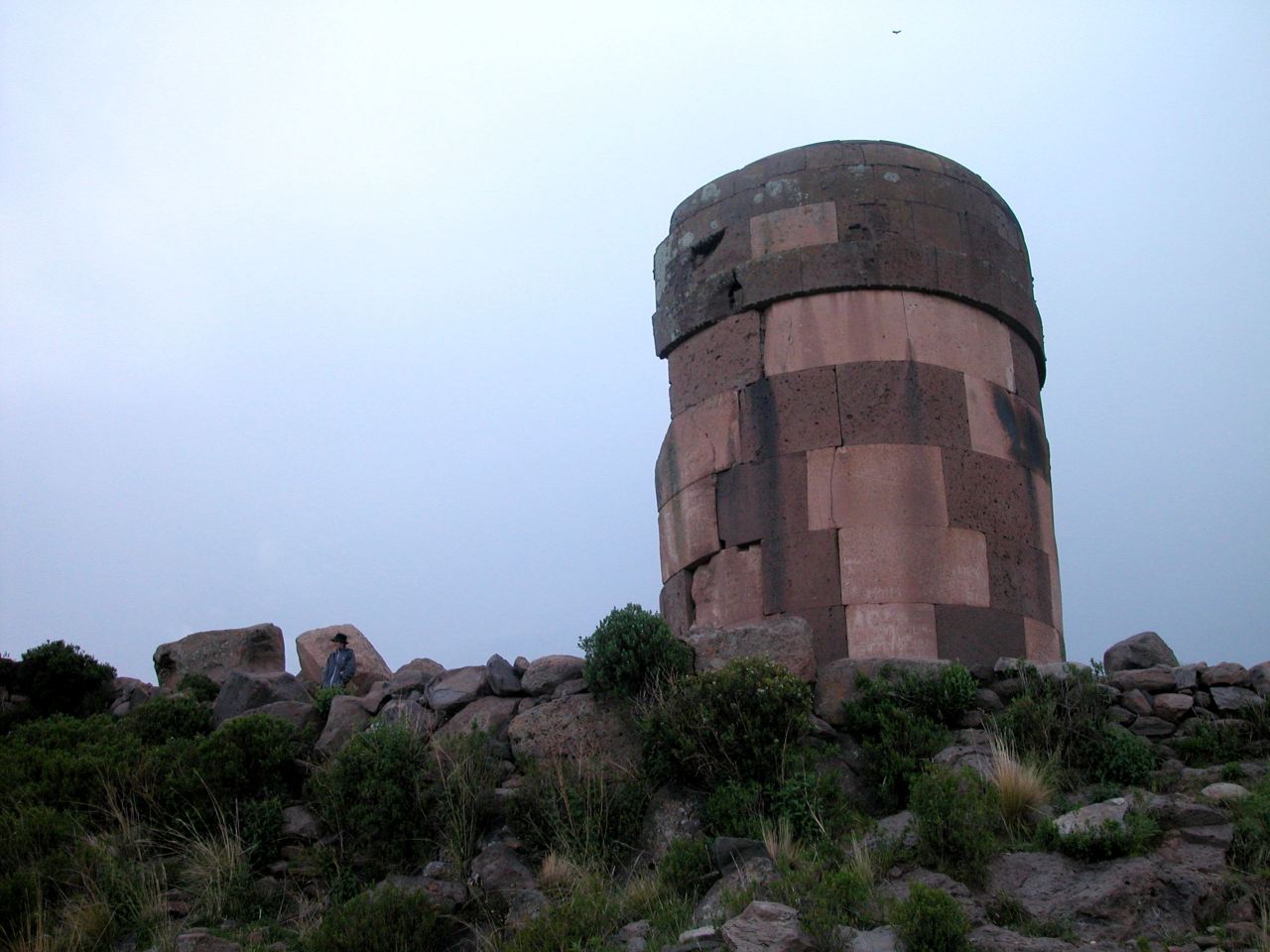
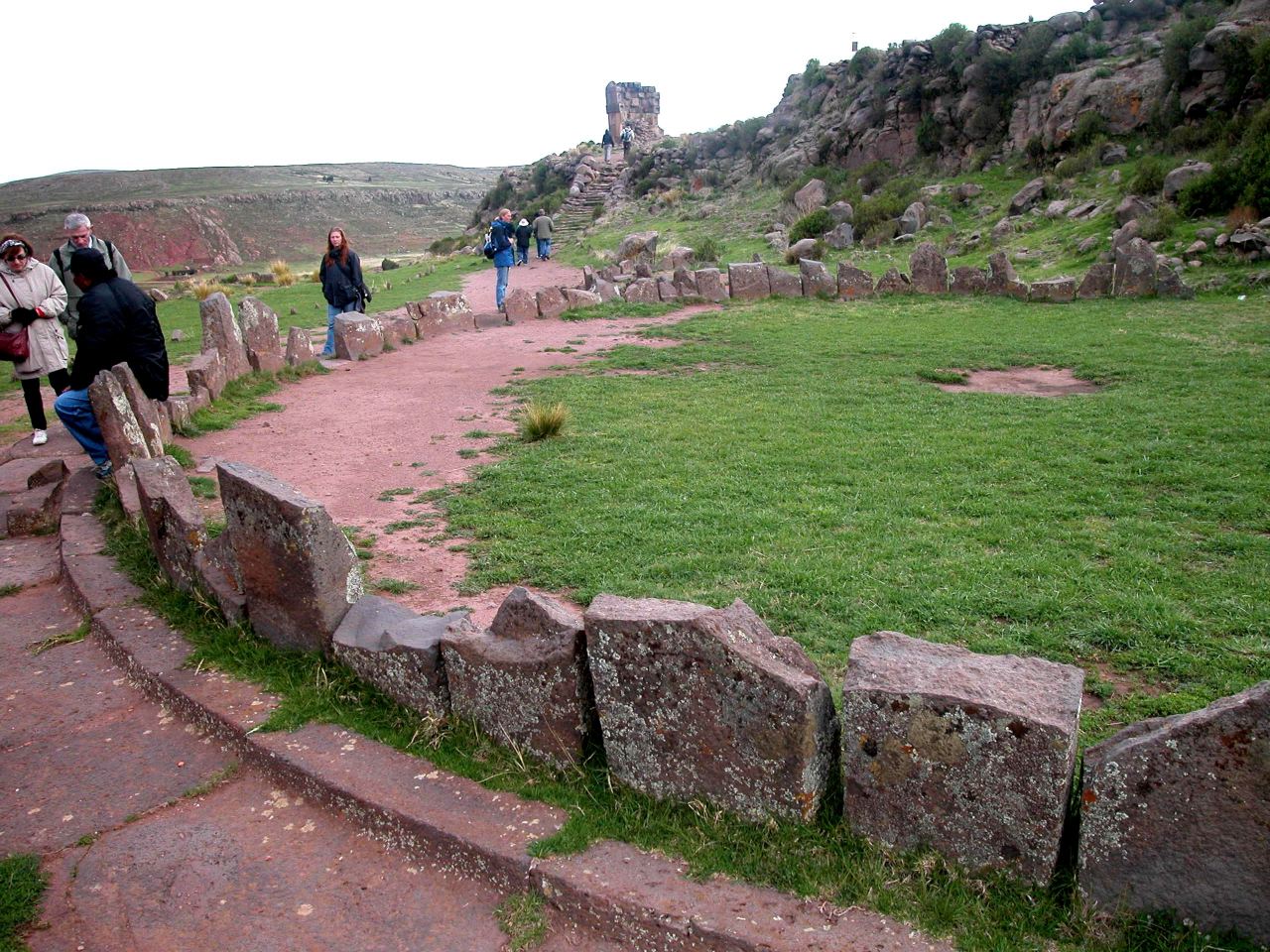

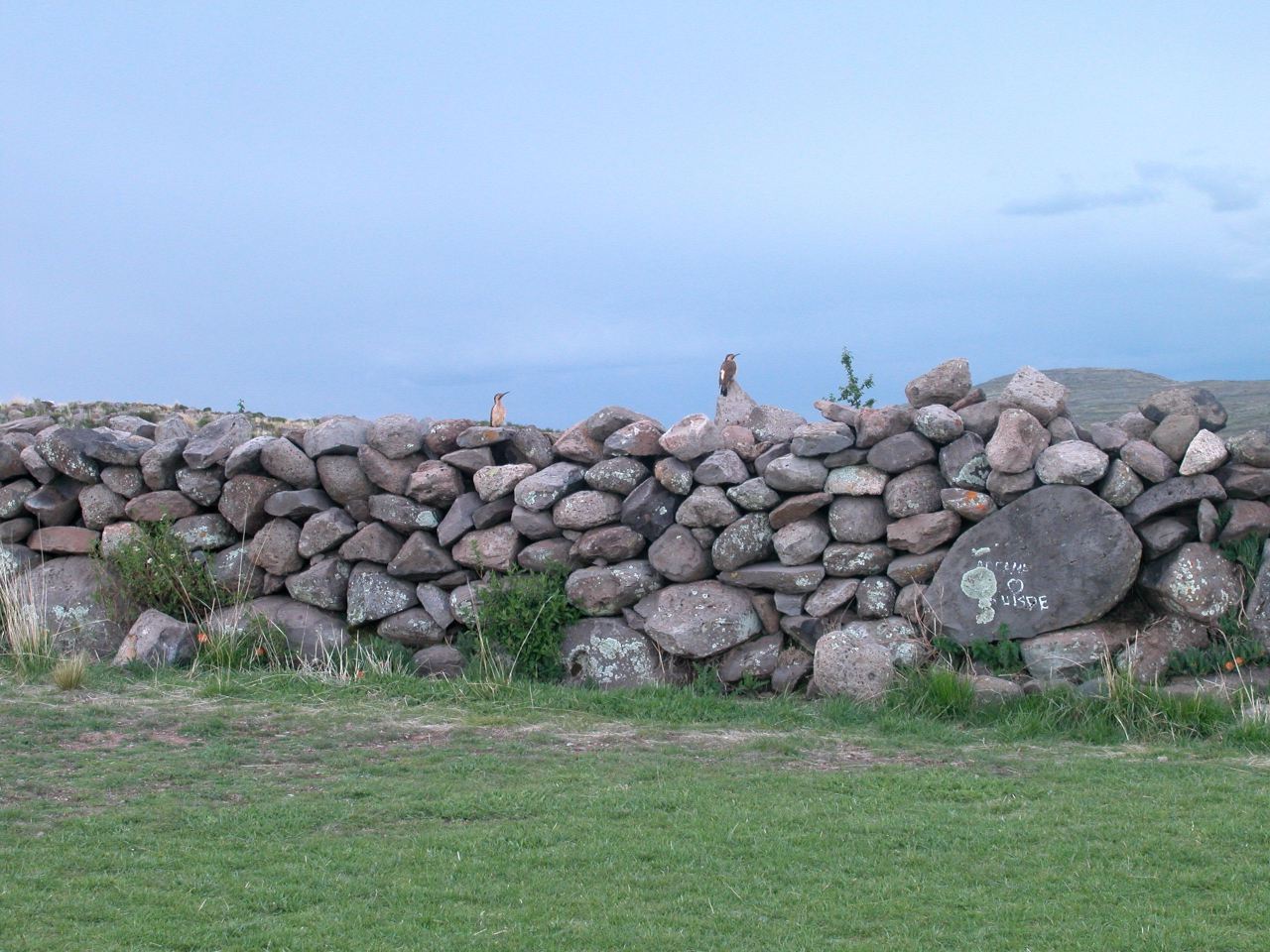
They say all sorts of occult people congregate here. These mountains are supposed to be directly below Tibet, and when winter begins up there people take off for somewhere warmer. Some axis of energy supposedly makes these places equally sacred. Mountains everywhere, lamas there, llamas here… People believe it, though there's no reason to. Look at any map and it's clear that what's on the opposite side of the Earth is the South China Sea off Vietnam. The closest landmark is the famous Golden Triangle. If there really is a link through the Earth's core, it involves quite different spirits.
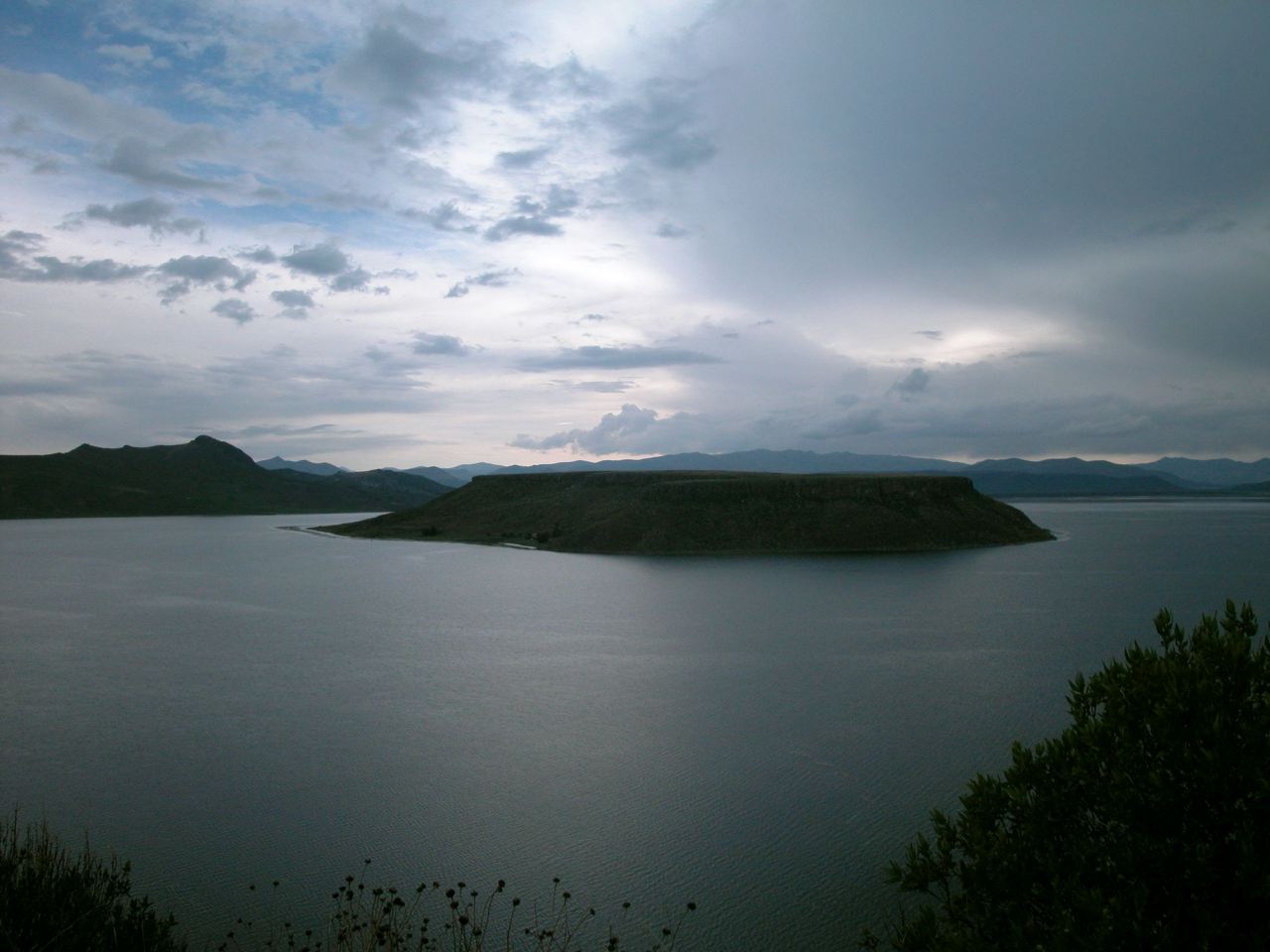
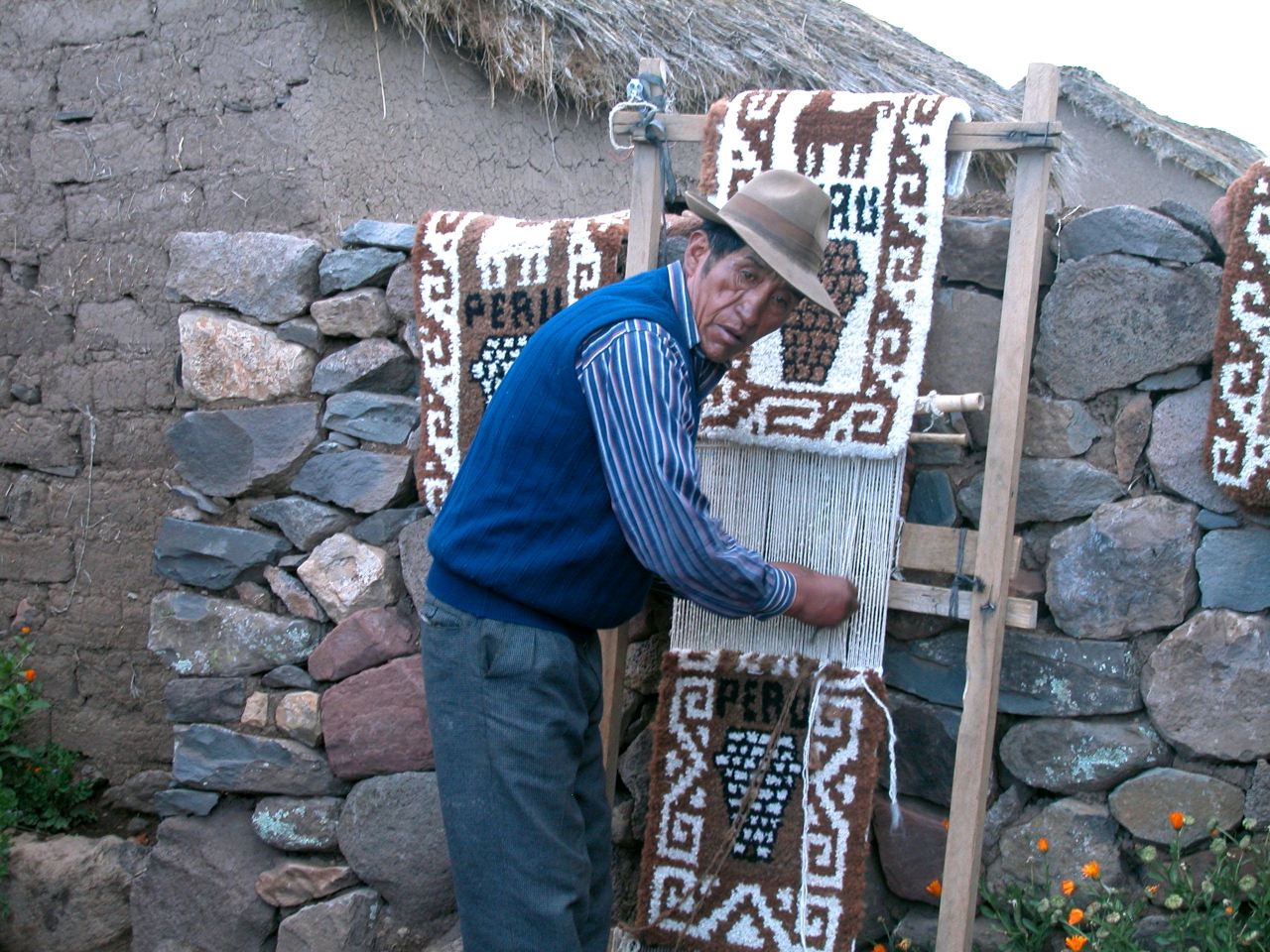
Cold and crazed with boredom, we still had to visit a village where the locals put on an imitation of traditional life.
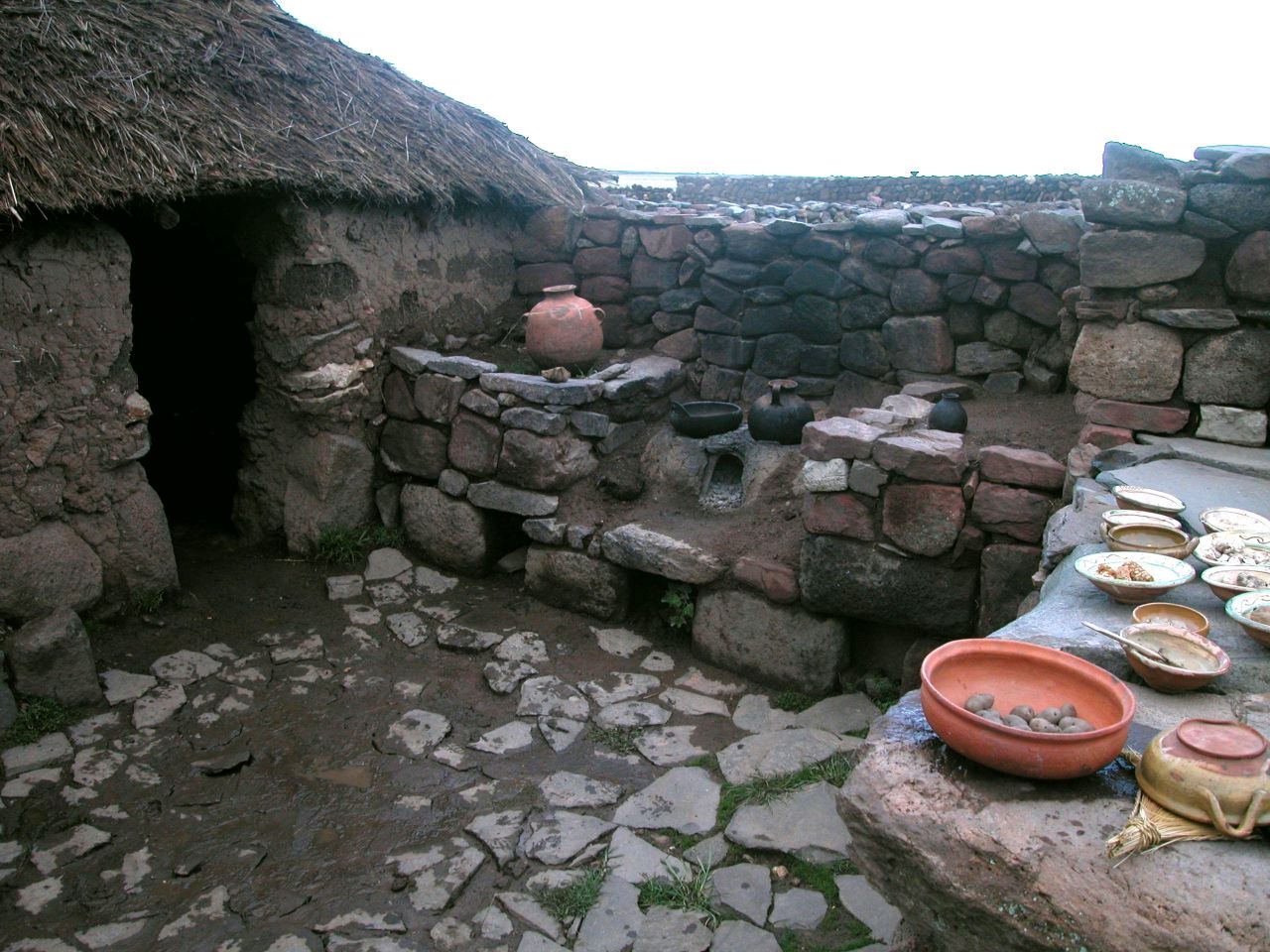
We spent the rest of the evening after getting back at cafés of various kinds. Fortunately there are plenty in Puno, the portions are small and the food is good.
Lunch in a typical Peruvian tourist town usually comes to twenty or thirty soles. Out in the wilderness you can eat for four. Soup is the custom. I don't know where it came from. The Spanish don't seem to eat it.
The star of Peruvian cooking is alpaca. A serving costs between fifteen and twenty-five soles. It really is delicious, especially in a wine sauce. Every restaurant has fish from Lake Titicaca. Usually what they called salmon. They brought it to the lake from Canada twenty years earlier, the story goes. It had bred and eaten all the other wildlife, so the only thing left to do was promote it as food of the Incas.
Serving sizes in Peru are quite unpredictable. Sometimes you're left hungry, sometimes they give you three times more than you can eat.
On our third day we took an organised tour of Lake Titicaca. The man who'd met us at the bus station hadn't left us alone for three days. After getting the price down to sixty soles per person, we agreed to a two-day tour with him.
In Peru they pick you up right at your hotel when you go on a tour.
There was a weather-beaten vessel at the pier, what they call a barca in Spanish. Before we left, a representative of the unsolicited-services industry played us a tune on a pipe. One sol from everybody, by custom.
Lake Titicaca is supposed to be the highest lake in the world, which obviously isn't true. Then you have to add the qualification about being the highest navigable one. That's not right either, but something has to be declared the best of its kind in the world. The water of Titicaca is slightly salty. You can't taste the salt and the people who live here use it as drinking water. The lake has an outlet. The Desaguadero River carries the water to the salt lake and desert of Poopó in Bolivia. Puno's part of the lake is separated from the main body of water by a neck of reeds. A channel has been cut for the boats. Near the shore at Puno, the lake is dirty and the water has duckweed on it. Out in the lake proper it's quite different. The blue water is clear to a depth of ten metres and fit to drink.


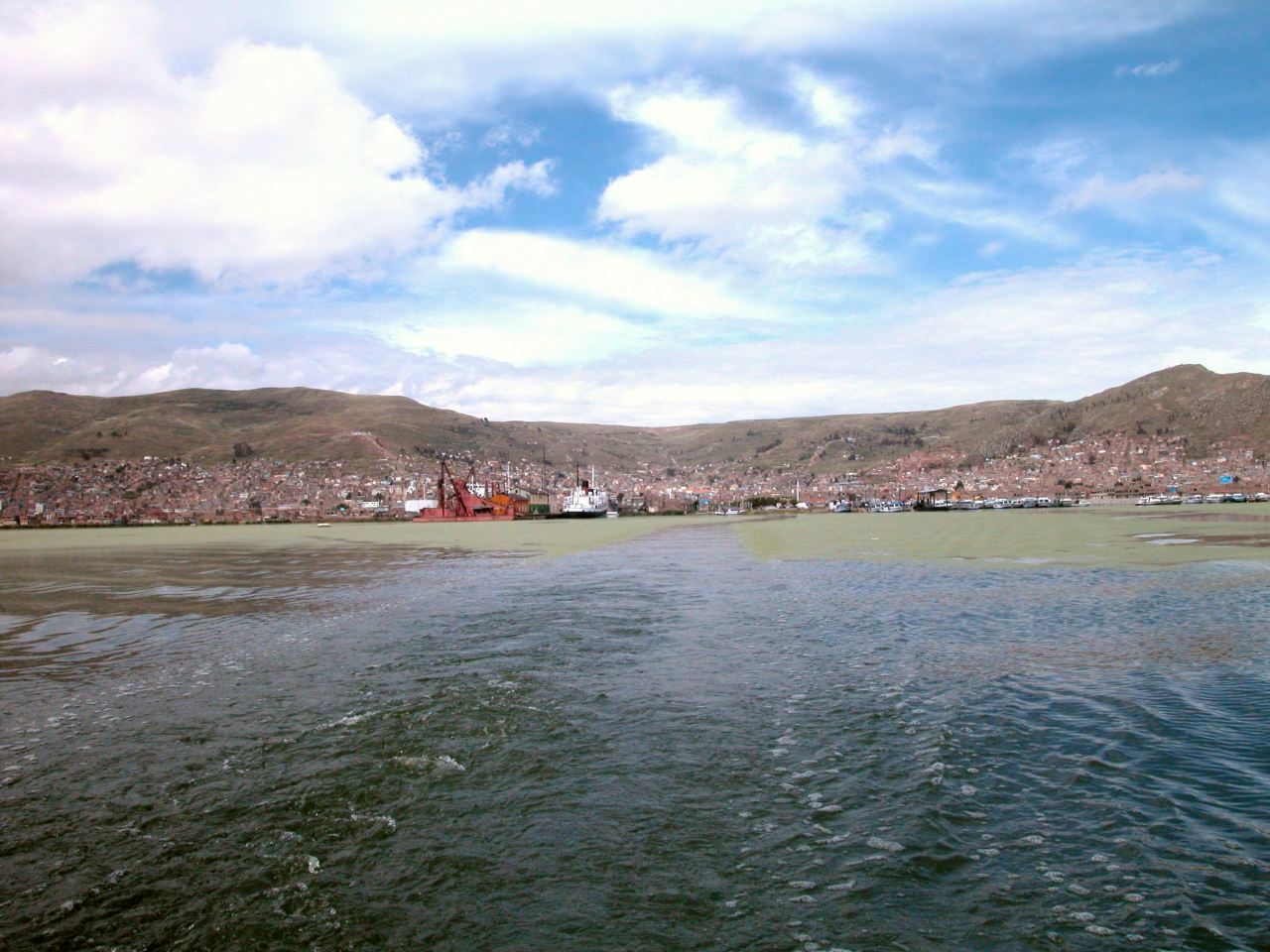


The shores of Titicaca are heavily settled. People do a little fishing, but mostly they use the lake to gather reeds to feed livestock. People eat them too. I ate a whole stalk and rather liked it.
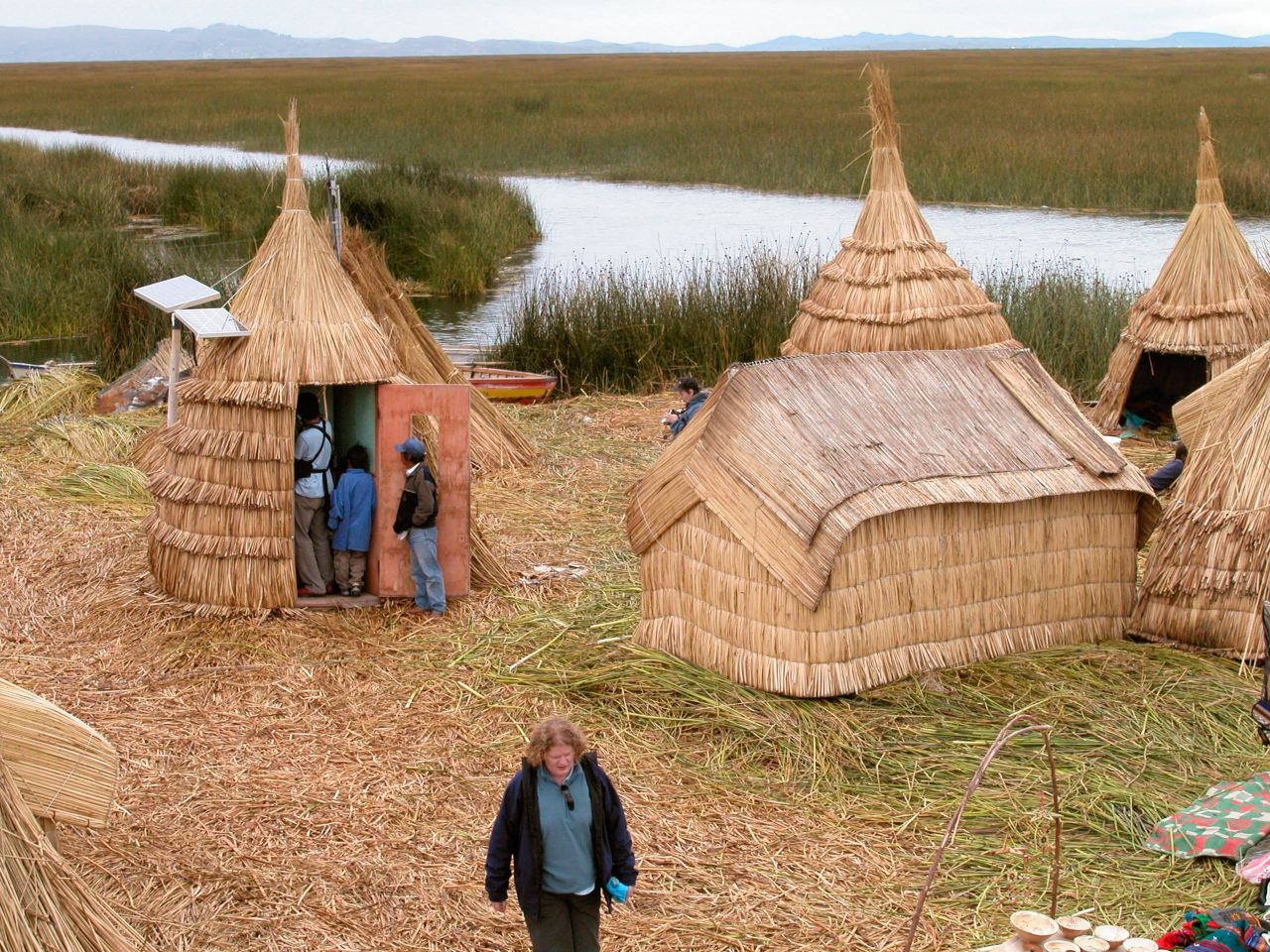
The first tourist stop is the floating islands of the Uros. They make them out of reeds, with reed houses on top. In places they've added a layer of earth and grow potatoes on it. People used to escape from the authorities and other brigands on these islands. Nowadays they're moored in place. The border guards have fast launches, and you can't sail away to Bolivia. There's no regular passenger service between the two countries at all.
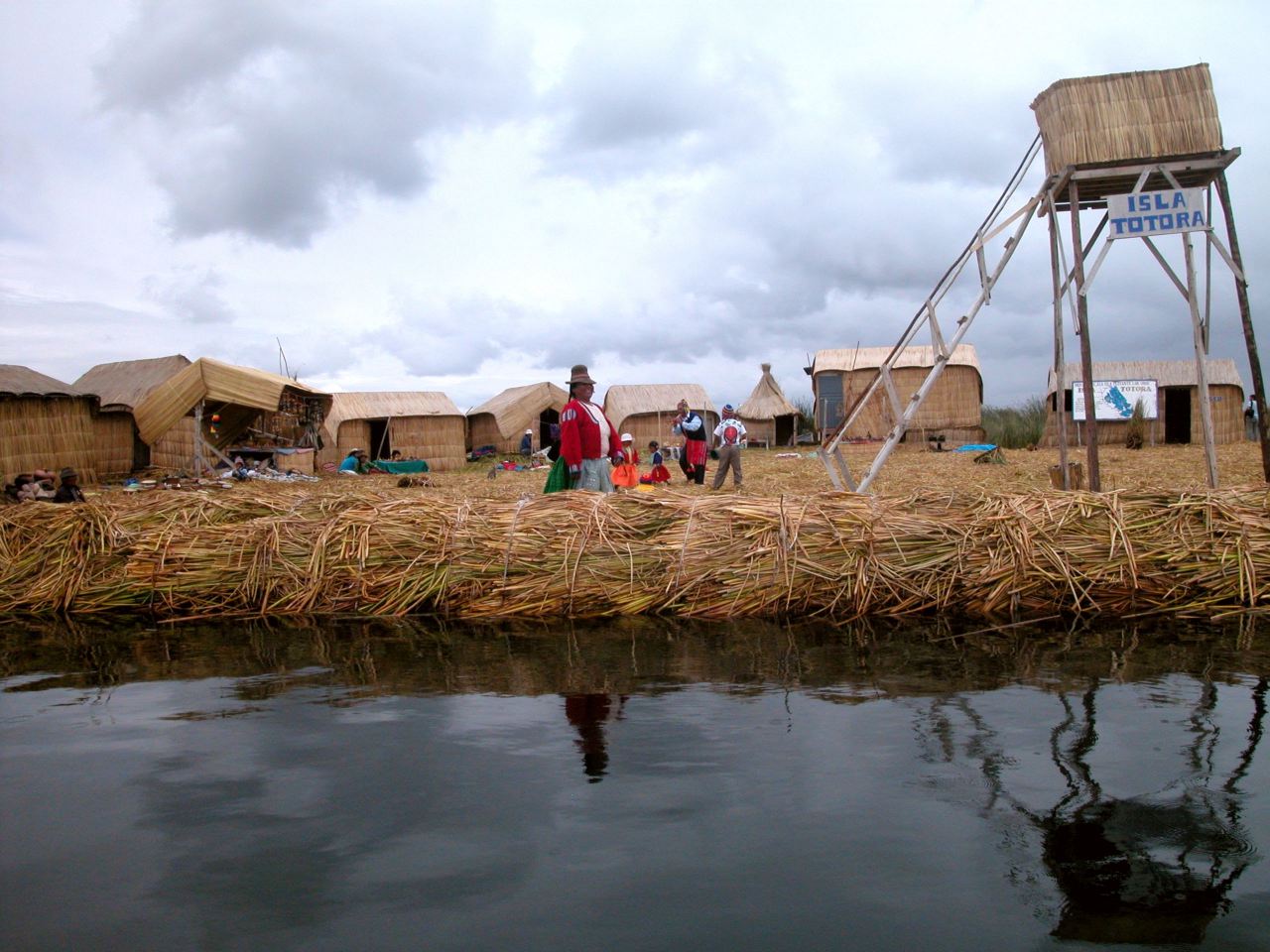

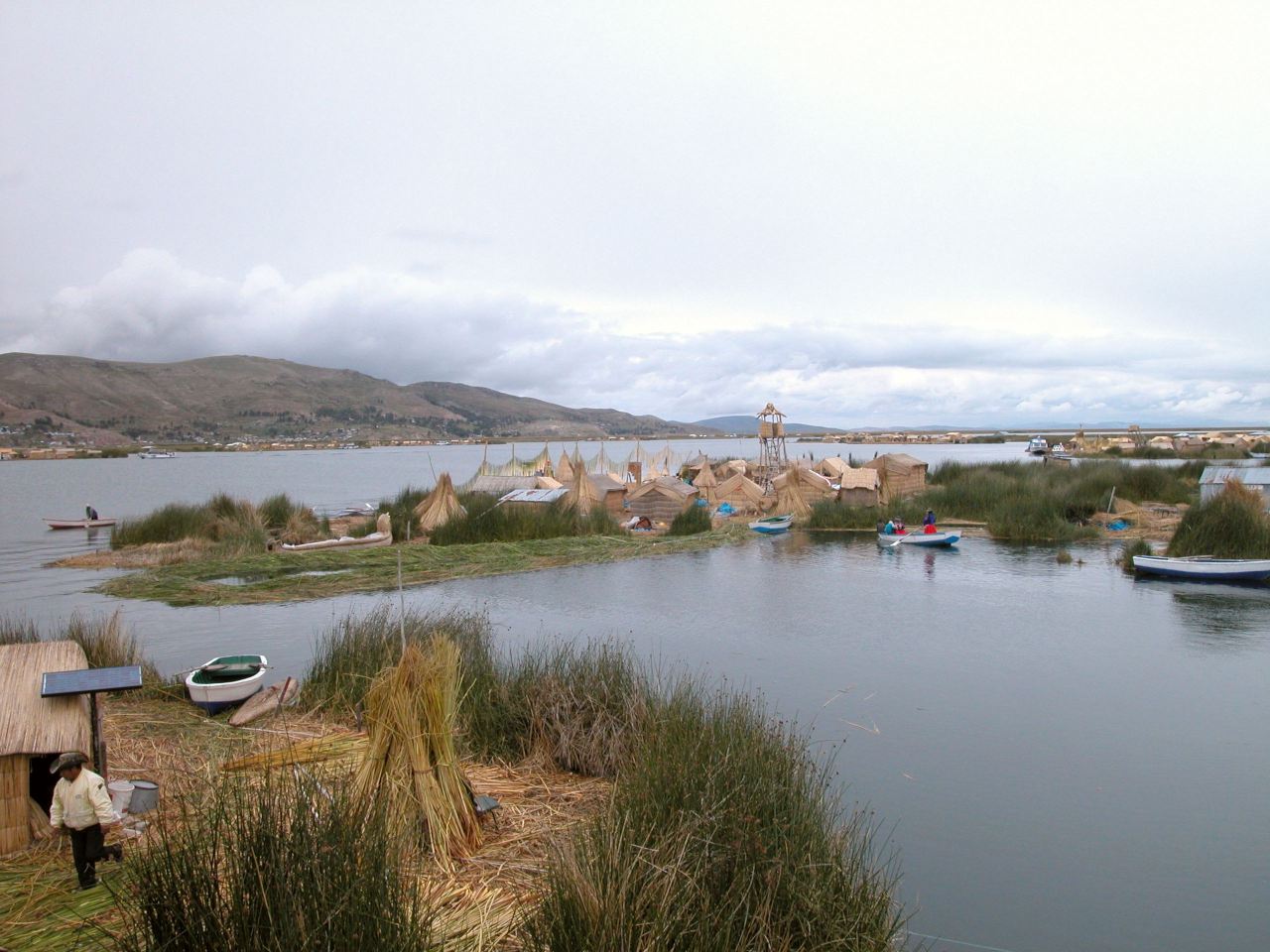
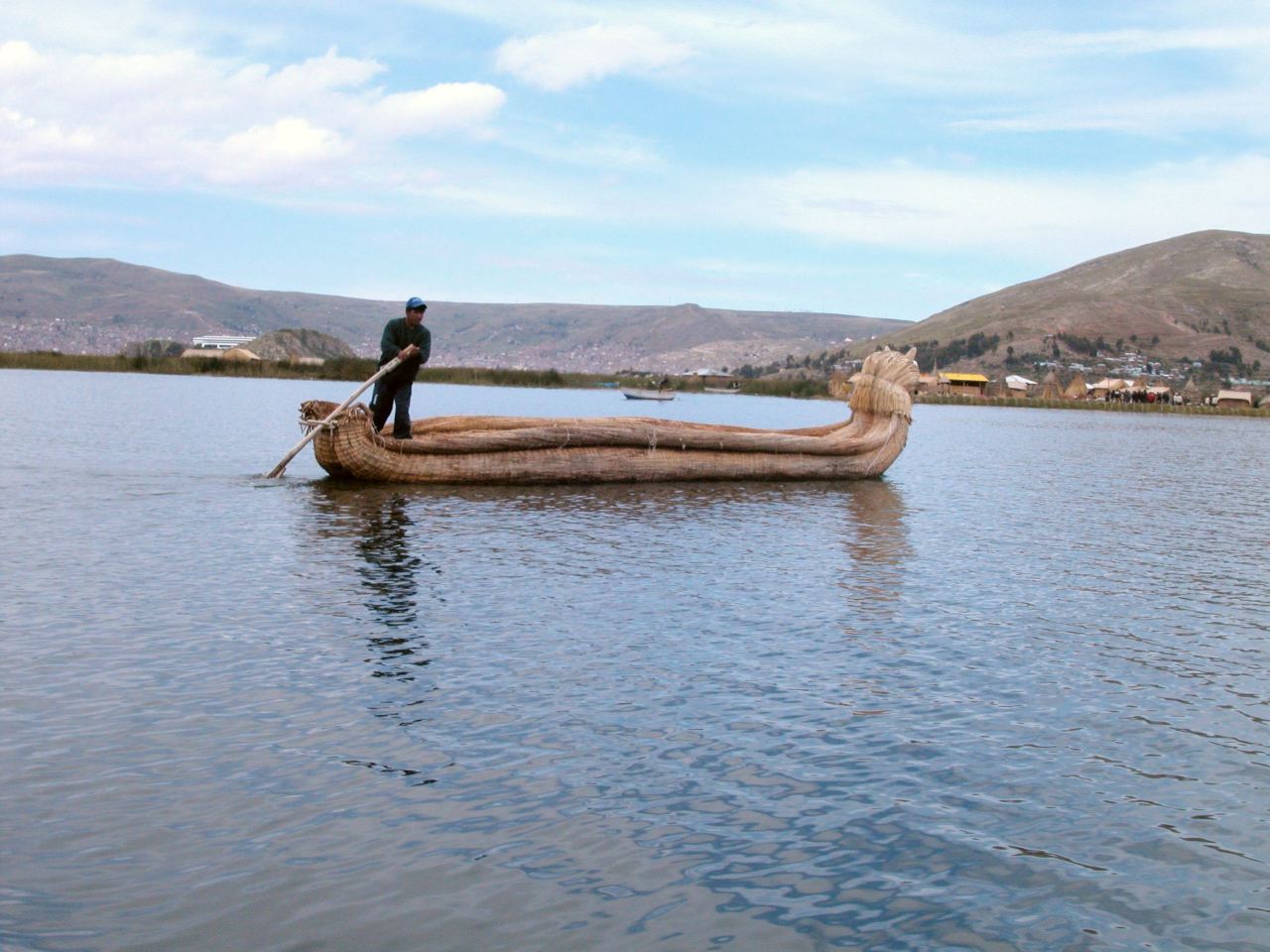
The islanders have lived off tourism for a long time. They sell souvenirs and take people out in an enormous reed boat for one sol. Those boats, incidentally, were devised purely as an attraction. Indigenous people here never used them. They went about in little one-person boats, and today they've got modern motorboats tucked out of sight in the reeds.
Each island has a telephone booth and a post office. They promise an Internet café as well.
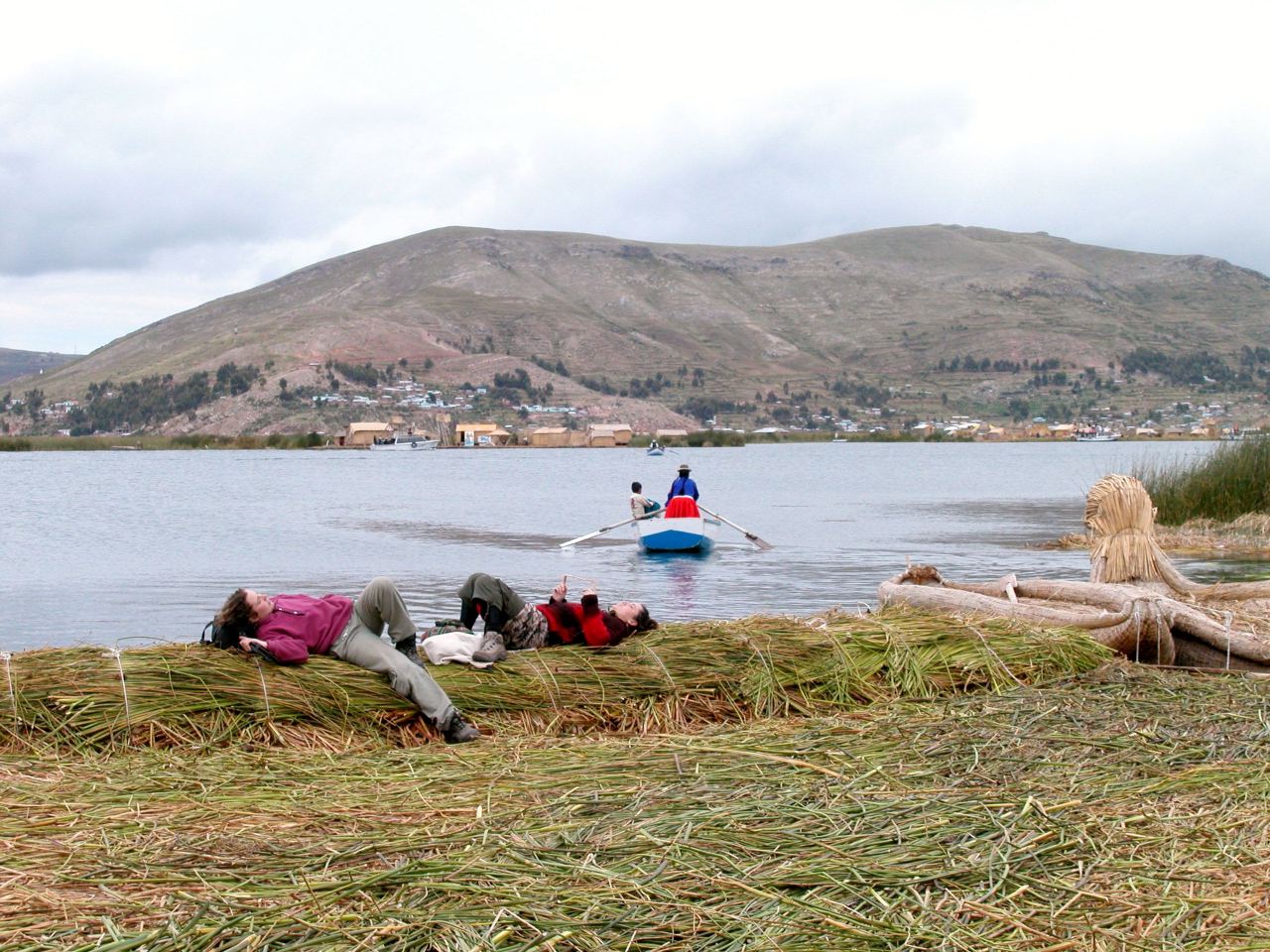
Having made sure everybody had bought their regulation number of trinkets and started playing with their phones, they resumed the tour. Now we had a four-hour trip to the island of Amantaní.
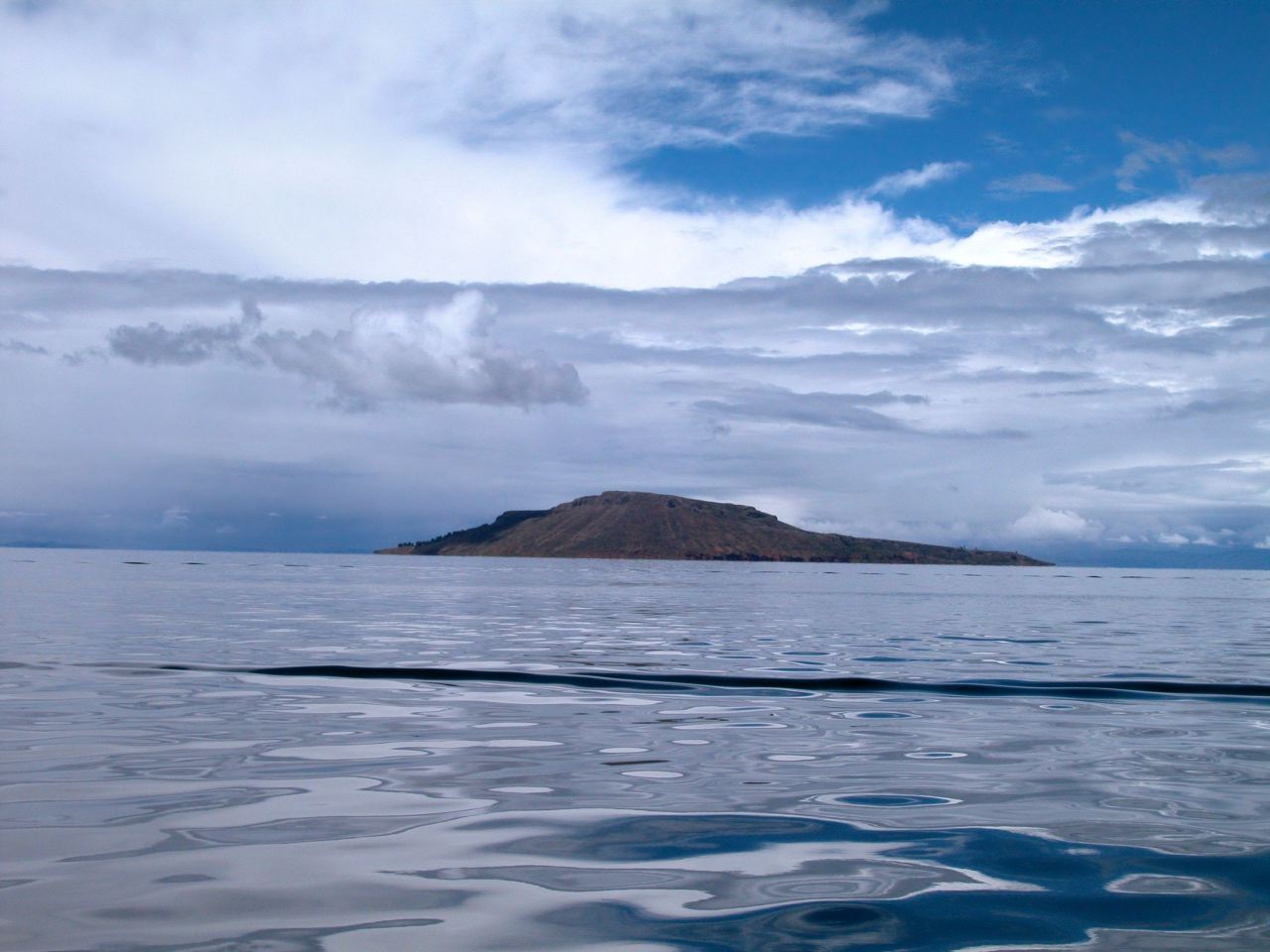
According to the Tiwanaku religion, this was the birthplace of Pachatata and Pachamama, two deities and two pillars of creation. The pair of hills that make up the island are crowned by their respective temples. People still practise the religion. On the appointed days shamans perform the rites. Tourists aren't allowed in the temples, because their presence would be held to desecrate them. According to one statistic, seventy per cent of Peruvians are Catholic, while another says eighty per cent believe in Pachatata and Pachamama.
The hills rise three hundred metres above the lake.
Tourists spend a long time climbing one of the summits. It's said you can't do both before dark. Most people climb the northern hill named for Pachatata. According to a belief invented for tourists, you make a wish and walk anticlockwise round the temple three times. Your wish, they promise, will come true. Pachamama doesn't give away miracles, so she doesn't get as many visitors. We didn't believe the guides and set off for Pachamama after Pachatata. By then the crowd had thinned out. All that remained were a few independent travellers, sitting on the edge of the drop, meditating as the sun set. It really was a lovely scene. We sat and looked at this beautiful world ourselves.

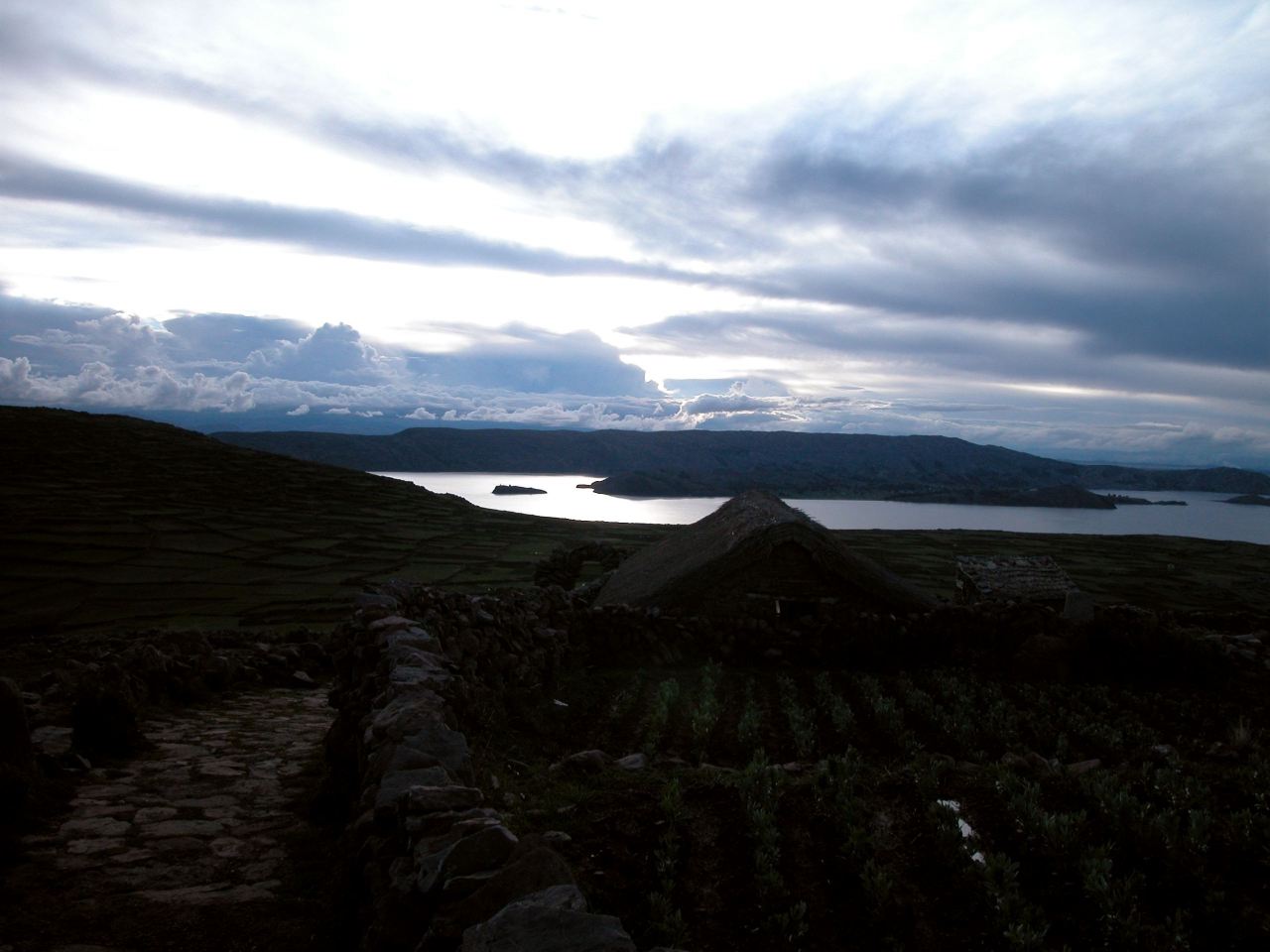
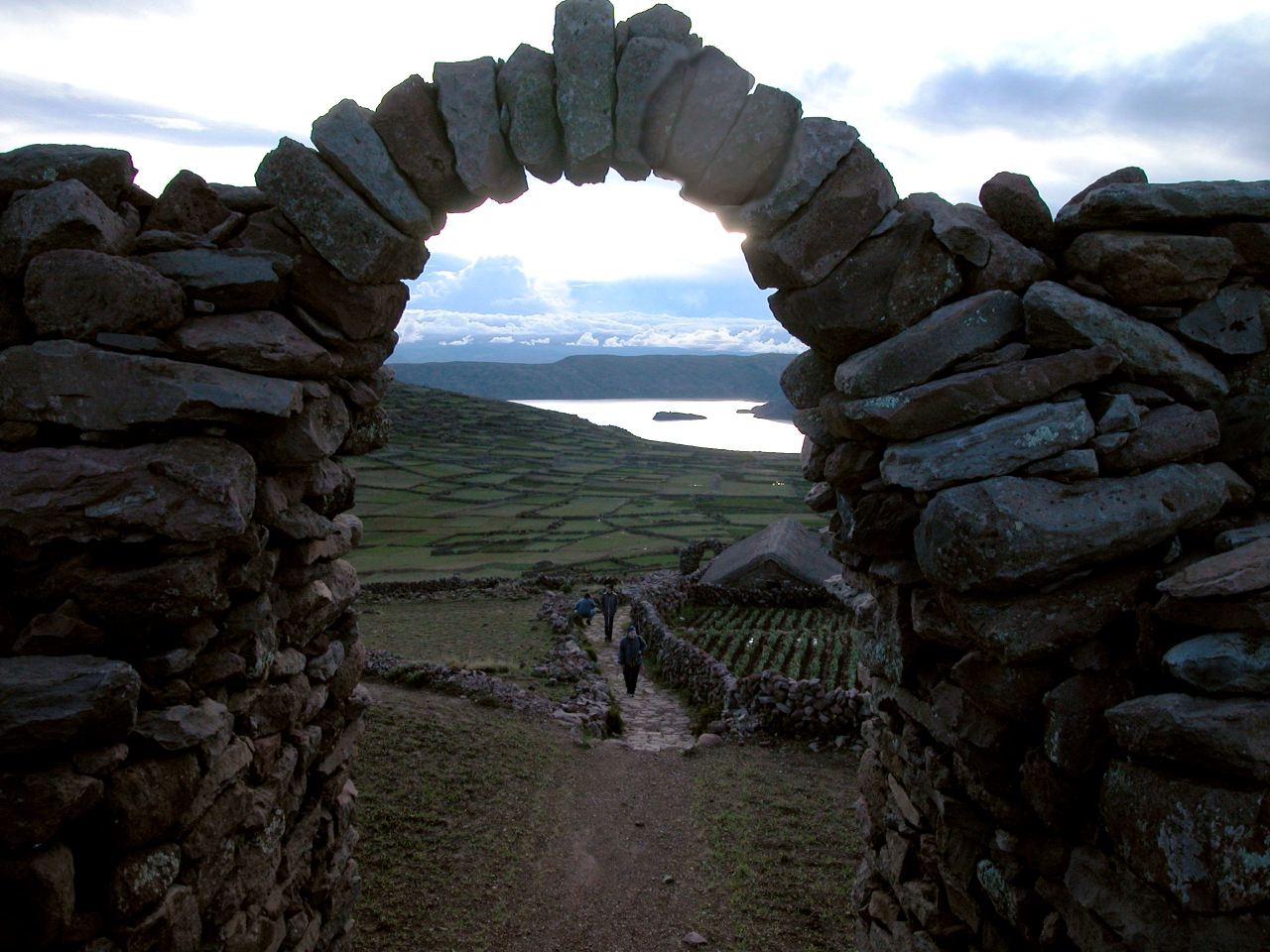


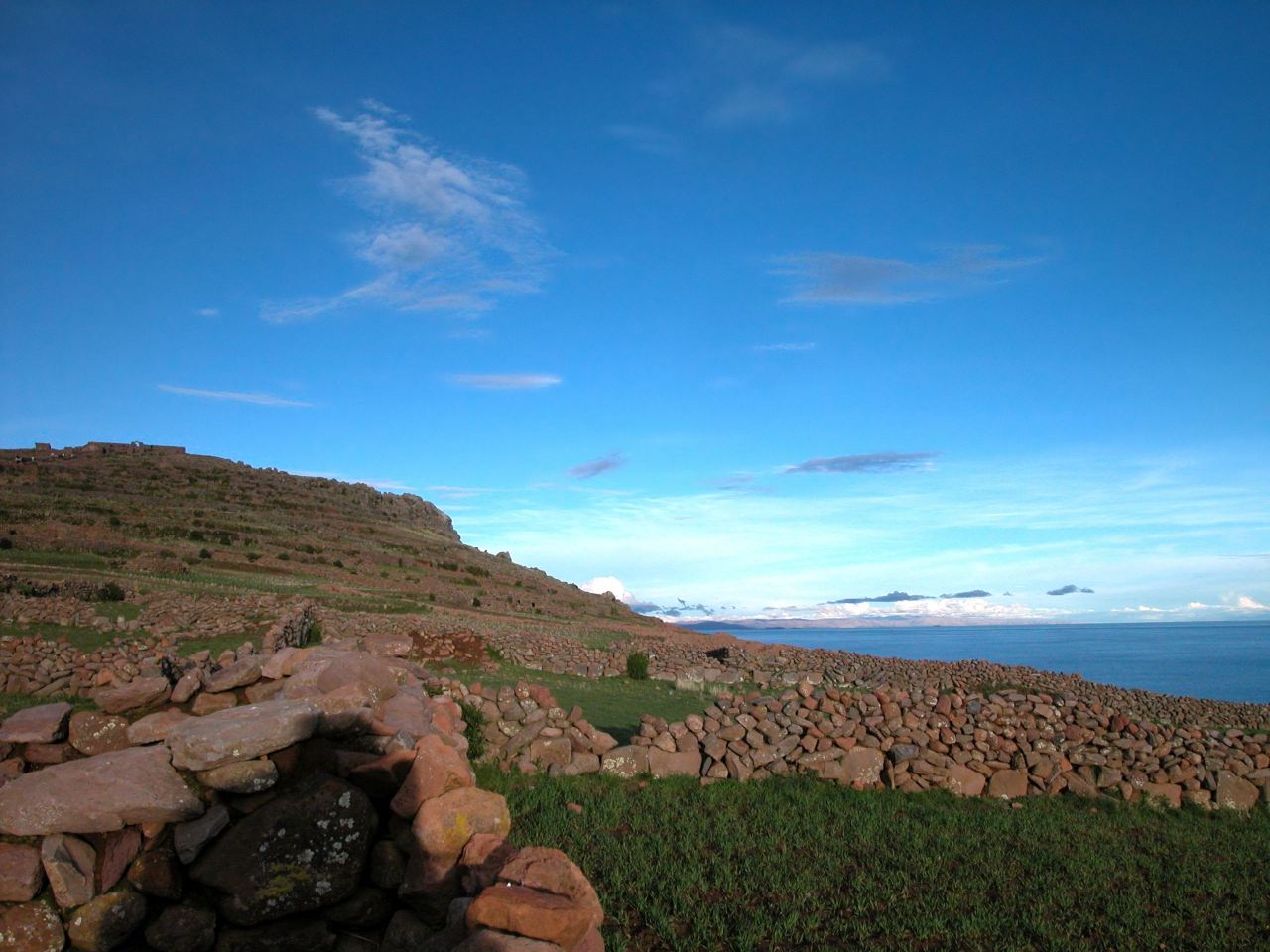

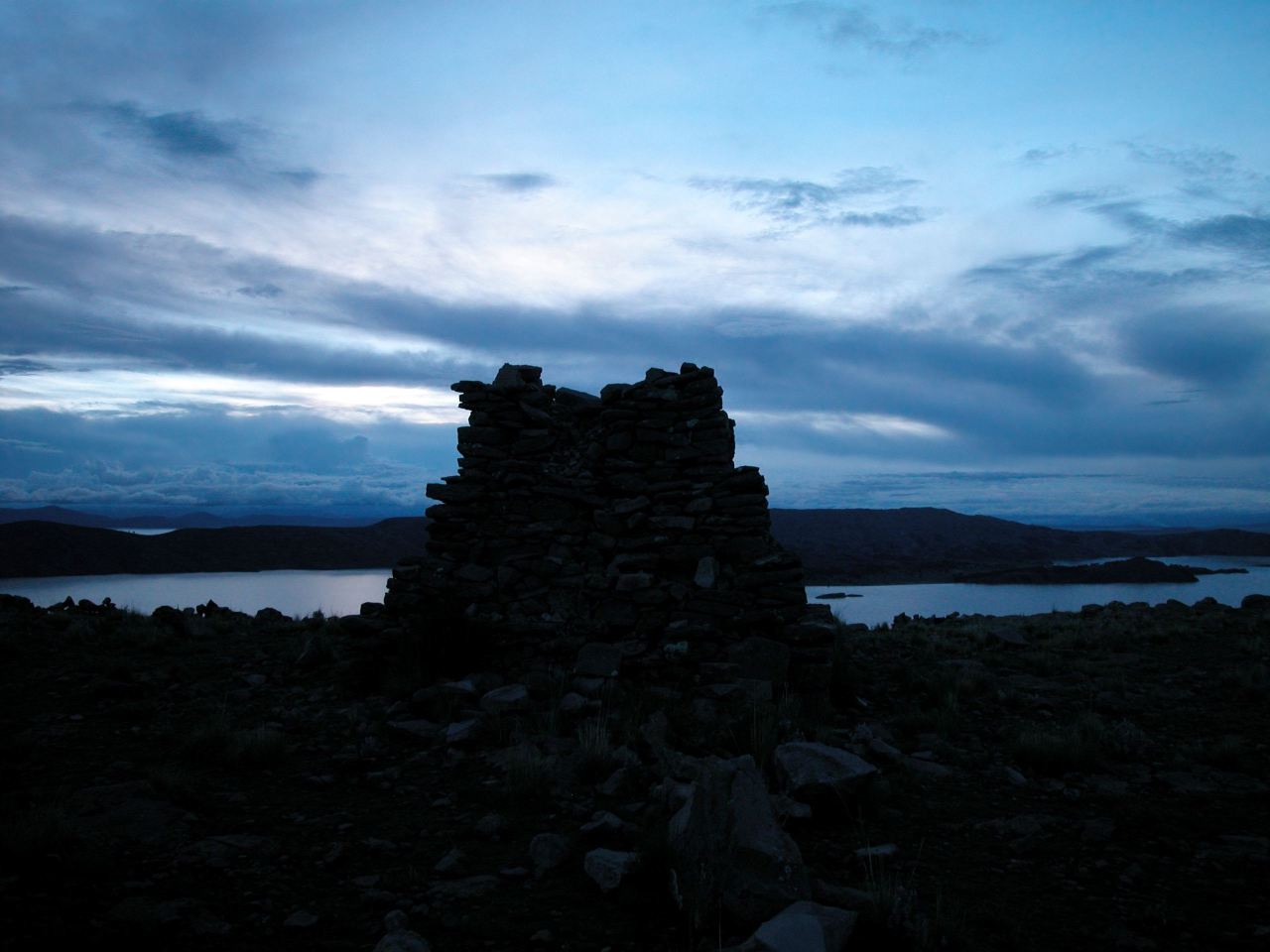


It was getting dark. The guides and other locals cleared off to the village. This was our chance to get past Pachamama's wall and break the taboo. Inside we discovered a stone phallus. Oops, but she's PachaMAMA. Perhaps the idea was to keep the young lady company.
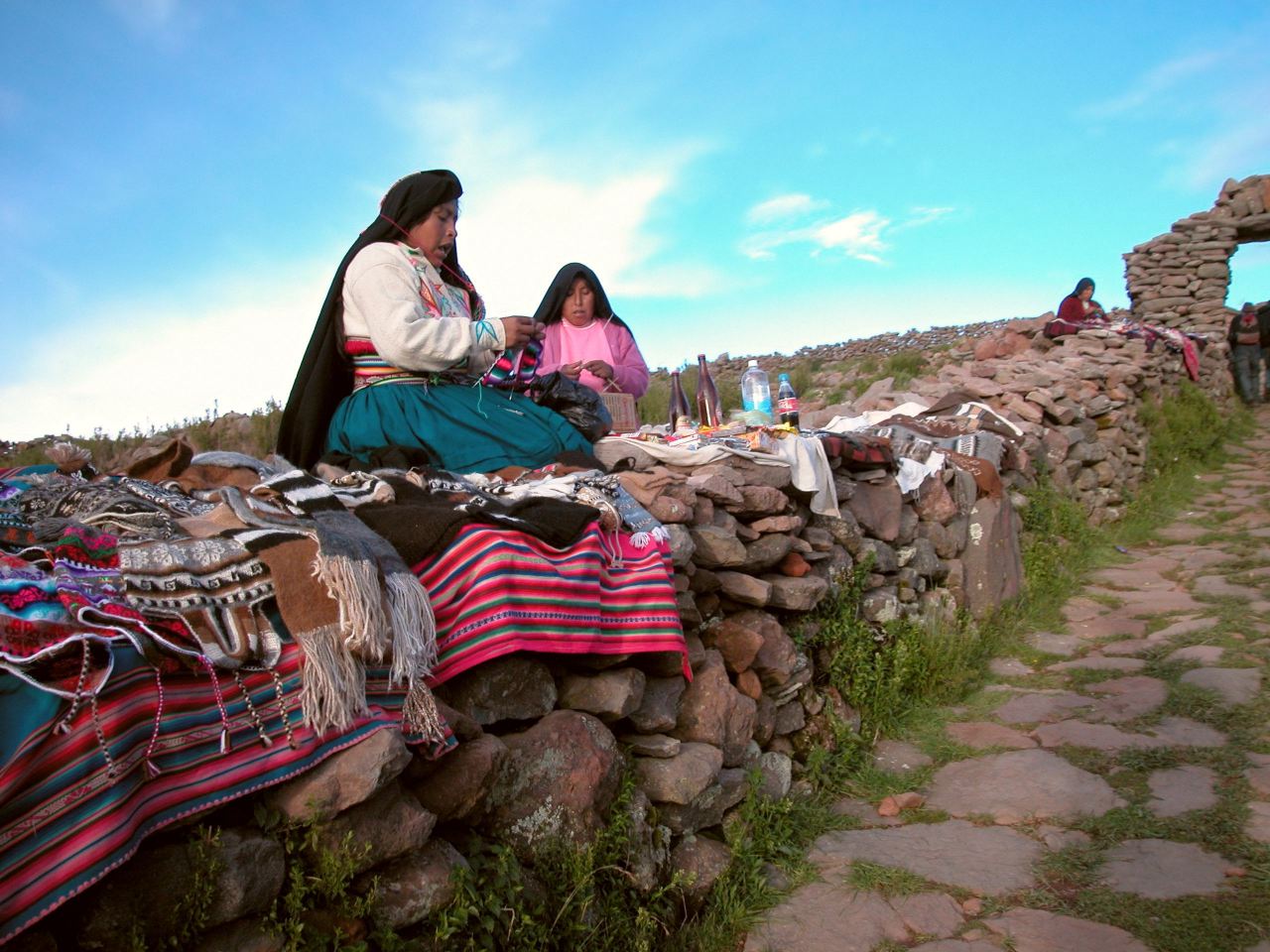
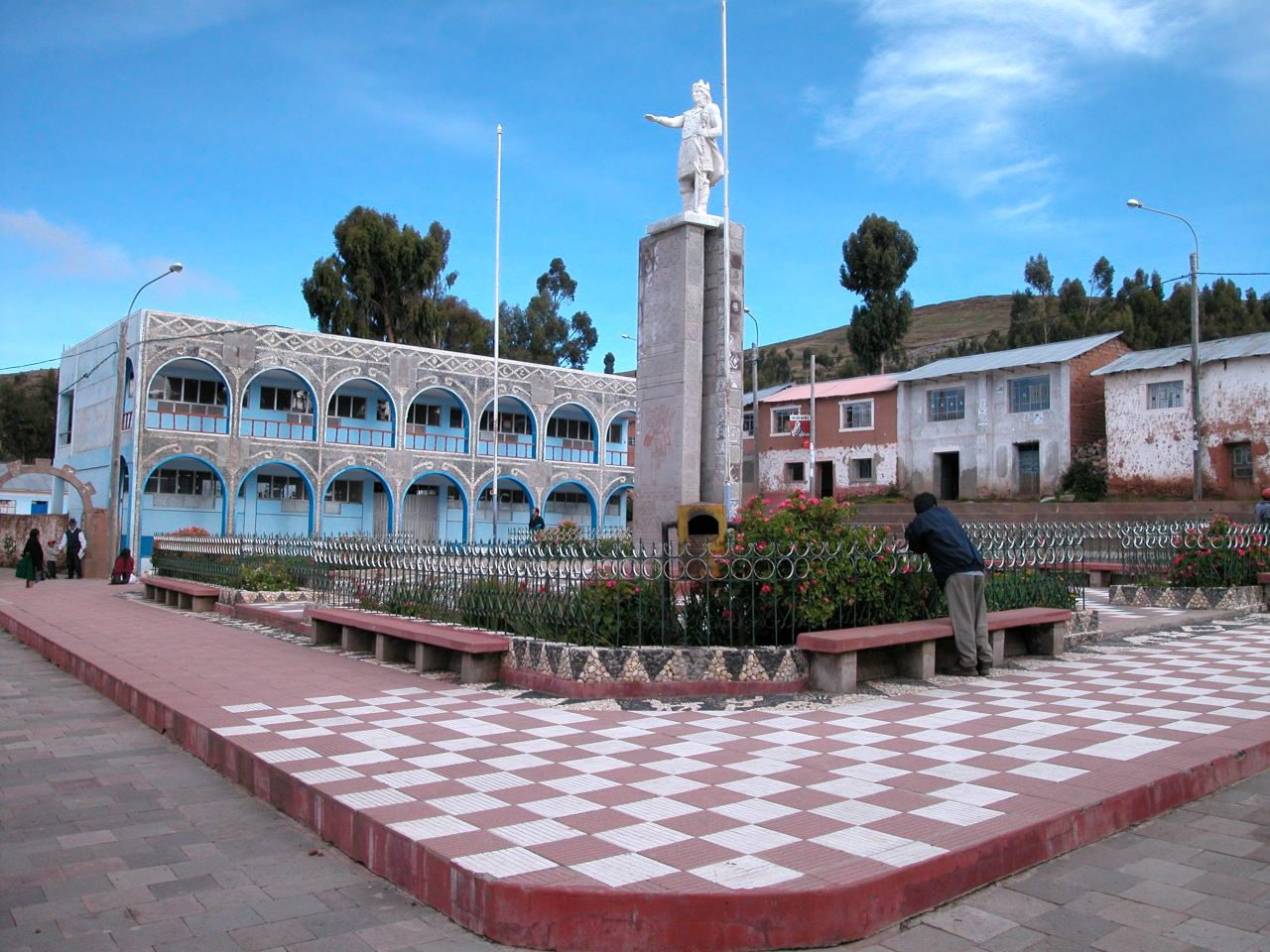


It was pitch dark by the time we got back. Our guide met us in delight at the end of the track. He'd been quite worried we'd get lost.
We were put up for the night in the homes of island residents (15°39.516′S, 69°43.401′W). We got a little room on the upper floor. Our hostess was thirty-five with five children. She spoke Spanish a little better than we did. Her native language was Quechua. She'd never once left her island in her entire life.
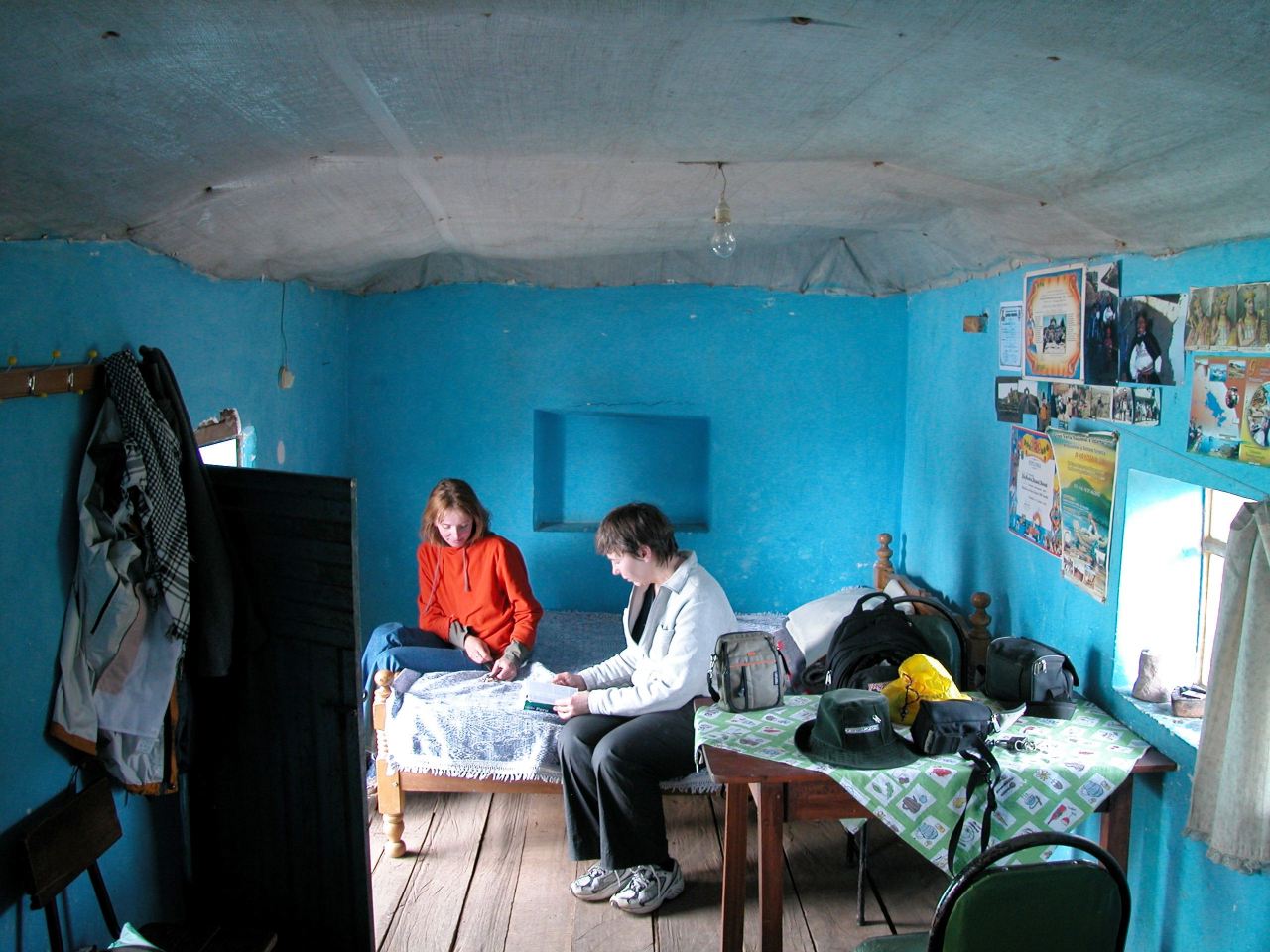
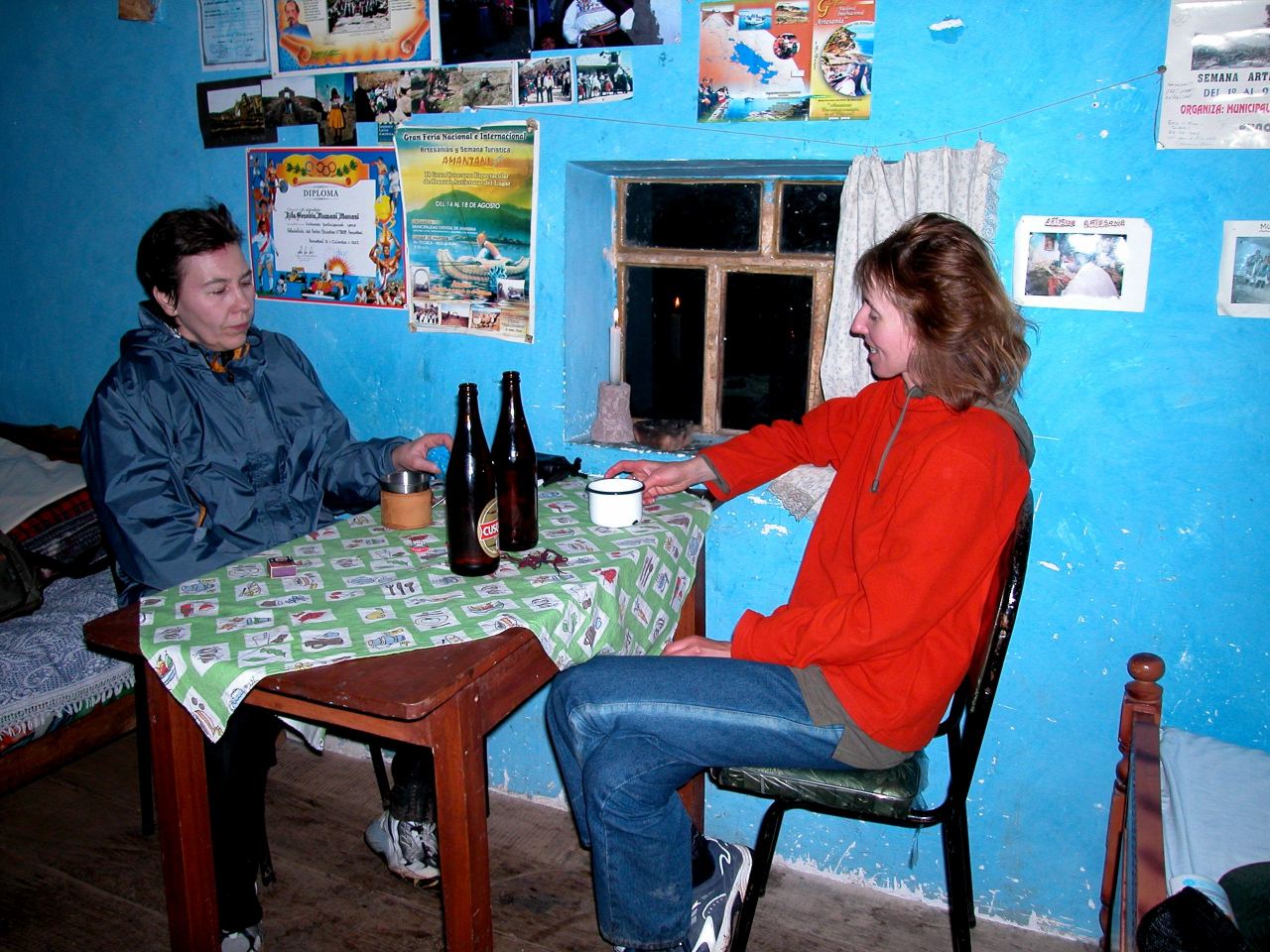
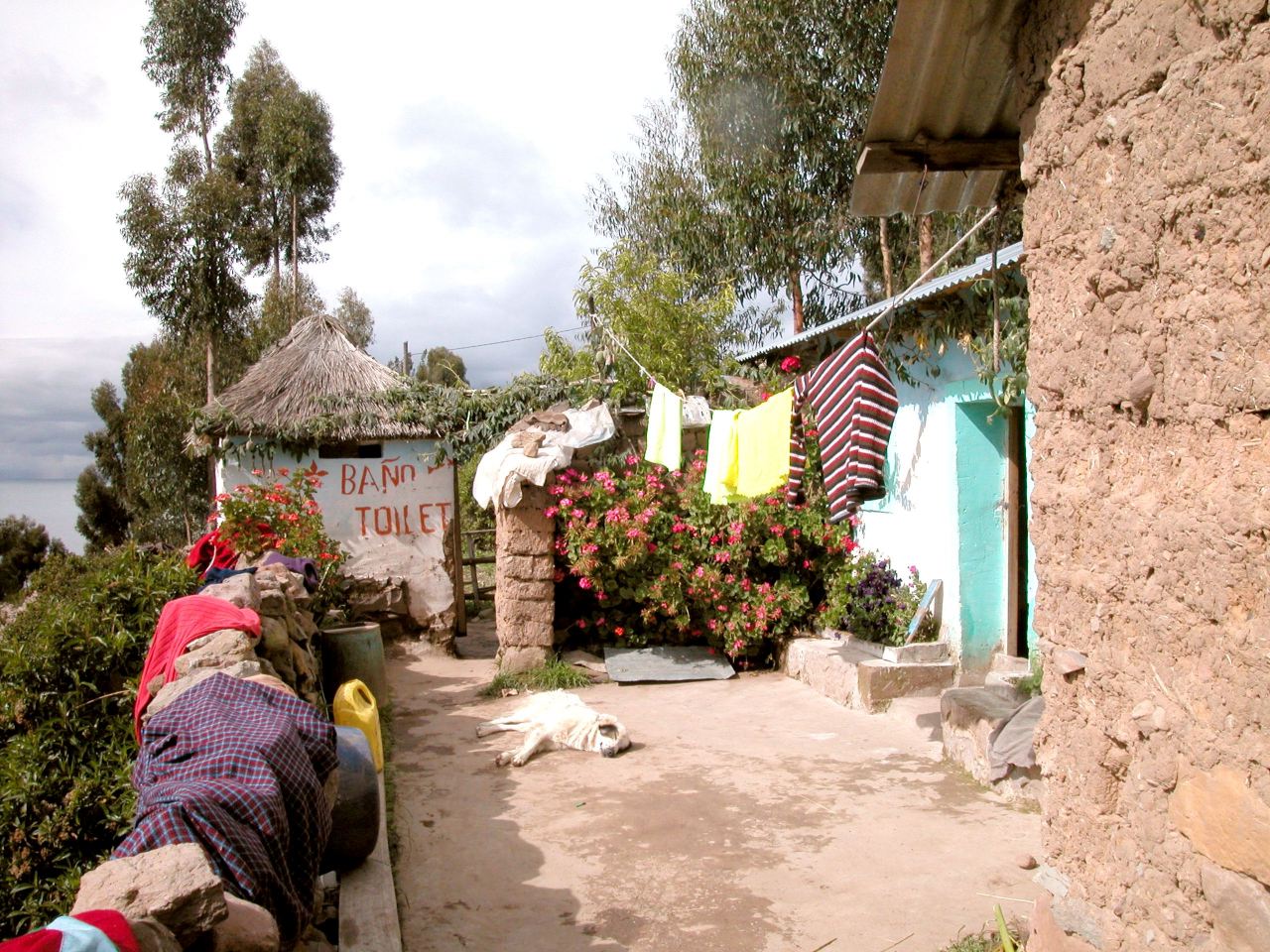
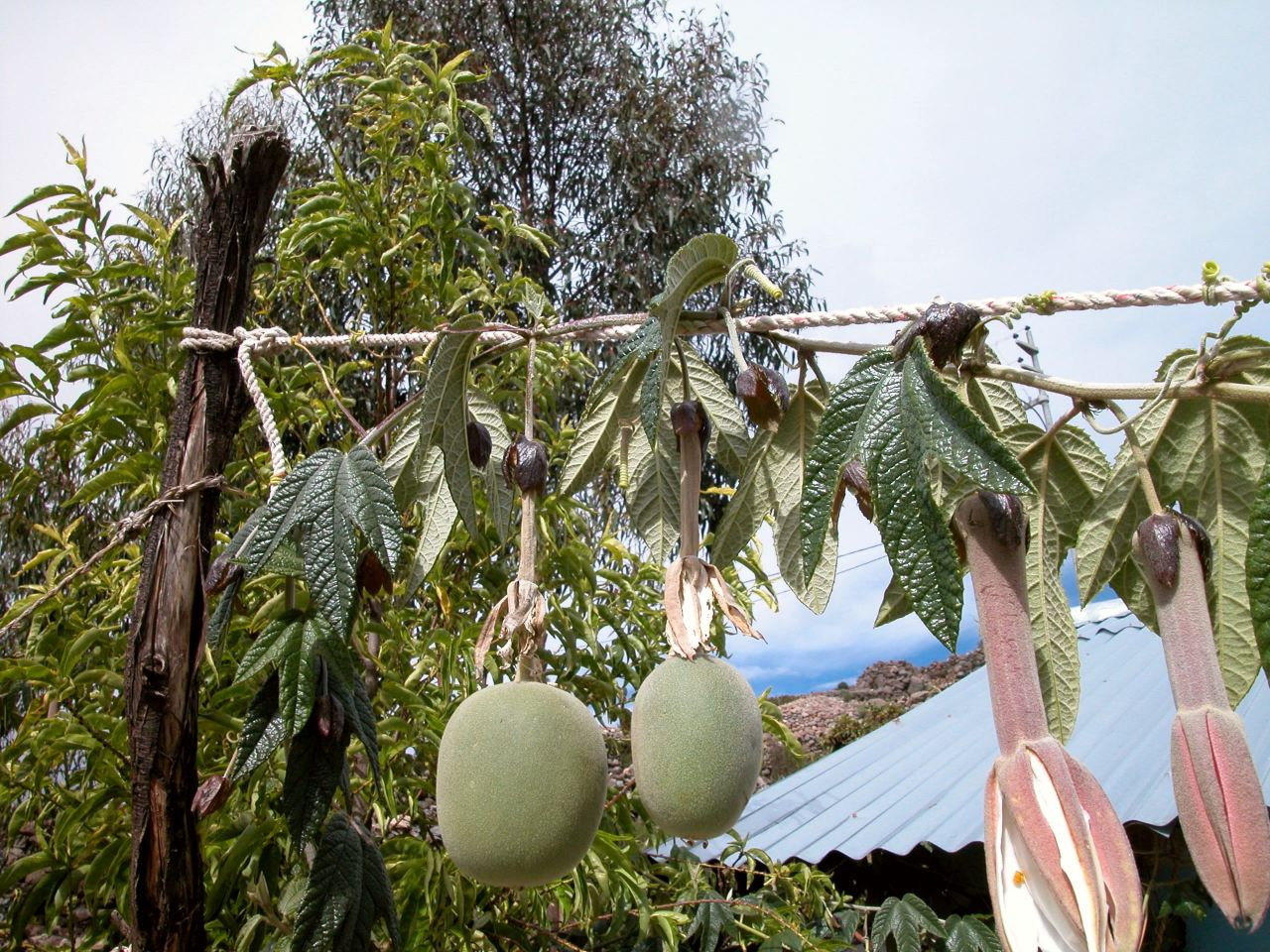
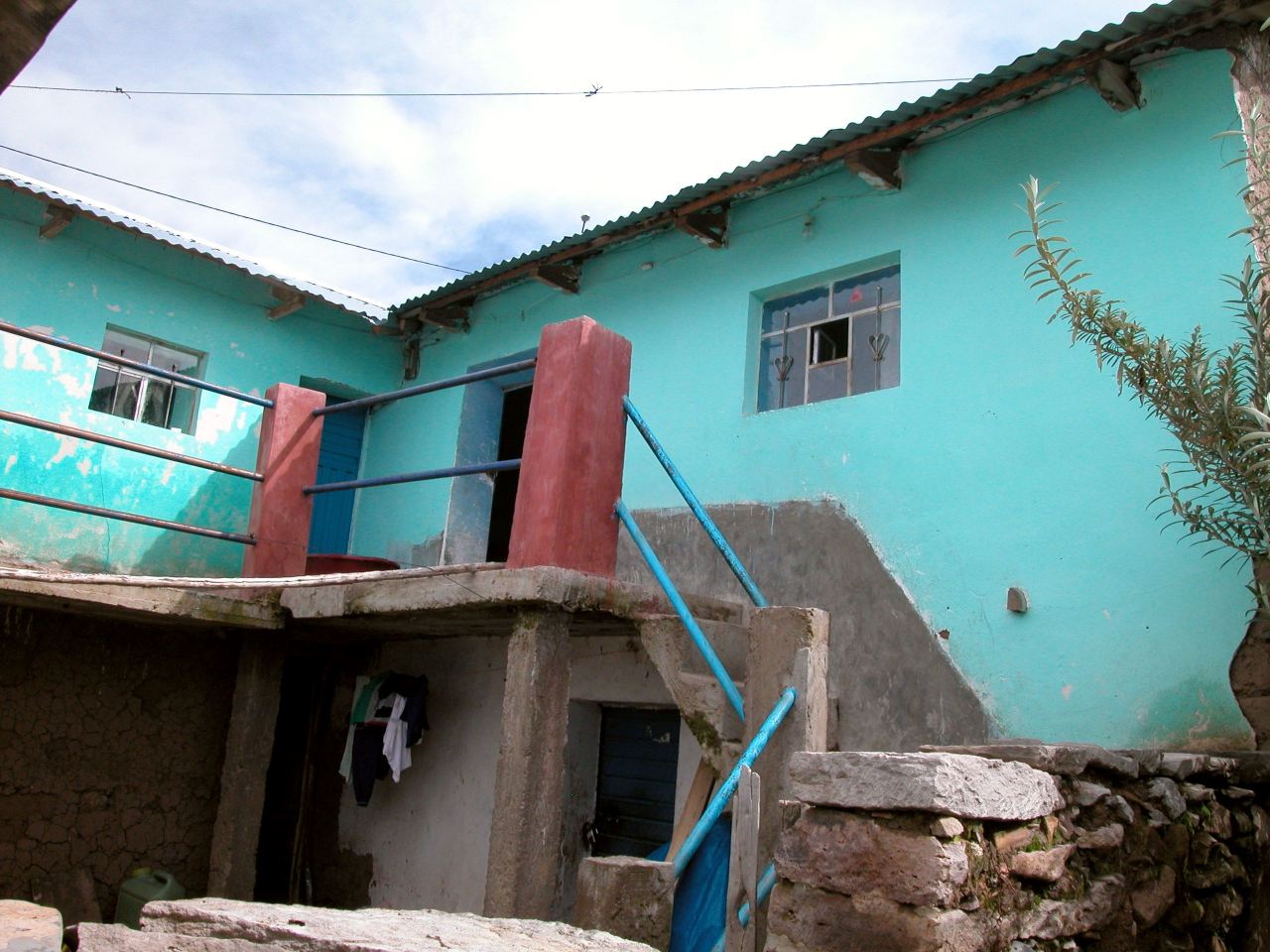
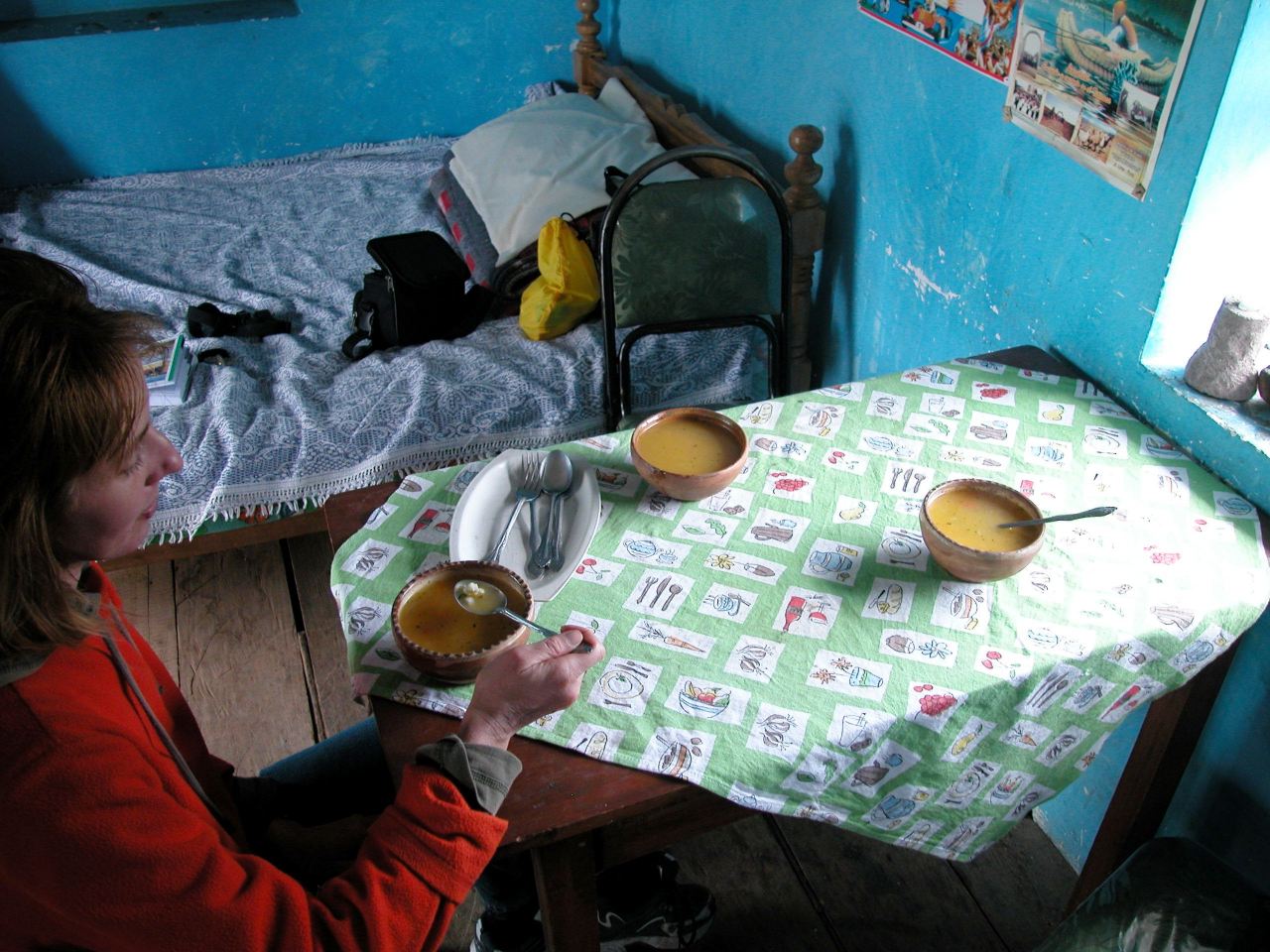
A very pleasant, good-natured woman. She fed us lunch and dinner. To earn a little extra she embroidered caps and offered to sell us some. We wanted to make her happy, but there was just too much colour in them.
In the evening a disco was on the programme. We started out for it, thinking we could sit quietly in a corner, then discovered you were meant to get out and dance, which I don't like at all. We beat a hasty retreat. There was no electricity on the island, so our torch and GPS came in handy. Without the latter you couldn't find your way back to the right house. They all looked alike, and four thousand people live on the island.
The next day they loaded us onto the boat again, got the engine started at the tenth attempt, and took us to the island of Taquile, which we called Tequila.
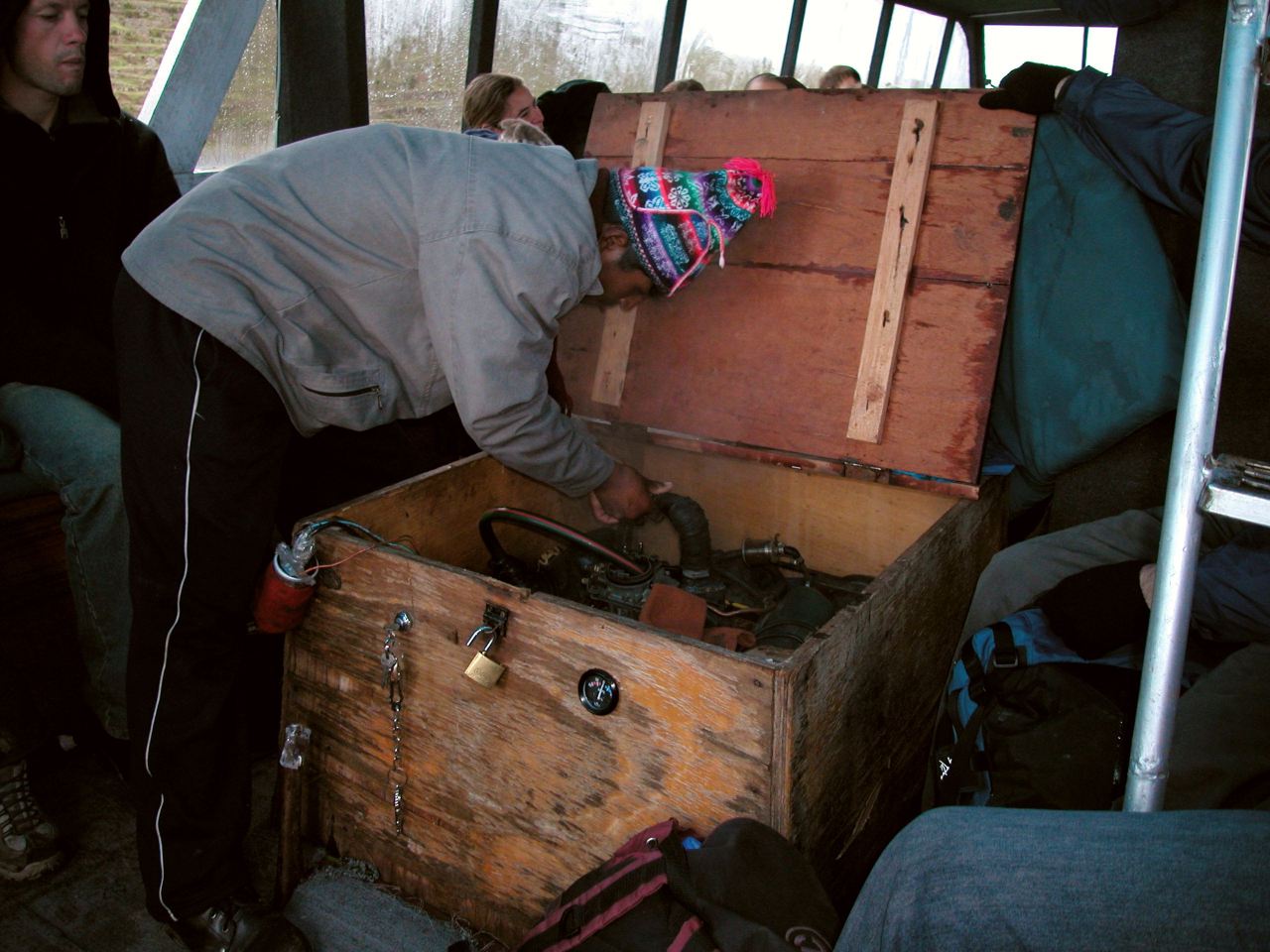
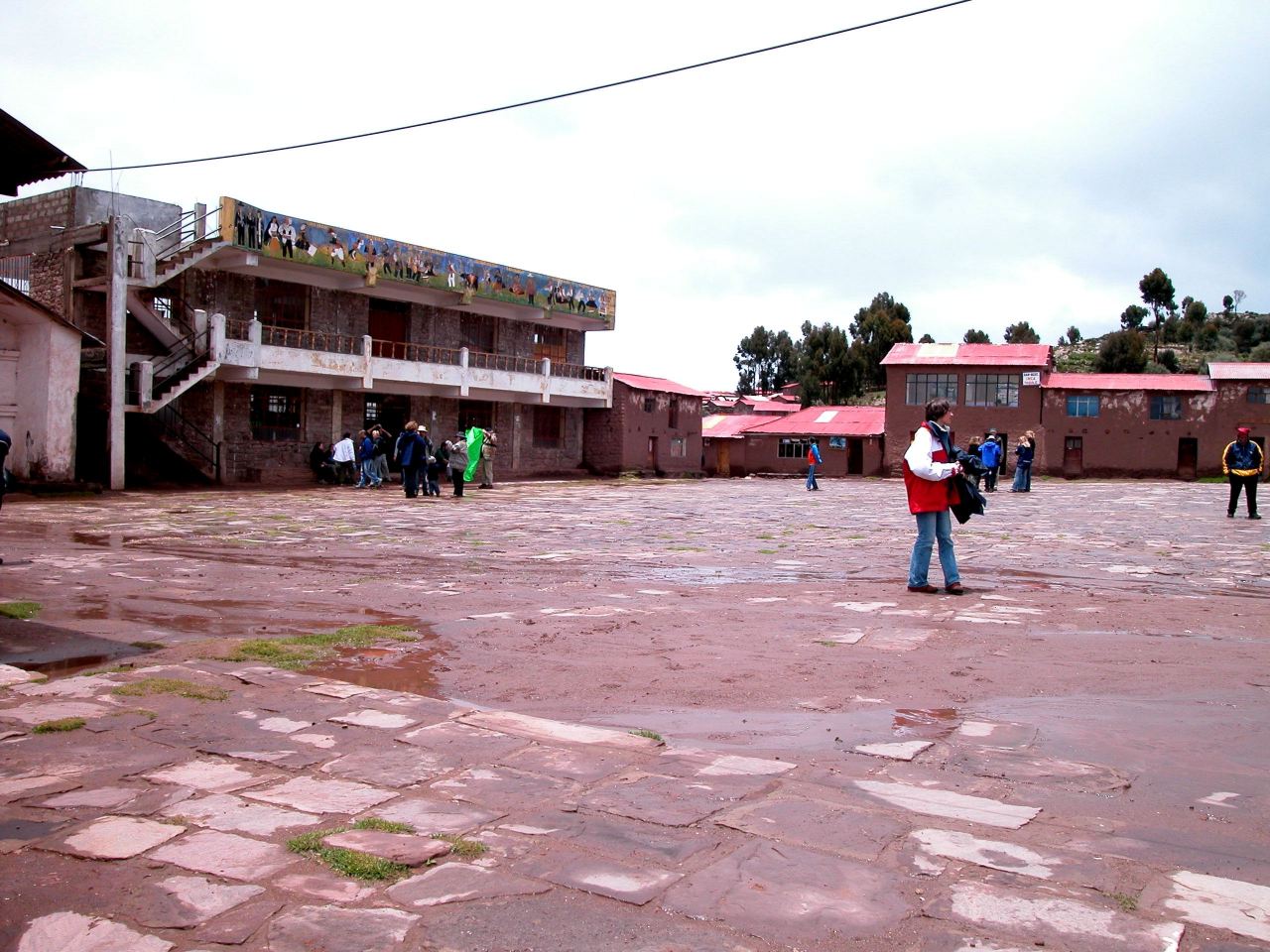

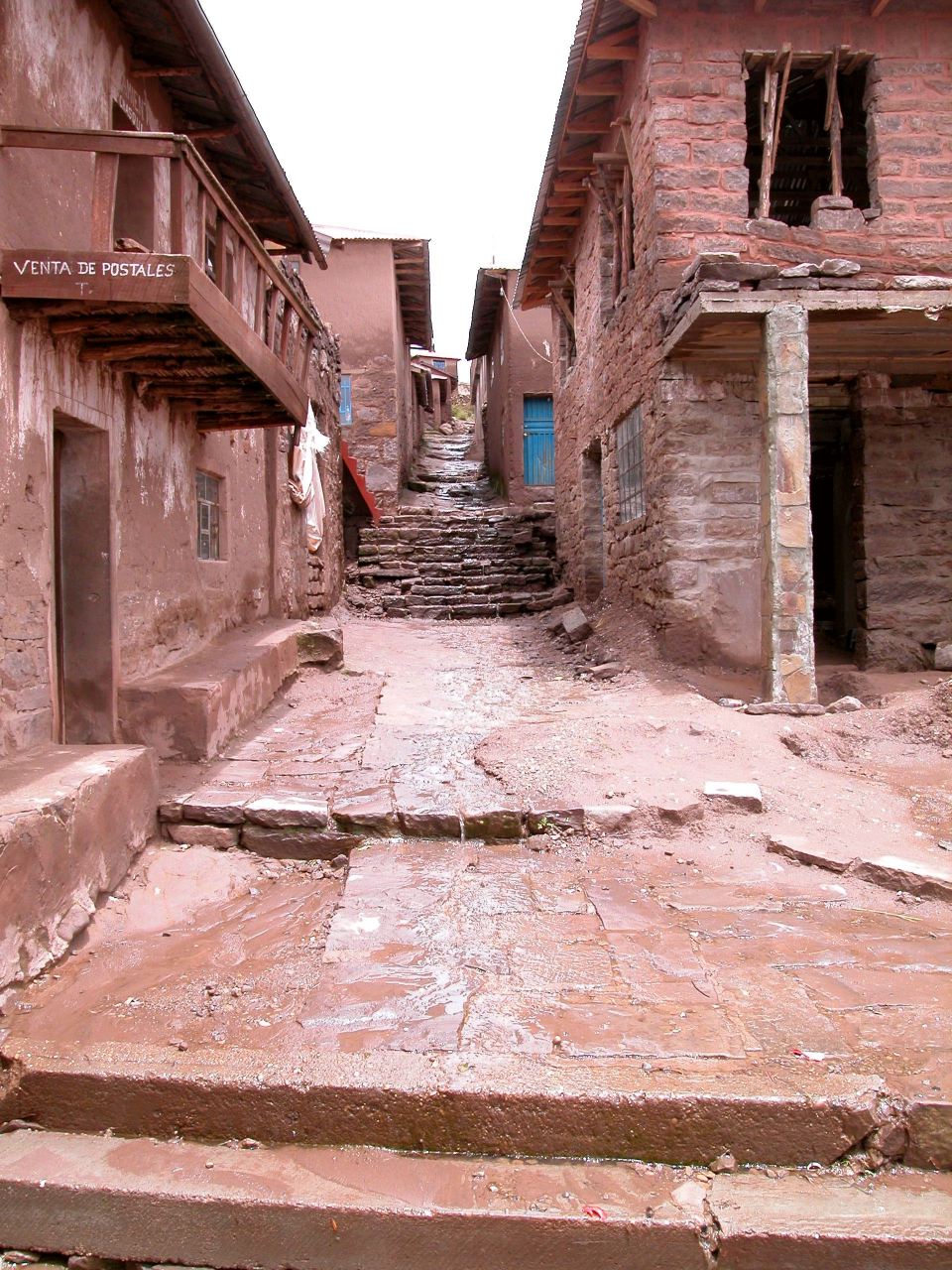
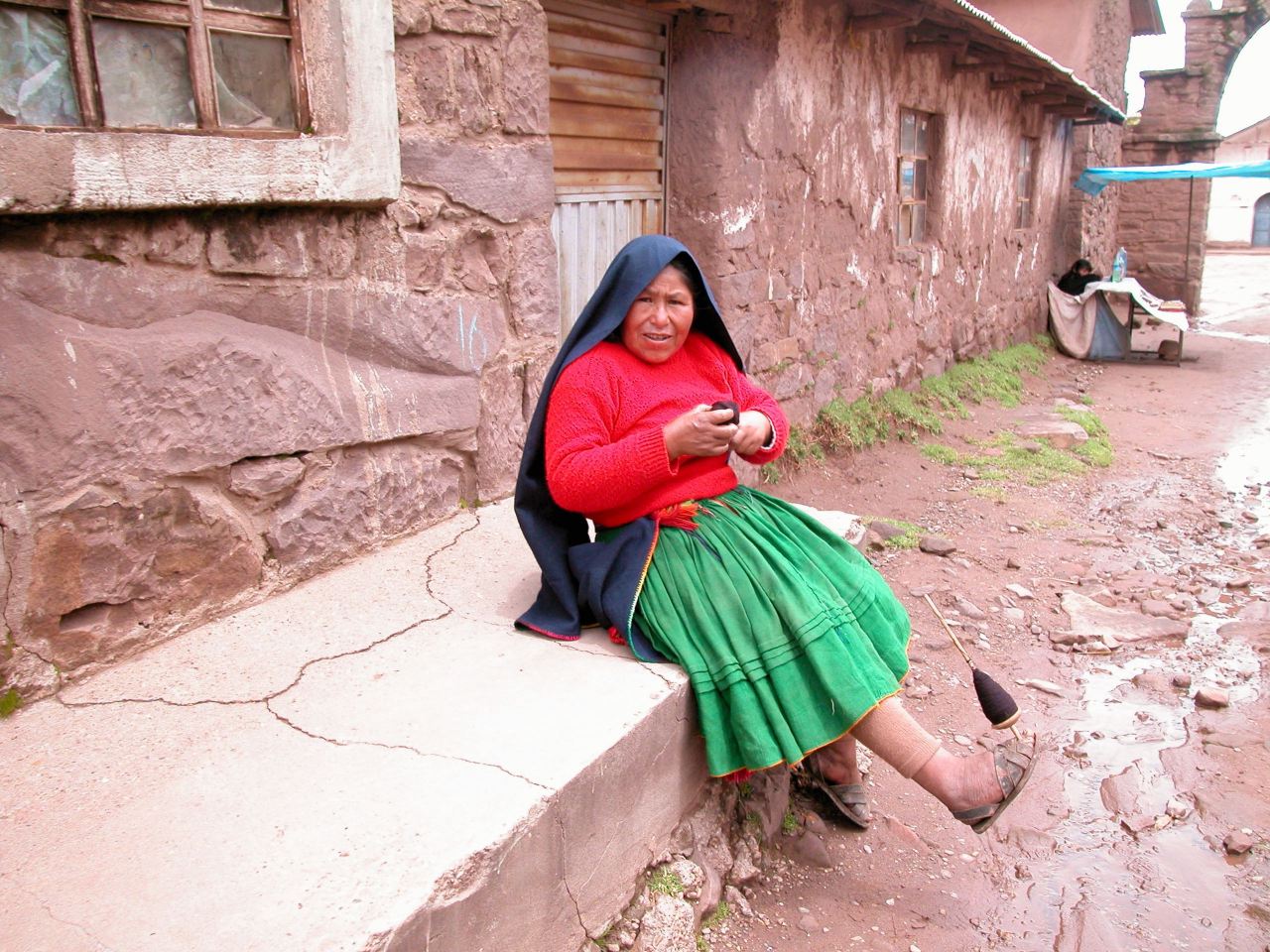
Here we were meant to have lunch, walk to the other side of the island and go back to Puno. We went faster than the rest of the tourists and decided to go for a swim. It wasn't really the custom here, but we wanted to. It must be some sort of Russian national dream. When our guide heard where we were from, he recalled a group from Moscow the year before who, would you believe it, had gone swimming. We said we wanted to as well. The man told us the beach was on the other side of the island. We decided to nip over to it. The track seemed good, and there were signs marked Playa. So there were. We walked and walked, with no sign of a beach. After an hour it was clear we'd missed the boat. They'd wait a while, swear furiously, and then probably go without us. Well, it seemed too late to run back, so we might as well find that wretched beach now. Anywhere else would be difficult to swim. The shores were rocky and even the ways down to them were divided into private plots.
The beach was at the farthest southern point of the island. Fine sand, nobody around, everything we needed. The sun came out. We went in. The water was about ten degrees.
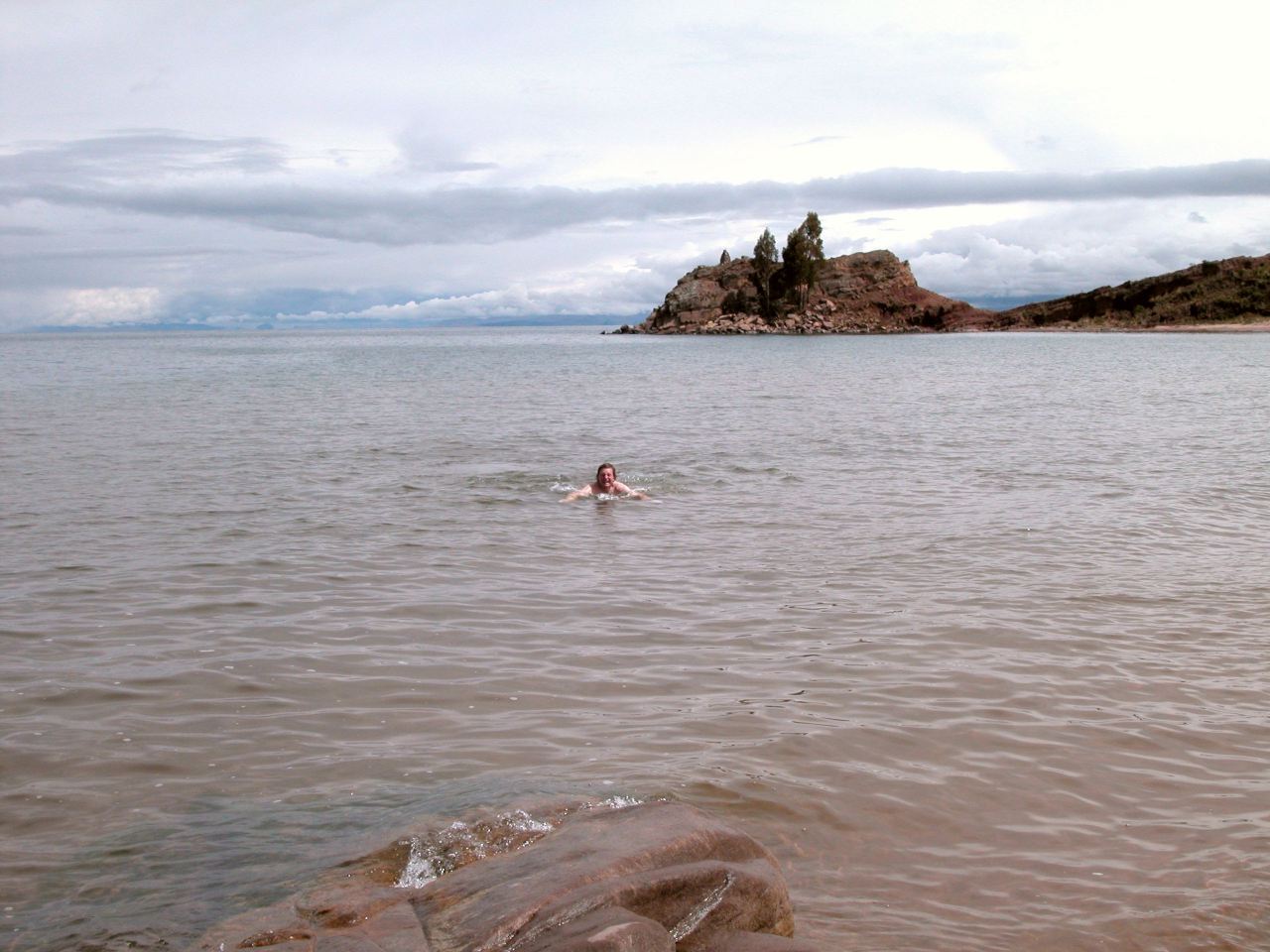
We'd definitely missed the boat now. I could scarcely bear to think what they were saying about us and how the guide must be cursing the minute he'd told these wild people about a beach. How could he have guessed we'd really go there?
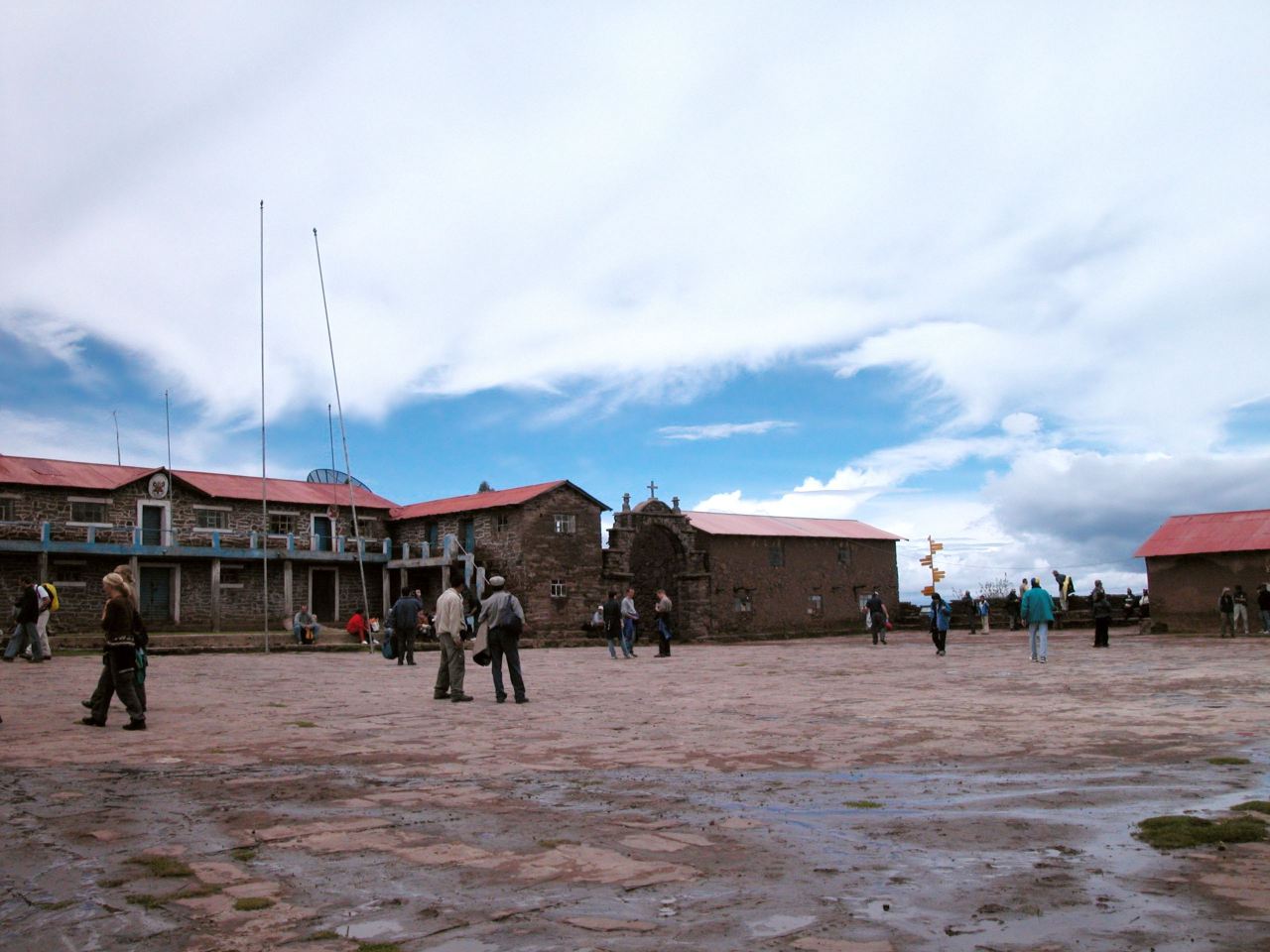
We got back to the pier at about five in the evening, when we ought to have been in Puno. The last regular boat sailed off right in front of us. We went down to the pier. The islanders were building a breakwater. Women carried stones of fifty kilos or so in bundles on their backs, and the bigger boulders came in a small boat. I tried to hire it to take us to Puno. The man was prepared, in principle, to do it for two hundred soles, but he decided it was too late. There are no lights on the lake and people don't sail at night. Besides, he was on community duty, mi trabajo, and that was sacred. The island community is very proud that it has built socialism. There's a chief on the island who is required to wear a black cowboy hat and decides everything for everybody. The island has twenty restaurants, but only ten operate at a time. After a week on duty they swap. Each is meant to feed one group of tourists a day. When a group comes in, the guide goes to the chief, who decides which place gets to feed them that day in the interests of equality and justice. No initiative without his say-so.
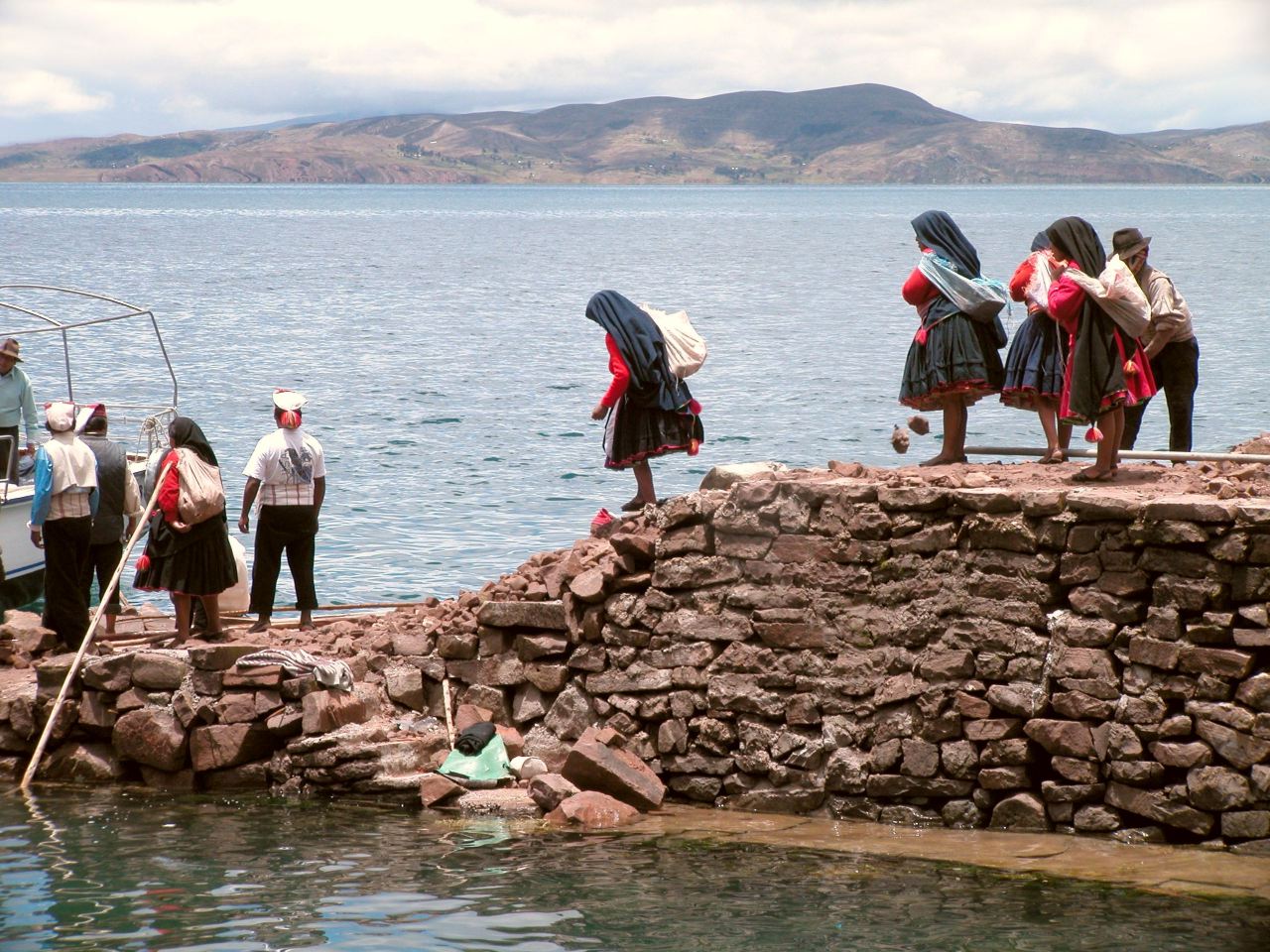
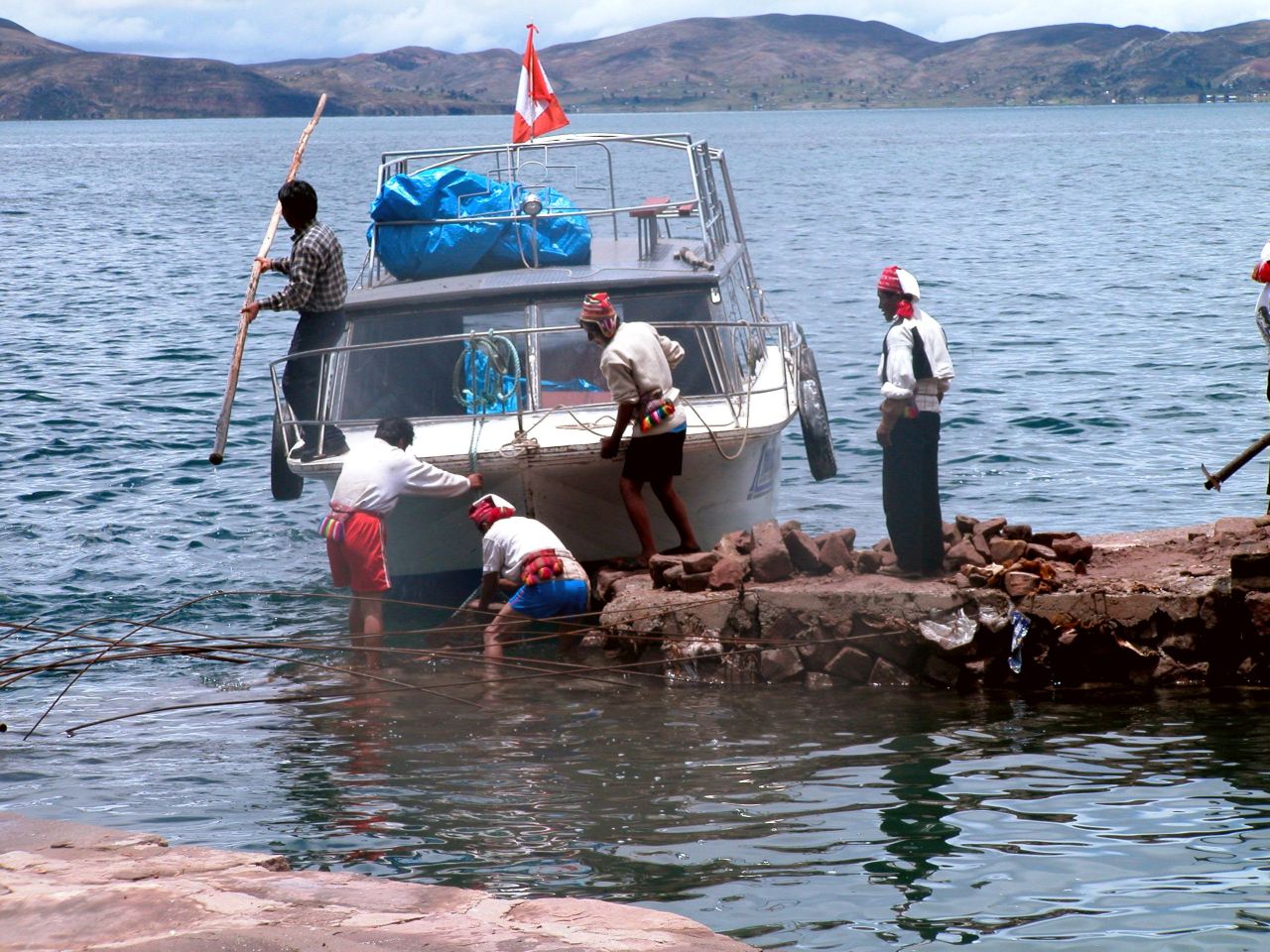
The rest of the islanders are supposed to wear knitted woollen caps like Buratino, our Russian Pinocchio. It's the men who knit them, by the way. The dangling end is to hold coca leaves. Good manners, when you meet, mean taking off your hat and offering the other person some of the restorative leaves.
Everybody in Peru chews coca, and it's sold on every corner. Unlike Bolivia and Colombia, where the governments tried to put an end to this noxious plant with Western, particularly US, support, things stayed quiet here. Nowadays mate de coca, coca tea, is sold anywhere that serves food. They sell it on buses and planes, and often there's no other drink to choose from. A sol gets you a little bag of leaves.
Our boat was long gone, which was only half the trouble. So was Lena's backpack with her plane tickets. We found that mobile phones worked on the island. There was a base station somewhere thirty-two kilometres away, right at the physical limit of GSM. We rang the man who'd arranged our trip in Puno. To our surprise we came to an understanding fairly easily: ‘Mi perdido, mochila y barca, mañana mochila y oficina…’ In other words, ‘Me lost, me backpack went off on boat, me you tomorrow backpack in office.’
The next boat was tomorrow at noon. All that was left was to relax and go for a walk. We soon found a place to stay (15°46.126′S, 69°41.494′W, elevation 3,935 m, Americas). It was thirty-four soles for the night. We got a lovely little house almost on top of the hill, with a view of Puno. It stood at the edge of a precipice. I liked the local toilet. They'd put it right at the edge, and through the hole you got a view of the world a few dozen metres below.


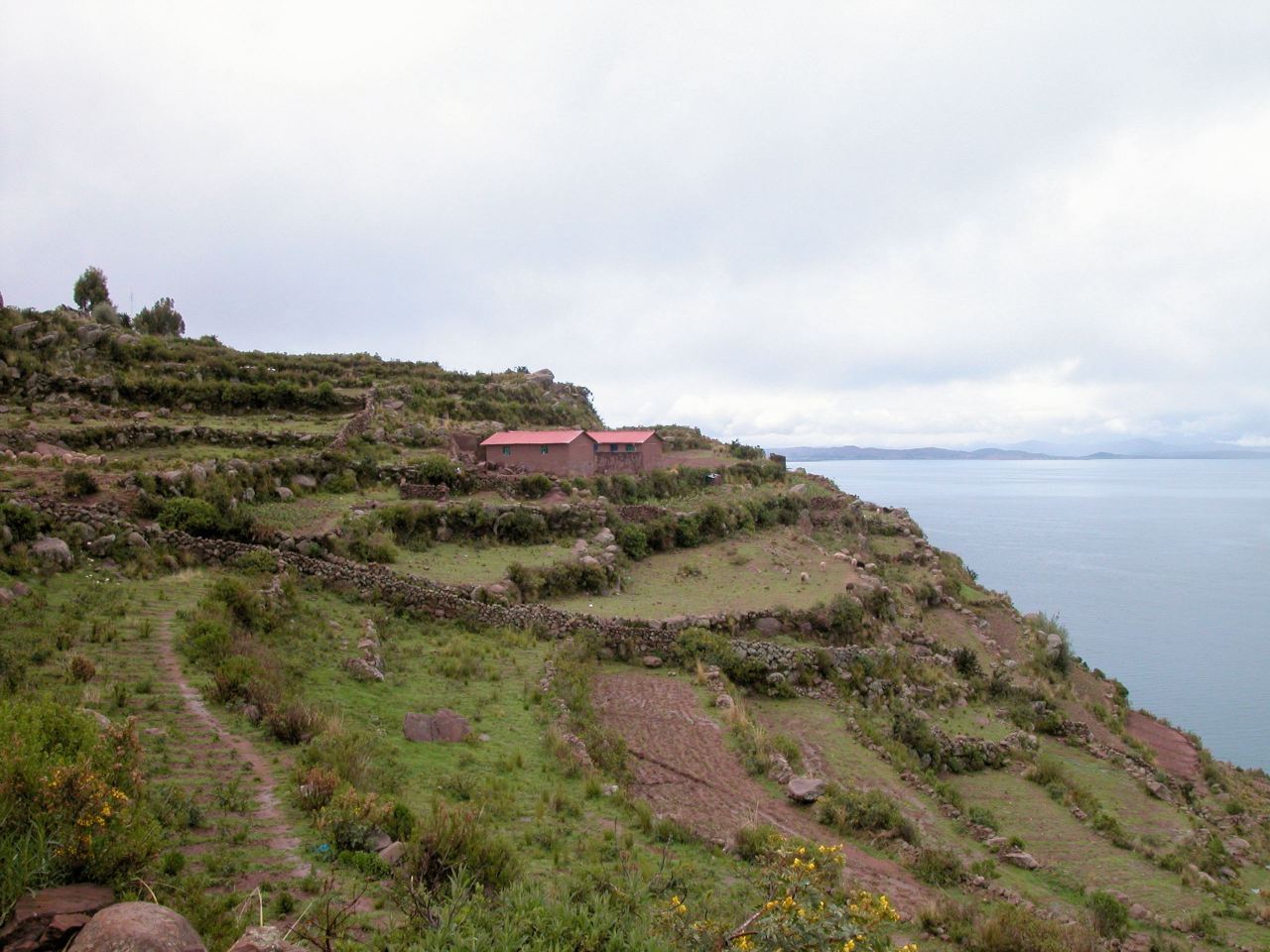
We walked to the main square and ate. The chief in the black hat spotted us and asked solicitously whether we were all right, whether we'd found a place to stay and whether we liked it. The fact that we'd done it all on our own and were satisfied seemed to disappoint him a little.


We tried the local fish at the restaurant. They said it was kingfish. You can't get it in Puno and Taquile is probably the only place where you can eat it. Fish like any other, with fewer bones than I expected.
It gets dark early here and there's no electricity. We read a little by candlelight and went to sleep.

At last we got a proper night's sleep. Lying in bed in the morning, we texted everyone we knew: ‘Greetings from Peru, from an island in Titicaca. We missed the boat. The island's called Tequila, so you can tell from the name it's a good place. We'll survive.’
We found a boat back without any trouble. The fare was ten US dollars a head.
The passengers were mostly tourists. One family with a year-old child especially stuck in my mind. We ran into them again several times afterwards. They were English. They'd taken the birth of their child as a reason to travel around the world. They'd been on the road together for six months already. They'd begun with China and South-East Asia, and now they were doing Latin America. And look, they were all still alive.
Back in Puno we found Lena's backpack. We had to spend the night there again. We got our things back from the laundry. To our astonishment they were clean and dry.
The next day was spent getting to Cusco. You can get there by train, but a ticket is $35. The regular bus costs seven. We picked a tourist bus from Inka Express. All the names have an Inca in them here. We paid more so they'd take us along the way to the Temple of Viracocha and the Jesuit church at Andahuaylillas. There was no other way we'd have seen them.
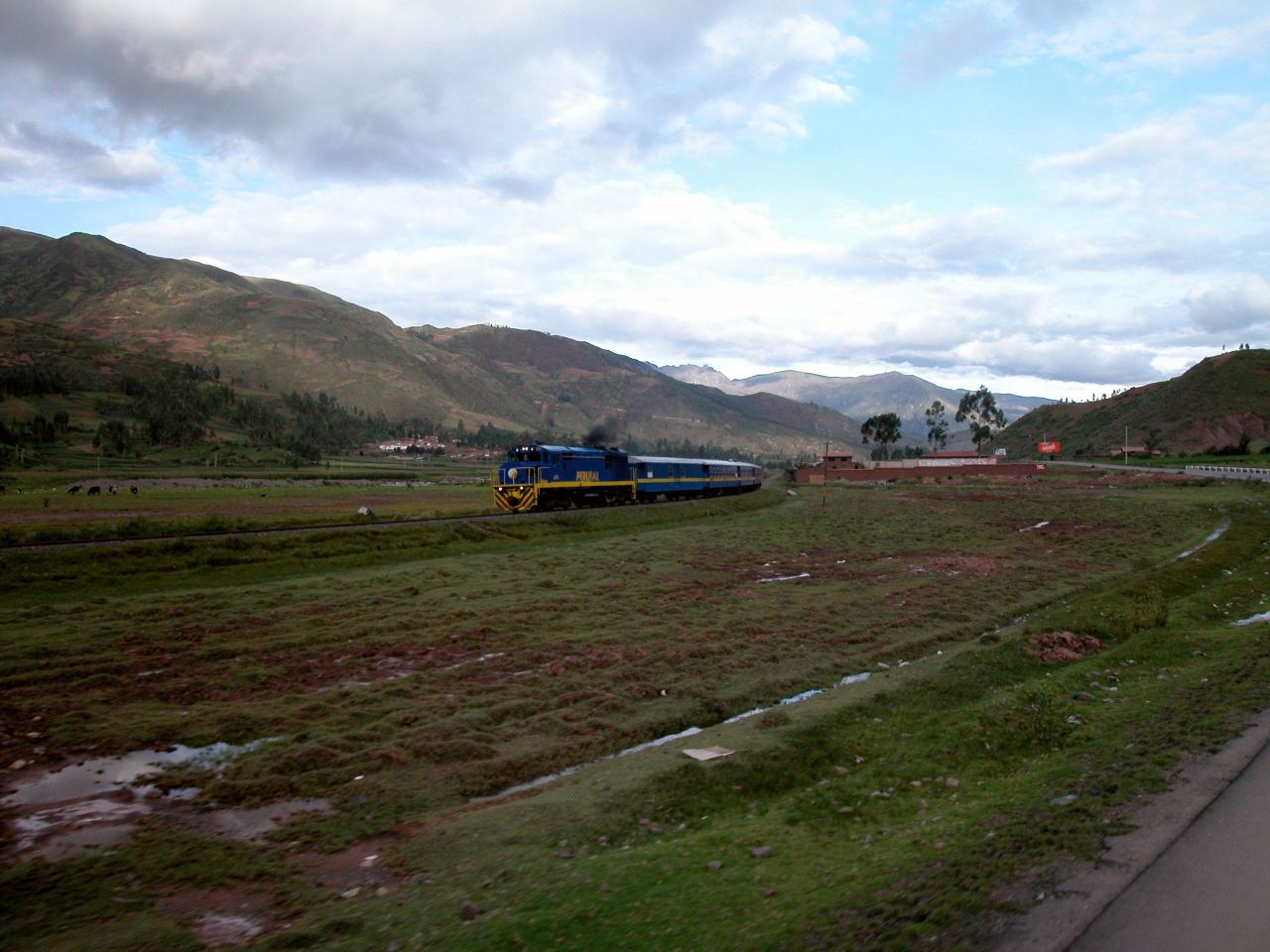
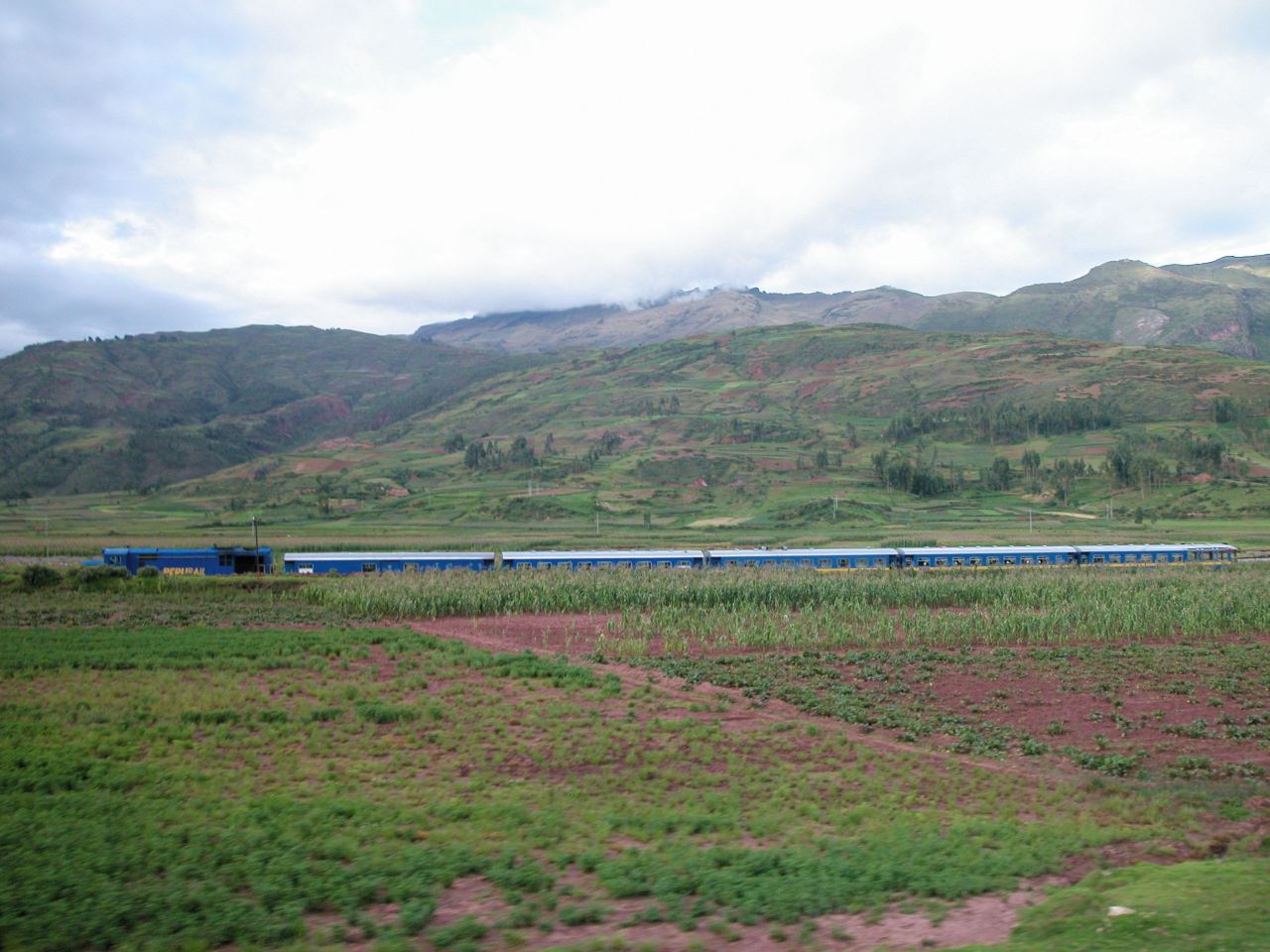
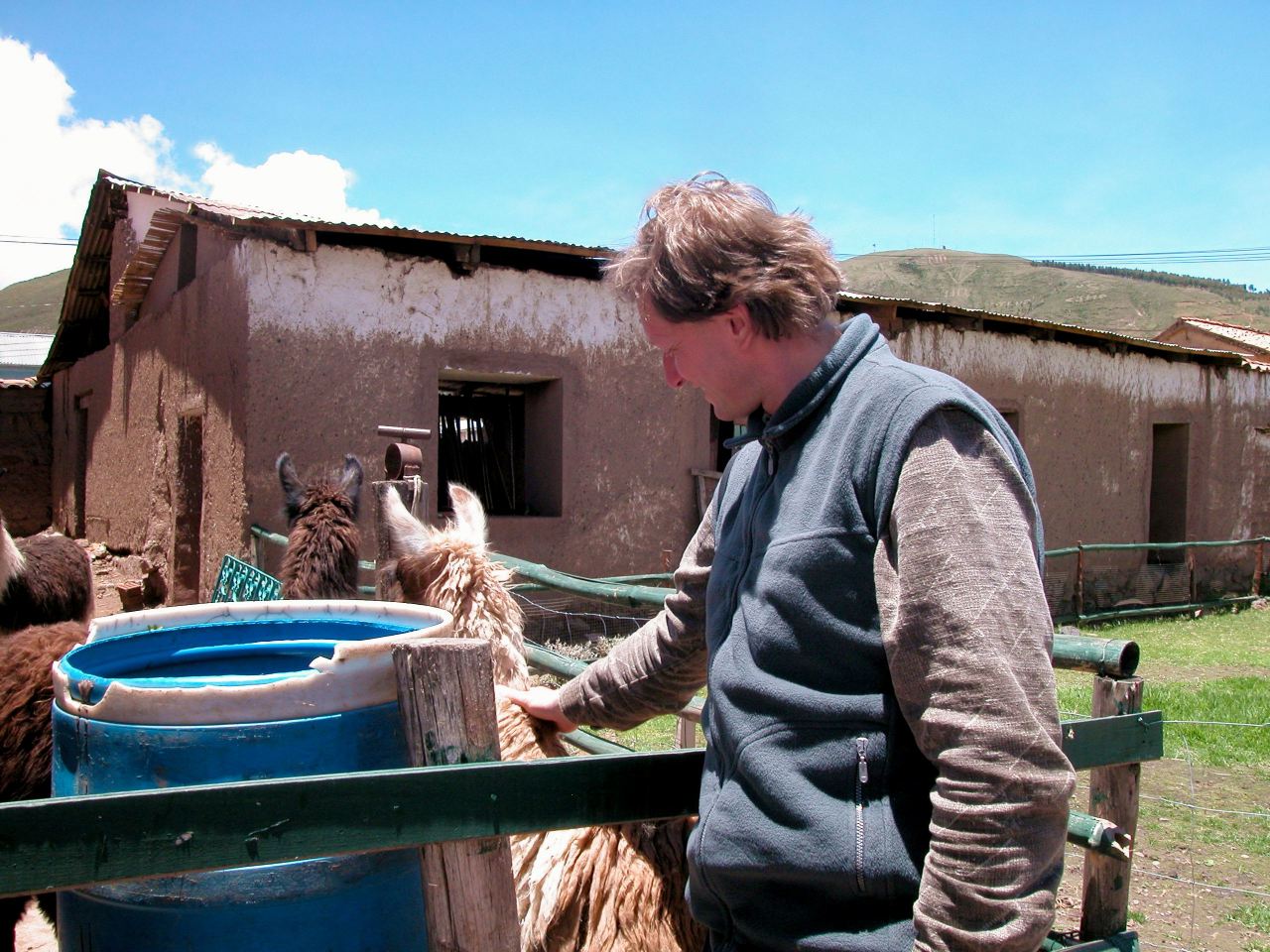


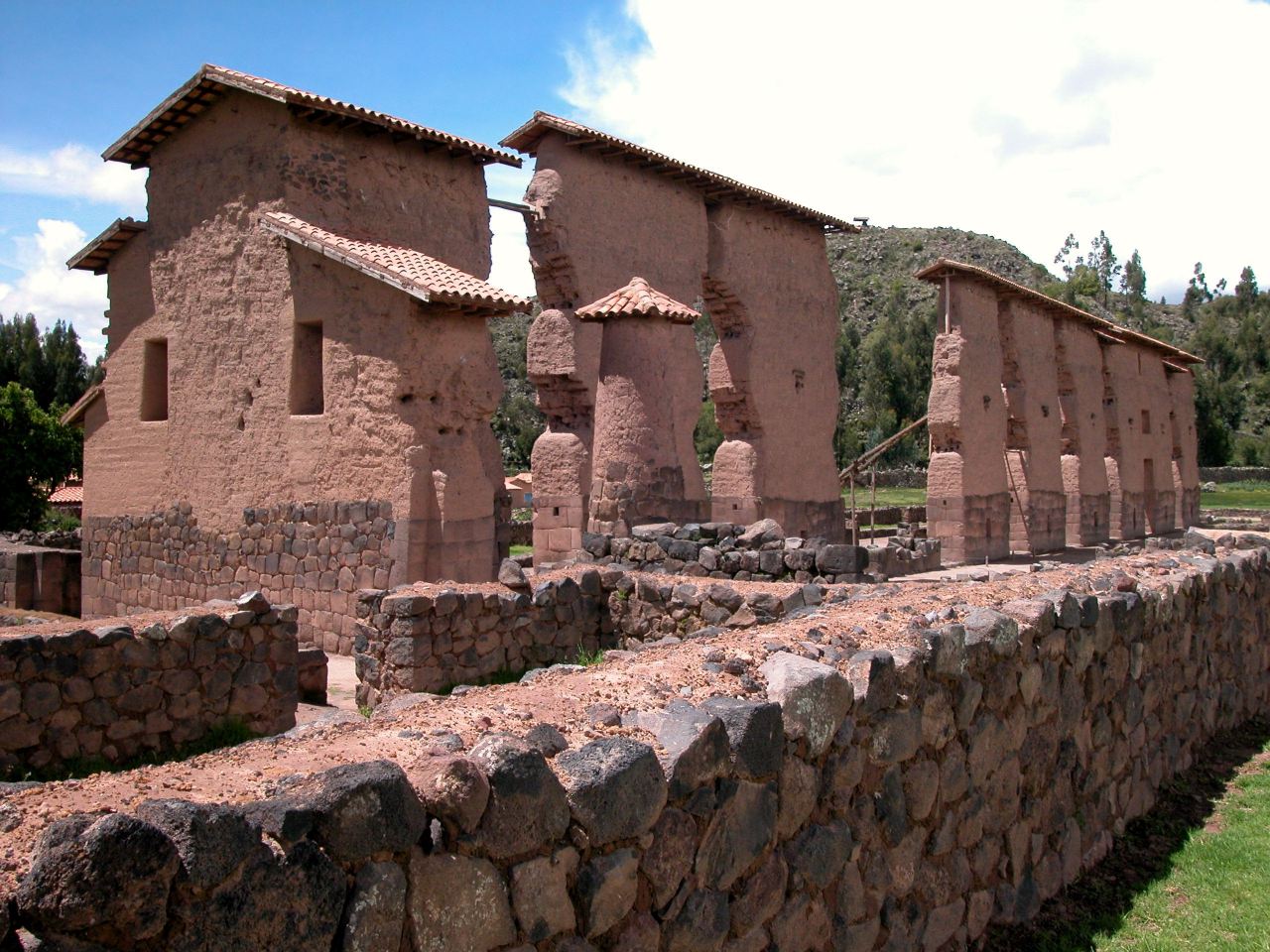
The Temple of Viracocha is an unusually interesting and fairly well-preserved building. Viracocha founded the Inca empire, as the story goes. There are many legends about him, which, like all the legends about the Incas, are quite unconnected with verifiable facts.
Strip away the fancy words and he started right here, with this temple, or perhaps not quite a temple. It was a building blocking the road through a gorge, and they apparently charged people to pass. Nowadays, incidentally, they charge five soles to look at it. The neighbours got angry and started a series of wars, but a few decades later the Inca empire covered half of Latin America.


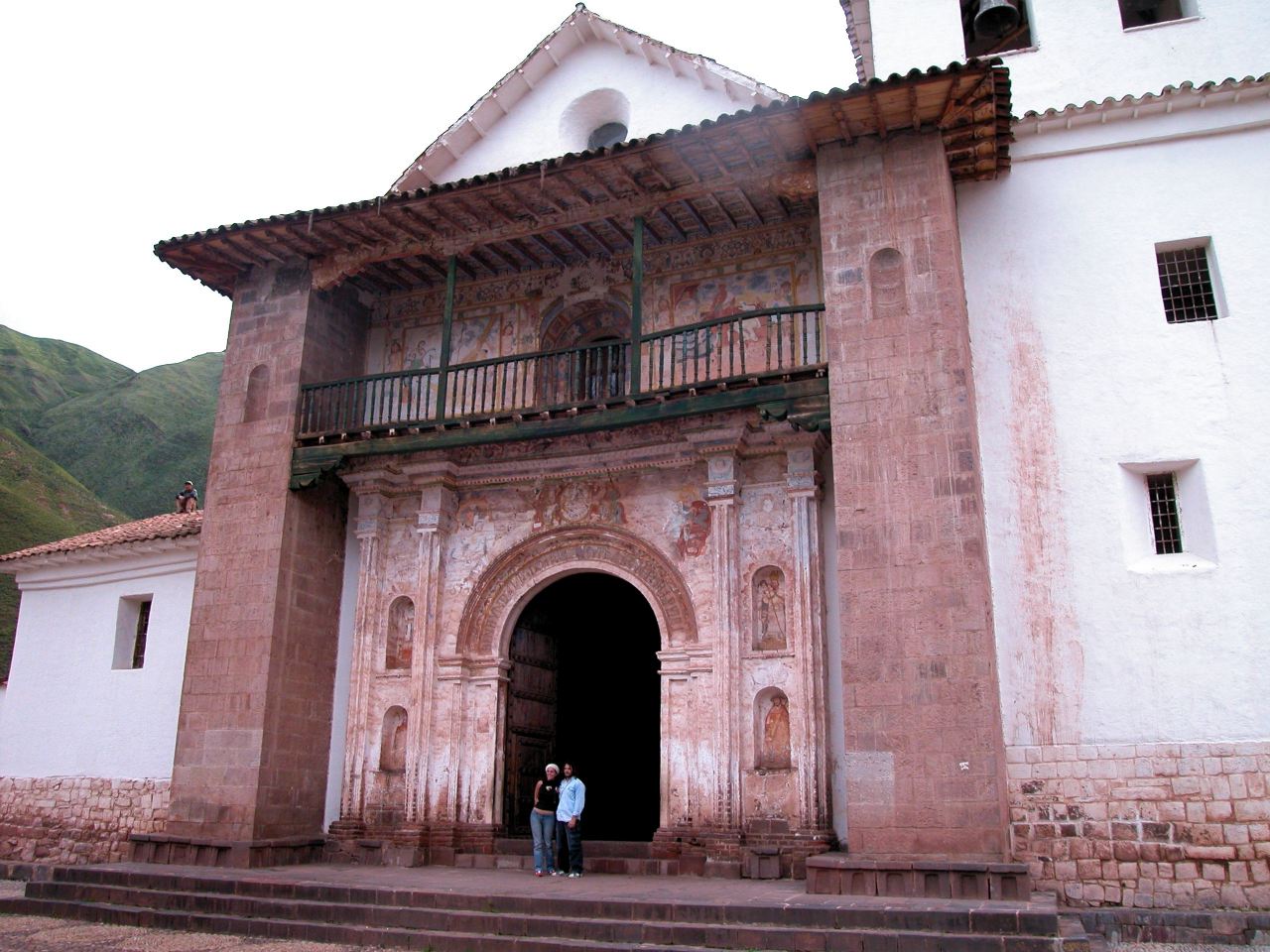
The Church of Christ in Andahuaylillas stands out for the richness of its decoration. It's held to be richer than any other, even the churches in Cusco. I'd be inclined to agree. A pity it's dark inside and they don't let you take pictures, though they do take four soles at the door. For some reason photography is barred in churches all over Peru and the worshippers keep a close eye on visitors. Only now and then did I manage to press the button in passing, as it were.
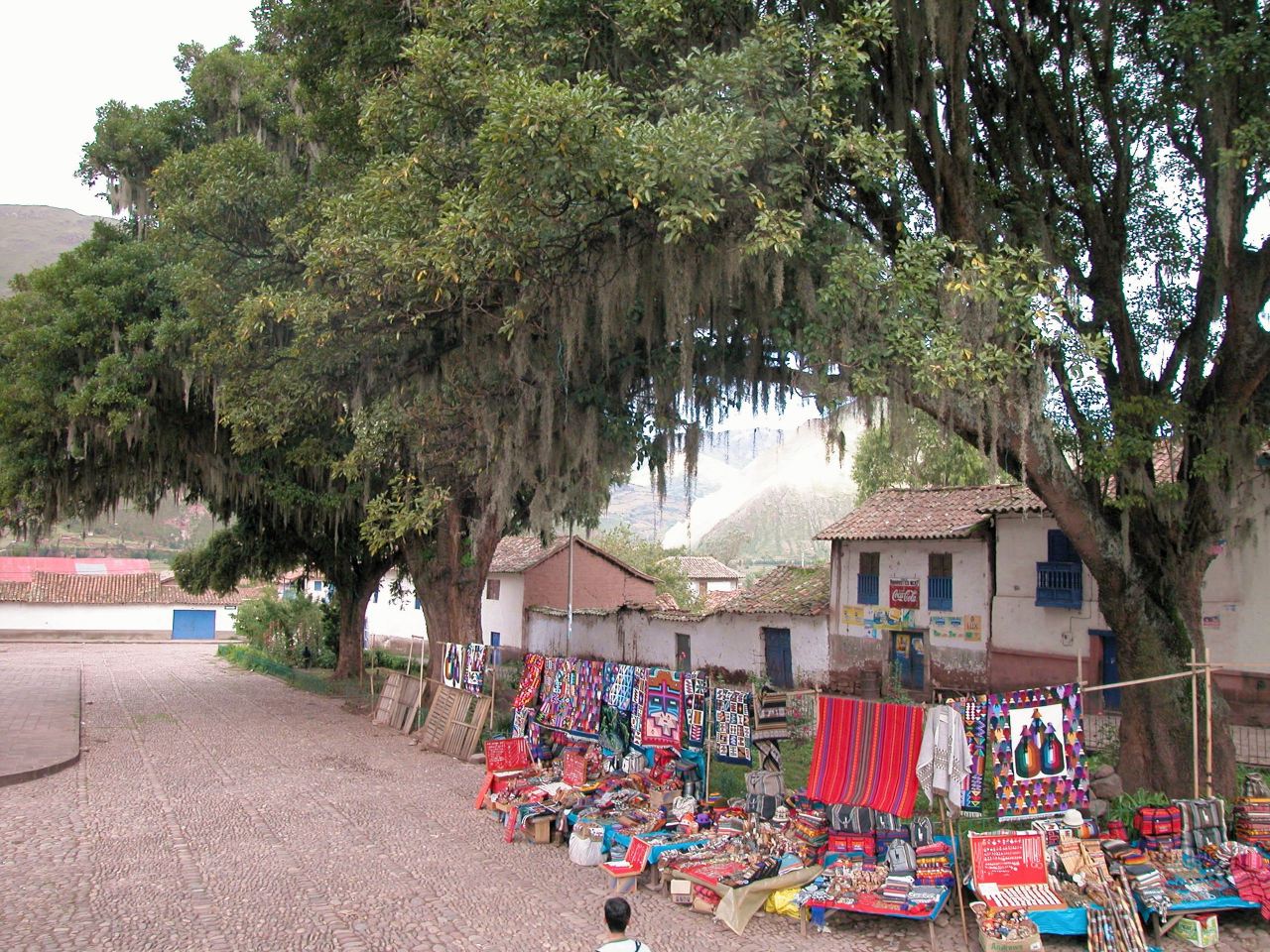
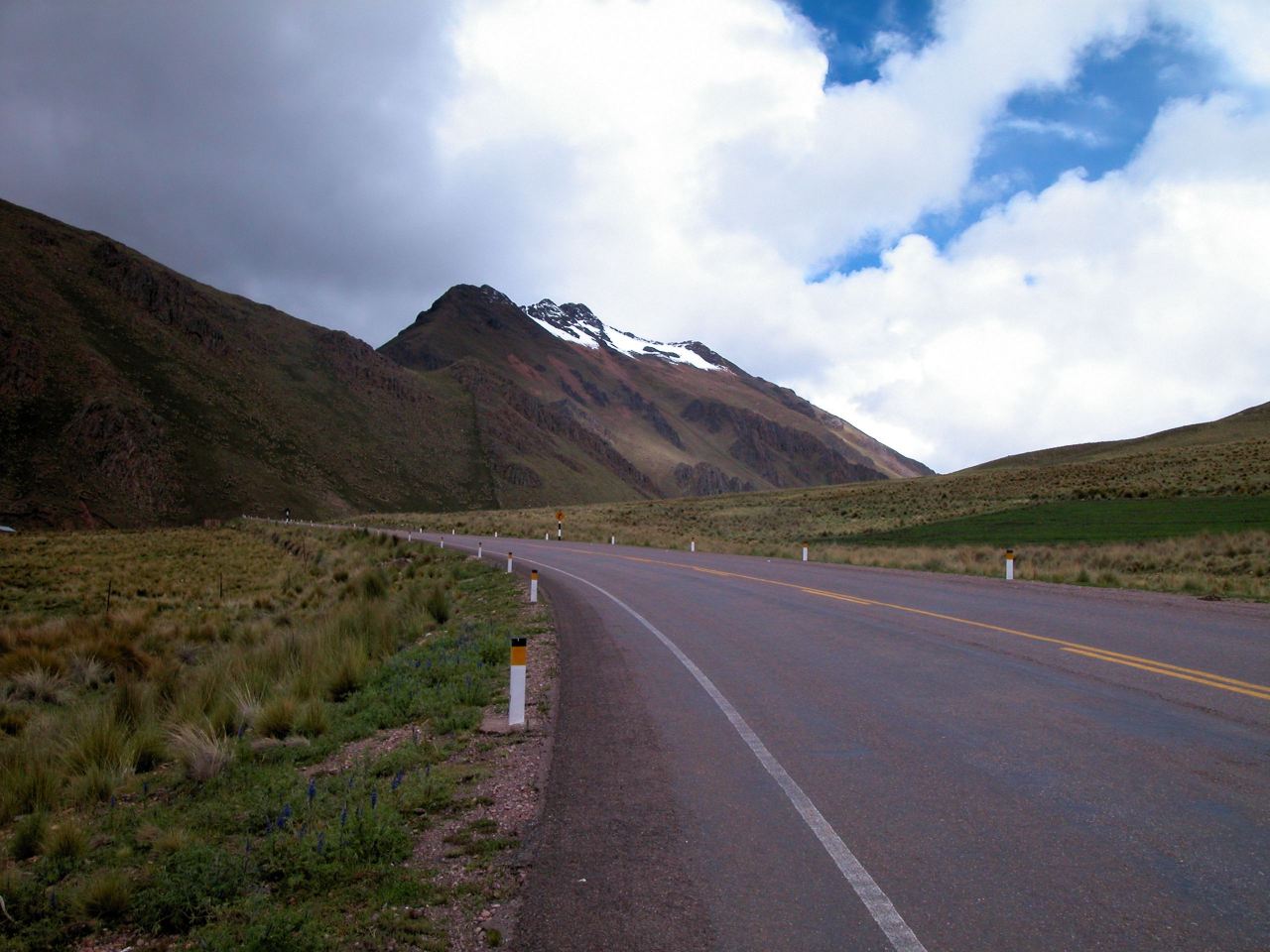
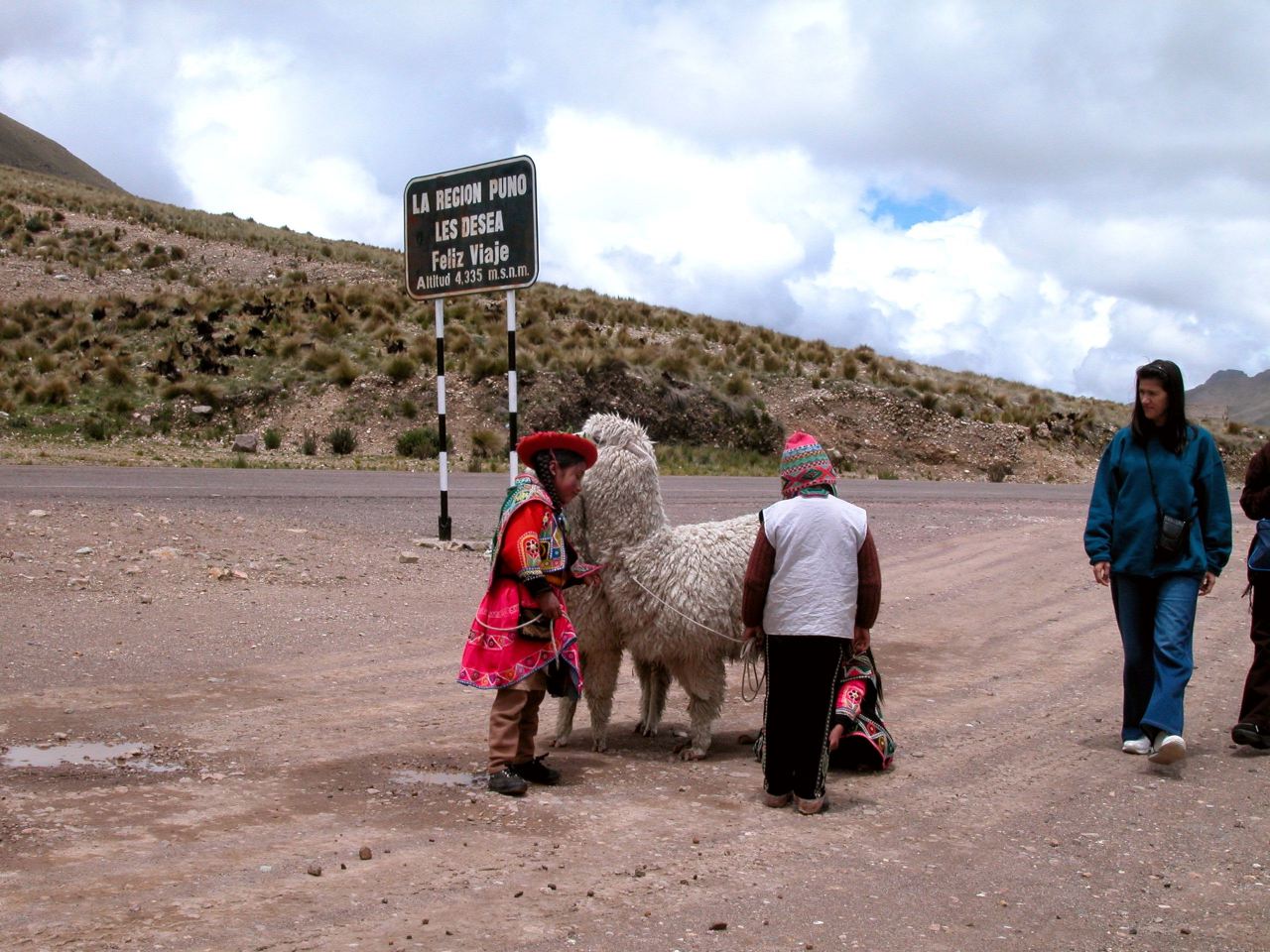
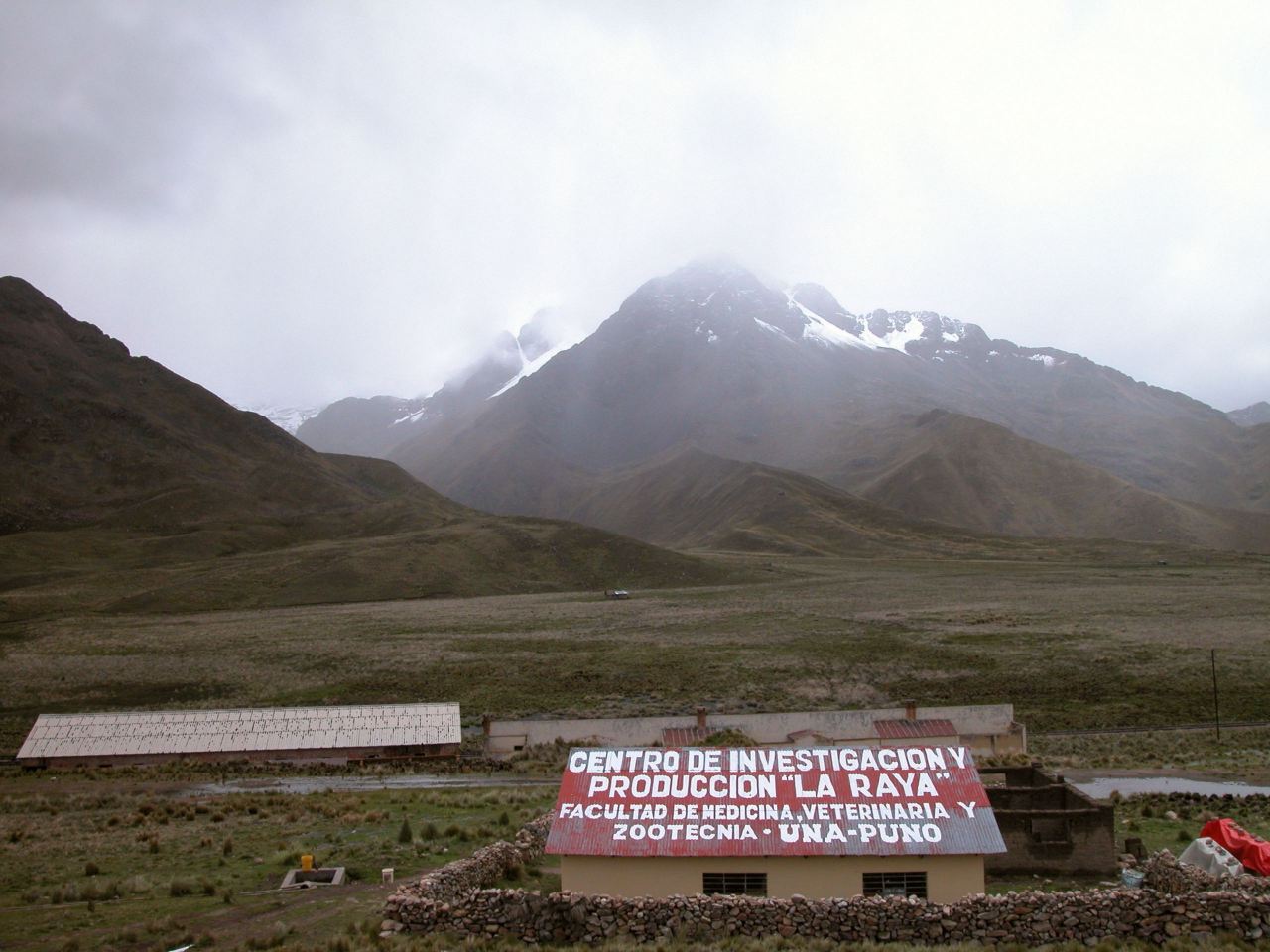
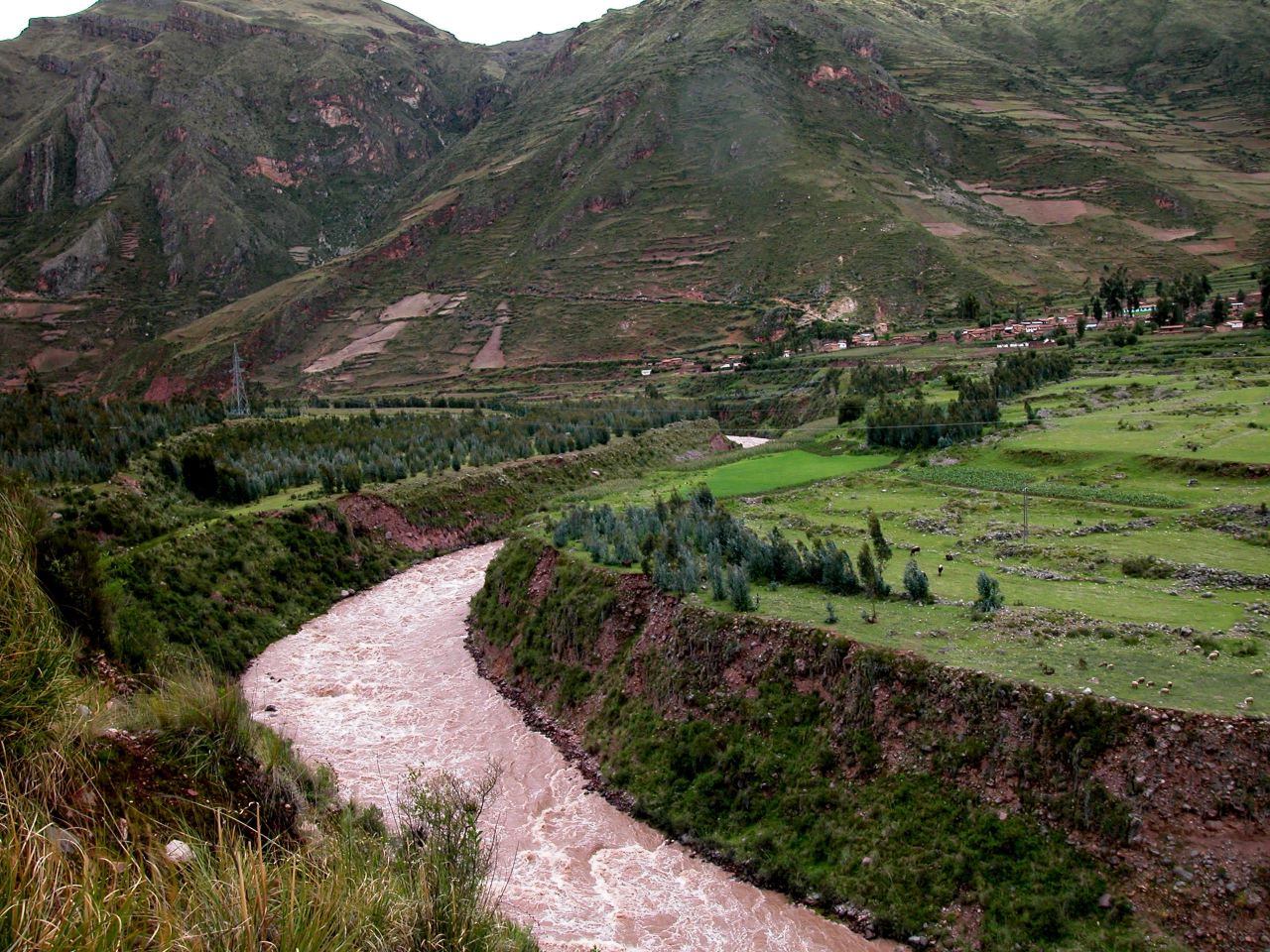
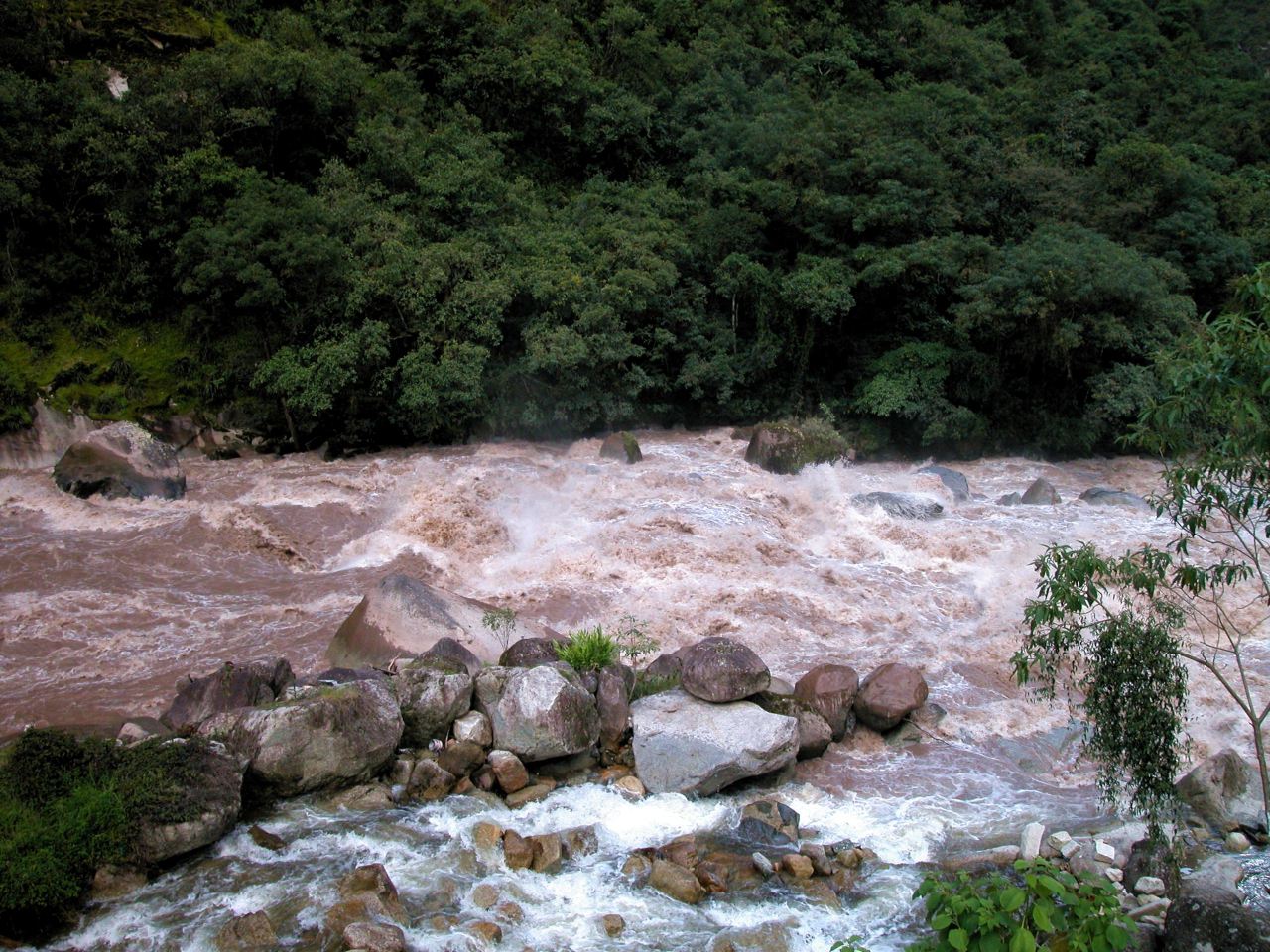
The road from Puno to Cusco goes over Abra La Raya. It's only 4,312 metres high, but snow lies quite close by despite this being midsummer. The Urubamba begins as a small stream here, later merging with many other rivers and forming the Amazon. This is one of the farthest headwaters, so the locals consider it the very place the great river begins. They're hardly alone in that opinion. Villages at the sources of other streams have their own take on the world.
Fifty kilometres short of Cusco, our bus blew a rear tyre. Normally they have twin wheels so that, if one goes, you can reach your destination without climbing under with a jack. As far as I could tell, here they keep driving until both tyres give in. They also keep going until the tread wears clean through. Where they get the tyres is a mystery. Here we are in a proper branded tourist bus and you can see the cords sticking out of most of the tyres. They must buy them used. Not even Finnish second-hand, but third-hand, by the look of them, from India or Russia.
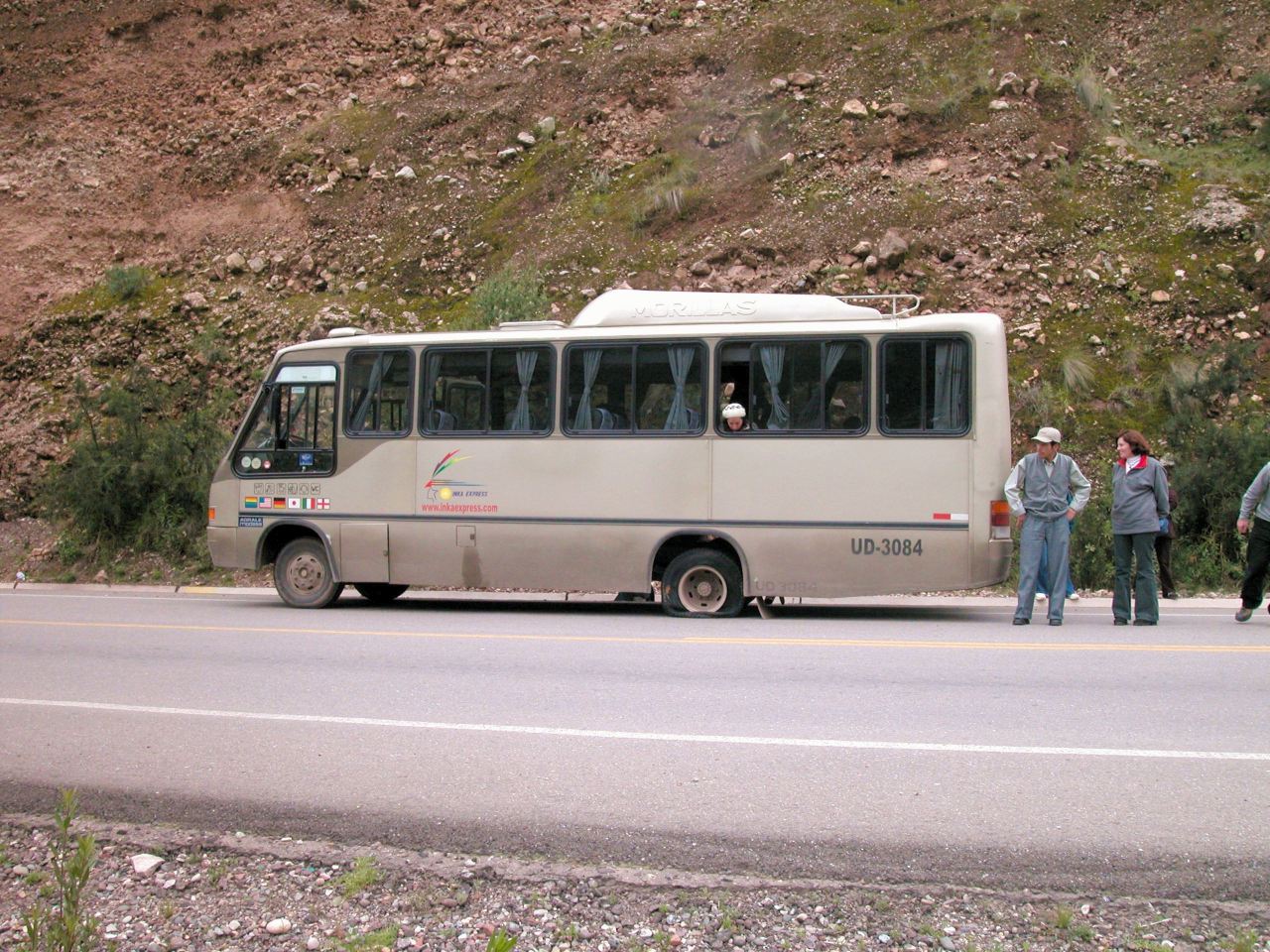
They had to change the wheel. We just made it to Cusco, as it was getting dark.
Cusco is the capital of the Inca empire. Curiously, it's spelt in every possible way in Latin letters, even in official documents. Cuzco, Cusco, or even Quzquo.
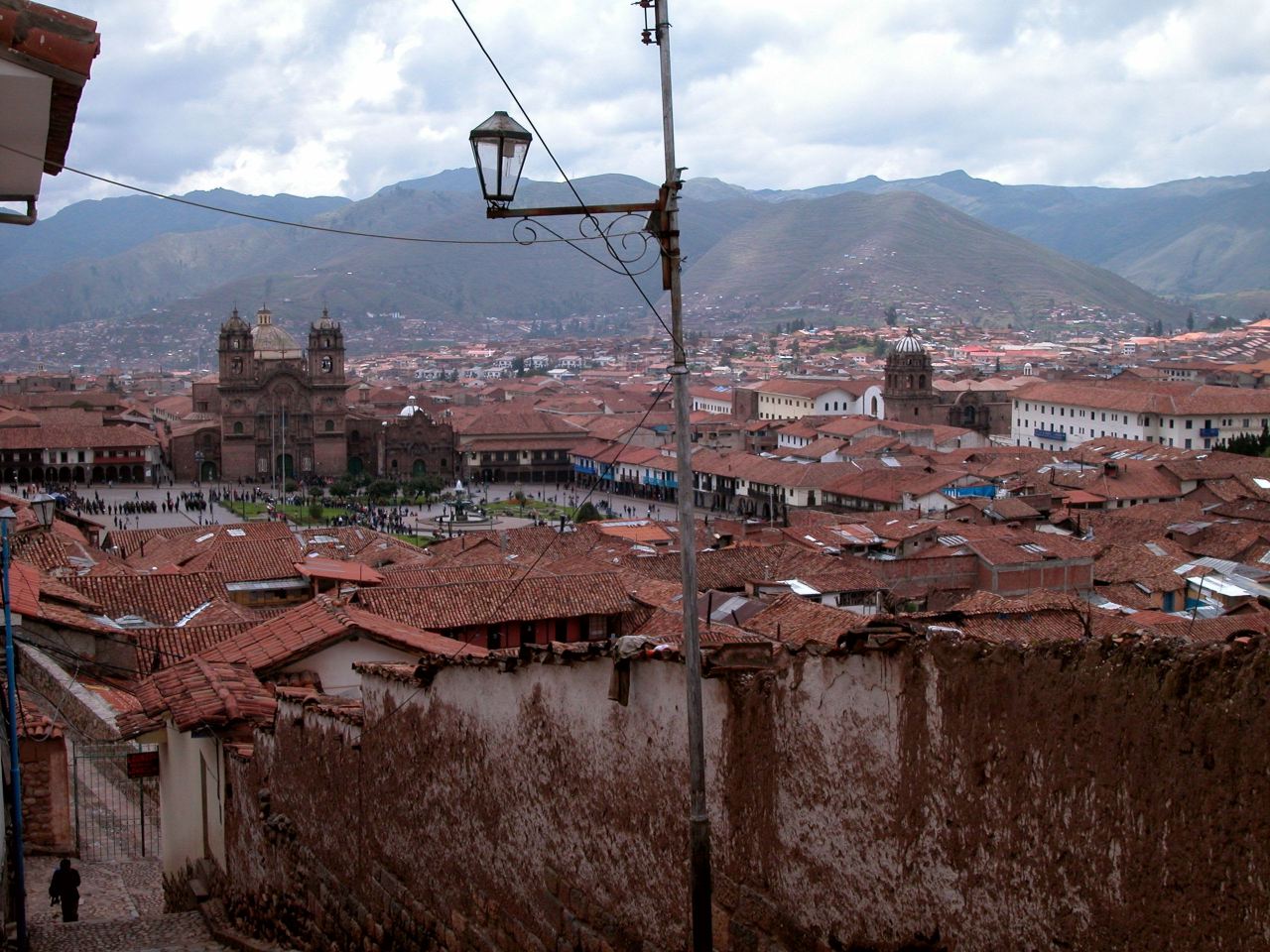
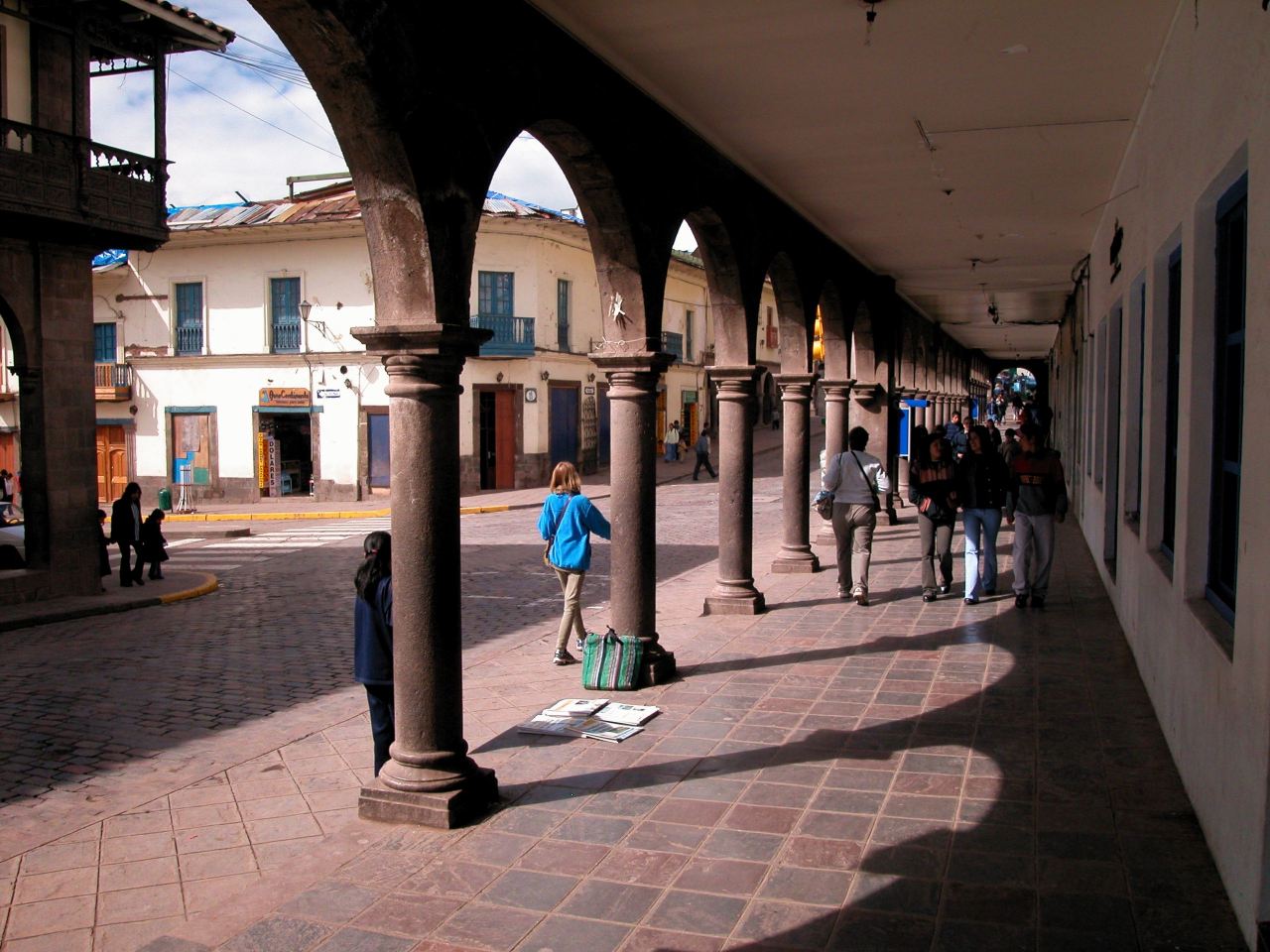
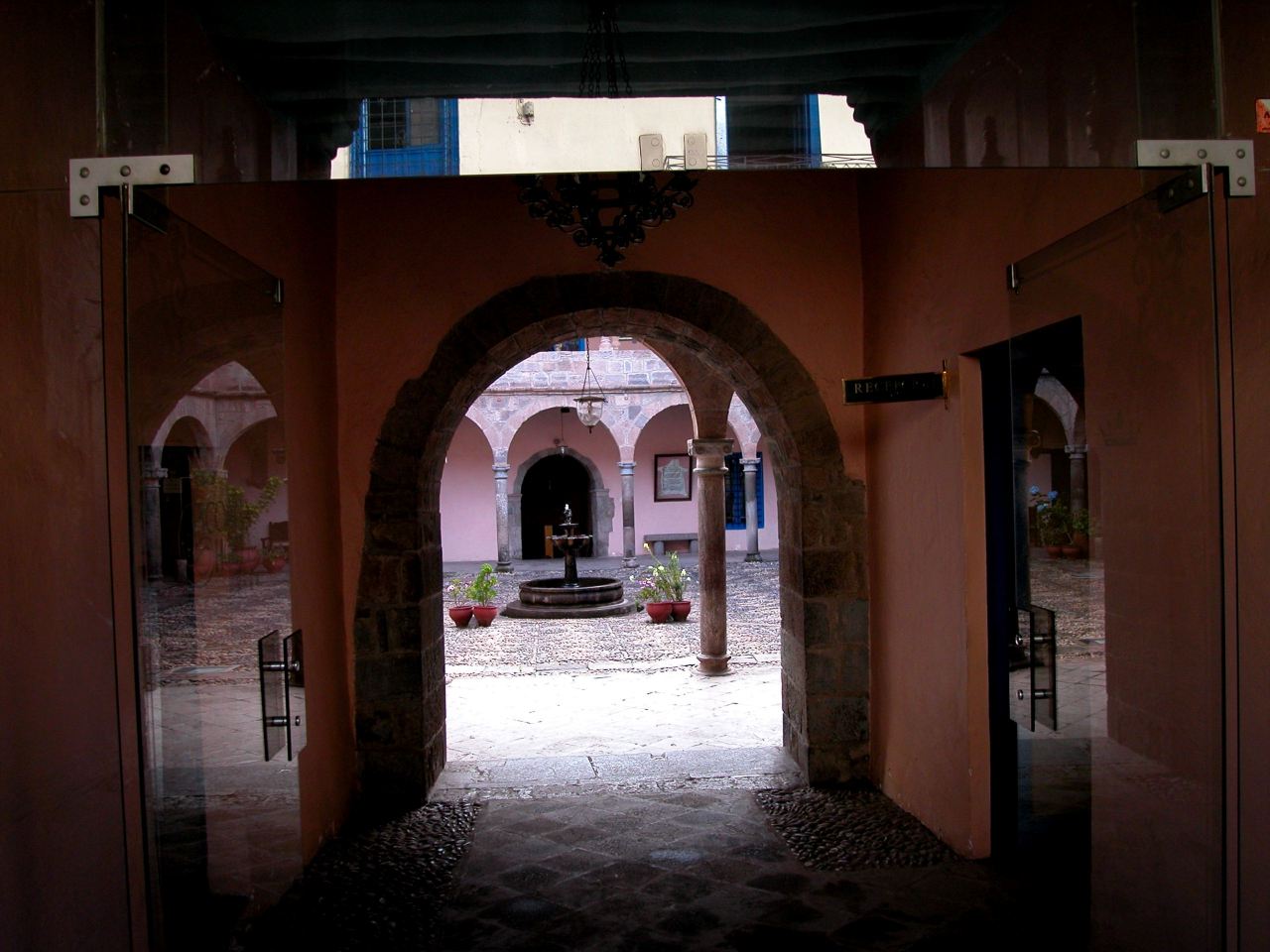
We had to hunt around for a bed. The first few hotels we tried wanted quite ridiculous amounts, like sixty US dollars a night. We soon found somewhere for forty-five soles for all three of us, the Corihuasi hostel not far from the main square. They say the area is very unsafe and you've every chance of leaving what you've saved with the local pickpockets. We followed the earnest advice to go out in a group and keep our wits about us. It turned out all right.
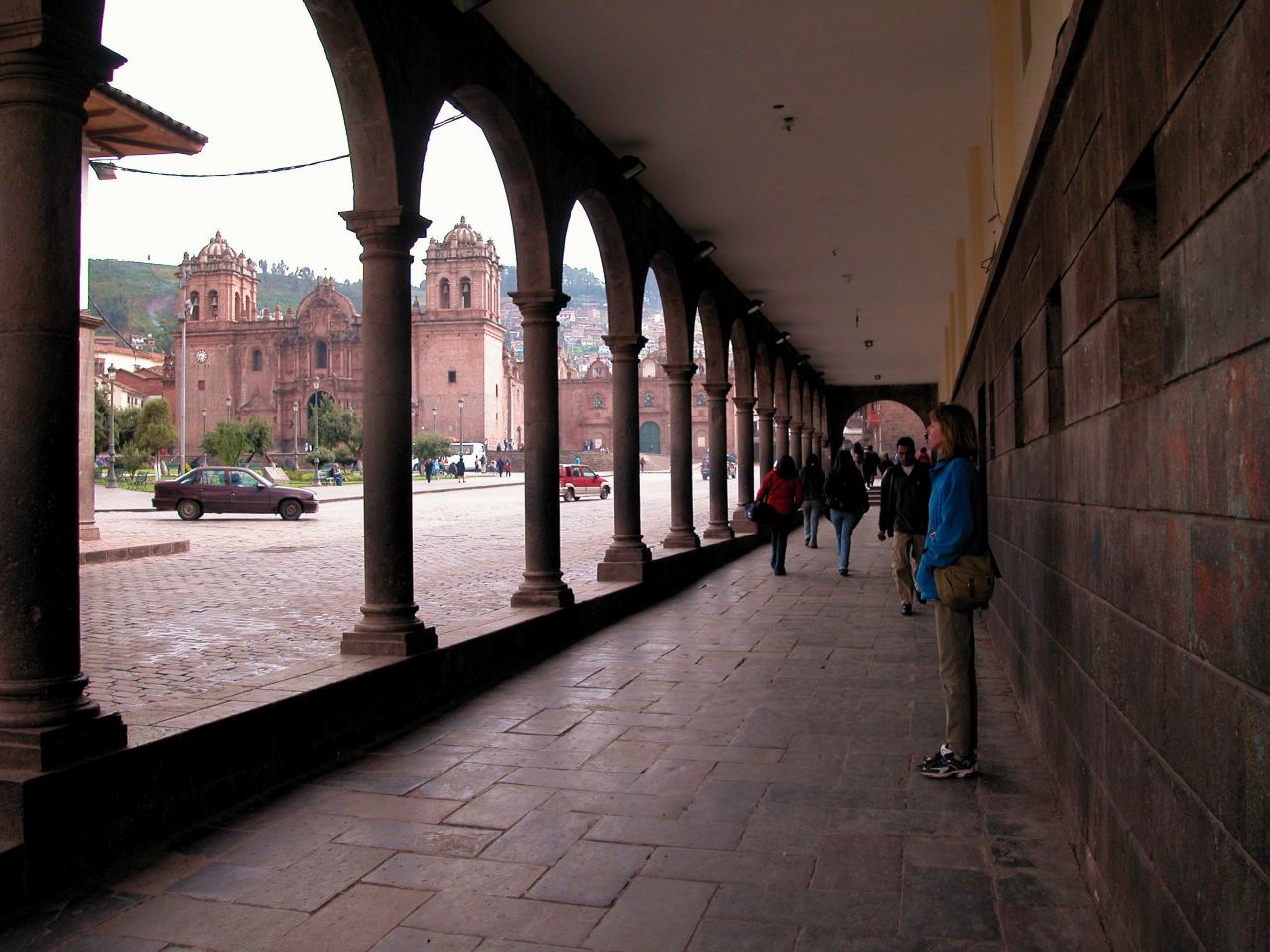
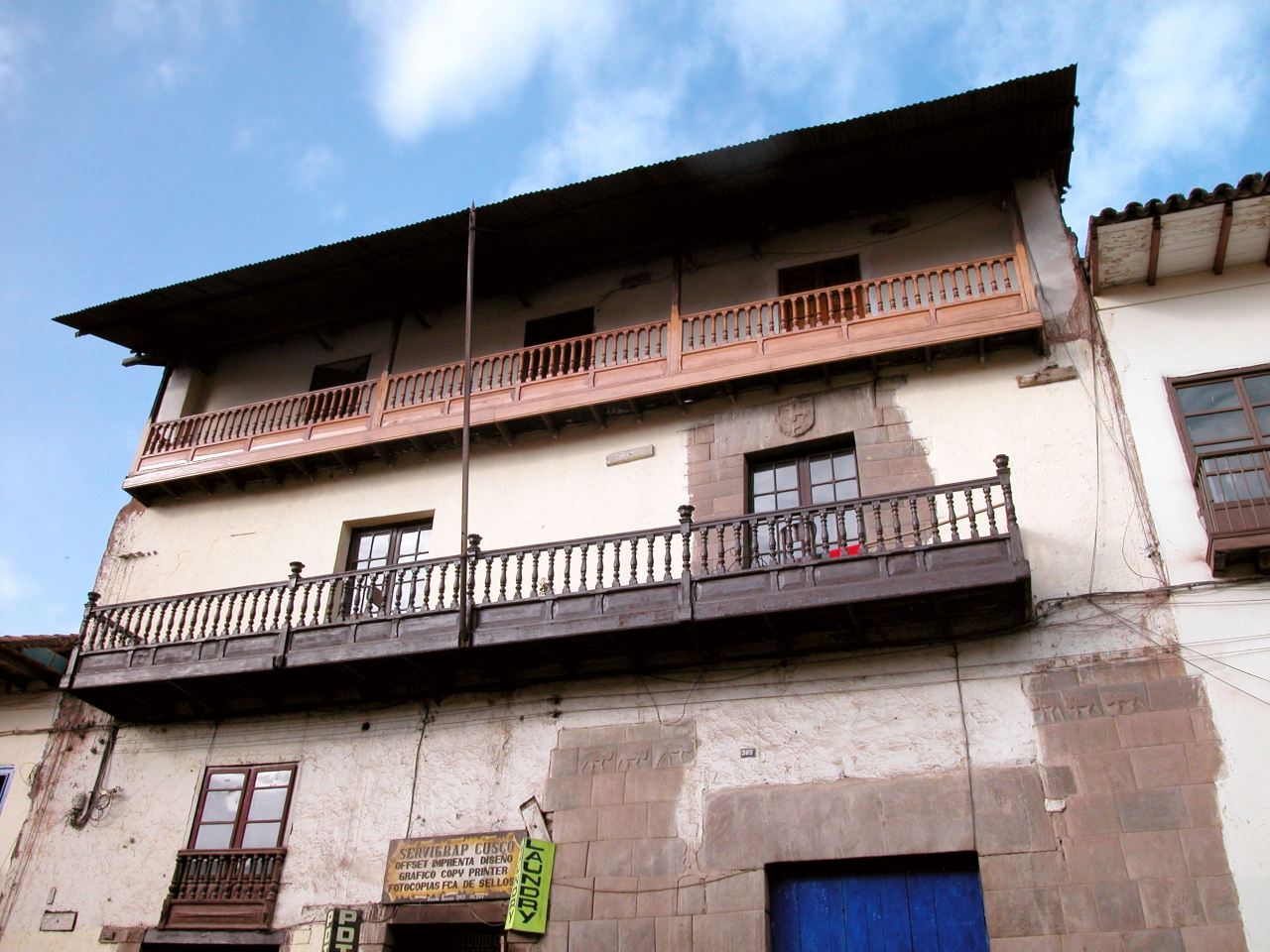
The walls of our hotel were built by the Incas, like most of the other houses in the centre. Inca masonry is known for stones of quite irregular shapes fitted together with practically no gaps. There are stories that the builders had a secret liquid that softened stone. Some herb, they say, and birds use it to make nesting holes in rocks. The secret, of course, is lost. What I can't understand is why, if they cite the birds as evidence, nobody can catch one and see what awful stuff it brought to the nest. I'm convinced the tale is sheer invention and at best describes bricks being made of clay. Quite apart from the fact that a liquid like that goes against the laws of physics.
Inca masonry didn't stand still. Before their time the stones were hardly worked at all, just selected by size. Early in the empire, stones of irregular shapes were ground to fit each other. In fact, they only did this to order for very important people. Everyone else made do with loosely fitted stone walls or adobe made from a mixture of volcanic ash and cacti. Then came the idea of making rectangular blocks and laying them in courses, though they still fitted each block individually. Towards the end they figured out standard blocks of uniform height. Given a little longer they'd have come up with identical square bricks, but then the Spanish arrived.
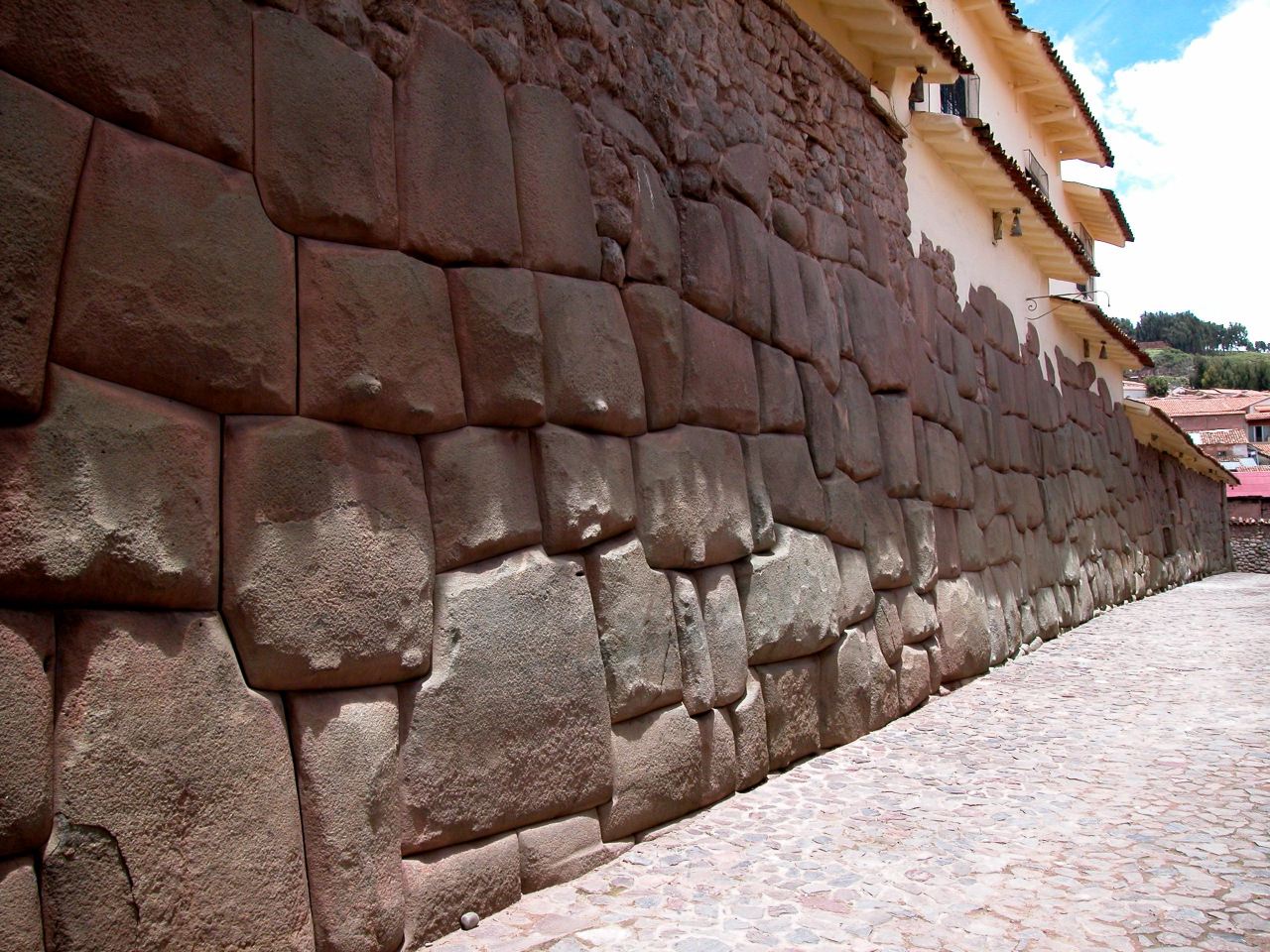
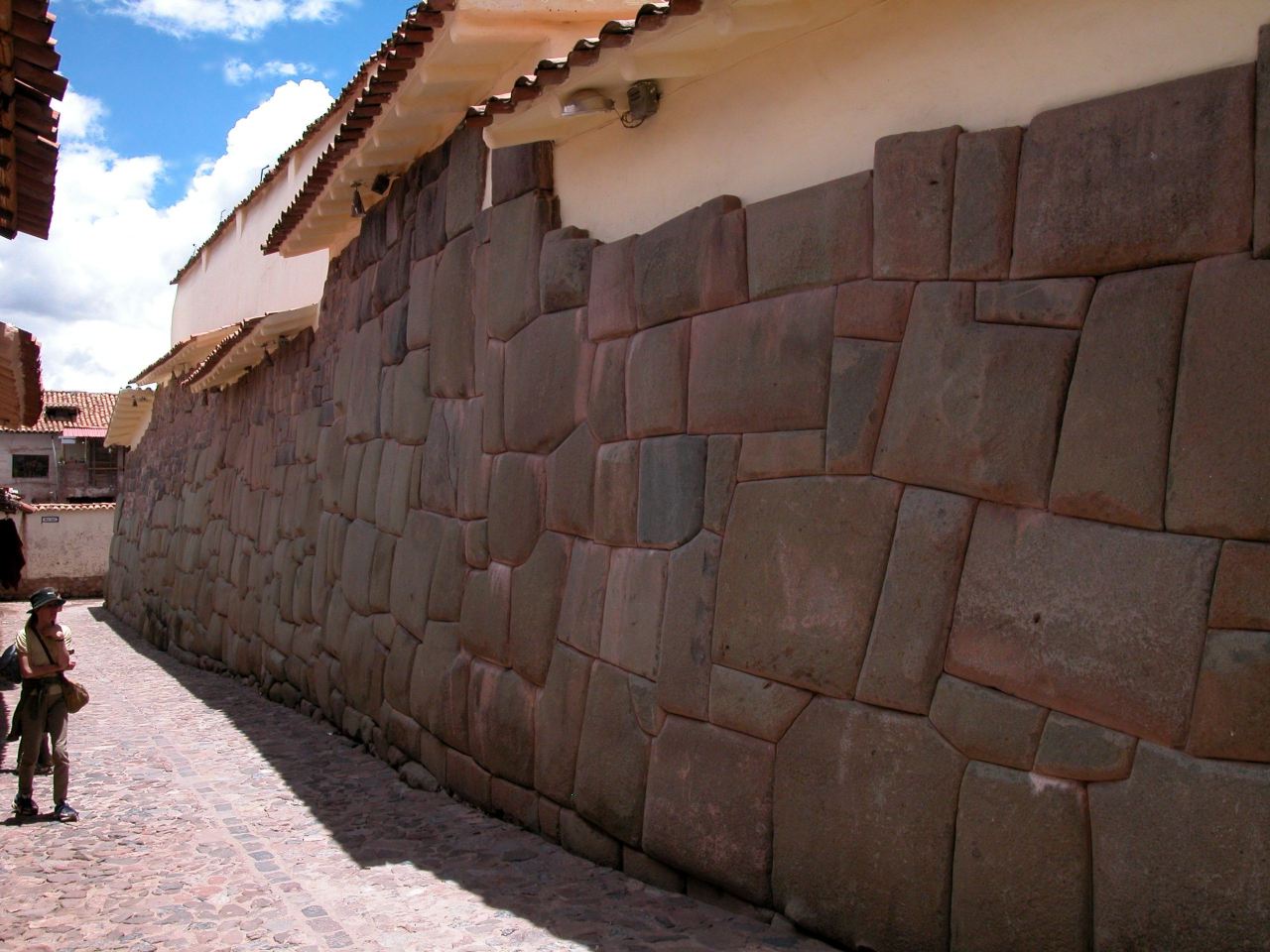

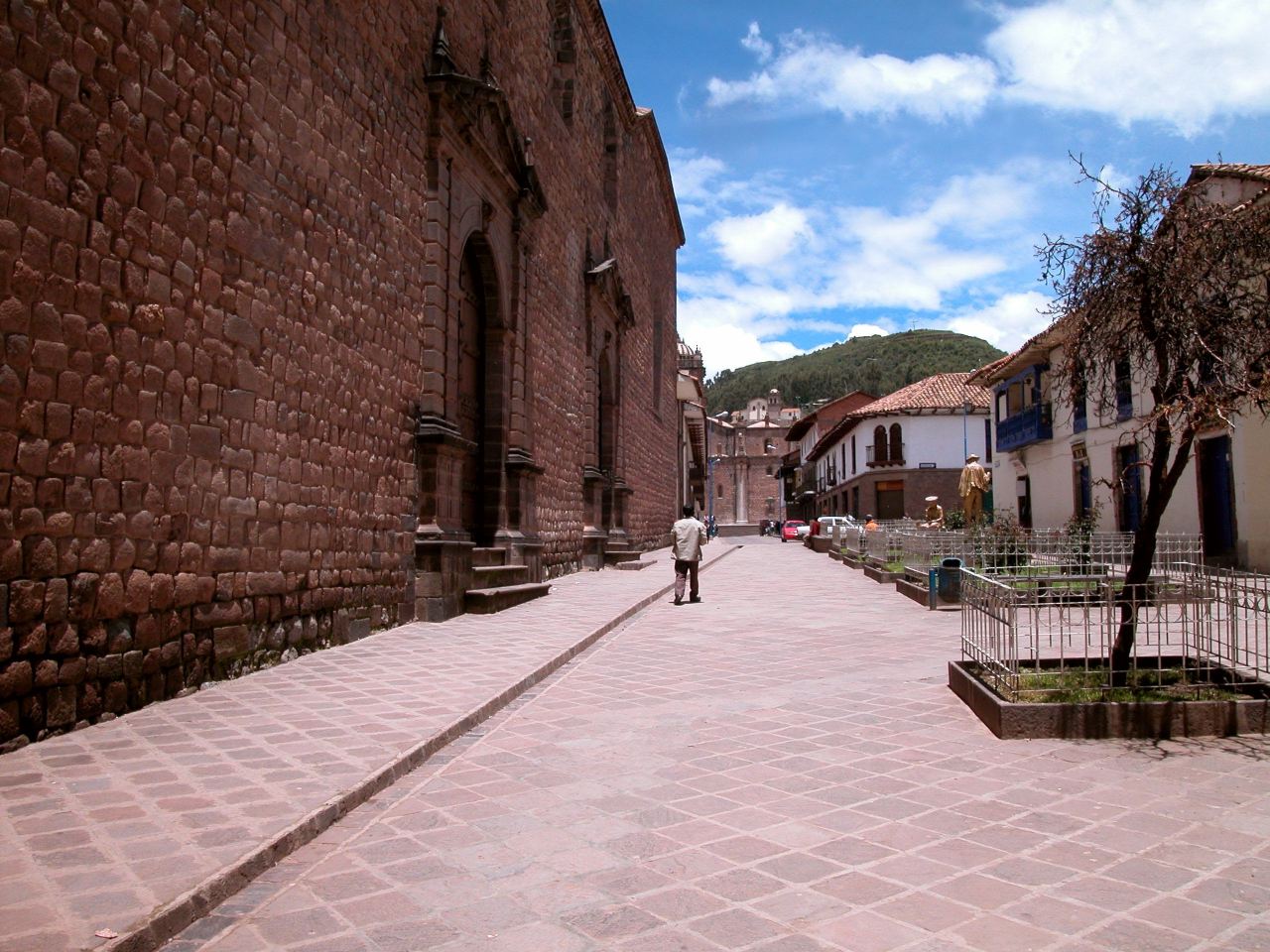

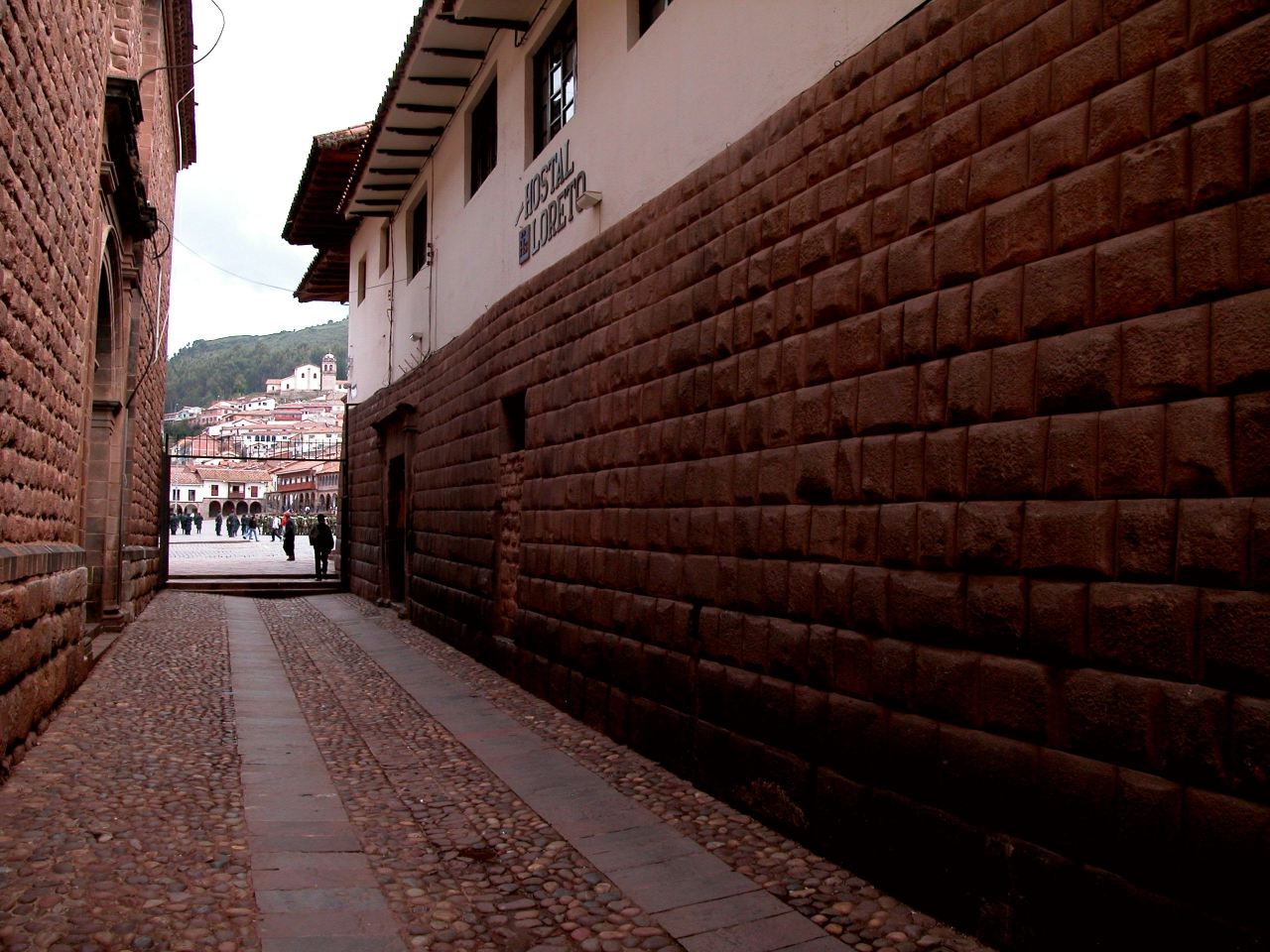
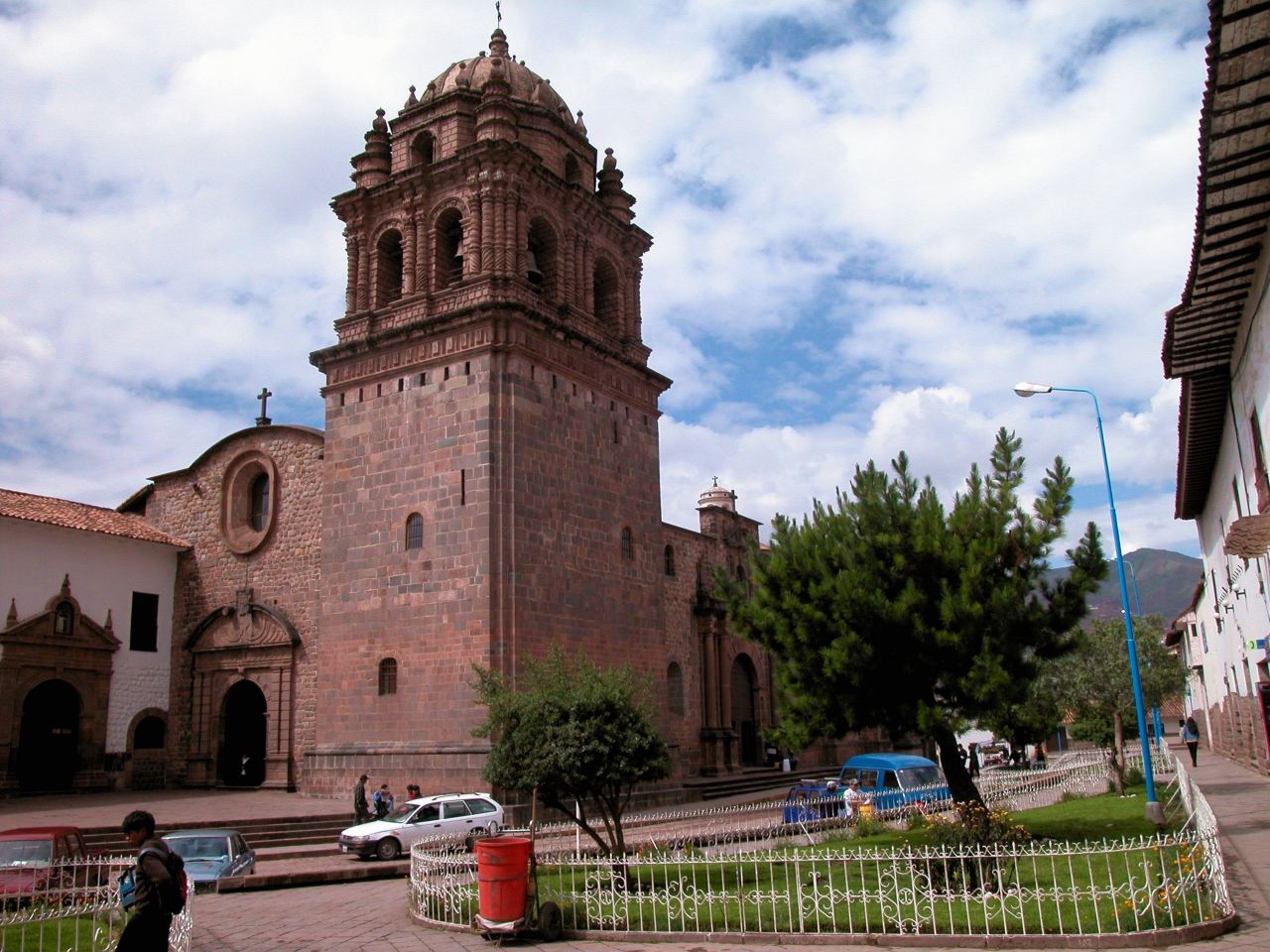
Cusco had been the capital of the empire, which explains all the first-rate old stonework.
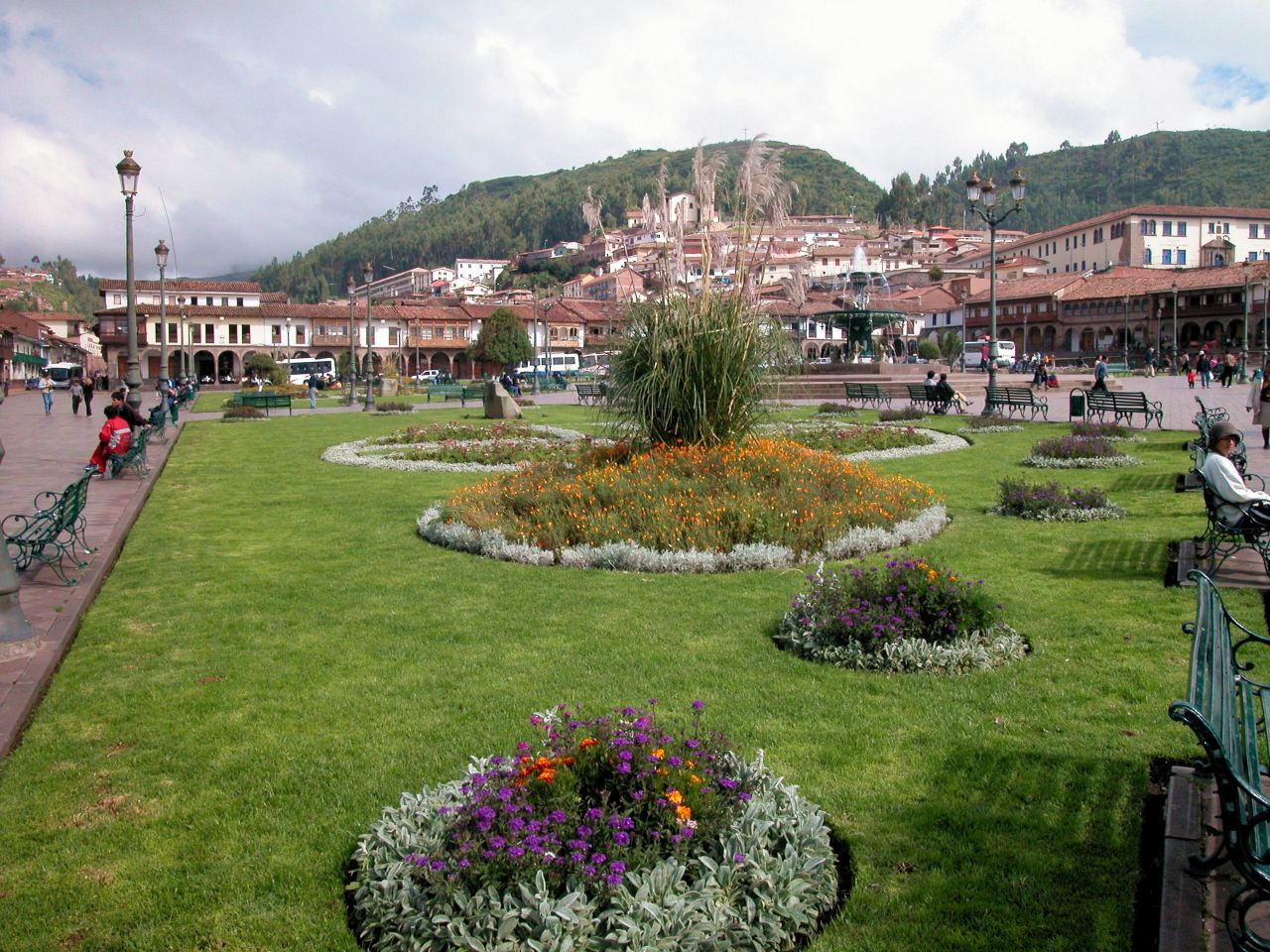
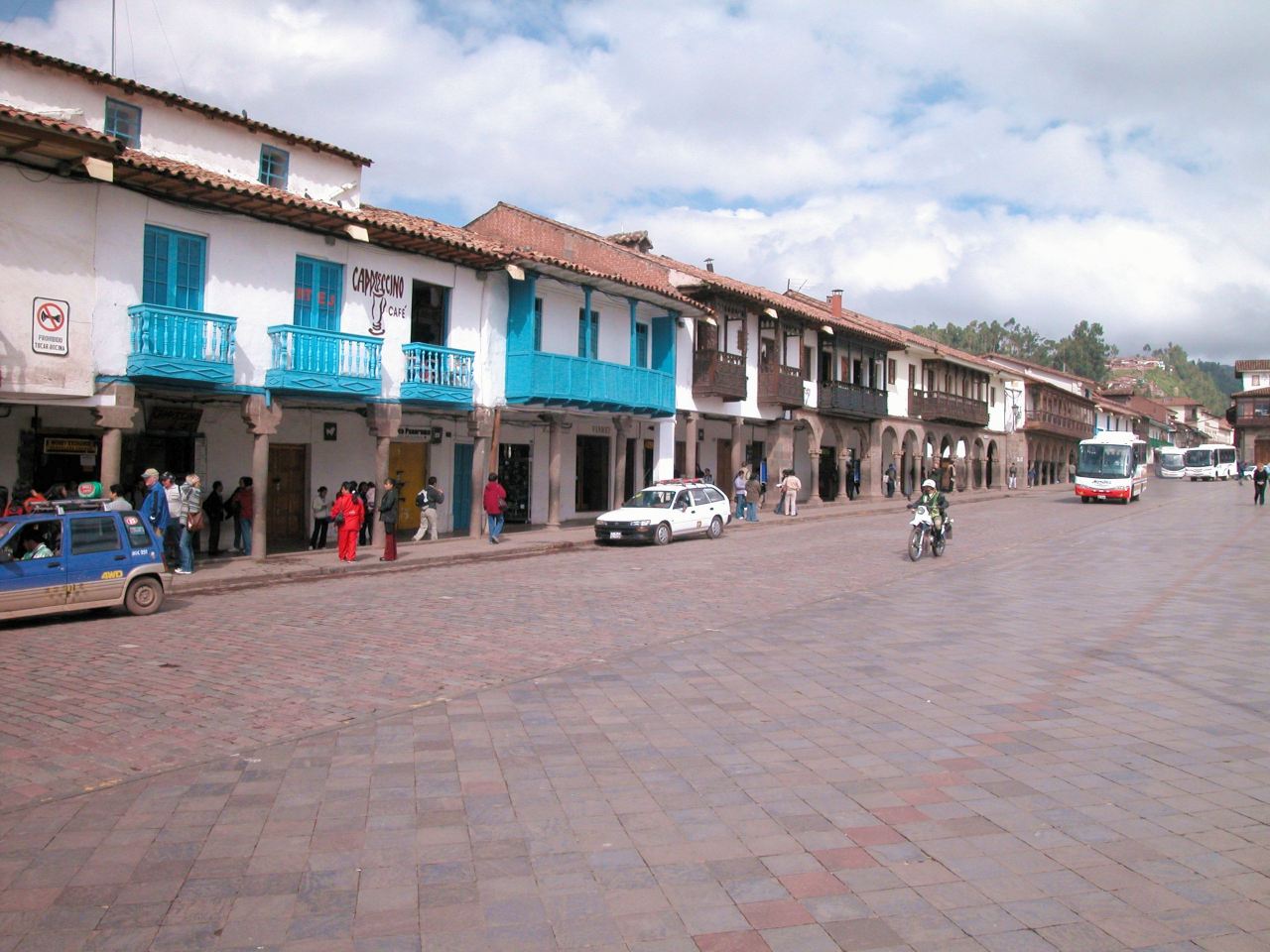
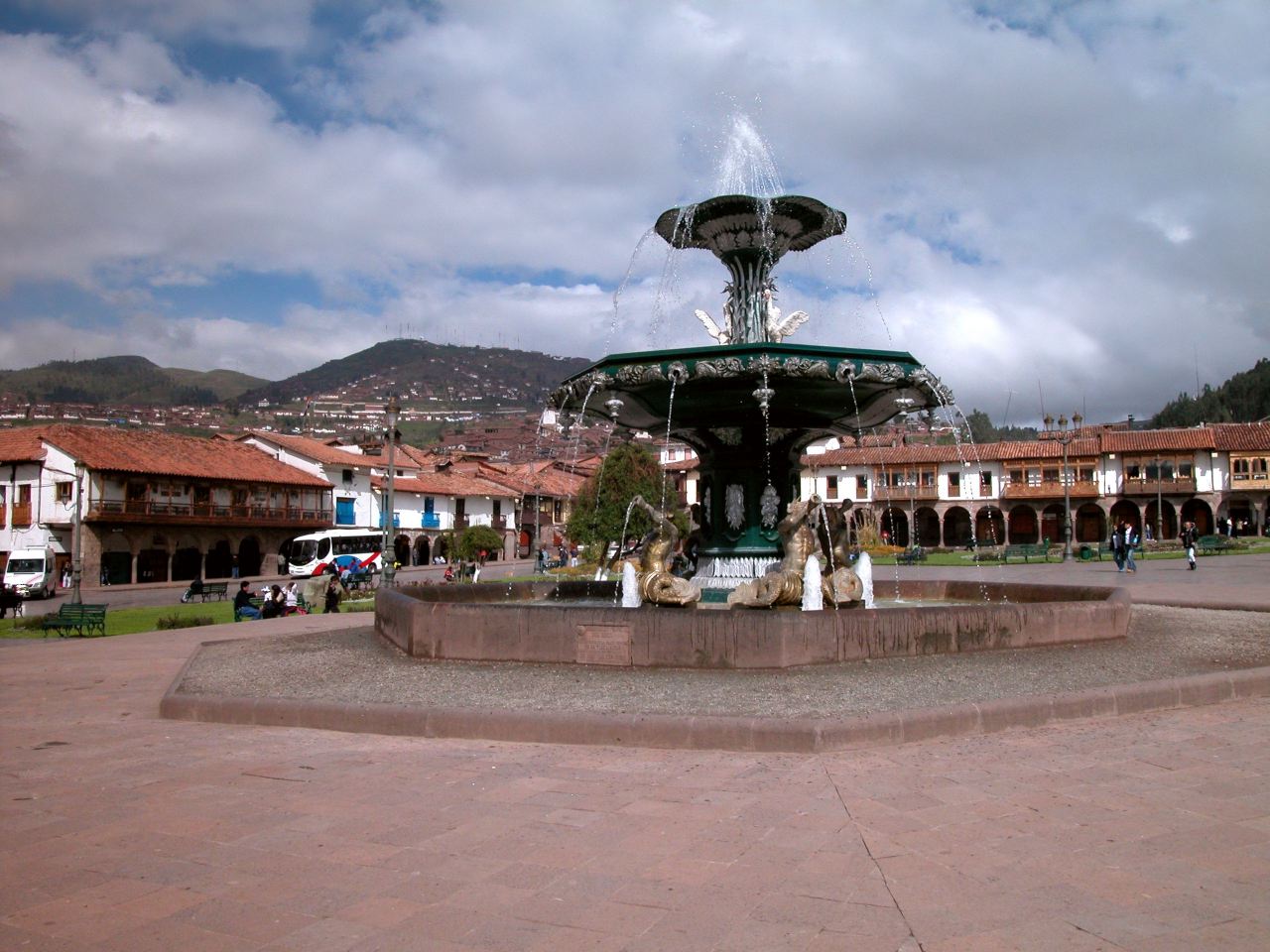
The main square in Cusco, as in all the other Peruvian towns, is called the Plaza de Armas, the parade ground. Every Sunday you're supposed to have a parade in front of the town authorities and raise the flag while the anthem plays. You're meant to stand for this, and the police physically hoist uncomprehending tourists off the benches. Luckily the rule doesn't extend to the cafés around the square. I have no taste for that sort of devotion to the military and those in charge. I liked the way things were in nearby Bolivia much better, but in Peru it's a national tradition.

Peru's recent political history is essentially the history of the reign and flight of Alberto Fujimori. He's of Japanese descent, but was born in Peru, even though his political opponents dispute that too. As president he dispersed the entire opposition. The Maoist rebels among them had it coming, but he cleared out everyone. The most prominent opponents were killed or put in prison. In 1992 he dissolved parliament and the constitutional court when it began to ask whether what he'd done was legal. He even divorced his wife. She later ran for president herself and, with good knowledge of him, fed damaging information about her ex-husband to the public.
They say the economy grew under Fujimori. They say the people loved him and that there was a great deal of construction under him. His approval kept going up along with the government machinery employed to keep it up. Fujimori took roughly two-thirds of the vote at elections. The constitution was changed as needed, since the new parliament was completely under control. The prohibition on a third presidential term was no exception. A new constitution was adopted and the terms started counting all over again.
It fell apart remarkably quickly. Friendly pollsters declared his approval rating to be practically ninety per cent. Those who didn't believe them were called enemies of the fatherland. At the third presidential election most serious candidates withdrew for various reasons, and they'd hardly have lived long had they tried not to. For the sake of democracy they left a supposedly harmless rival in the race, Alejandro Toledo, an Indigenous man with a populist programme that went as far as talk of reviving the Inca empire. Toledo had started as a shoeshine boy, then made his way in the world. He went to the United States, graduated in San Francisco, took a doctorate at Stanford and worked for the UN, World Bank, ILO in Geneva and OECD in Paris. He taught and worked as a researcher at Harvard.
But he was born into a big family and went hungry himself. Seven of his seventeen brothers and sisters starved to death. Now he was wealthy and successful, married to a glamorous Belgian blonde. As I saw it, that was the very image of having made it in his world.
The first-round results were a shock. Toledo held a clear majority. Of course, the state machinery helped, and Fujimori was declared the first-round winner. But fooling a crowd isn't the same as making fun of the intelligentsia. In Russia, 0.1 per cent of the country came to a march against the closure of NTV and dispersed quietly afterwards. Here so many people came out onto the streets of Lima, and they were so determined, that a run-off had to be announced. Fujimori, they said, had taken 49.79 per cent. A perfectly honest count, no fiddling. Otherwise, how hard would it have been to slip in another twenty thousand ballot papers?
Between the two rounds, the whole state machine was deployed in all its glory. Even Toledo had had enough and withdrew in protest, hoping to wreck the election. But the ruling party knew a trick or two of its own. They announced that he'd written his withdrawal incorrectly. When he called for a boycott and urged people to stay away, they passed a law imposing an enormous $30 fine for not voting.
In the end Fujimori got eighty per cent, but it was too late and it no longer mattered. A year later Toledo became president in a snap election. Fortunately he didn't carry out his silly campaign promises. Fujimori, meanwhile, had to flee. The country has been surprisingly peaceful since. Elections take place, people have even stopped painting fences with political adverts, and there's less of the dirty campaigning.
At the time of writing Interpol was looking for Fujimori, but he was in Japan and the Japanese don't extradite their own. Opposition leaders summed up his rule like this: he pursued policies in the interests of the rich, relying on the hopes of the poor and ignoring the middle class, whose rapid growth was probably his greatest achievement.
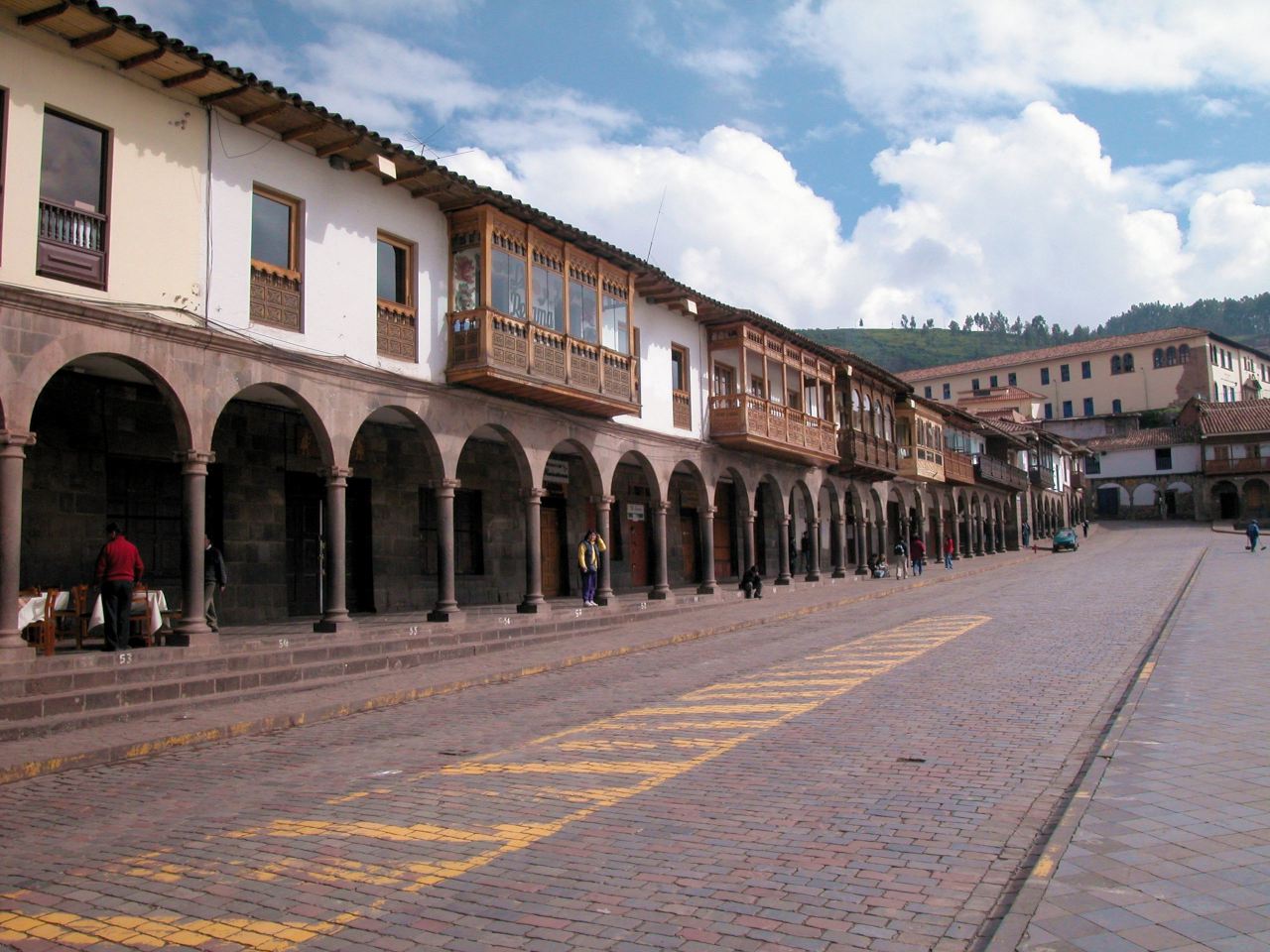
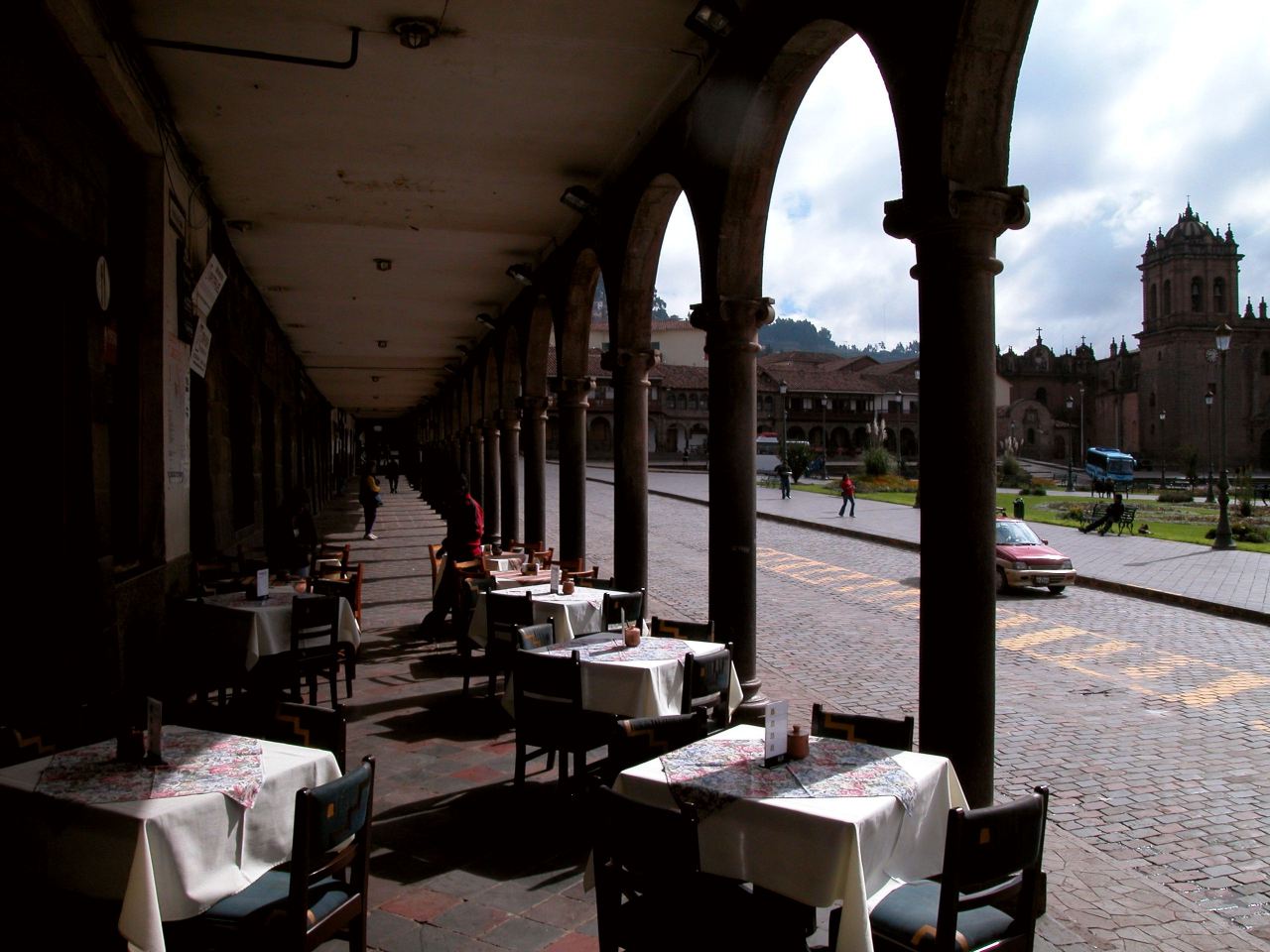
In the morning the main square is a triumph of militarism and deference to rank, and it's best to stay away. In the evening it's the loveliest of places. A perfectly tidy little garden with the inevitable fountain, houses on either side in Spanish colonial style with balconies on the upper floor. All of them are full of restaurants. One is called Baghdad. The moment you appear, touts surround you shouting ‘Balcony! Glassed-in balcony!’ For a moment you think they sell property. They all thrust menus at you. Prices are about the same. We picked an open balcony, the lower prices and a free pisco sour. The serving was so small we had to buy another, and a tequila cocktail as well. We ate and drank at length and very well. We spent the long southern evening looking at the lovely square, the many lights, and walls that had been built by the Incas.

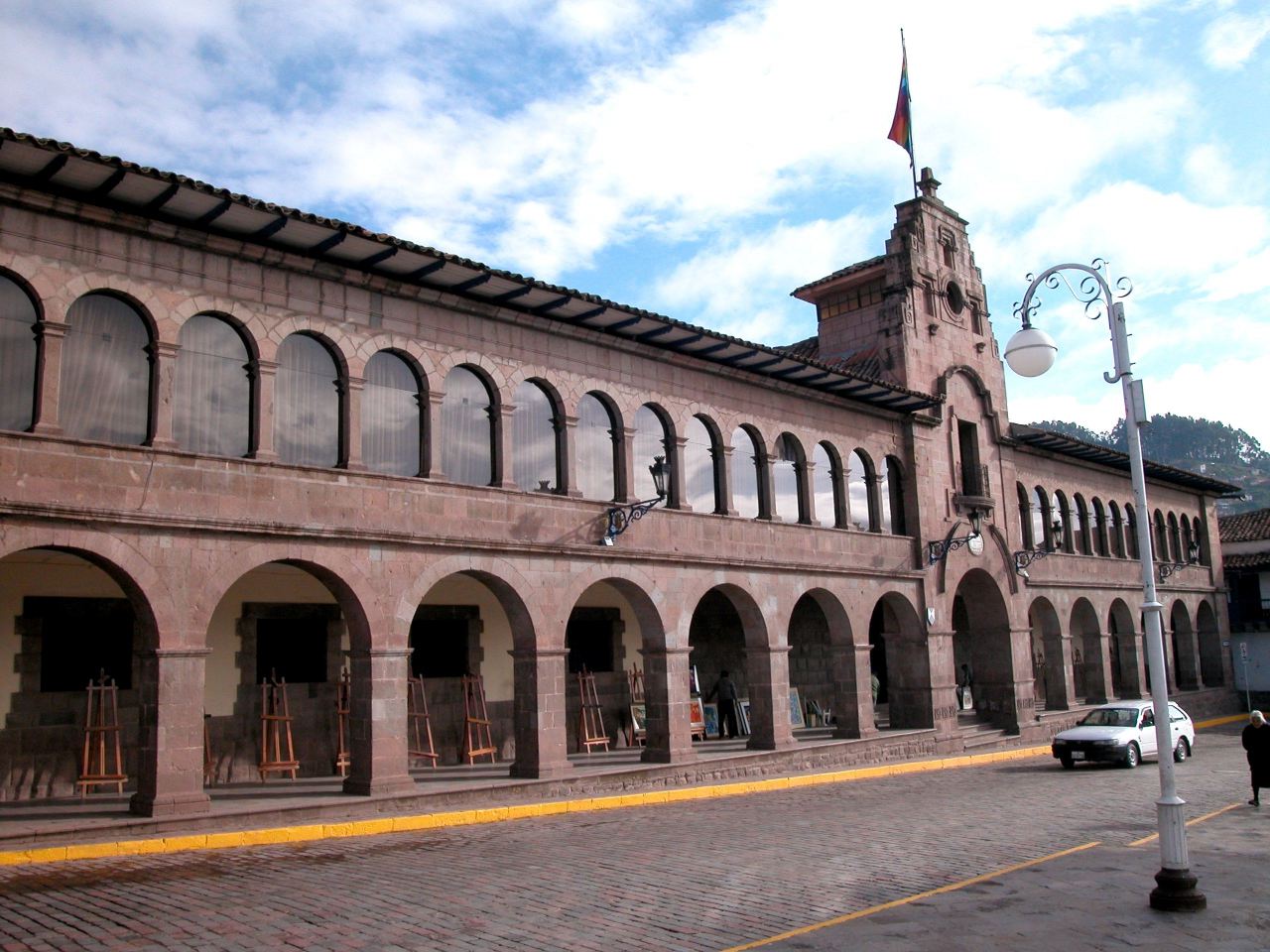
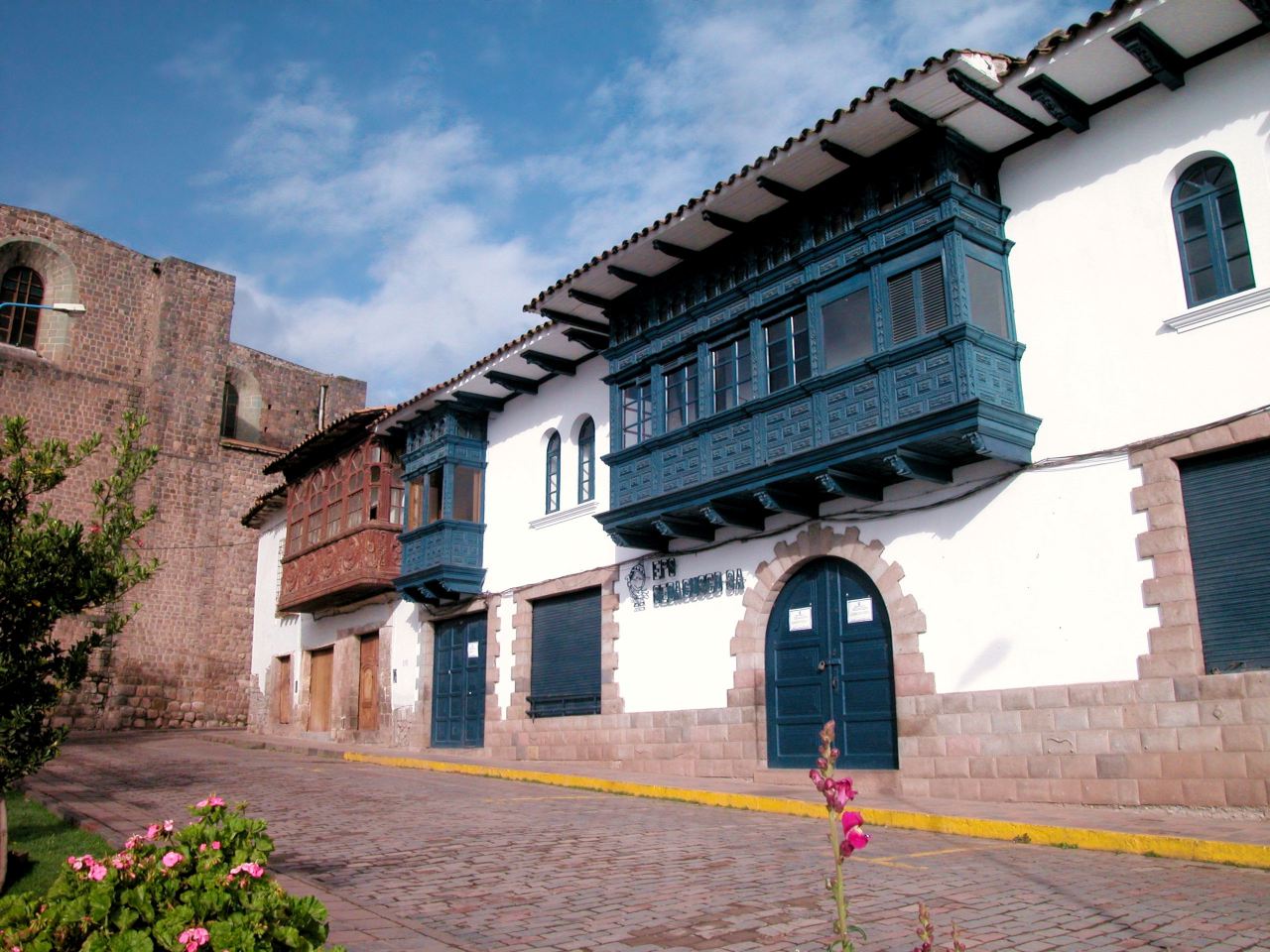
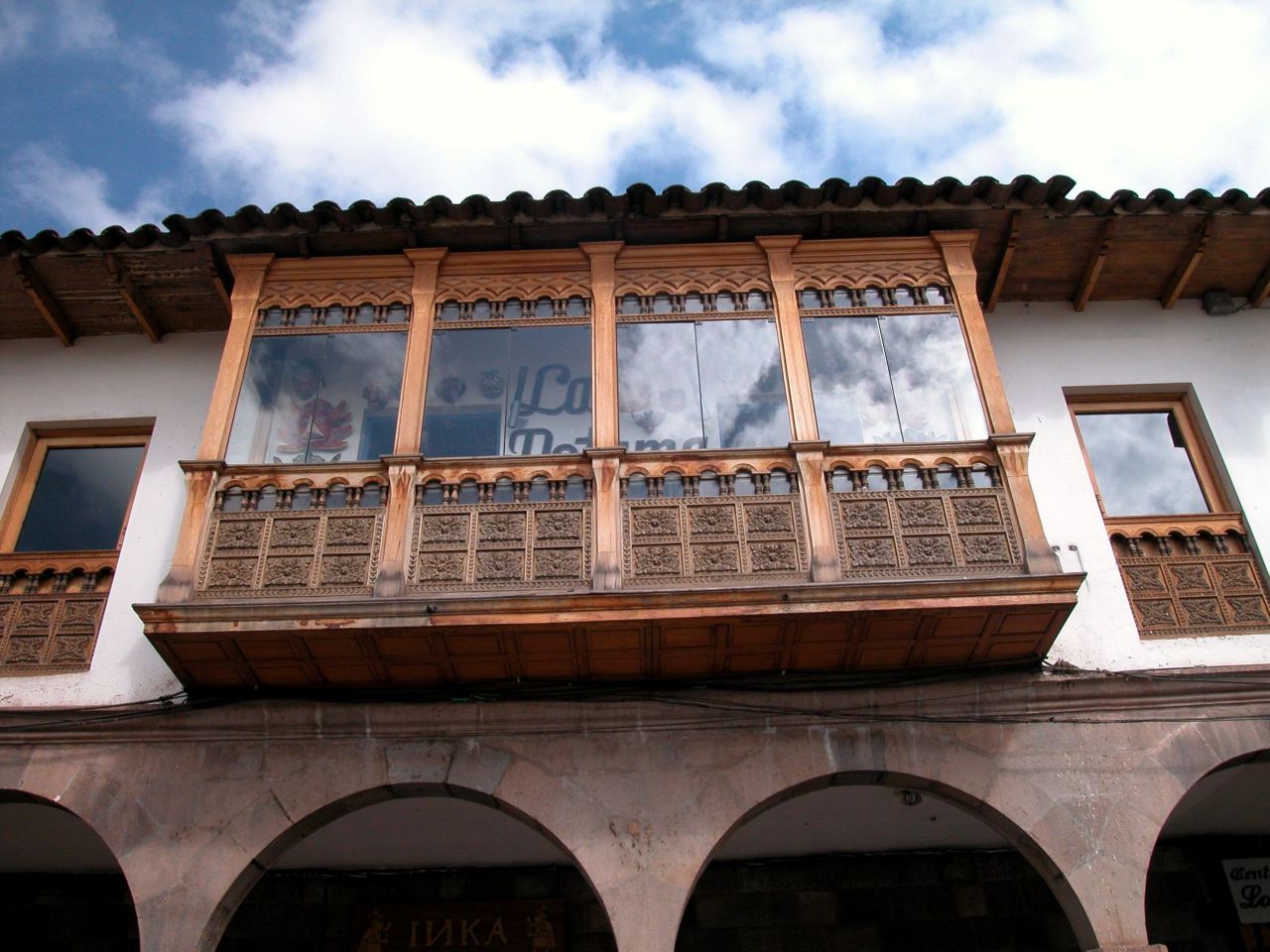

Next morning a cock woke us. It sang right outside our window, three minutes' walk from the main square. There turned out to be roosters everywhere here.
In the morning there are services in the churches, as there ought to be. Tourists aren't admitted to many churches during services. But the churches are closed the rest of the time, so you have to make your way in all the same. In practice nobody stopped us. There are dozens of churches, but I'd single out Santa Clara. The whole inside is decorated with mirrors. It looks marvellous. How it all fits with religious dogma, and what it's meant to signify, I don't know. Santa Clara is attached to a convent and the religious community sits behind a screen. The church is locked immediately after the service and stays shut till the following morning.
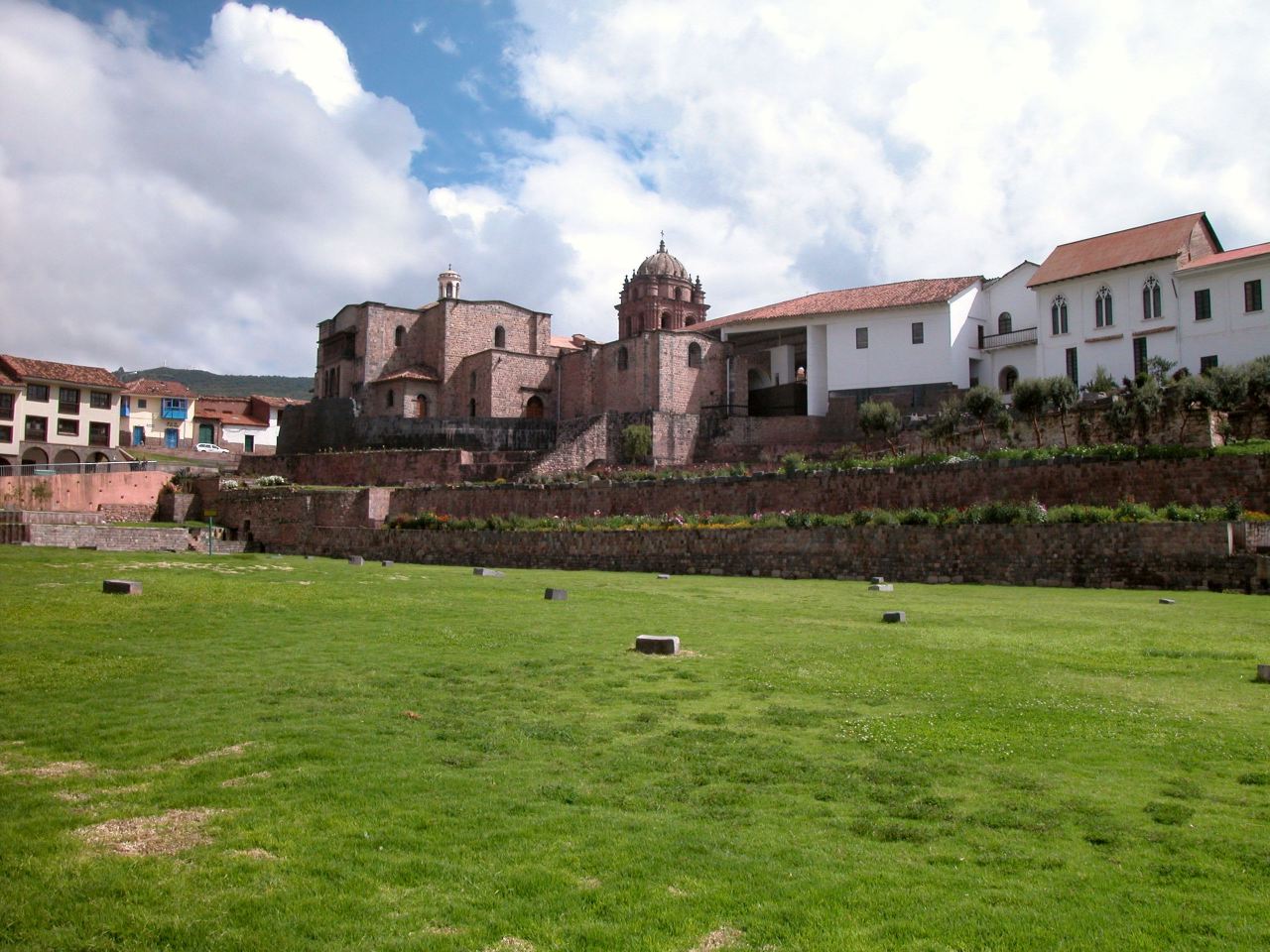
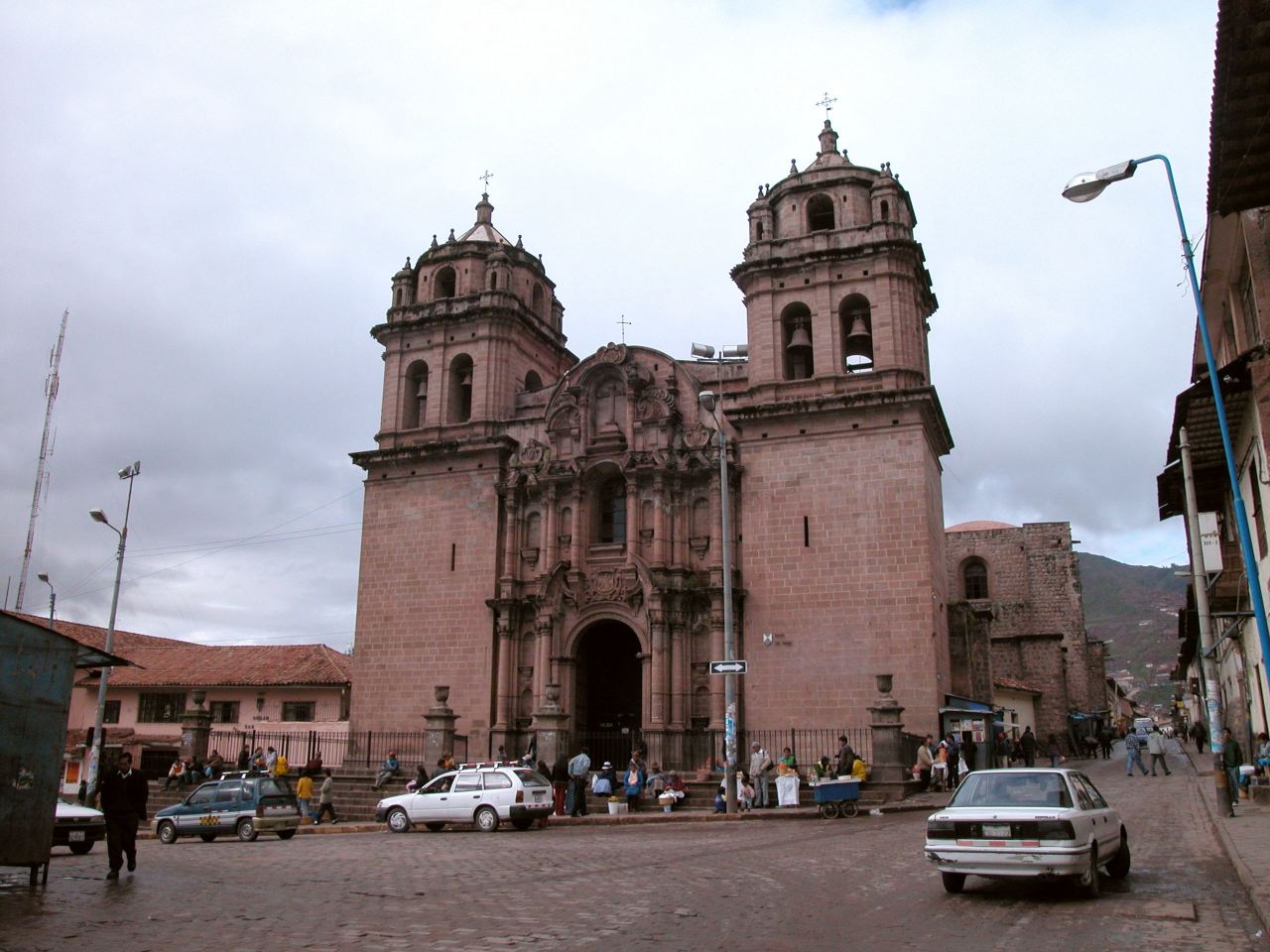
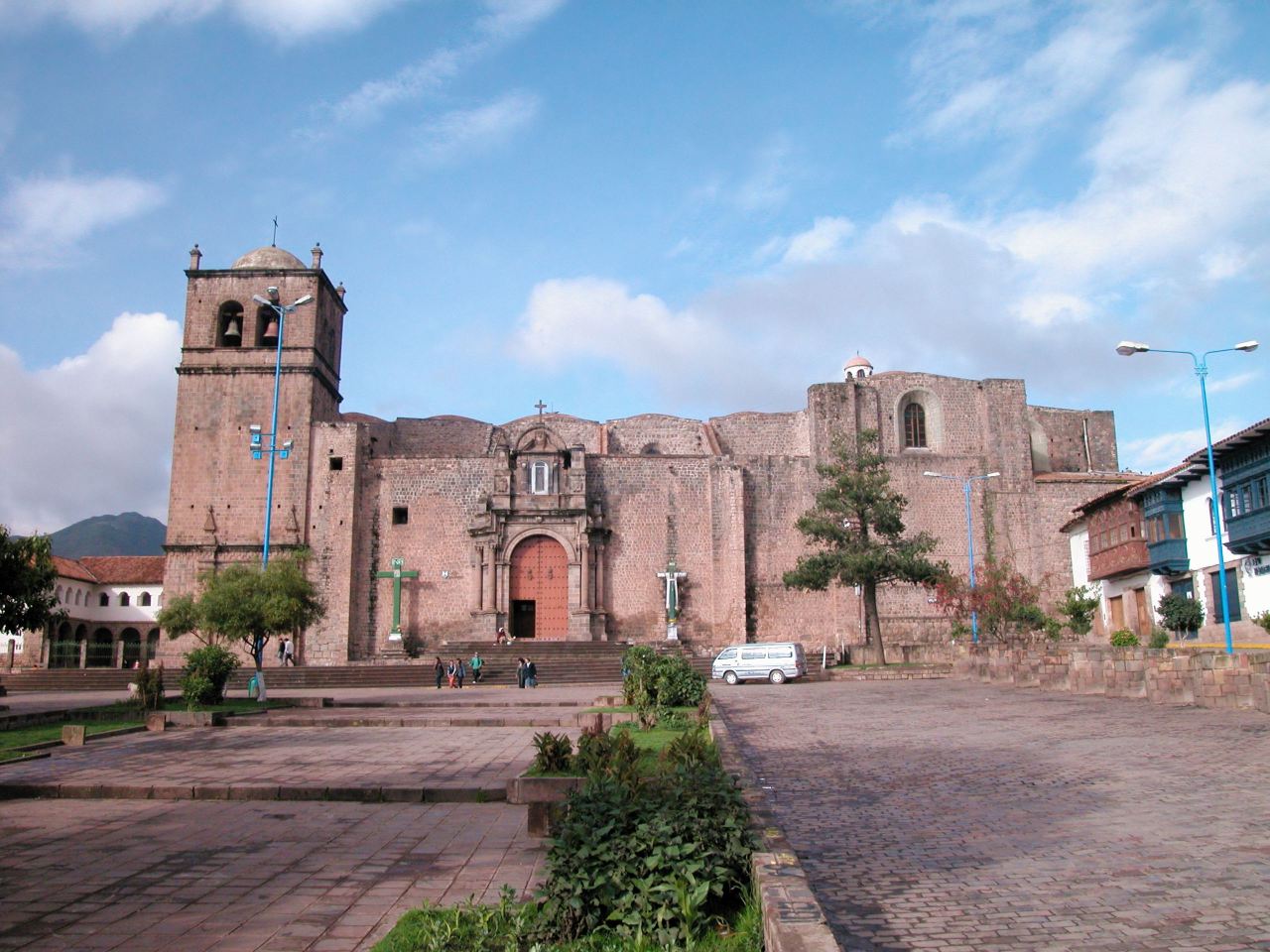
Catholics like to build cathedrals named for Our Lady. In Paris, for instance, there's Notre-Dame de Paris, or simply Our Lady of Paris. As for Cusco… Cusco has the Cathedral of Our Lady of Cusco. You have to see it for ideological reasons alone, and remember Khrushchev. It sounds in Russian like ‘Kuzka's mother’, the figure he famously threatened to show the Americans. Perhaps it was this very lady he meant, and now we'd seen her for ourselves.
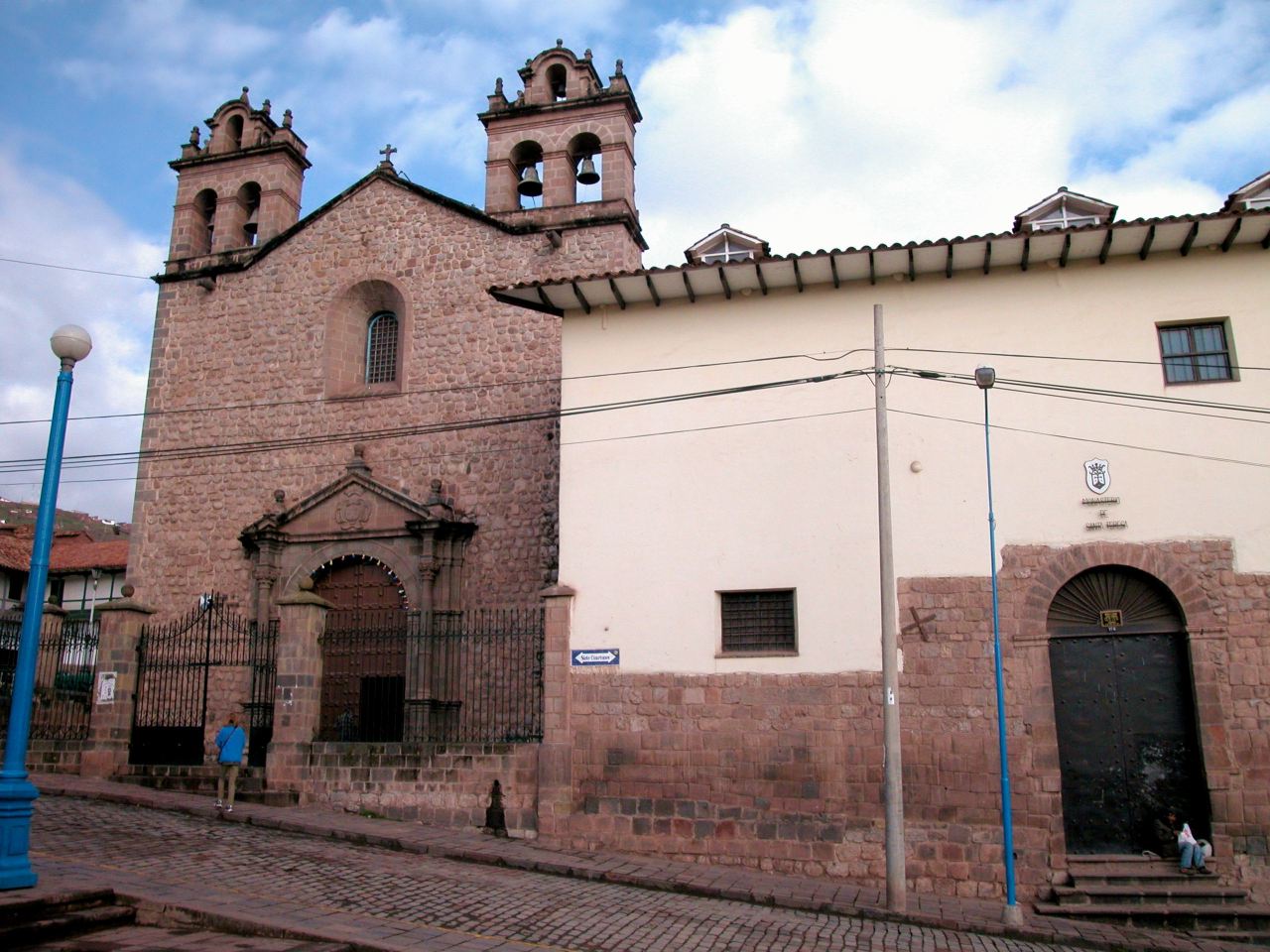
There's a lot more of the ancient world in Cusco, including an Inca museum, but I won't repeat the guidebook here.
Time to go to the famous Machu Picchu. It's simply impossible to come to Peru and not visit these celebrated ruins. The Peruvians understand that and make full use of the brand. There's no road to Machu Picchu, only a railway. A return ticket costs nearly a hundred dollars. The railway has a monopoly, and monopoly breeds every disfigurement of socialism. Queues at the ticket office, five minutes for every ticket, one window open. To buy a ticket the passenger has to be there in person with a passport. It's to stop ticket touts. Yet any travel agent will sell you a ticket on a local flight even at night, even without a passport, and a hundred dollars will get you right across the country.
There's no getting around it. The only way to save money is to go to Machu Picchu via Ollantaytambo. That isn't simple either. First you need a bus to Urubamba. There you find another one to Ollantaytambo or pay fifteen soles for a taxi. It should be said that Peruvian taxi drivers are shrewd. Tell one you want the bus station and he'll take you to the one farthest away, rather than the one you need, then say there are no buses today. And there really aren't any, because you're at the wrong station. He'll then offer, without a blush, to take you in his taxi to the town you're going to, or at least to the station where the buses actually leave from. Another trick goes like this. How much from village A to village B? Ten soles. You get in, you go, and at the end you owe sixteen. Why? Simple: three soles to get across A to the edge of the village, three to get from the edge of B to the centre. Sixteen in all. Precisely how we got from Urubamba to Ollantaytambo.
Ollantaytambo is more than a place to change trains on the cheaper route to Machu Picchu. Here in the mountains stands another Inca town. It's famous as the place where the Spanish suffered one of their very few defeats at the hands of the Incas.
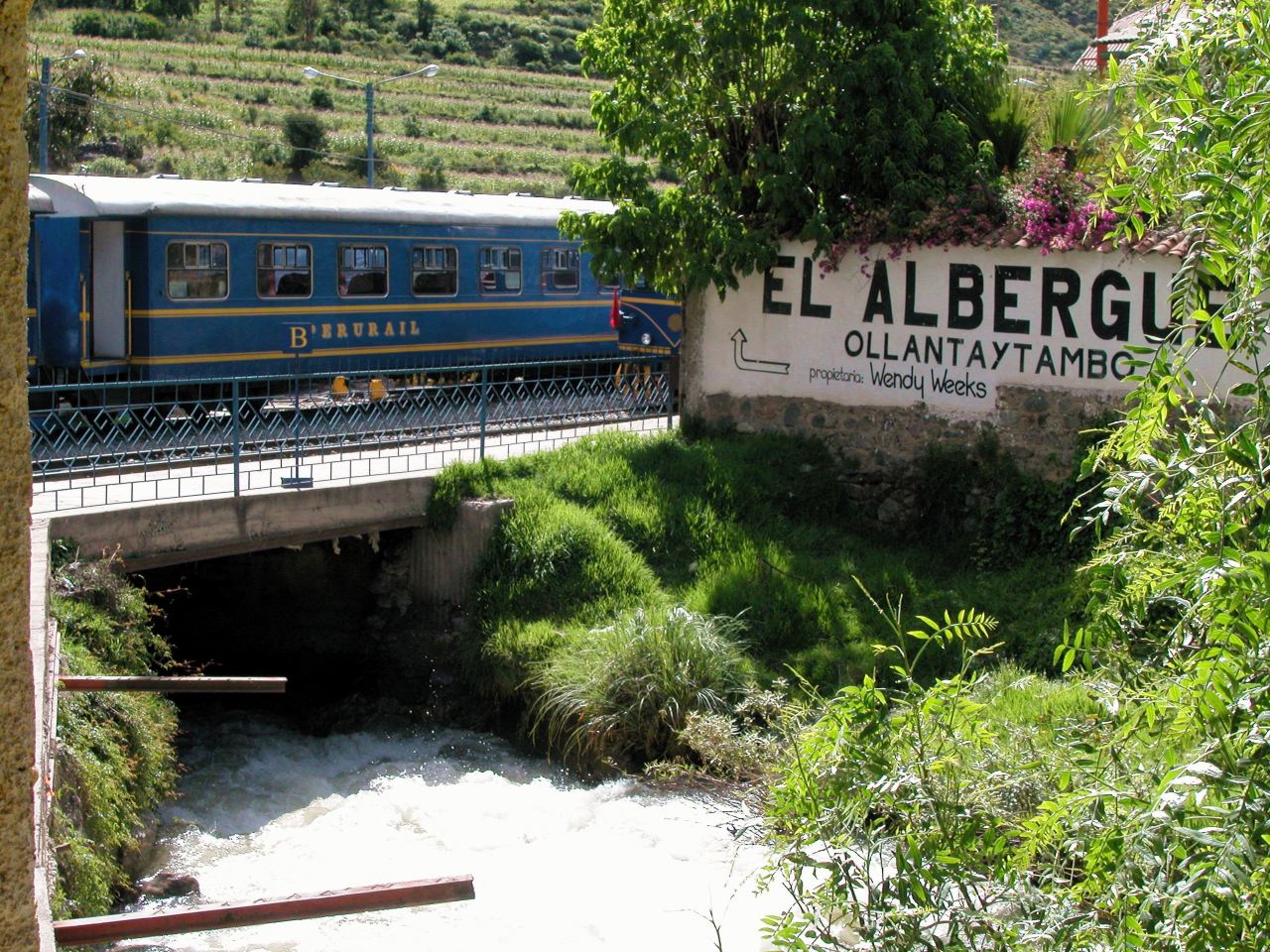
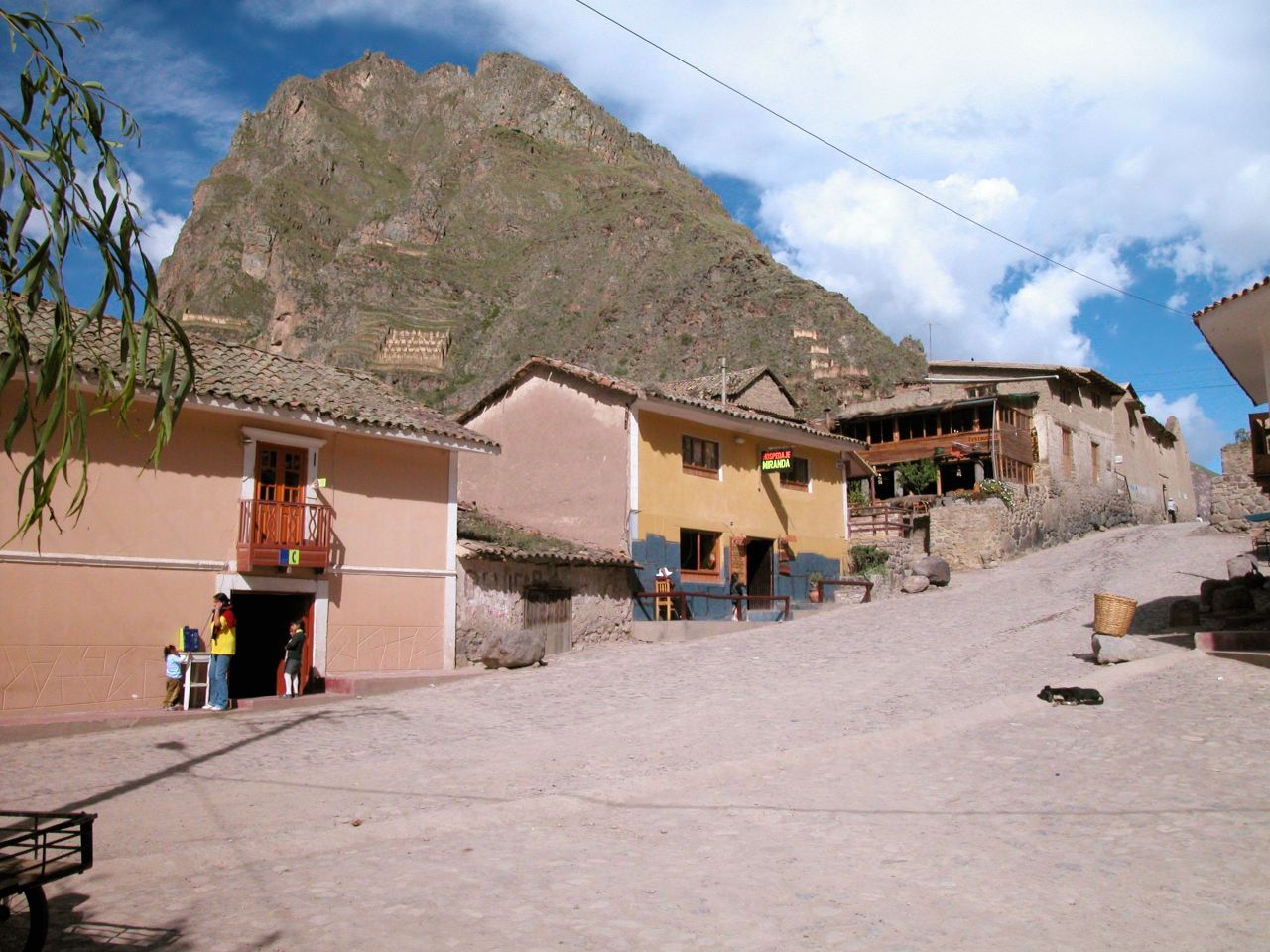


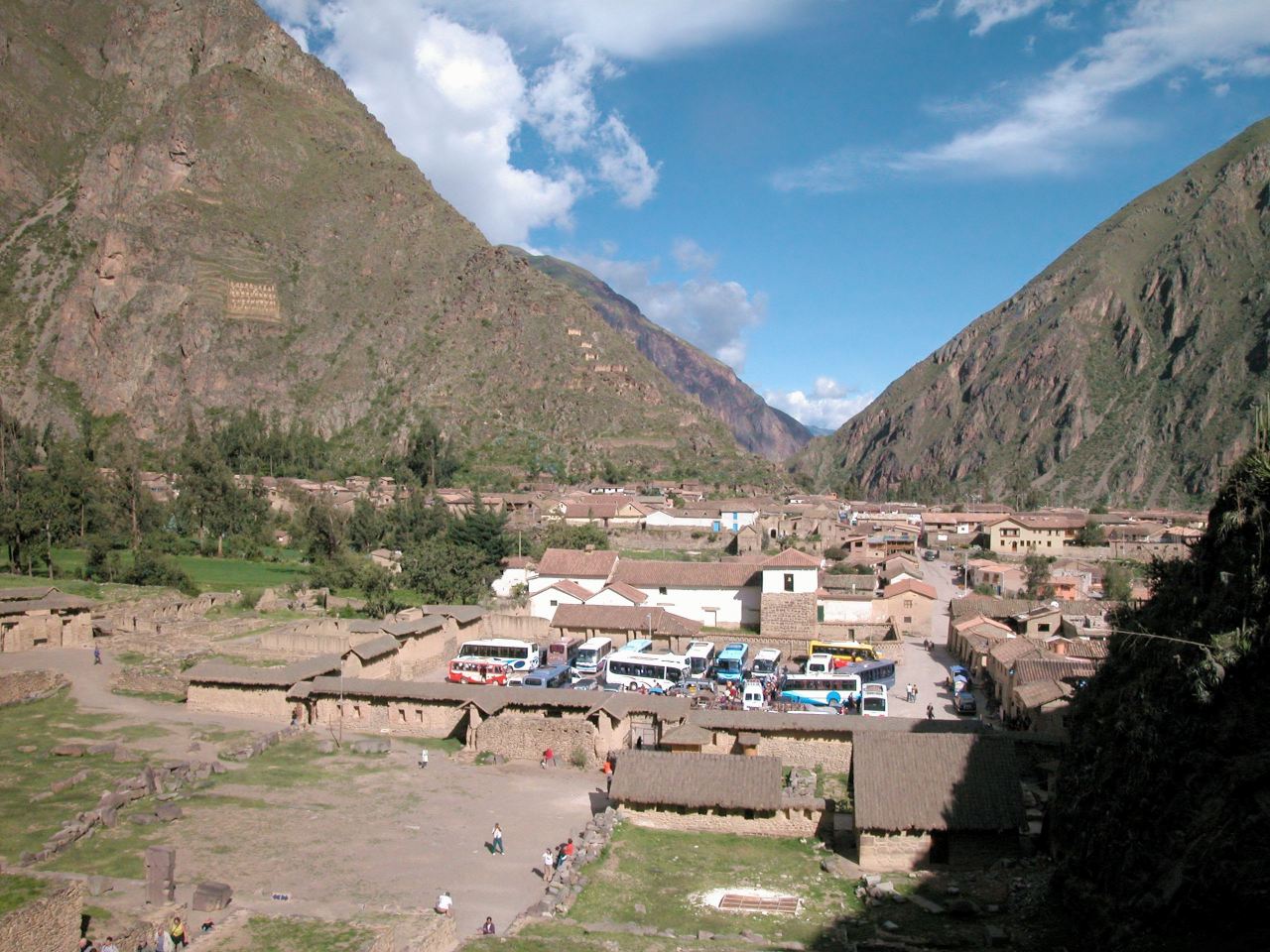
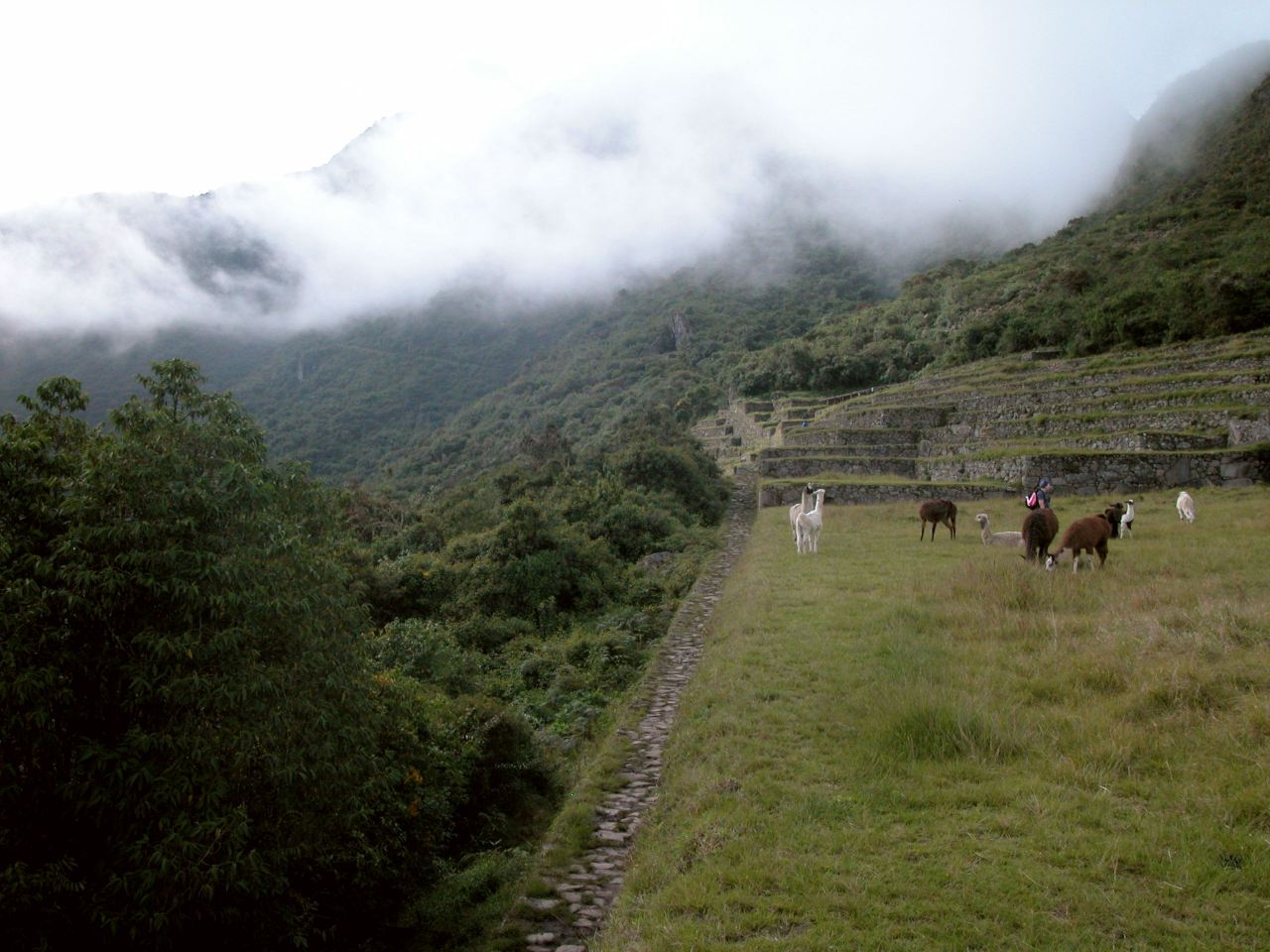
On the mountain slopes, the ruins of many houses remain to this day. Many of them are almost intact, only missing the thatched roofs that rotted long ago. The crop-irrigation system has been restored to show how it worked. All those enormous stairways around the towns weren't fortifications at all, but terraces for growing food, especially potatoes. There is a view that the towns whose remains now sit scattered about the mountains were originally built only for times of war. An invading army was something you could successfully wait out in the mountains.


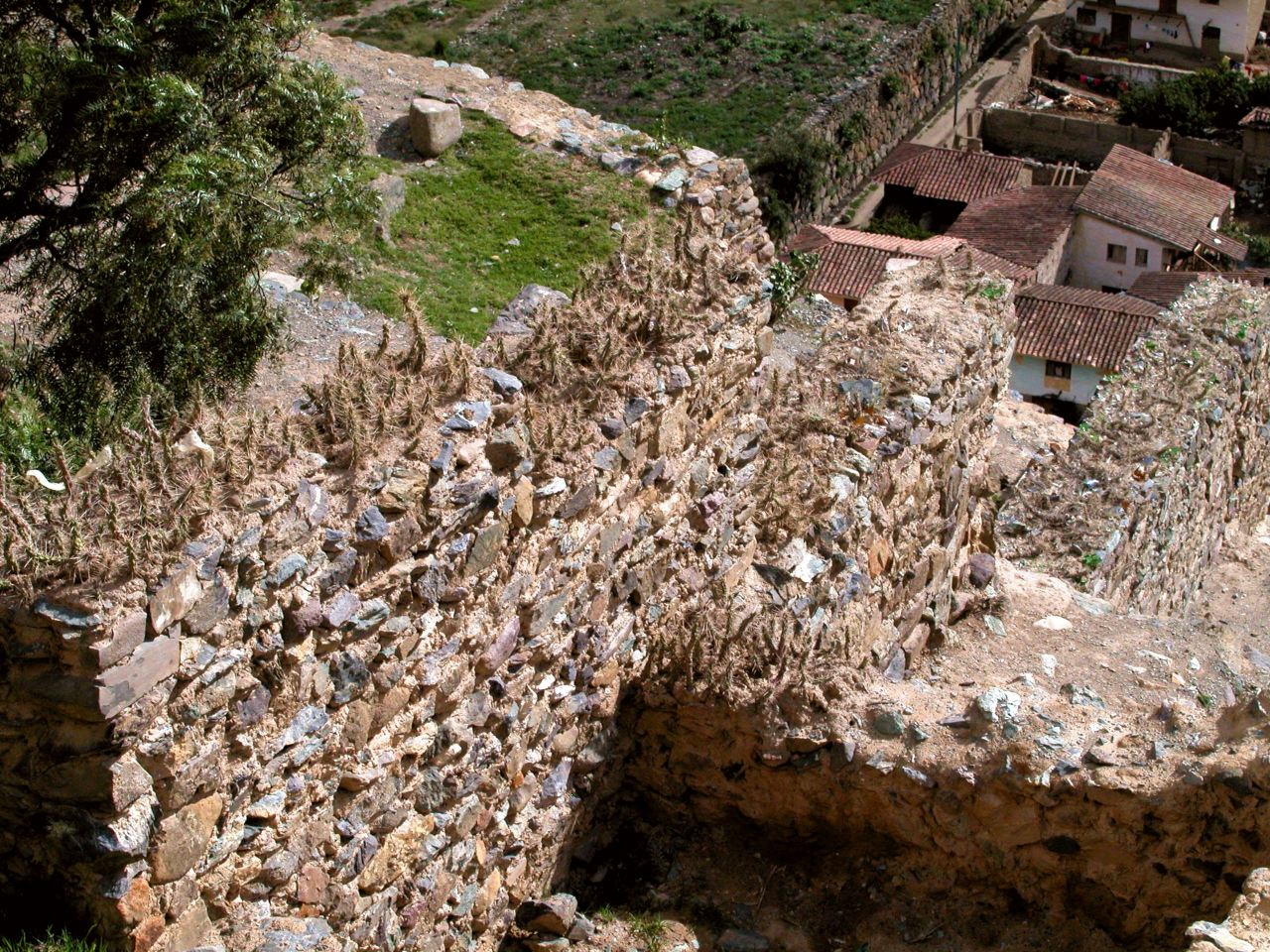
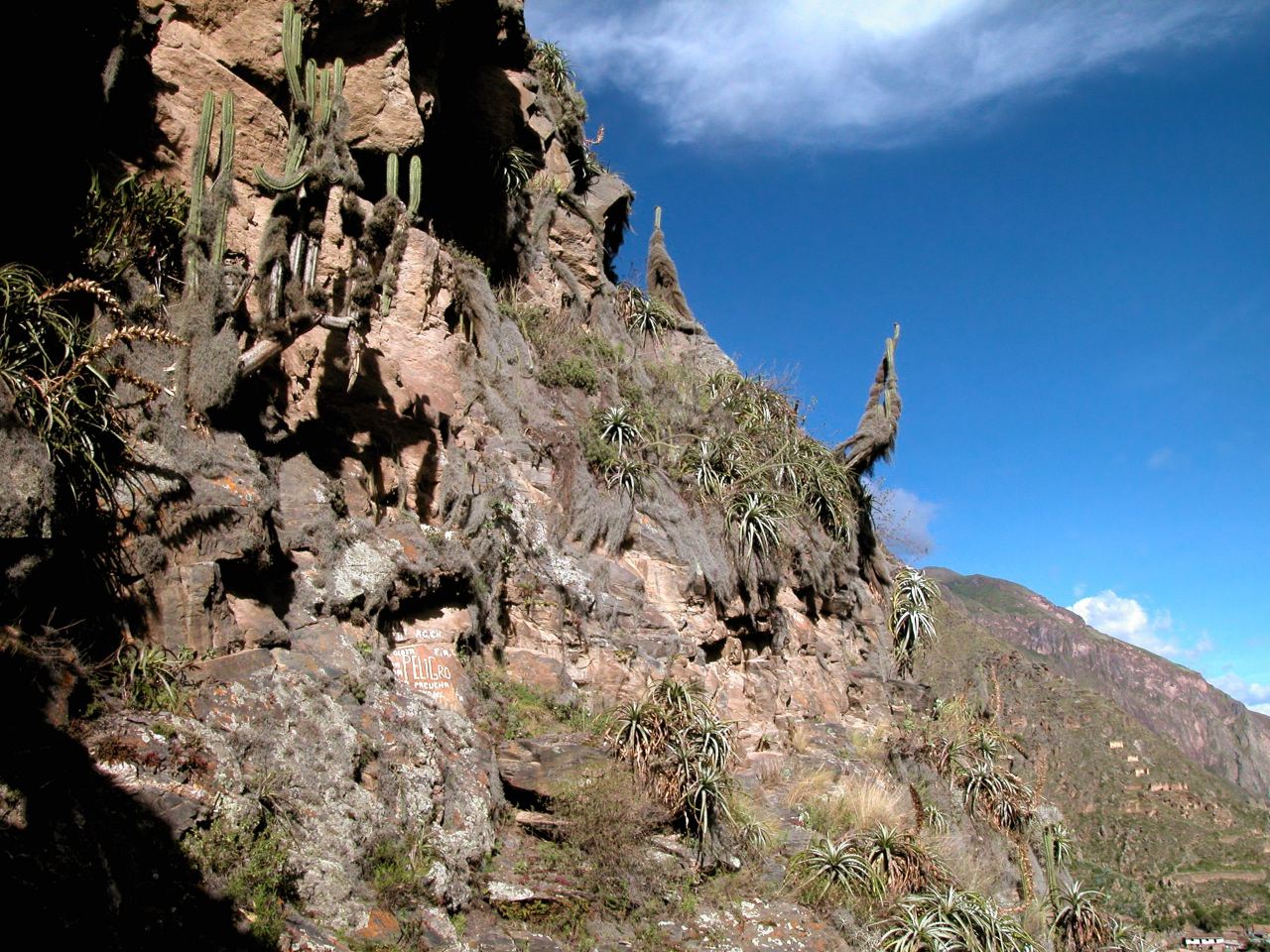
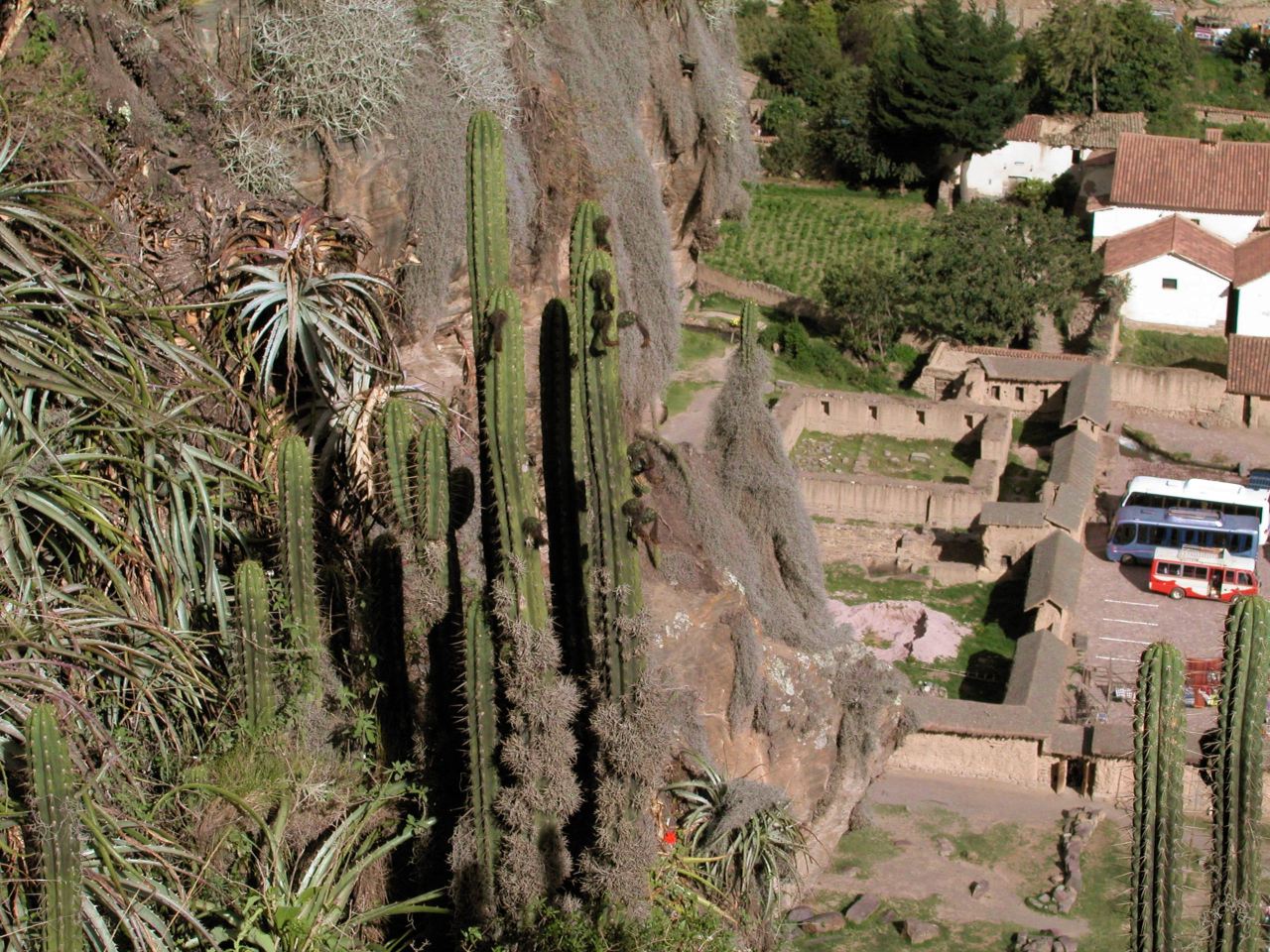

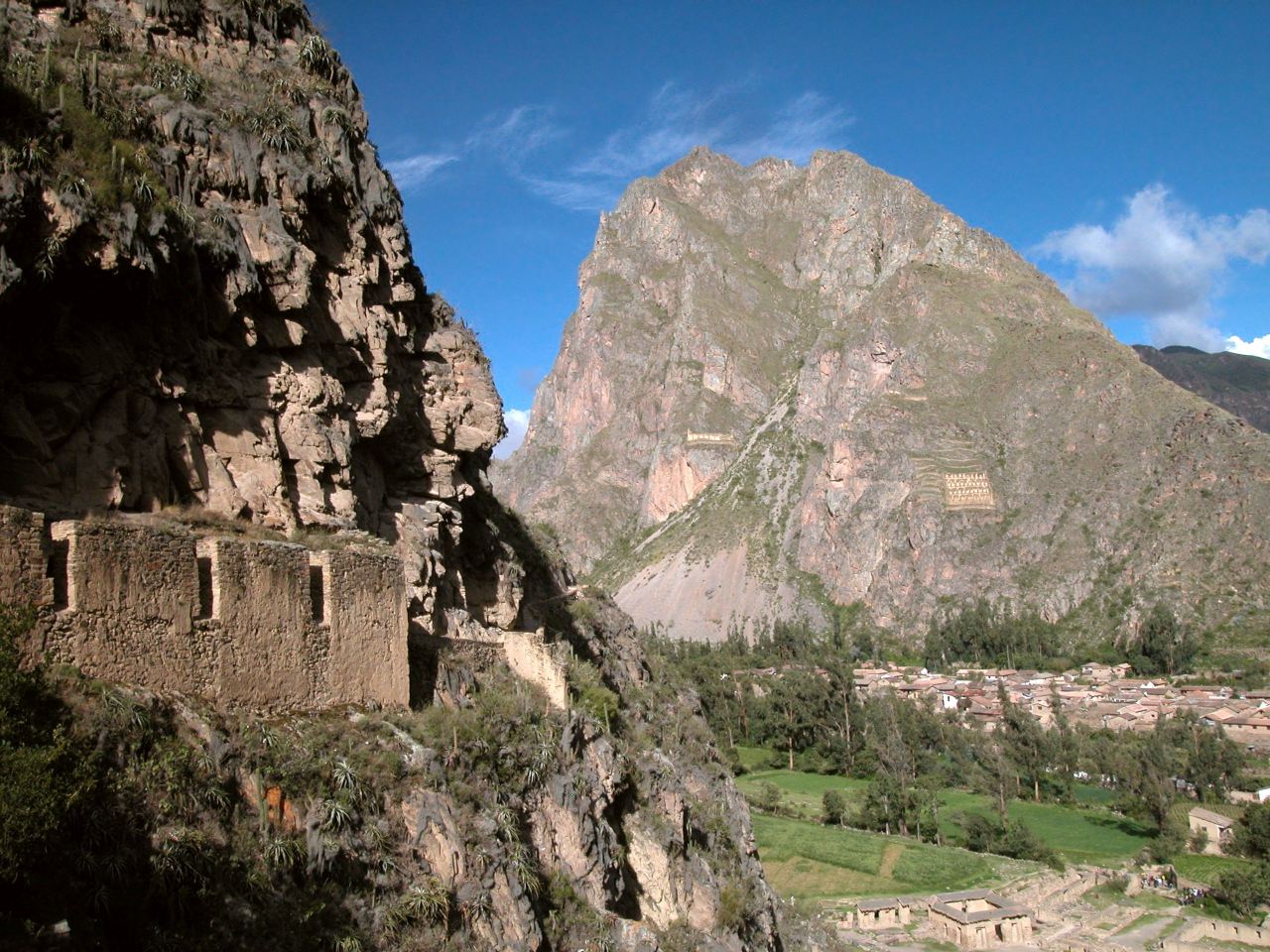

The main buildings are heavily visited. Ollantaytambo is usually part of a one-day coach tour from Cusco. When we reached the ruins there were several hundred people walking round and it was impossible to move freely. Admission costs six dollars.
A few houses also stand on the other side of the valley, but tourists practically never visit them, though they're easy enough to reach. A little path leads from the present-day village to them. There's no charge. I got immense pleasure out of climbing precisely to this wild part of town. The sun was already going down over the horizon. We got to spend that loveliest time of day away from the noisy crowds.


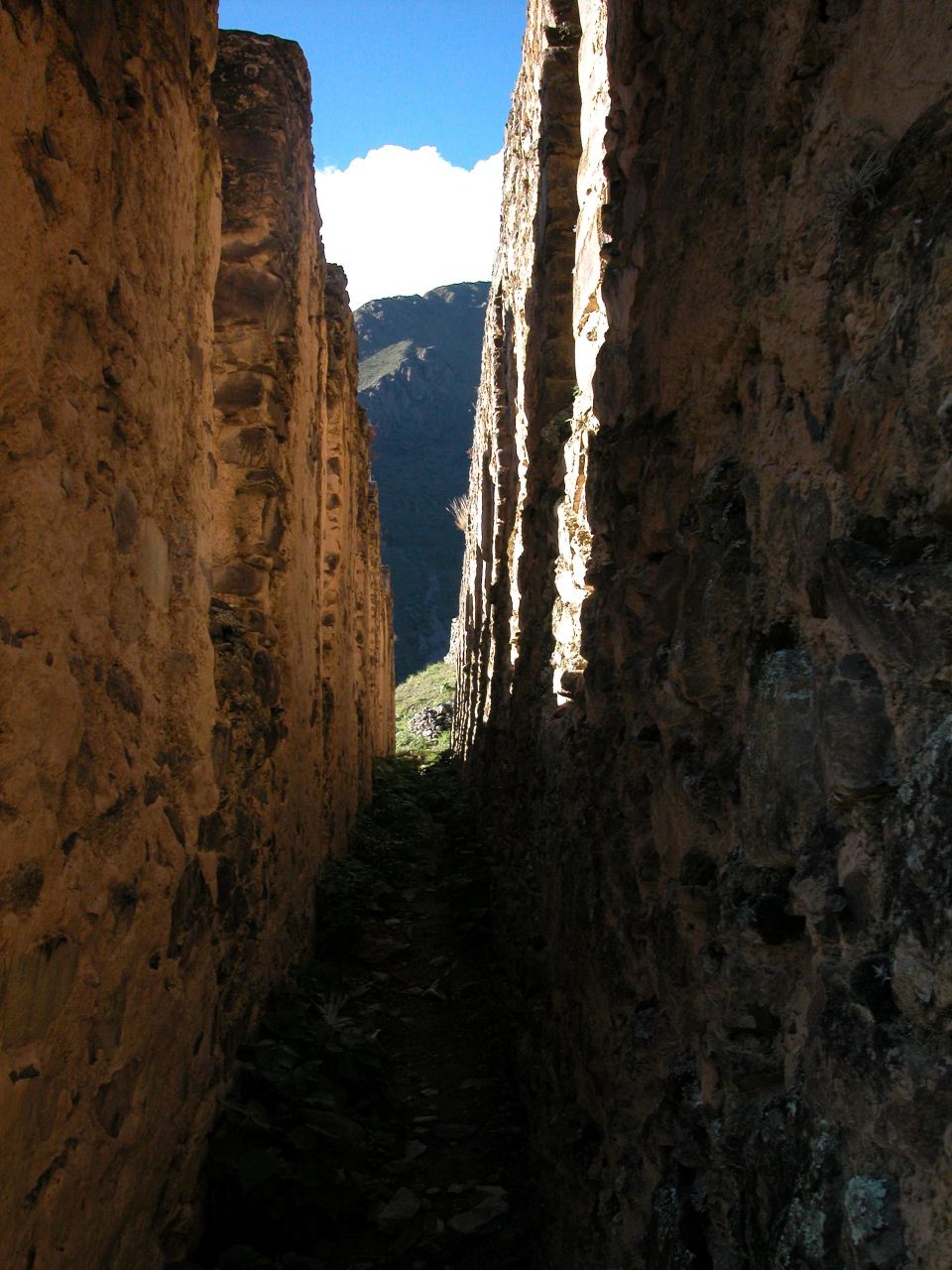


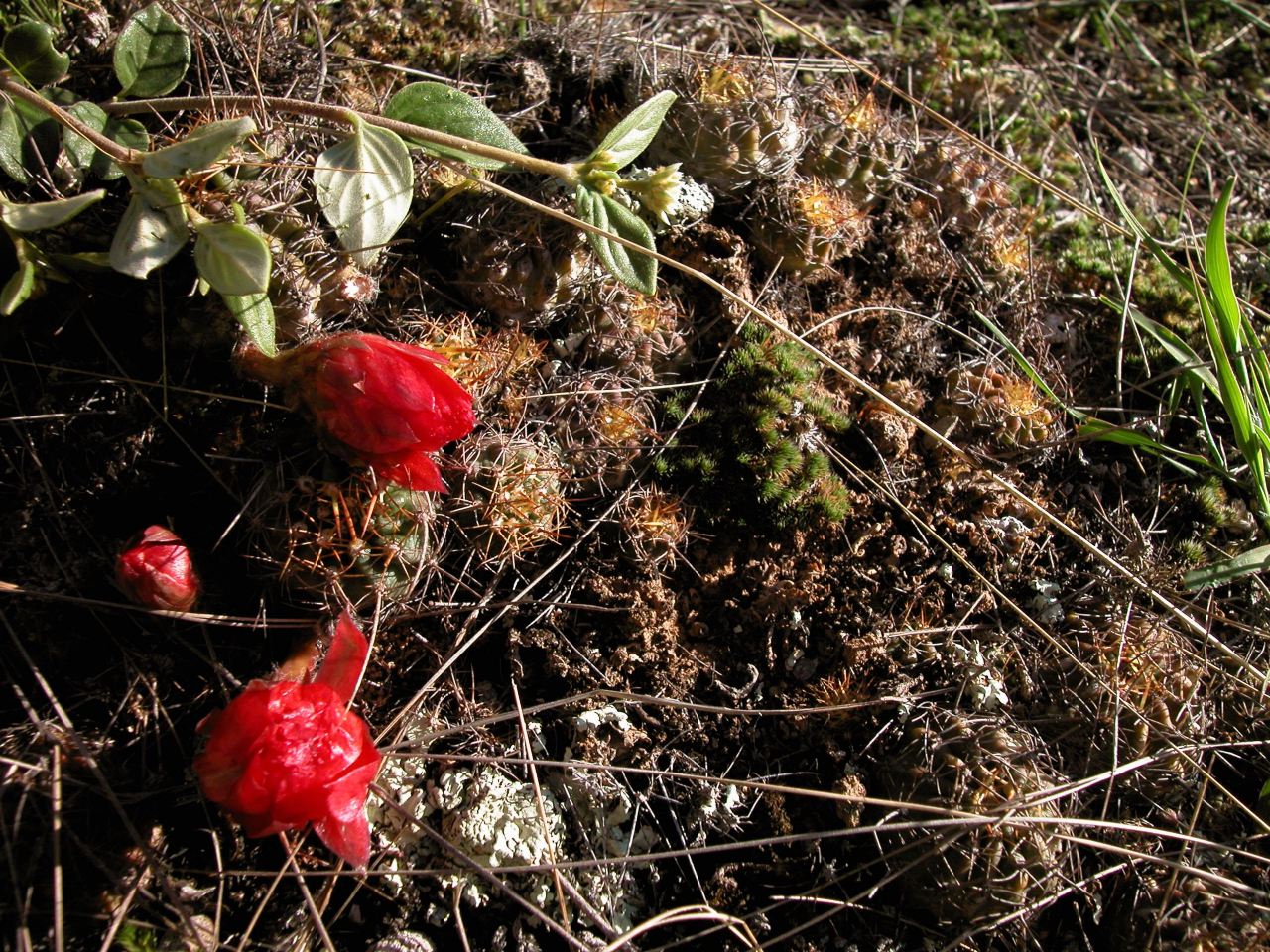
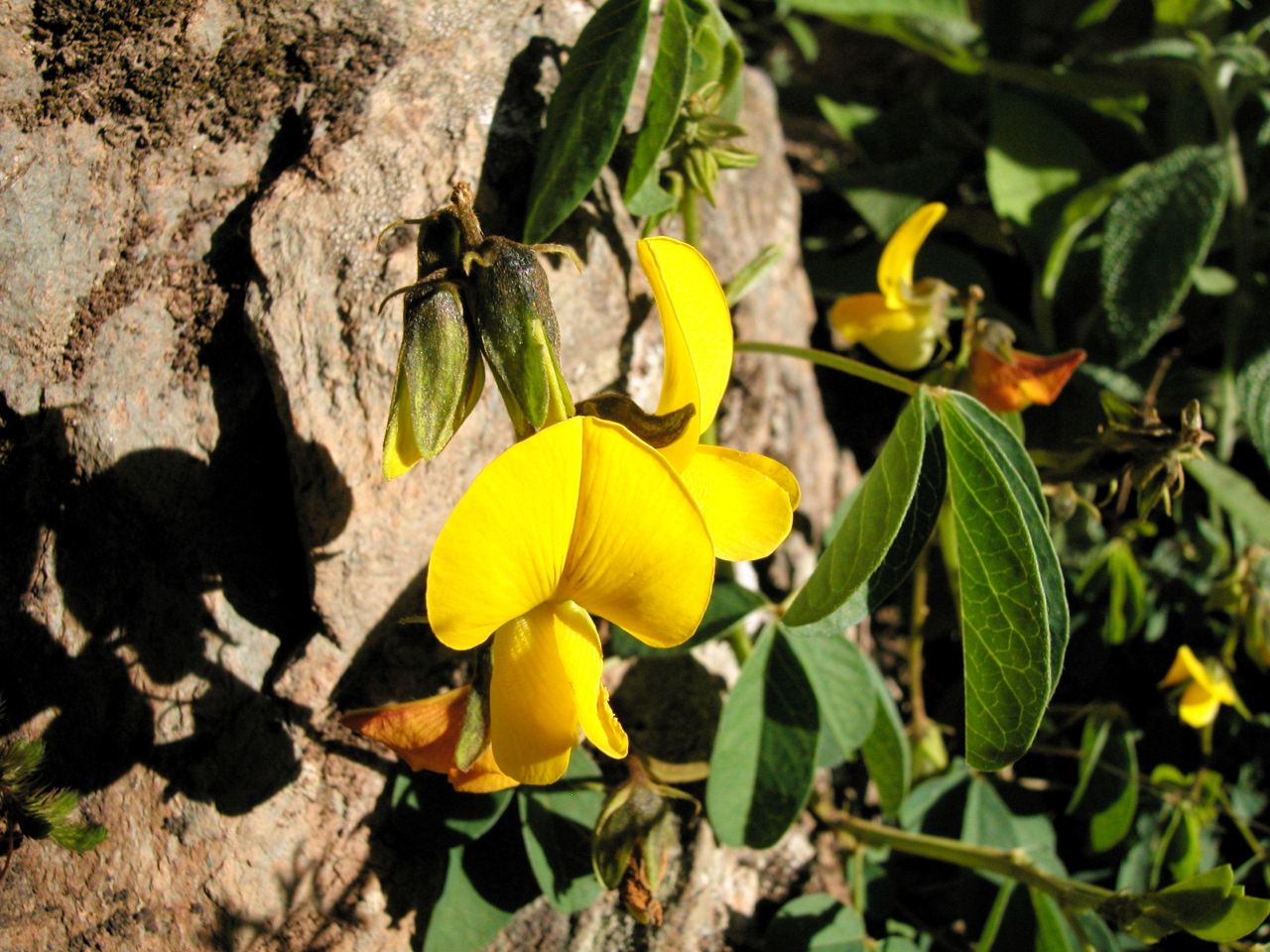
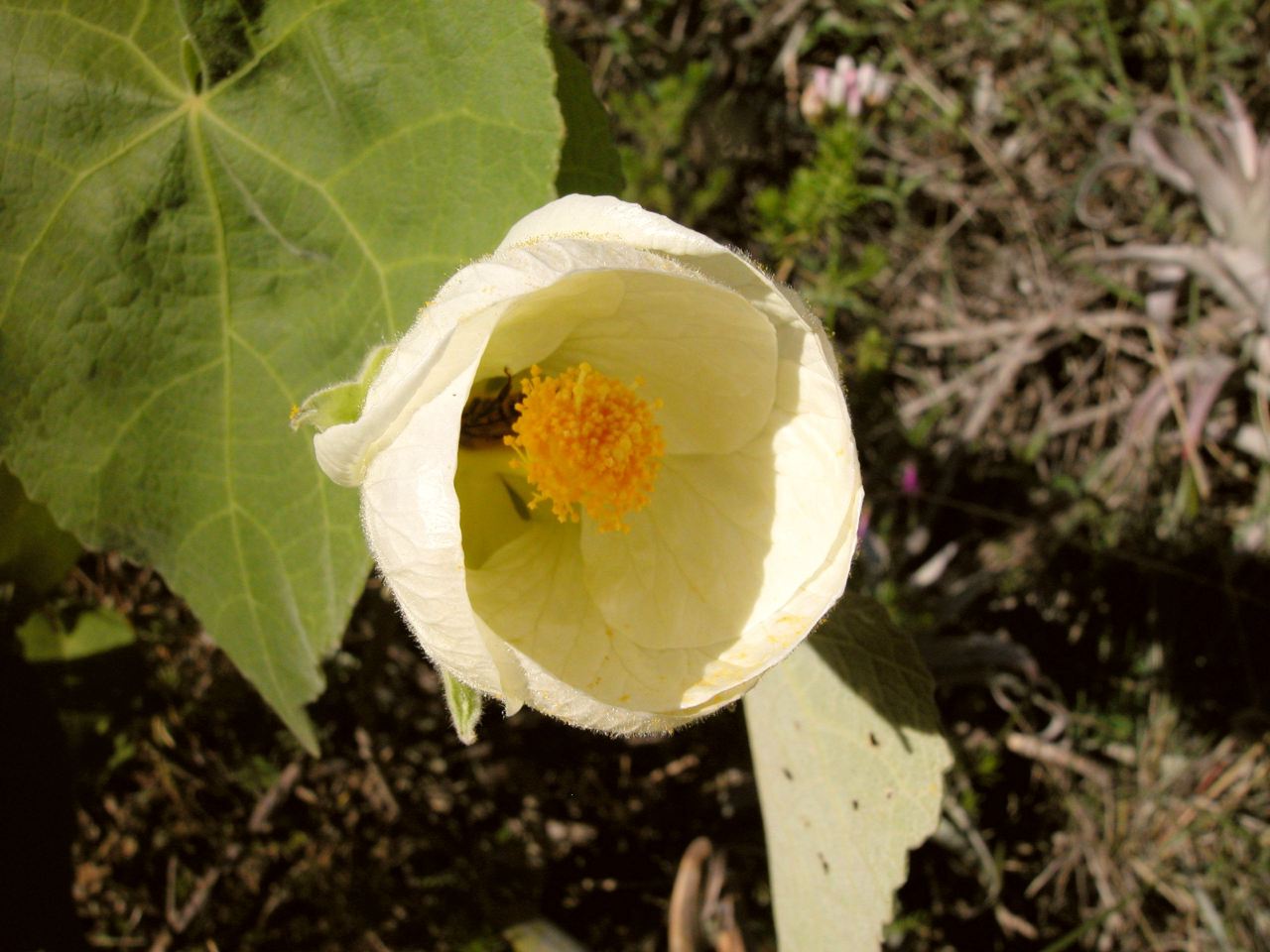

Back down from the mountain, we had lunch and even drank some coffee. There's a café in the middle of Ollantaytambo with real espresso. That's rare in Peru. They grow coffee here, but there's some peculiar way it's meant to be drunk. Perhaps I understand nothing, but I couldn't get used to that liquid that tastes like soy sauce.
The train to Machu Picchu leaves at 7.45 p.m. It's the only cheap train intended for foreigners, the Backpacker Shuttle. A one-way ticket is US$11.90. It goes in complete darkness and comes back before dawn in the same darkness. It's made as inconvenient as possible, but it's packed, and sometimes there are no tickets for days ahead. The coaches have seats, and the train stops everywhere along the line, reaching Machu Picchu station in two hours. The station was named when the railway was built, and in Quechua the words mean ‘big mountain’, as I understood it. The town has its own website. The village nearby is called Aguas Calientes, which means ‘hot springs’. It does have thermal springs. They've built an immense bath there. It's open from five until half past eight and costs five soles to get in.
In recent years the village has grown a great deal. Every day there are thousands of visitors to feed and put up, after all. Prices are about one and a half times those in neighbouring villages. A night at the Imperio de los Incas hostel cost sixty soles for the three of us.
You can walk to the ruins from the village. It takes a little over an hour and climbs three hundred metres. The bus ticket says eight kilometres, but on foot it's much shorter. A bus ticket both ways is nine dollars. They start running at about seven in the morning, and you'd do well to get one of the first ones. That way you reach the town before the mass of tourists who come in for the day on the train from Cusco.

Admission to the ruins is twenty dollars, eighteen of which go to the national institute of culture and two to the municipality of Machu Picchu. Until quite recently it was ten. You're not allowed to bring food, water or a backpack. We managed to get all of it in, and a good thing too. There's no food or water at the ruins themselves. Not even toilets, only lots of little barriers blocking the entrances to temples. For that money, they could have made some effort to provide a service.
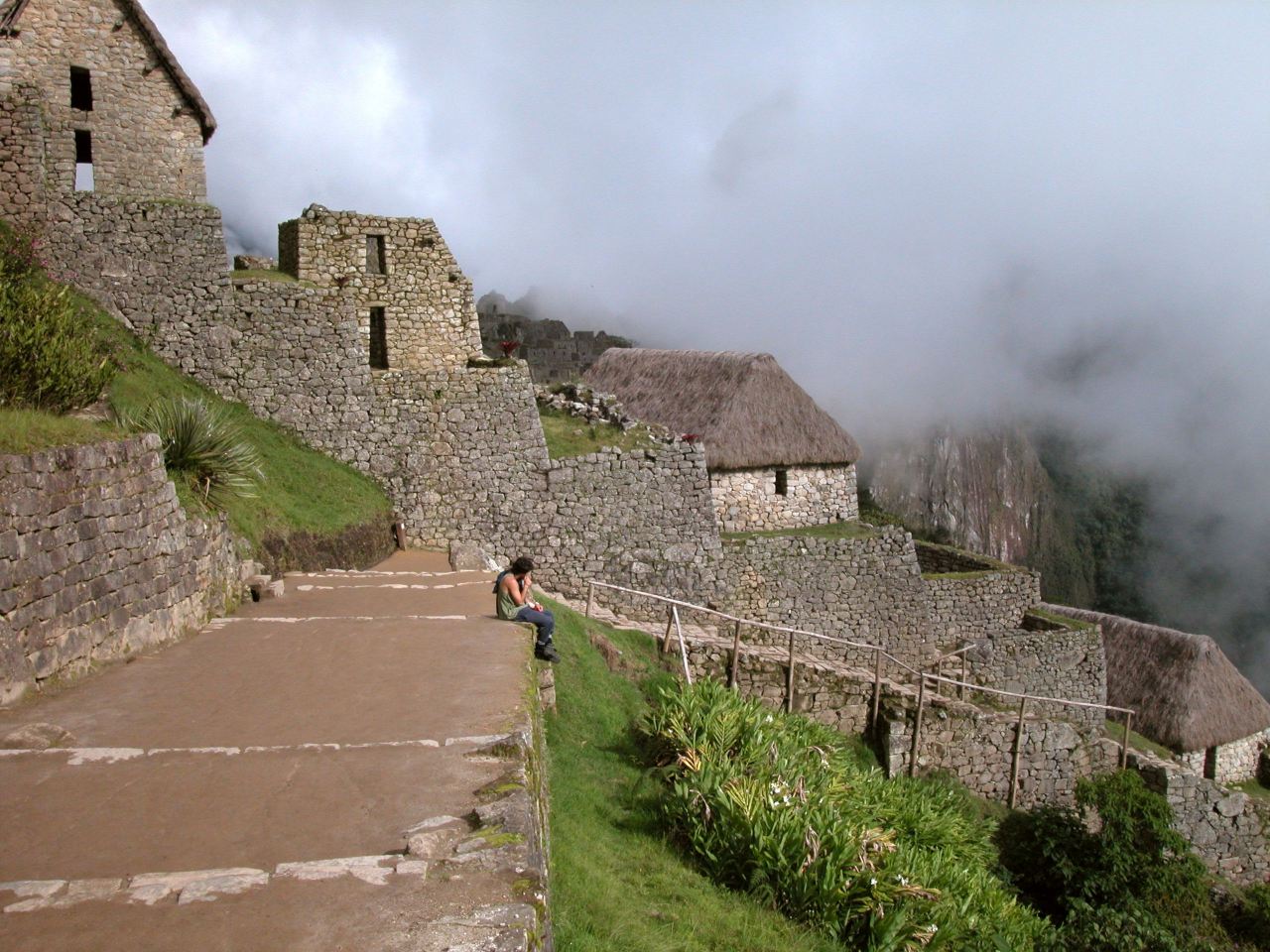
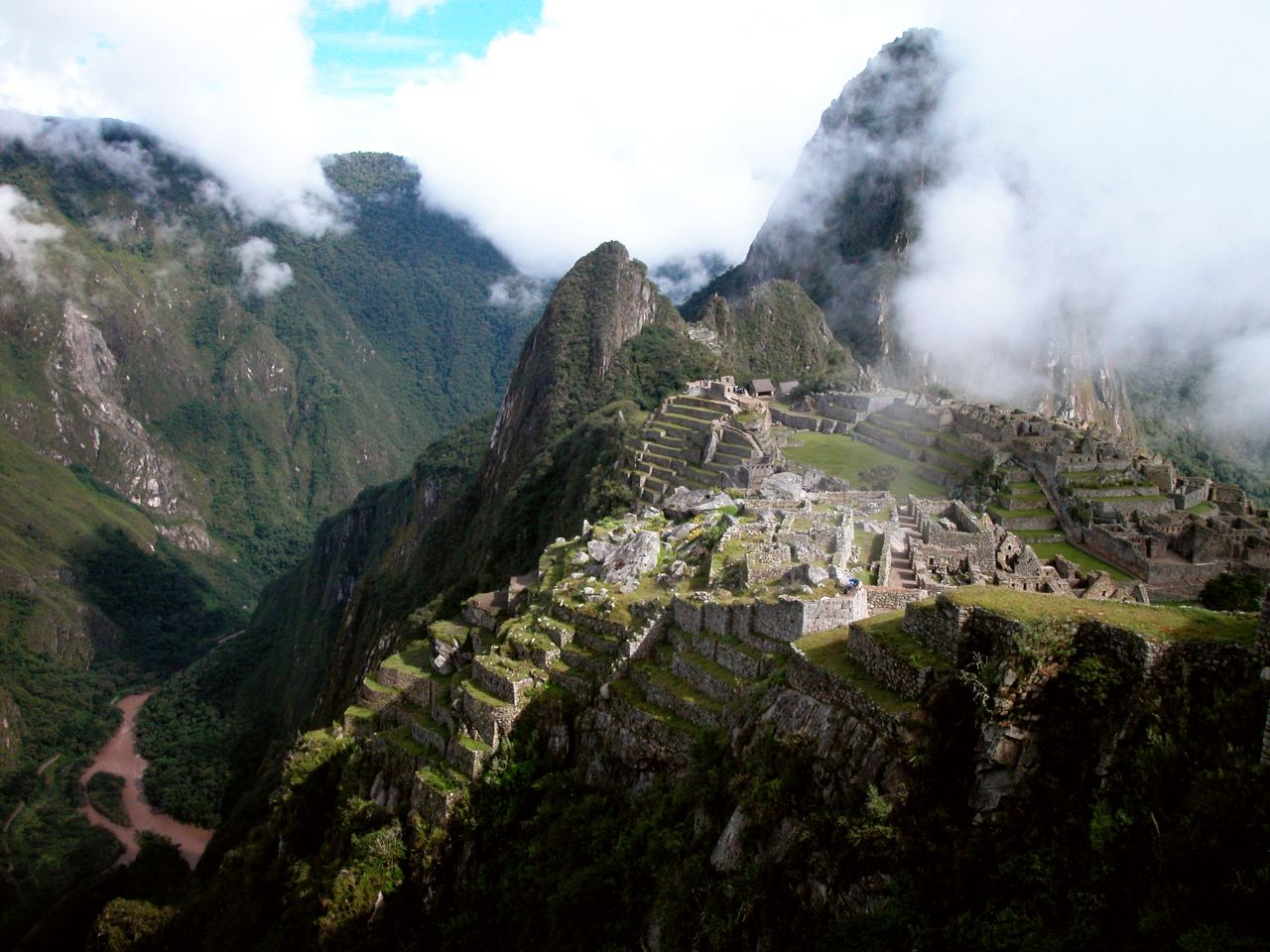
Machu Picchu was found by chance. It's hard to apply the word ‘found’ to what happened. In 1904 a railway was built along the Urubamba valley. Some of the buildings sit at the edge of the drop and from the very beginning could be seen perfectly well. It didn't surprise anybody. There were plenty of ruins like that on the nearby mountains. Ollantaytambo alone would have been enough.
According to the history as I knew it, after the final defeat at Ollantaytambo the Incas retreated to Vilcabamba. The legend says they took a heap of gold with them. The Spanish knew where Vilcabamba was and in 1544 wiped out the Incas, failed to find the gold, and didn't get around to recording the location for posterity. By the beginning of the twentieth century, looking for Vilcabamba and digging up the gold the Spanish hadn't found had seized the minds of those with an interest in archaeology. So, seven years after trains began running, on 7 July 1911, an American historian named Hiram Bingham appeared at Machu Picchu station and asked people whether there was a town called Vilcabamba near by, or any ruins at all. They directed him to the nearest ones. Among the bushes there really was an untouched town. The Incas had abandoned it for some unknown reason before the Spanish came, so nothing had been destroyed. They cleared the town and made a museum of it. At first they decided it was the longed-for Vilcabamba. Then, forced to accept the facts, they admitted it wasn't and named it after the nearest railway station. Not terribly romantic, but the publicity had already done its job. Tourism grew and by our time had reached extraordinary proportions. Thousands of tourists wandered through the ruins every day. For the more adventurous there was a three-day excursion on the Inca Trail that connected the place with Cusco. Seventy thousand people walked it every year, and even that was because the government had set it as the maximum. Tourists still prowl around in the neighbouring bushes, hoping to find Inca gold and finally discover Vilcabamba. Luckily they rarely go far and there isn't anywhere to get lost. The railway and the Urubamba wrap around Machu Picchu on three sides. On the fourth there's a fence and an entrance gate.
All this is despite the fact that aerial photography and other methods of remote sensing turned up several more towns in Peru from the sixties to the eighties, some of them bigger than Machu Picchu. It's even mentioned in Lonely Planet. One of them was identified as Vilcabamba. It's marked on the road map of Peru that you can buy in any shop. For all the gold expected to be hidden there, Vilcabamba had never been excavated. No money and no enthusiasts. How sad. There don't seem to be any people of substance left in the world, the true adventurers and treasure hunters.
It isn't easy to reach the newly discovered towns, mind you. There's no well-trodden tourist path and no booth to collect your money. In technical terms, the mountains look impregnable but can be crossed. After Bolivia and six kilometres a day through the jungle, I could guarantee a walk in to Vilcabamba in five days or so. It's a pity there was no time. I was itching to walk through genuinely wild ruins. Nobody had plans to build roads to them. It had been decided that promoting them would cost a fortune and, if a second Machu Picchu appeared, tourists wouldn't spend twice as much. So opening the newfound towns to the masses was deemed a bad idea.
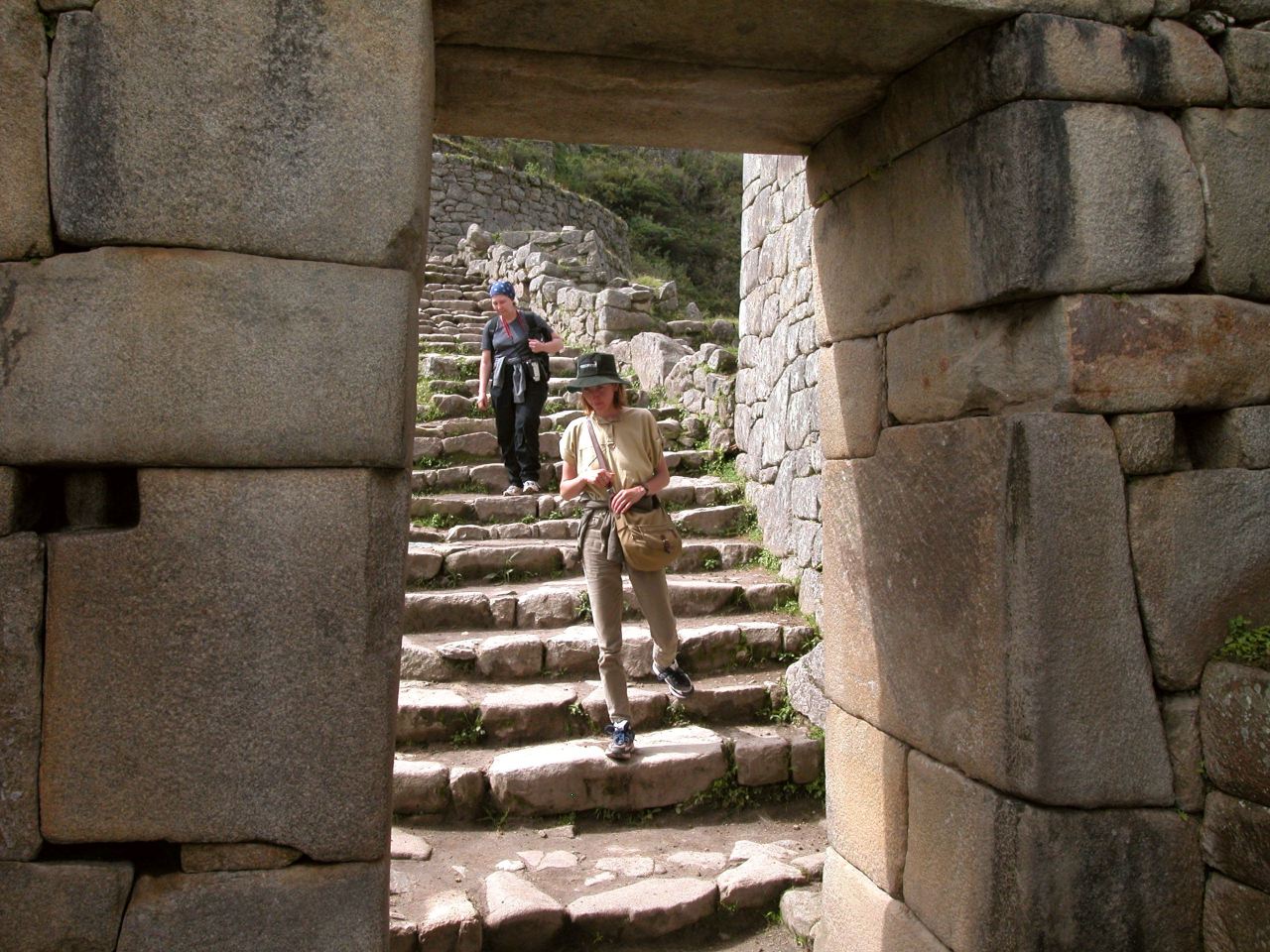
That left us to look round Machu Picchu. The town really is remarkably well preserved and sits amid fantastically beautiful mountains. I had seen nothing so lovely as that place in the immediate neighbourhood. The many guidebooks spell out what every building means, but you need to treat that information with a fair amount of scepticism.


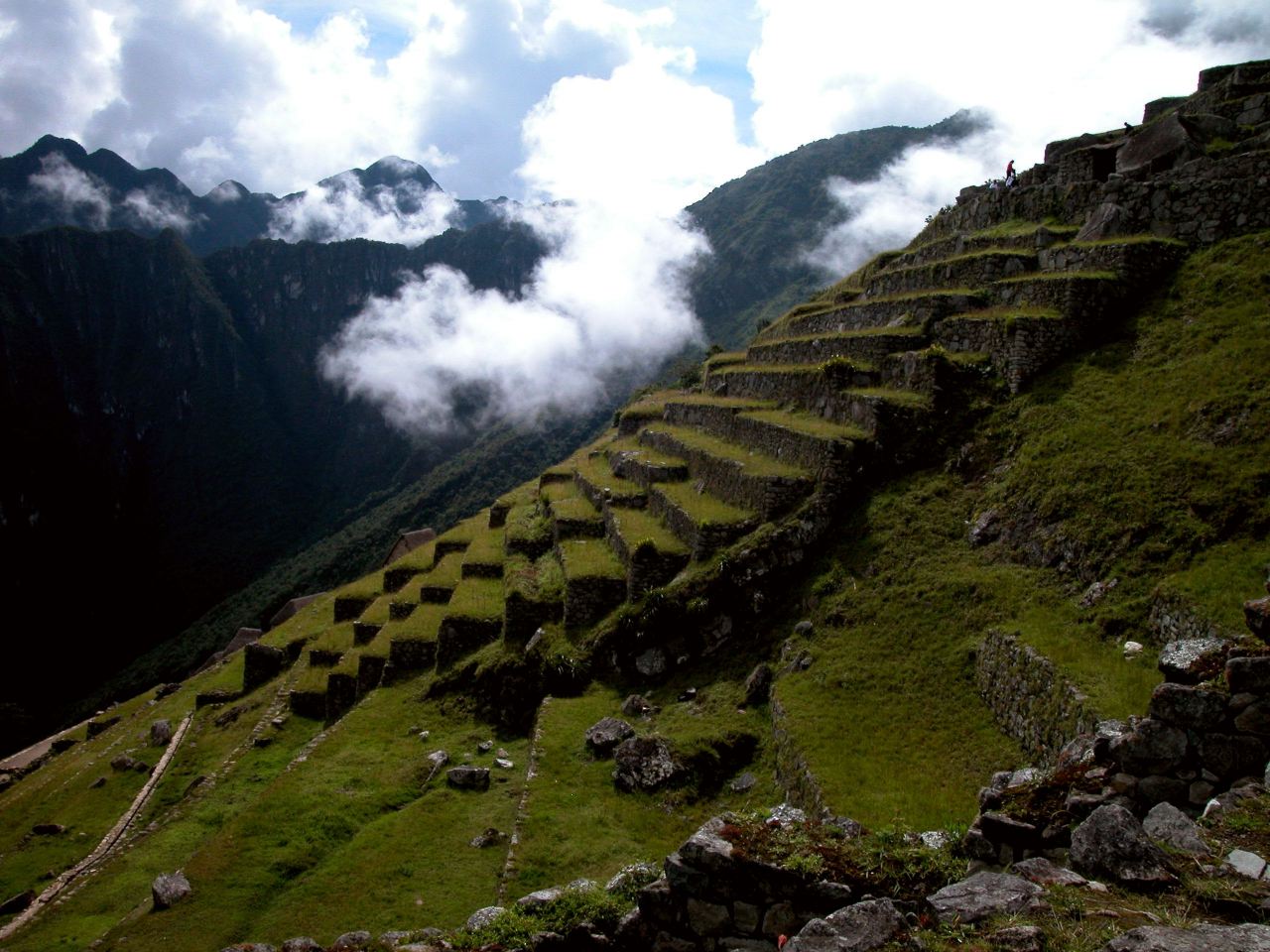


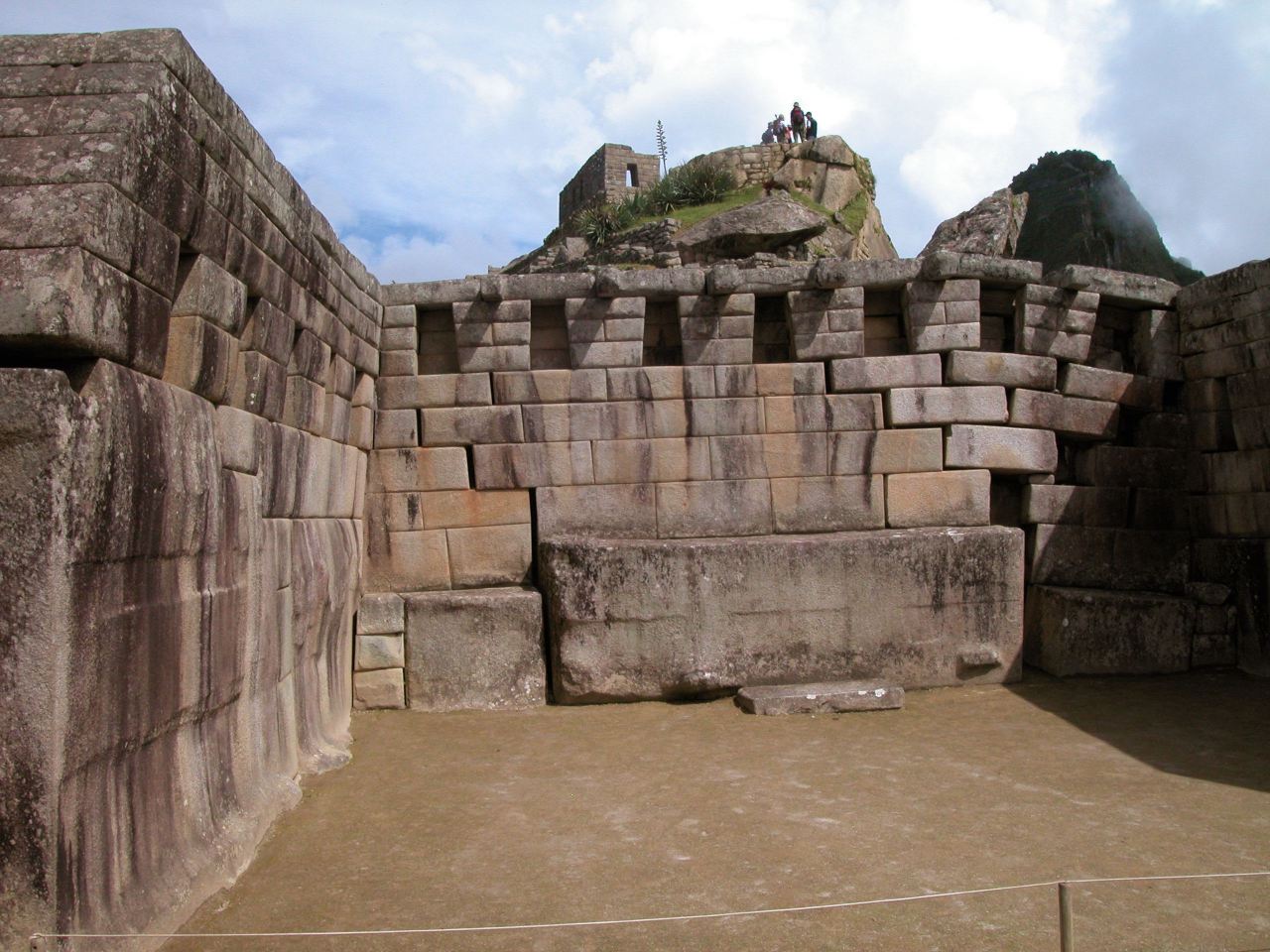
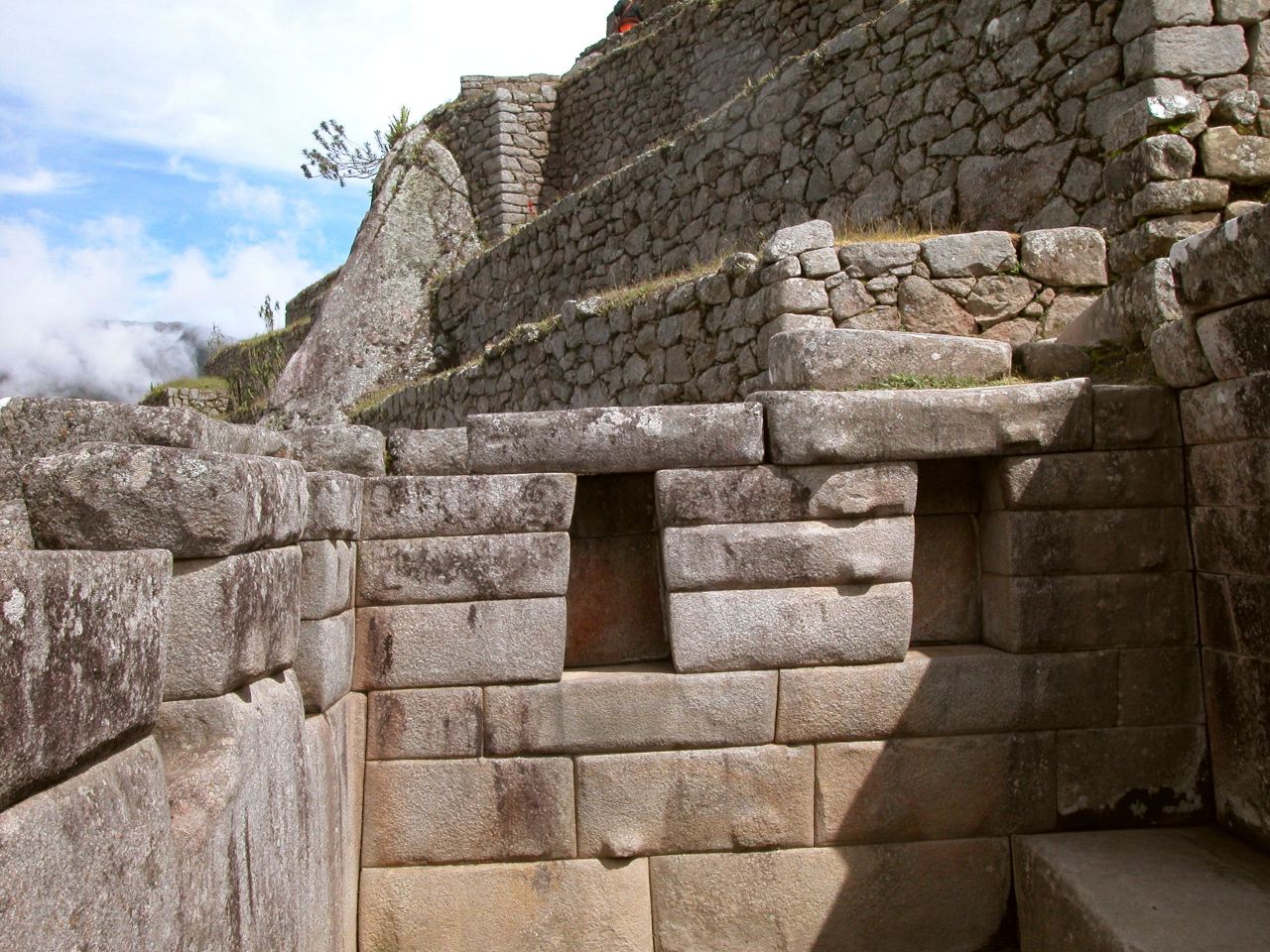
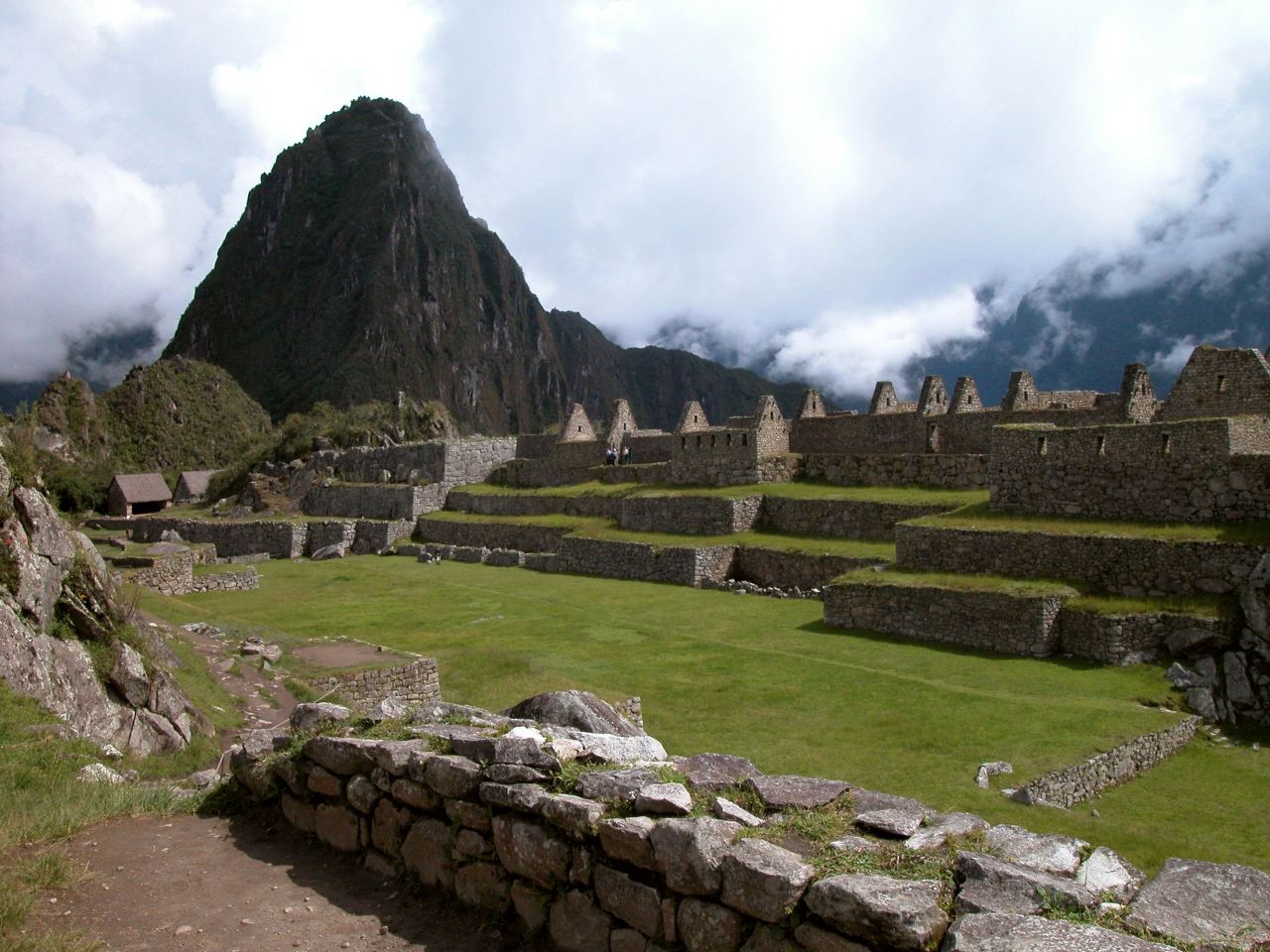
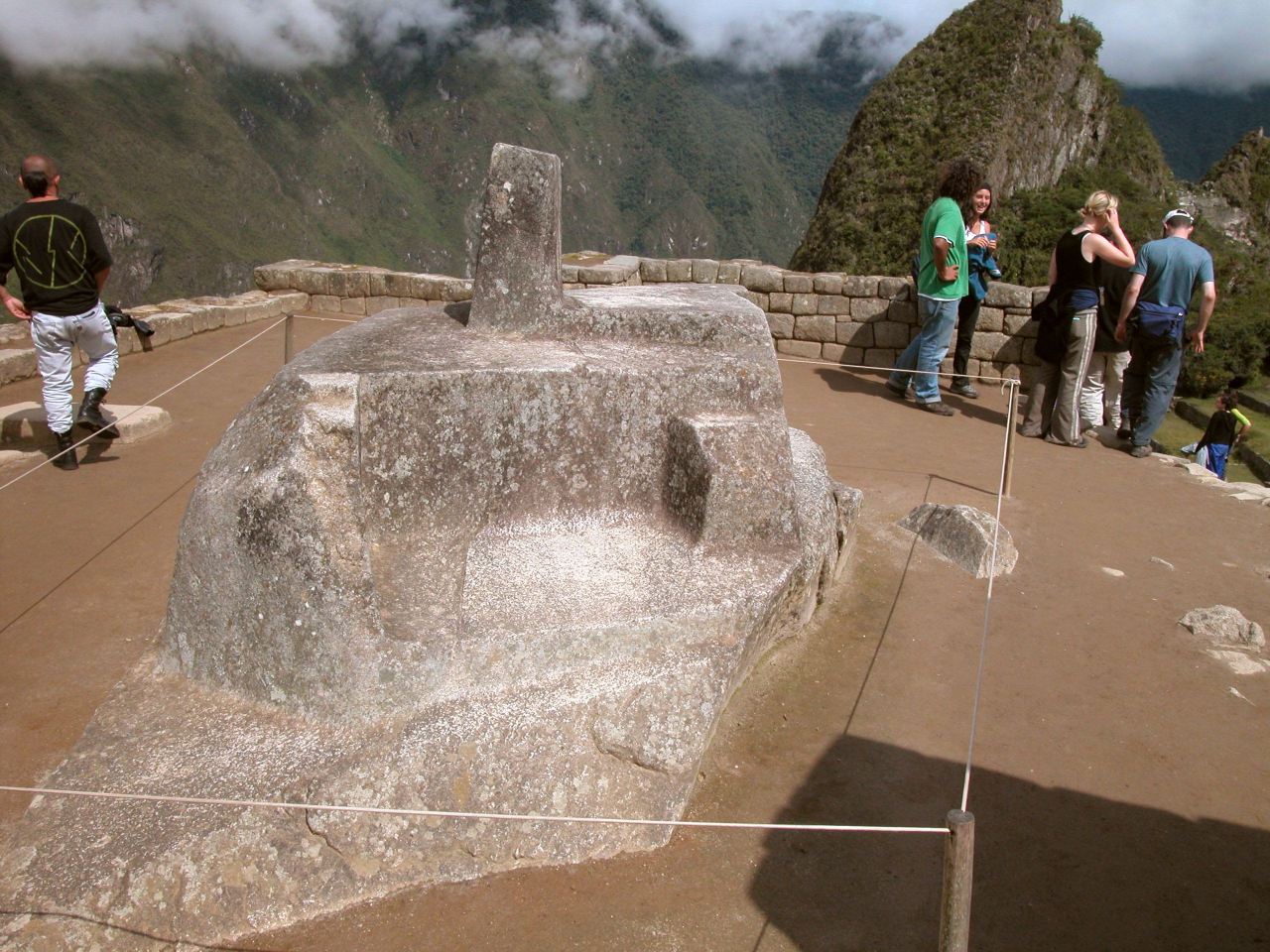
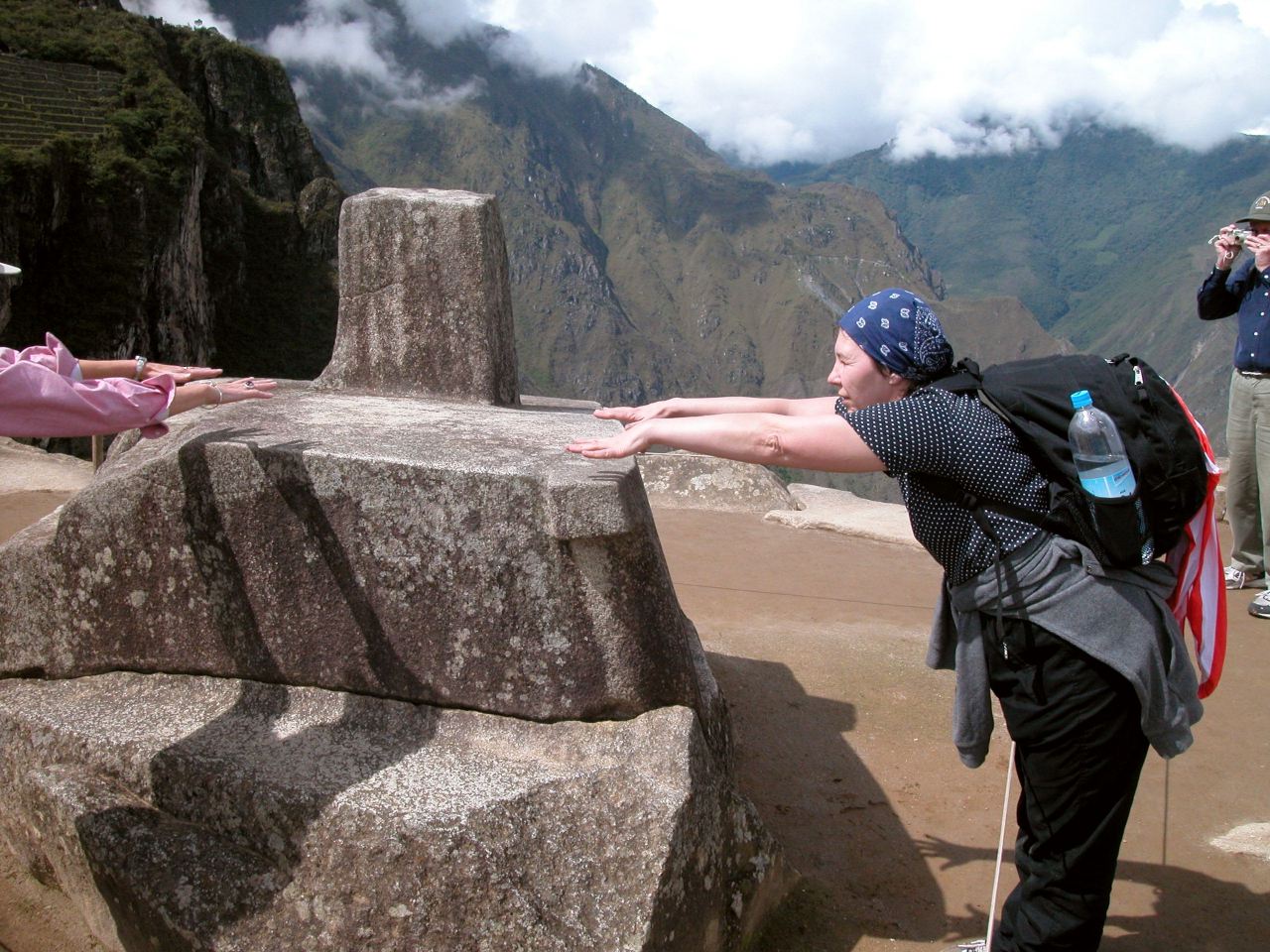

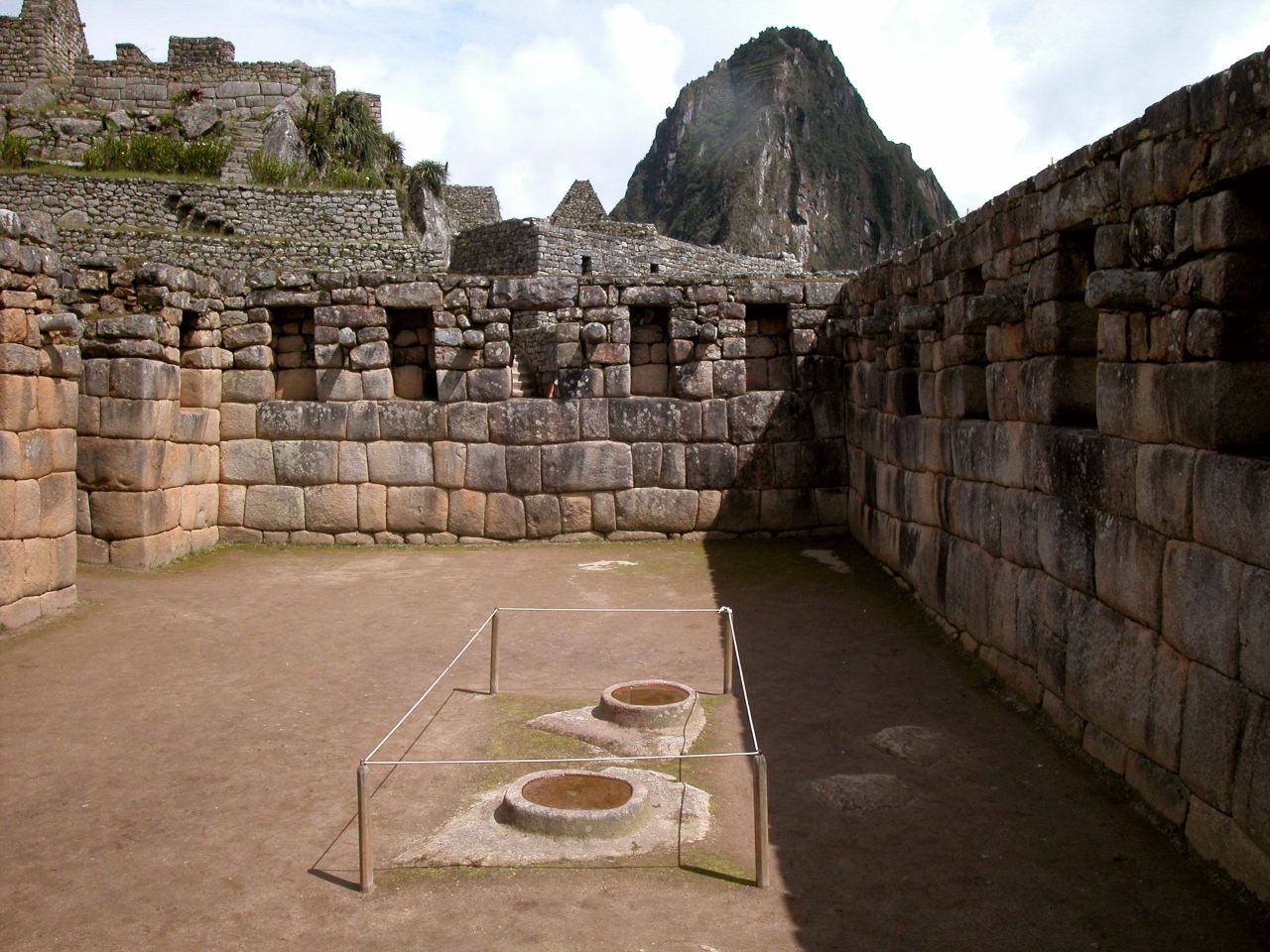
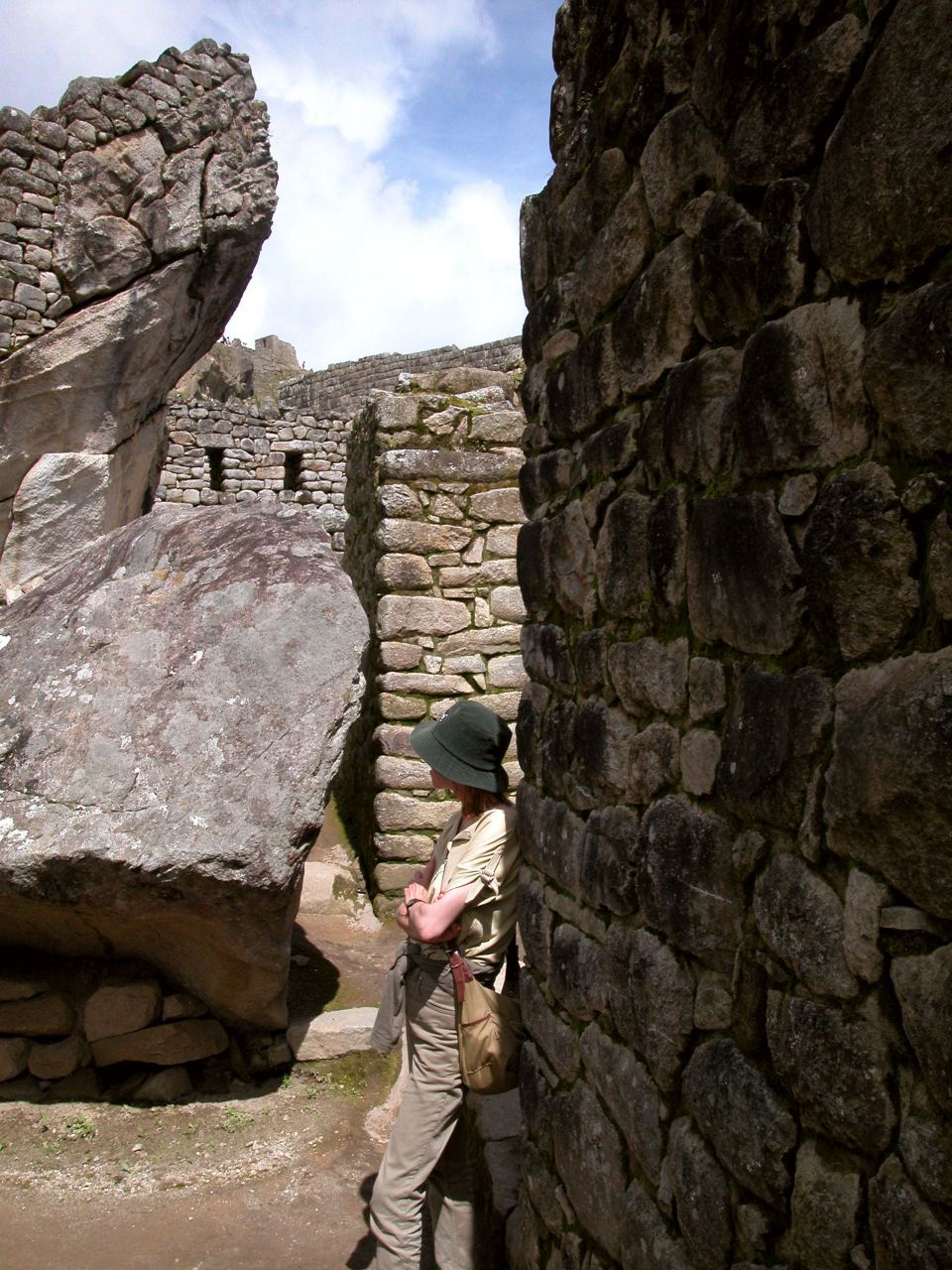

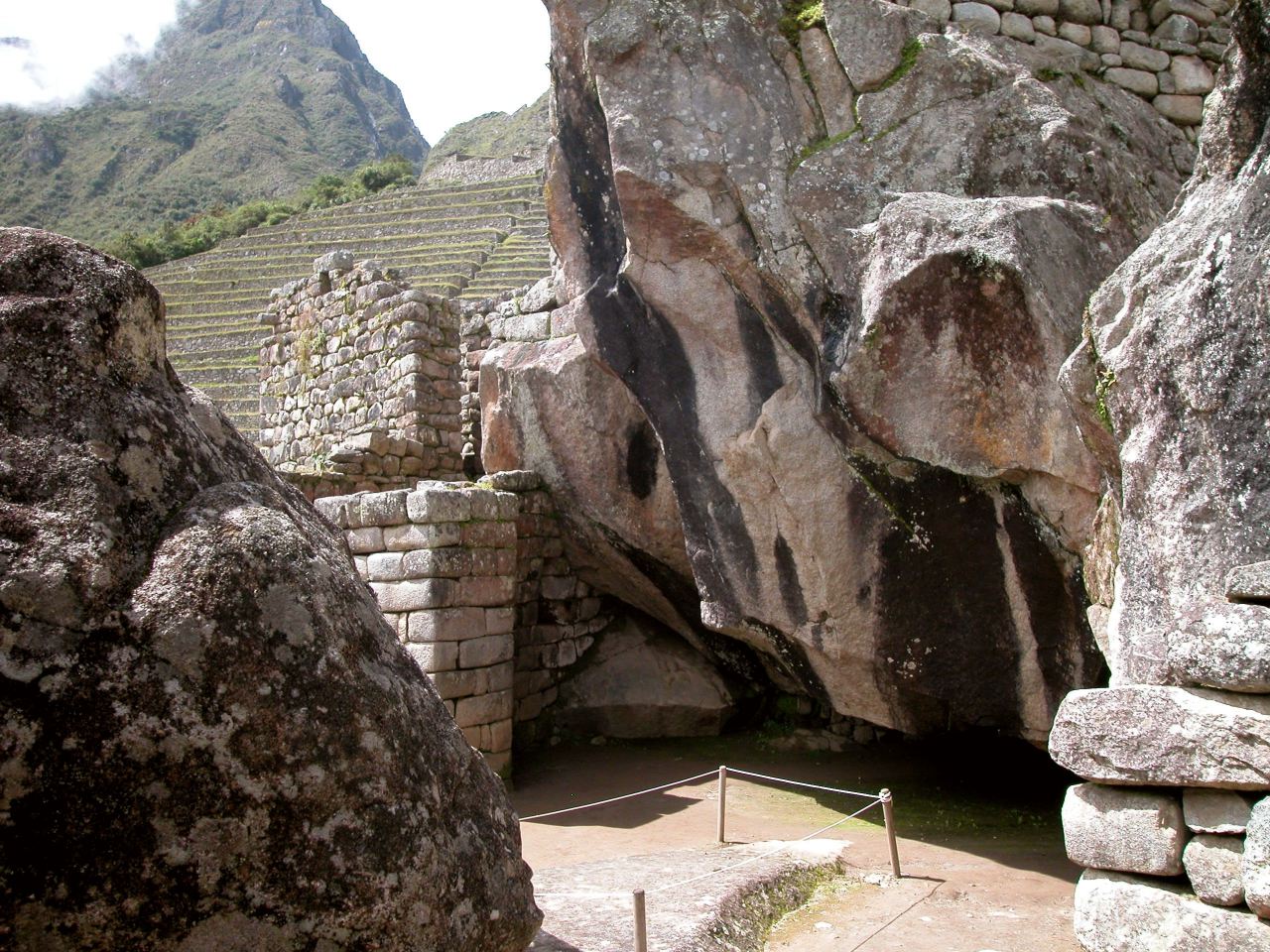
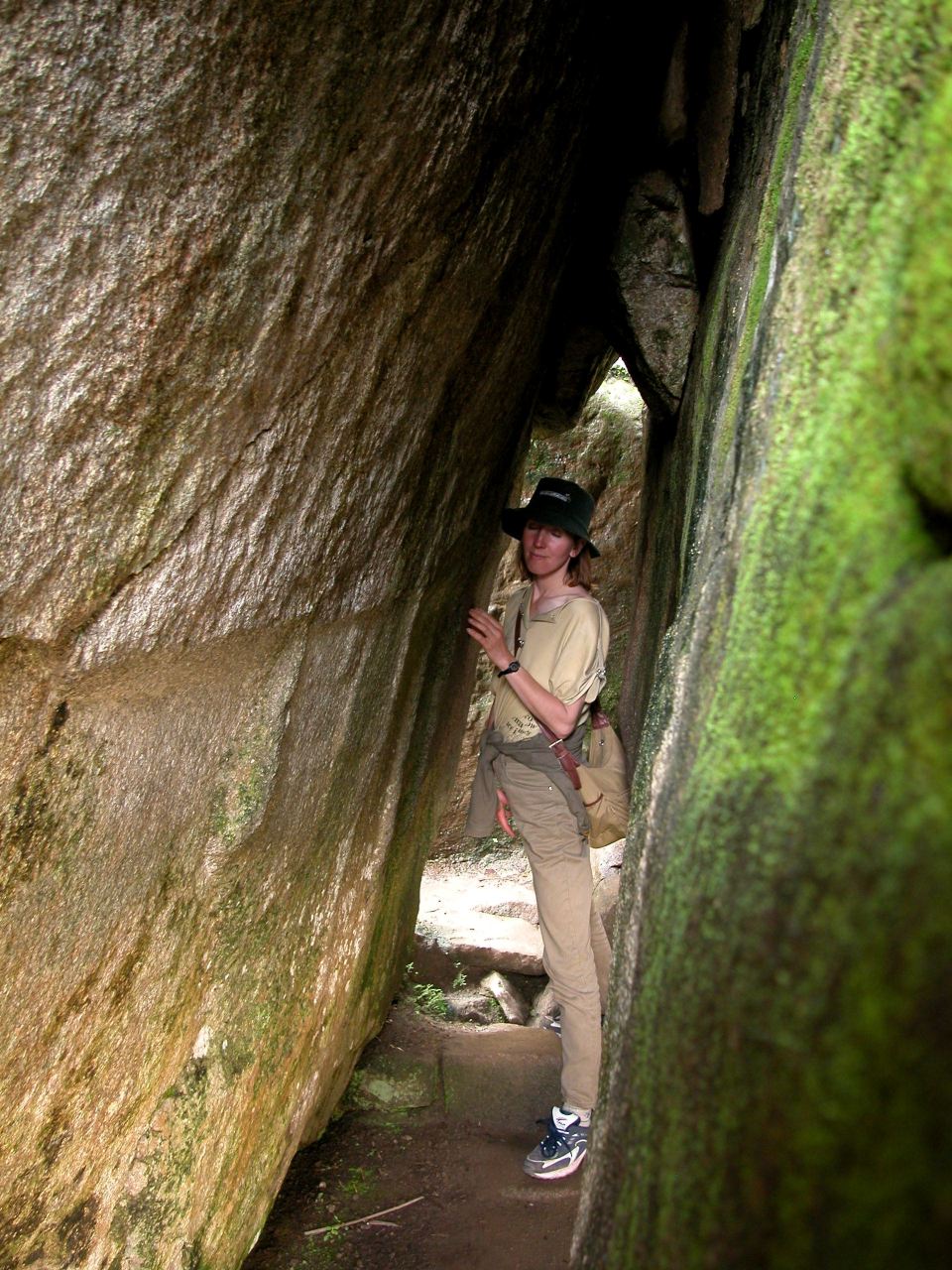
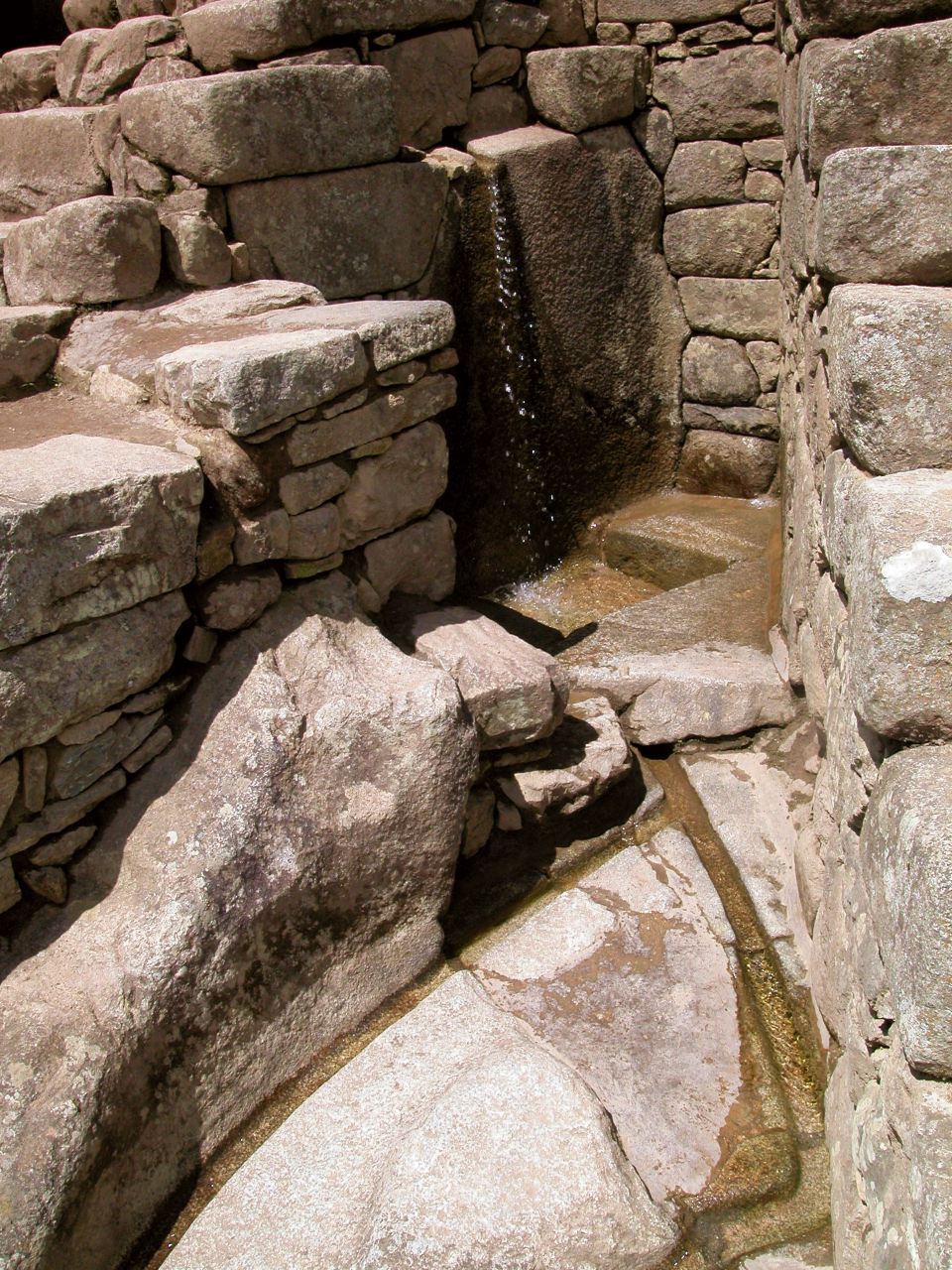
The Incas had no writing and very little is known about them, surprisingly. Many well-established views are stereotypes with no basis at all. The purpose of many buildings is unknown, and their names are just conventions. Take the Temple of the Three Windows. Which three? Windows 2000, XP and ME?
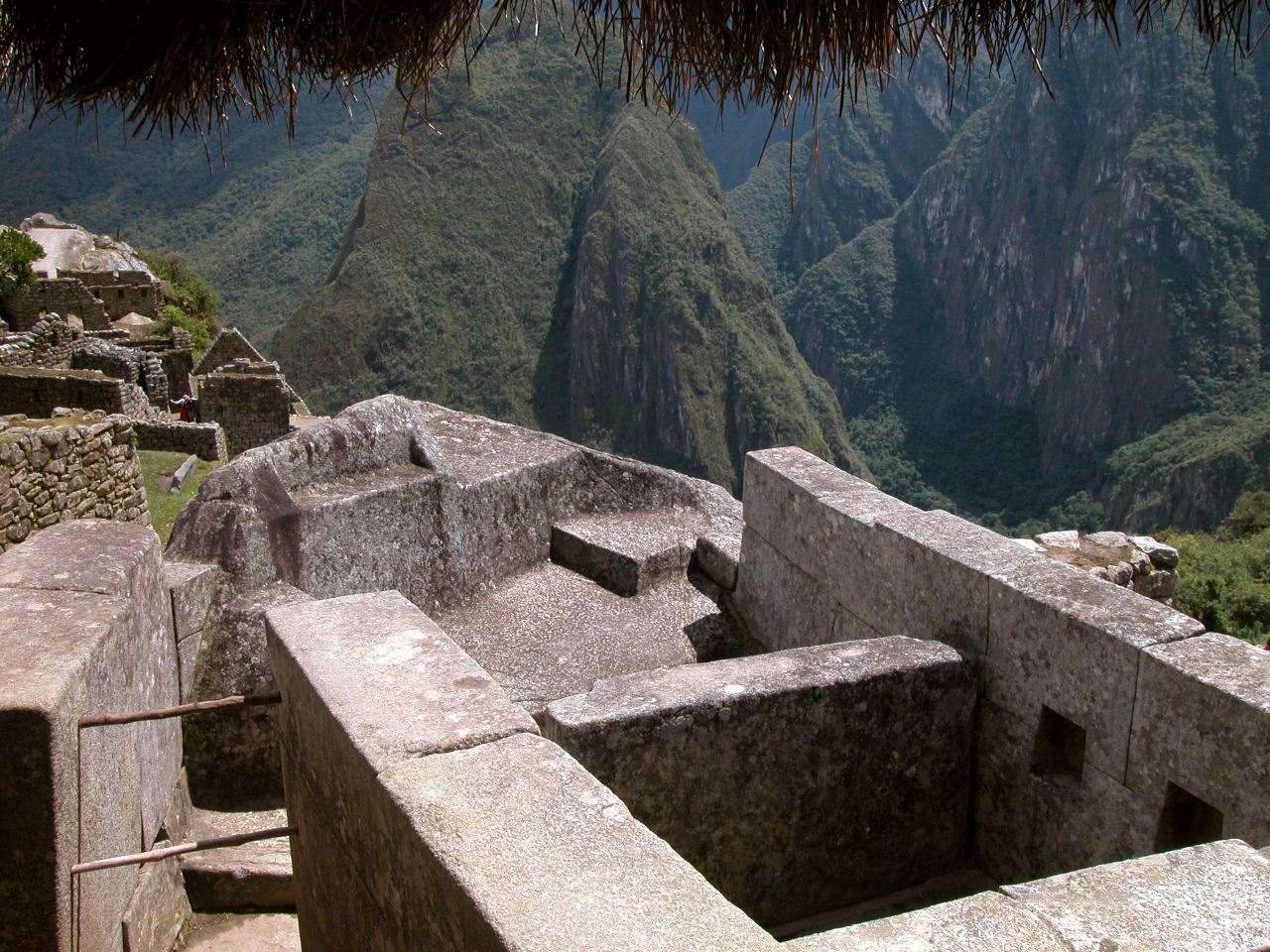
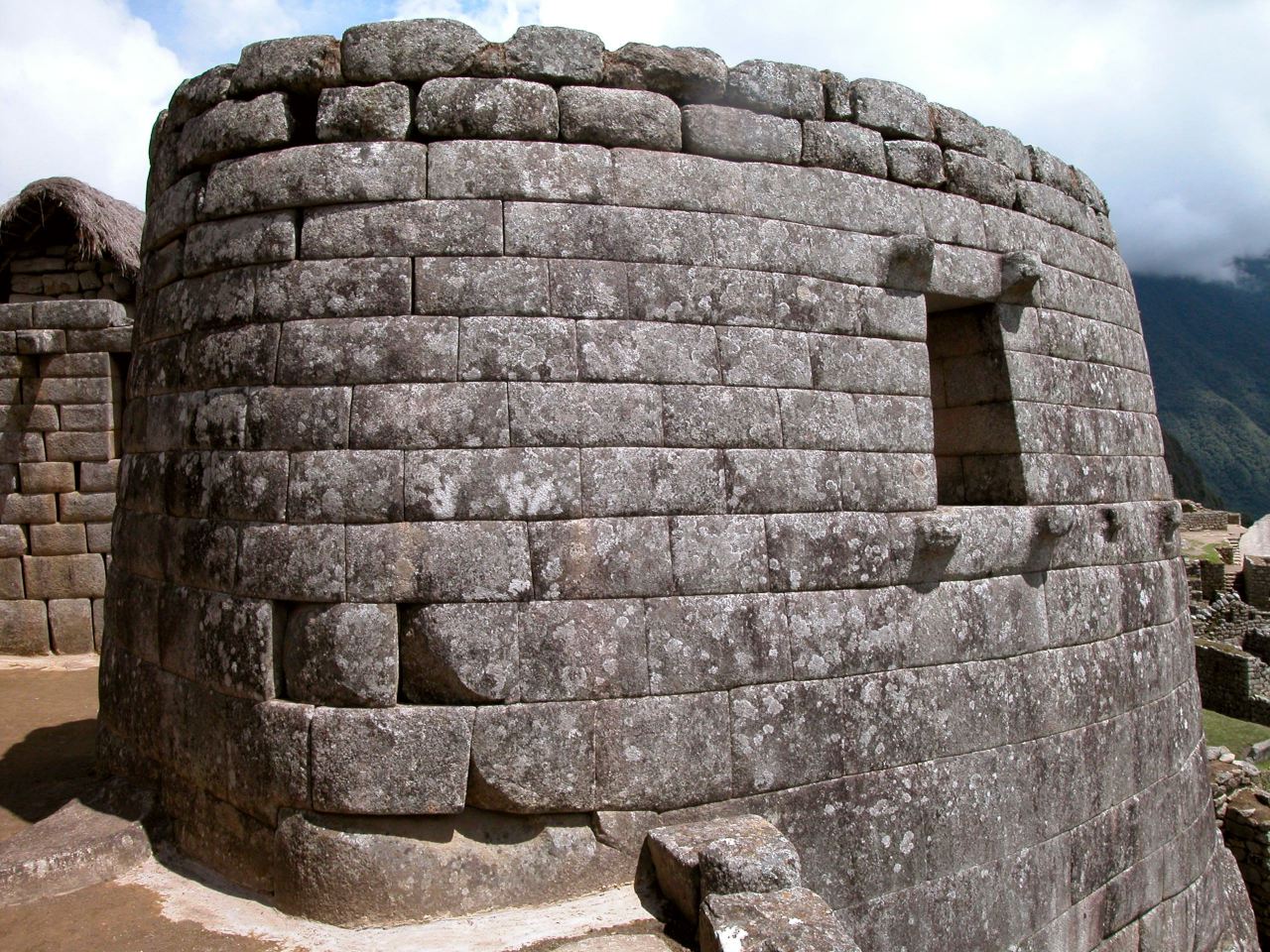
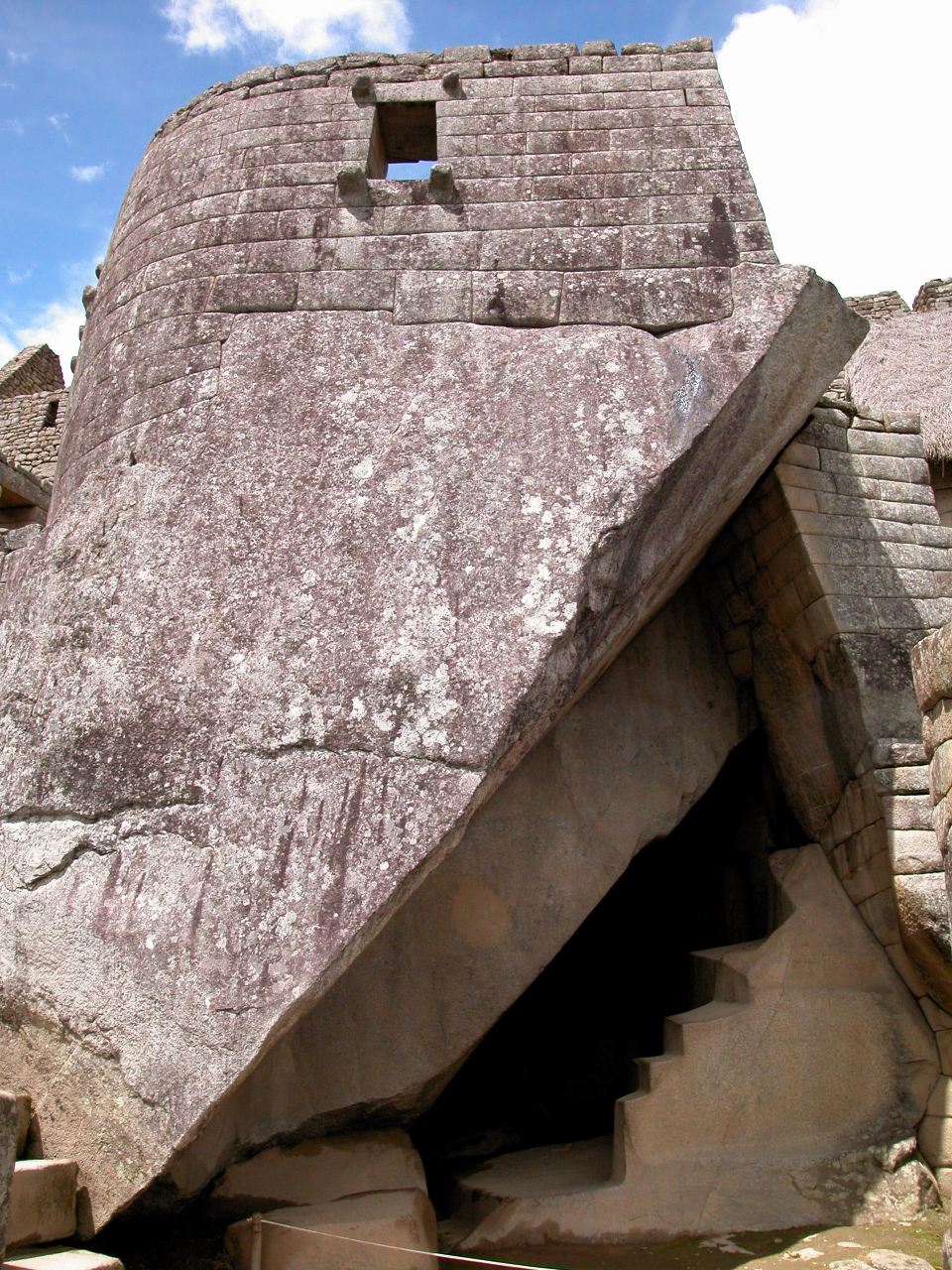

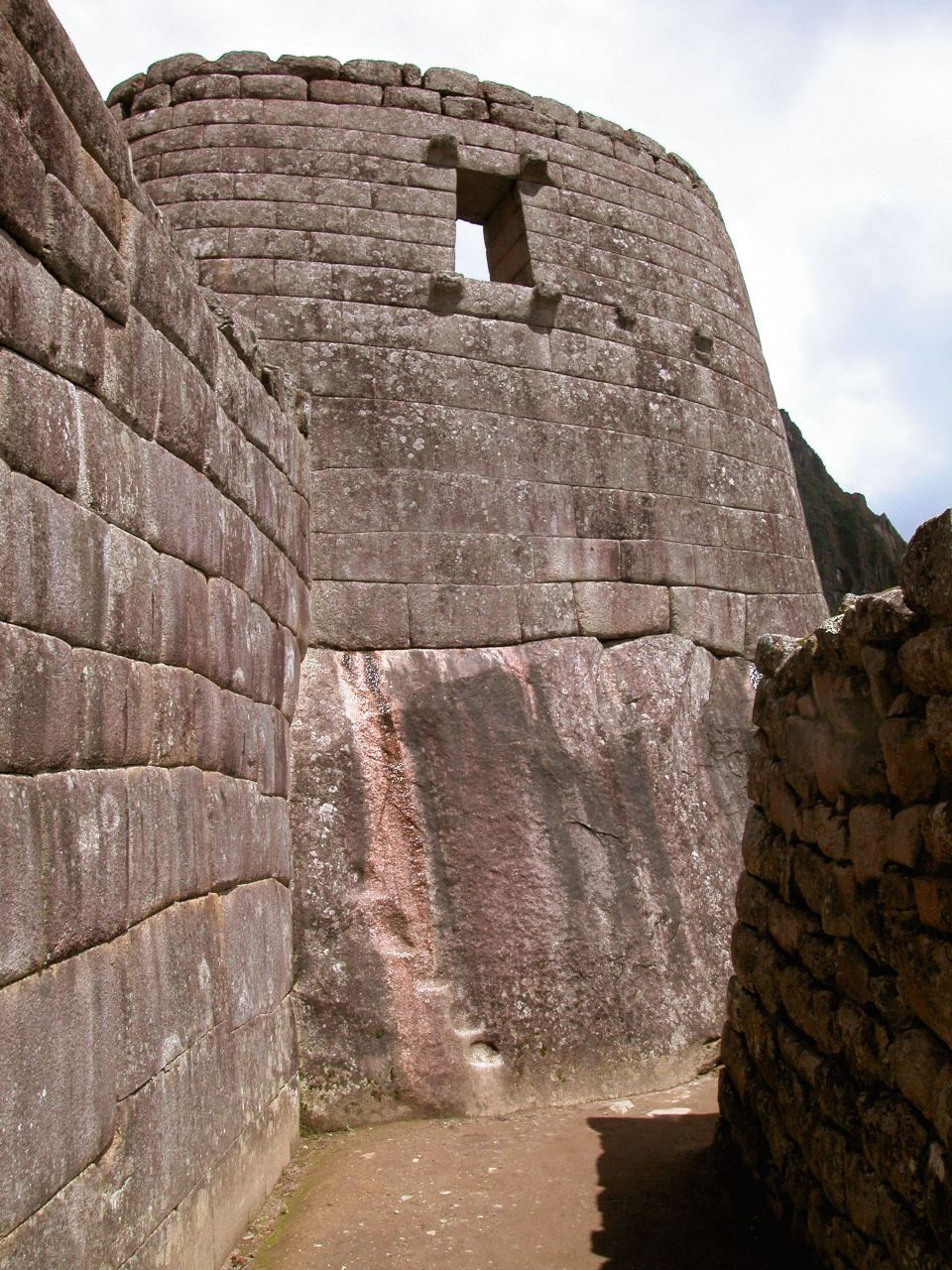
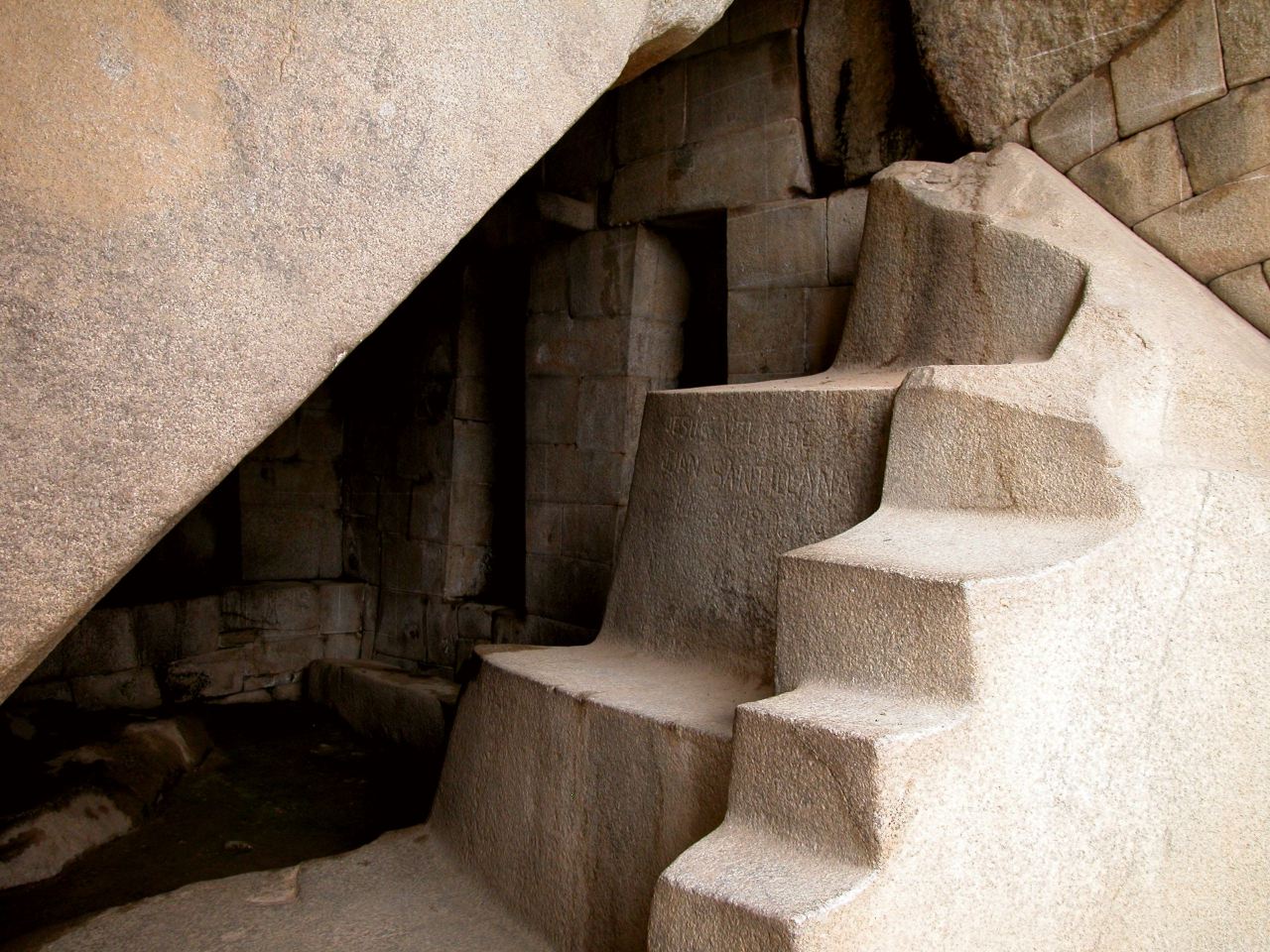


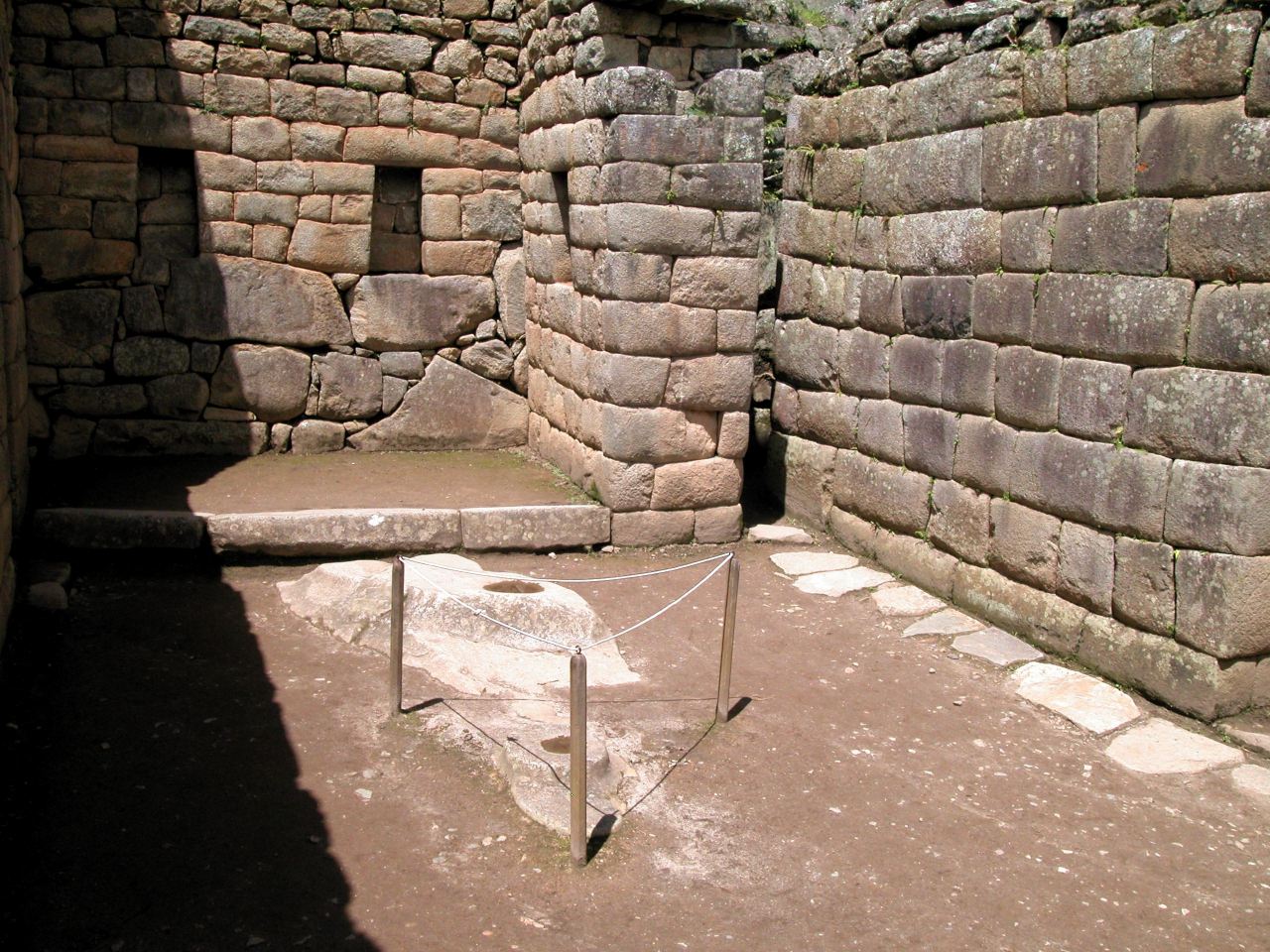
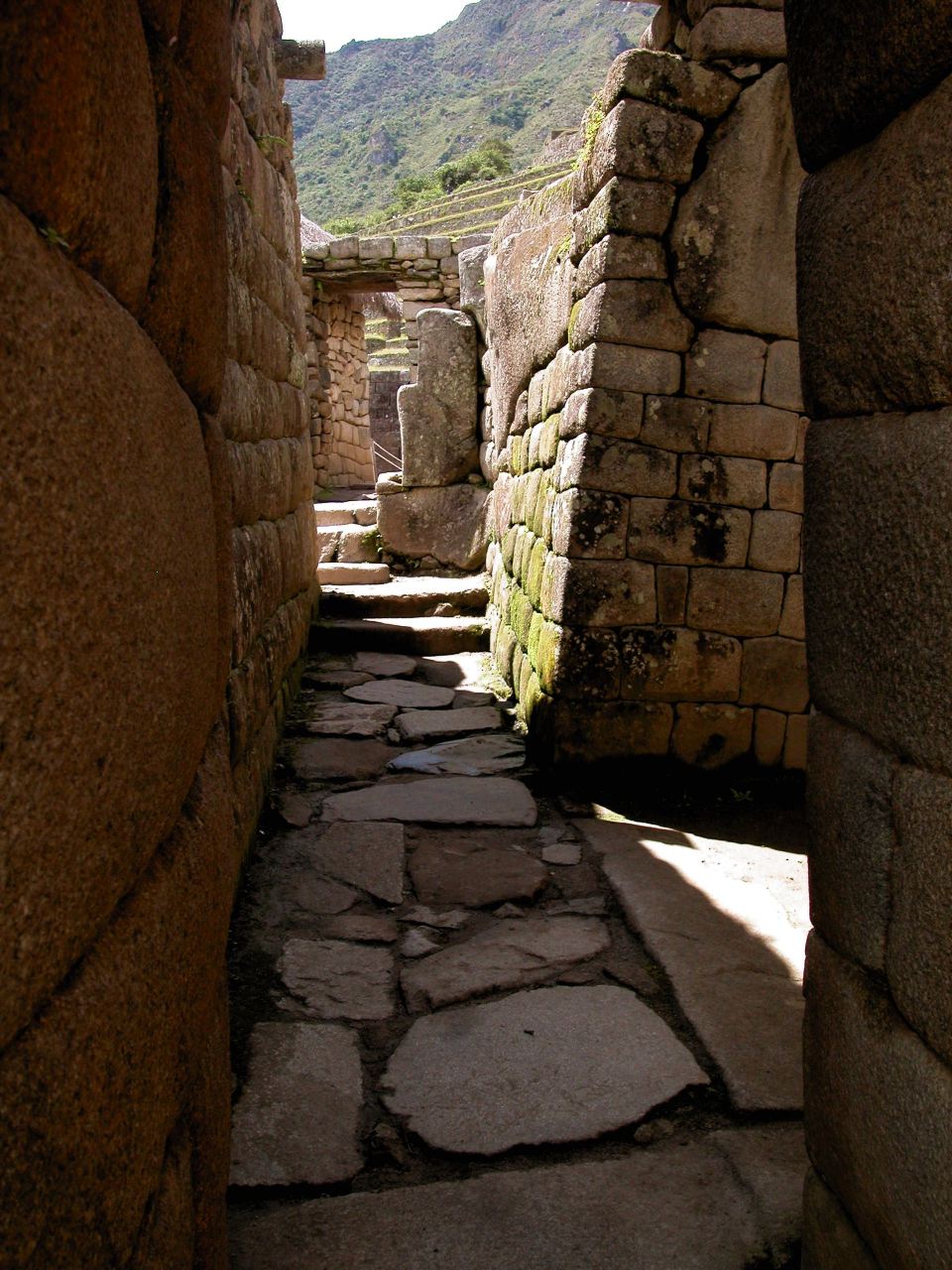
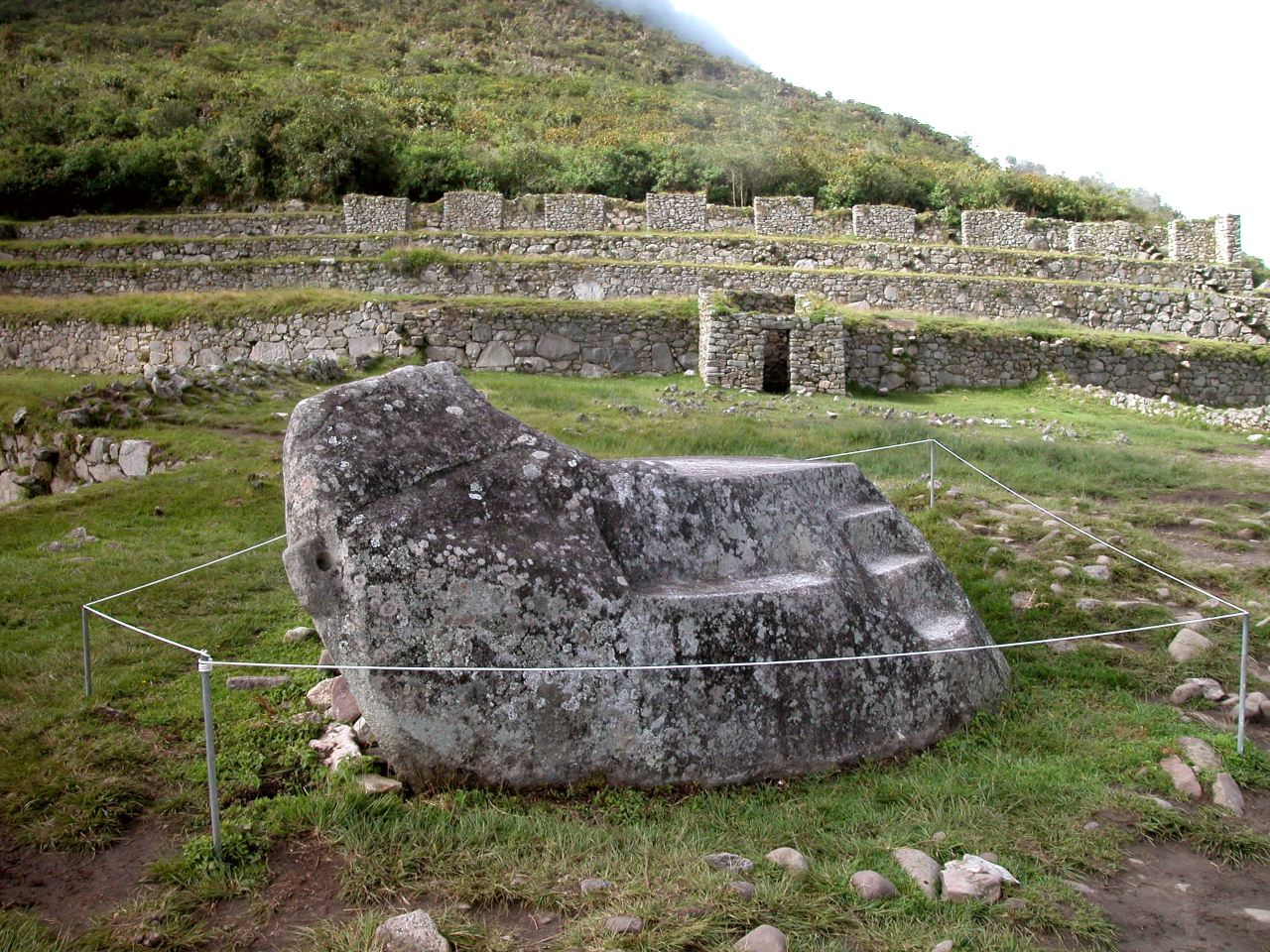
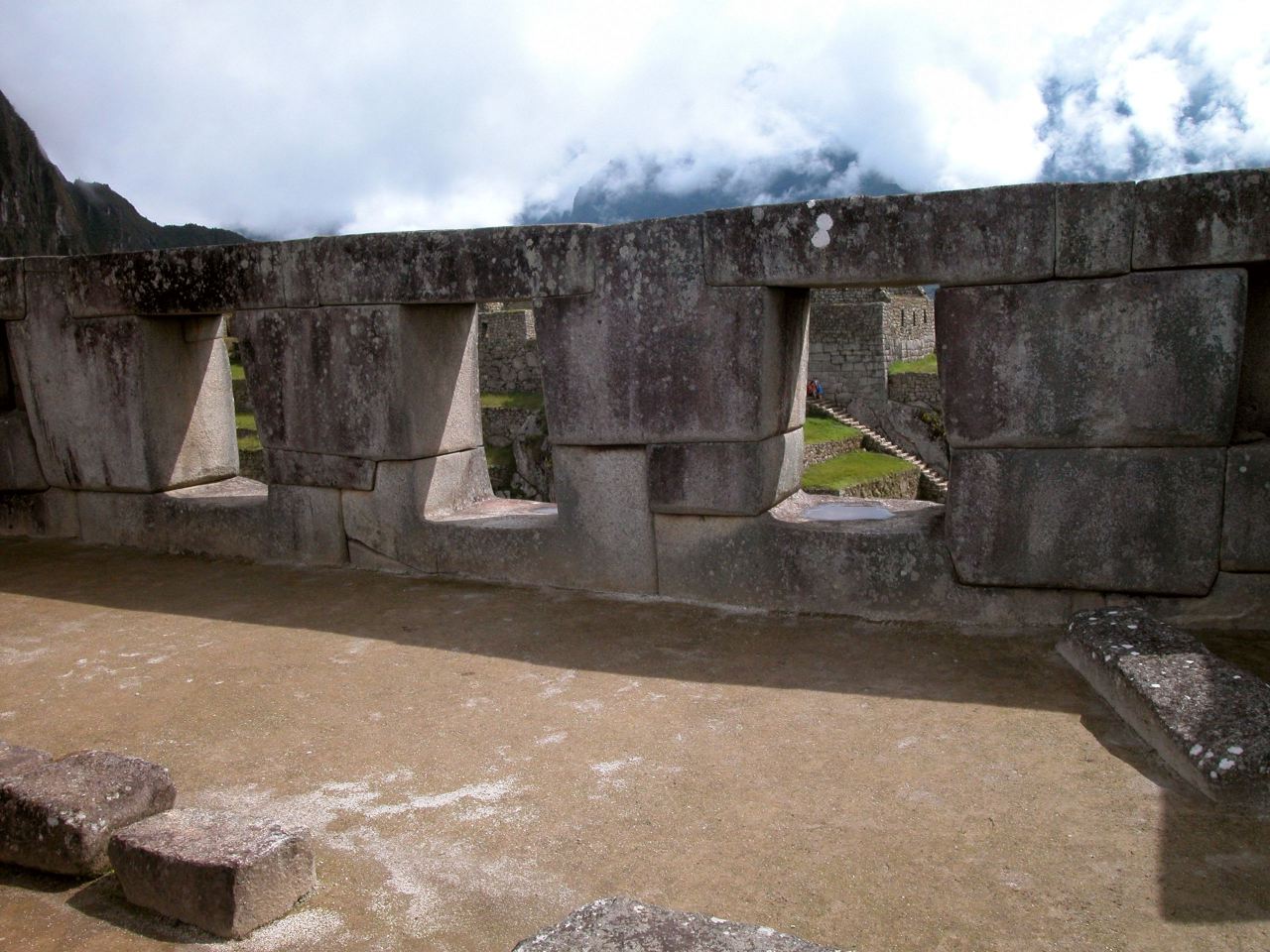
You can spend hours walking along its many streets. The number of interesting things in such a small area is quite astonishing.
Apart from the main group of buildings, you can go to the Temple of the Moon. The path leading there descends gradually by 150 metres. The walk takes about an hour each way, and the saddest part is that the whole way back is uphill. The Temple of the Moon has hardly been cleared of jungle. What's more, the inevitable rope barrier doesn't block the entrance. Of the thousands of visitors every day, only a few dozen get there, and it's worth being one of them. Far more people go to Huayna Picchu, on the top of the great mountain that you can see in the distance on the right in the classic Machu Picchu picture. The climb isn't technically difficult, and Lonely Planet allows an hour and a half. We did it in forty-five minutes. The path is well made, but you have to gain three hundred metres. The walk is beautiful. In places it actually passes through a cave. The view from the summit is astonishing. But there's one summit, and a lot of people who want to admire the view, so there's nowhere to sit. People take photographs, send texts, and make calls. Peru doesn't have good mobile coverage generally, but they built a base station especially for Machu Picchu.
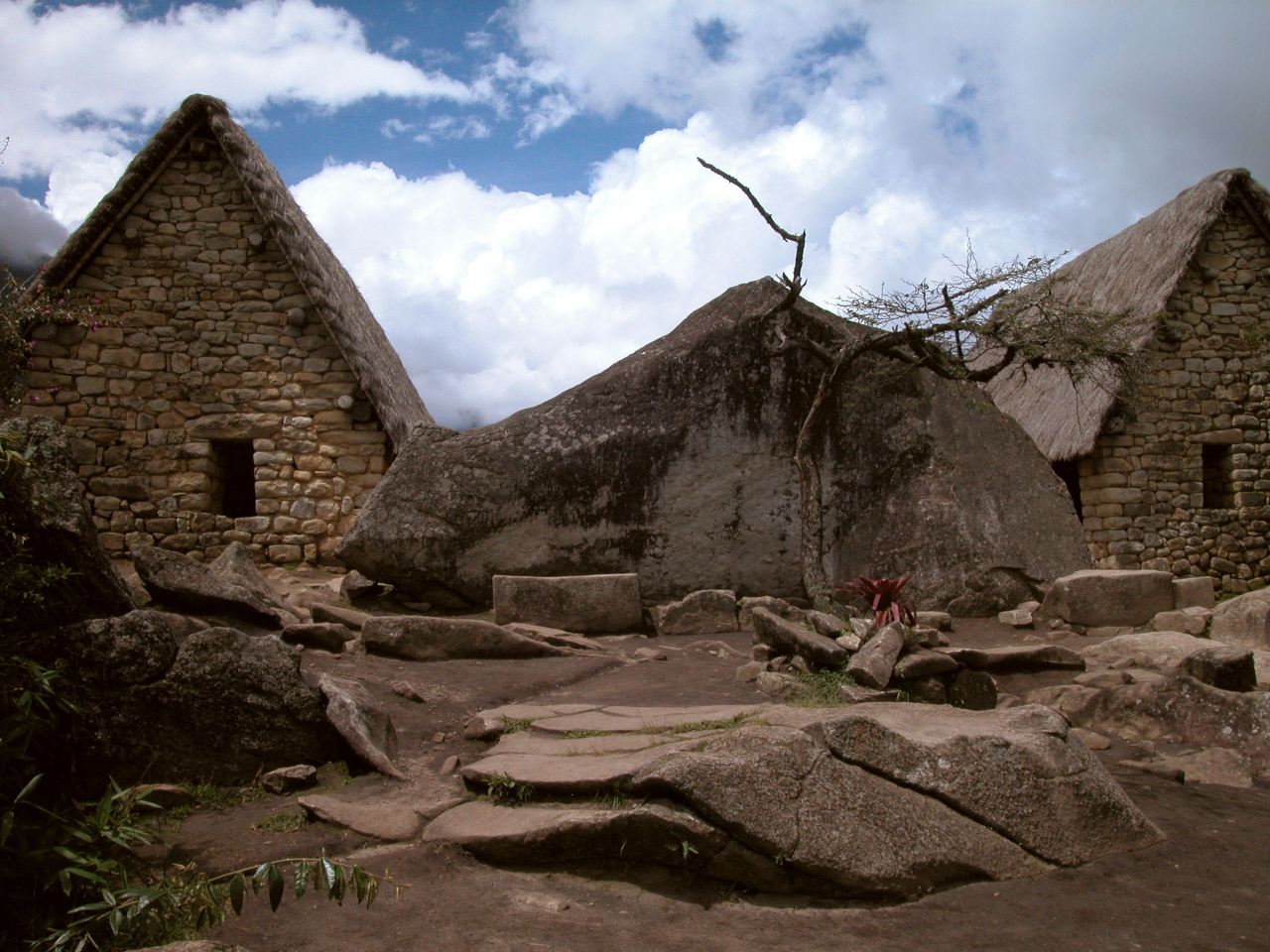


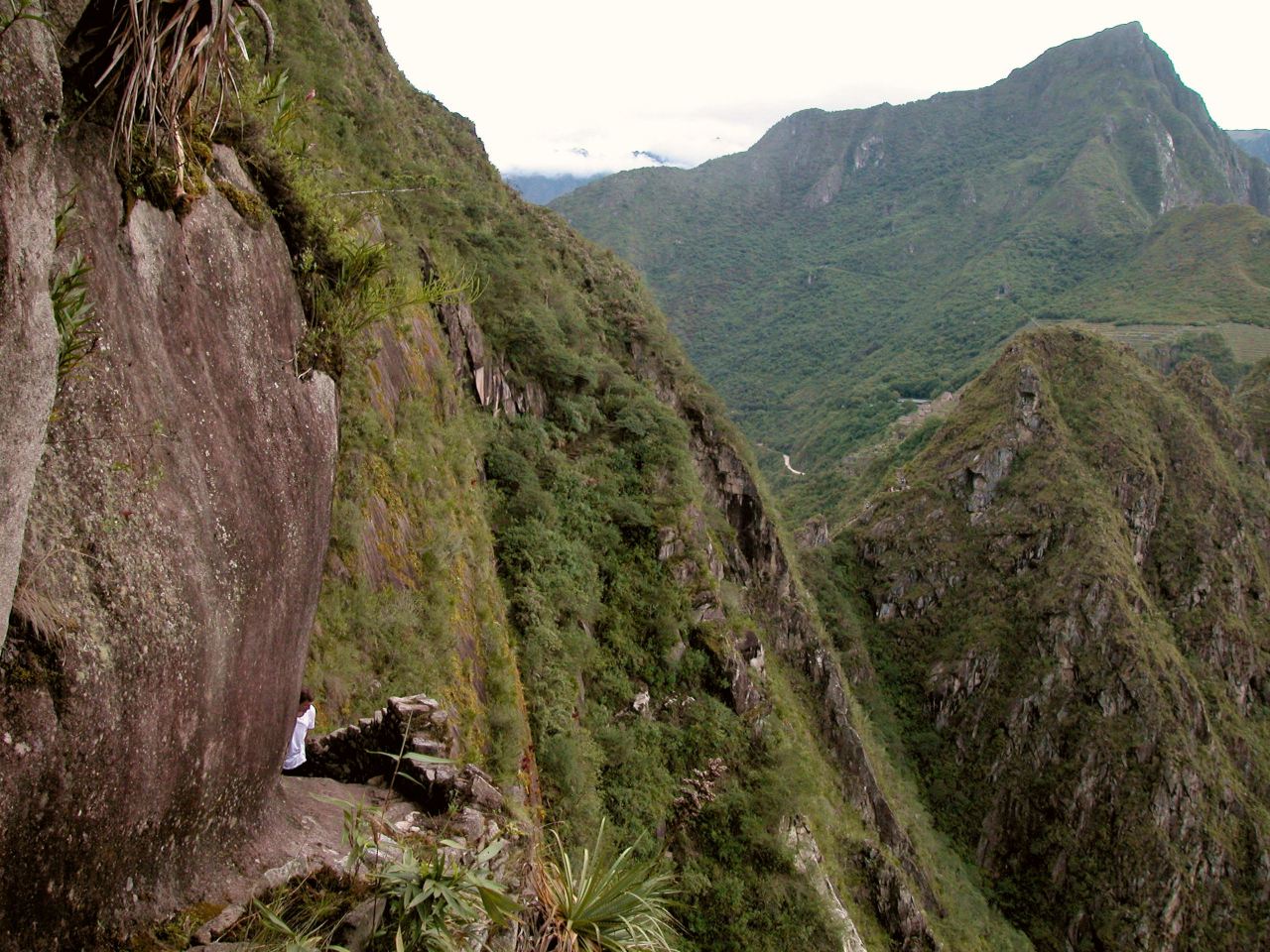
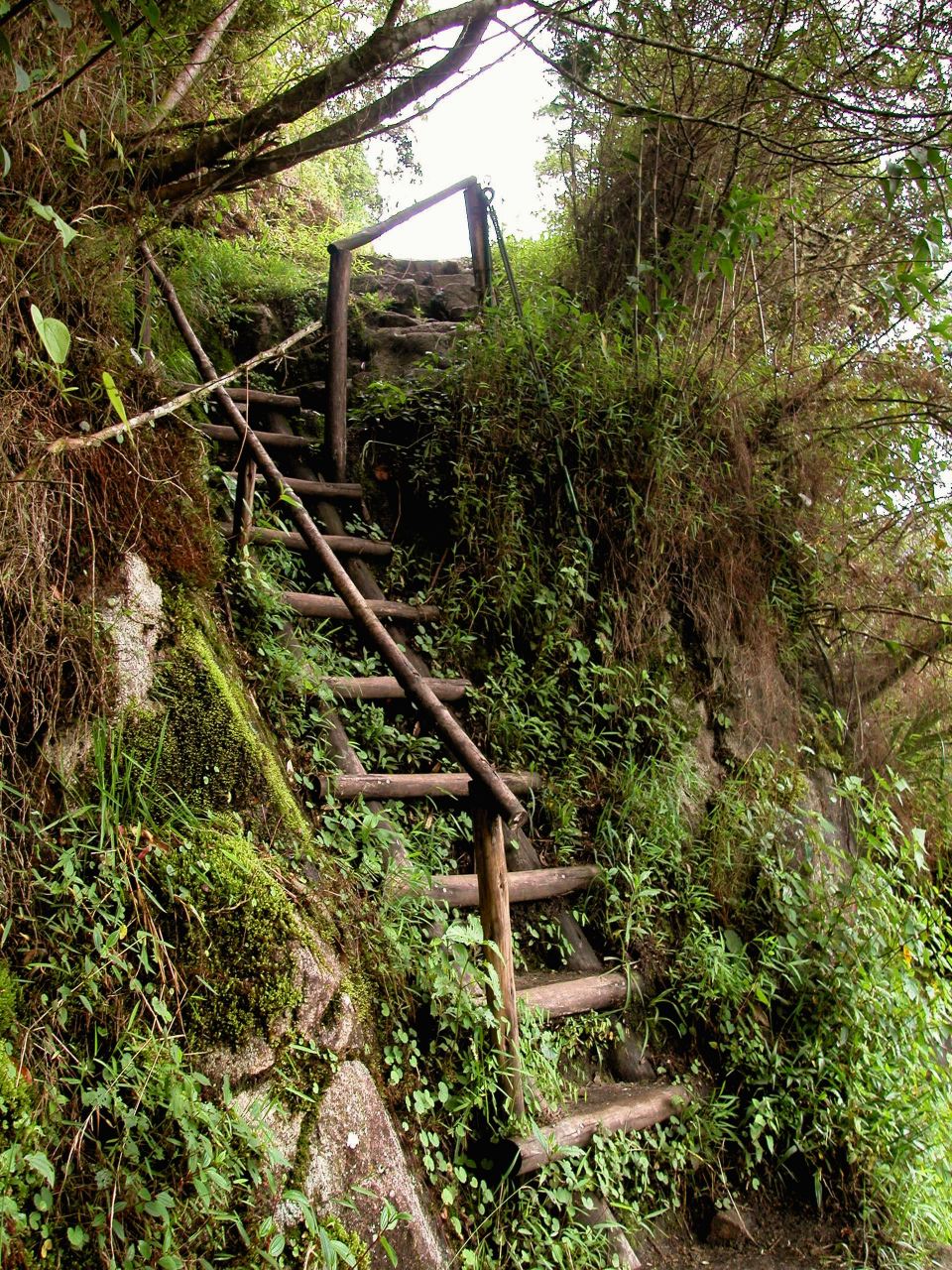
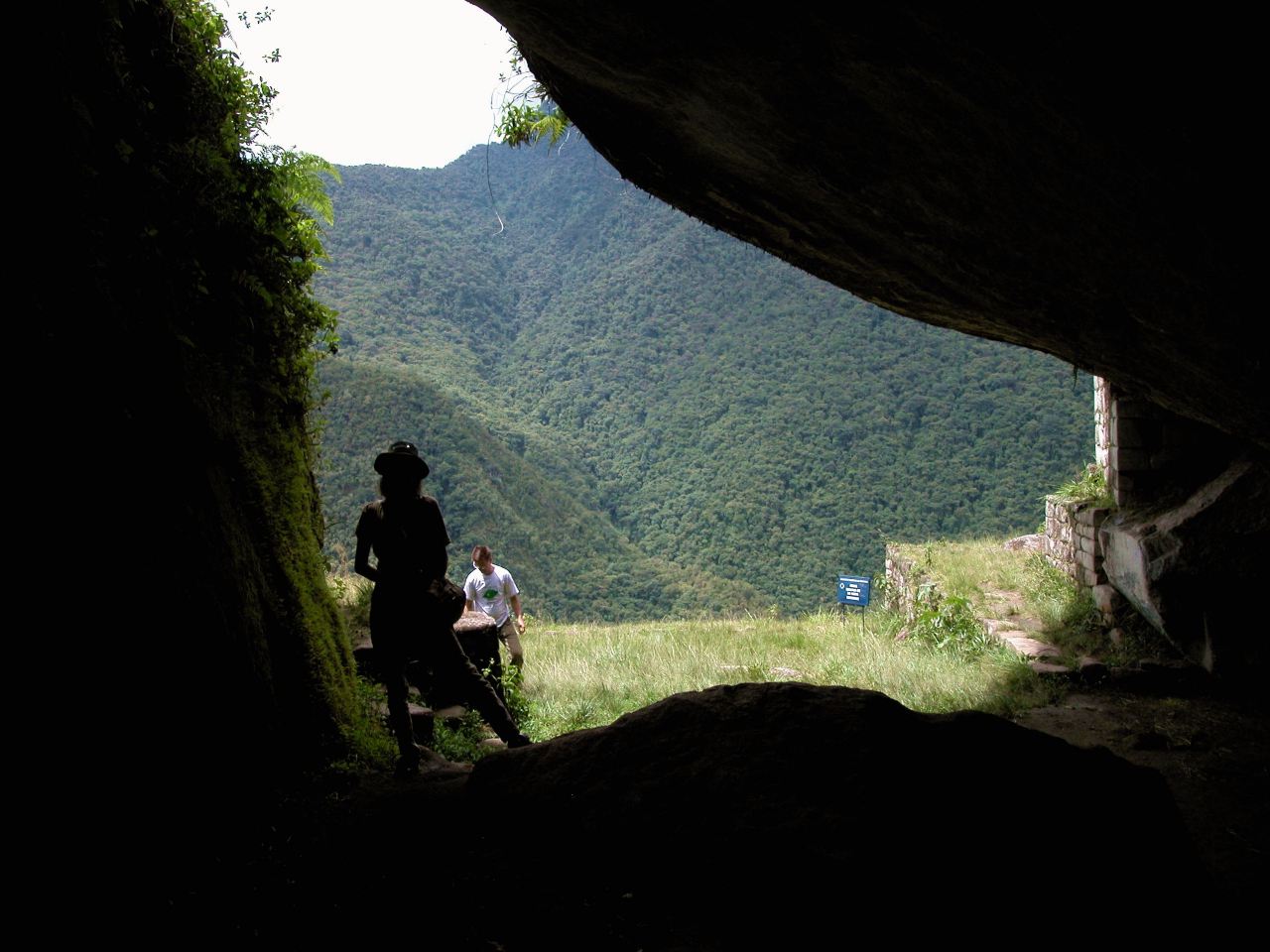
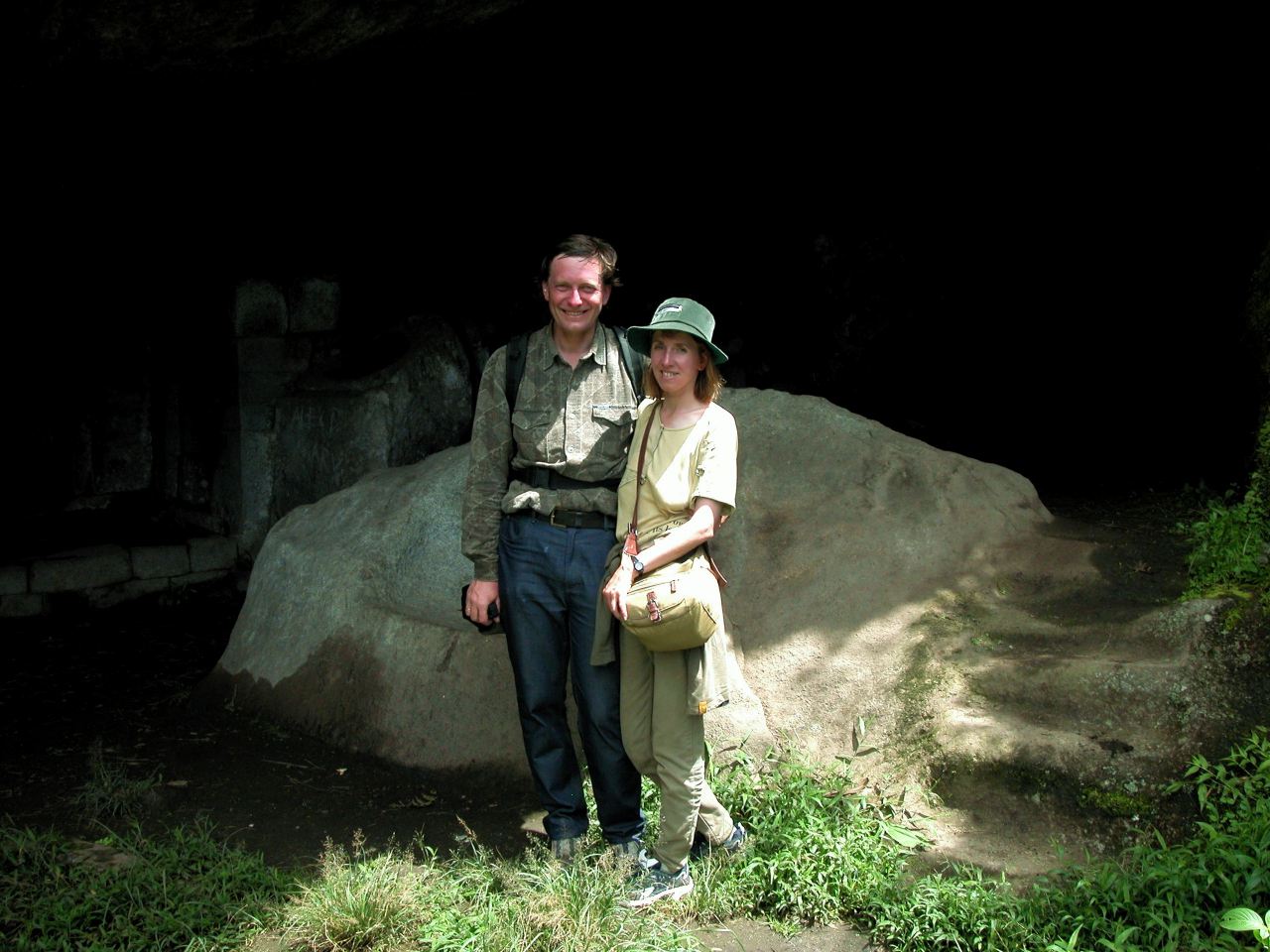
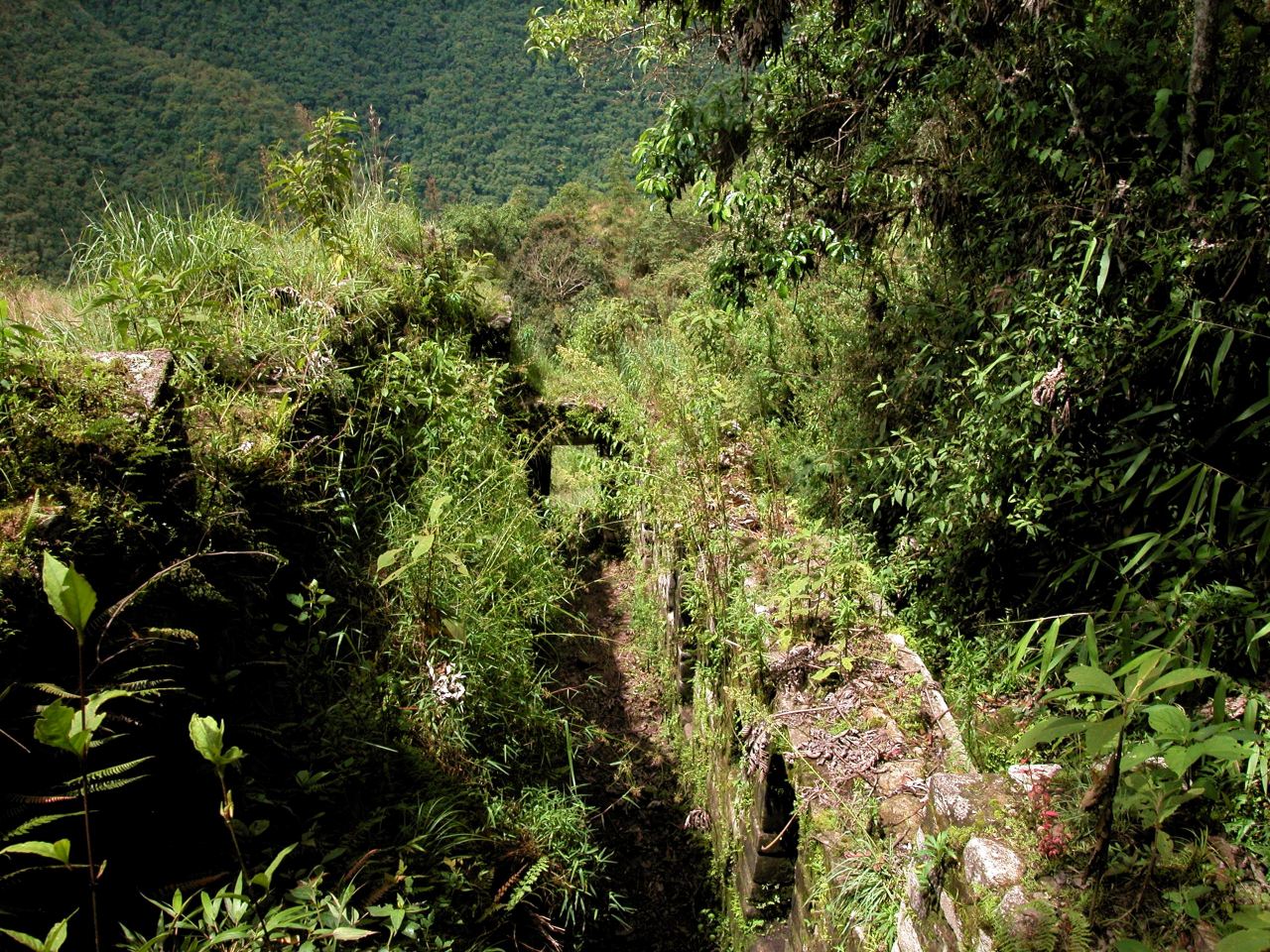
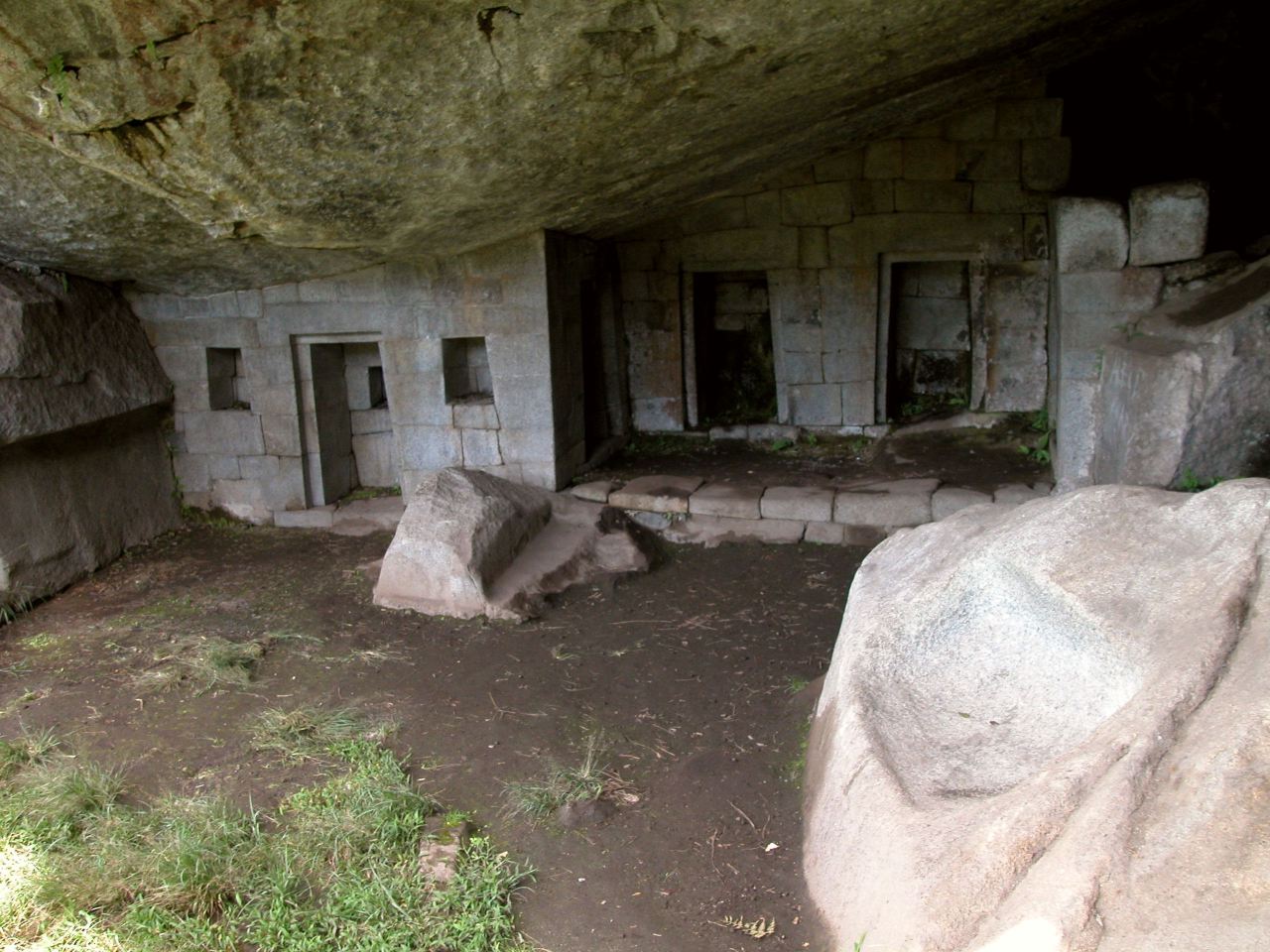
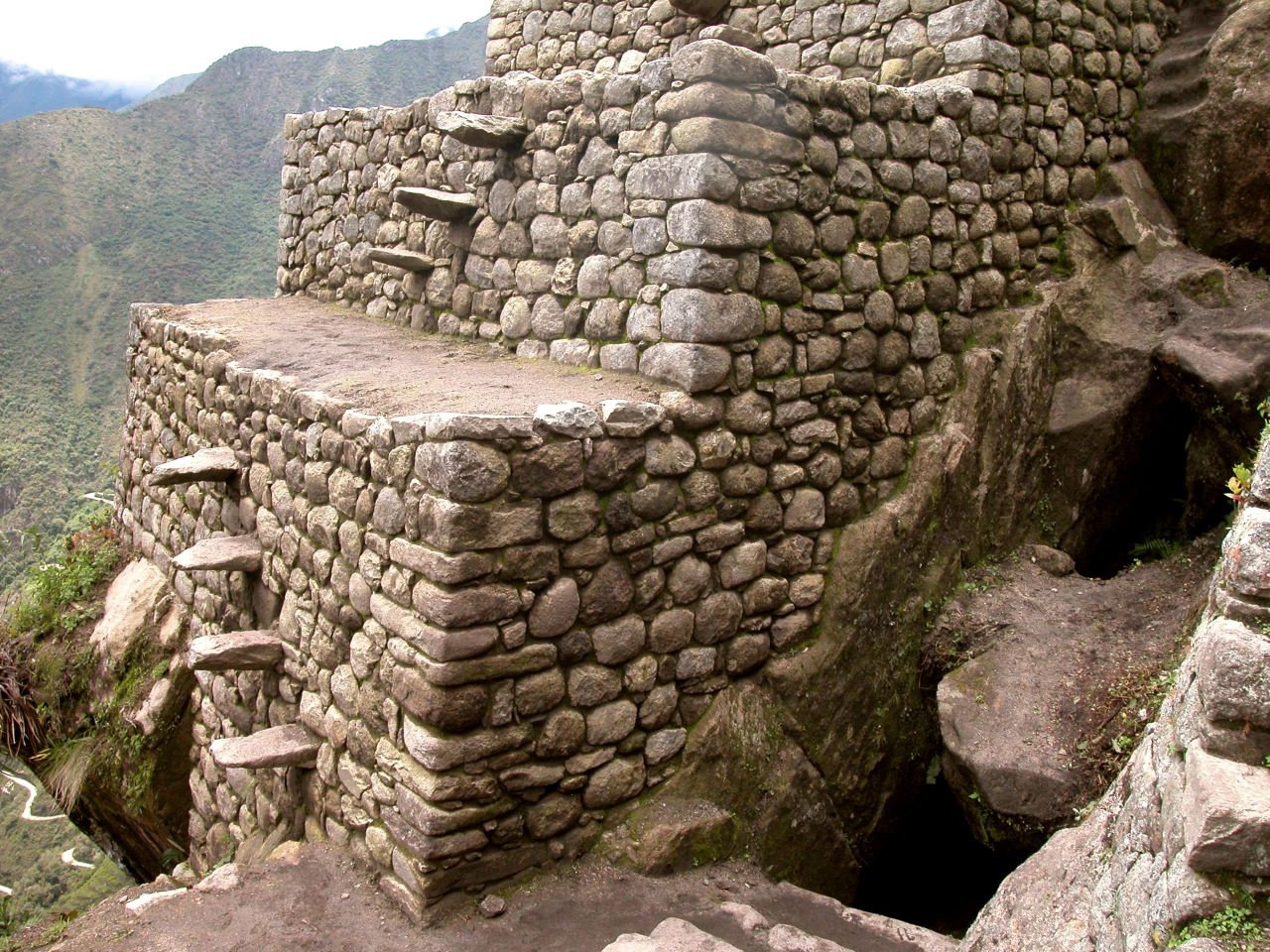
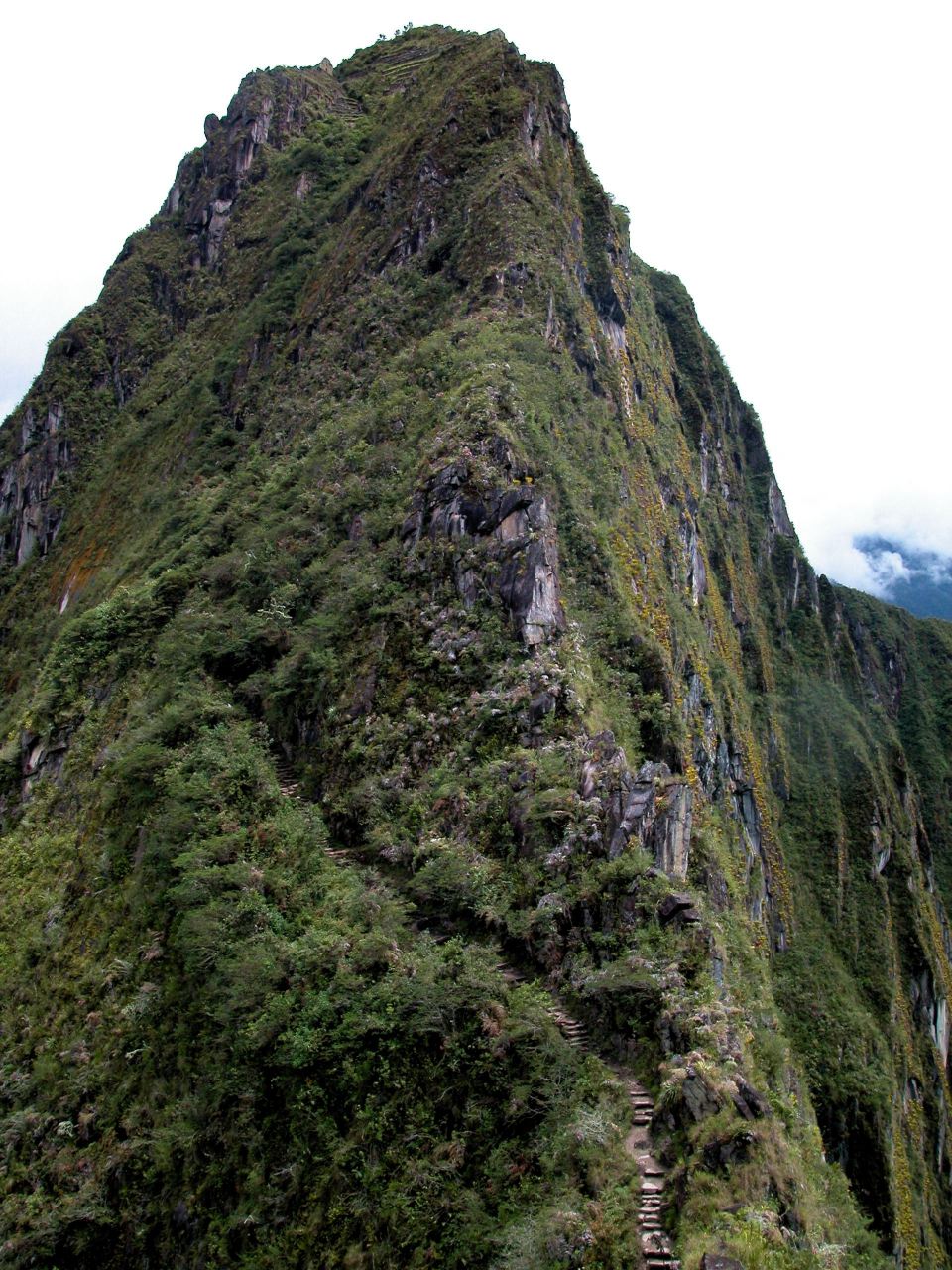
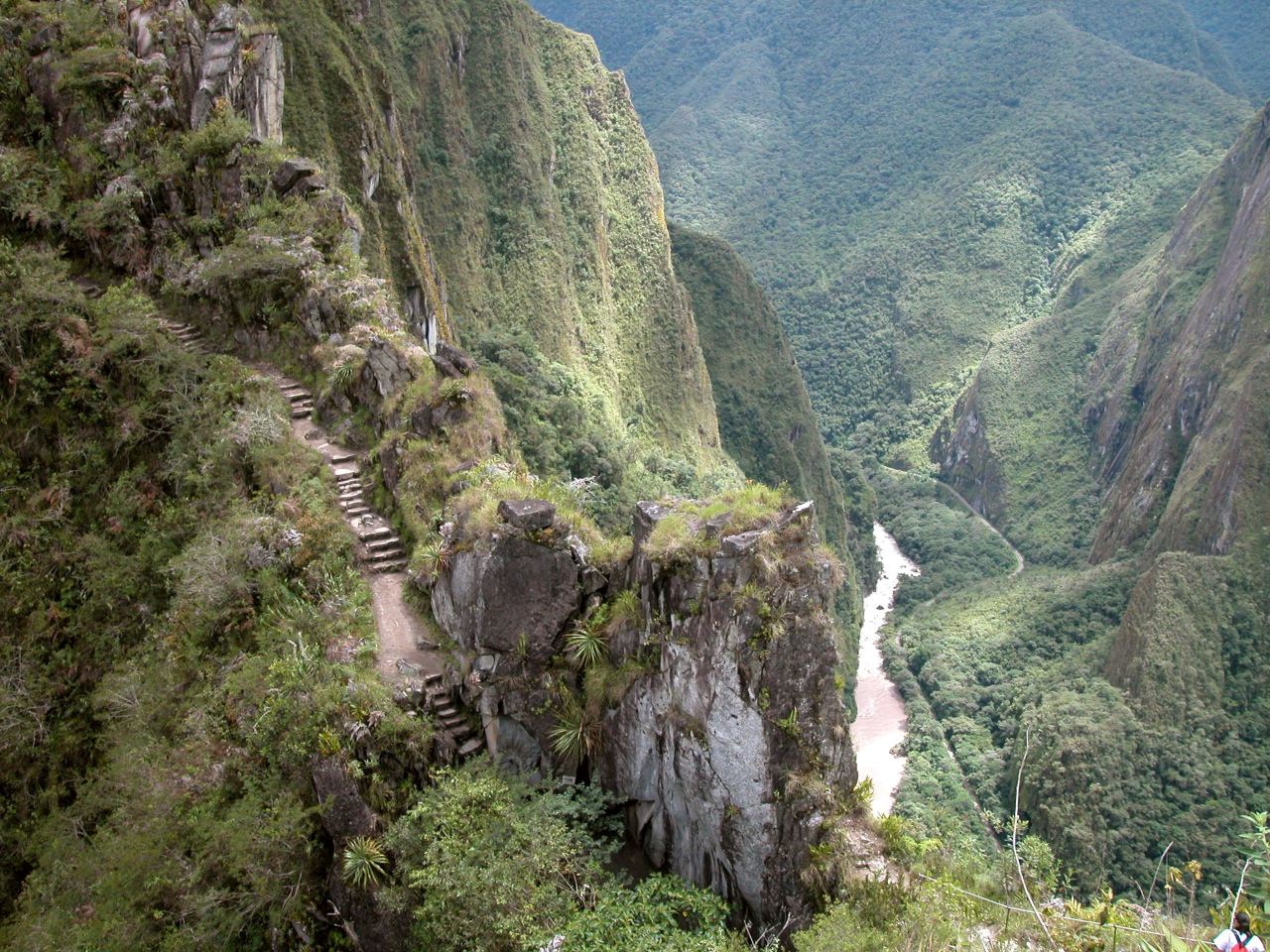
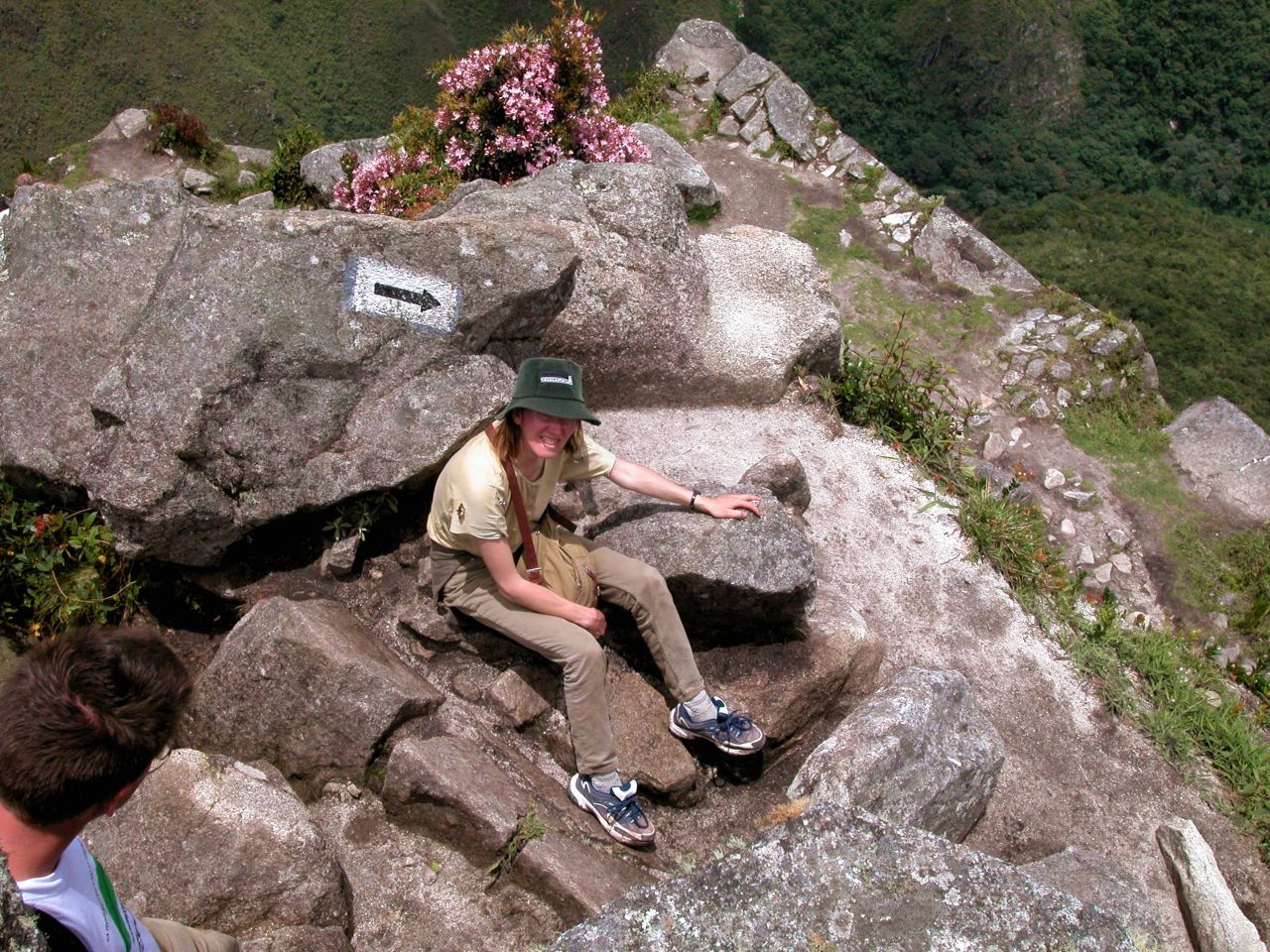
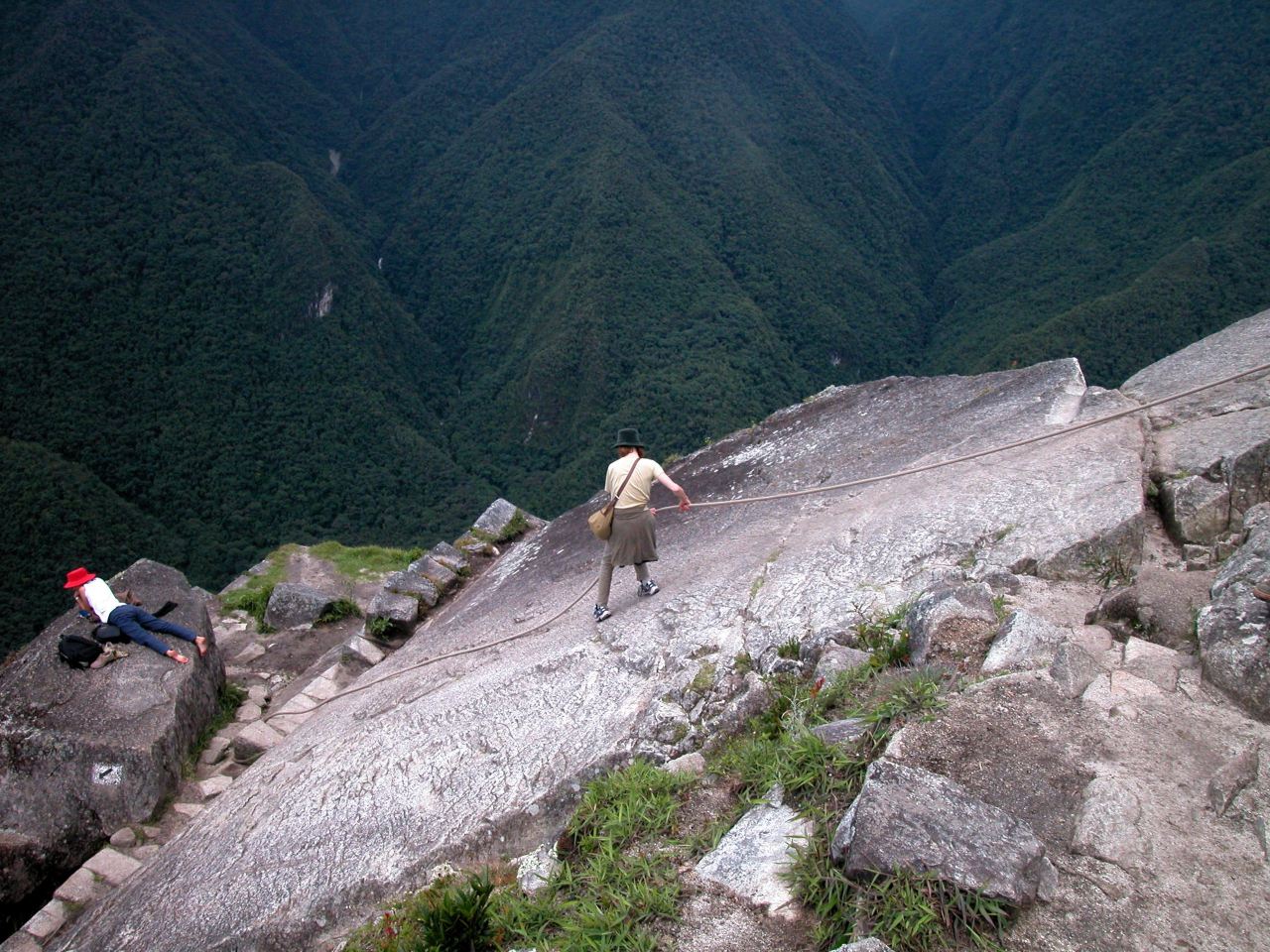


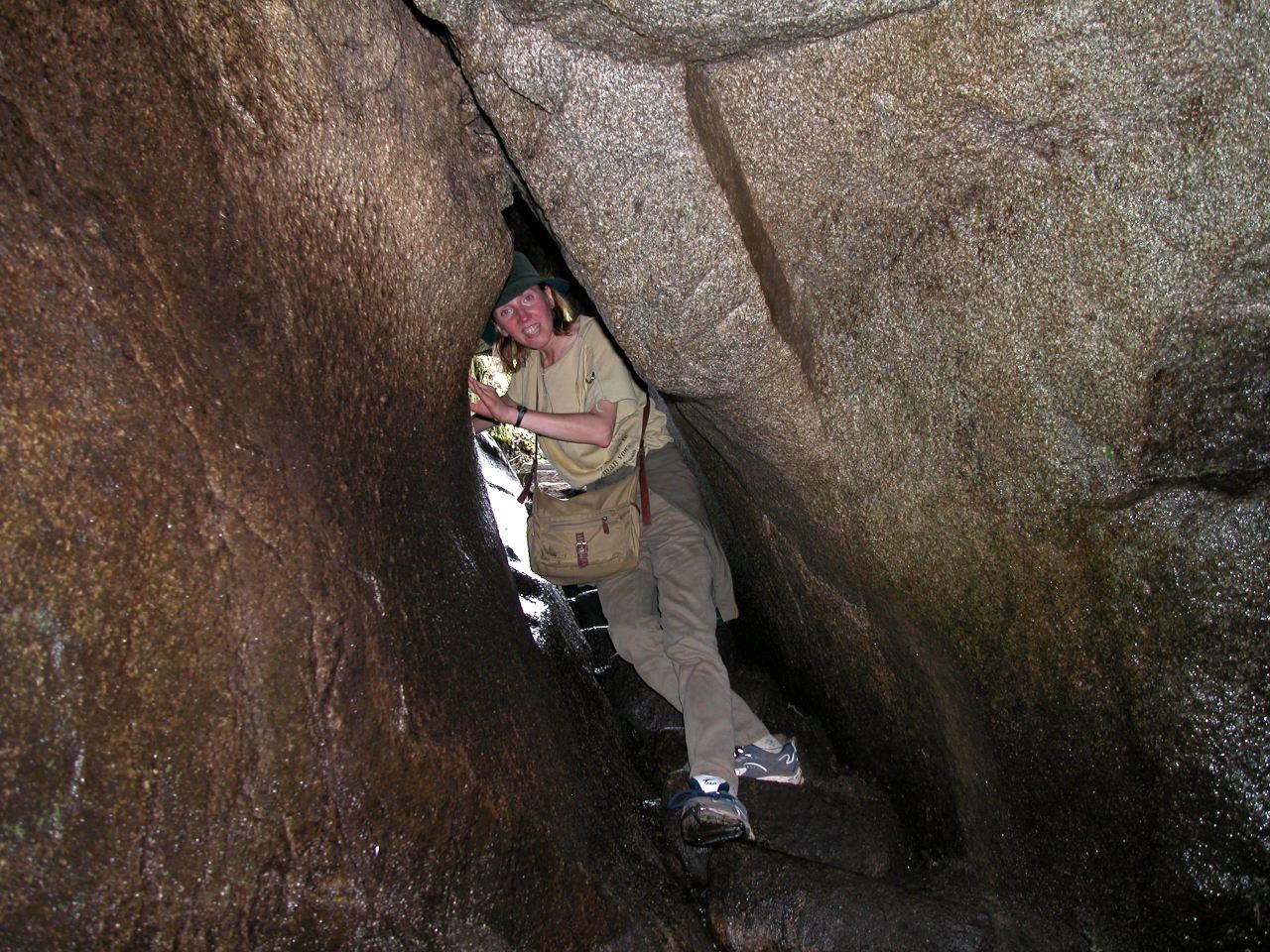
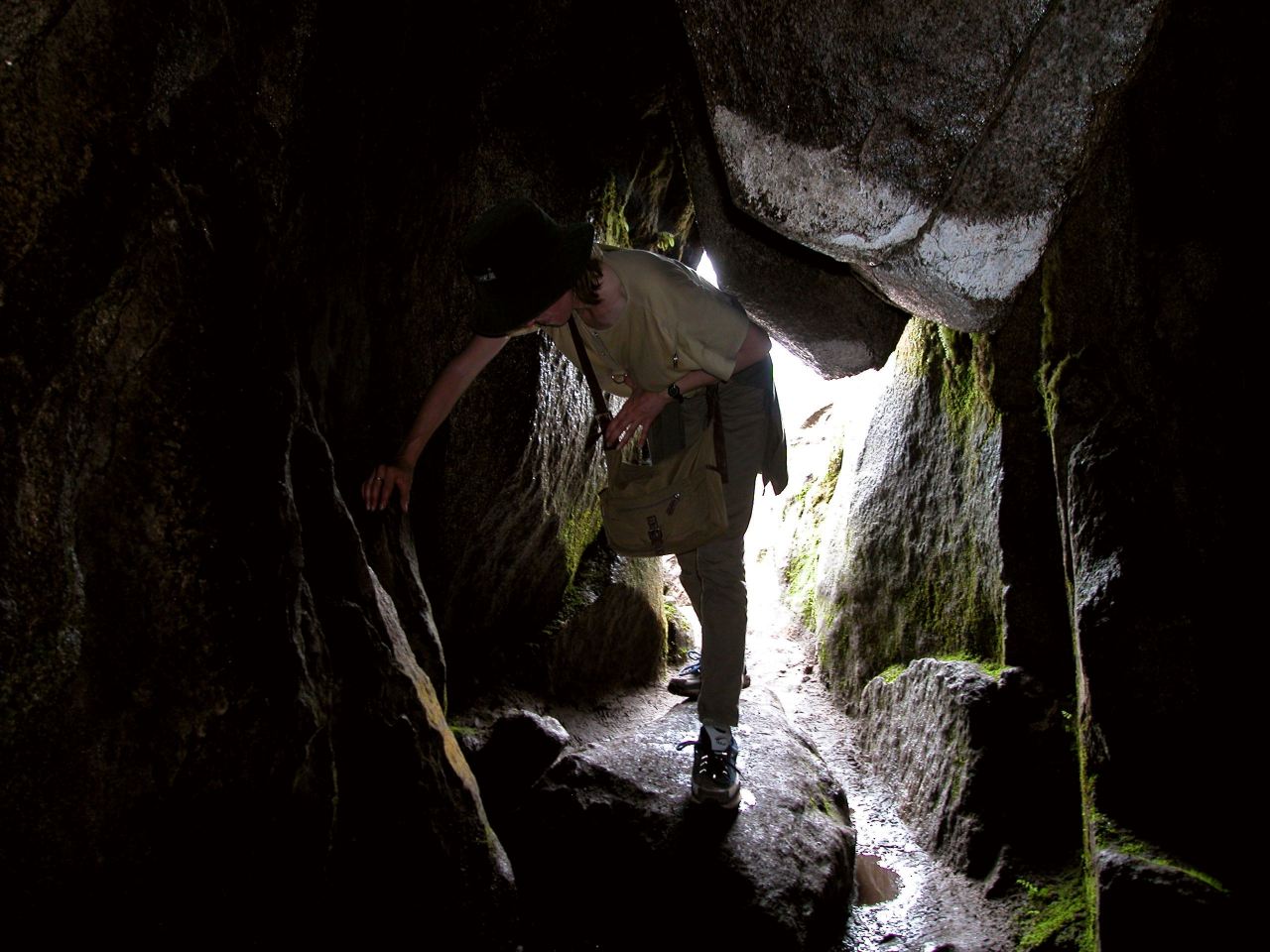
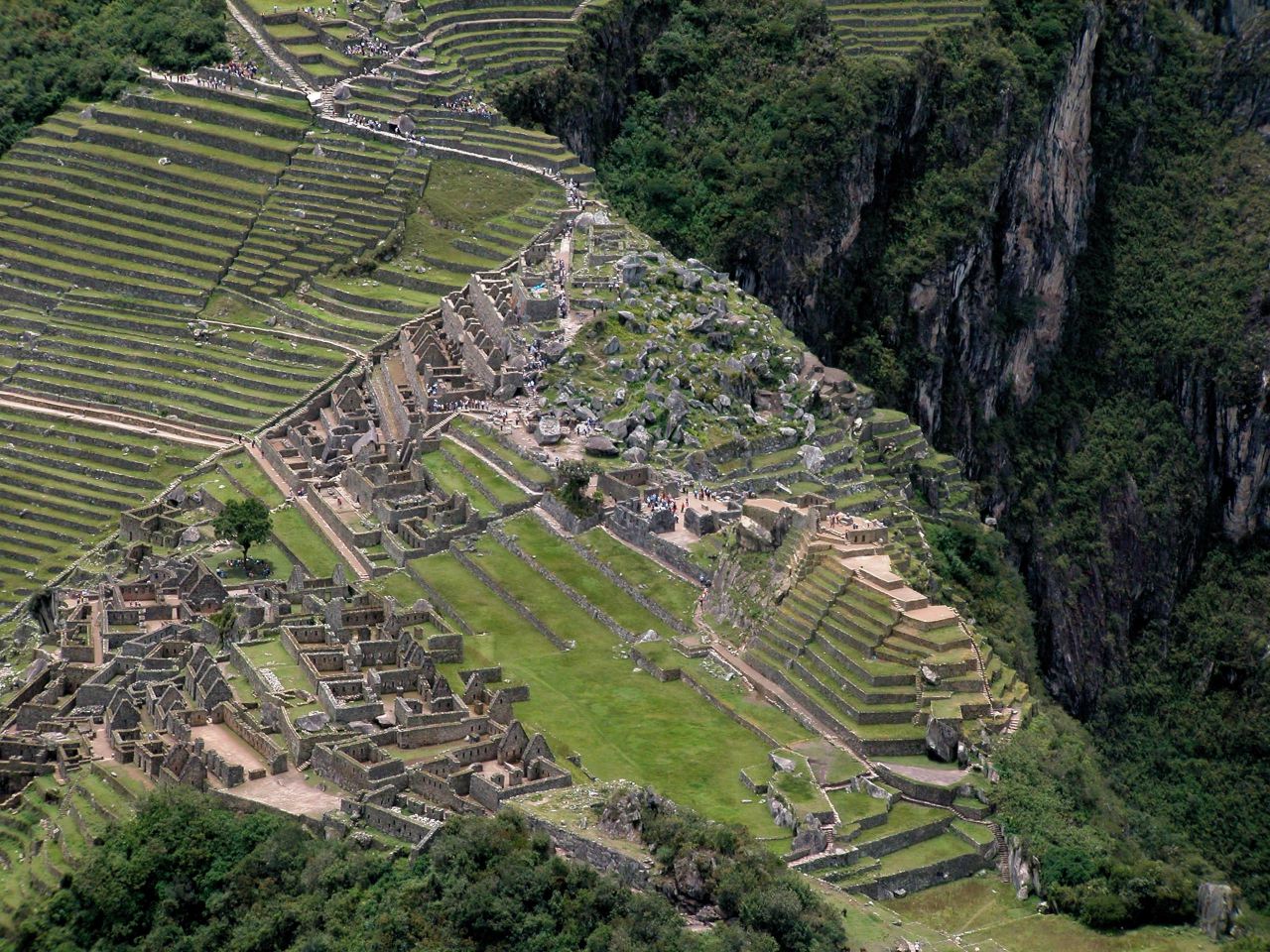


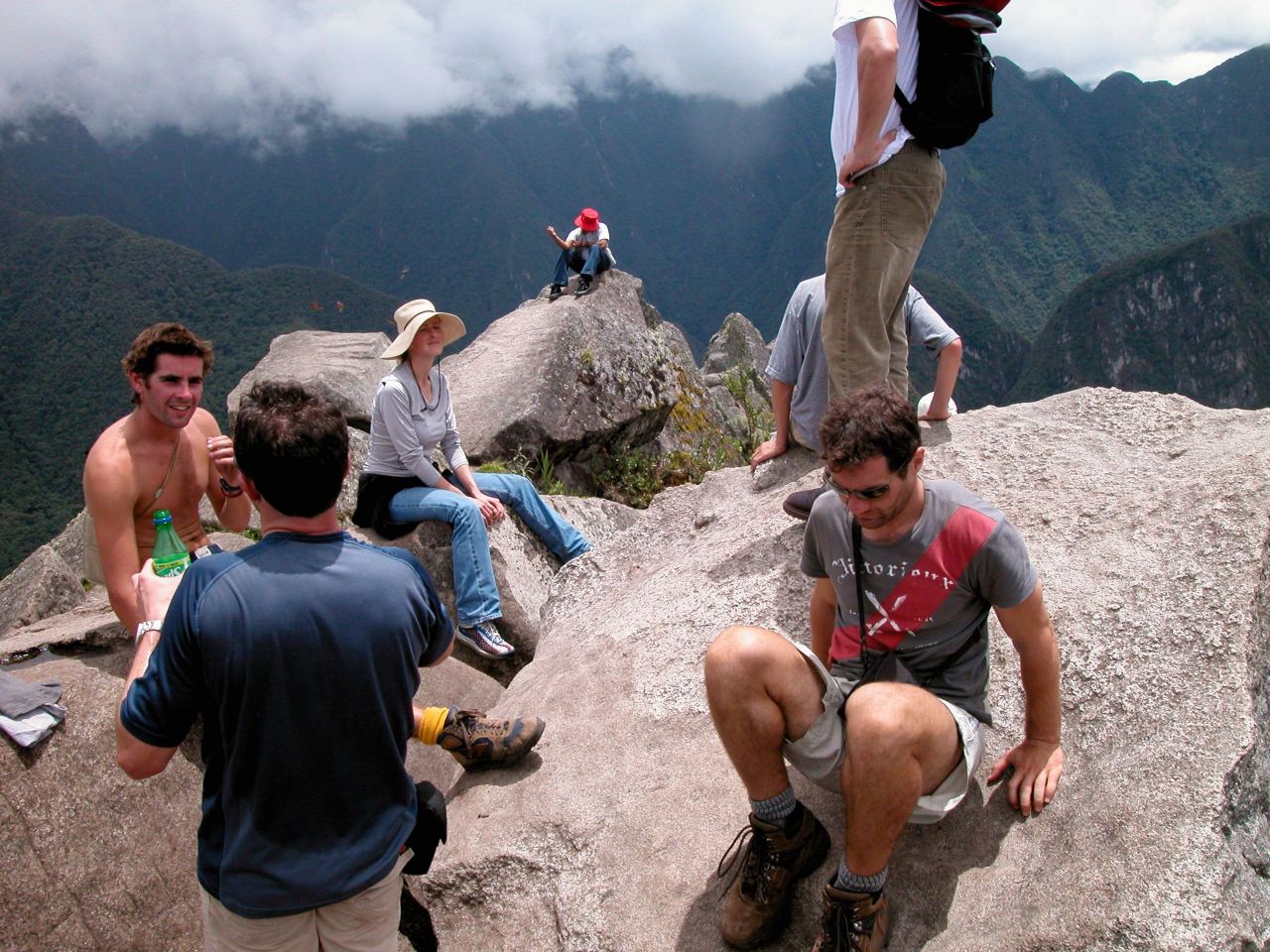
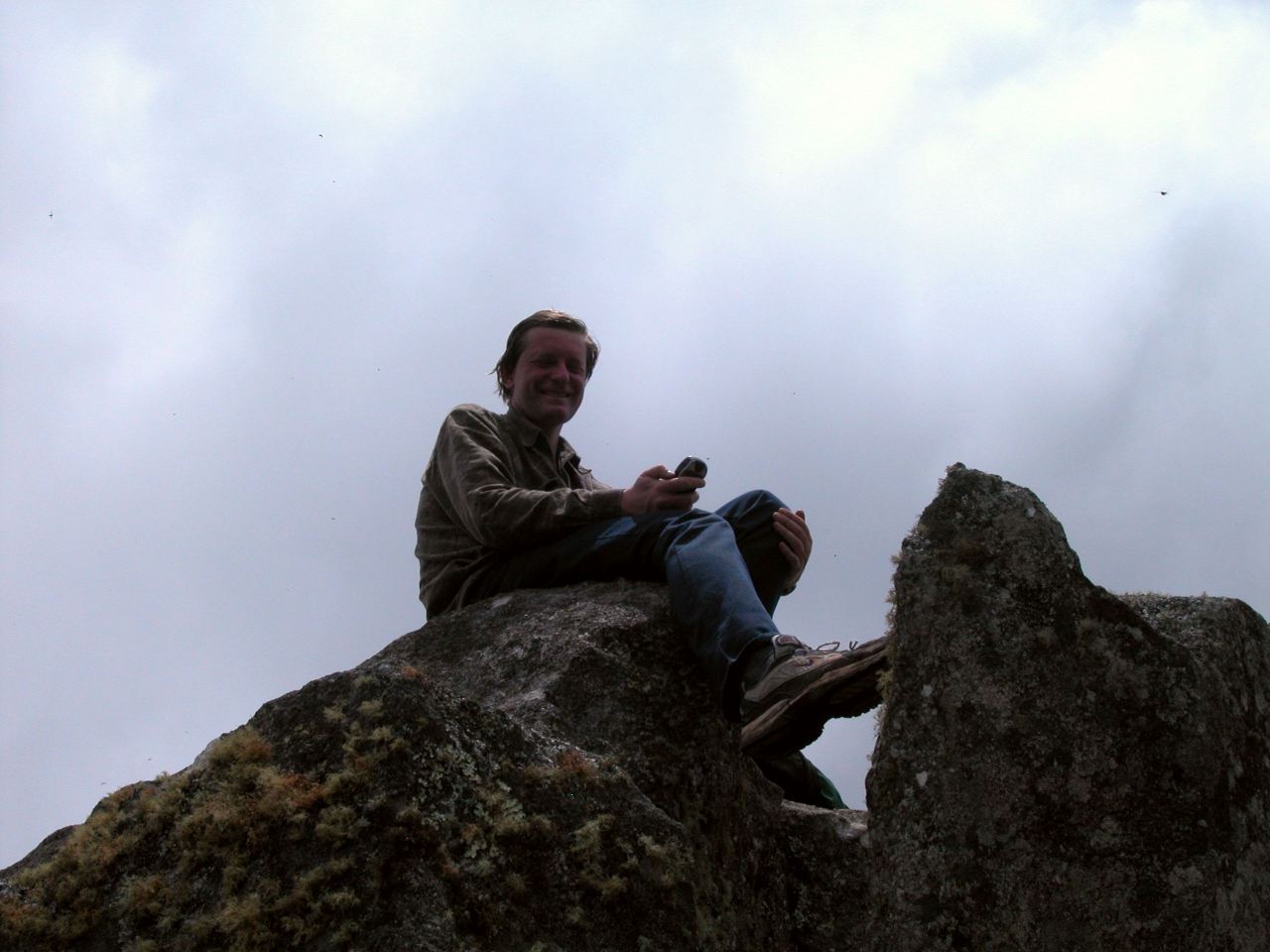
You can see all three main spots in a day, but you need to move quickly. We were quite worn out and gave up on our original plan to walk down to the village, taking the bus back down as well.

We didn't go on the Inca Trail. First, there are far too many people on it. Second, Lena didn't want to walk it and Tanya and I had had our fill of Inca trails in Bolivia for quite some time. Third, we were short of time. Fourth, it was the wet season. I could go on listing reasons, but of course I was sorry not to do it. I'd spent so long planning that route. Yes, there were good reasons, but the disappointment stuck in my mind.
Back down from the mountains in the village, we stood in a huge queue for train tickets. The cheap train next morning had sold out. They wouldn't sell foreigners tickets for the evening local train. A ride costs only four dollars, but it's not for us, even if we offer to pay more. I swore at the system, called them monopolists, wished them ruin once a road was built, and called their policy racial segregation and discrimination by nationality. It made me feel a little better, but not much. We had to buy tickets to Ollantaytambo for US$34.51 each. No change given, dollars only.
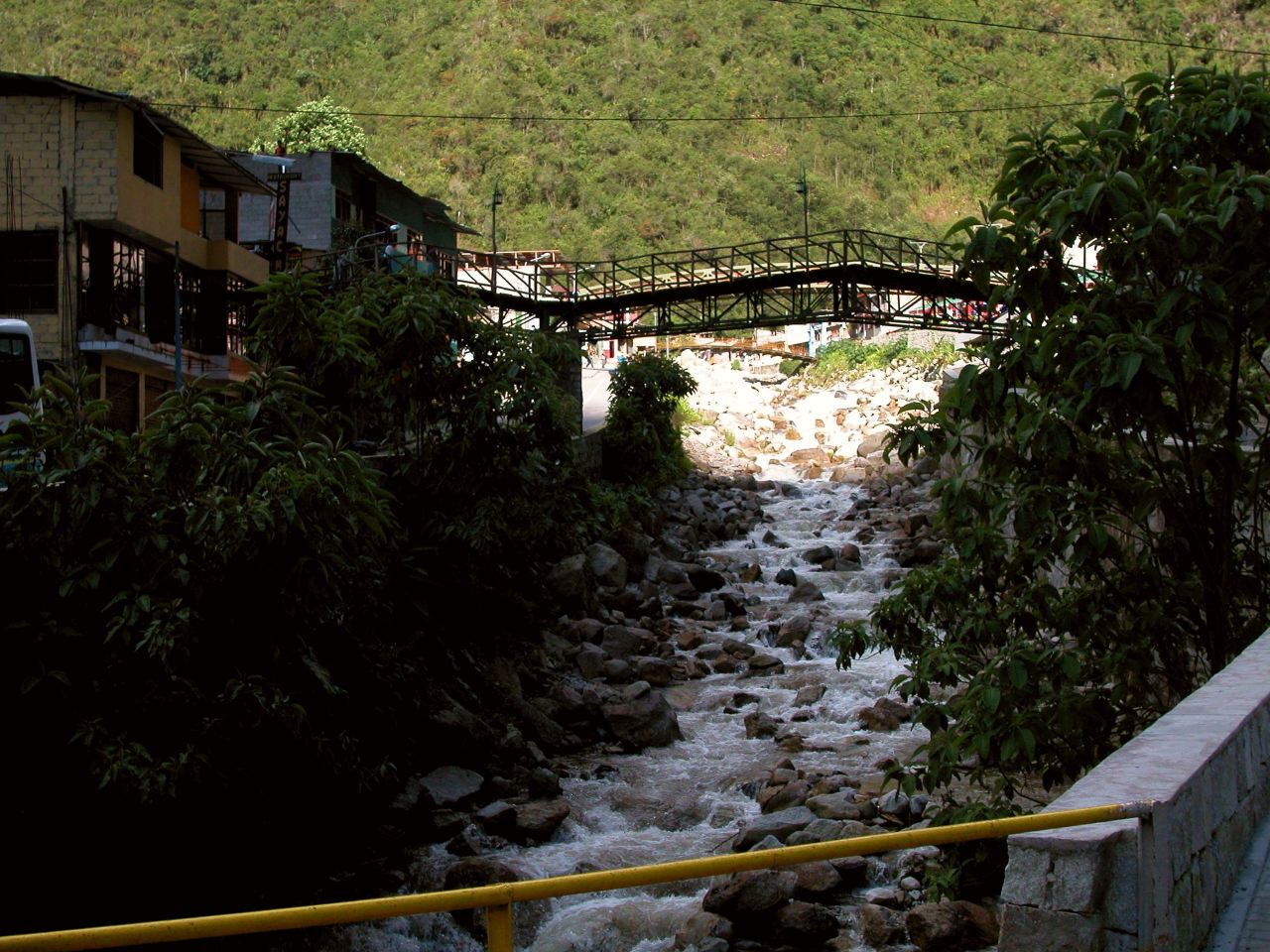
On top of that, they didn't even want to let us into the carriage with a ticket like that. For a long time they tried to work out if they were obliged to stop at Ollantaytambo, or whether this was an express and we'd have to pay more and go all the way to Cusco. In the end they stopped. Scores of taxi drivers threw themselves at our feet, offering to take us to Cusco for fifty soles. We picked a bus for five soles each. Only four people on board, which made it more comfortable than the taxi.
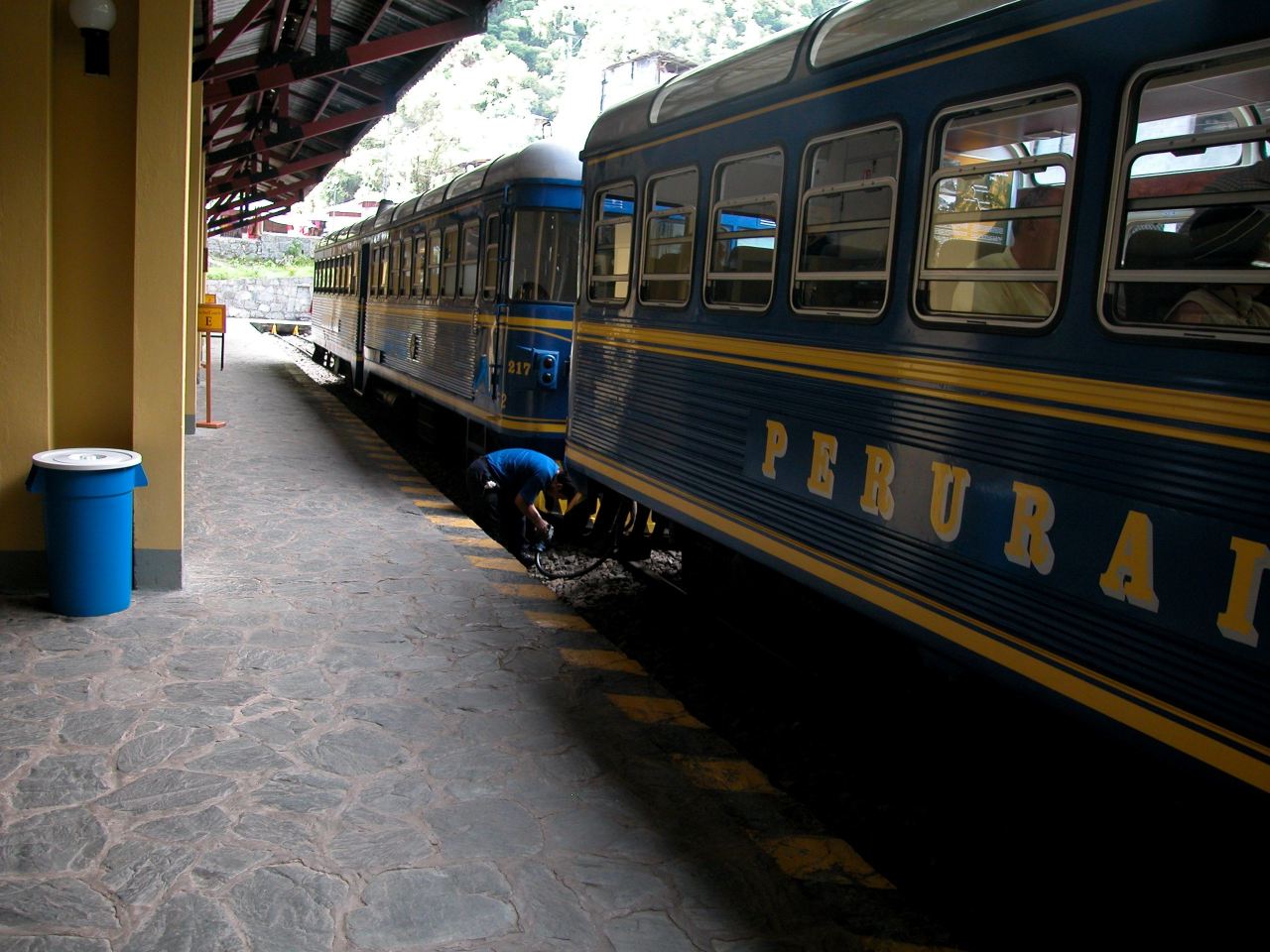
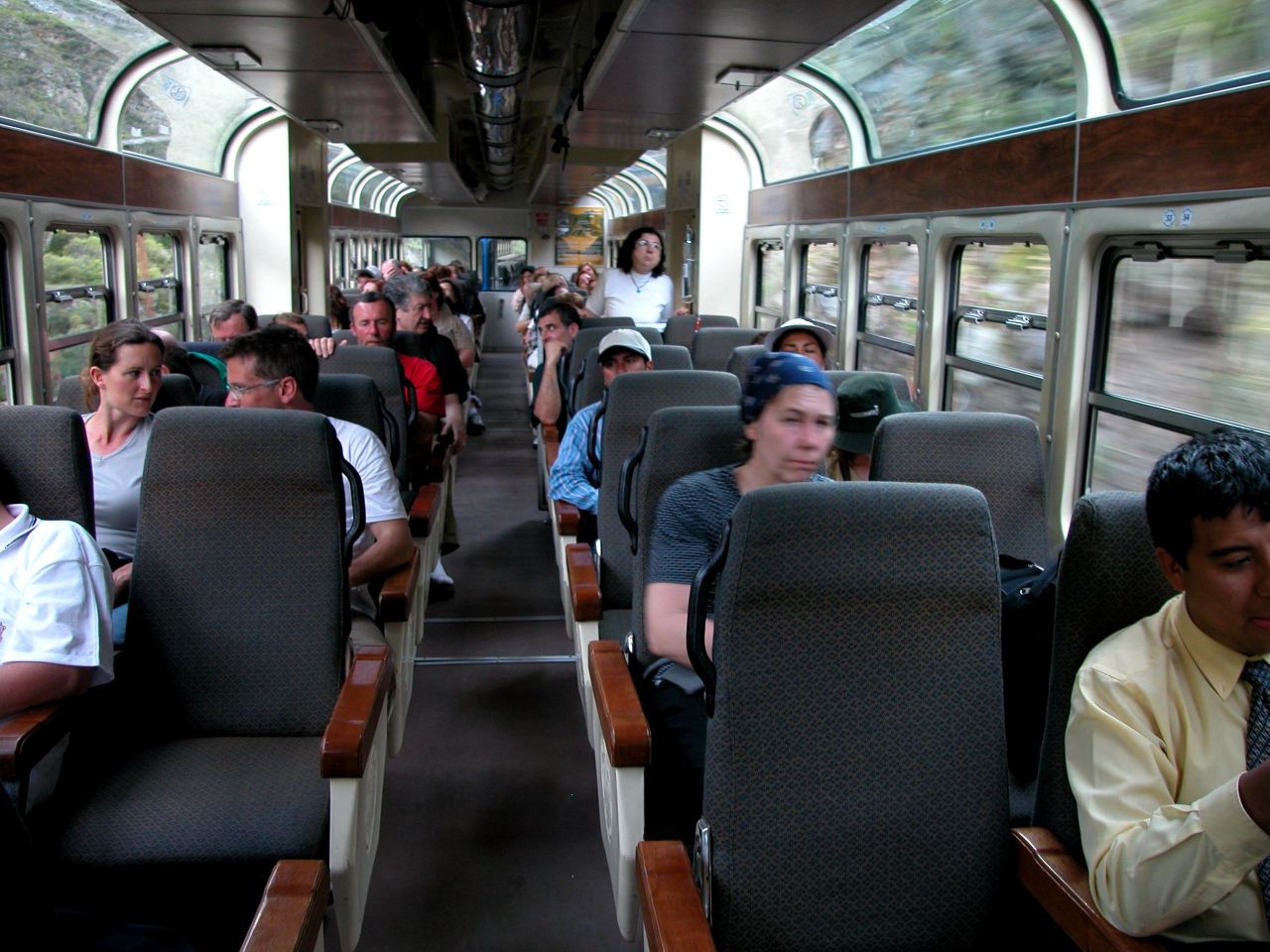
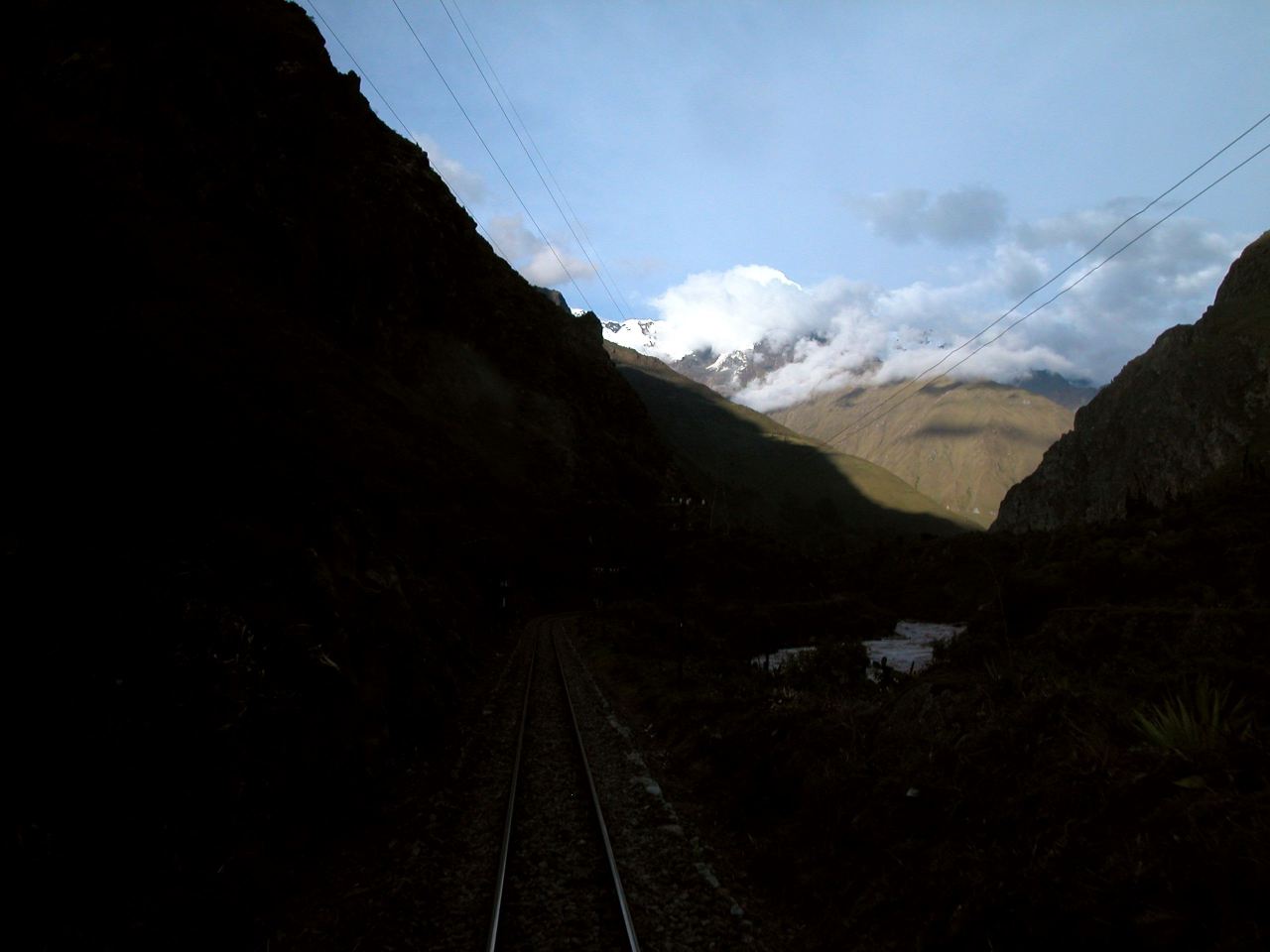
We spent the night in Cusco, and in the morning flew to Lima. The tickets were US$74 each, on Aero Continente. Their poster says you can get tickets at half that price, but not every day, and they're sold out a month in advance.
We had a four-wheel drive booked in Lima. The only people offering them over the Internet had been Avis. The trouble was that all the Peruvian rental companies normally included only about a hundred miles per day in the basic rate. A Toyota Land Cruiser was a mere $75 per day at Avis. We needed one for eleven days and planned to drive five thousand kilometres, making the whole thing $2,400. Much too much. I'd already started imagining jacking up the back wheels overnight and putting the car in reverse, but besides Avis there were Hertz, Budget and National counters at the airport. Competition is a wonderful thing. Everyone except Avis agreed to give us a car with unlimited mileage. National was the only one with a four-wheel drive free, at $115 a day with unlimited mileage. It didn't end there. We waved the piece of paper from Avis and said we'd just check what the competition could do. They dropped the price at once to $90 a day.
All the same, we went to Avis. First, it turned out they weren't expecting us and they looked at our online booking confirmation as though they'd never seen one in their lives. Second, they wouldn't agree to unlimited mileage. Long live the market. Less than an hour later we were out of the airport in a much-travelled Toyota Land Cruiser. The odometer said 90,000, but it had been driven hard and looked to have been in a serious collision. In any case, the body was out of shape and there was something wrong with the suspension. No electronics and a diesel engine. In Peru they call diesel petrolino, as opposed to petrol, gasolino. Prices per US gallon weren't fixed and could vary a great deal. We bought diesel at between 6.95 and 8.60 soles per US gallon, which is 3.78 litres. The highest prices were in remote mountain villages where they poured the fuel by hand from drums, using a five-gallon can and ladles for measuring. In theory there are two grades, D1 and D2. The second is supposed to be cleaner and more expensive. You hardly ever see D1. Petrol comes in every possible grade. Here's the assortment and prices we saw at one filling station as we entered Trujillo, in soles per gallon: 80 at 8.65, 84 at 9.54, 90 at 9.80, 95 at 11.64, 98 at 12.98, D1 at 7.75 and D2 at 7.85. You only find high-octane petrol in the big cities or on the Pan-American Highway.
Cars get stolen in Peru too. Ours came without an alarm. The rental agreement said nothing about where to keep it overnight, but if someone stole it we'd have to pay a third of its price. The local way is to use guarded parking only. They call it cochera or playa. The latter are big underground car parks in cities. You have to do it because parking in city centres isn't allowed. There are no signs, but the police may give you trouble.
The first few kilometres in a new country and a new car are always a little tense. So we didn't quite work out which way to go and headed into the middle of Lima. It's a huge city of ten million people. The roads are broad, but even they aren't enough for the rapidly growing traffic. The city seems endless. Jams everywhere. Most of the drivers are taxi drivers in little yellow Matizes and Ticos and the like. I wouldn't say people drive badly or especially aggressively. It's about the same as in Moscow. Perhaps there's more cheek on average, but they're all professionals. There are no VIPs with fancy number plates you have to yield to just because they've appeared on the horizon. Driving a four-wheel drive in all that confusion of little bugs, of course, isn't easy. I can't fit into the gaps they squeeze through, and our acceleration isn't great. Something wasn't quite right with the engine either. At intersections, those little things pulled away faster than we did.
Almost every guidebook says Lima is a city it's best not to stop in, and we decided to go south.
It took about three hours to get onto the Pan-American Highway and leave town at last. Mostly thanks to some very good signs in the city. Once we'd seen the coveted ‘Panamericana Sur’ and queued our way to it, we were on a fine four-lane motorway with cleverly laid-out interchanges.
We stopped for lunch in the little resort of Pucusana, sixty kilometres south of the capital. The beaches in the capital are dirty and anyone who respects themselves comes down here to swim. Prices are very high. They first took ten soles from us for driving in. Then on the second floor of a waterfront restaurant a sumptuous lunch of various creatures from the sea came to seventy-seven soles for three of us.

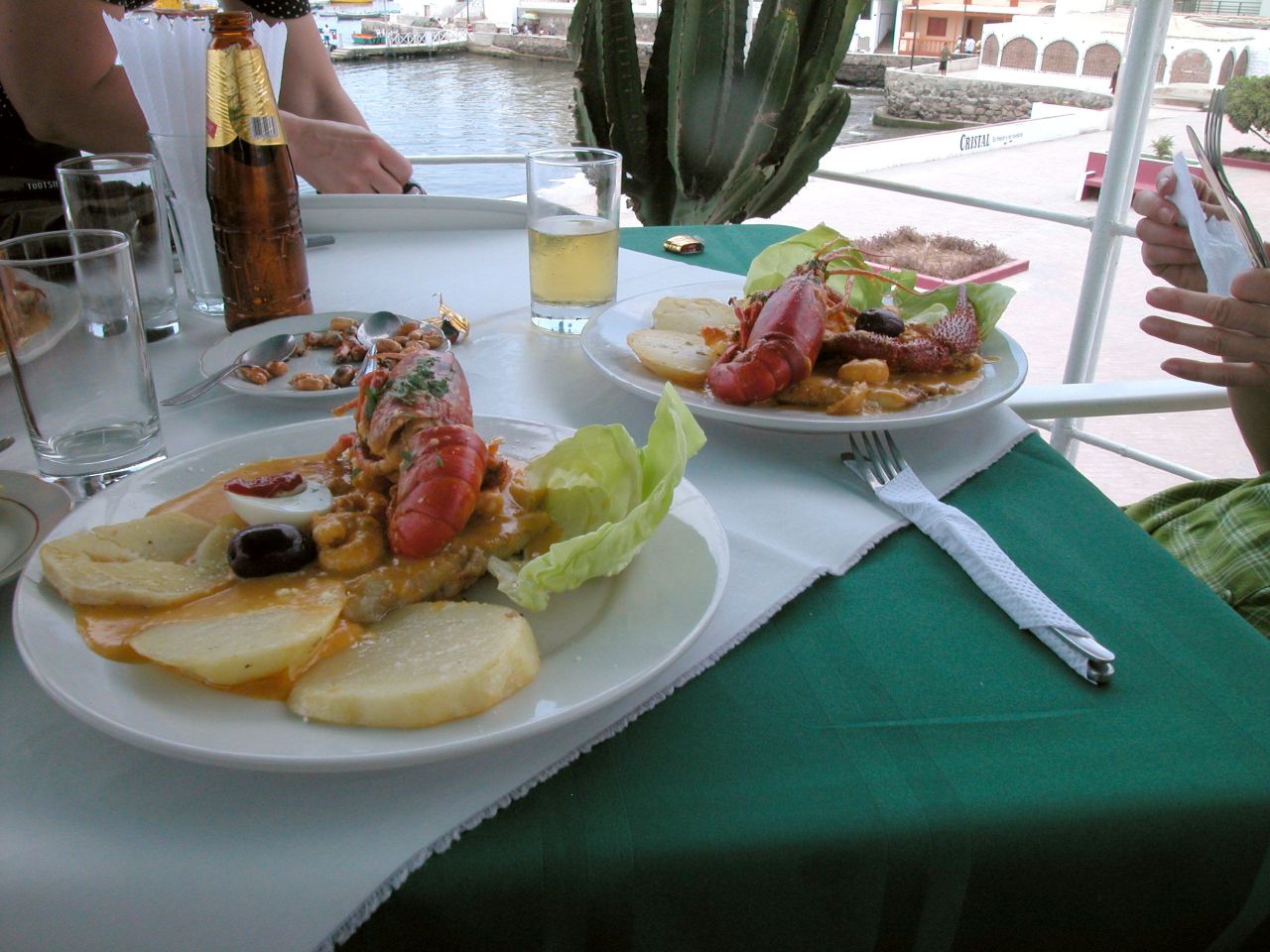
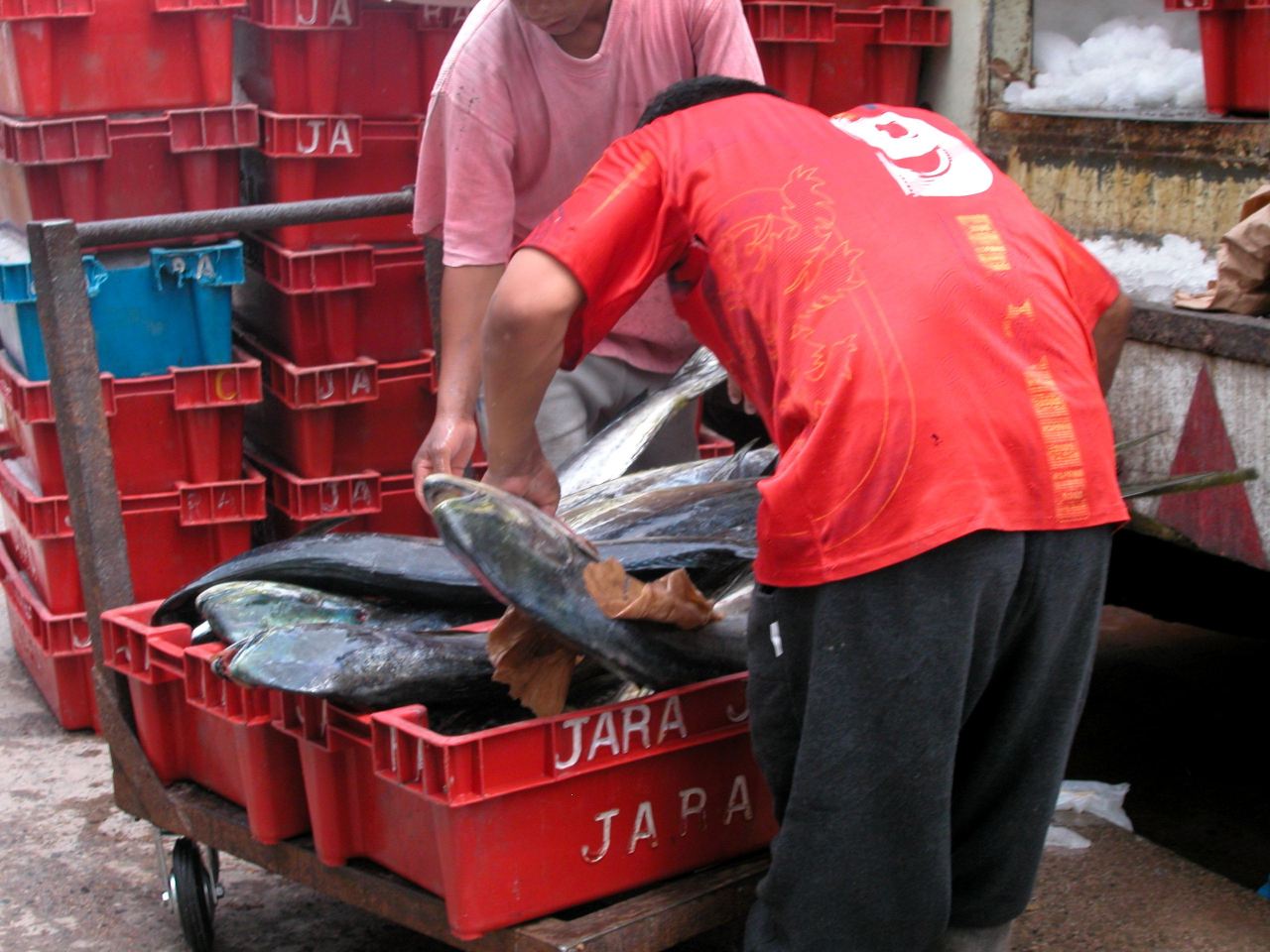
The coastal restaurants are very different from those in the highlands. You won't even hear of llama or alpaca here. In their place there are all sorts of crabs, lobsters, shellfish and other spineless monsters. The collective name is mariscos. Some of the shellfish are served in the shell. Portions are enormous. Sometimes you could feed all of us on one.
Pelicans sit on the roofs and fences in place of our crows. A proud bird, soaring with the bearing of a pterodactyl, looking for something to pinch. They're especially funny when they fly circles around you while you eat a fish at a table outside a restaurant.
Pucusana is ideal for swimming. The rocks make a sheltered harbour. There are plenty of fine beaches elsewhere, but the enormous surf is better suited to surfers than simple swimming. It's no easy thing to get past the breakers and out into the open ocean for a swim.
The cold Humboldt Current runs along the west coast of Latin America from southern Chile to Ecuador and has a huge influence on the coastal climate. It's the reason the shores are desert even in the tropics and why it's cool even in summer. On the other hand, there aren't many sharks and the inshore waters teem with other life.
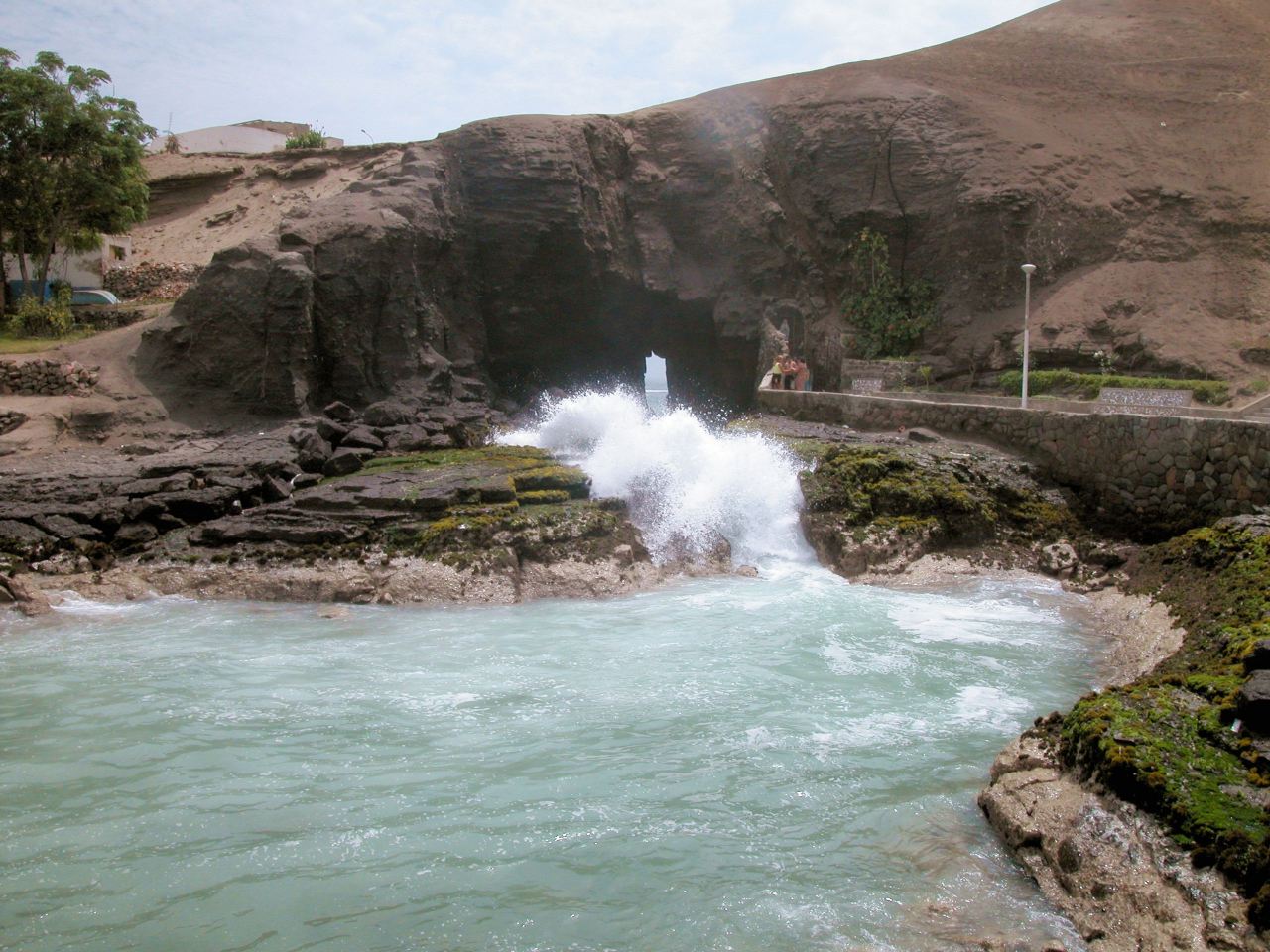
Apart from the beach, Pucusana has a little inlet connected to the ocean by a tunnel. What's left of the waves that force their way through the rocks splashes about in it.
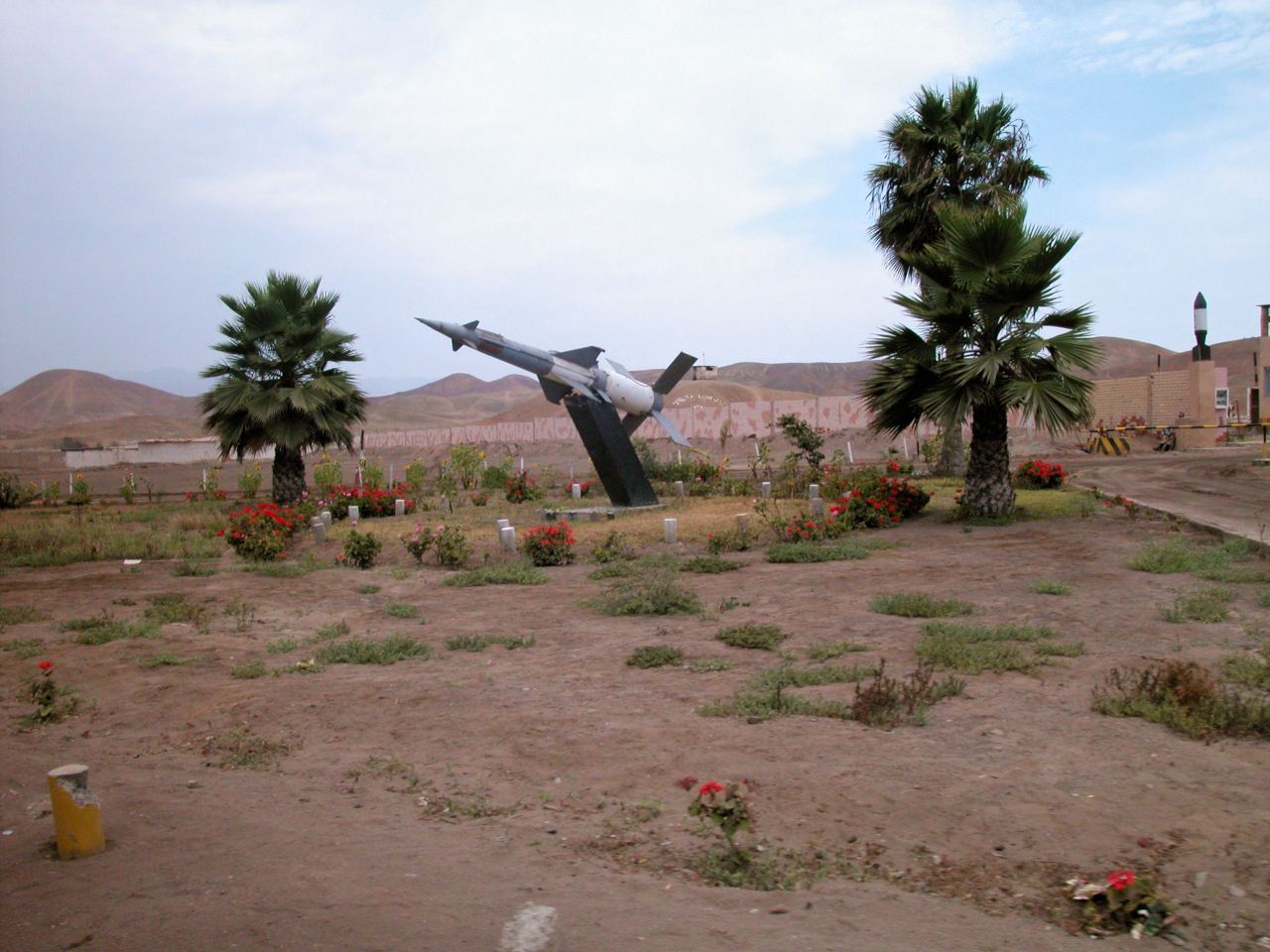
There are soldiers by the gate into town. The gateposts are enormous air-dropped bombs. At the main gate, on a plinth, stands a Soviet anti-aircraft missile from an S-125 system. As a student I studied this marvel, with all its electronics built on vacuum tubes, in the university's military department.
Shortly beyond Pucusana the desert mountains reach the coast and the country becomes lifeless. The motorway turns back into an ordinary two-lane road. The plans for a bright future include upgrading the Pan-American farther south, with numerous interchanges and other infrastructure, as well as a new direct road to Cusco. At present the only decent road to Cusco goes via Arequipa and Puno, nearly two thousand kilometres all told. The locals don't waste time and follow the government's plans with enthusiasm, finding out about them before the government does. Much of the land in the path of the future motorways has been bought up and covered in something that passes for houses. Five rush mats tied together, a Peruvian flag over it, a symbolic fence around the patch. All of this in an utterly waterless, lifeless desert, over tens of square kilometres.
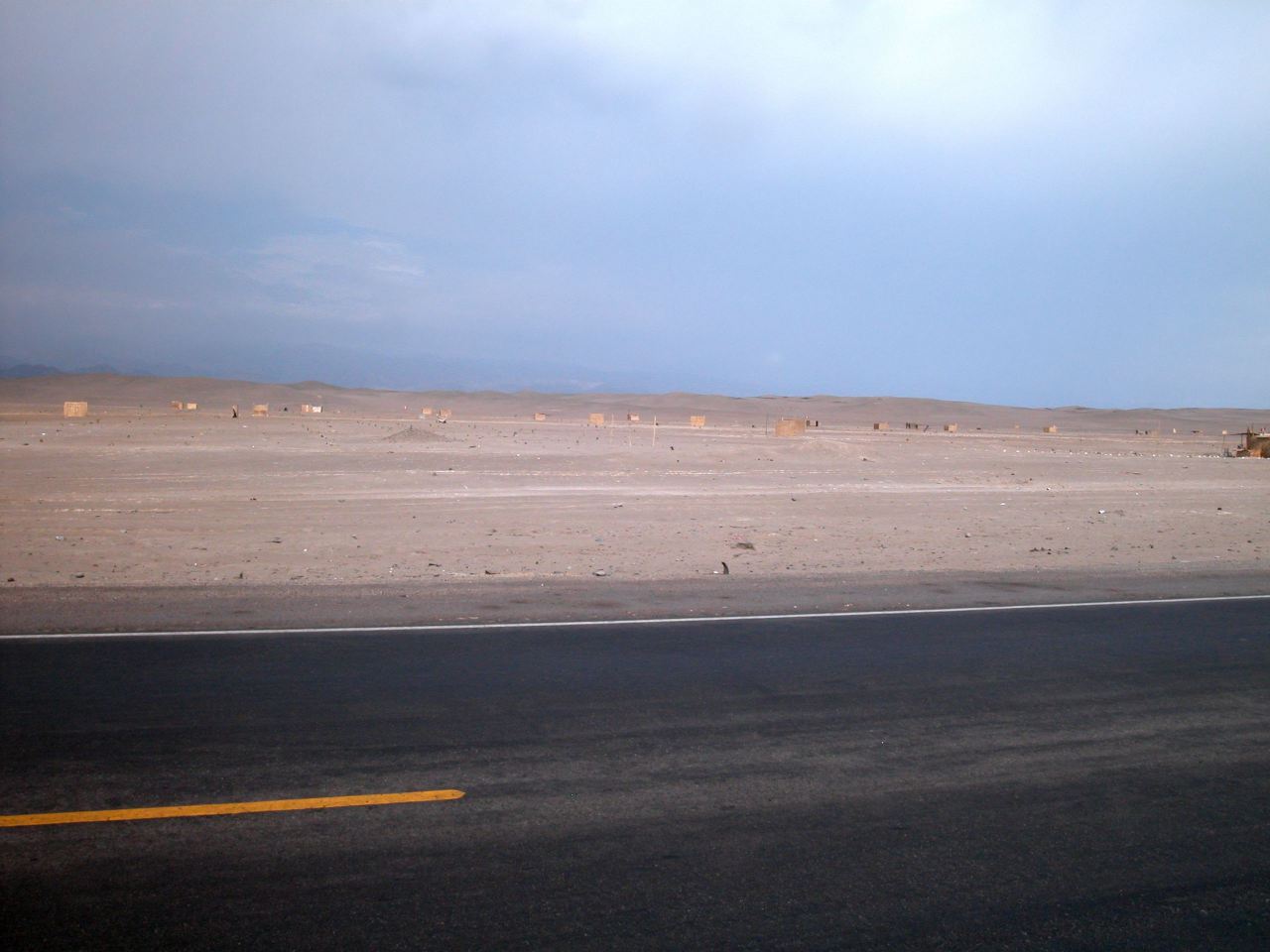
Peru respects private property, and the government will have to part with a fair bit of money if it wants to get a road through those parasites' shacks.
The day was already coming to an end when we came to the gate of the Paracas National Reserve. A day ticket costs seven soles. You can pay up front for a visit with a night in the park. There were only three hours of daylight left, but we decided to go in that day anyway. The reserve is enormous and consists largely of uninhabited desert. It protects the birds nesting along the ocean shore and the sea lions.
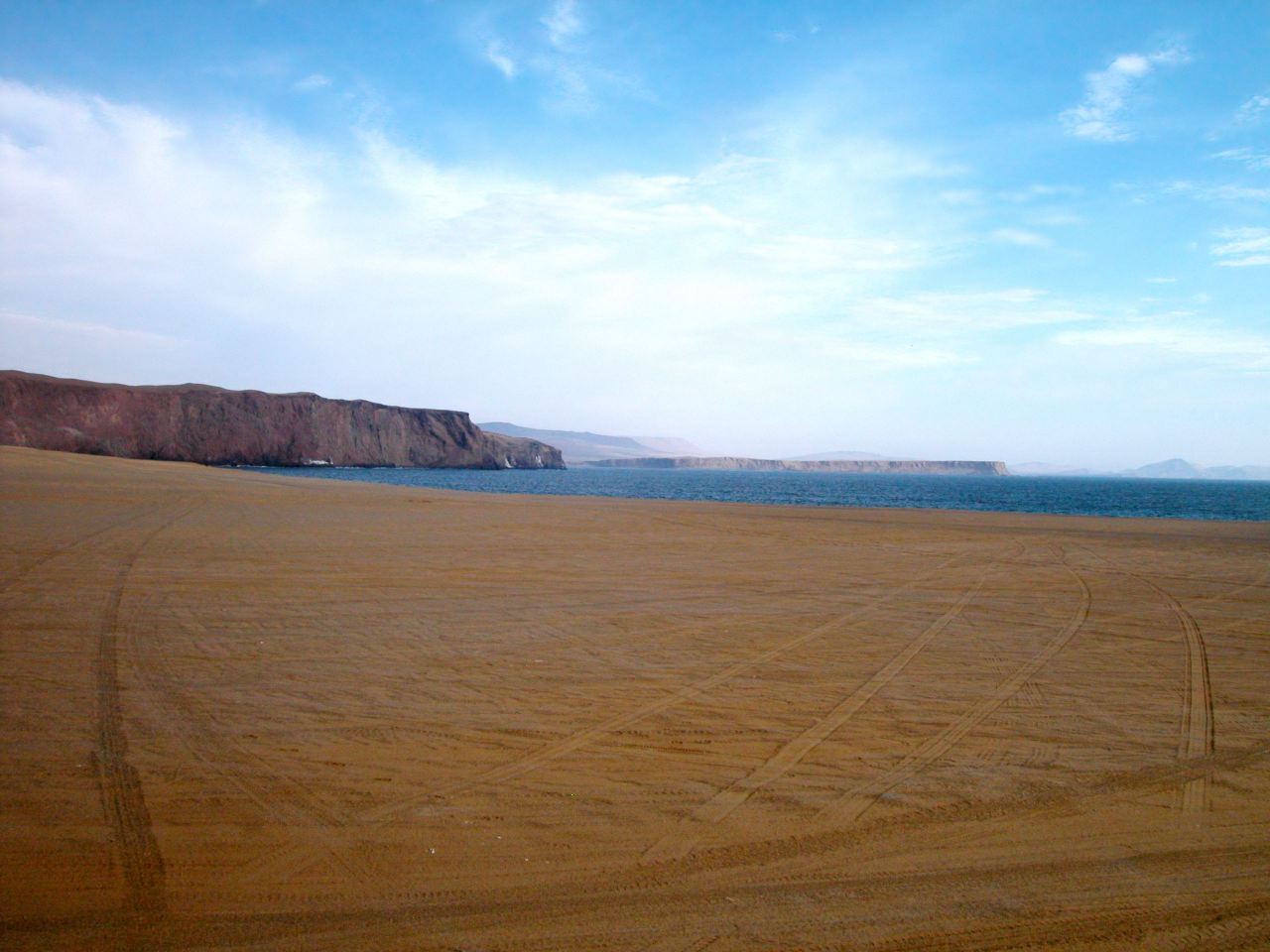

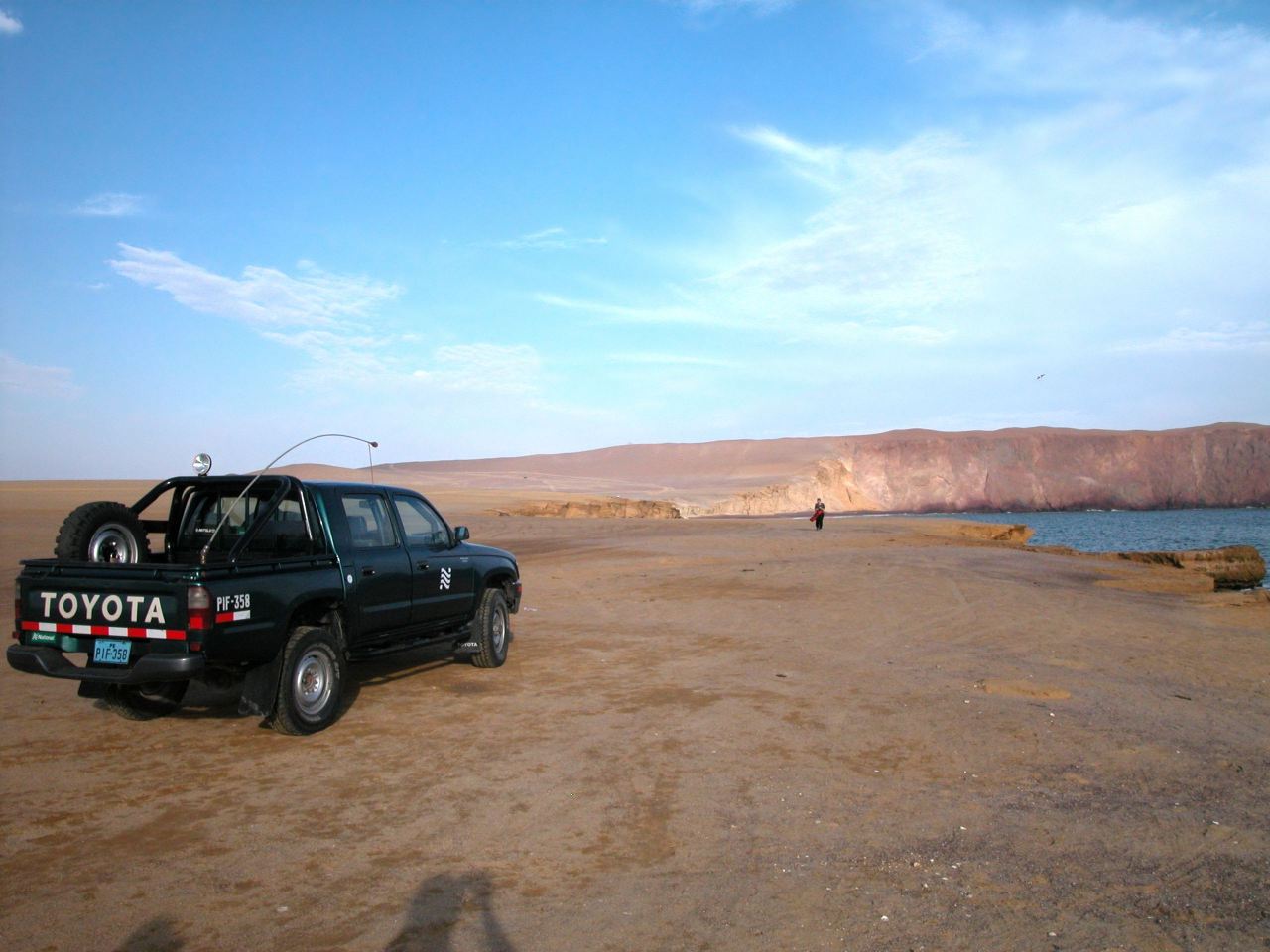

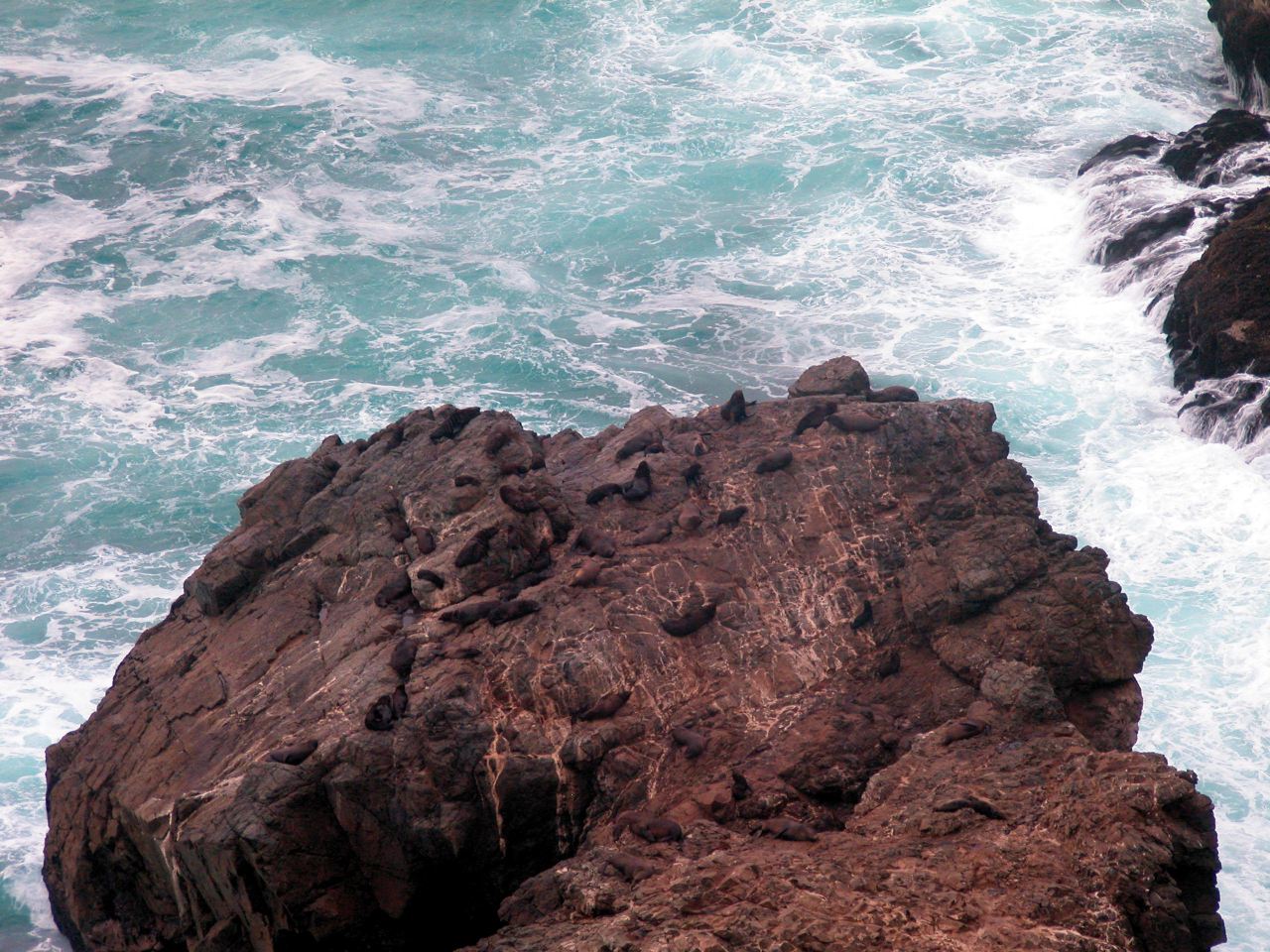
The recommended visitor route only covers a small part of the Paracas peninsula. You can walk it, of course, but it's better to drive it in a four-wheel drive. There are organised tours, but they'd finished for the day and we were lucky enough to have it to ourselves. The coast is deserted. It hardly ever rains here, around once a century. There is no vegetation and you can drive wherever you want. The gentle hills break off into steep coastal cliffs. In the light of the setting sun and with banks of sea fog, the rocks and sea looked very strange.
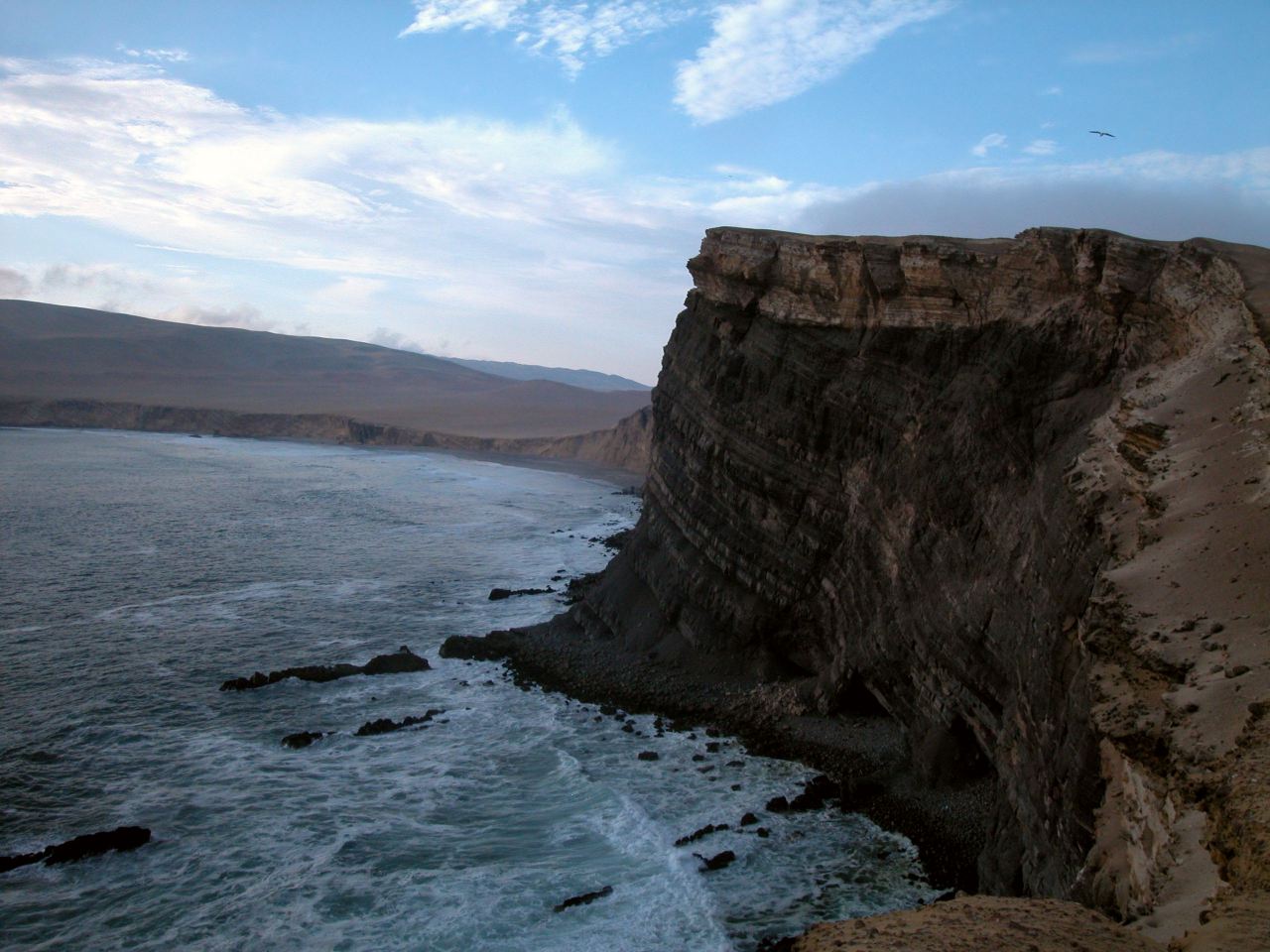


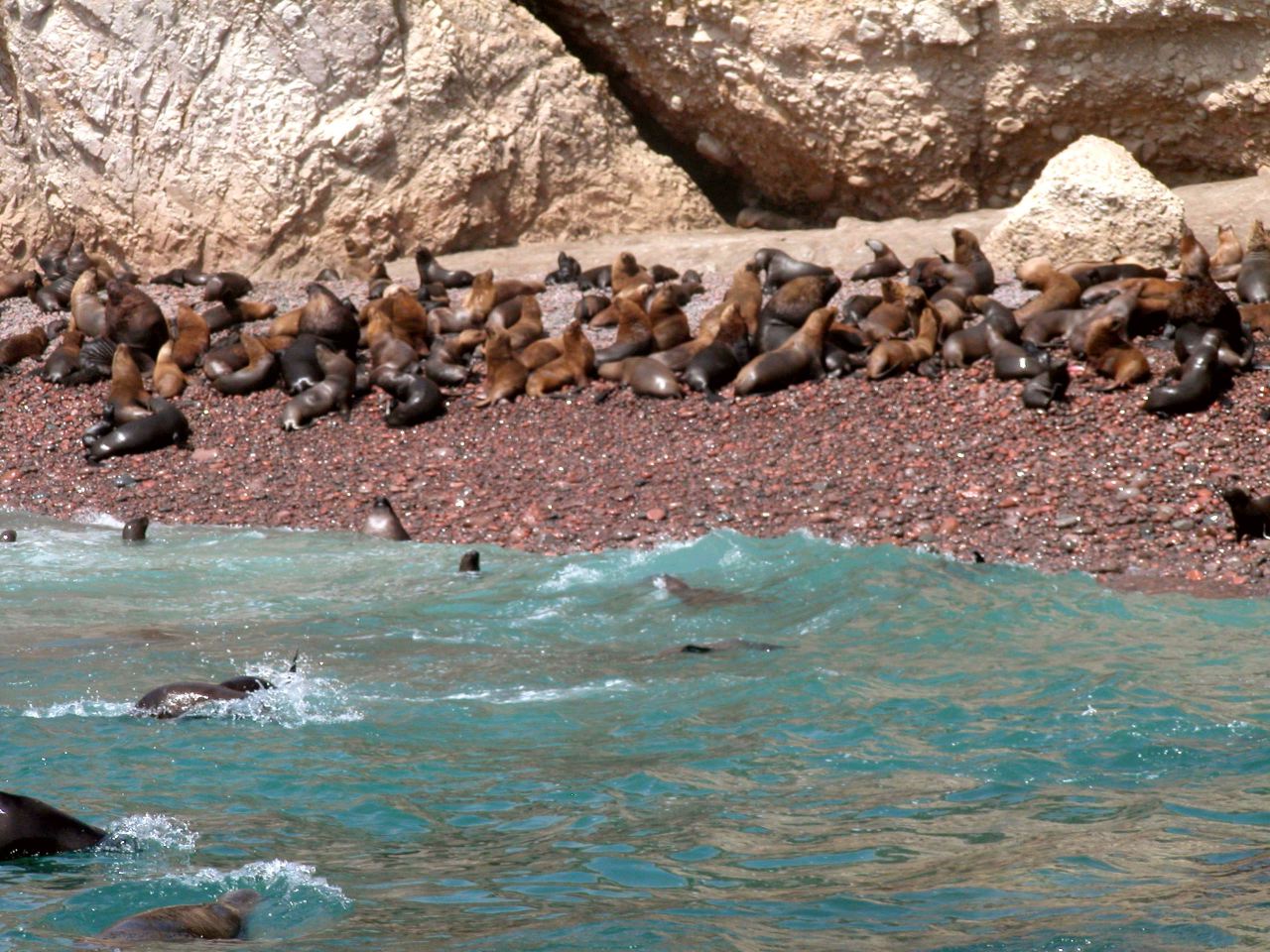
They give you a leaflet listing sights when you enter the park. First, the road reaches the little fishing village of Lagunillas. There's a beach by the village where you can stop for the night. Unfortunately, it's small and there was already a tent on it. We fancied a little space, so we didn't swim there. It may be the only spot where you can get down to the sea. The rest of the coast is all cliffs, facing the open ocean. Huge waves break on the rocks and it's a difficult place to swim, if you're human. There are sea lions everywhere lying on the rocks without any difficulty. They've made viewpoints at the clifftops where you can watch them. You might even see a Humboldt penguin on those rocks, though it happens very rarely. The colony is farther offshore, on the uninhabited Ballestas Islands. You can get there on a tour for thirty-five soles. You could probably find a private boat, but we didn't try and took a tour. It was organised by Zarcillo Connections, whose office is on the Plaza de Armas in Pisco. That's where we went to spend the night. We paid forty soles at the Posada Hispana hostel.
In the morning a bus collected everybody from their hotels and drove us to the pier in Paracas. From there it's about an hour in a fast boat to the islands. The tour begins with a look at the Candelabra, a thing several dozen metres across dug into the hillside. Nobody knows who made it or what it's meant to show. It might be a candelabrum, a cactus or something else. I'd say it was almost certainly the work of the Spanish. Originally the drawing was dug two metres into the coastal hill. Over time the wind filled the trenches with dust. They were only sixty centimetres deep by then, but the design was still quite clear. You can reach it along the shore from Puerto San Martín. Unlike the Nazca Lines, nobody guards it and you can clamber all over it.

After the Candelabra they take the tourists to the islands. There used to be an enormous layer of the famous saltpetre here, formed from bird droppings. Everywhere else the rain washes the droppings off, as the salts dissolve very readily in water. The rocky islands off the west coast of Latin America, however, never get rain. The result was enormous deposits. It was a gift to Peru's economy. In the previous century, saltpetre once accounted for more than half the country's exports. They even shipped it to Europe. All well and good, but in a few decades the supply was exhausted.

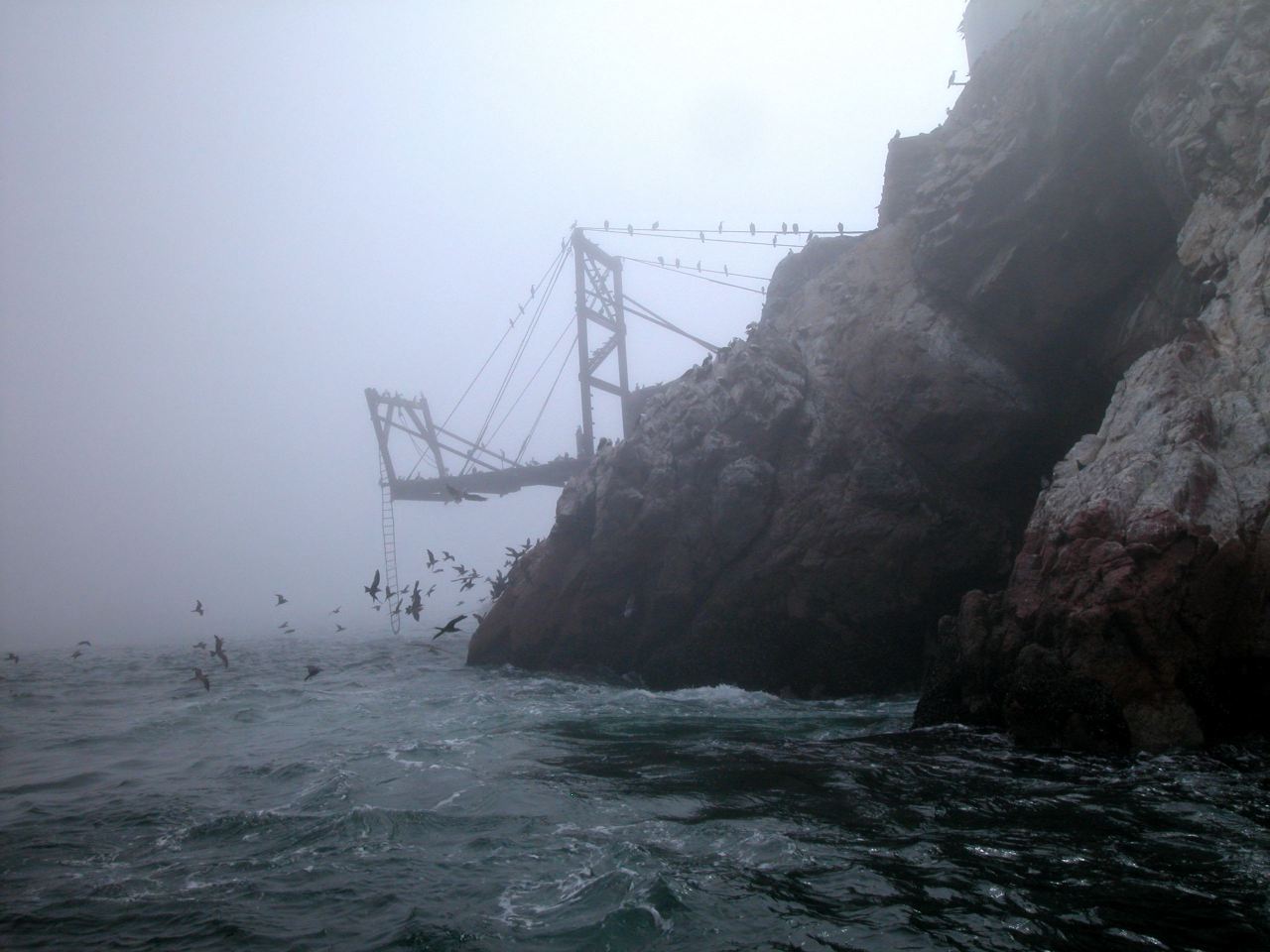
Now all of these islands have been declared national parks and reserves of various kinds. The birds are protected and what they manage to leave behind is collected carefully, though it comes to very little. Some species used to nest in burrows they dug in the deep guano. Once the guano went, they died out.


The islands are officially off-limits to landings, but the guano collectors are exempt.
There are indeed lots of birds on the islands. Mostly pelicans, though they don't produce much. It's a small kind of gull that turns out the most product.
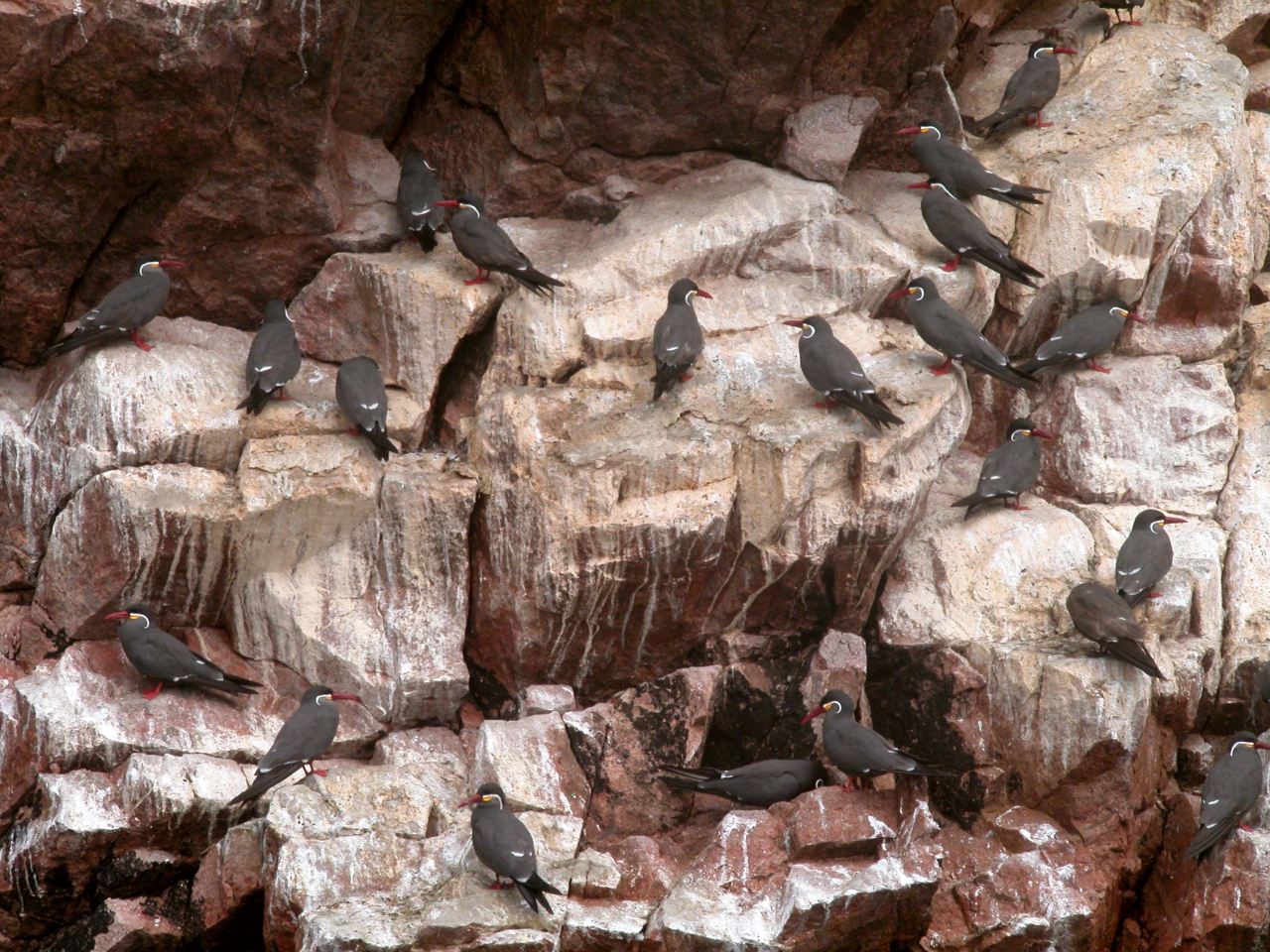
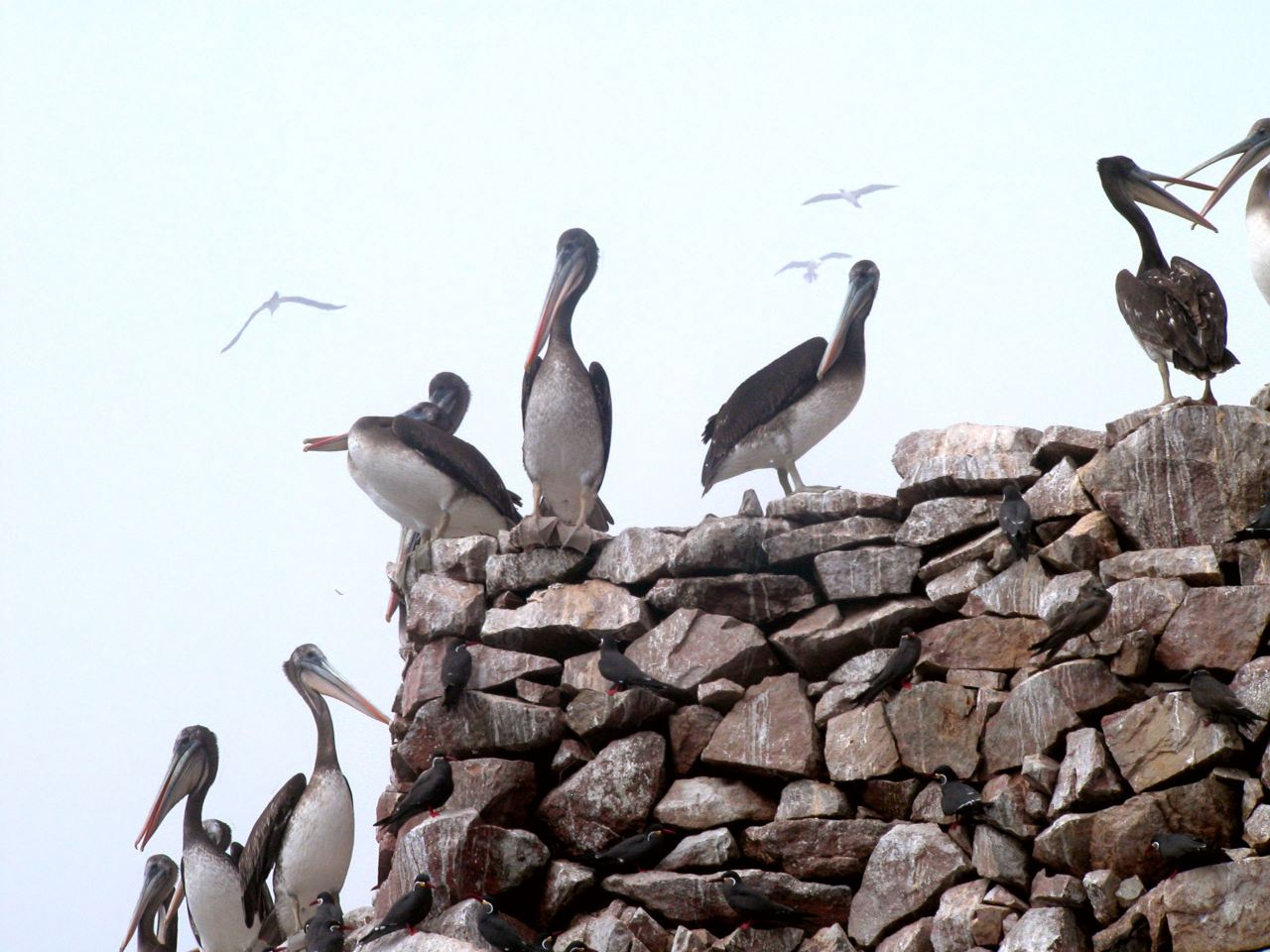

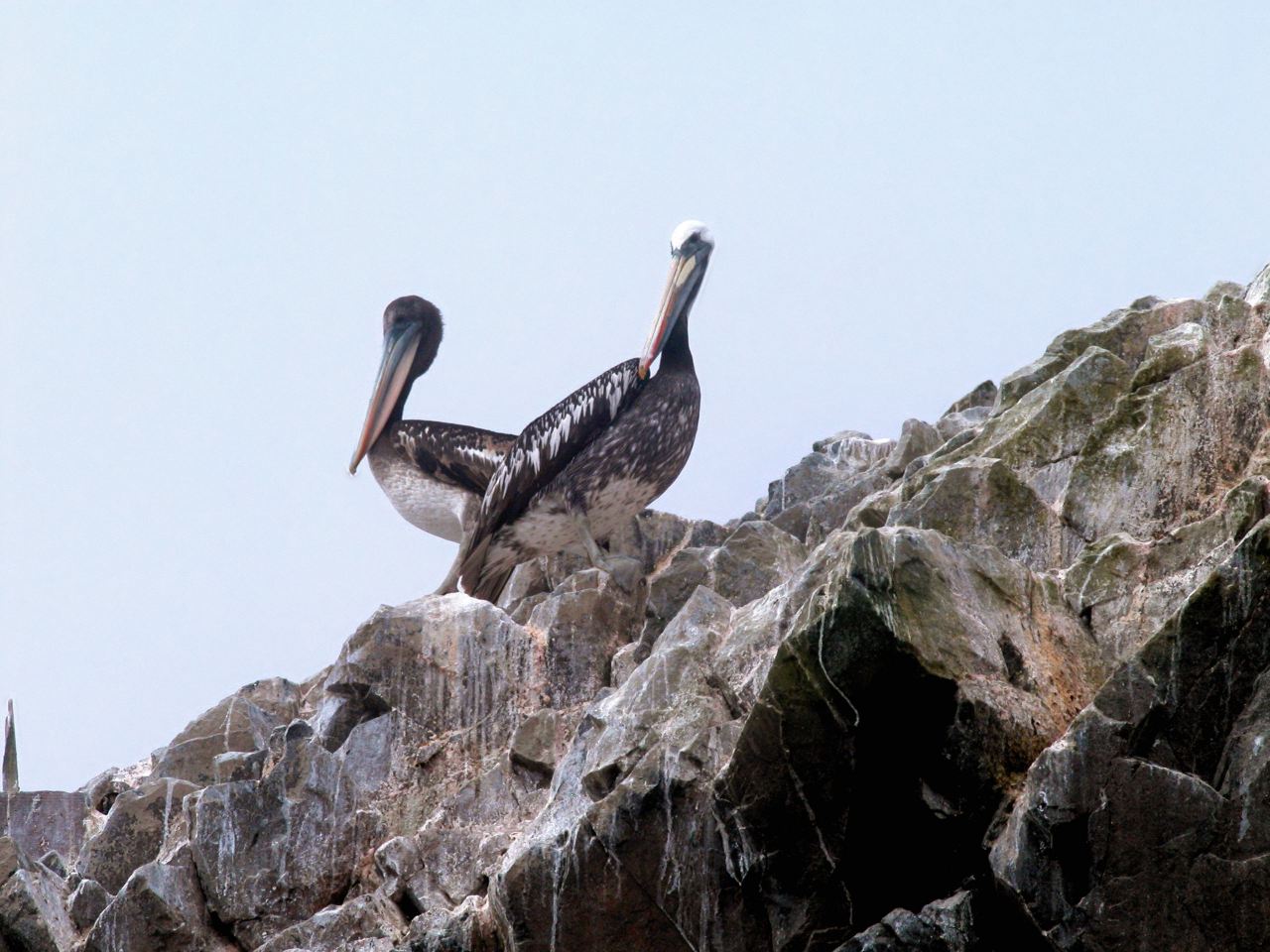

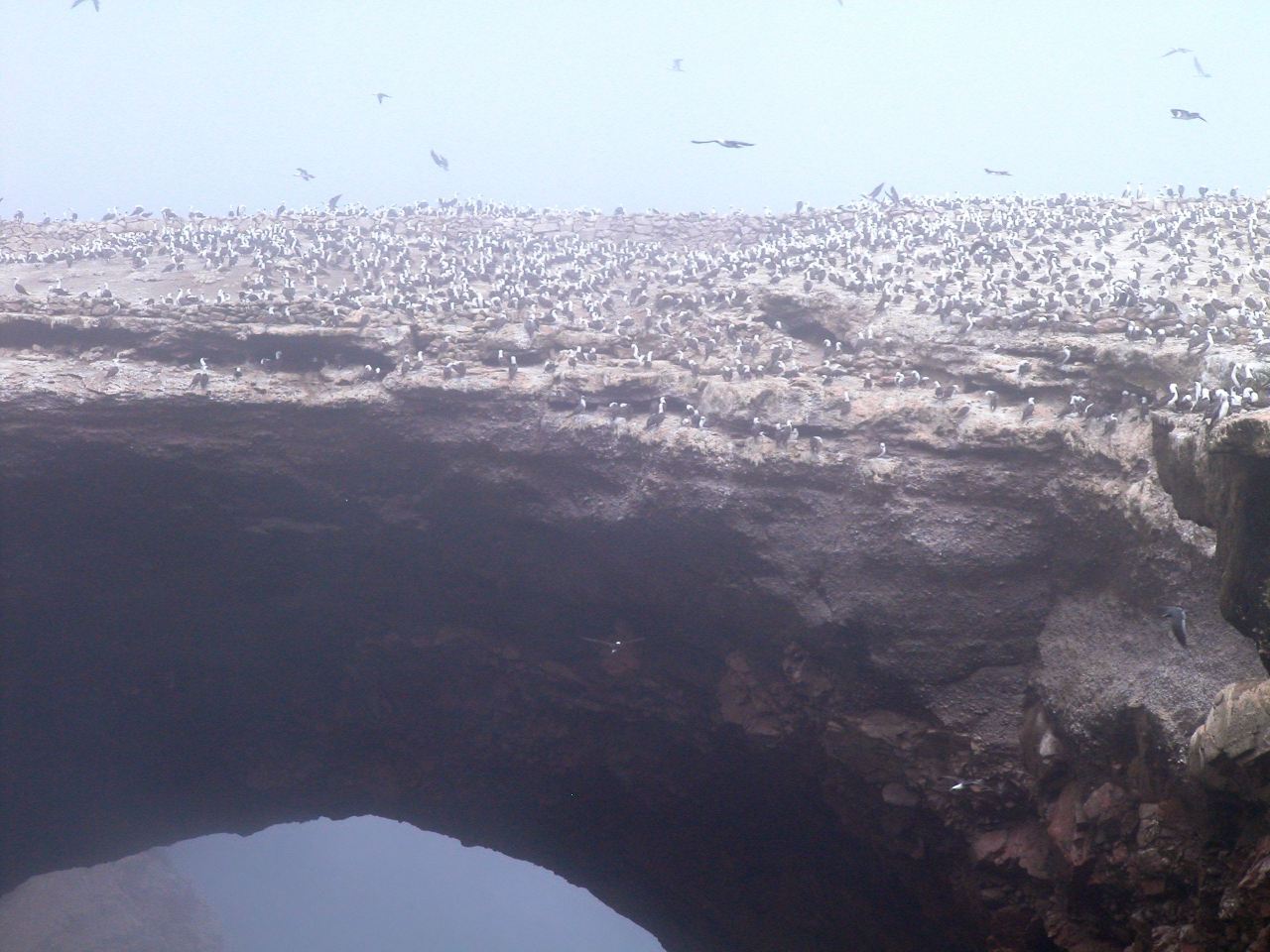
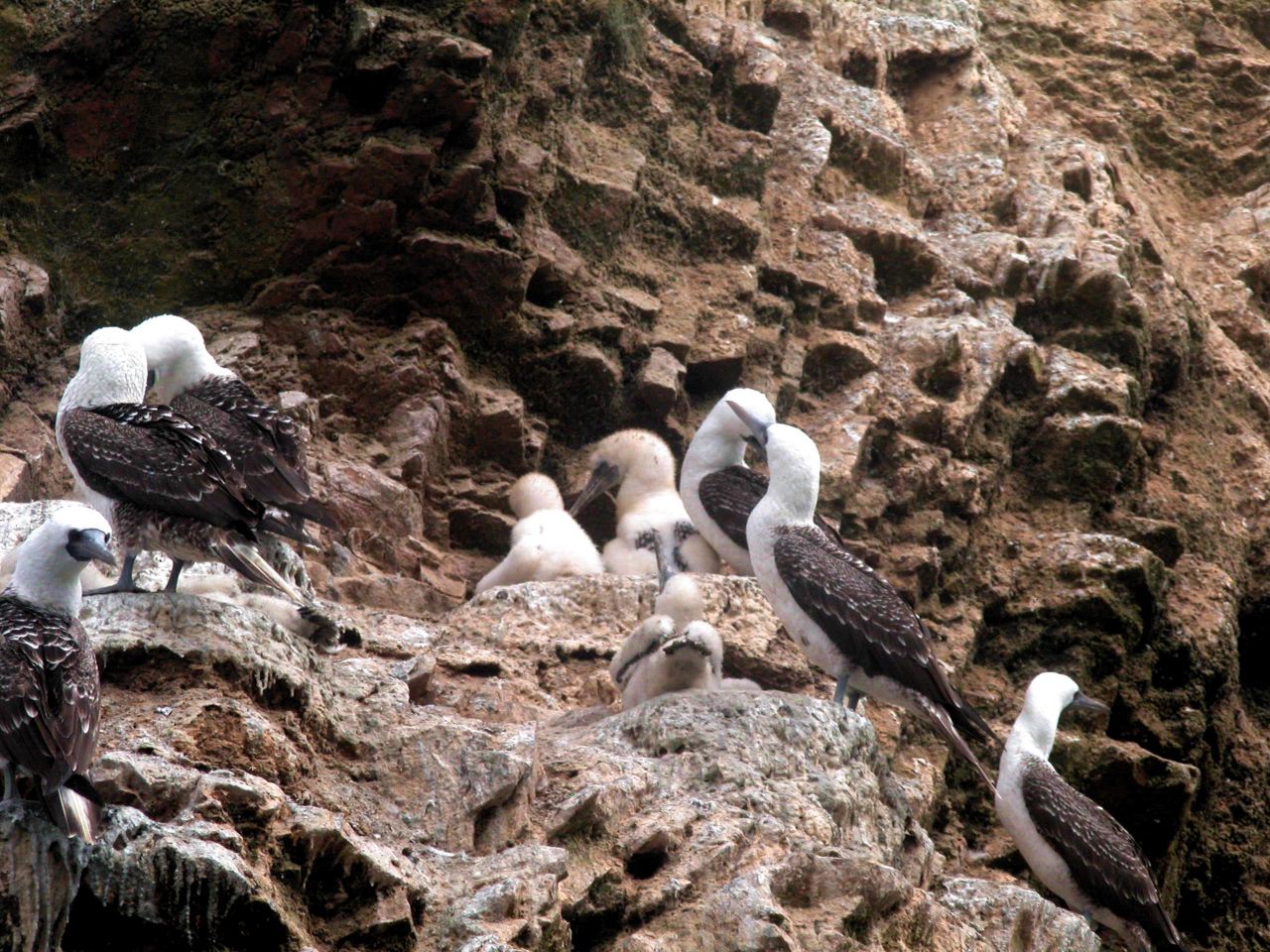
A penguin colony nests on one of the islands, but not many survive. In an El Niño year, warm water approaches the islands, and there's no fish in it, only sharks. That's disastrous for the penguins. After several El Niño years they nearly died out. Now sea lions take up all the coastal rocks and beaches. To see that many elsewhere, you'd have to go to remote, inaccessible Arctic or Antarctic islands. Only Chile and Peru let you get to a great seabird colony so easily.


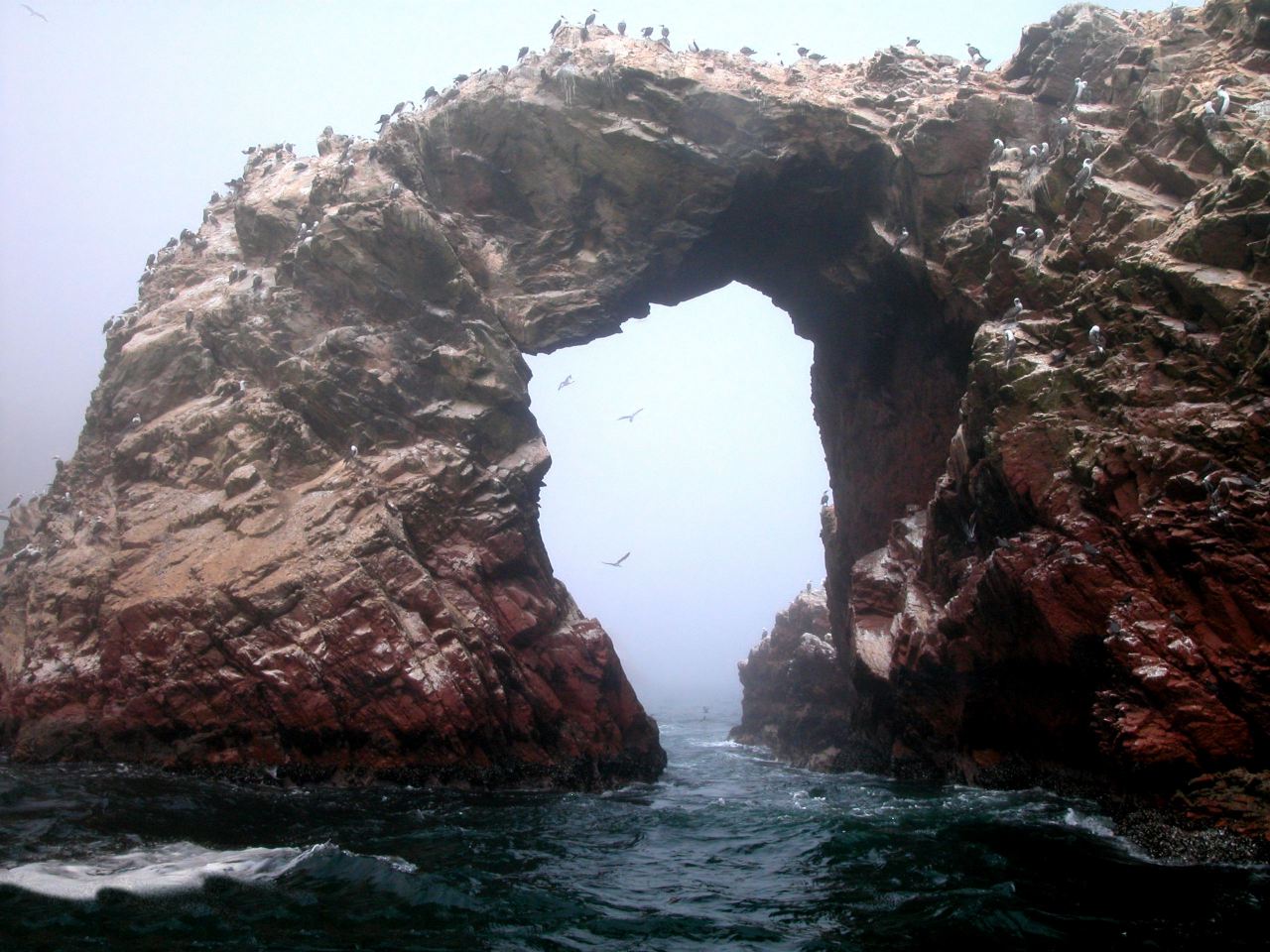


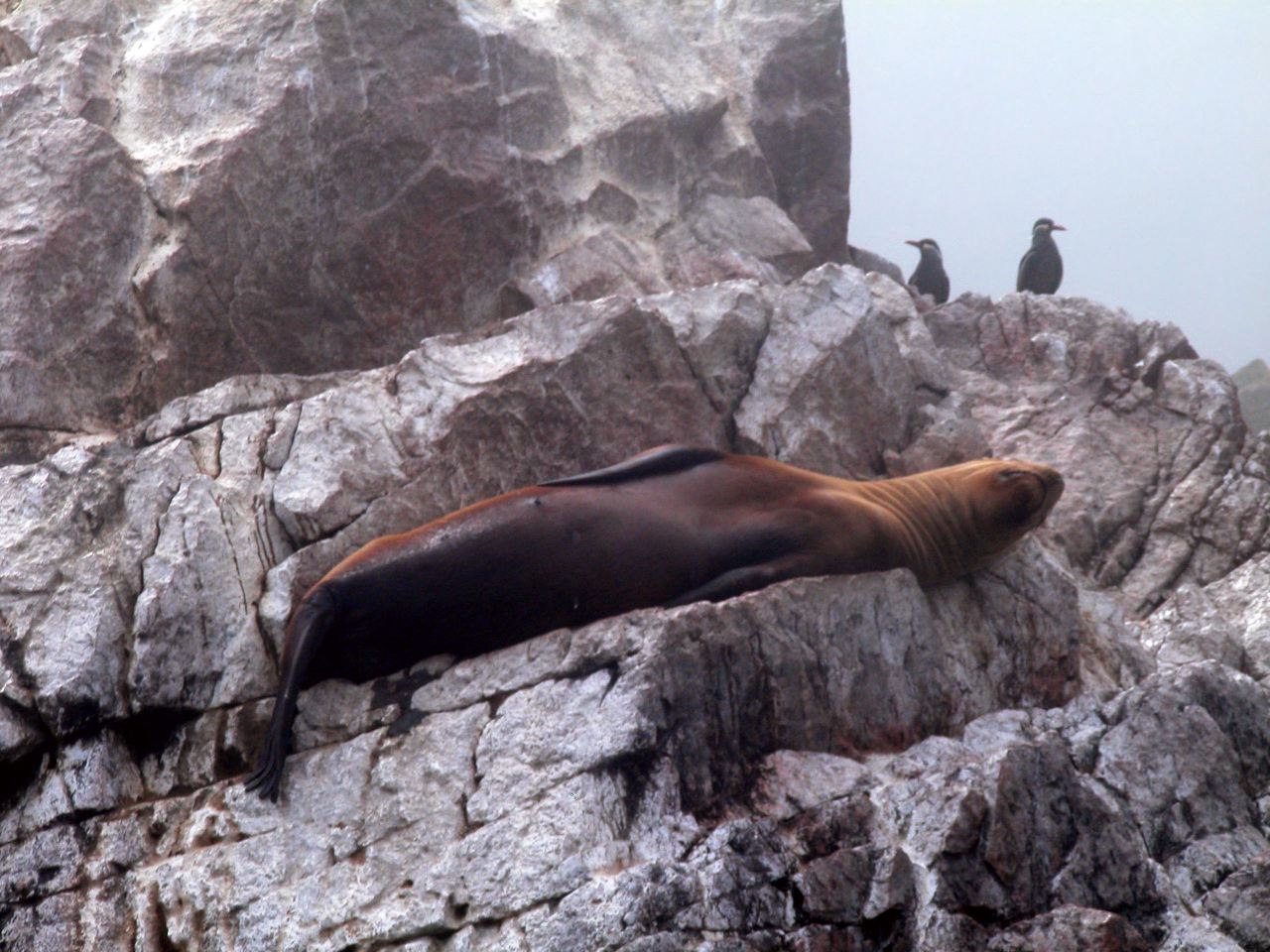


The standard outing is from eight until eleven. We still had the whole day ahead. We'd liked yesterday's drive along the desert shores of Paracas so much that we decided to go through the wildest, southern part. The guidebook said it was a good place to have fun in a four-wheel drive. It suggested bringing plenty of water and a guide who knew the area.
We don't like guides, so we went on our own. We didn't have a proper map either. Near a little village on the road from Pisco to Ica, we found a likely-looking road heading into the desert. In forty kilometres it ought to reach the sea. We drove fifty and saw no sea. The road more or less vanished. Sand dunes all around. Driving in the Sahara had accustomed me to getting over dunes in a Cruiser without getting stuck, almost without fail. The sand here was different. You could get hopelessly bogged right on the road. Luckily I realised that in time and kept off the dunes. Now we'd driven into a sandy area and they were on all sides.
No sea. Time to get out the GPS. It was buried in the depths of a backpack and up to now I couldn't be bothered. It turned out we were in the middle of the desert, in a part with no roads at all, supposed to be a military training area. We had to go back. That's always unpleasant. When we saw a little road leading towards the sea we took a chance on it. We reached the shore near the Independencia Islands. On the shore, in the middle of a red five-pointed star, stood an obelisk. How had it got there? The Red Army had never made it to this desert, and the star isn't one of Peru's symbols. There wasn't a soul about.


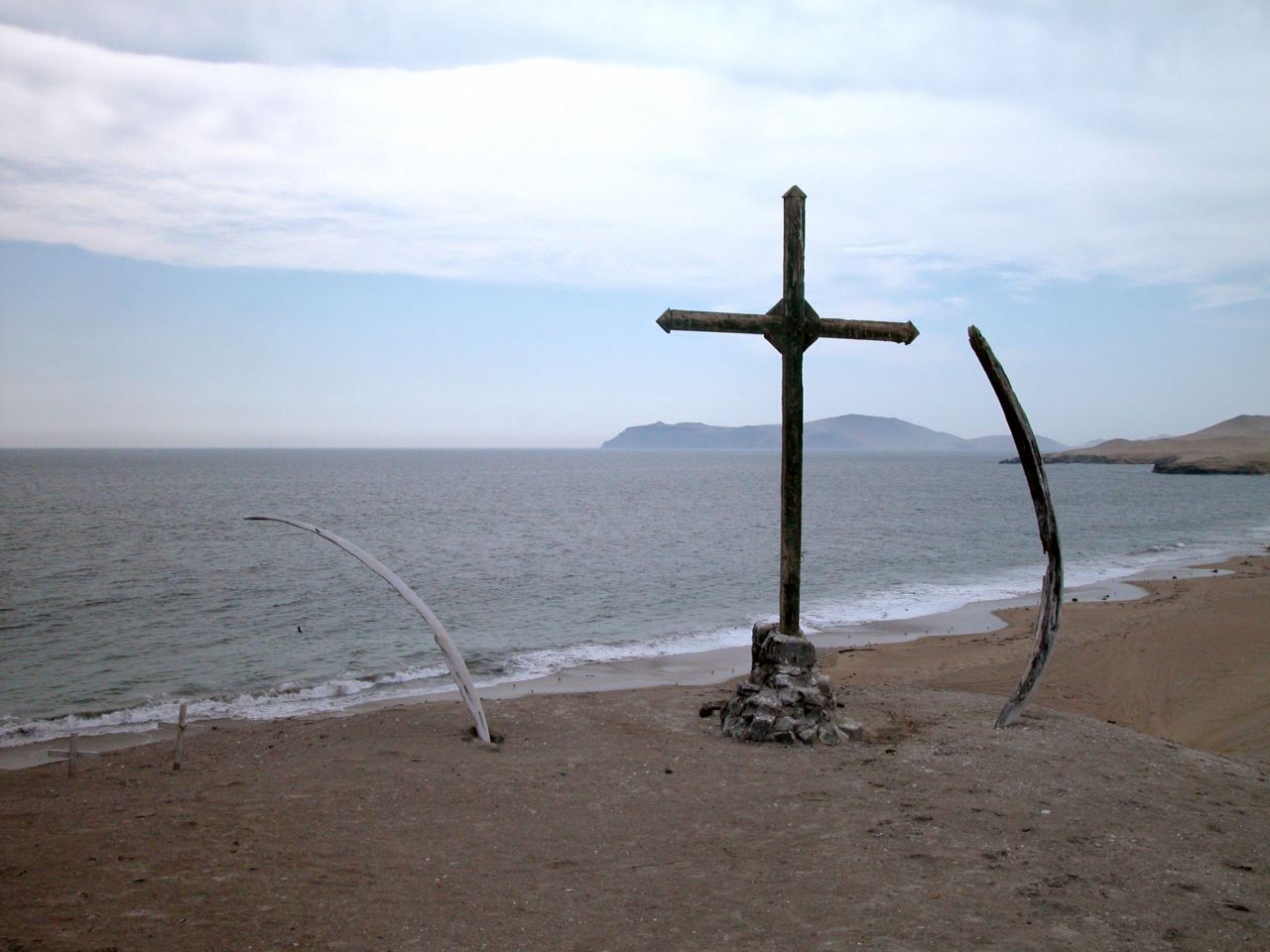
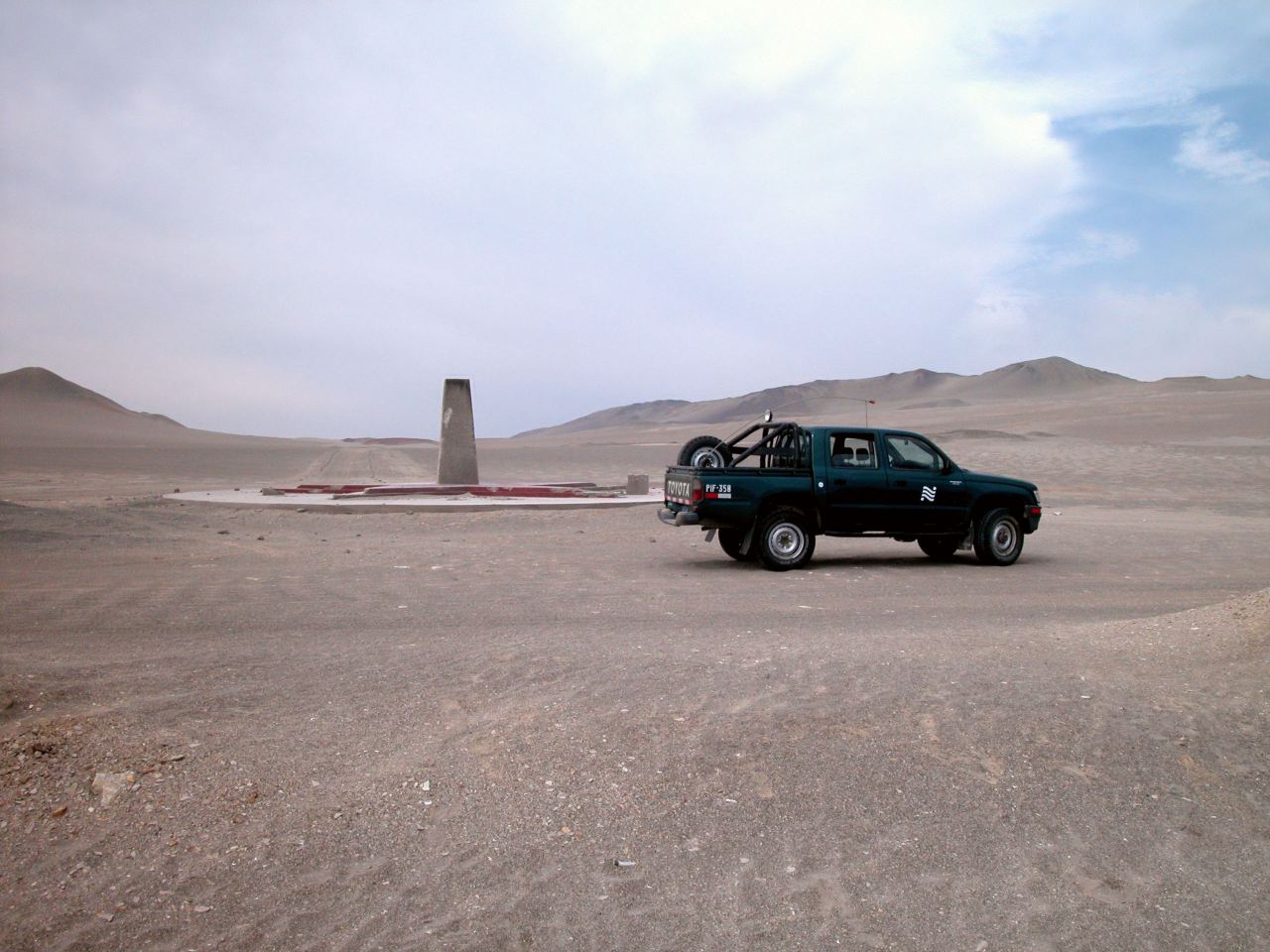
A nice beach. At last we had a suitable place to swim in the Pacific without turning all the packs inside out to find the elusive swimming costumes.
We wandered about the desert for a long time yet before we made it out to Paracas. Everything was full of dust. It was going to take a long time to get rid of it.
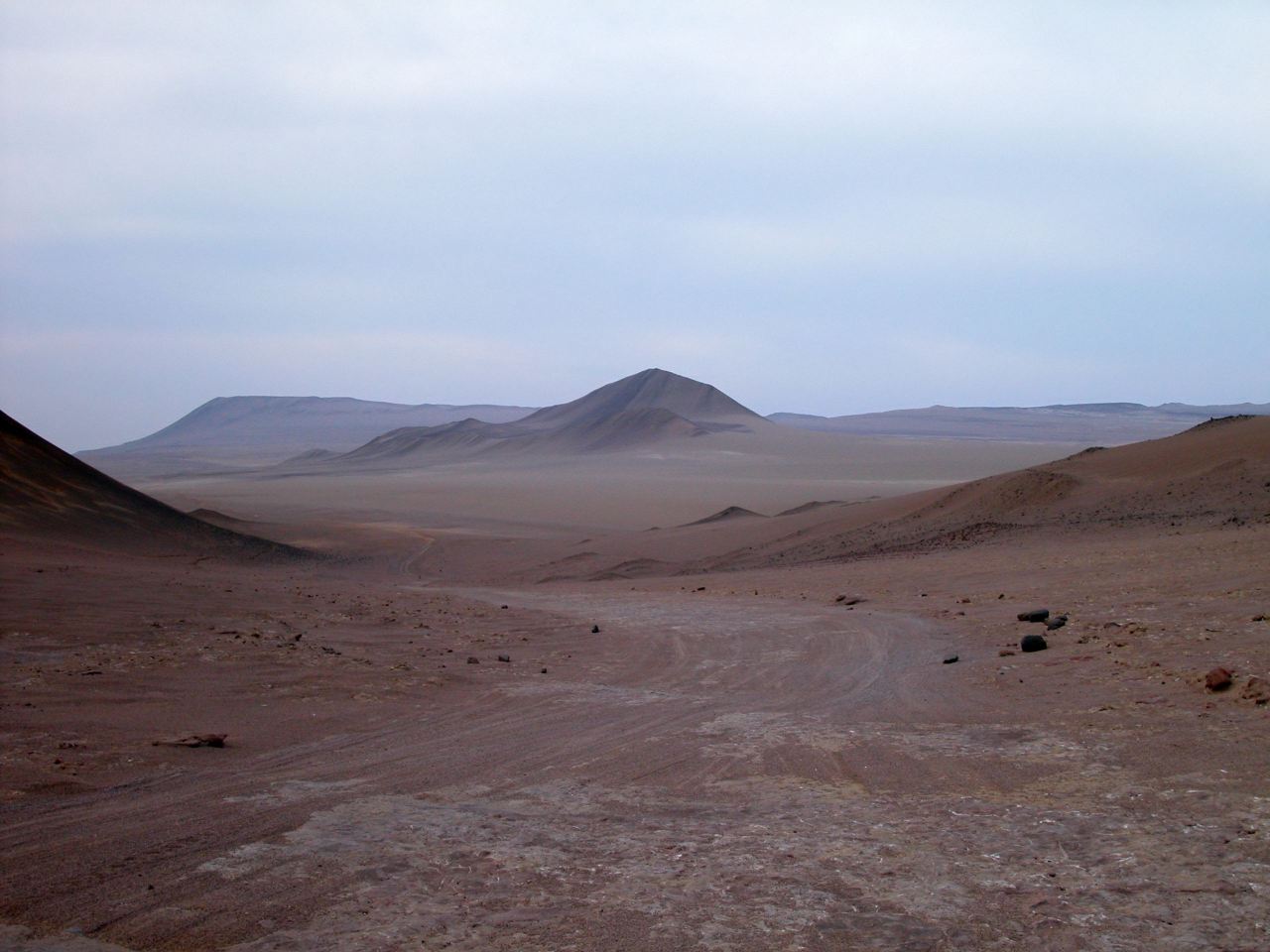


We had to drive farther south along the Pan-American Highway in the dark. The plan for tomorrow was a flight over the Nazca desert.
Most of the highway runs through empty desert. The road is straight and there are few villages, so we did the two hundred kilometres in two and a half hours. We spent the night in a very pleasant place, the Hotel Internacional. Despite such a grand name, a triple room was sixty soles. It had its own parking in the yard, so we saved ten soles or so and didn't have to lug our things far.
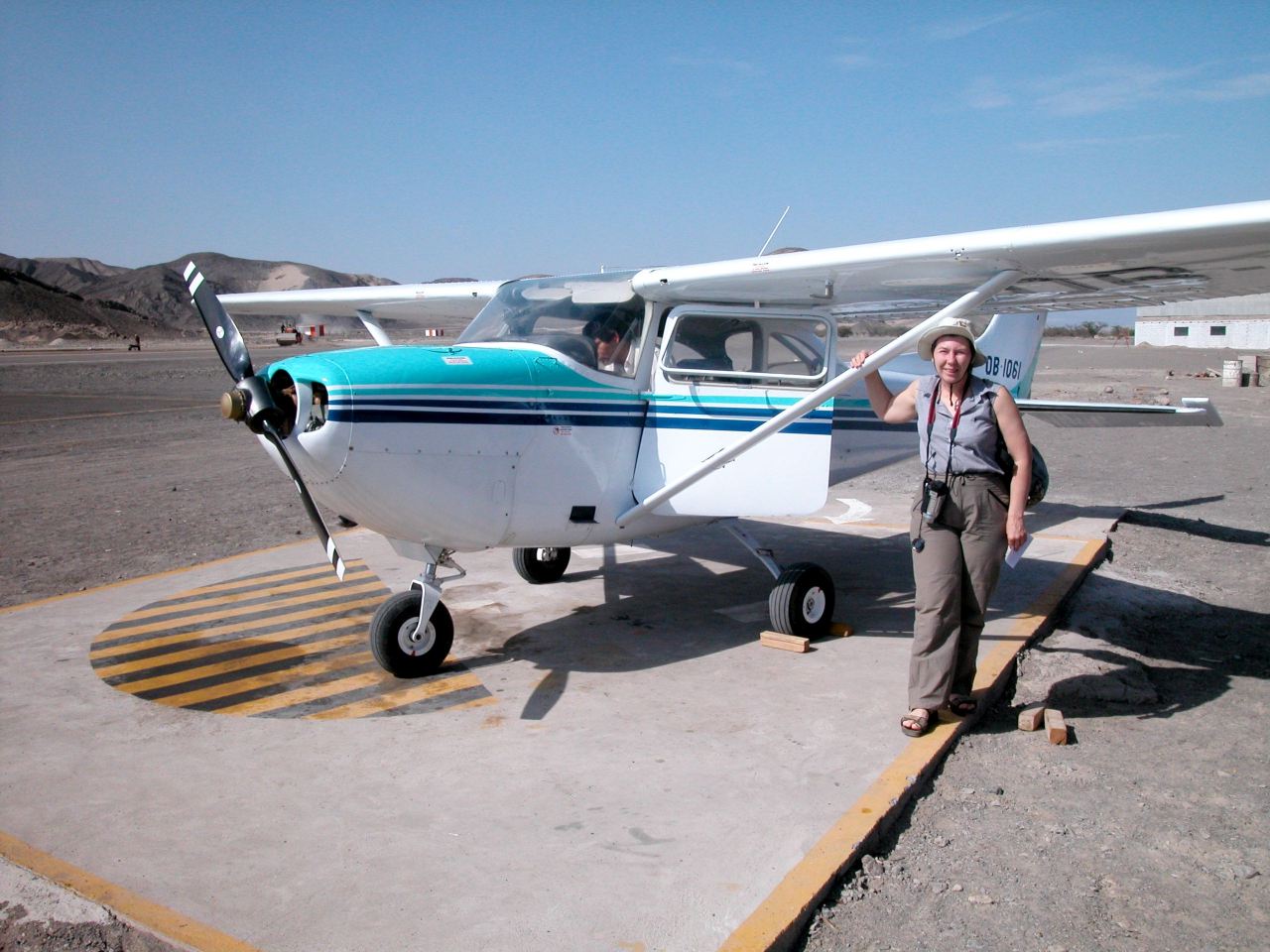
We made the rounds of the many tour companies and found out about flights. The cheapest and most interesting was a little four-seater plane. One seat for the pilot and three for the passengers. There were exactly three of us. You can book anything from eight in the morning to five in the evening. Best to go in the morning. The low sun picks out the relief, you see the figures more clearly and the sky is almost certain to be clear.
The price was US$27 per person, including the ride from your hotel to the airport but not the airport fee of five soles.
The flight is at three hundred metres. The programme calls for flying over twelve figures. You get an excellent view of everything. I liked it very much. Other tourists had reported that sometimes the pilot lets you fly the plane. I'd been looking forward to that, but they didn't let me.
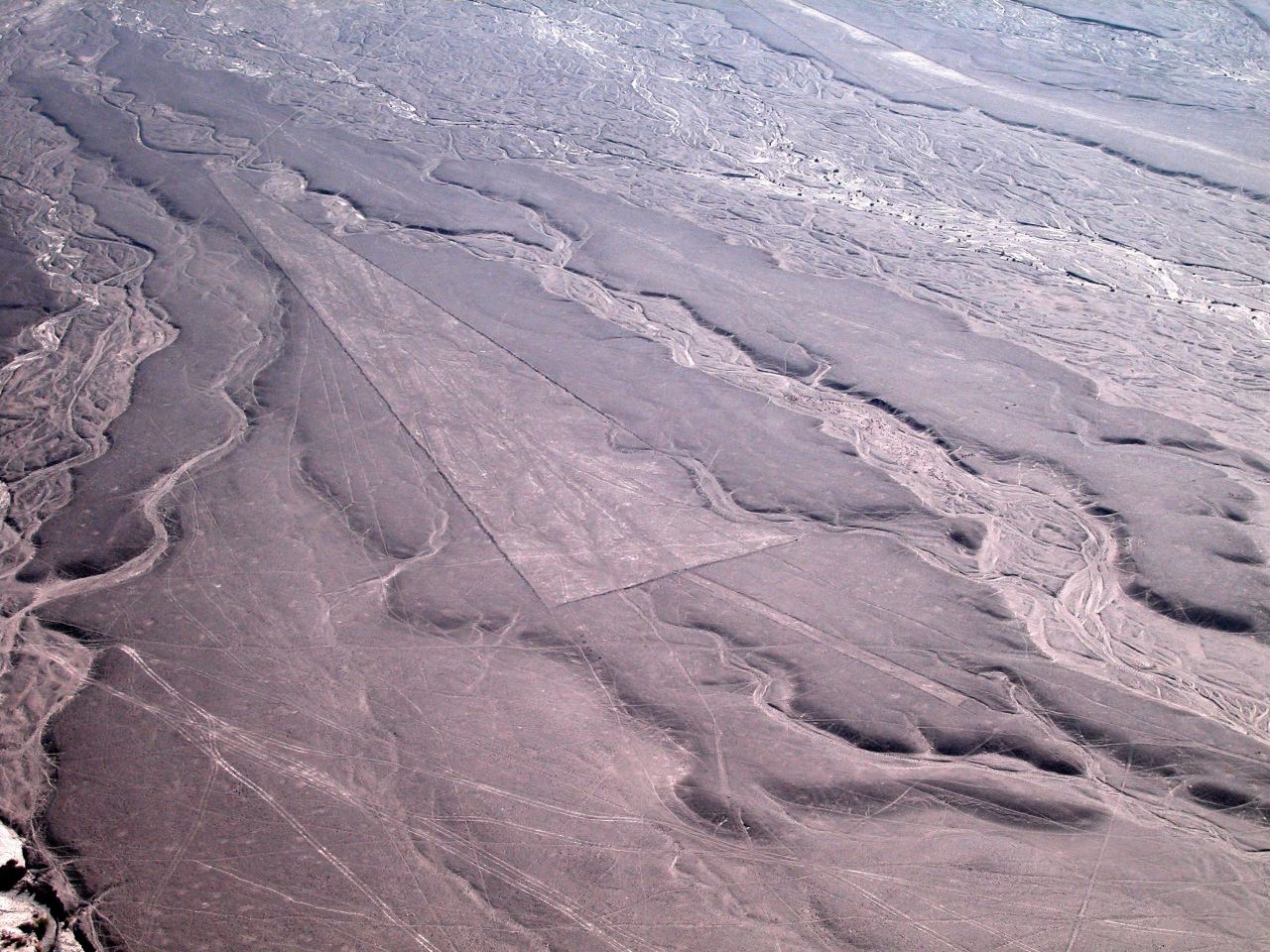
The figures in the Nazca desert became widely known after von Däniken's film Chariots of the Gods. The idea was to prove they came from beyond Earth, and the fellow on the hillside was proclaimed a picture of an astronaut. He looked like an ordinary fellow to me. If we're going to build silly theories, I could argue there's a picture of a pachypodium, a plant endemic to Madagascar. Let someone explain that. On the plan, this figure doesn't even have a name.
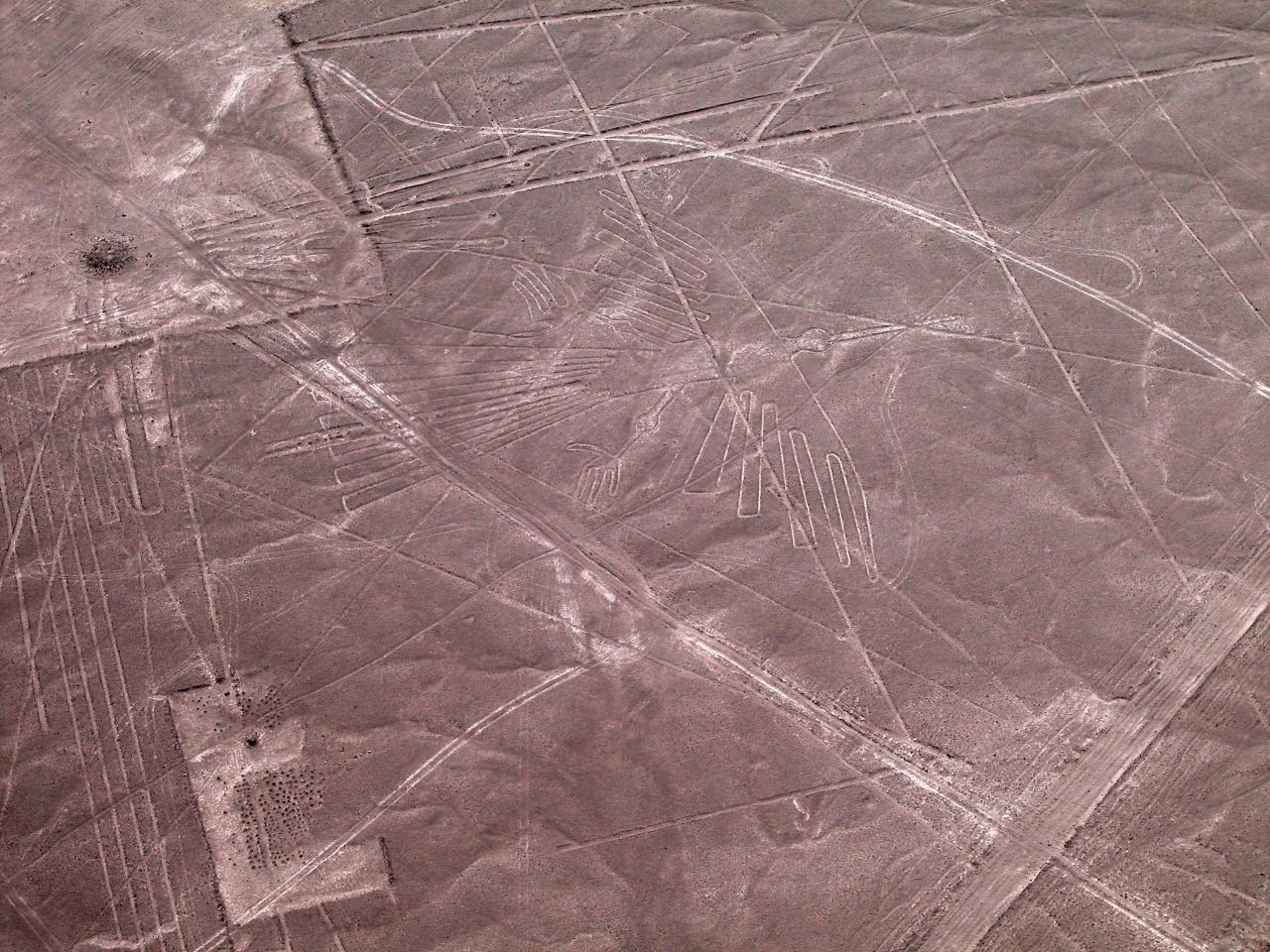

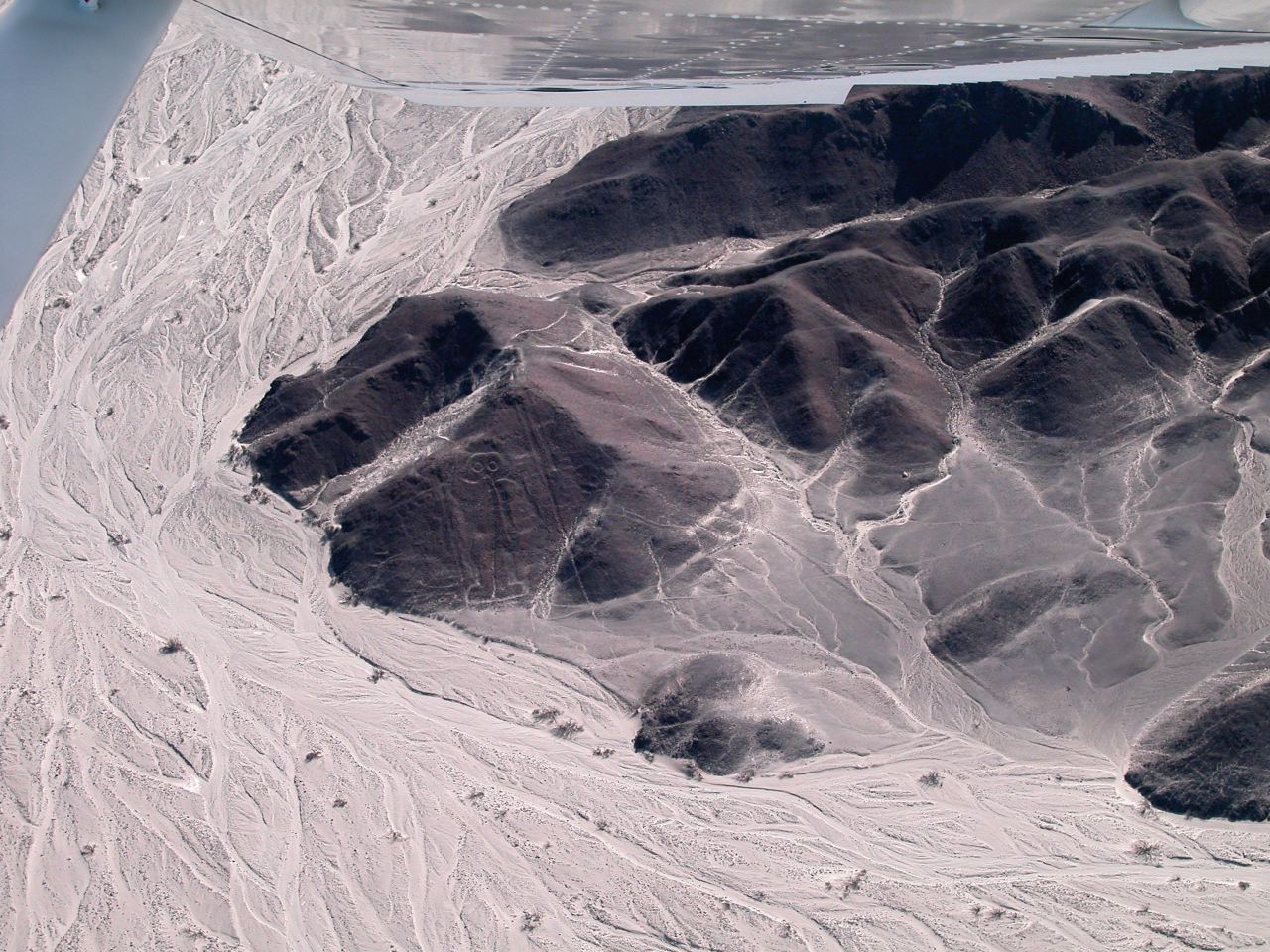
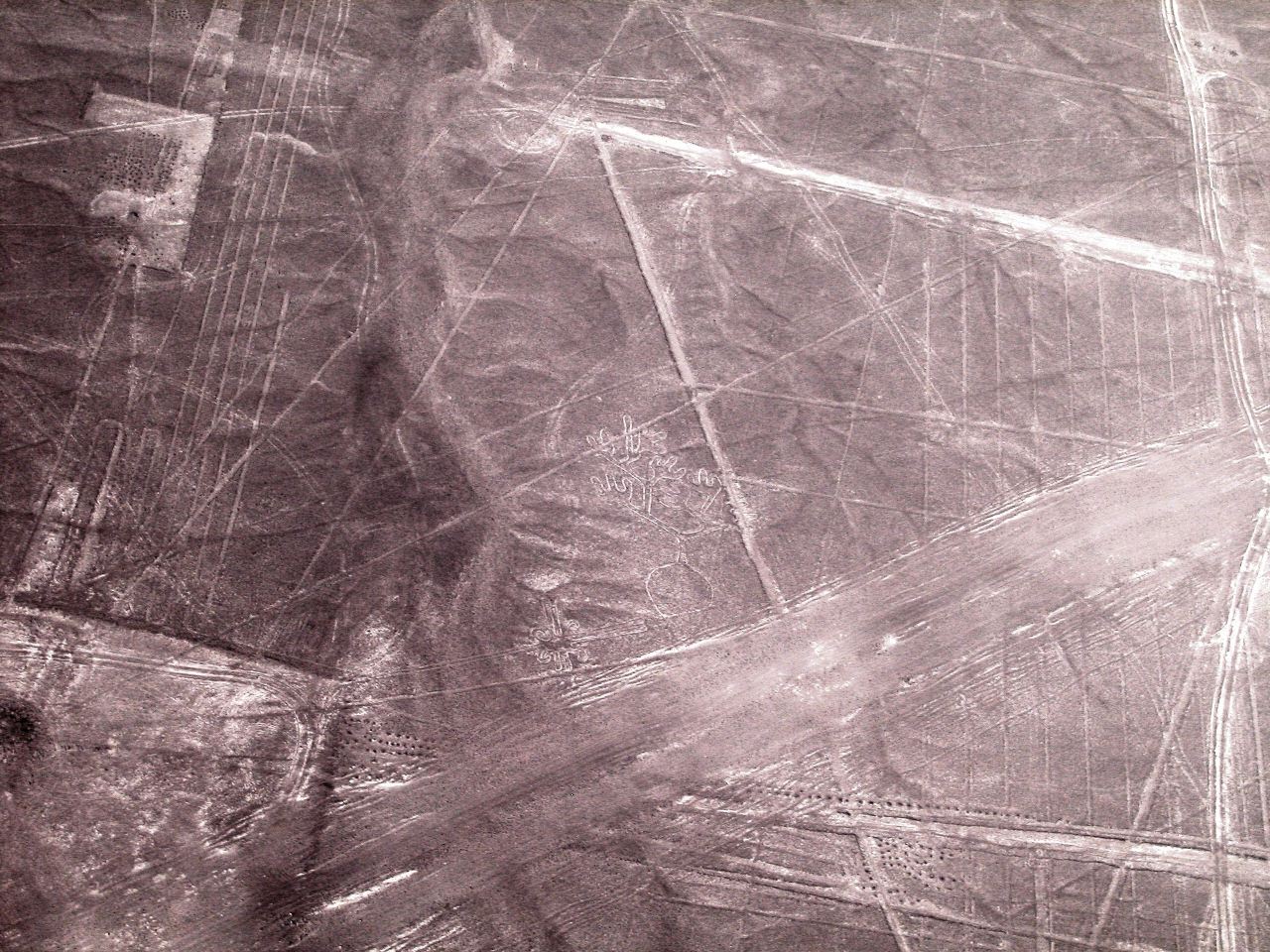
To tell the truth, I can understand the little drawings of animals and plants. But triangles kilometres long are considerably harder to understand. This whole design was laid out on a stony desert where the wind blows white sand about. Remove the dark rocks and the patch turns white. That's the way the big triangles were made. The little pictures, seen close up, consist of a furrow several centimetres deep and several dozen centimetres wide.
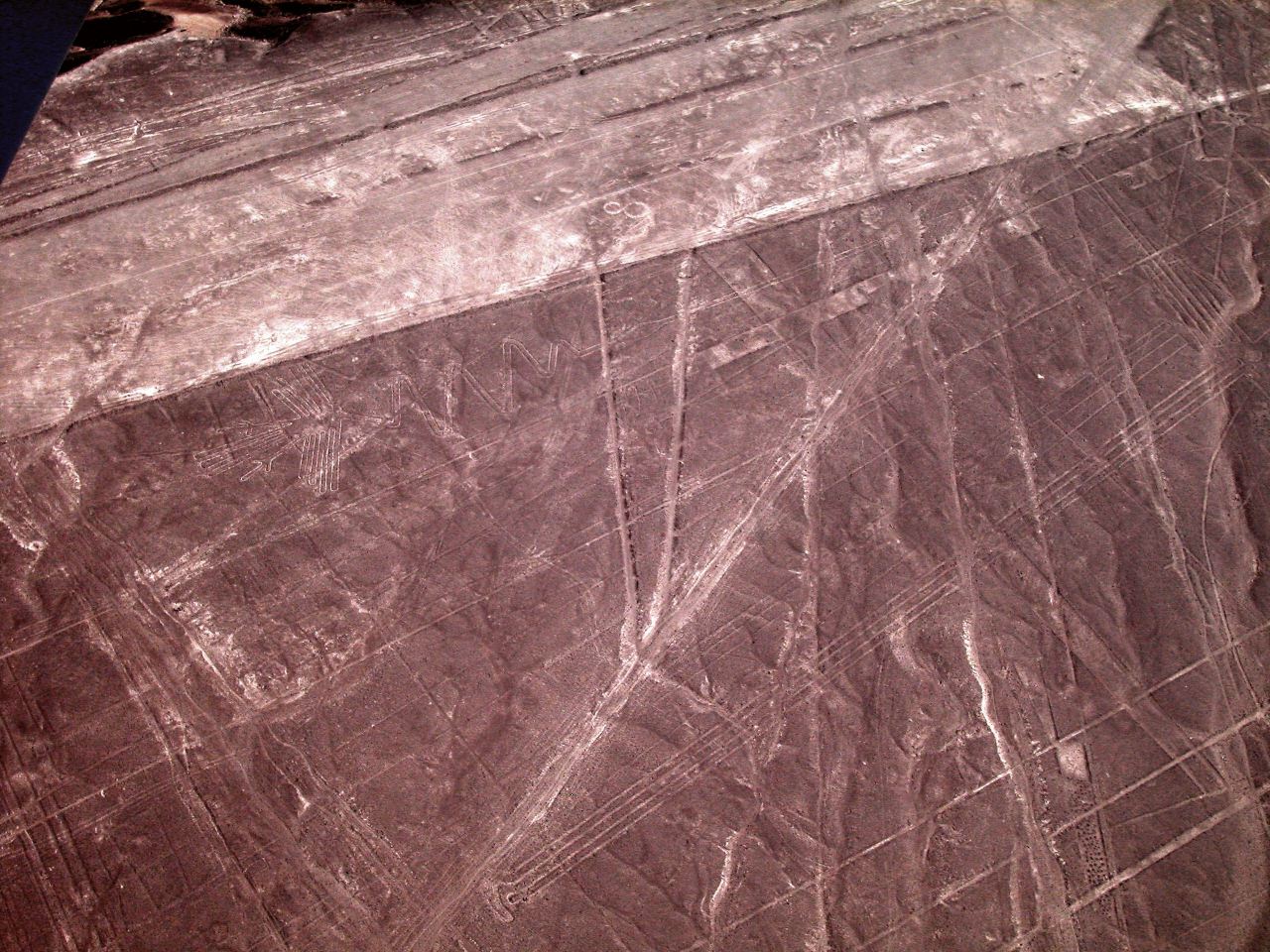
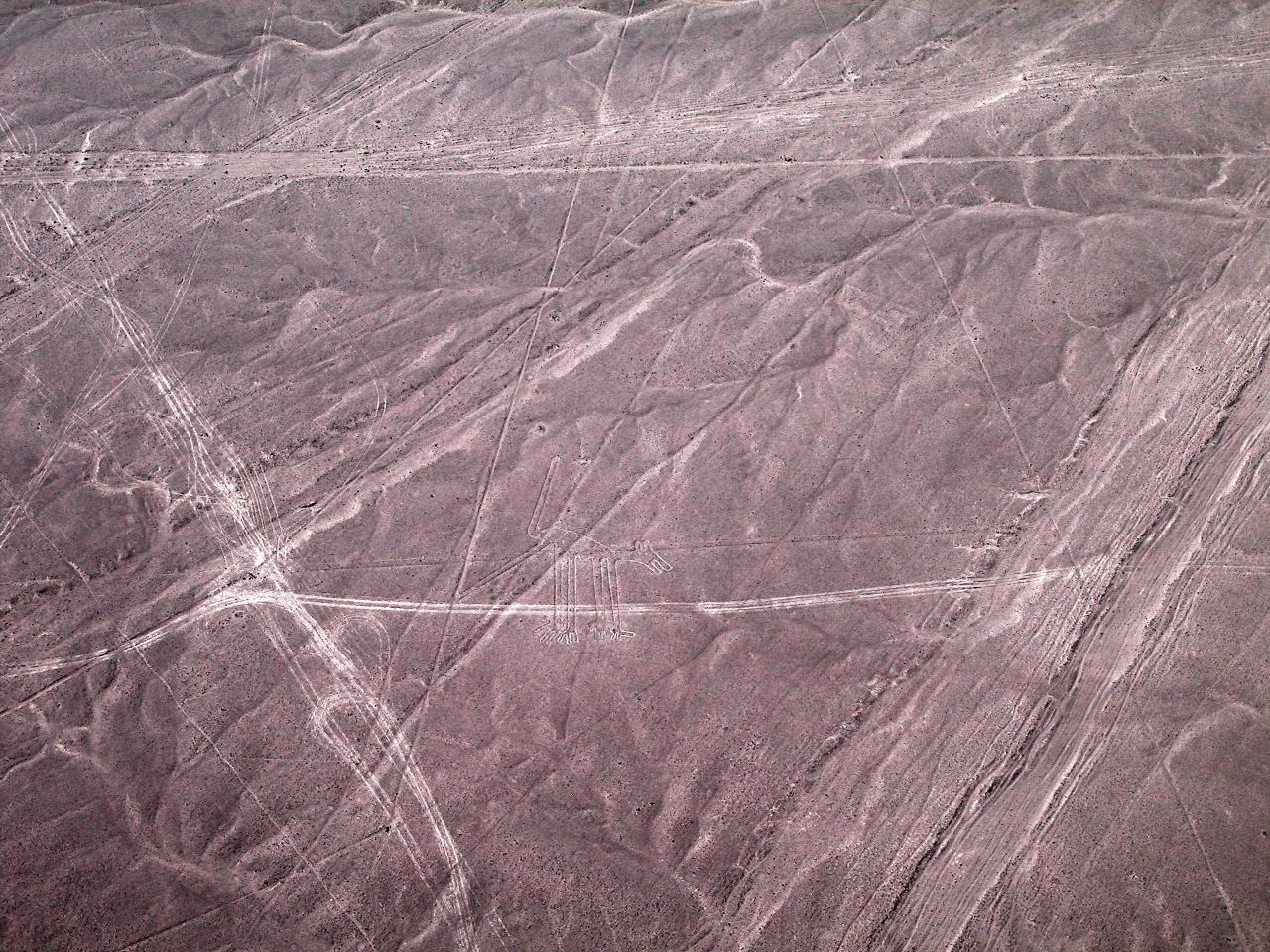
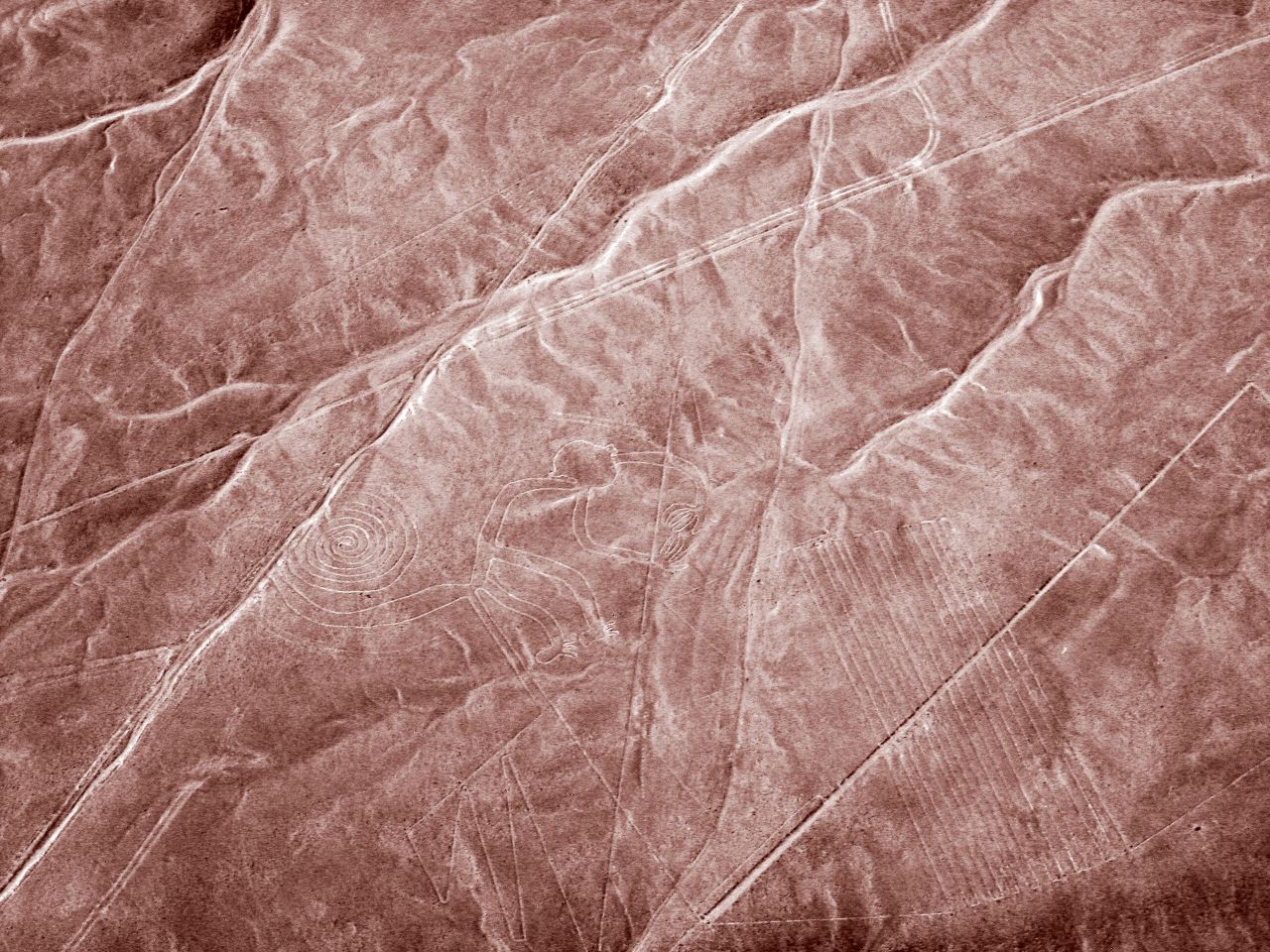
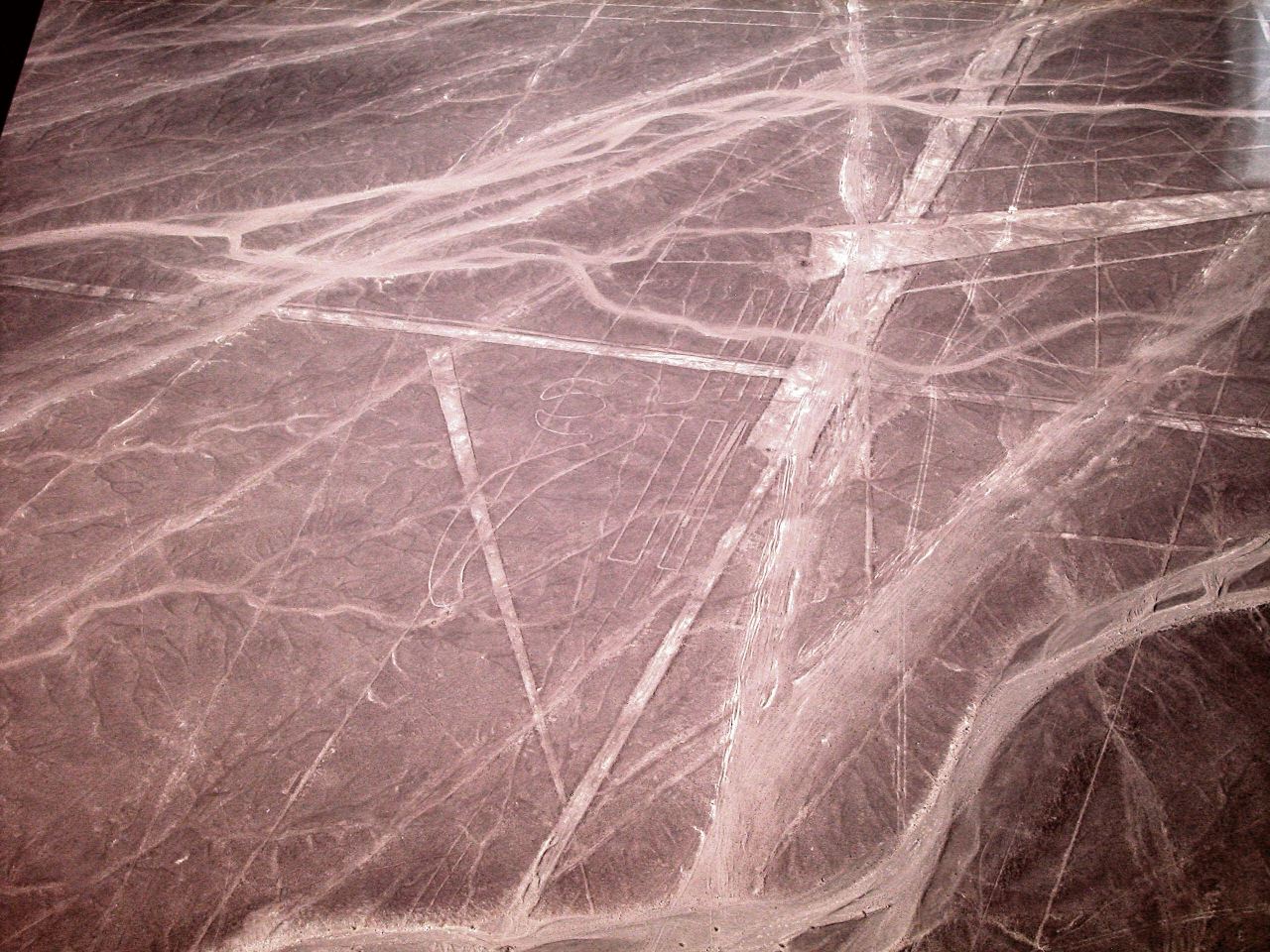
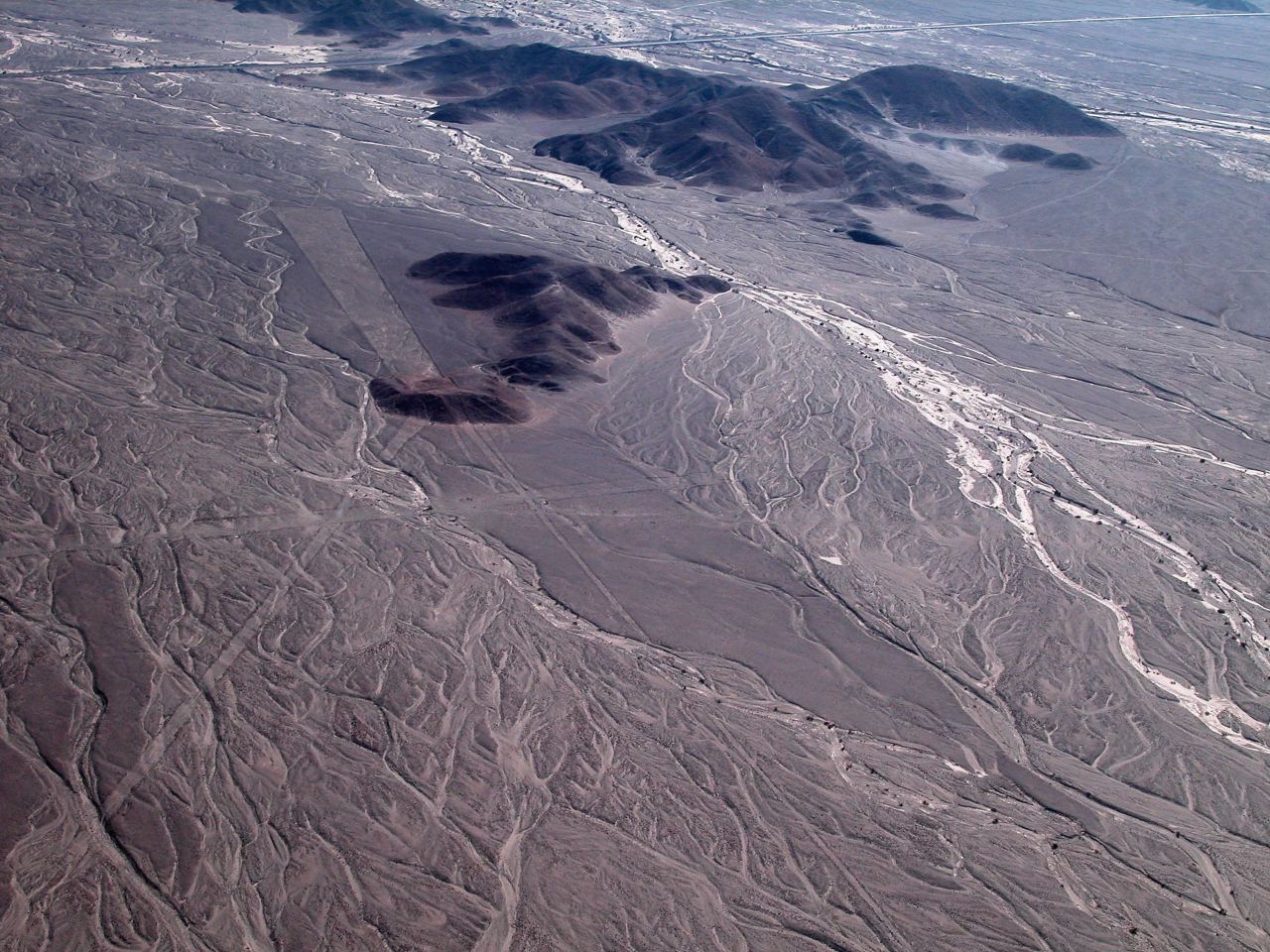
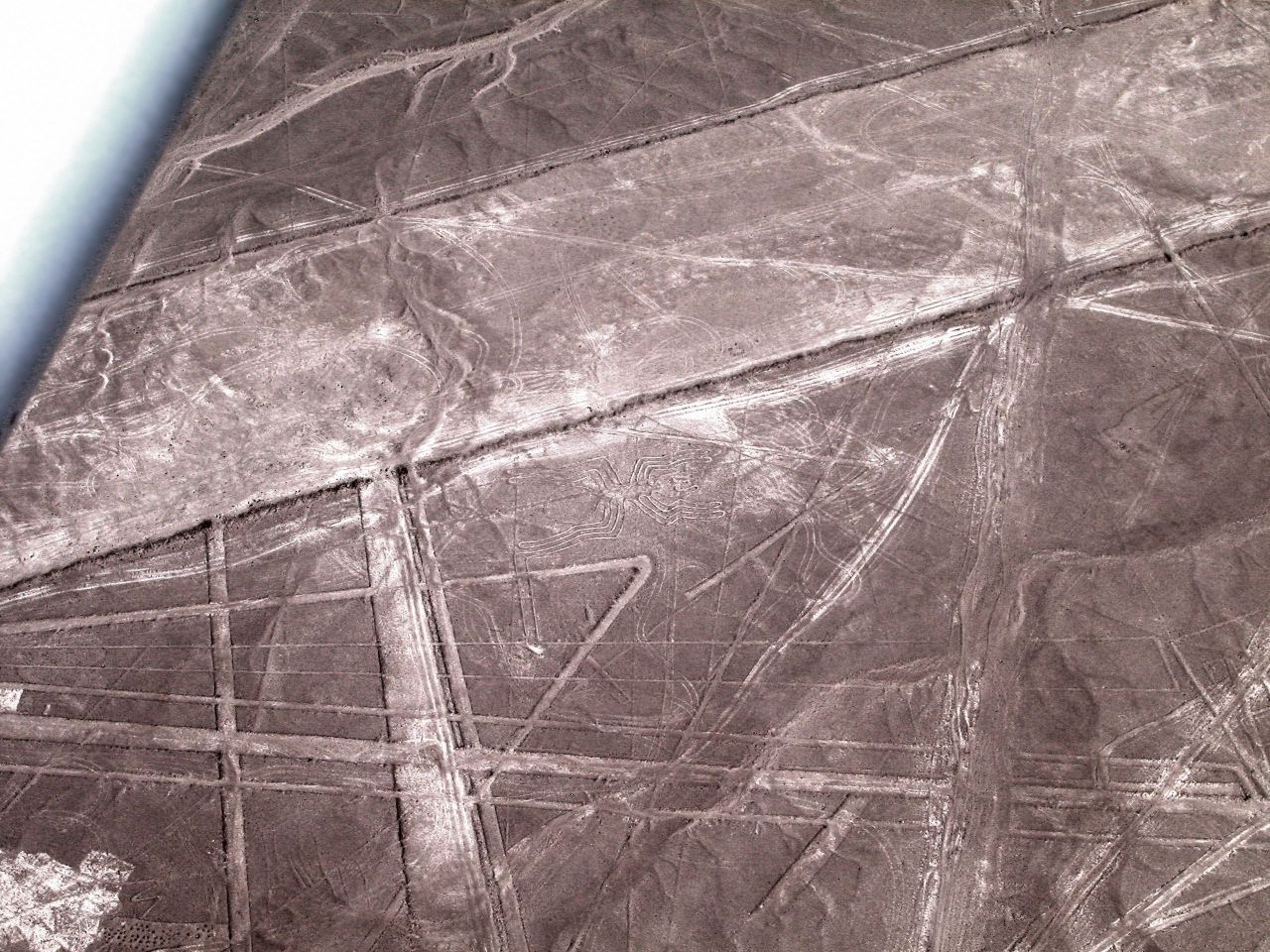
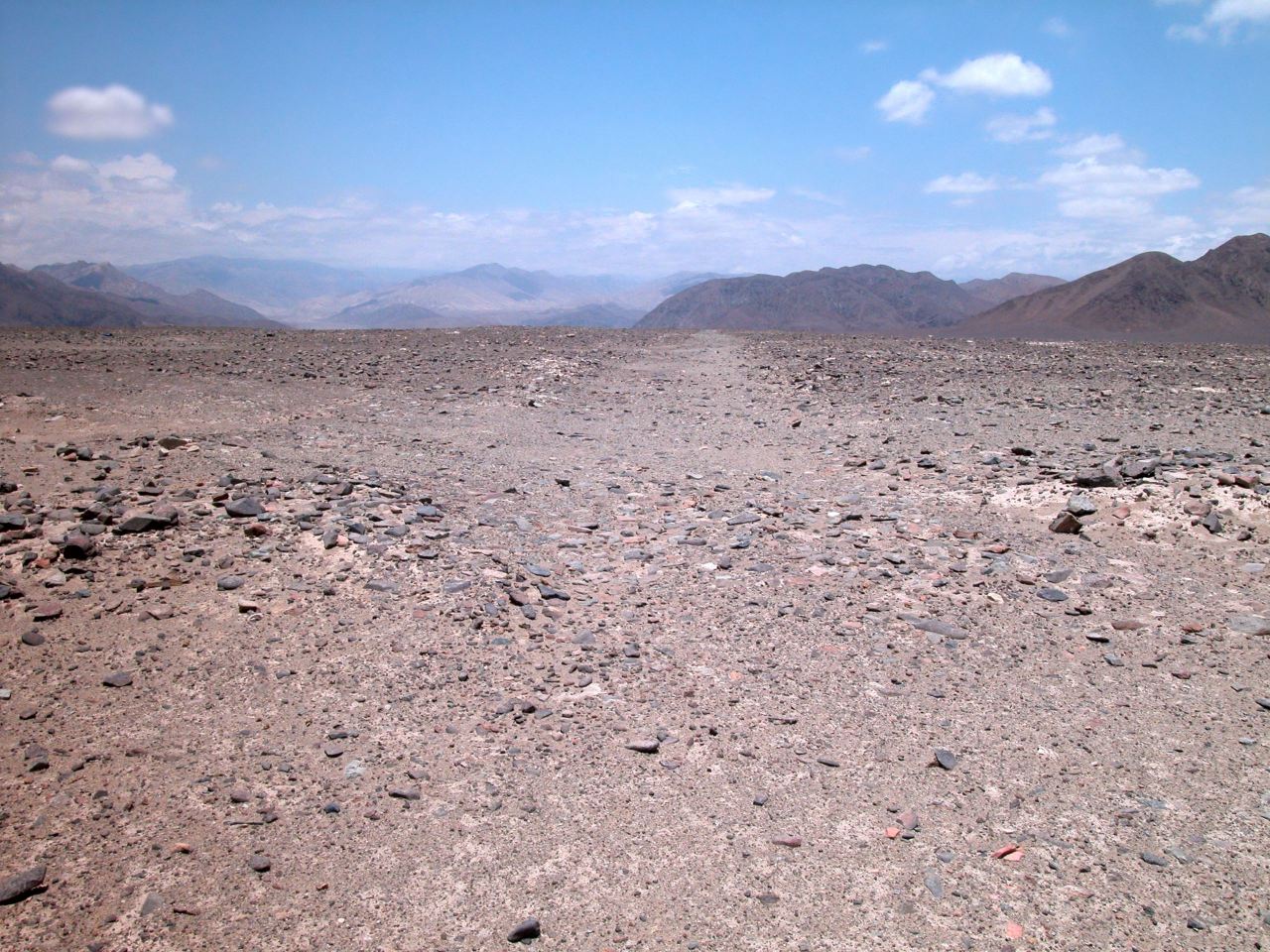
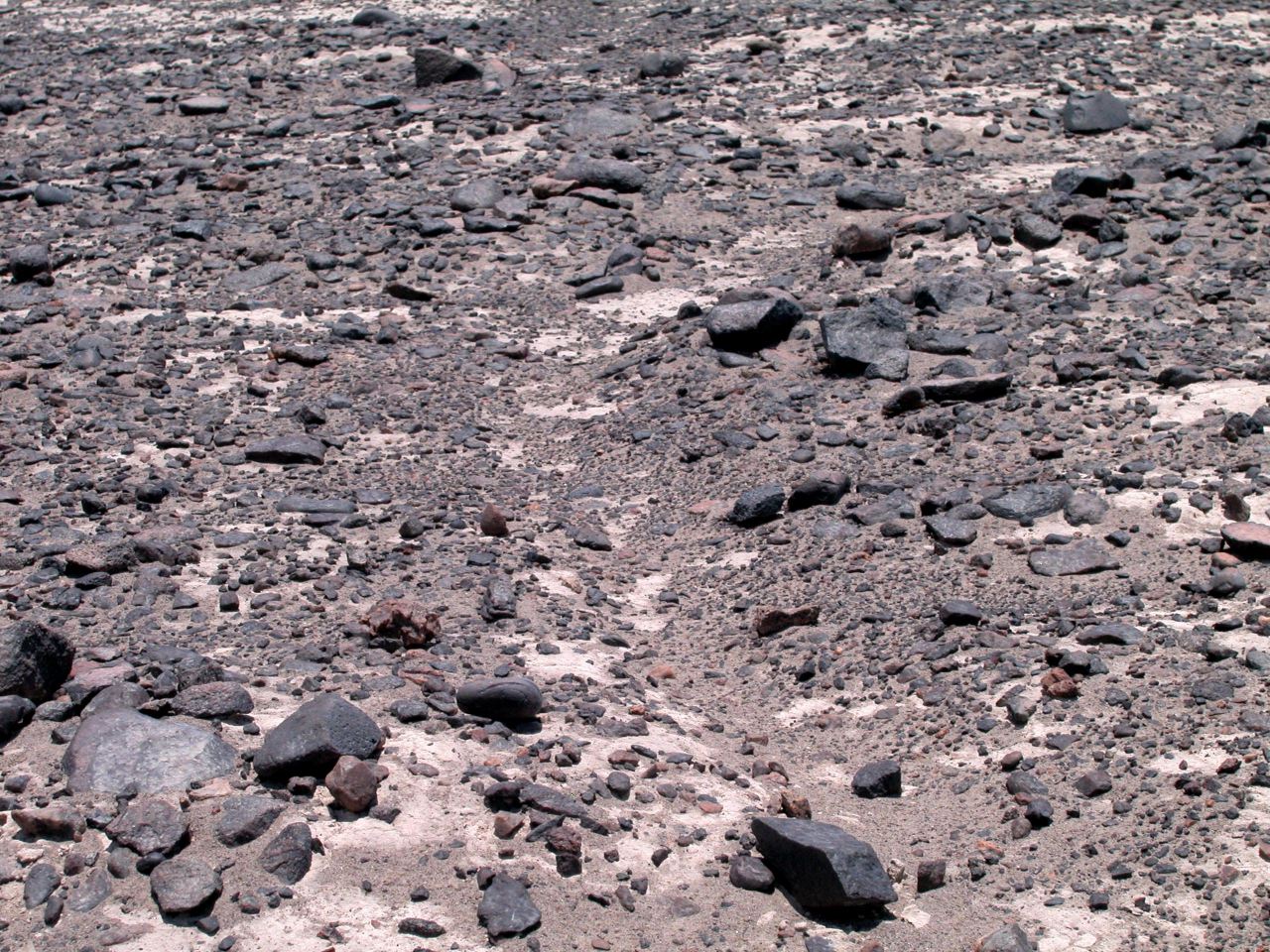
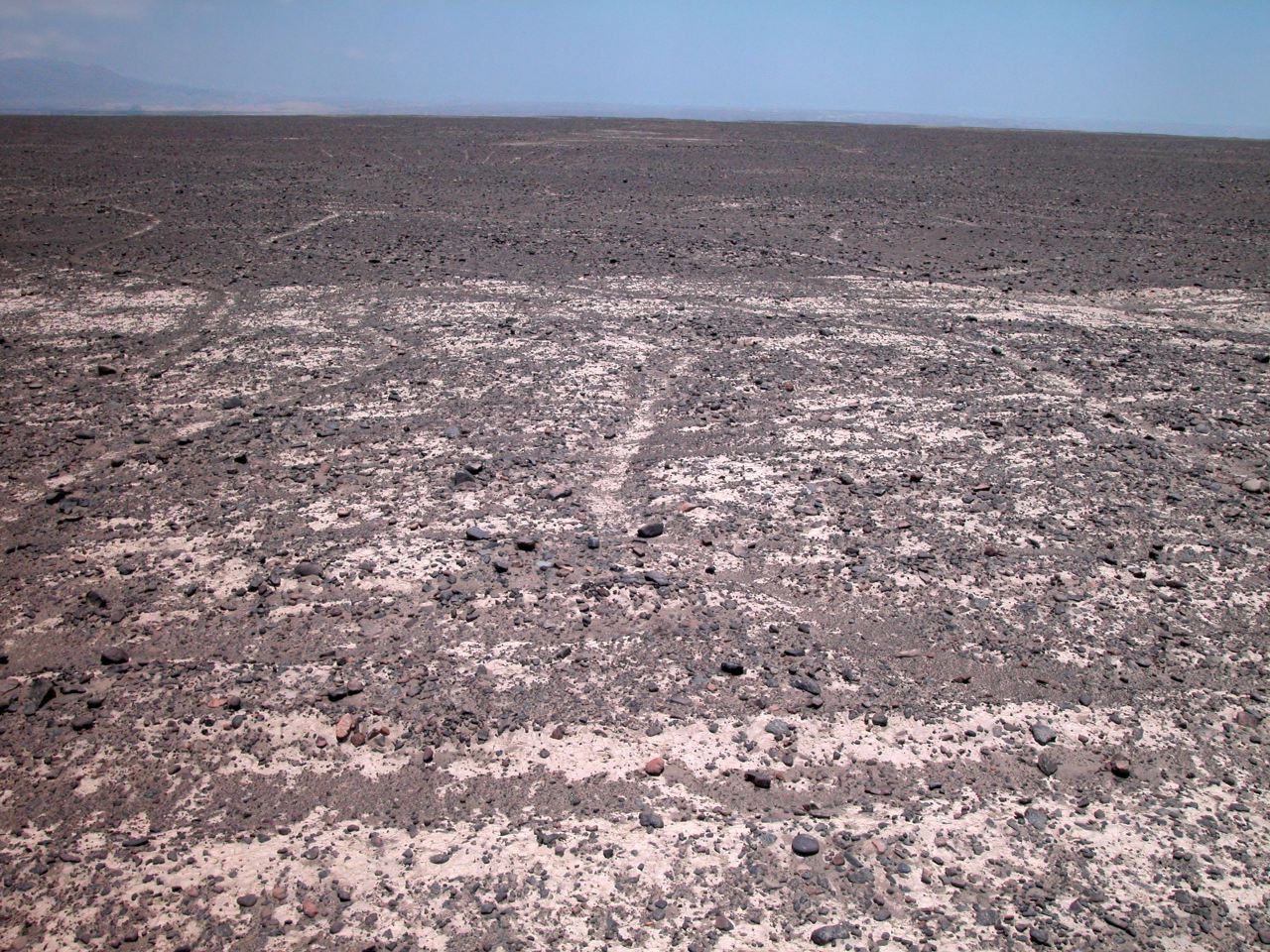
Nobody knows what the figures mean. Their age is unknown too. They obviously came before the Spanish. The accepted dates at the time were around 900 BCE to 600 CE. Archaeologists can date things precisely from organic remains, but there aren't any here in the desert. The figures are practically unique. There is nothing like them anywhere in the world. Similar ones had apparently been found in Bolivia recently, but I hadn't seen photographs and there might be a good deal of wishful thinking in the discovery. The degree of stylisation in the pictures is astonishing. From everything I'd seen in Latin America there was nothing like it, except perhaps the images on the walls at Sechín.
Contrary to popular belief, people knew about those figures as early as the sixteenth century. The Paracas Candelabra is most likely plagiarism. Nobody paid much attention to the lines until they were seen from a plane in the forties and got a lot of publicity. At the beginning of the century people didn't regard them as valuable, and built the Pan-American Highway right across them. Until very recently, people drove four-wheel drives about the desert. Now everybody worries about preserving the lines. Tourists aren't allowed off the highway. ‘No figures, no money’, they say. A person walking through the desert leaves no obvious trace, and I wanted to walk to the famous hummingbird, but it was a long way off the road and the locals keep watch and chase tourists away. The only figure I managed to see from ground level was the ‘Tree’, the closest one to the highway. Incidentally, you can get a look at it from the observation tower for one sol, a great deal cheaper than a flight.
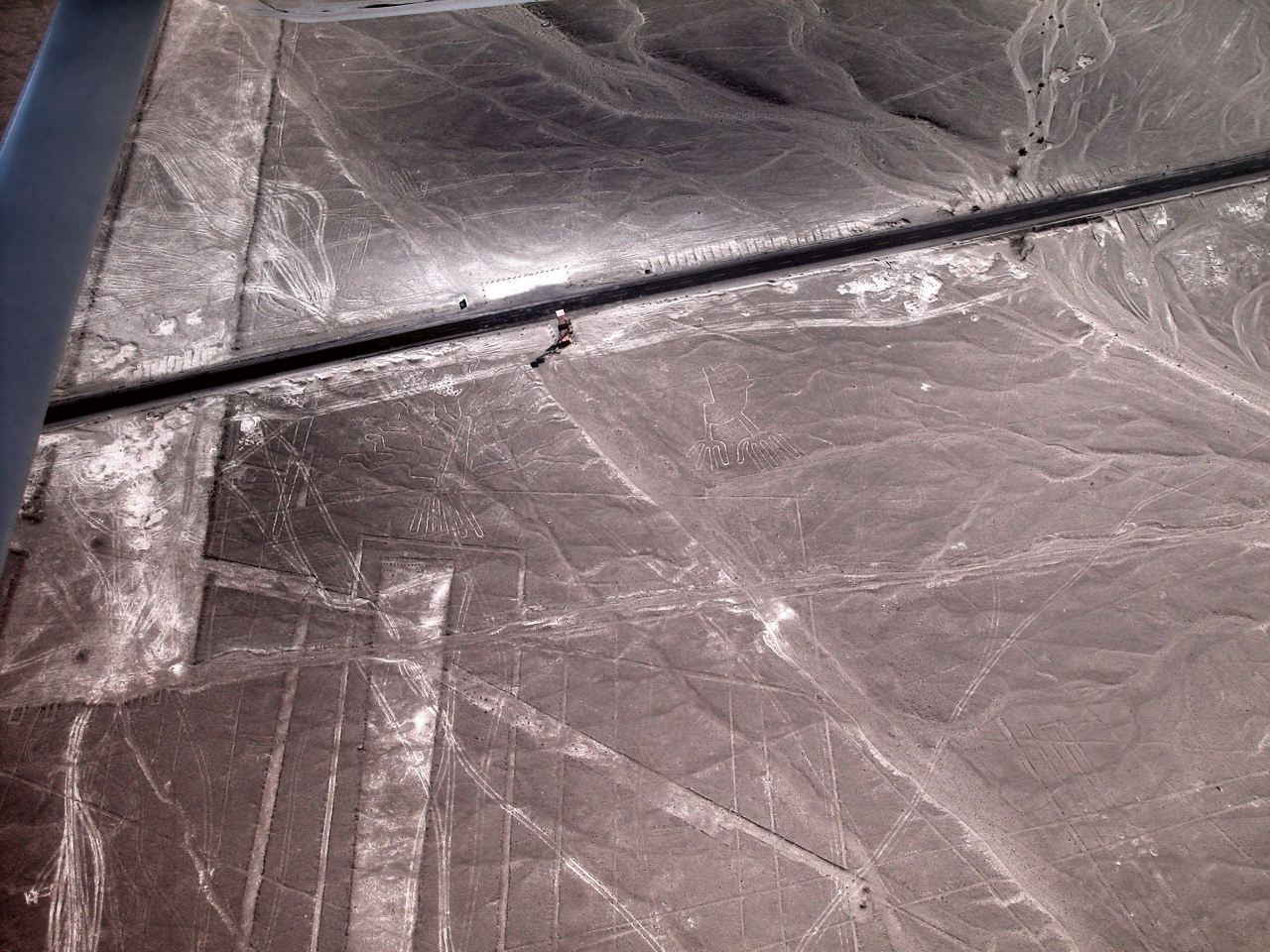
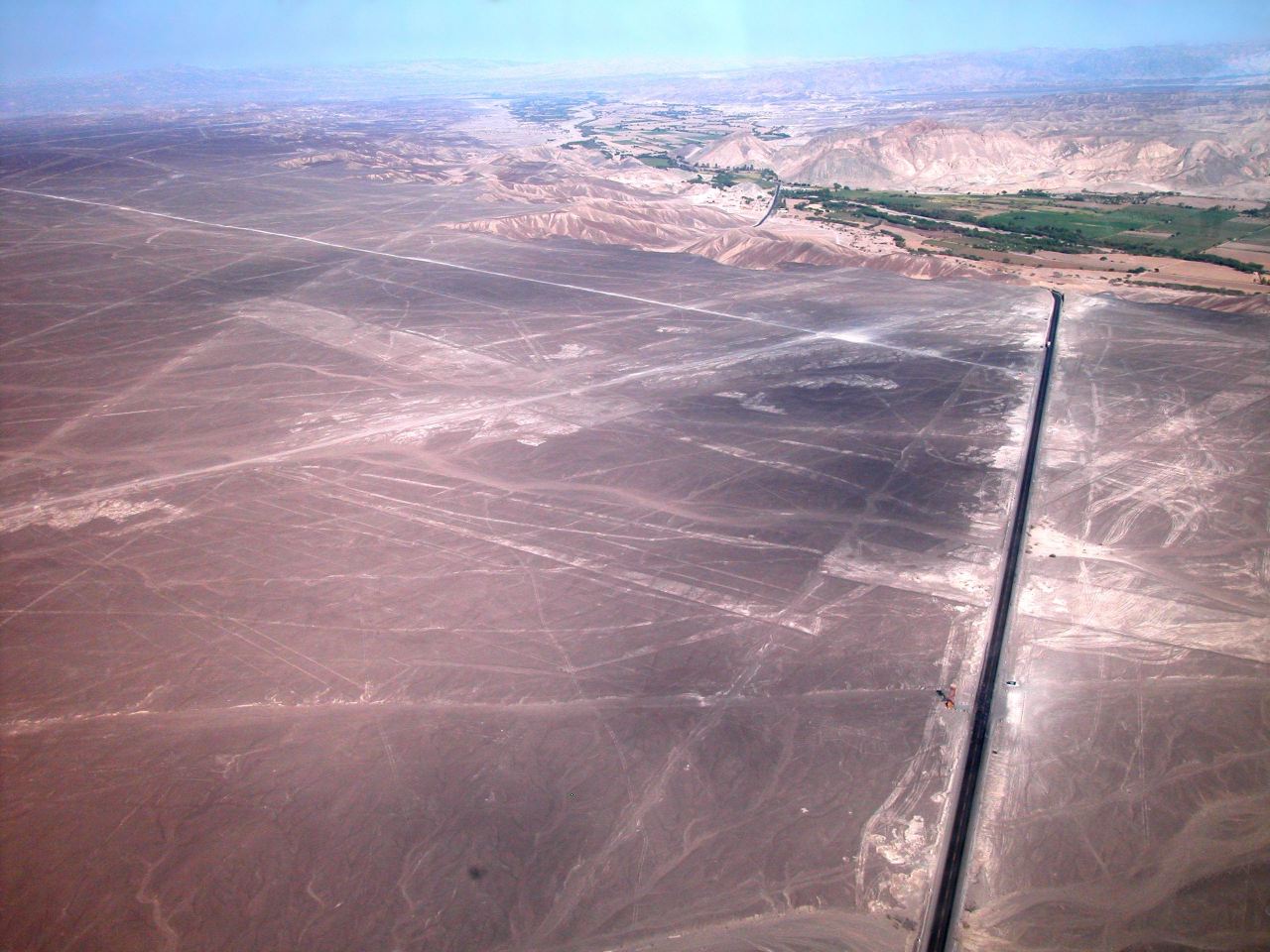
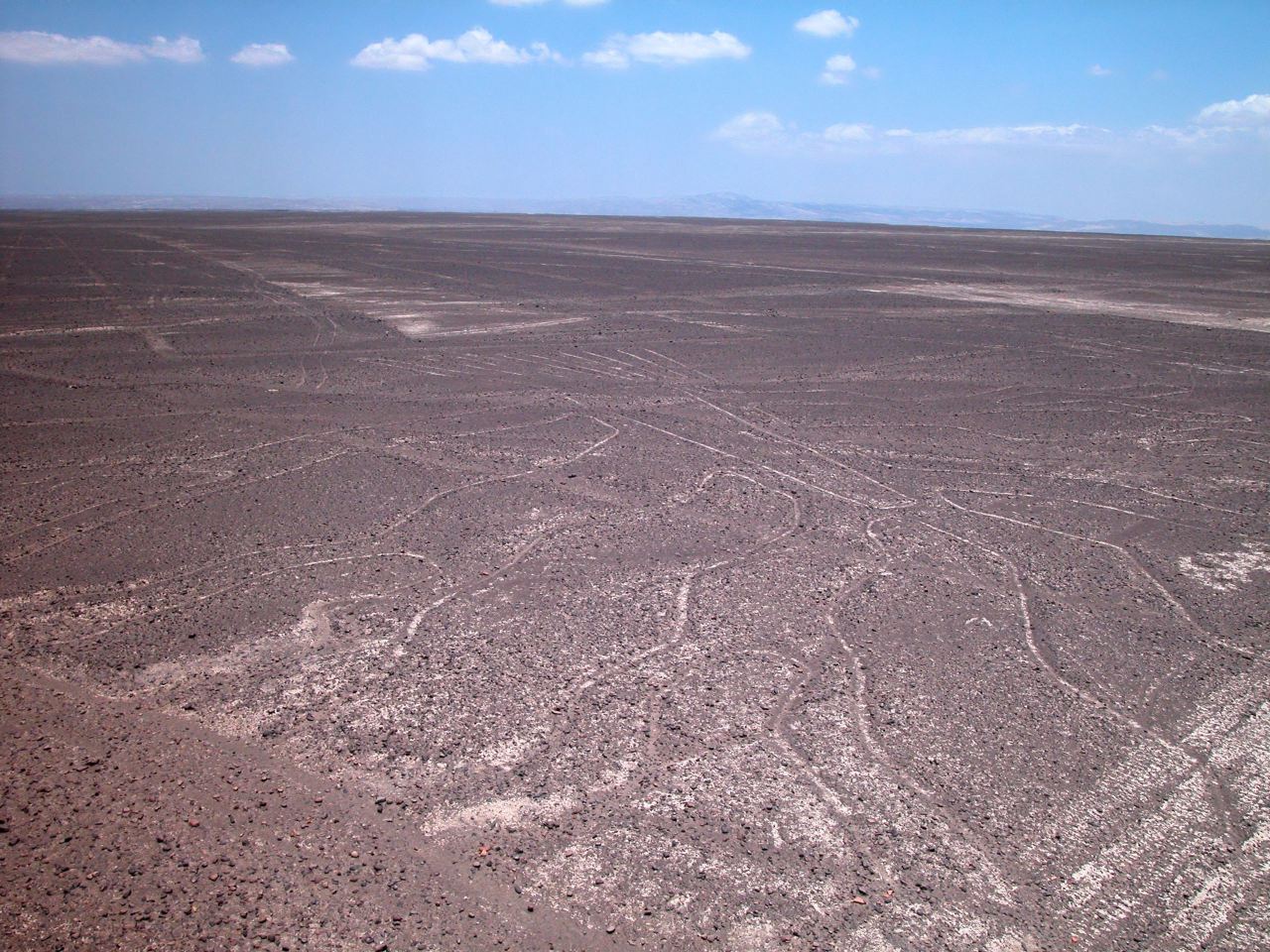
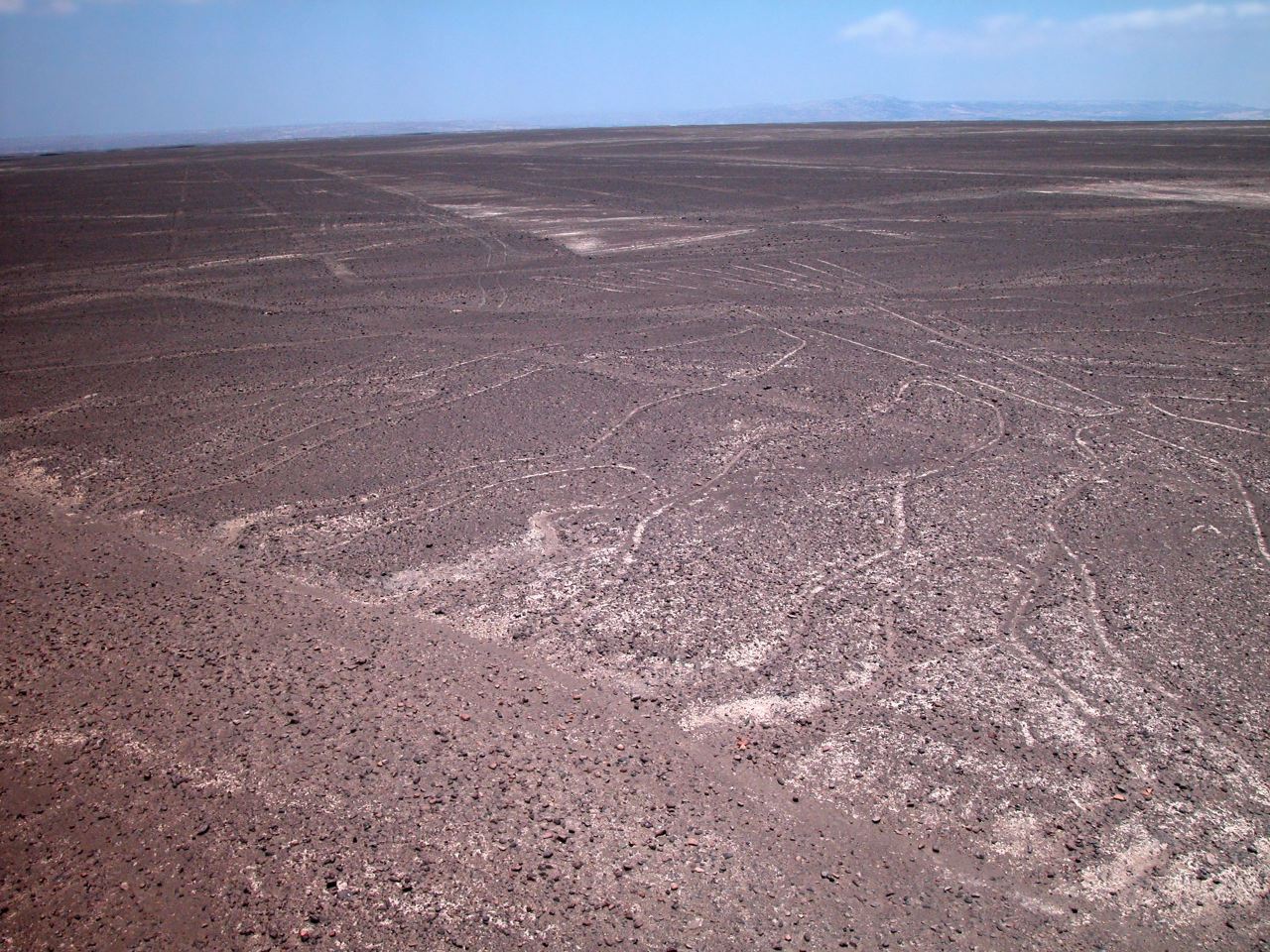
It was a shame we didn't get to walk round. Perhaps the one good reason to keep people out is that some artist will always want to add to the design. A computer, say, or something else to prove the alien theory. The local people have taken up the idea, by the way. All over the country, mountains are adorned with advertisements or slogans such as ‘Vasya was here’, ‘Class 10A, graduating 1974’ or ‘Buy your fish only from us’.
Apart from the desert figures, there's a Spanish viaduct around Nazca and an excavated pre-Inca cemetery.
This is one of the driest deserts in the world. Nothing can rot here and things stay preserved for ever. This applies to burials as well. Even if a body hasn't been deliberately mummified, it keeps as well as an Egyptian mummy. The local burials are seven hundred to a thousand years old, from a period just before the rise of the Inca empire.
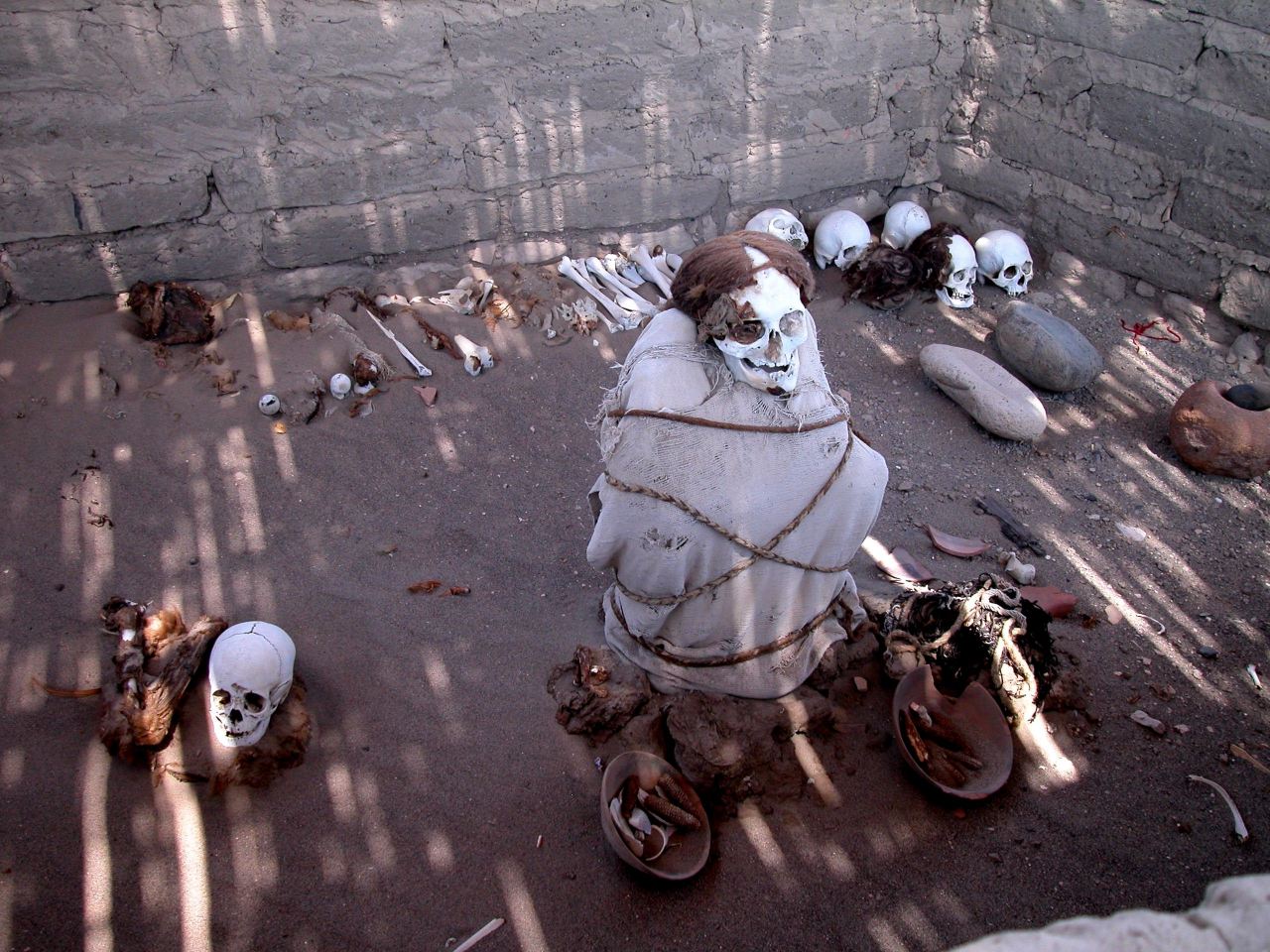
The cemetery was excavated and made into a museum. The custom was to bury people in families, in a sitting position. In the grave they put a variety of useful things and provisions in pottery vessels. Several burials are laid out for visitors, but an enormous area around them is covered with bones, skulls and masses of shards. You can wander around if you want and prise a fragment from some old pot.

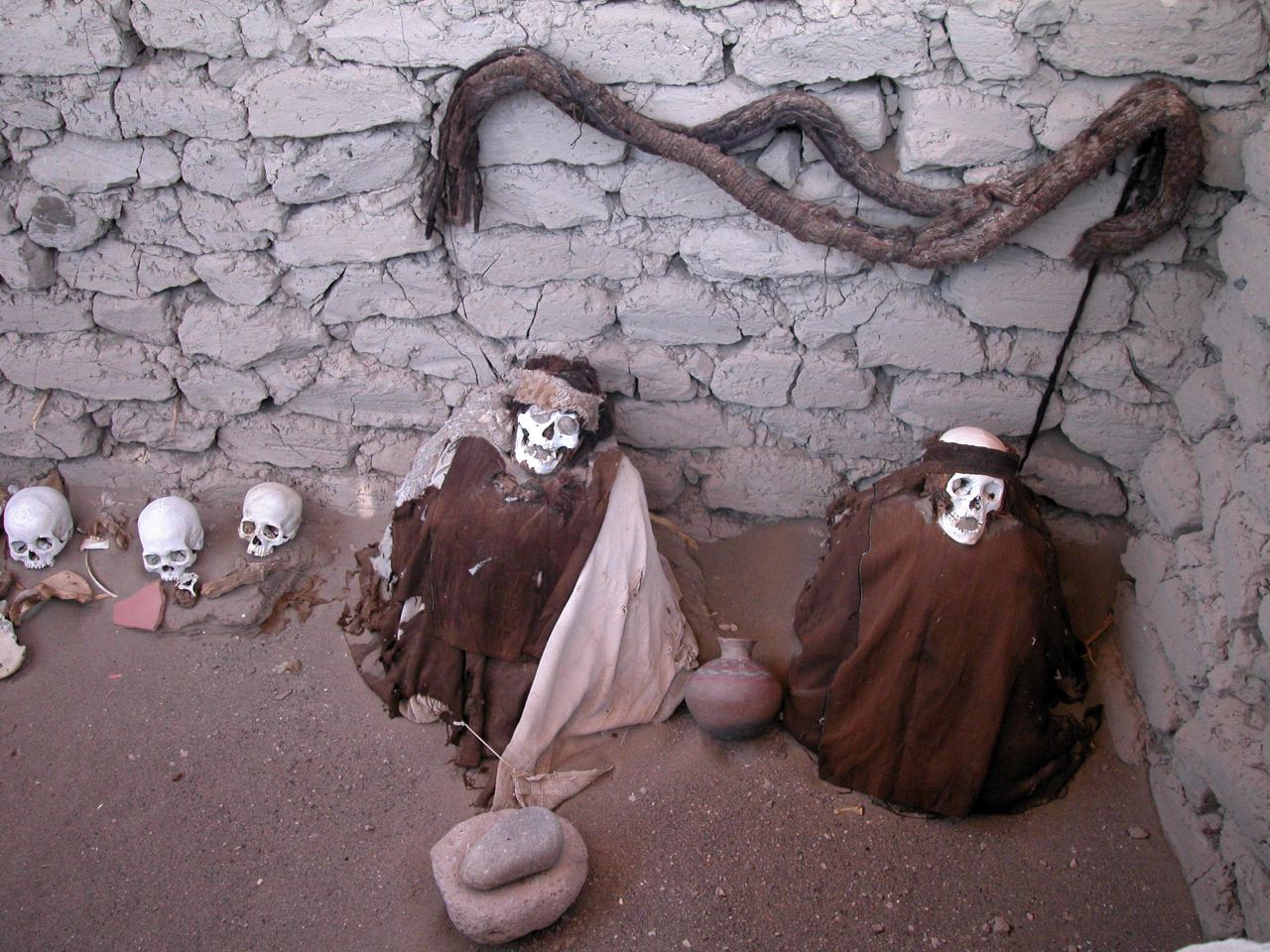
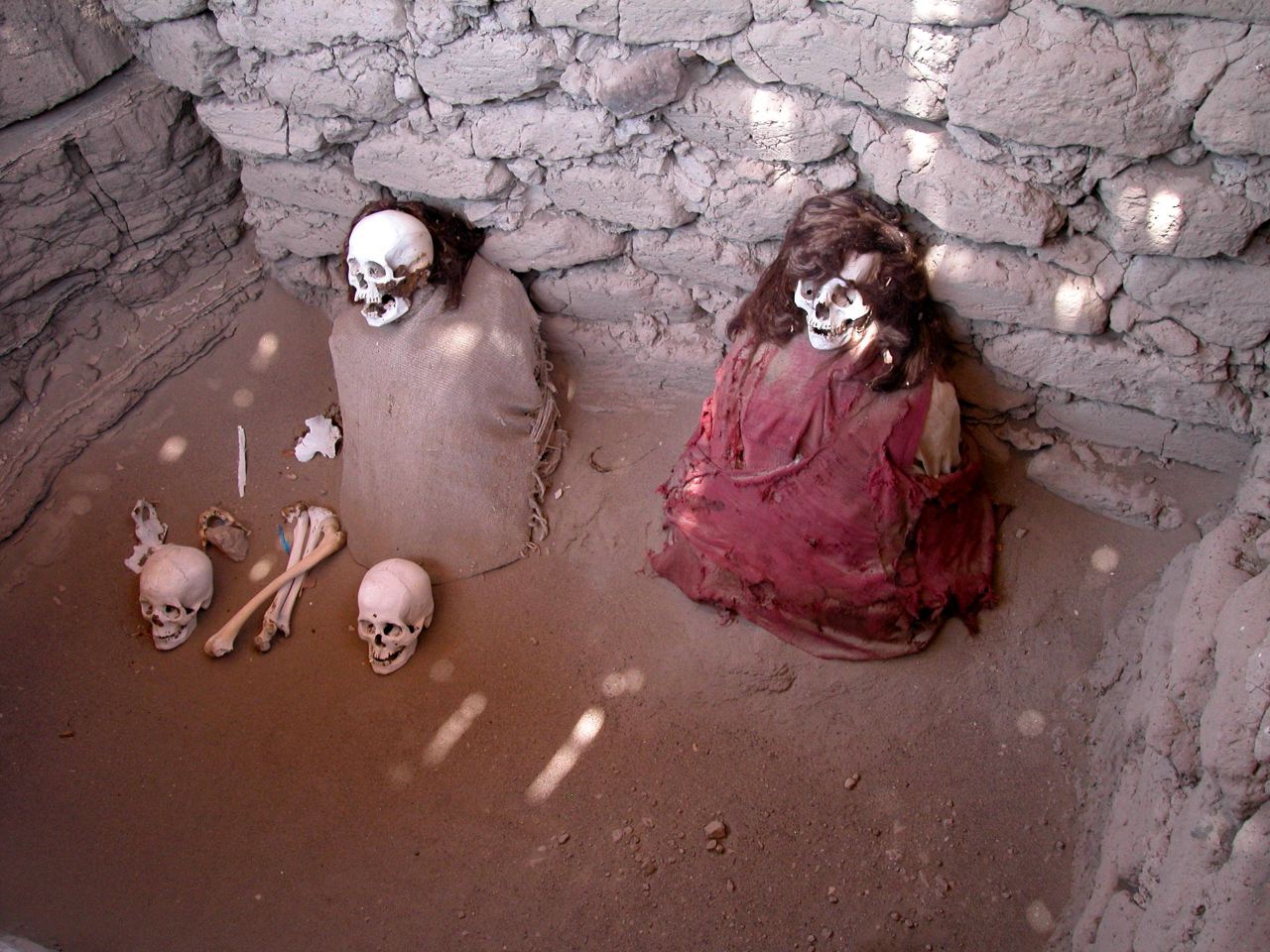
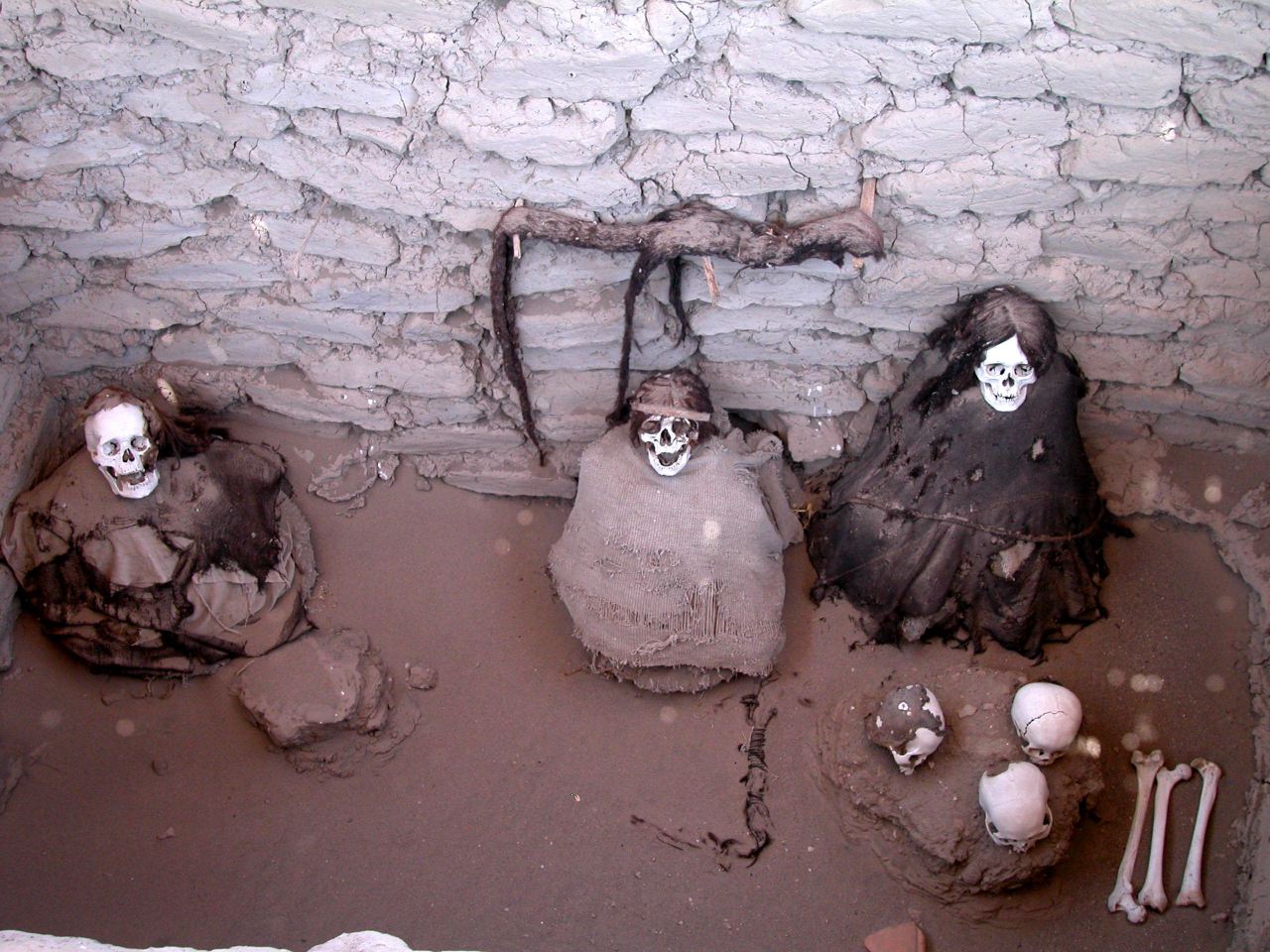

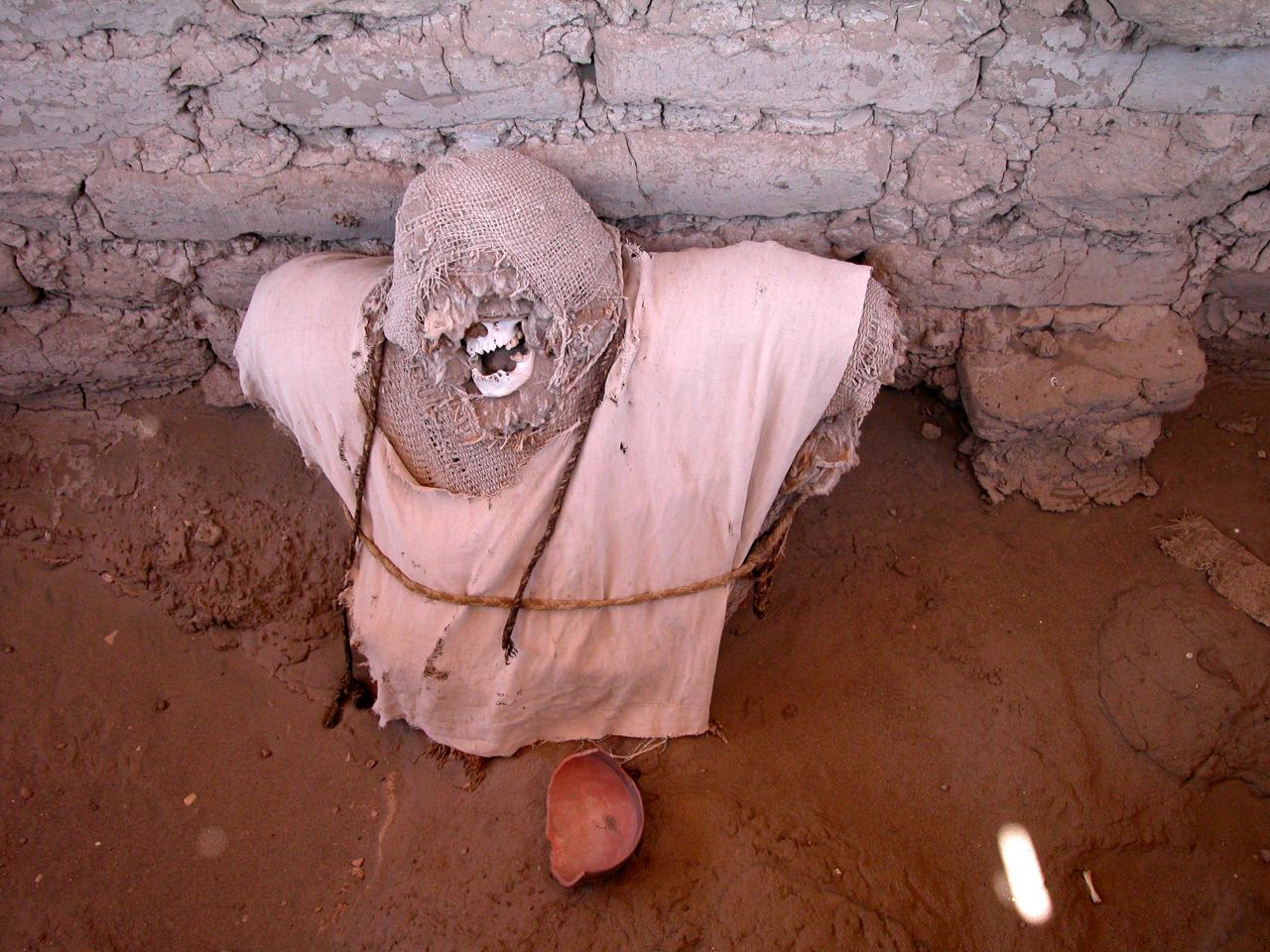
Like many other pre-Inca sites, this cemetery south of Nazca doesn't attract a lot of tourists. Most literature on ancient Latin America is about the Inca empire. Probably because the Spanish fought it, because it took over half the continent, and because in the twentieth century it felt relevant as an analogy to fascism and Bolshevism. But if you think about it, the empire only lasted two hundred years. In that time it managed to rise and decay, ruining the economies of peoples who had flourished for thousands of years before it.
The first settlers in what is now Peru appeared around twenty-five thousand years ago, according to what we read. They came originally from Chukotka, crossed the Bering Strait and peopled the whole American continent.
Some two and a half thousand years ago, a succession of highly developed civilisations began to appear. Weaving and pottery reached a remarkable level. Cities and pyramids were built. The rise of the Incas, with their forced equality, lack of individual rights and all the other trappings of socialism, looks less like the flowering of civilisation than a collapse and a catastrophe.
South of Nazca, the road follows the coast across lifeless desert. It's one of the driest places on Earth. It only rains here once every few centuries. That isn't enough for plants, so the desert is entirely bare. Settlements are rare. Only at the mouths of rivers running down from the mountains are there green gardens along the banks that give the inhabitants a few vitamins. They still have to get their staple food from the sea.


The Incas preferred to live in the mountains, but there's one exception. Just north of the modern village of Chala, they built the port of Puerto Inca. It isn't known where they sailed or why, but the ruins show beyond doubt that they'd learnt to navigate. Their desire to become a great sea power only hastened their end. One day the Spanish intercepted a balsa raft and found gold aboard. That gave them grounds to look for a country where they could make a hefty profit. Without that discovery, it might have been another century before the Spanish reached the cold, high plains inhabited by the locals.
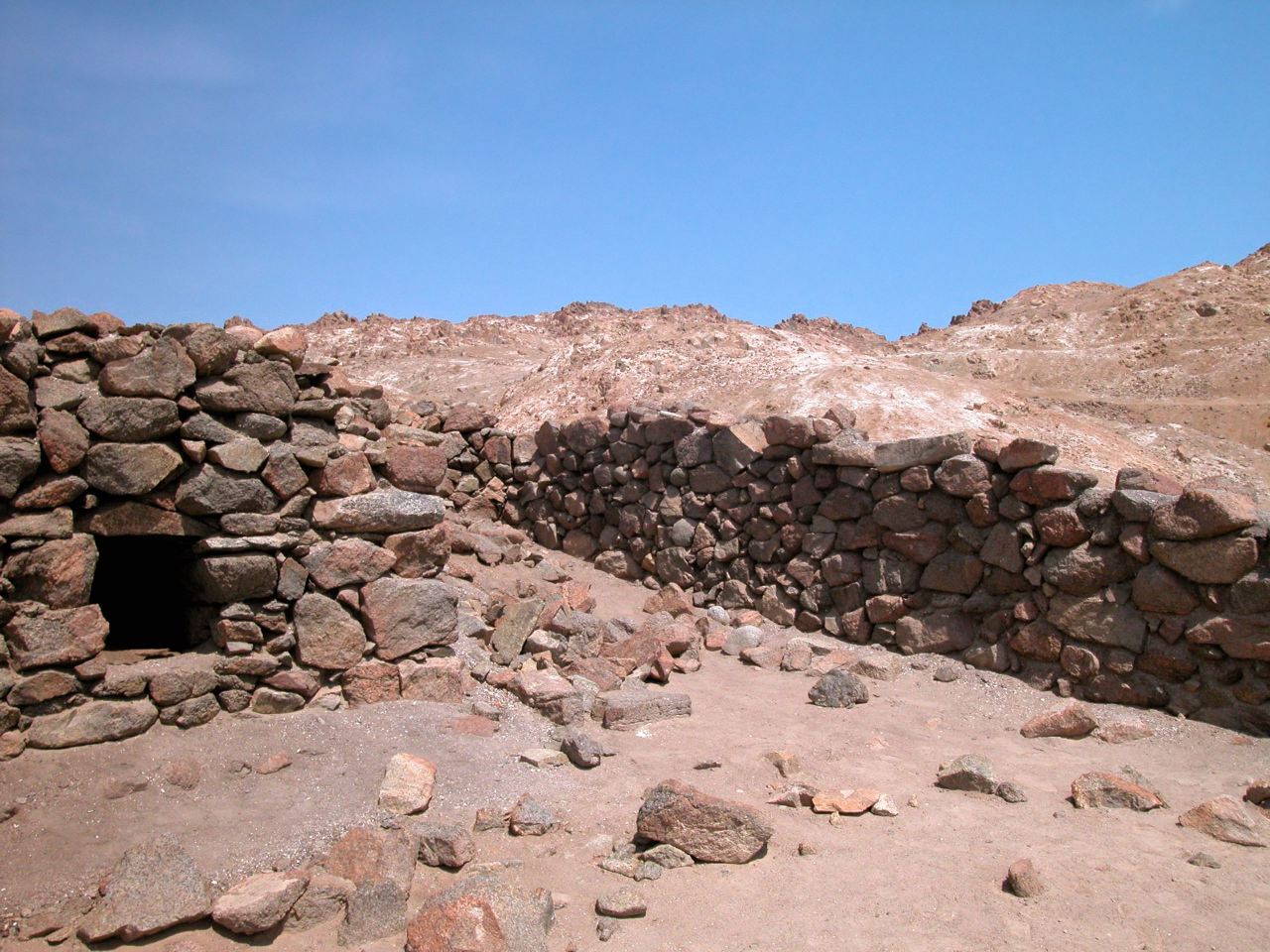
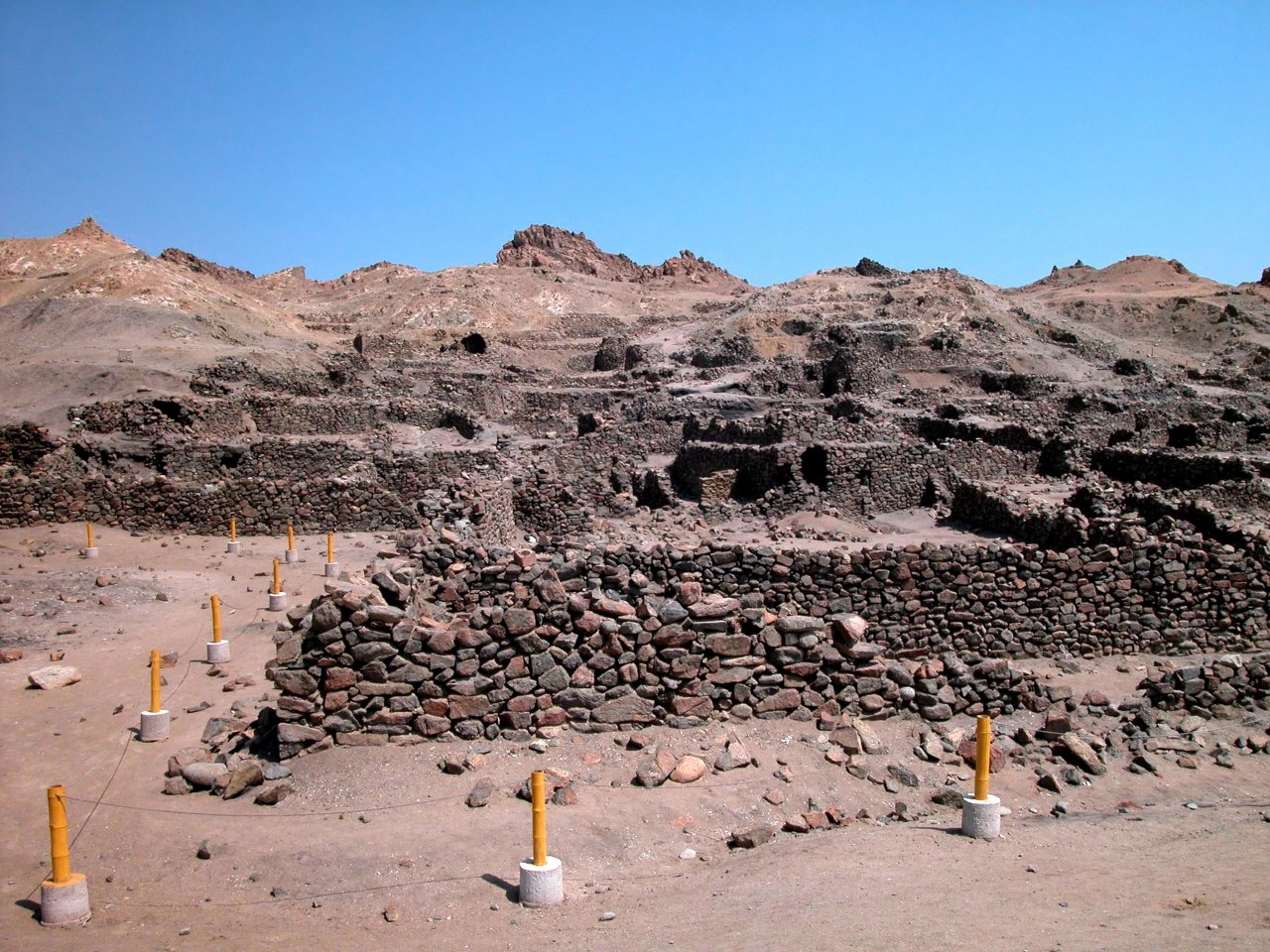

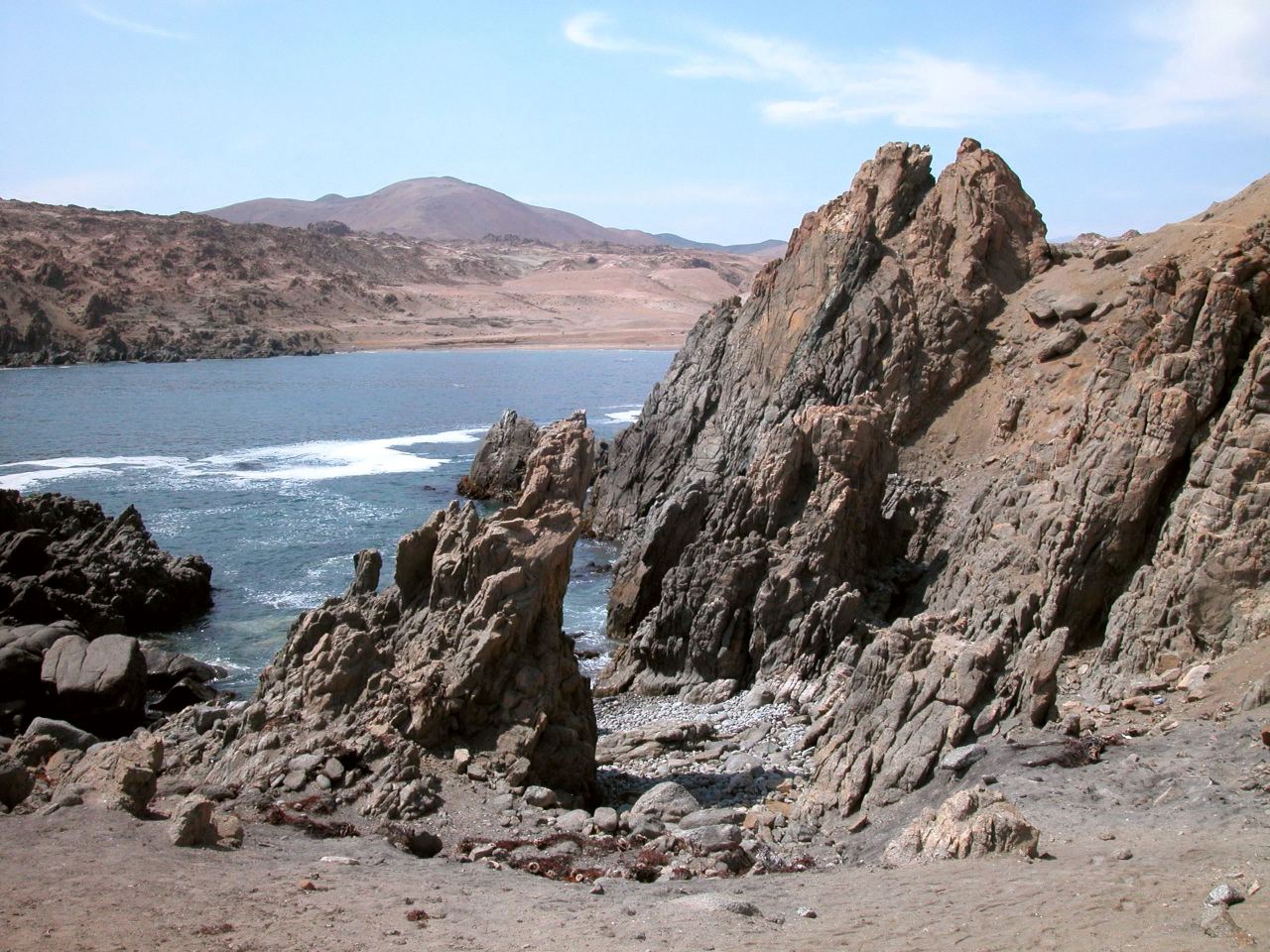
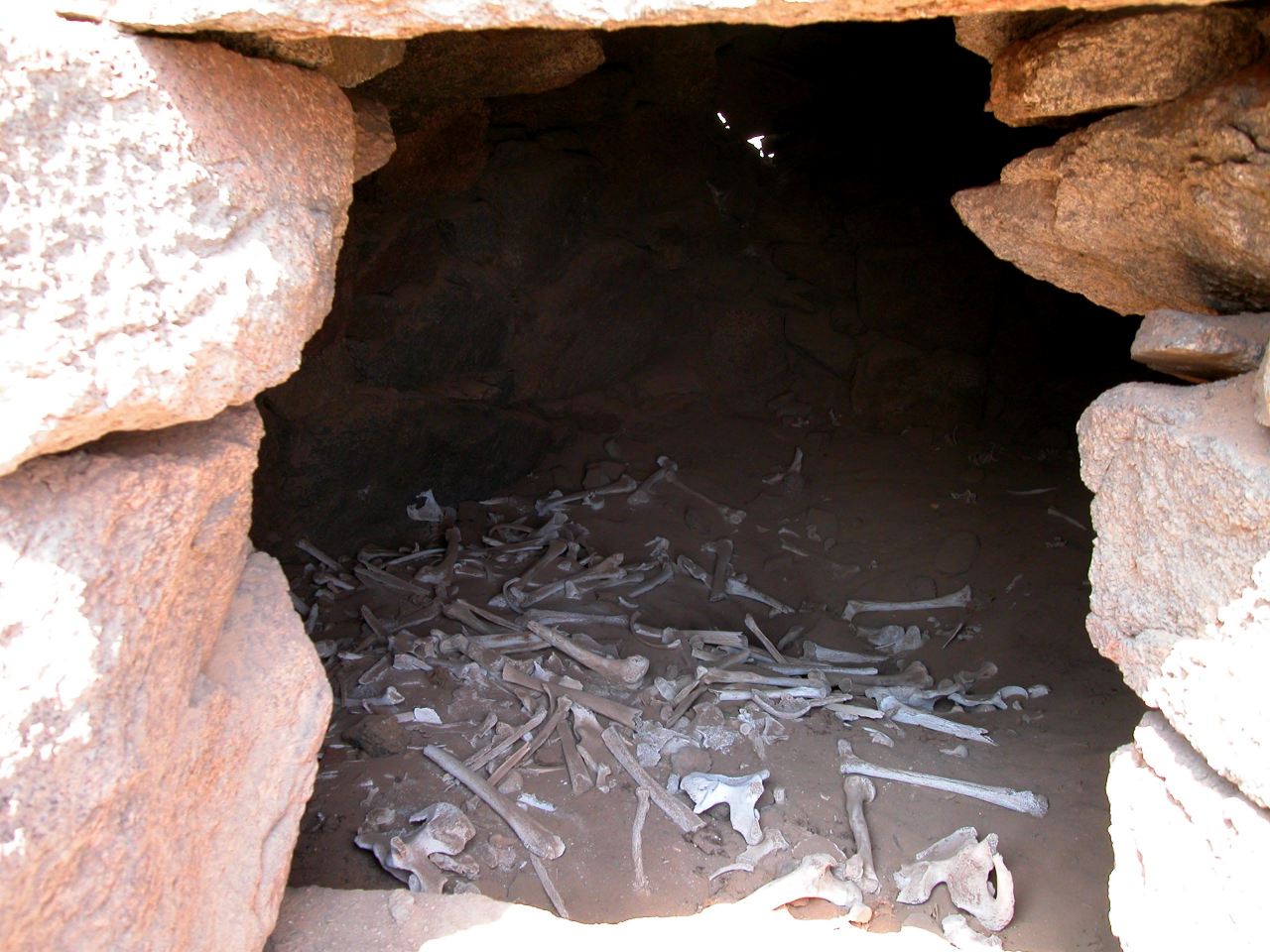
A very good complex with a hotel and restaurant has now been built beside the ruins. We happened to come by in the middle of the day, so all we used was the restaurant. Lunch there for three was seventy soles, quite reasonable. The overnight price was less good. A triple room cost US$49. That's expensive, of course, but in line with the facilities. You can camp to save money at two US dollars per person.

The ruins of the port aren't remarkable in themselves, except for the human bones scattered all over them. The majority of the structures are storerooms. To store grain and other supplies, the Incas built large cylinders, like modern grain silos.
After wandering around the ruins we decided to have a swim. The hotel is beside a fine beach with black sand, but ocean waves several metres high make it hard to get in. I was the only one to break through the surf and make it out to sea, after swallowing a great deal of water and being hit in the head more than once by stones.
Just beyond Ocoña the mountains come down to the ocean and the Pan-American Highway turns into a narrow mountain road, all hairpin bends. The wind drives sand over the mountains. A little farther north, the Peruvian coastal desert is essentially rocky with the odd metre-high dune. As you go towards Arequipa, there is more sand and it forms huge mountains up to a kilometre high. They say the tallest dunes in the world are here, and you can indeed see kilometre-high mountains of sand from the road. It's an impressive sight, though of course the sand isn't a kilometre deep. There's an ordinary mountain of rock under the dune. That's easy to see. The Pan-American Highway had recently been rebuilt. They straightened the original route, which followed a road built by the Incas, and in a few places made cuttings right through the dunes. In cross-section, you can see that the body of the dune consists of rounded boulders shaped by the tides. The sand simply covers the mountain. As you approach Arequipa, the mountains become craggier. The sand won't stay on the sheer slopes, which makes a very curious scene: black mountains sticking out of white sand. It looks like a high mountain range covered in snow.
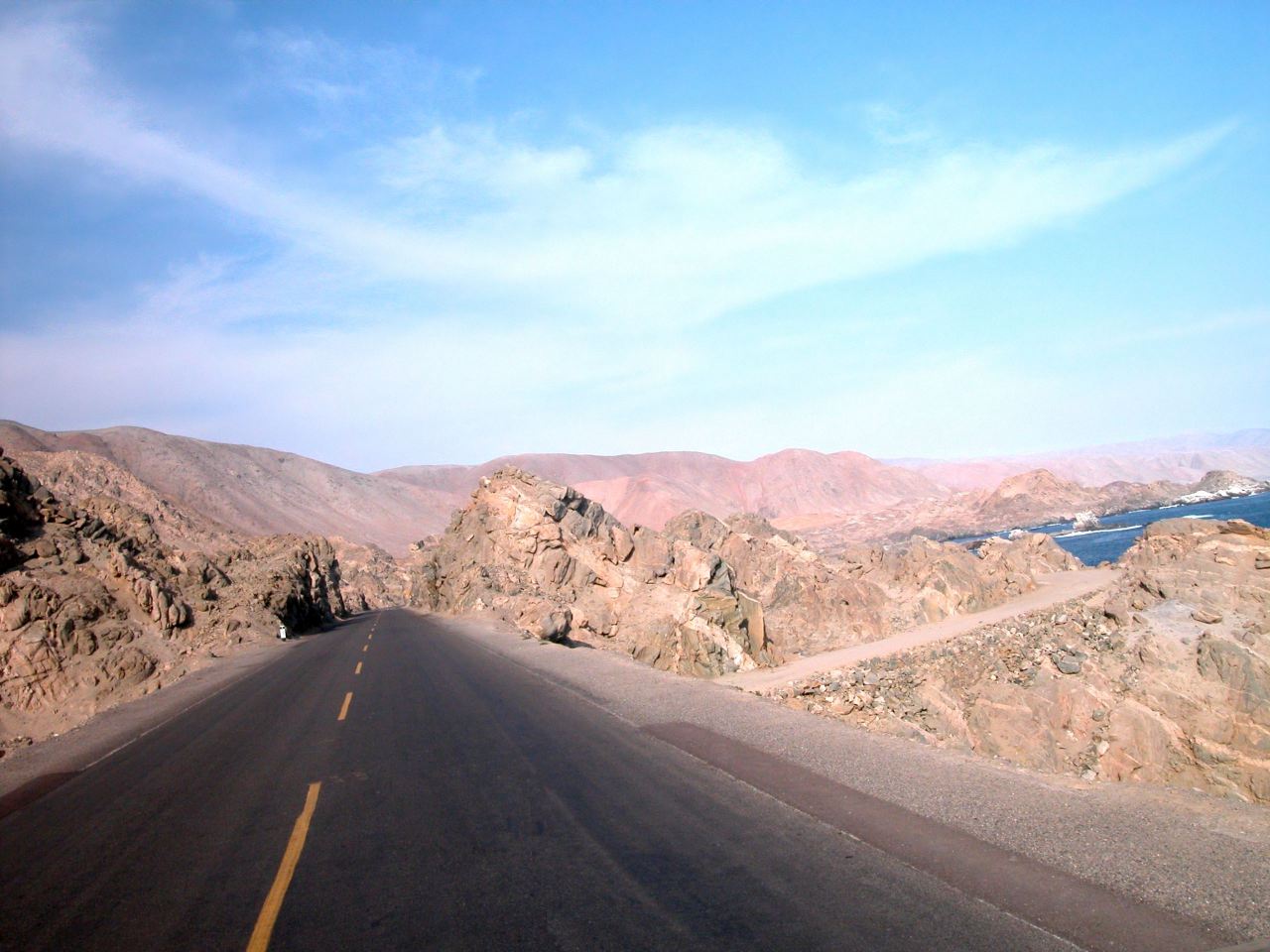
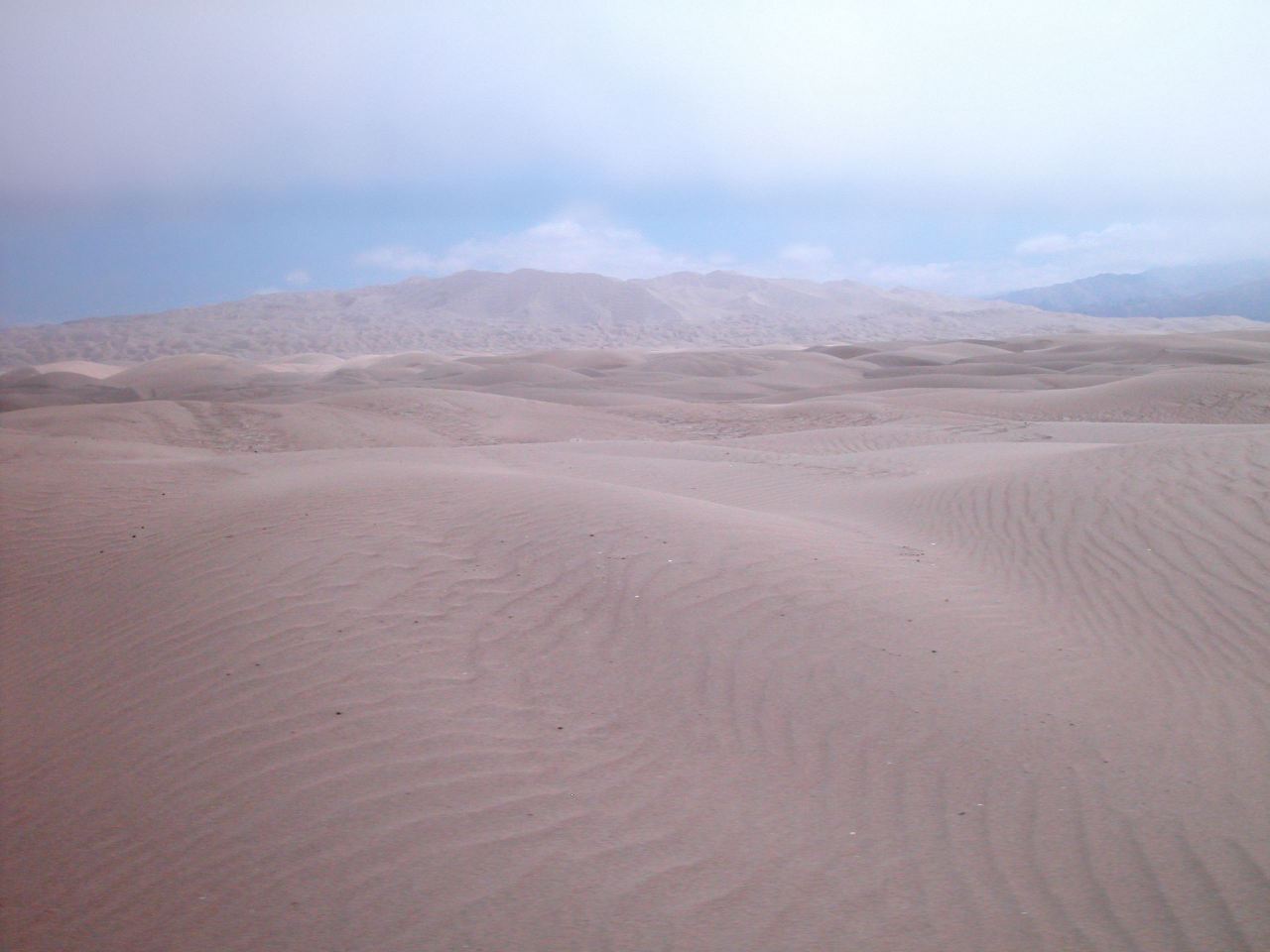
It doesn't rain on the coast, but a hundred kilometres inland in the mountains there's thunder almost every day. In millions of years, mountain torrents have cut some of the deepest canyons in the world into the Andes. Tourists are generally taken to Colca Canyon, but the neighbouring Cotahuasi Canyon is deeper, up to four kilometres. The cliffs don't allow for a road along the river, so the only way in is along a two-hundred-kilometre road, most of it unsealed and passing above five thousand metres. It's about twelve hours one way. This has kept mass tourism at bay so far. If there are no crowds, that's exactly where we should go.
The Cotahuasi road leaves the Pan-American near Tambillo. We reached the junction after dark and camped rough in the desert itself, a few hundred metres off the road (16°25.675′S, 072°22.822′W, elevation 979 m). An utterly lifeless plateau. The rock underneath was covered in a few centimetres of grey dust, like the Moon. All very well except that everything gets dirty on the spot. We had to climb to the top of a small rise where there was hardly any dust to camp. We'd just pitched the tent when, unexpectedly, it began to rain. Impossible! It doesn't rain here. All right, on with the fly. By the time we'd got it on, the rain stopped. After dinner, Tanya and I went for a walk together. The Moon lit the otherworldly landscape, it wasn't hot, and it was easy to breathe. Far away in the mountains, lightning flashed. Marvellous. Somewhere up there it was winter and a frosty morning, and we were lying here on the sand.


We got up before dawn. A long drive lay ahead, but now the car wouldn't start and I hadn't the faintest idea what to do. It was diesel, with nothing I could unscrew and clean. After a few minutes the trouble cleared up on its own. The engine spluttered and began to rattle away. It was a little worrying to head into wild mountains with an engine like that.
There's tarmac as far as Aplao and they're laying it as far as Chuquibamba. Beyond that, a narrow, well-used dirt road climbs the sheer slope in hairpins. It does rain here, and there are cacti growing all along the roadside. Having gained four kilometres of altitude and surmounted the wall of the canyon, we emerged into a high mountain valley. Cold, with a wind blowing. The road leads to a pass near the snow-covered 6,613-metre peak of Nevado Coropuna. Now there were snowdrifts all around us. We stopped at the pass for lunch. After so much time in the mountains of Bolivia, Tanya and I adapted easily to the altitude. The air even seemed light and pleasant to breathe, after the humid, clinging air on the coast. Lena was ill, however. Altitude sickness had caught up with her. It was her first time at five thousand metres, and she was getting worse.
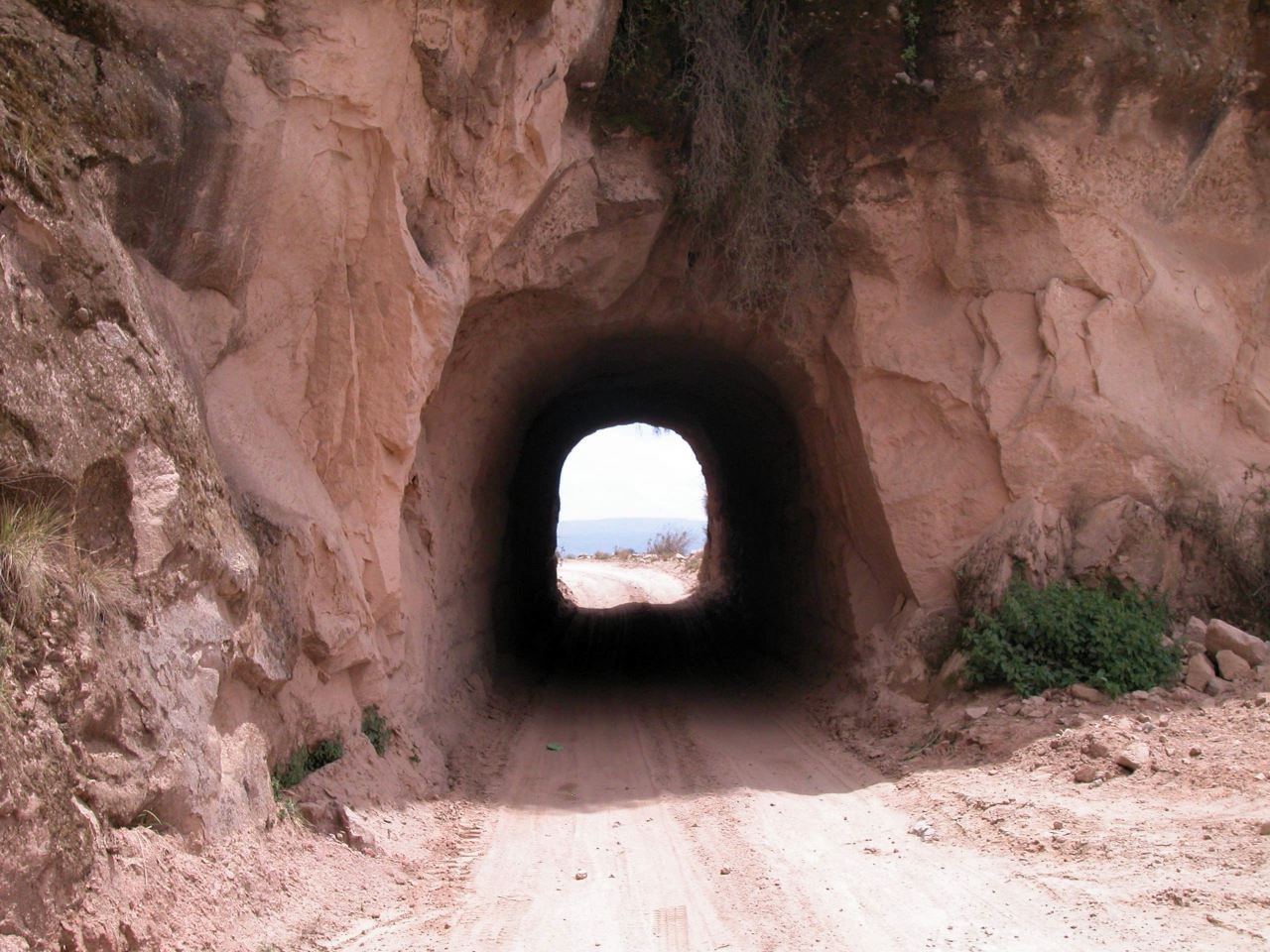
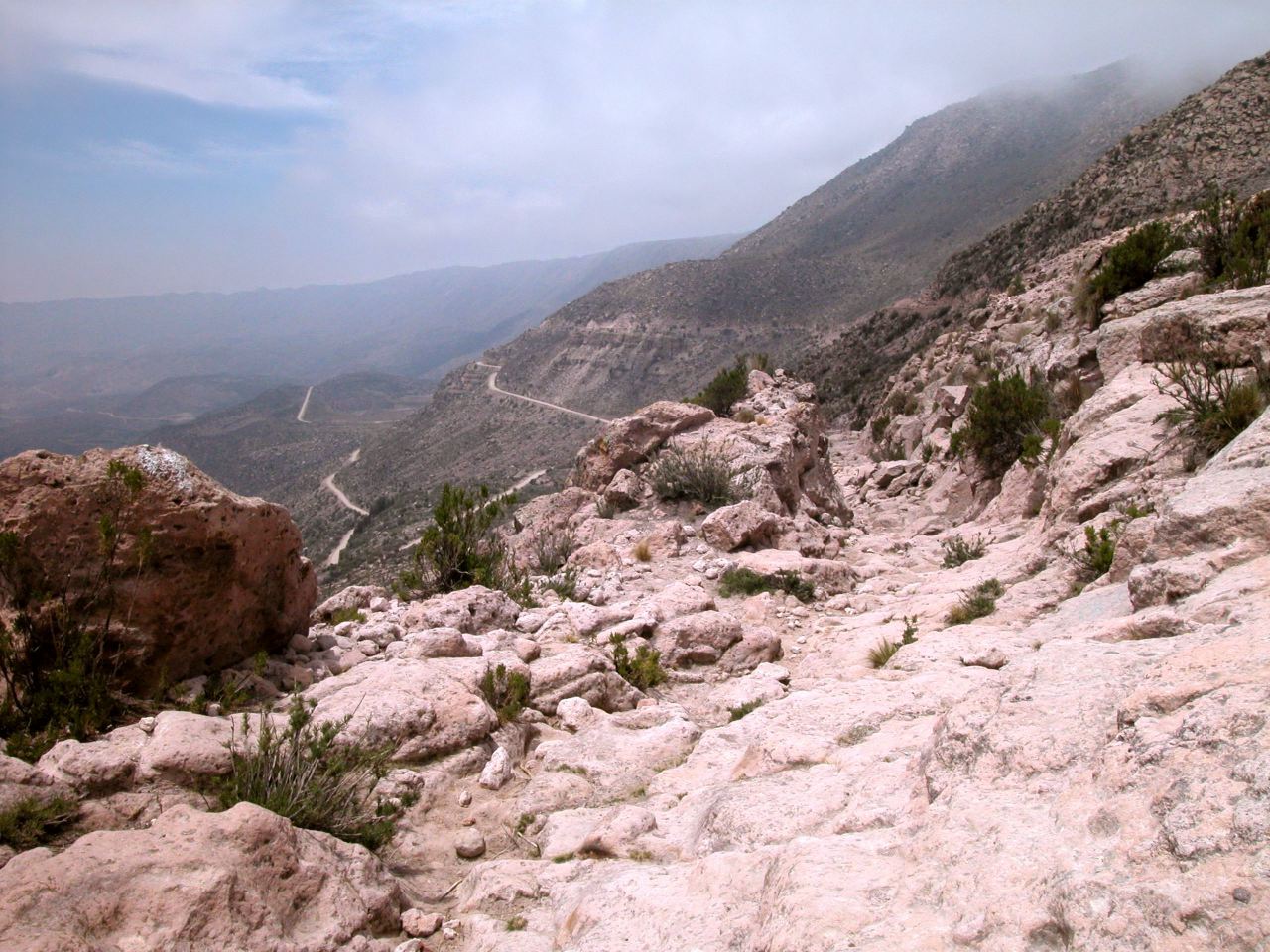


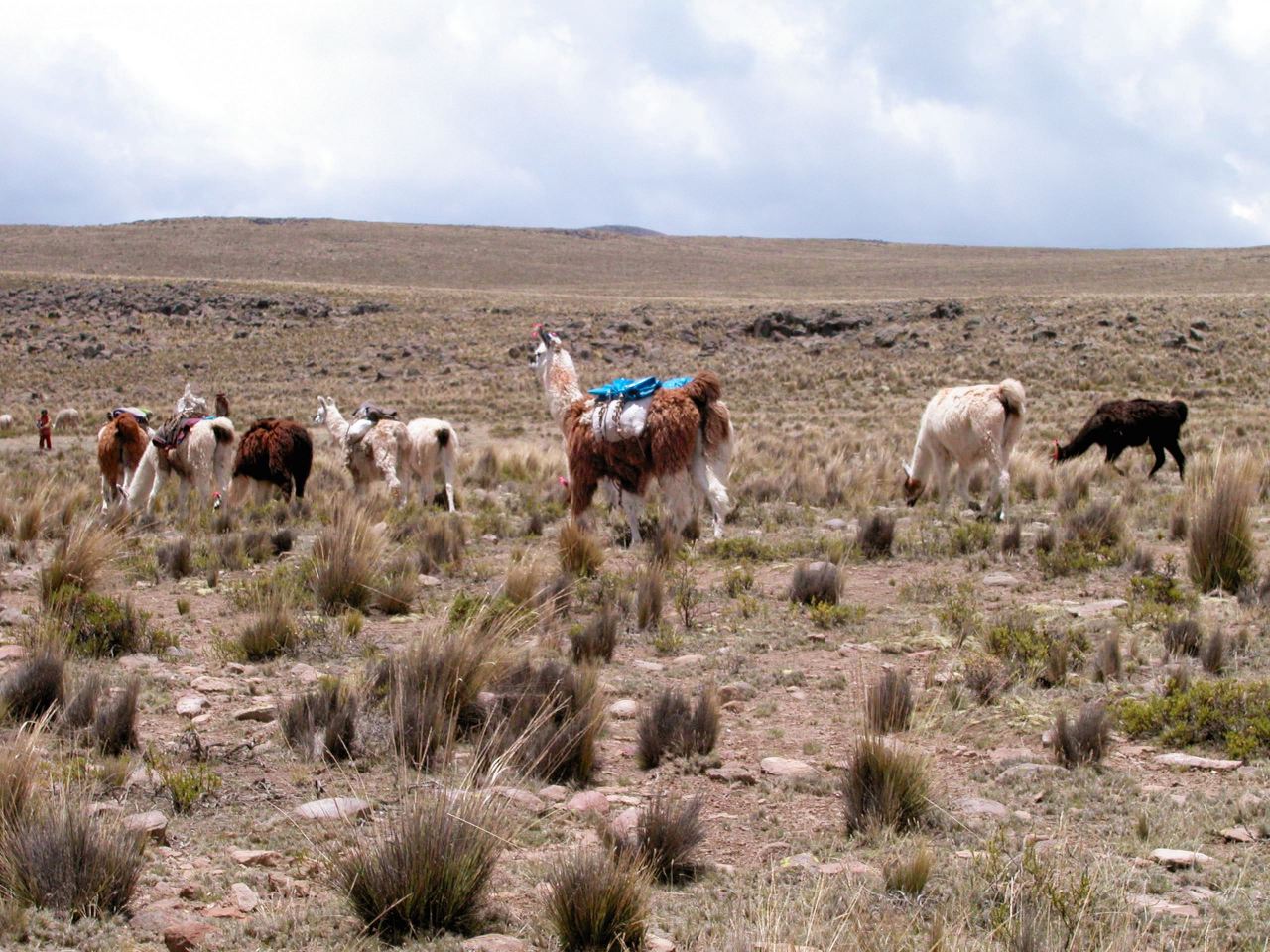
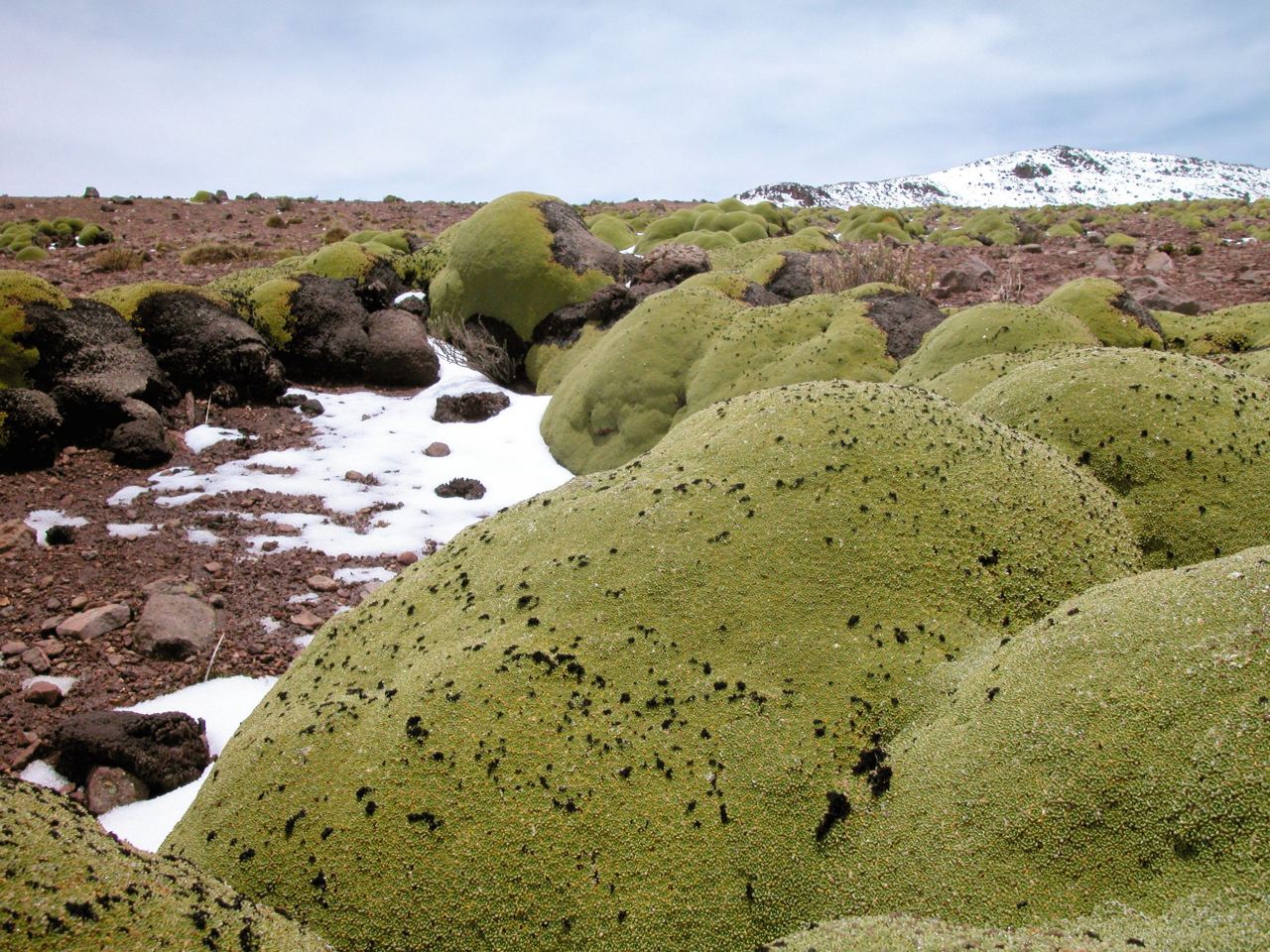

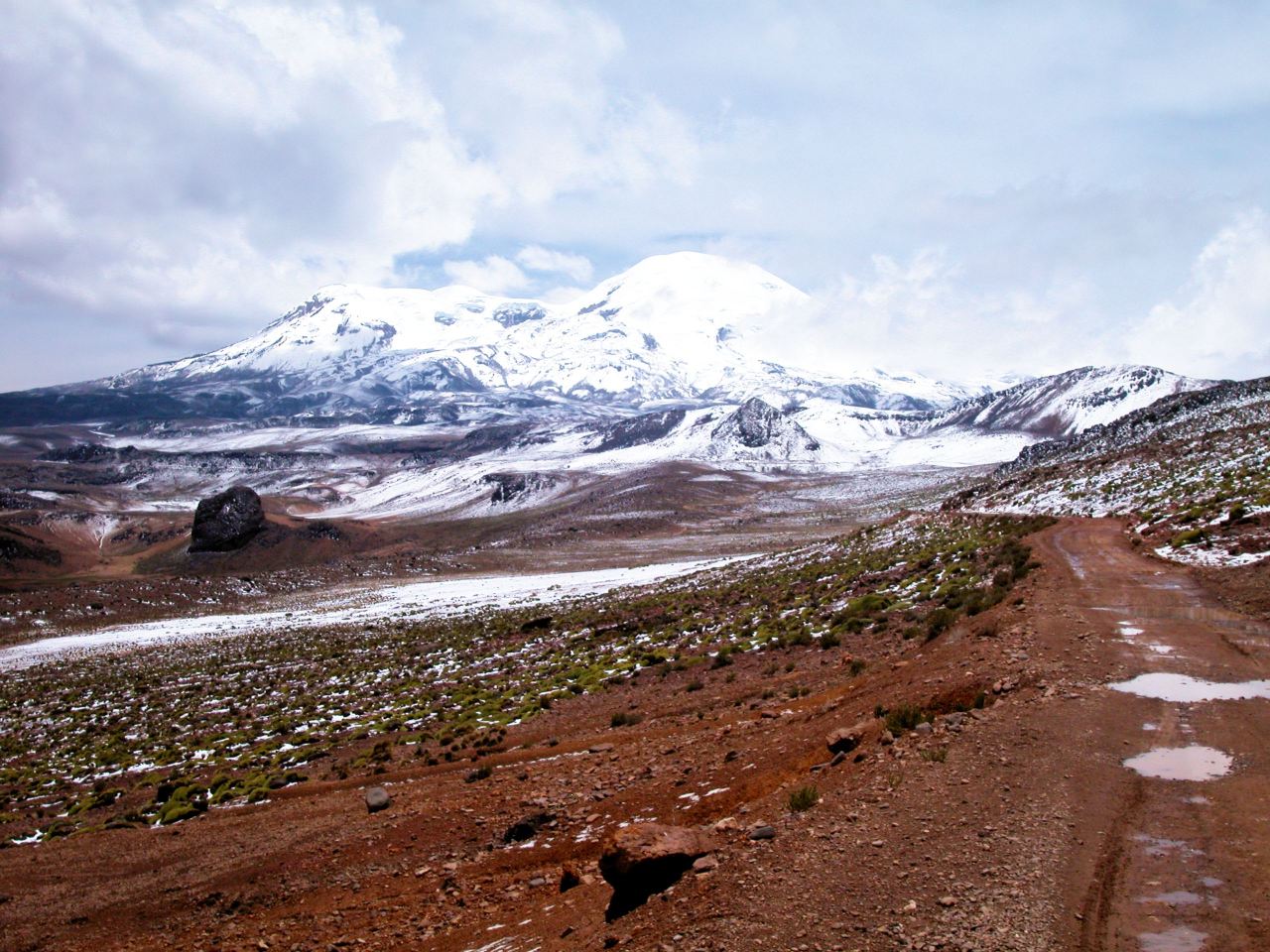

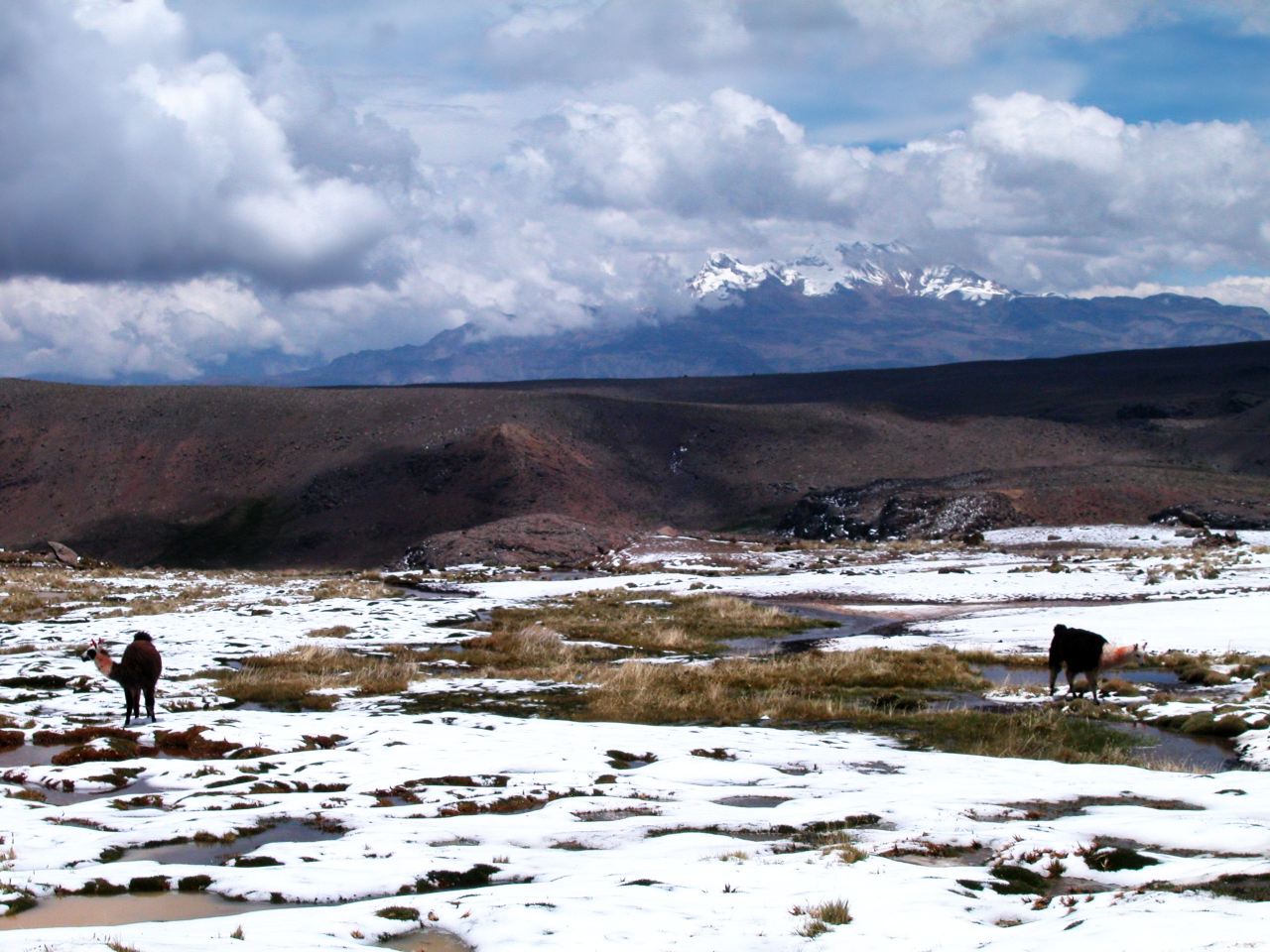
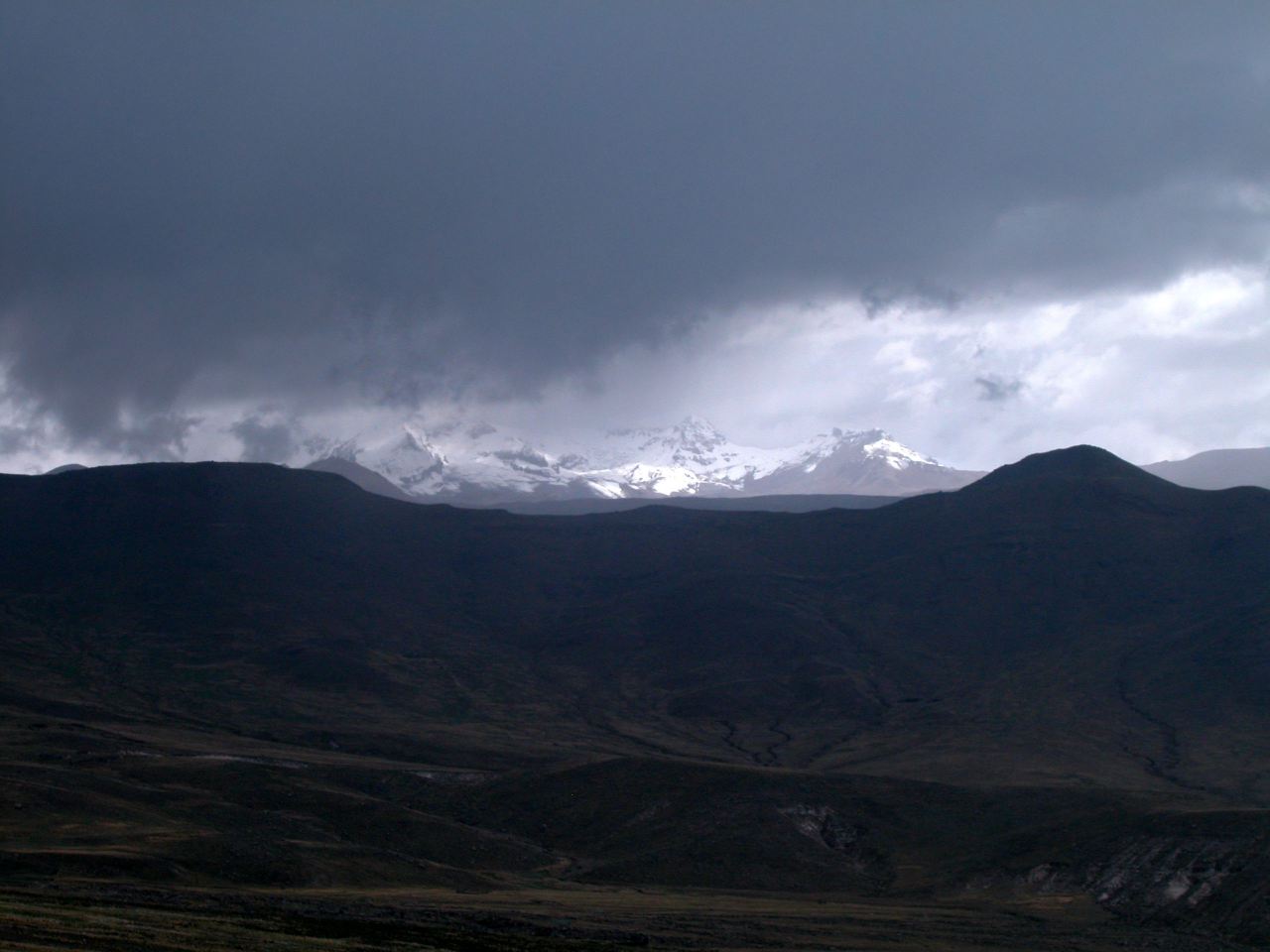

By four in the afternoon the Cotahuasi Canyon came into view. A funny name to Russian ears. We called it Kot Vasya, or Vasya the cat. Somewhere down there, three kilometres below us, we could see the river and the town of Cotahuasi. A view as if from a plane, but I'd expected more. These weren't sheer walls, just a valley with edges three kilometres above the bottom. Most slopes are fairly gentle and only in a few stretches become rocky cliffs. Cotahuasi was only a few kilometres away, but that was in a straight line. We spent another hour and a half winding down hairpins before we came to the town's narrow cobbled streets.

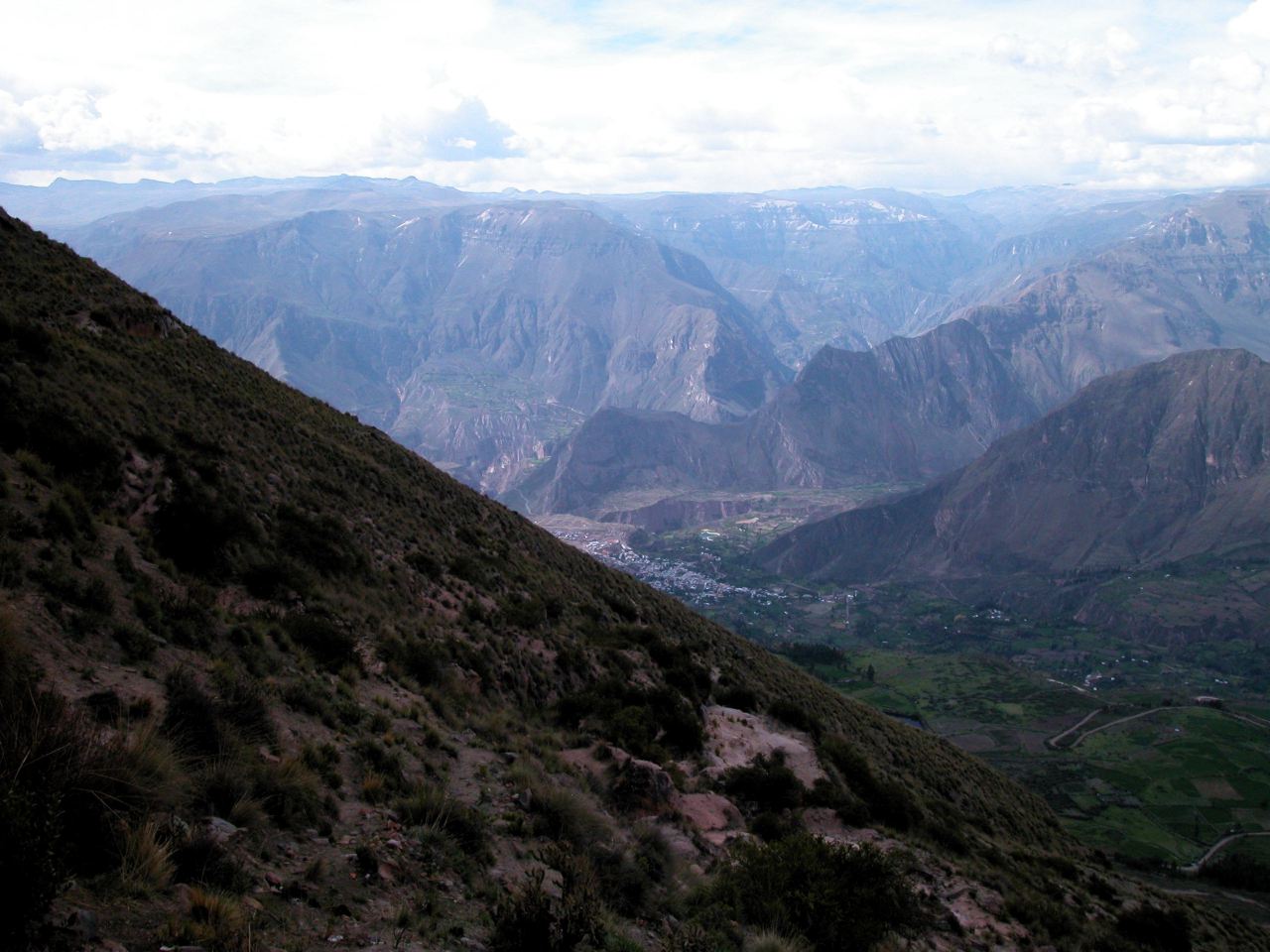

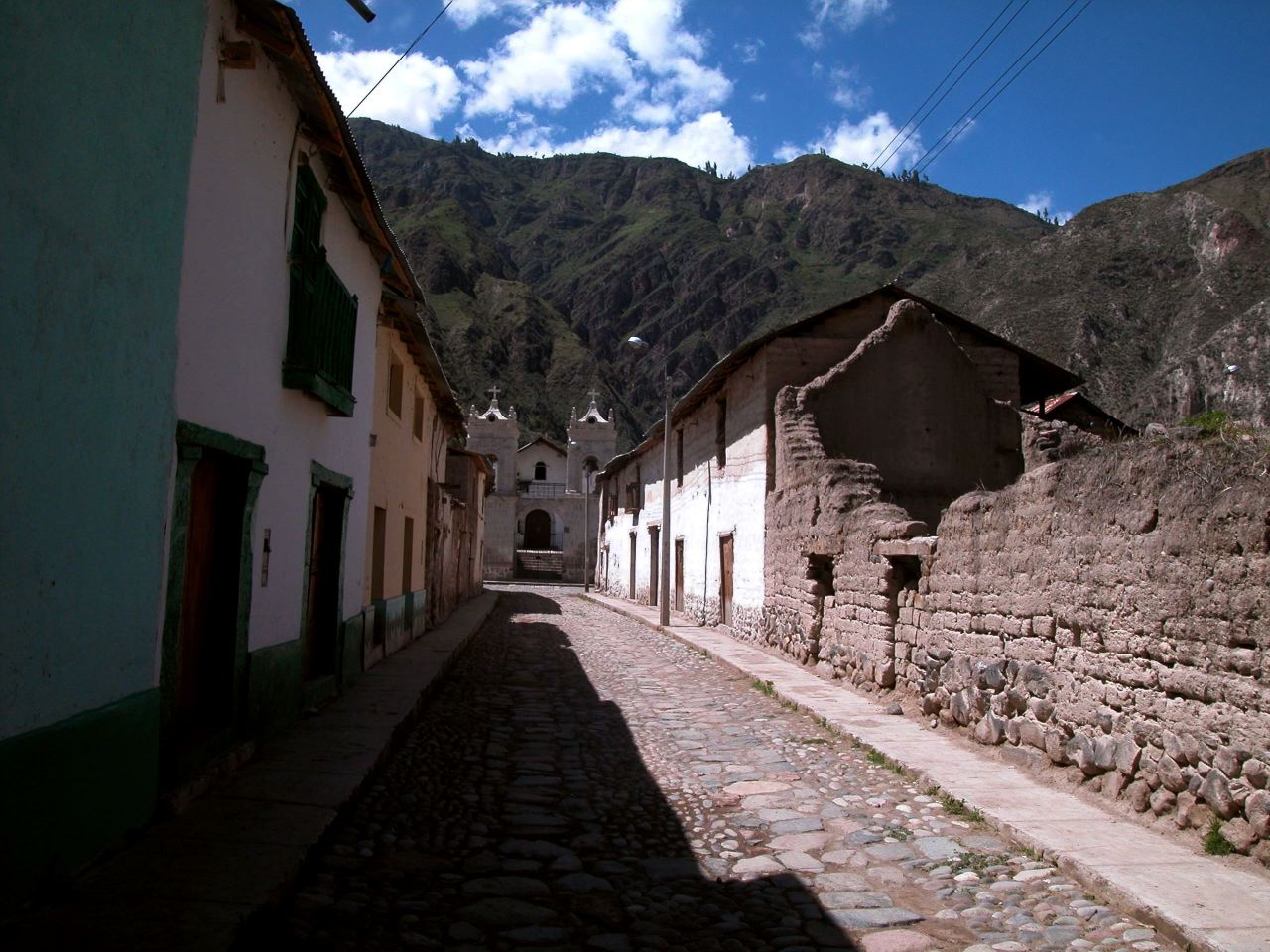
The streets are so narrow that you can only park in the main square, or on the outskirts if there's no space there. The town is quiet and has plenty of character. A foreigner is a rare sight, and locals try to tell you what else there is to see.
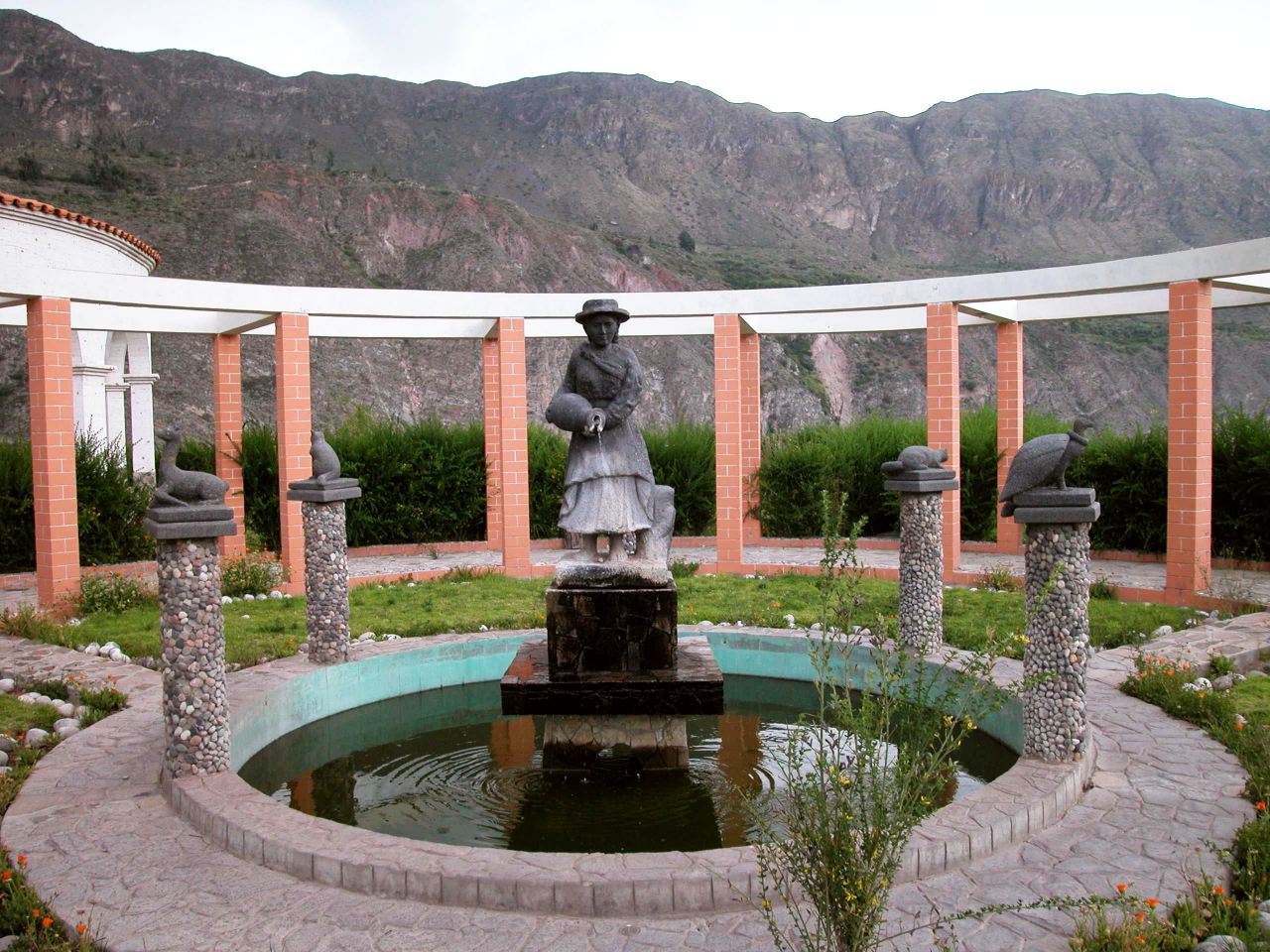
A storm was coming in. We decided not to go farther and to stay in a hotel in town. By the book there are many. In practice half are closed and the rest offer a room with the facilities outdoors. We chose a somewhat bigger room at Hostal Villa. Parking was included, they said, and sure enough they opened the gate to the yard for us. The question was how to get in. The gateway was ten centimetres or so wider than the car, off a narrow street with a drainage channel down the middle. Get a wheel into it and you'd be stuck fast. We spent a long time inching backwards and forwards before finally getting into the appointed spot.
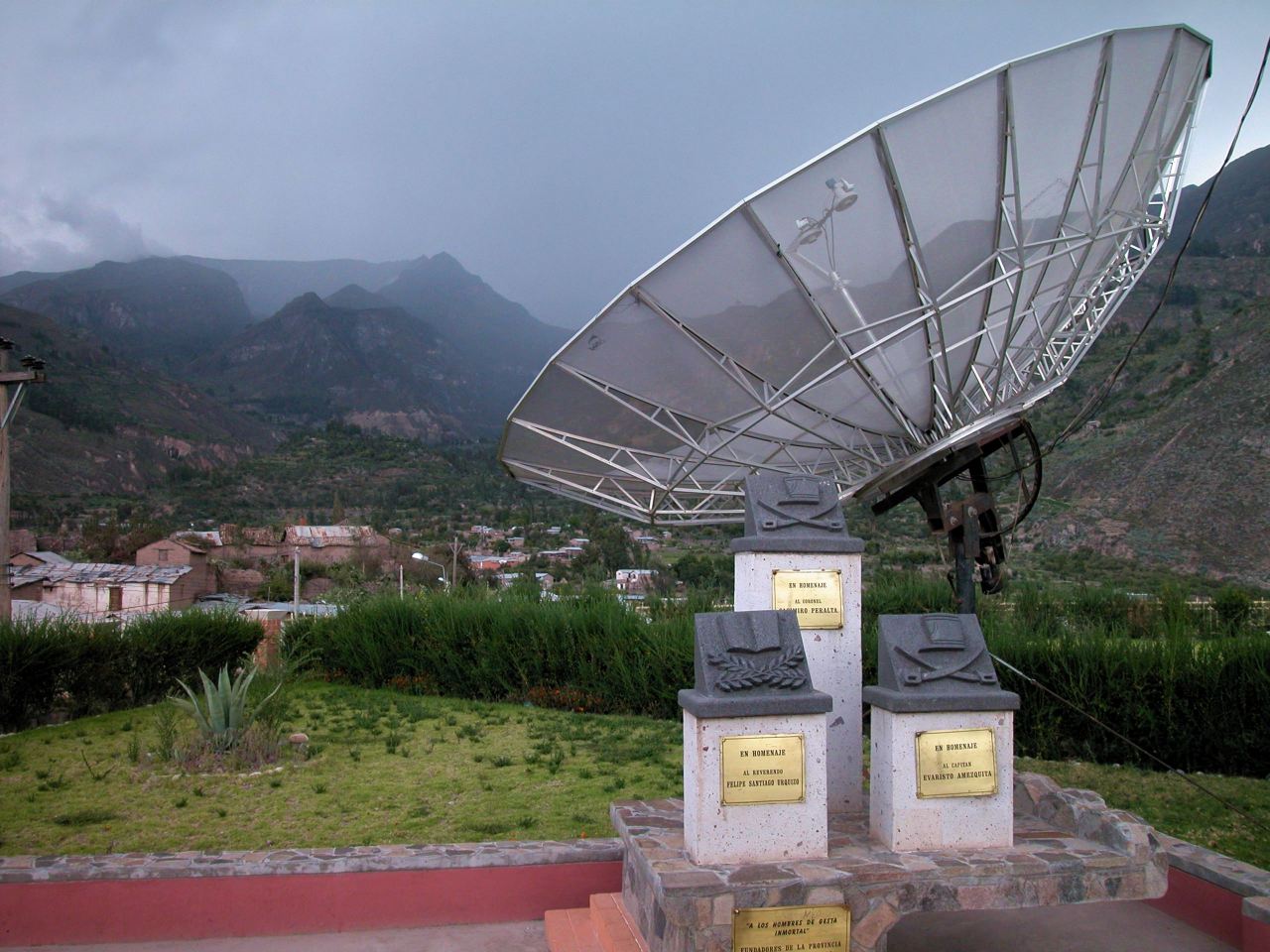
On the main square we picked a little restaurant. Actually it was the only one open. At the others, they suggested we go looking for the owners.
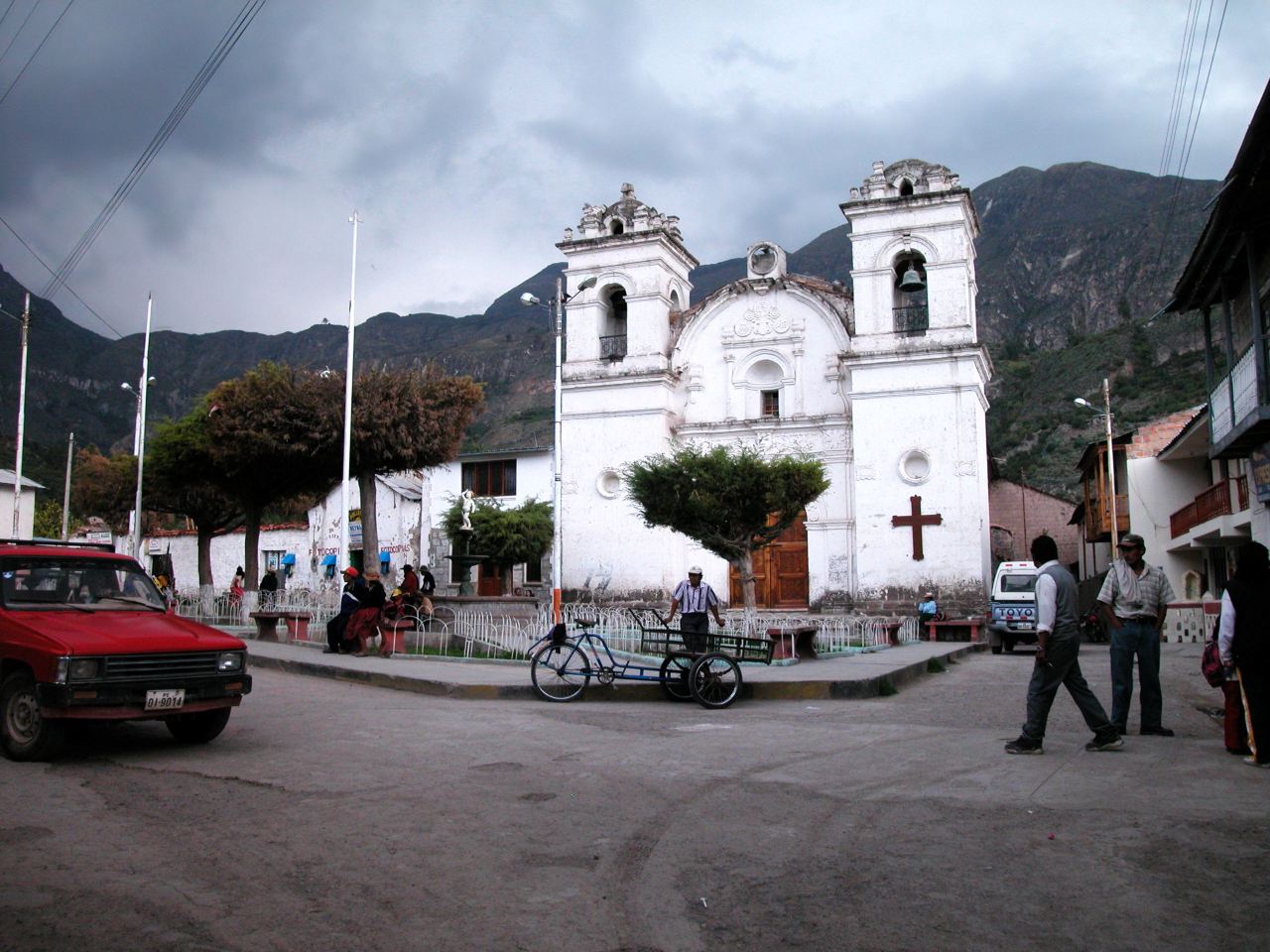
On the menu were soup and chicken with rice. More precisely, there was no menu. There was a woman who owned the place, who glanced over her supplies, spotted the unfortunate chicken that had come to hand, and offered us that combination. We sat down to wait. The walls were covered with posters about tourism development in the area. Caves, waterfalls, hot springs and rafting to the ocean. All very beautiful. You could spend a month here.
The posters were old, though. It looked as if the idea had fallen through, they'd given up on it, and decided to take people only to Colca.
Even the woman in the café couldn't explain how to get to the natural wonders in the pictures.
A rabbit ran round the yard eating flowers from the bed, and a hummingbird flitted a little higher above it. The owner lit the stove. That's life from day to day here.
We asked how much it was. They said 9.50. I'd been thinking of completely different figures. Only the other day a meal for the three of us had been ninety-five. I asked again, not trusting my Spanish. No, not even fifty-nine or nineteen-fifty, but exactly 9.50.
Lena felt truly ill and gave herself up at the hospital. Missionaries had set it up and staffed it. They wrote her a prescription for a thermometer and that was all they did at first. Her temperature was 39°C. Lena took to her bed after swallowing a packet of tablets. If it was the altitude, it should pass overnight. Cotahuasi stands on the canyon floor at only 2,680 metres.
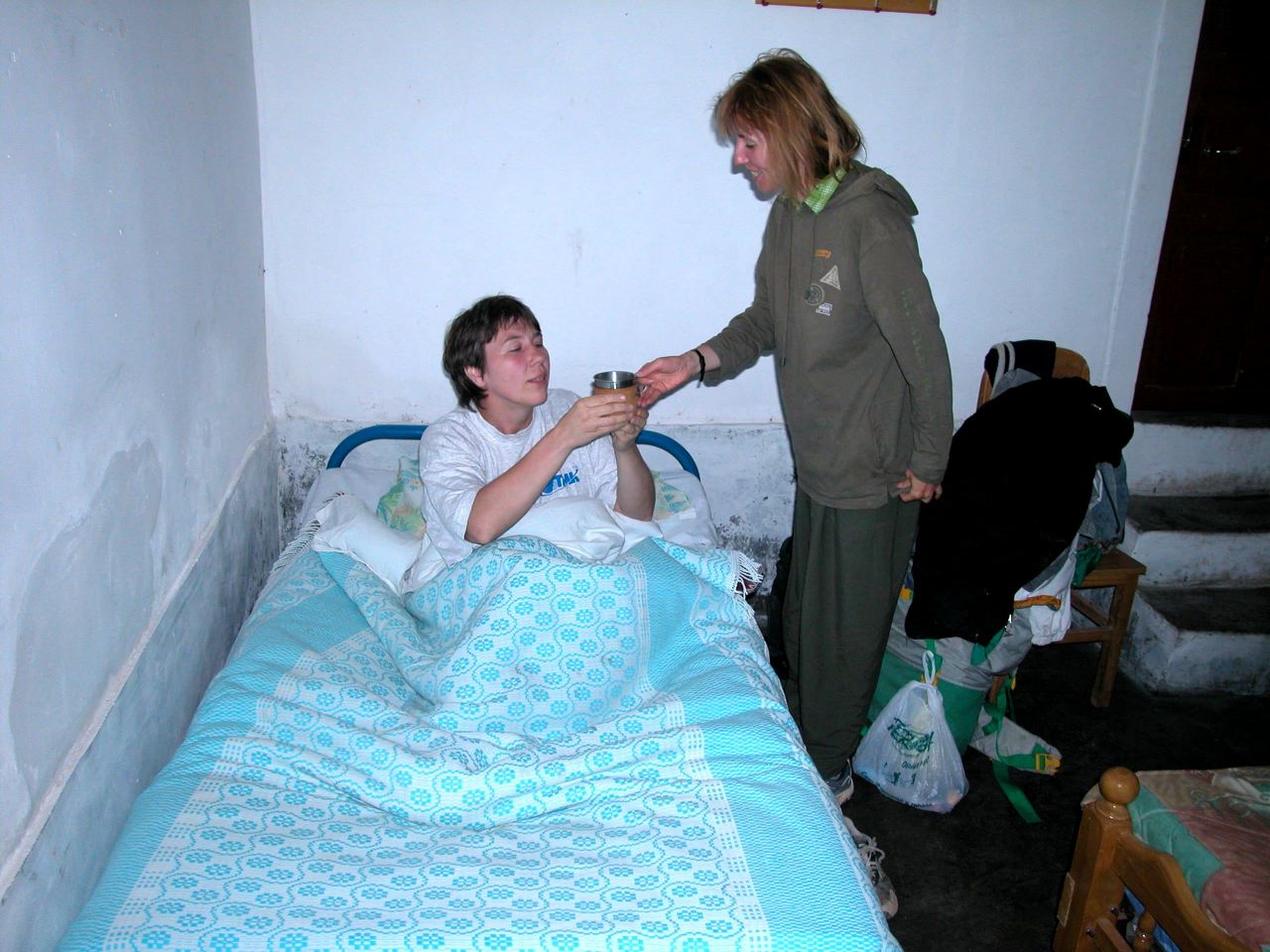
The hotel in Cotahuasi was the only one in all Peru with US-style electrical sockets. It wasn't for nothing that we'd brought the adapter. This was our one chance to use it. Everywhere the voltage was 220 V.
The sun came out in the morning. Lena was better and we went farther up the valley to Alca. The road is good and almost the whole gorge is inhabited.
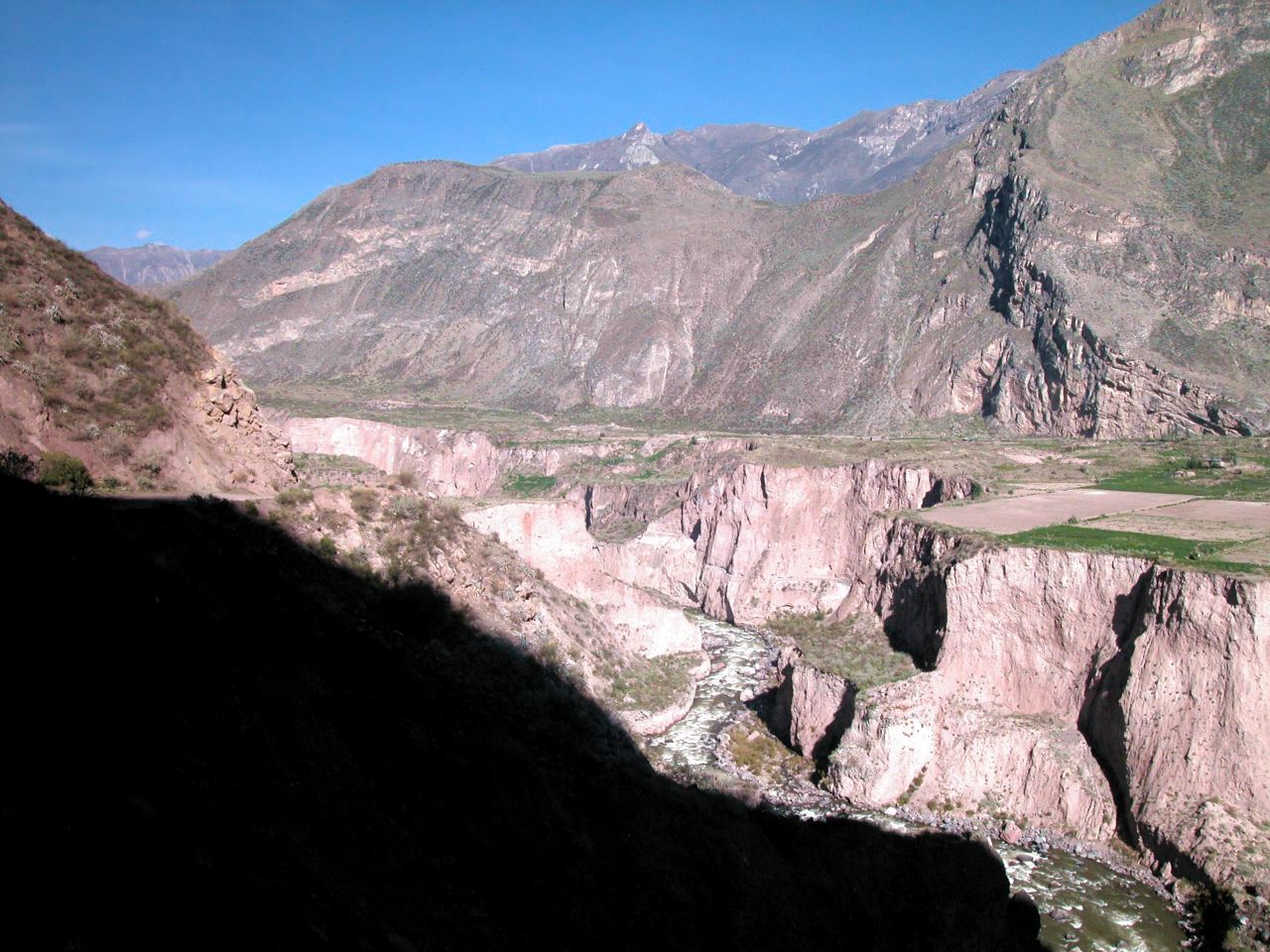


Alca and Tomepampa are respectable little towns with the indispensable Plaza de Armas and cathedral on it.
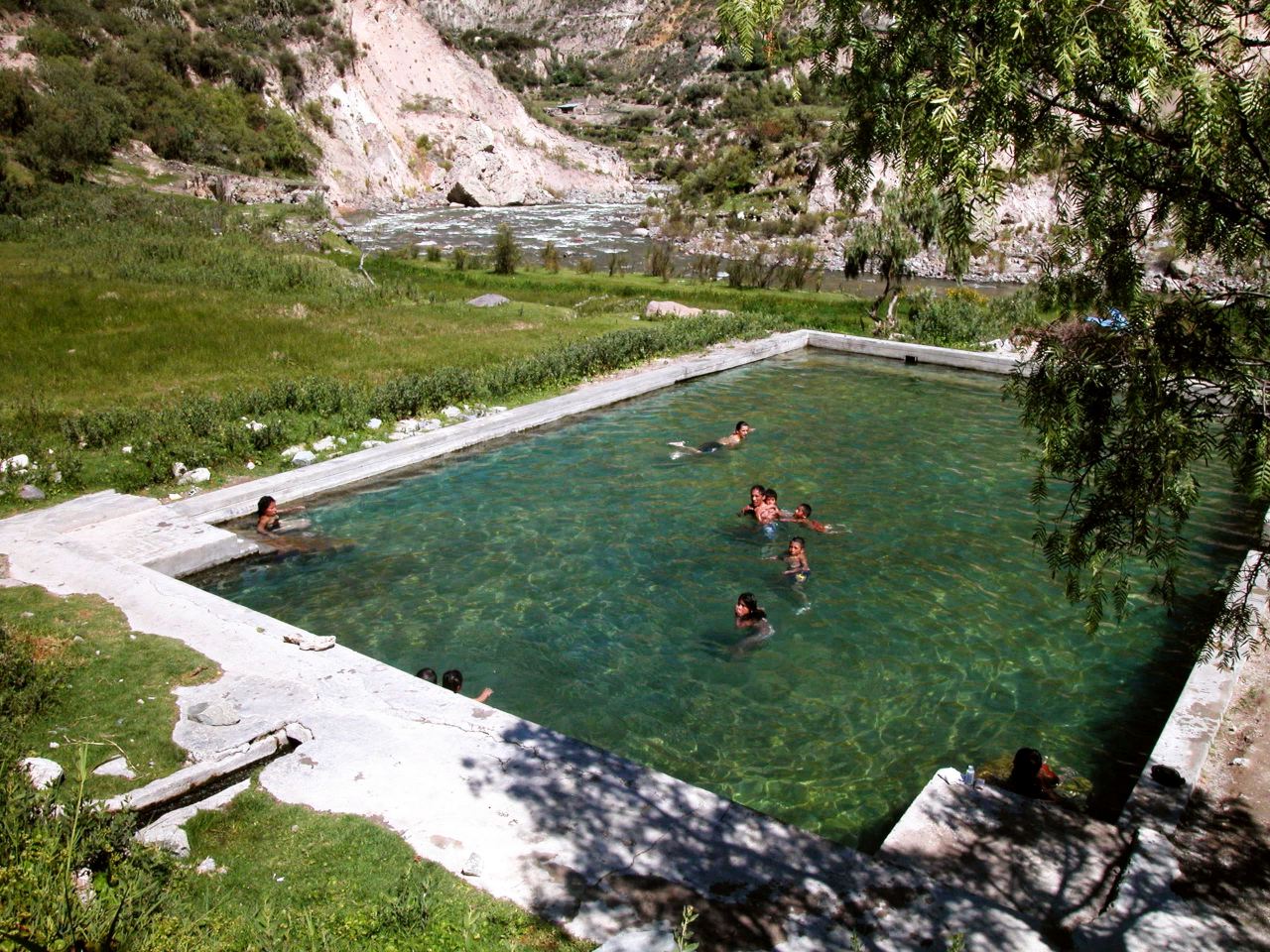
The brochure shows a couple bathing in a warm spring among rocks. We wanted to do the same. The springs are by the road, before Alca. Alas, we were too late. They were redeveloping them for tourists, and it was no longer possible to lie in a wild pool. In a year or two it'll all become a municipal bathhouse and laundry with a swimming pool. It'll still be spring water, but what difference does that make surrounded by tiles? In Bolivia, you see, everything is so good… Lena could no longer bear to hear that phrase and took offence. But what could we do? It really was good there.
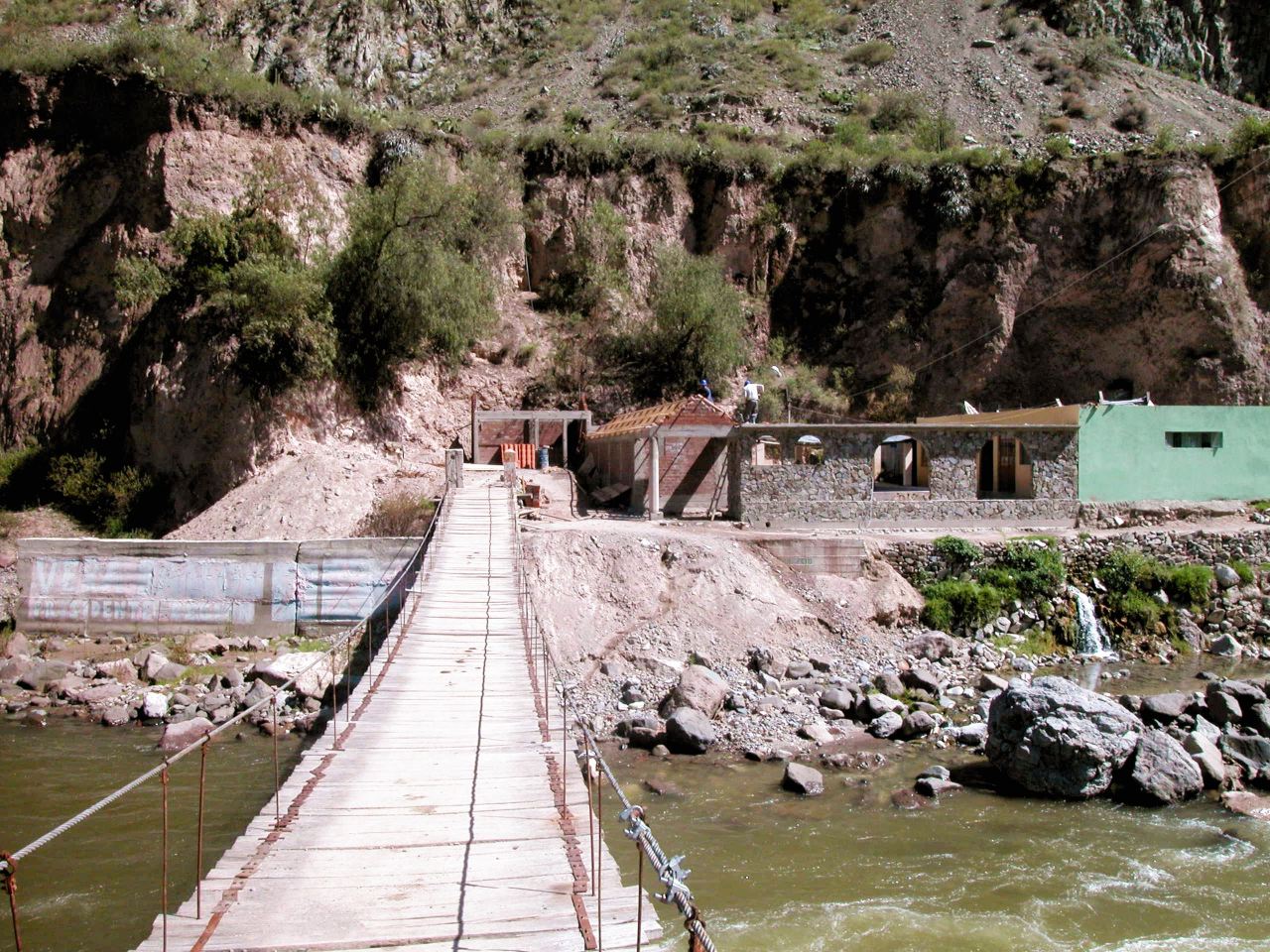
One spring had been developed long ago. That's where we had our swim, surrounded by children from a nearby village. They didn't even charge admission.
Dark clouds soon replaced the morning sun and the rain began. Time for us to go back. Cotahuasi has a filling station, two competing ones in fact. Fuel costs noticeably more here, 8.60 soles a gallon for diesel. They pour it by hand with measuring ladles and cans.
Highland farming in Peru is on terraces. The Incas built them and most are still in use. As a result Cotahuasi stretches along the road far up into the hills. As you leave the centre, local people flag cars down. We took a few people with us and gave them a ride a couple of kilometres uphill. They didn't offer money. So although there aren't many cars in the Peruvian mountains, it's clearly possible to get around by hitchhiking.

Once again the whole day went on getting over the pass. Only in the dark did we get out onto the Pan-American Highway. Arequipa was another two hundred kilometres. The first hundred flew by, as the road goes across flat, empty desert. After that there was a lot of work at the wheel. The main Pan-American follows the sea to the Chilean border. To reach Arequipa you have to cross a rocky mountain range. There was heavy traffic and we kept having to overtake long lines of loaded lorries crawling uphill.

Arequipa is a vast city with a million people and very irregular streets. We drove around for over an hour trying to find the centre, listening to confused explanations whenever we asked the way. ‘Straight on, right, then go round and right again, or rather left, then back a bit, and before the right turn take the fourth or fifth left and past…’
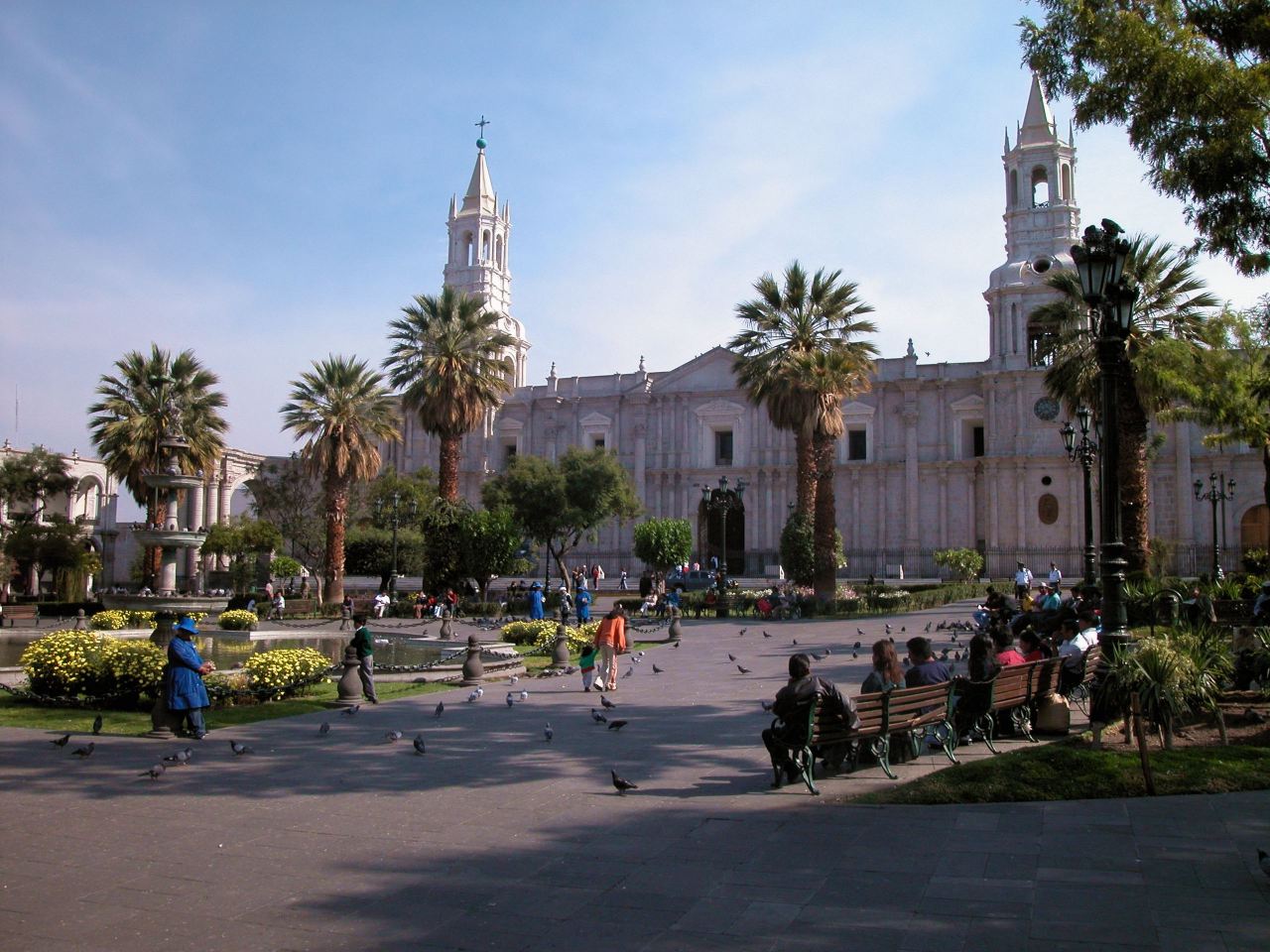
Sooner or later we were bound to find Plaza de Armas, and we did. Even a suitable hotel next to it.
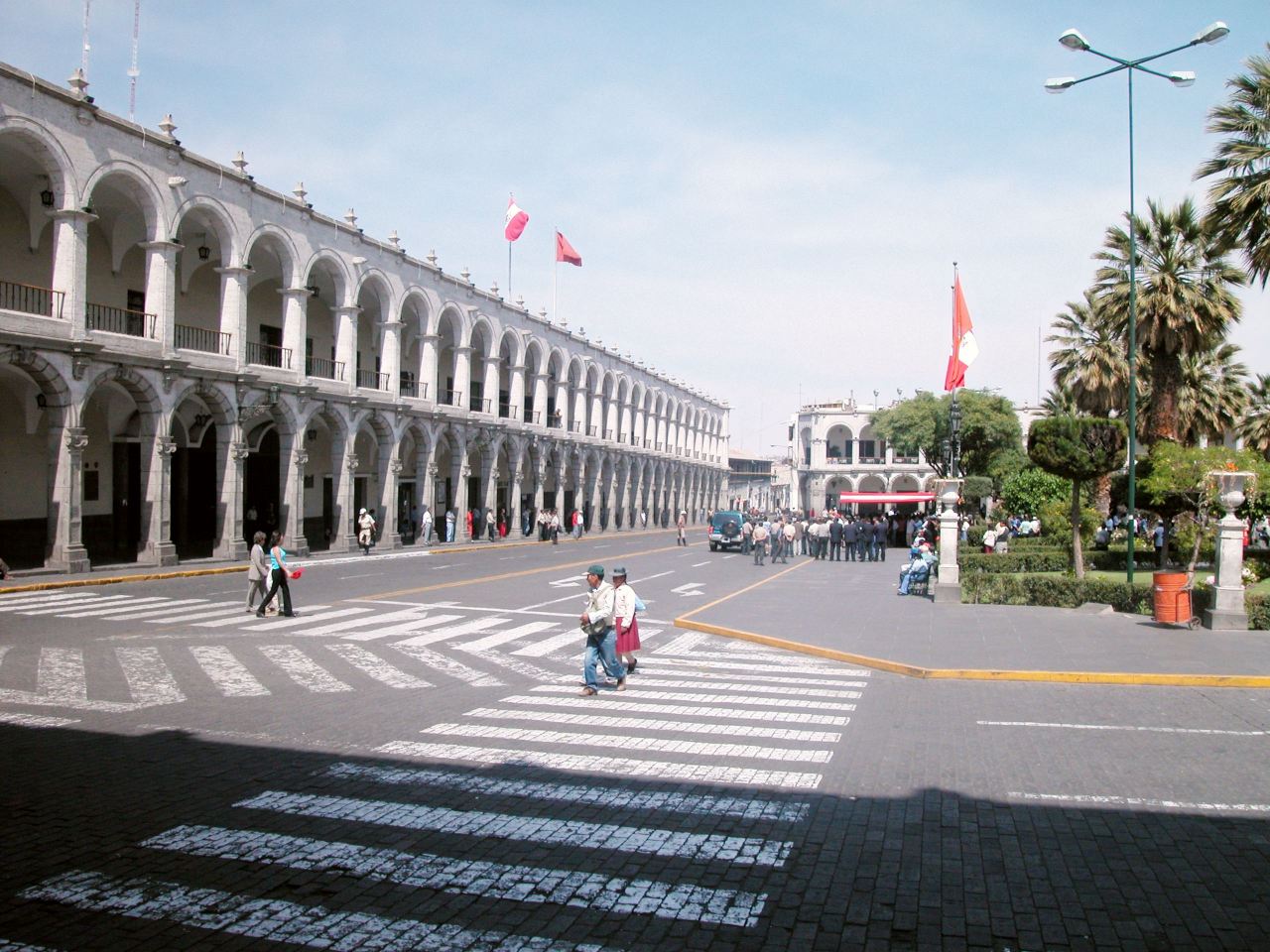
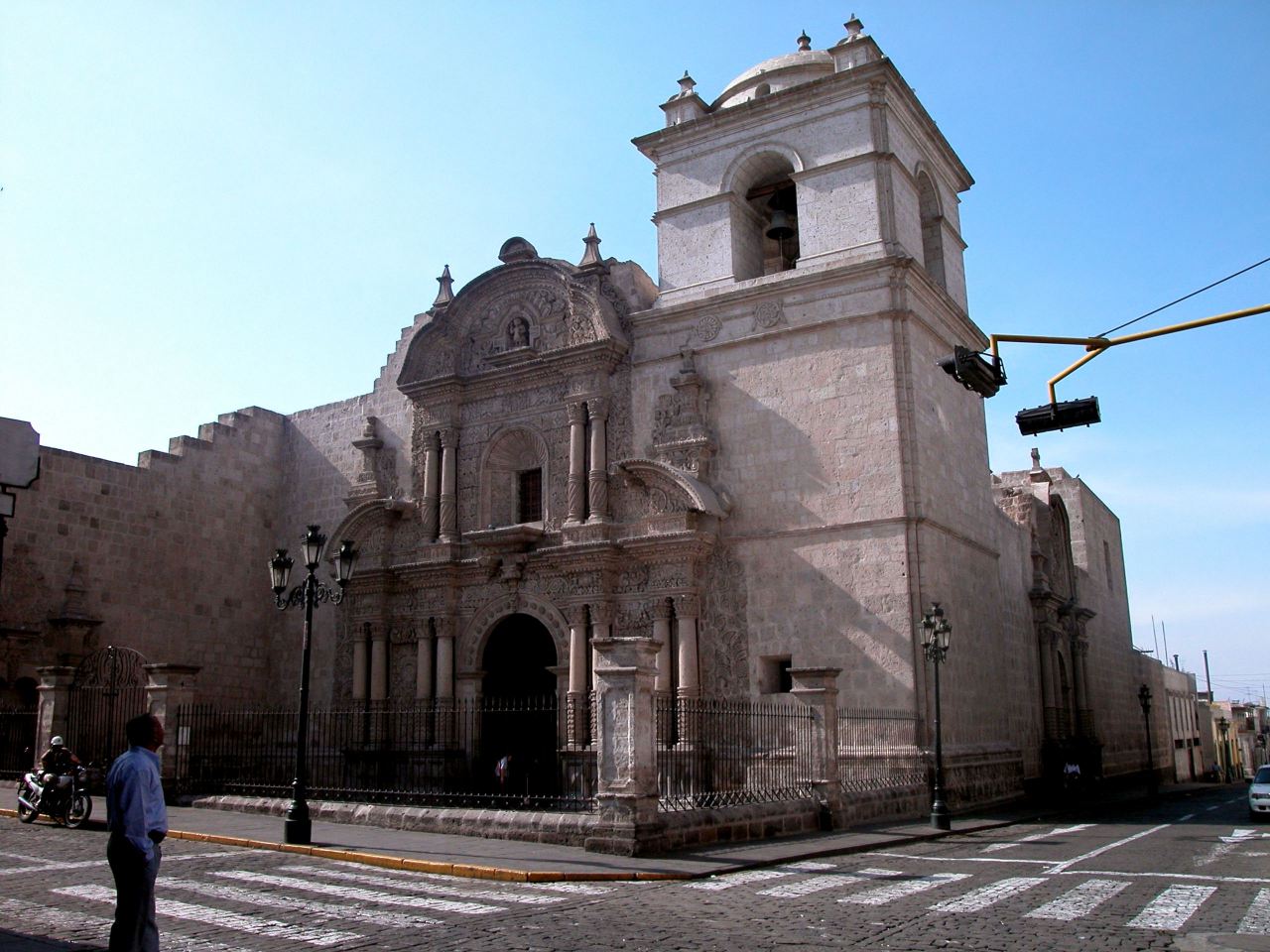
Car parks everywhere in Peru are called cocheras, but in Arequipa a car park is a playa. Perhaps that sounds grander. The price was no trifle, two soles an hour, so the little parking space cost about as much as our beds.
After a short walk around the city in the evening, we had dinner in a Turkish restaurant. Lena was learning Turkish and was delighted to have a chance to use it. There was a snag, though. The Peruvian Turks were born in America and didn't know a word of Turkish.
It had been a hard day and we desperately wanted to sleep, which proved far from easy. The windows of our upstairs room looked onto a street positively boiling with the city's nightlife. It turned out to be quite a spot. We never did find out why an indignant crowd was shouting and waving its arms and the police were trying to beat the people with batons. The battle continued with varying success until one in the morning. Then the drunks spilled out of the bars. They sang and shouted loudly, of course, but that was nothing to the taxis. Trying to get them home, the taxi drivers made an endless traffic jam and leaned relentlessly on their horns. Just as it all settled down, it was time for the morning buses, which spent a long and very loud time looking for passengers. They finally left at five, at which point the alarm clock and Lena both came to life. She'd decided to get up early.
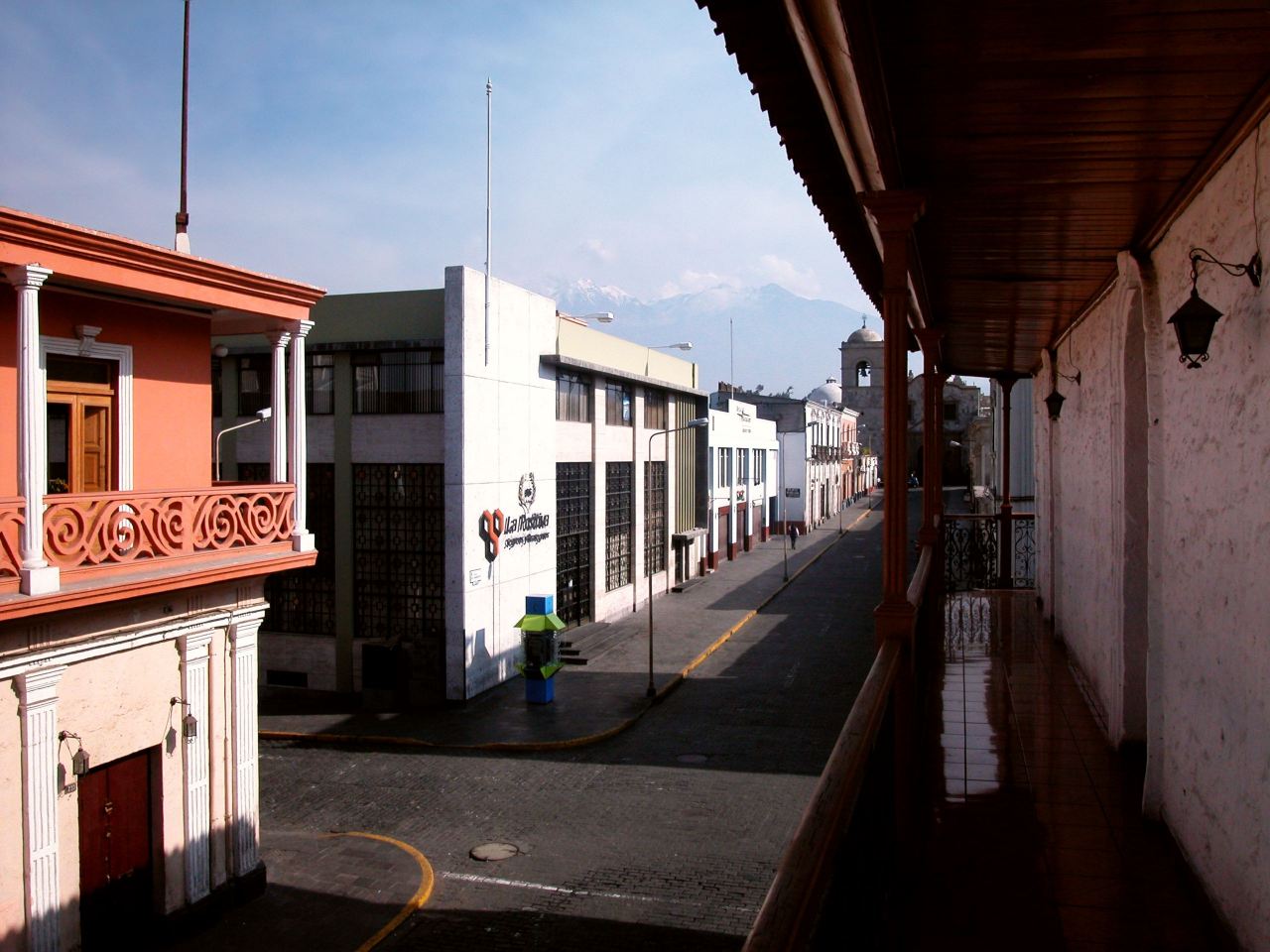
I'd promised to let the women loose in the shops for a few hours. Scarcely believing this glorious moment had finally arrived, they were eager to get out into the city.
The shops didn't return their enthusiasm and refused to open before ten.
We had to wait in a café to the sound of marching soldiers and the Peruvian anthem. It was Sunday again and the flag had to be raised in the Plaza de Armas.
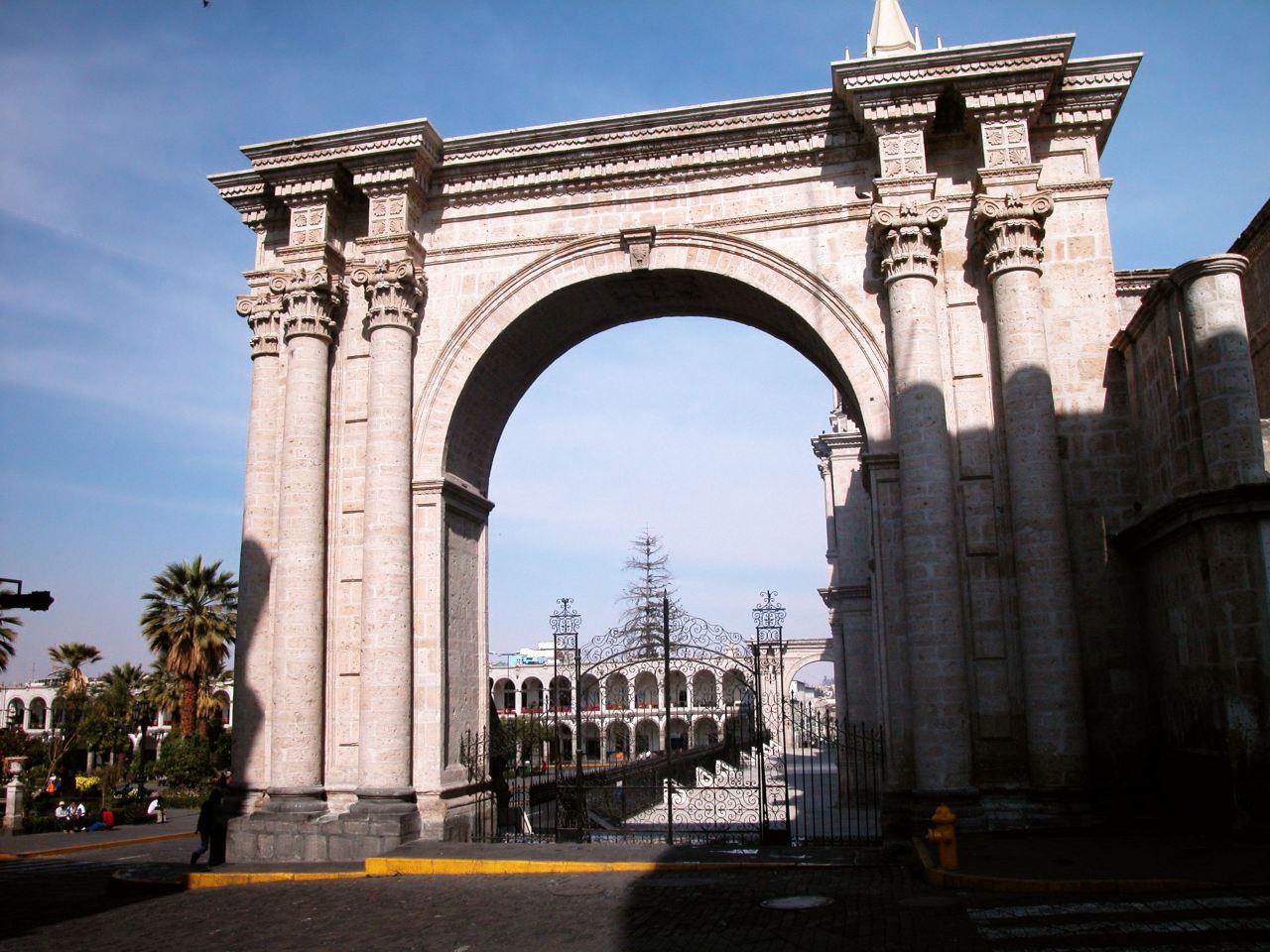
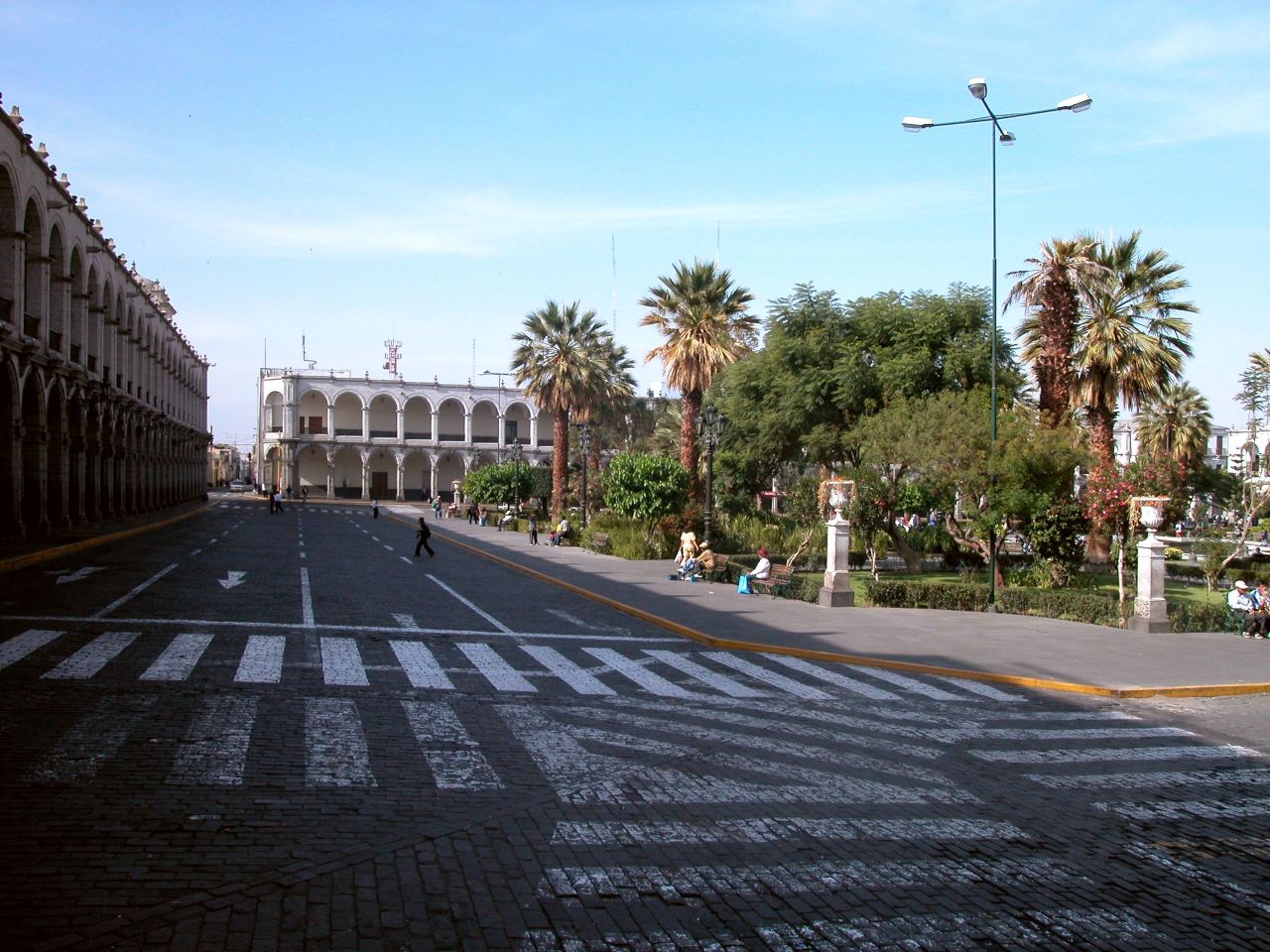

We did manage to do one useful thing: get a photo shop to copy all the photographs from our digital camera onto CD. Four memory cards fitted onto two discs. It cost 105 soles.
Once the shops opened and began selling alpaca skins, ponchos and every other indispensable thing a woman's heart can't do without, our luggage doubled within a few hours. It didn't matter now. We'd go to the airport in the car and load it all onto the plane. Only now the car turned out to be a little small. Lena kept getting buried under bundles in the back seat, swearing and flinging them away.
As well as shops, Arequipa has the convent of Saint Catherine, the Monasterio de Santa Catalina (convent website). It has stood for centuries. Wealthy Spaniards sent their younger daughters here. The convent was famous for its freedoms. The young women had servants, played harps and invited guests, artists and musicians. It all resembled a fashionable salon more than a humble religious retreat. But Rome was far away and many decades passed before a strict commission uncovered this nest of vice and took action. The freedom ended. The convent still operates.

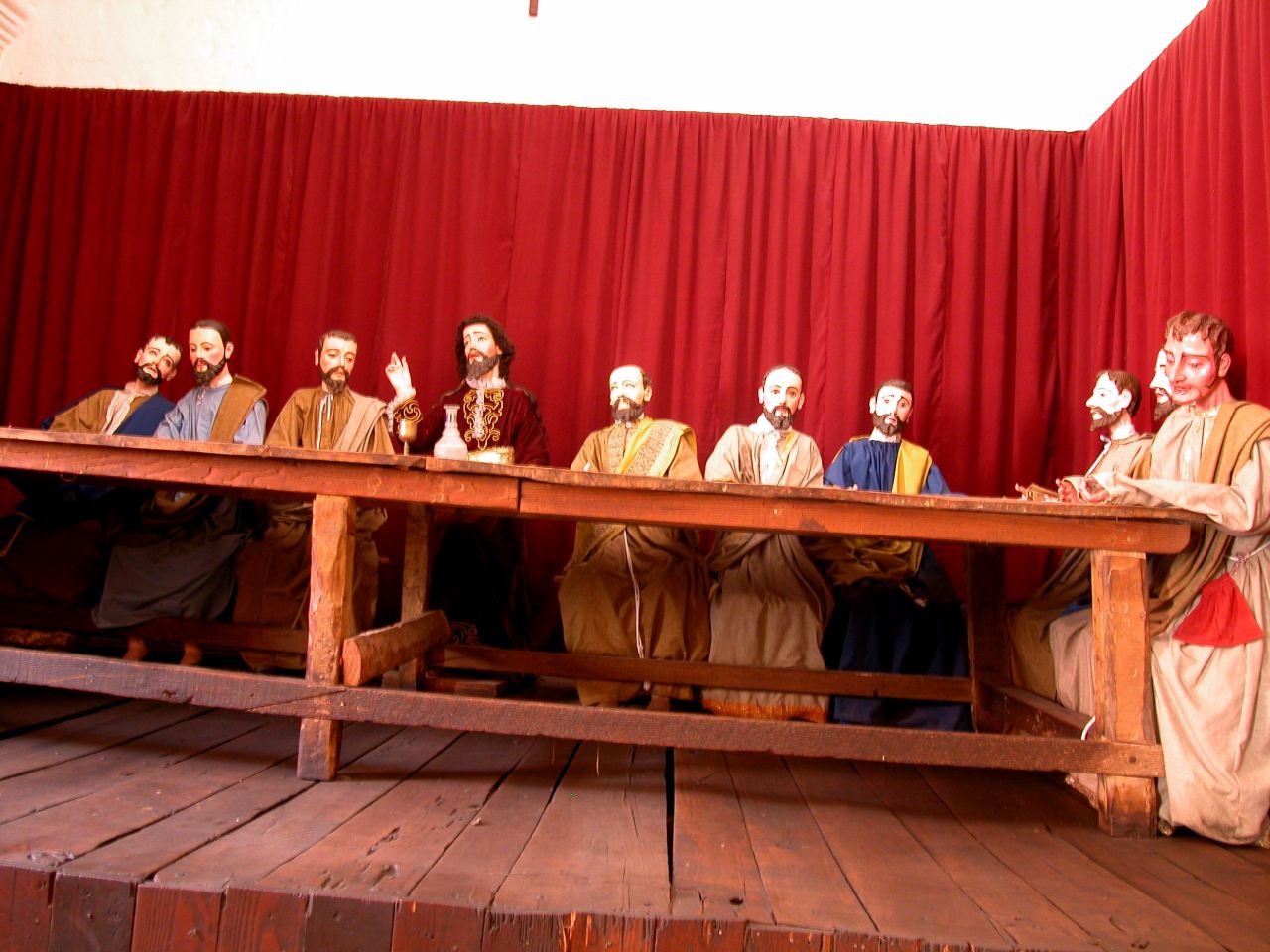

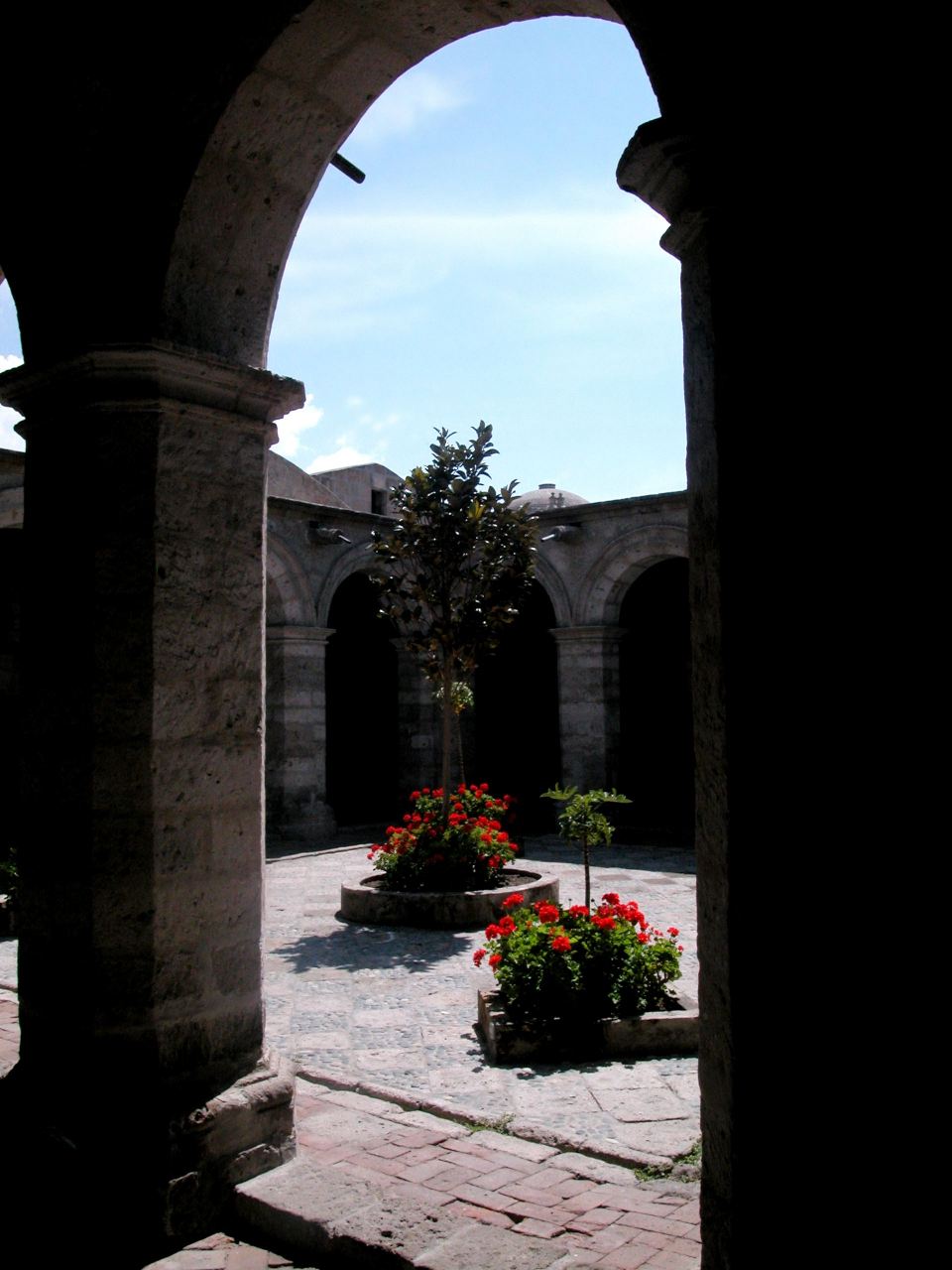

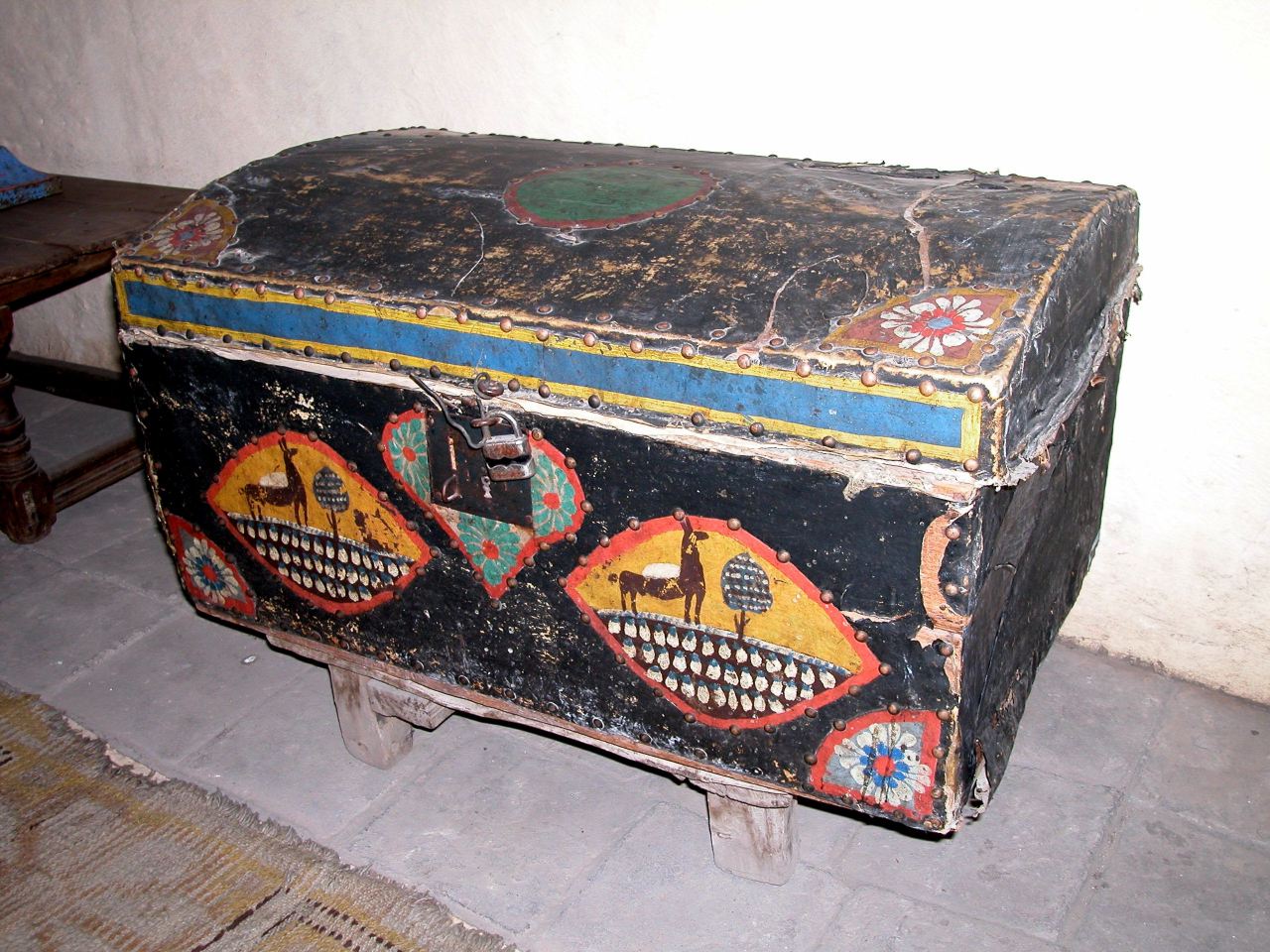
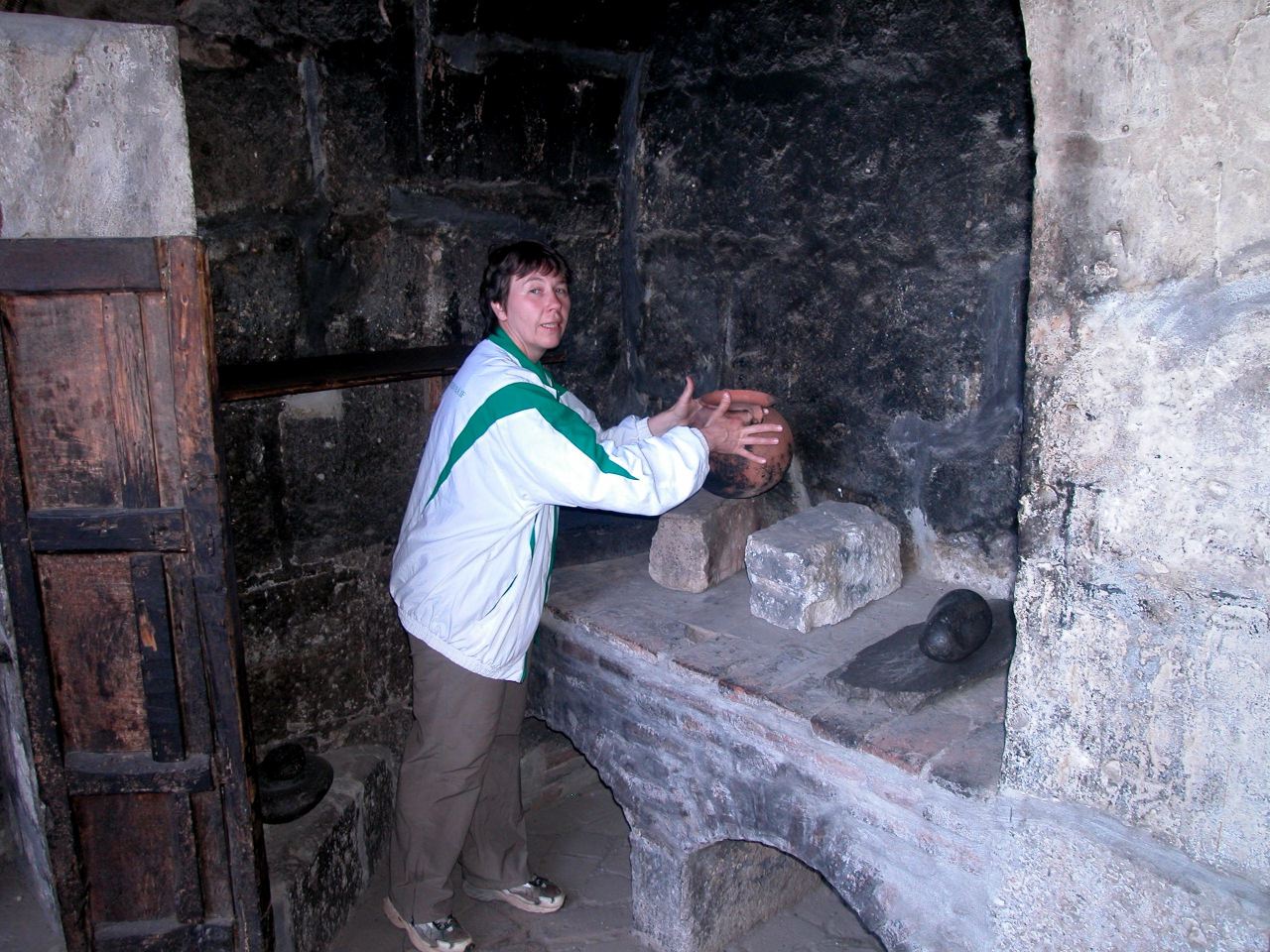


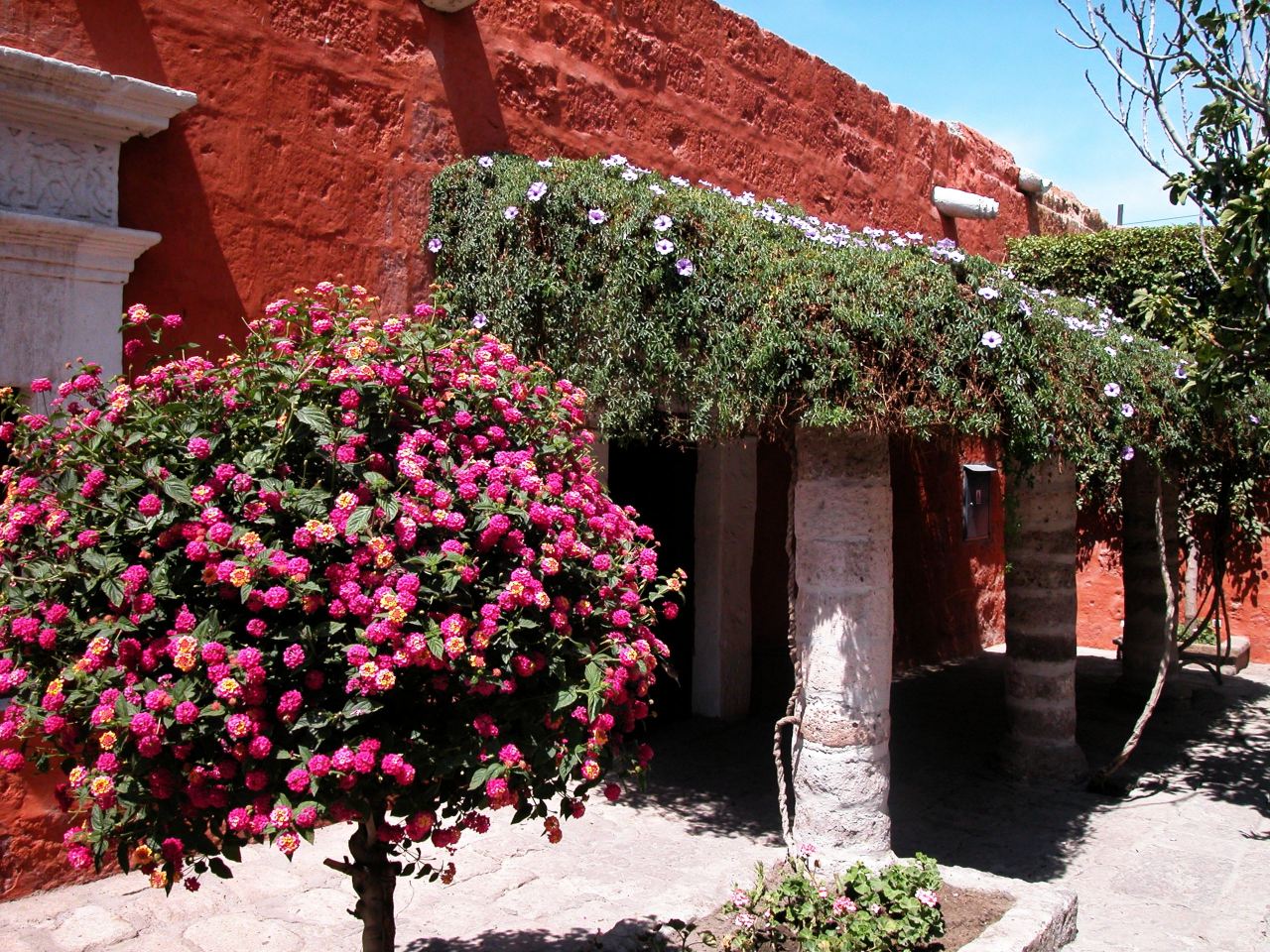
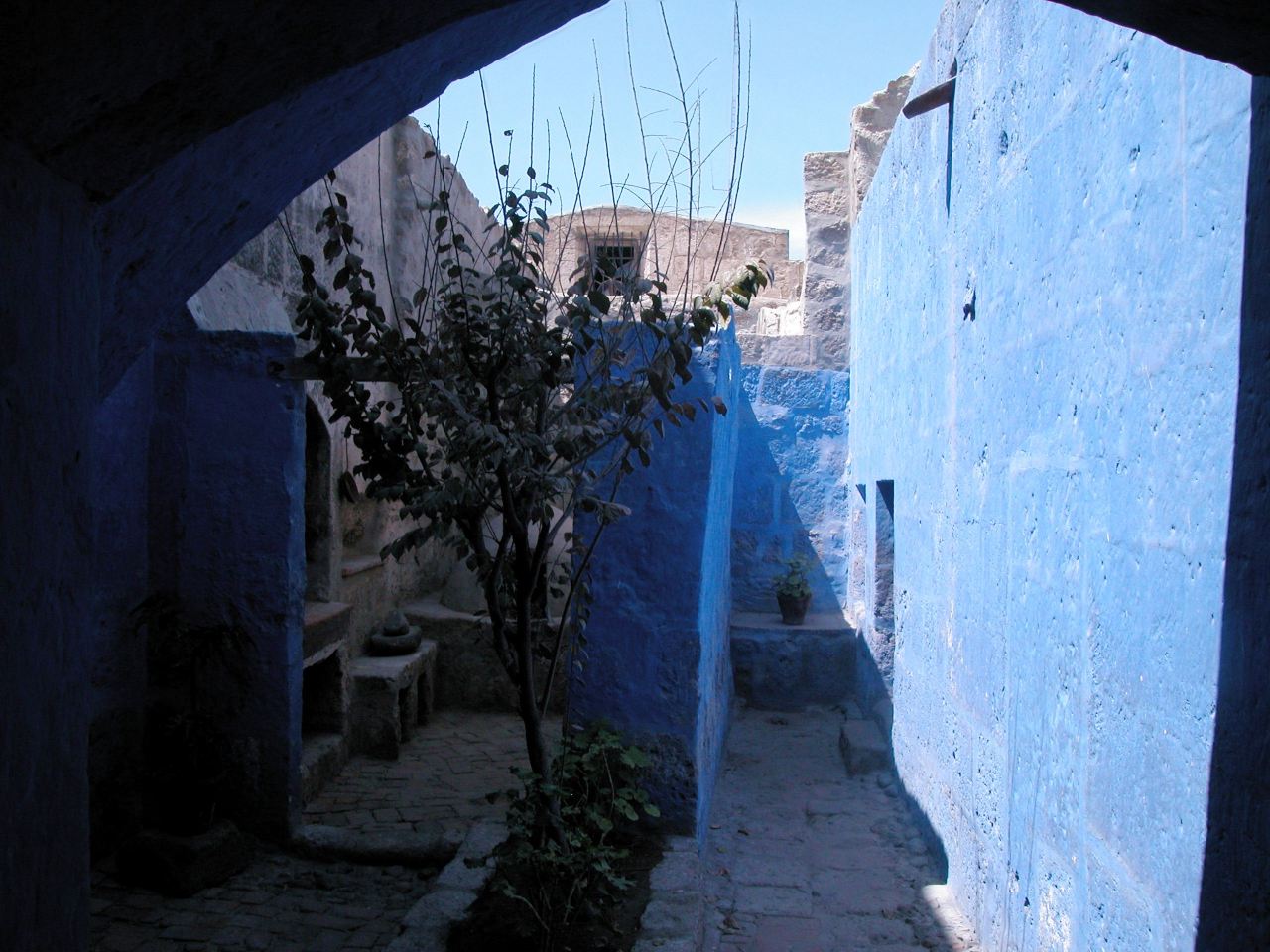

What survives from those days is an enormous city block full of little interior streets, named for Spanish cities, with lovely cells and flowerbeds. Only some of the buildings are open to visitors, but you can spend hours looking round.
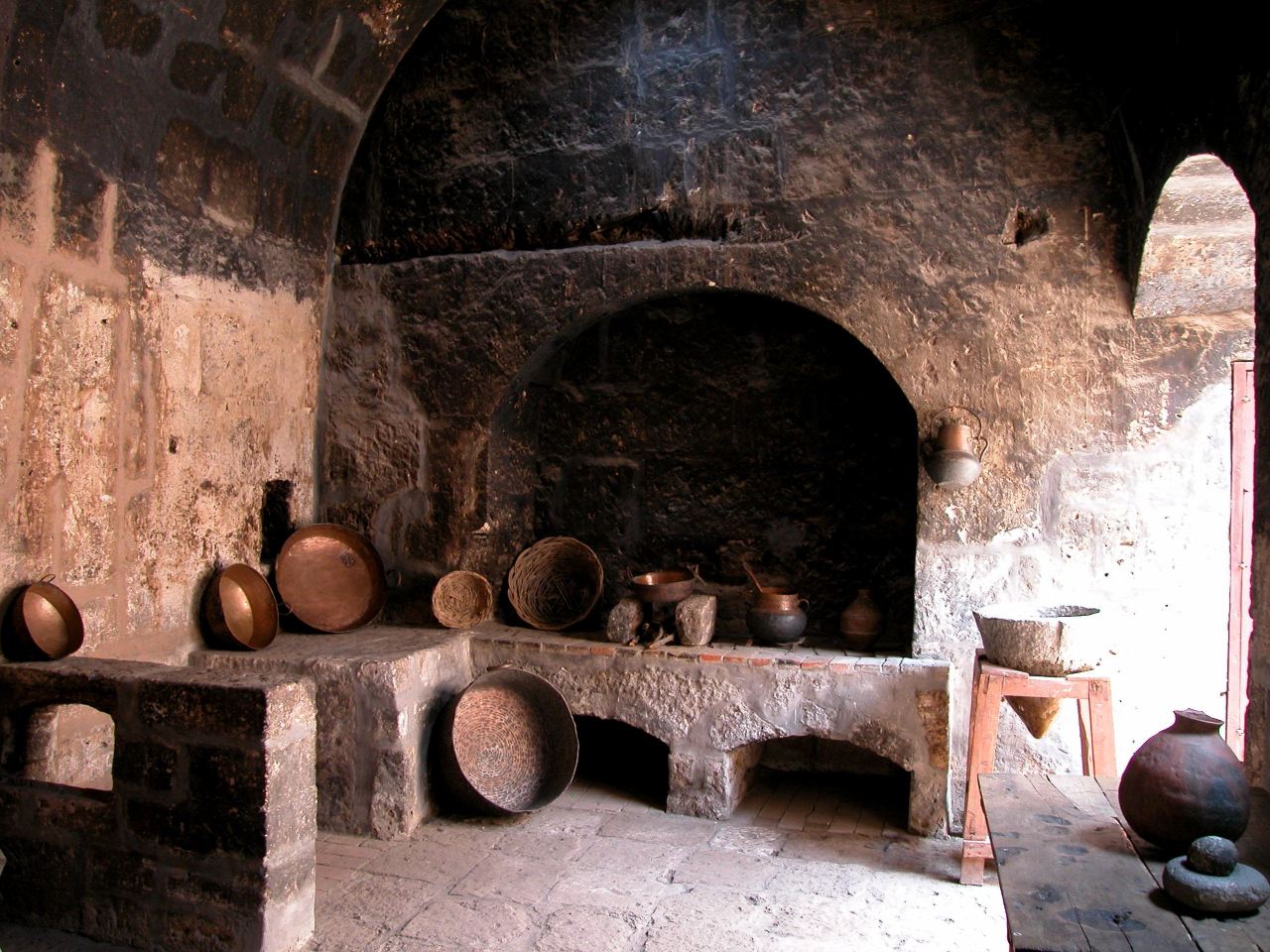


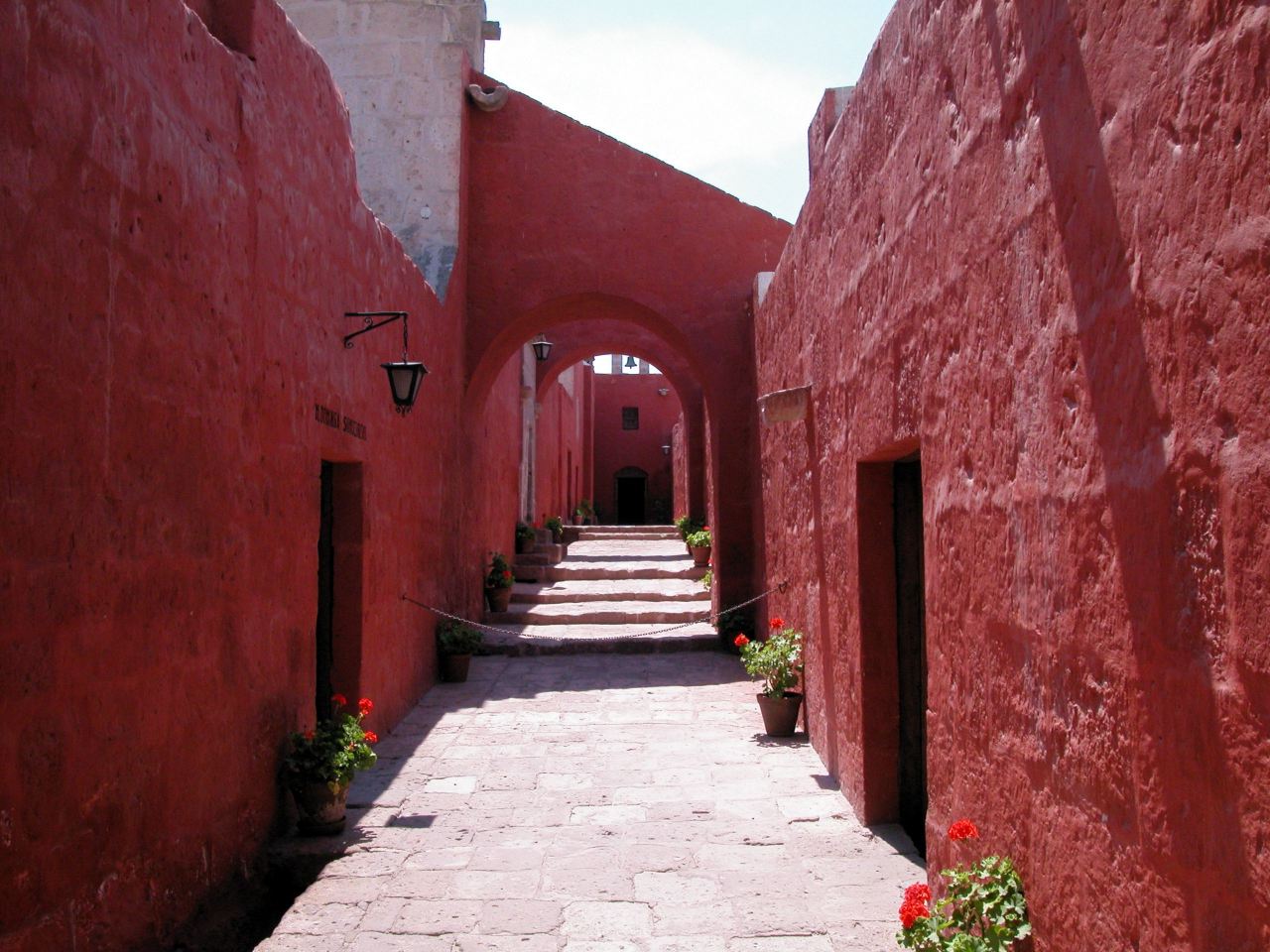
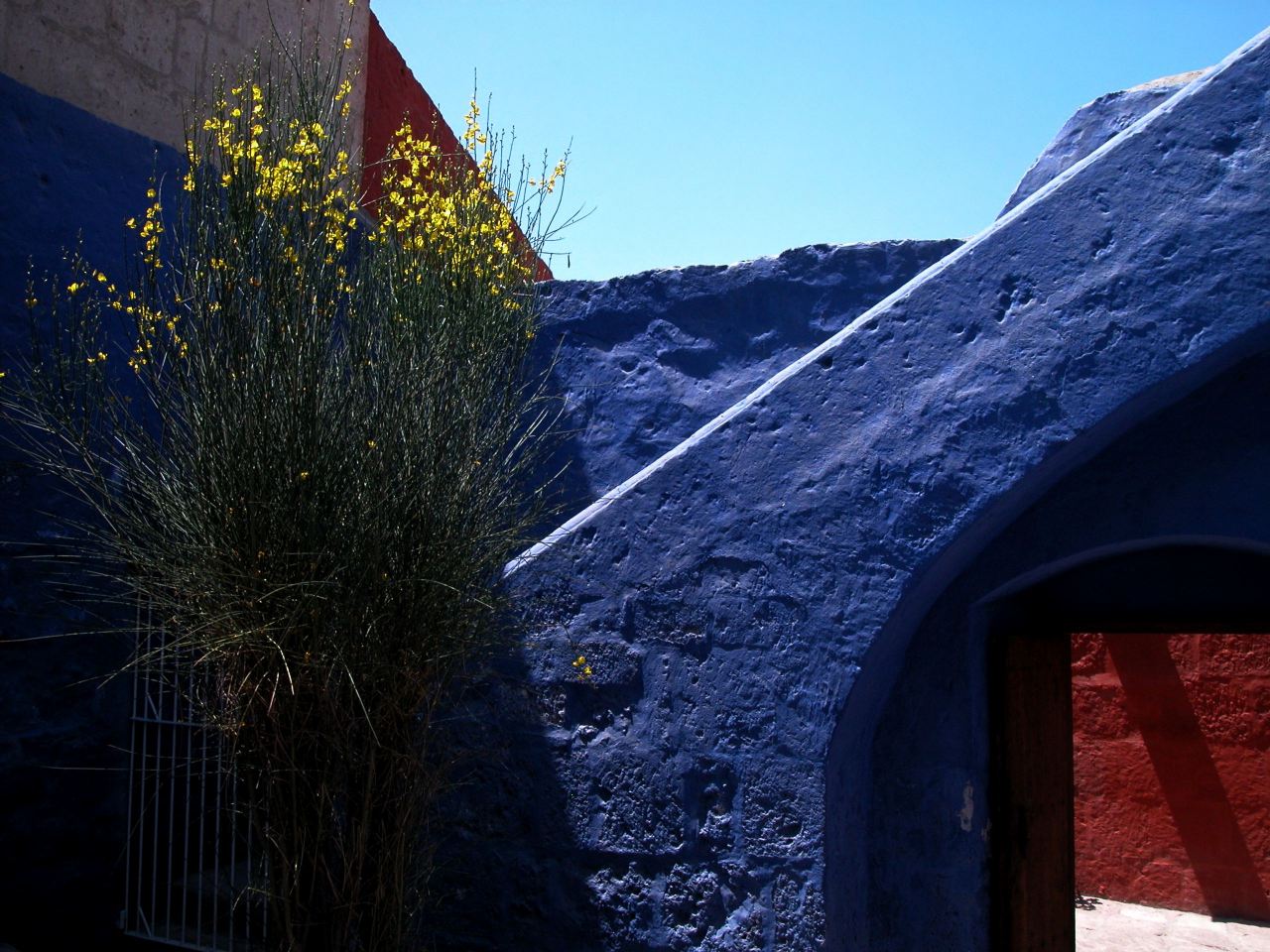
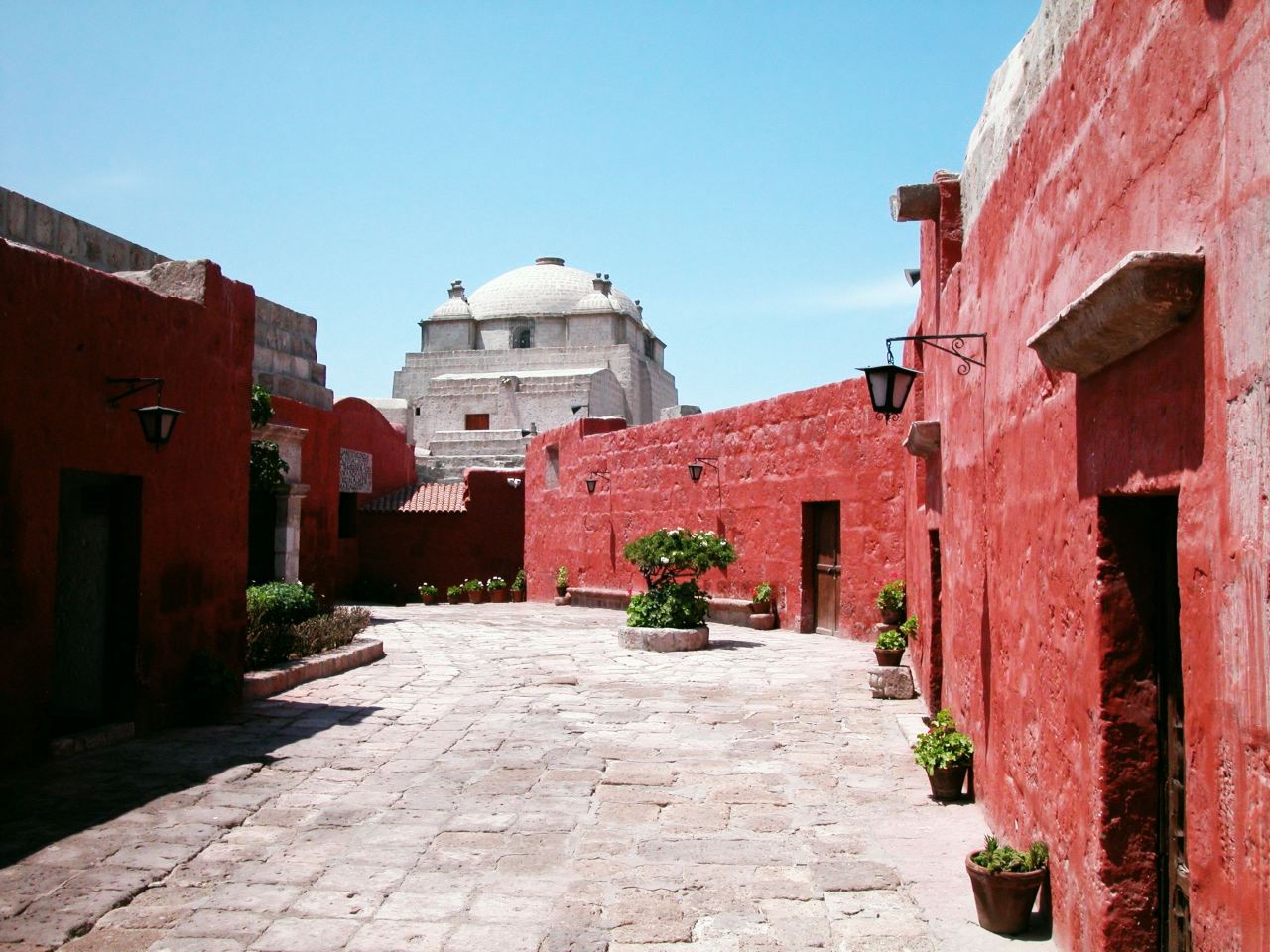


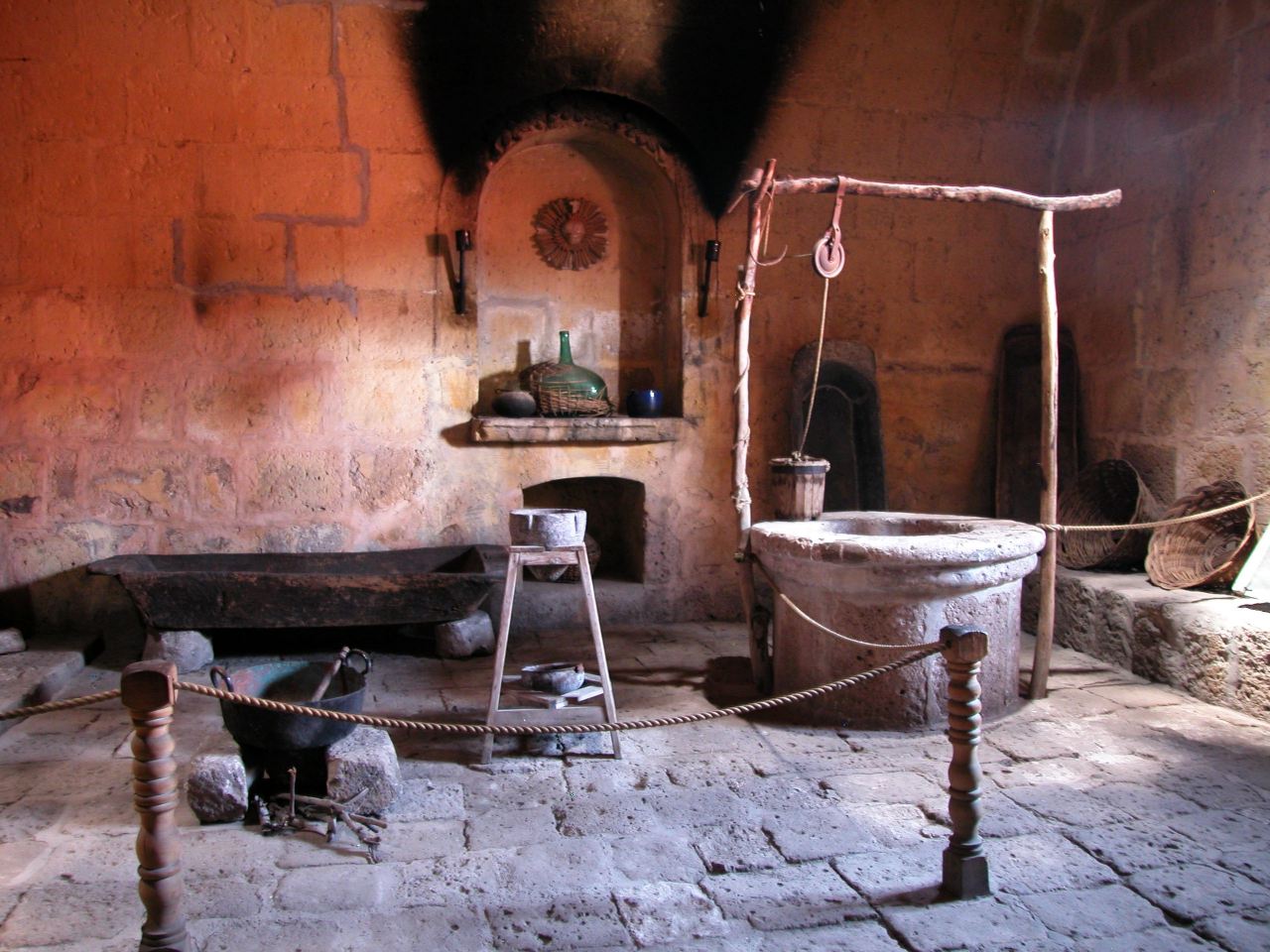
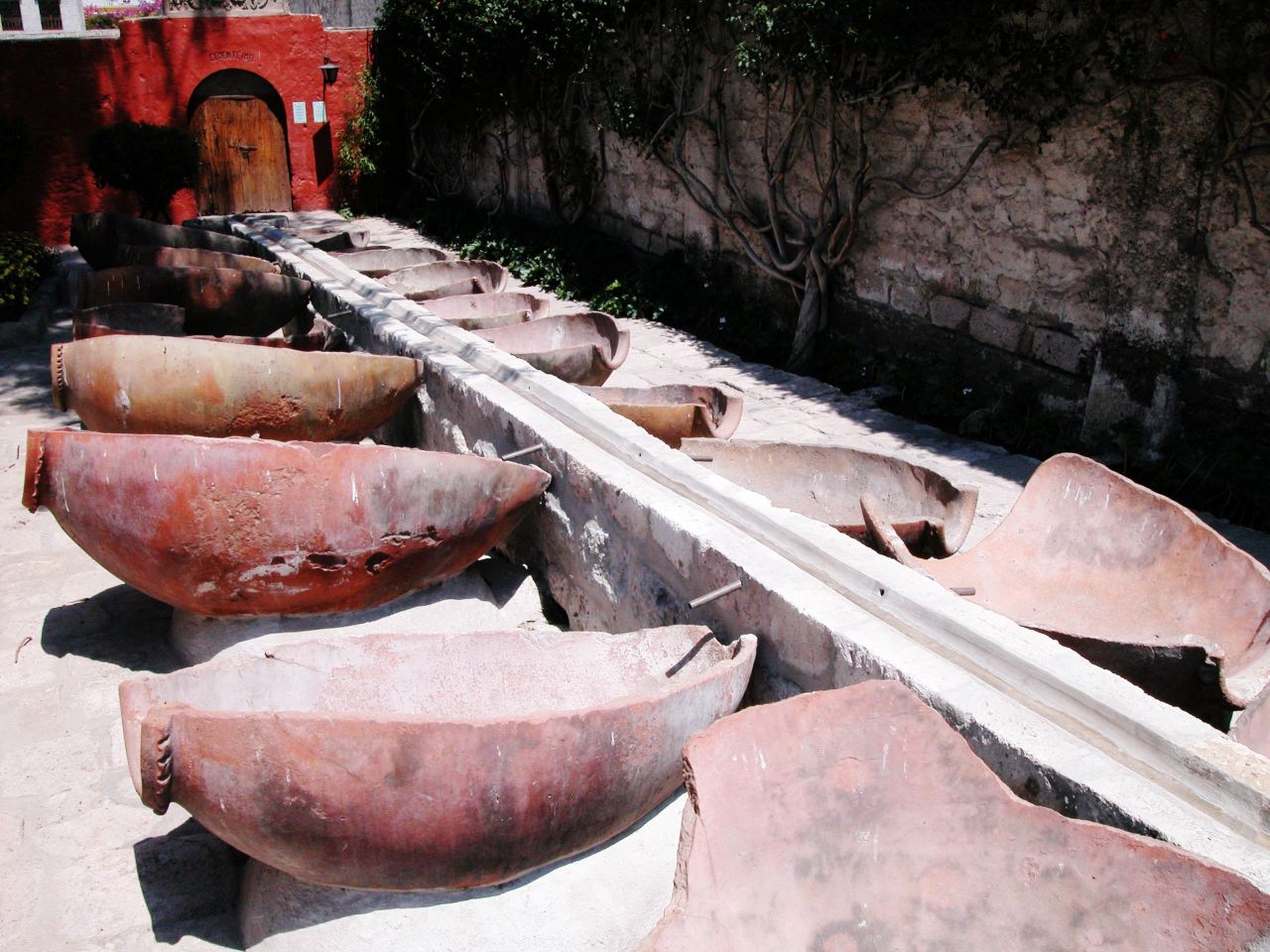

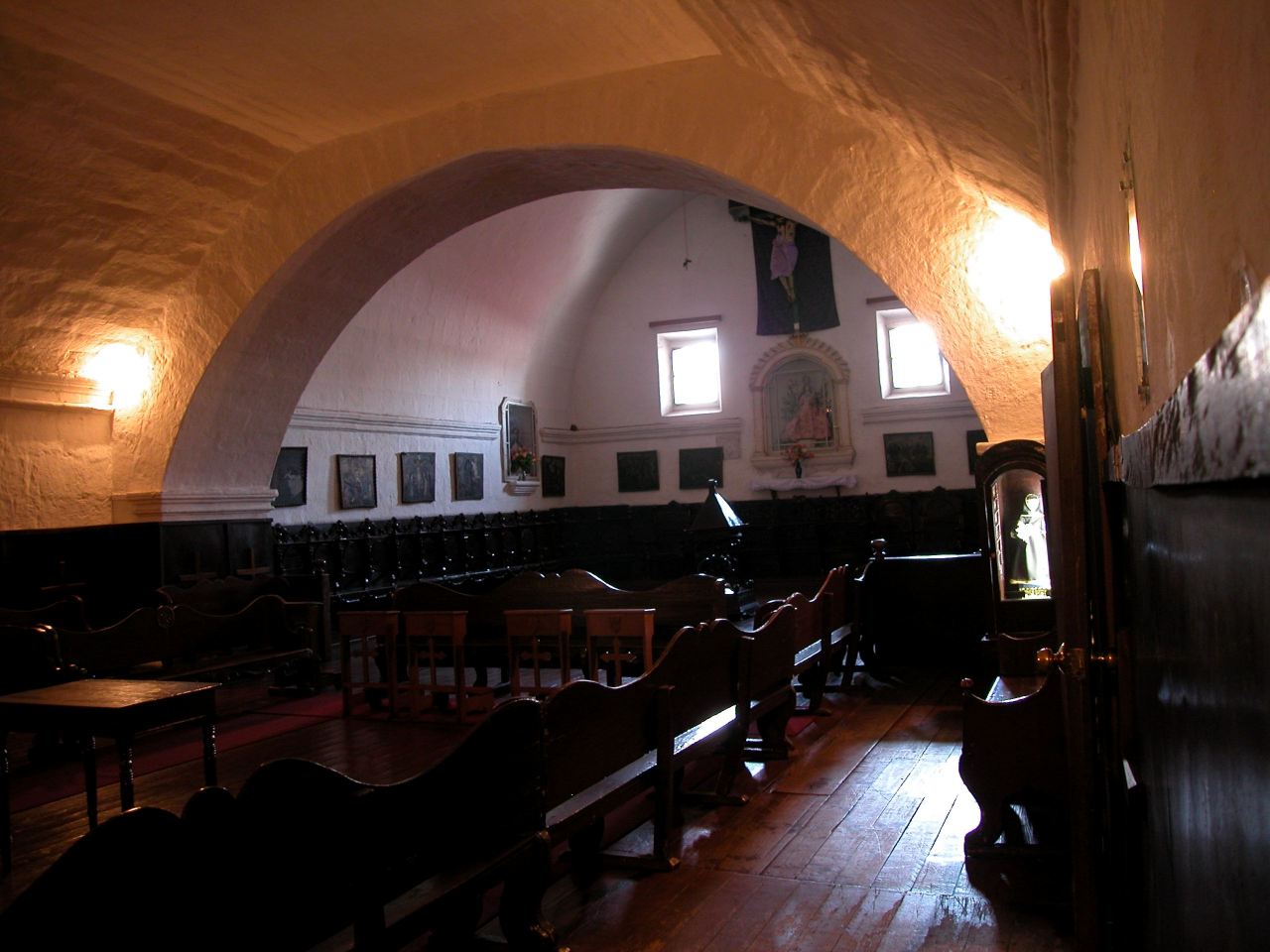
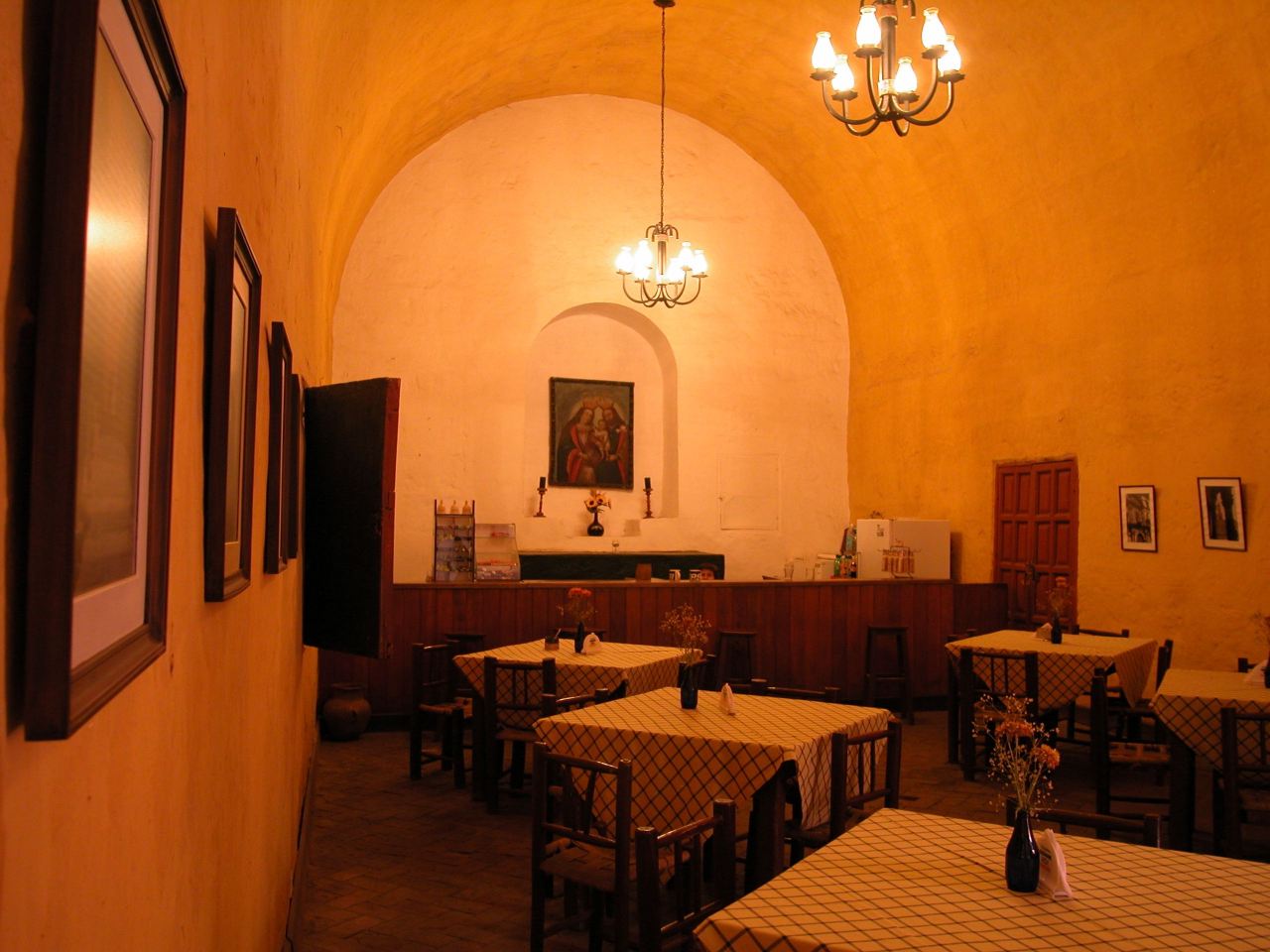
Admission is twenty-five soles, and it's money well spent.
Once we were done with the shops and had got the car started at the tenth attempt, we were finally out of the noisy city and on the way to Colca Canyon. It's a little smaller than Cotahuasi but better known as a tourist attraction.
The road is almost all sealed, though it also goes over a high pass. In the mountains there was rain mixed with snow. We picked up an Indigenous family and made room for them in the back at the pass. It was hard not to feel sorry for them standing in that icy wind. We arrived in Chivay, the main town of the gorge, in pouring rain. There were tourists everywhere and restaurants to match. For dinner we had alpaca. It came to exactly ten times what we'd paid in neighbouring Cotahuasi. Not far upstream from Chivay, hot springs rise out of the mountains. They were developed long ago and there are swimming pools now. According to the posted hours they close at six. We began to think we'd missed them, but they actually run until the last person leaves. Admission was two US dollars. They wanted dollars in particular. If you didn't have them they'd accept ten soles, which at the exchange rate was closer to three dollars.
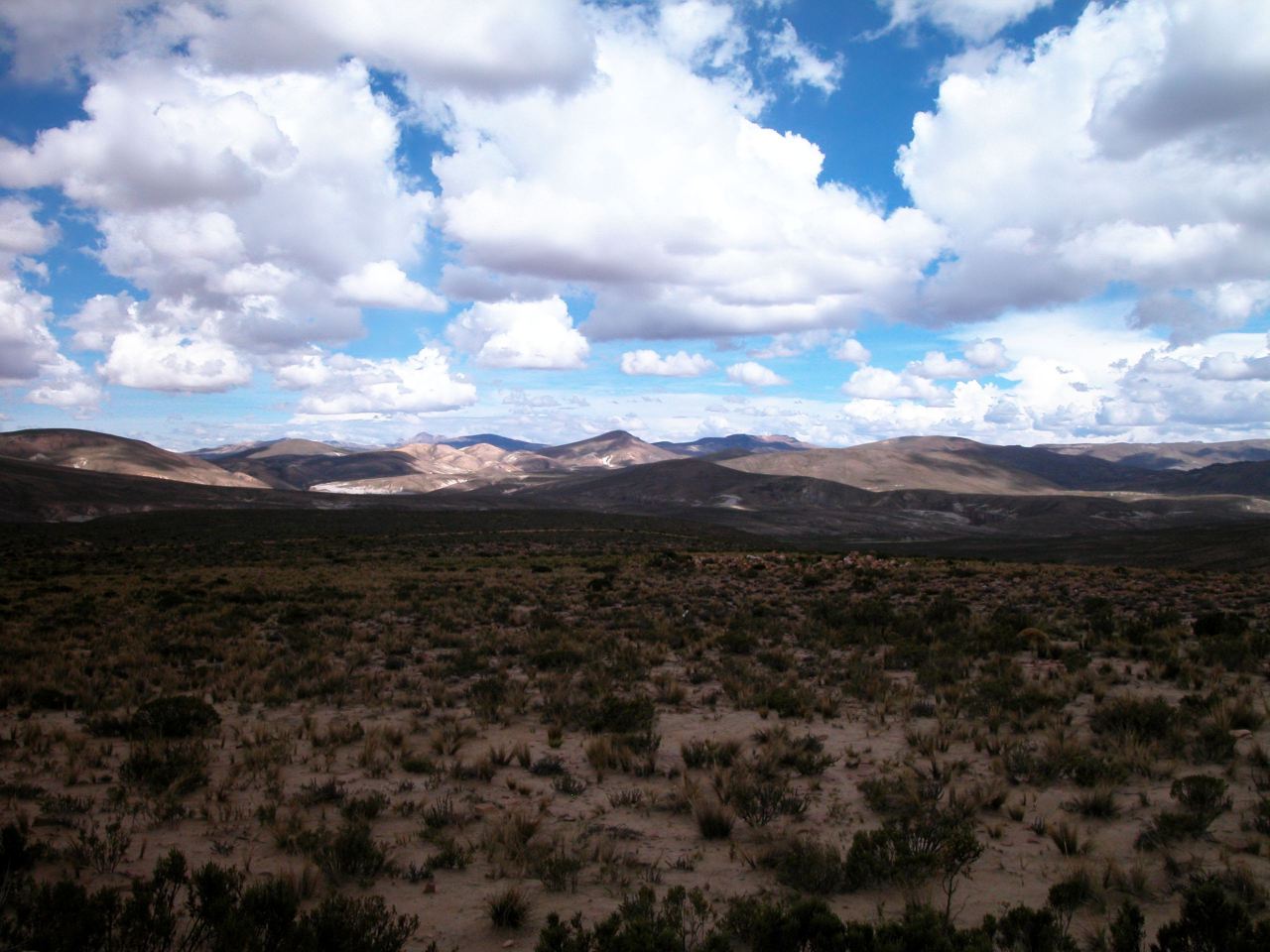
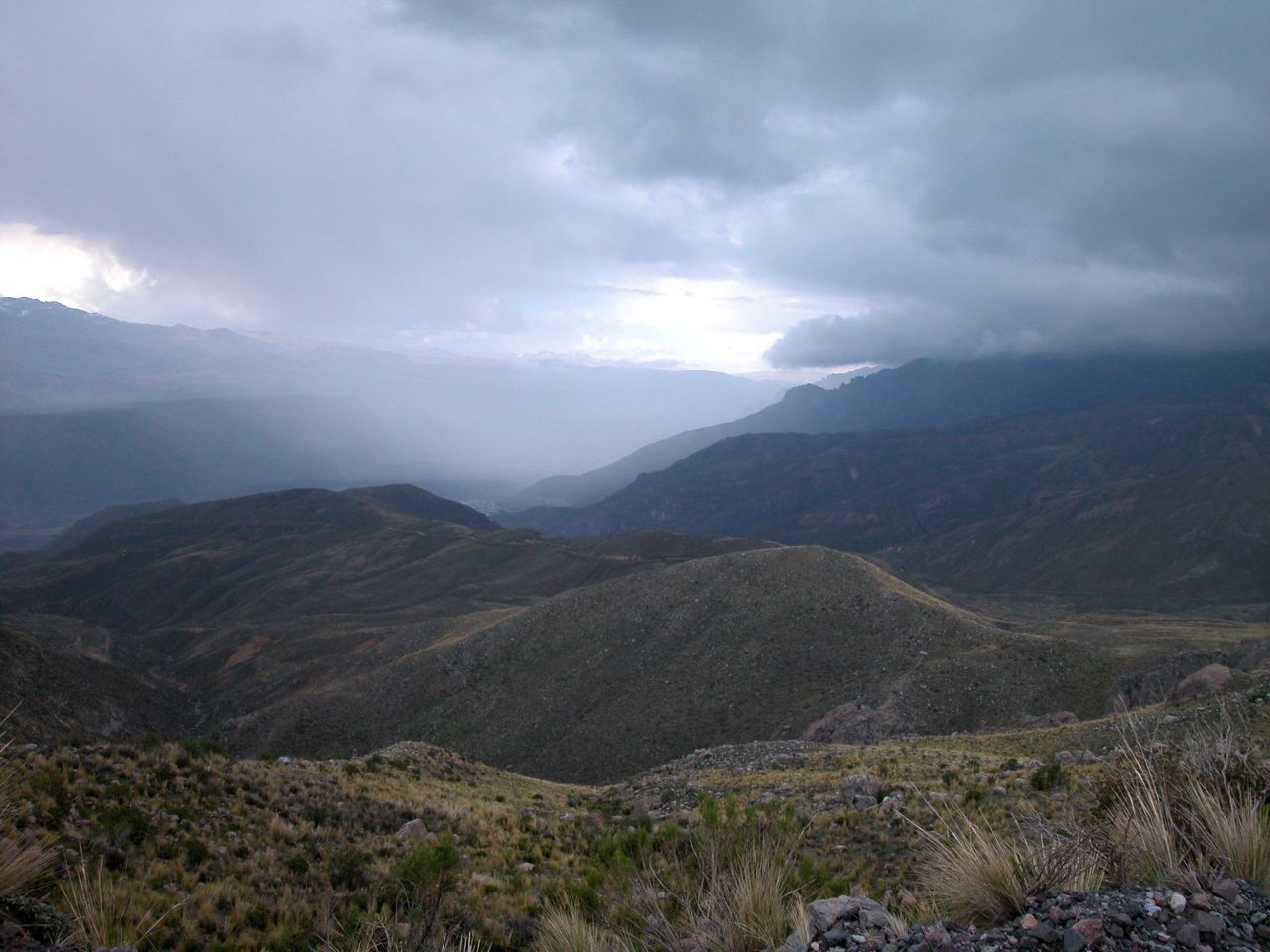
There are many pools, but only two or three are in use on any given day, while the rest are closed for cleaning.
You have to bring your own swimming things. You're meant to put your belongings into a locker and hang the key on an elastic around your wrist while you swim.
One pool was under a roof and another outside. Of course it's more interesting to lie out in the open, watching the last rays of sunlight leave the mountaintops and the first stars appear in the darkening sky.
We stayed in the water till it was quite dark. We'd planned to spend the night in the canyon, on the famous viewpoint where people watch the condors in the morning. You see these huge birds fairly often, but mostly far off and high above you. The viewpoint is on the edge of a precipice, above their nesting place. In the morning they take off with the first rays of the sun and begin climbing. That's the moment visitors are brought to see. Plenty of accounts say the finest photographs are to be had even earlier, in the grey dawn. Vladimir Dinets suggested staying overnight and watching the birds around five in the morning. That's what we did. The viewpoint is at the edge of the cliffs sixty kilometres downstream of Chivay. The road is unsealed and runs along the edge of the drop. Heavy fog came in towards evening, on top of the pitch darkness. So the short drive took two hours. It was hard going, but we got past a barrier marked ‘Control Turístico’ without stopping, since no local guard could imagine he'd see any business at that hour. All I can do is guess why the barrier's there, but it's probably a toll like any other.
At the condor viewpoint (15°36.677′S, 071°54.345′W, elevation 3,786 m) I expected, considering how popular it was, to find a noisy crowd camped for the night like us. We turned out to have the place to ourselves. We cooked a quick dinner and went to bed. We would have to be up so early.
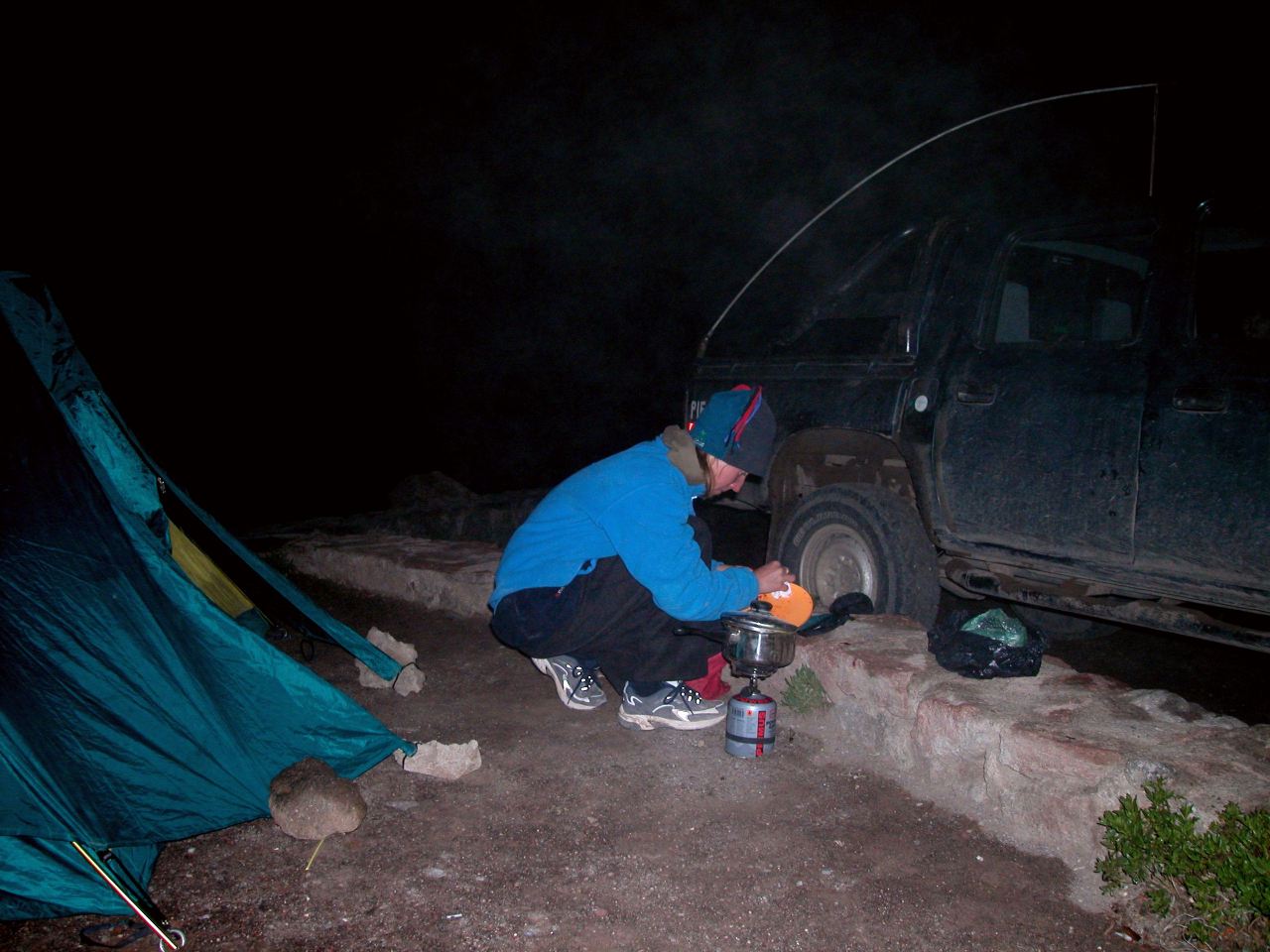
The alarm went off at five in the morning. It's barely dawn beyond the window. Freezing cold, probably below zero. The Southern Cross shines in the sky. We jump about to get warm and make porridge. Not a bird to be seen, or a ray of sunlight for that matter. Not that we should have been surprised. We could have pressed a button on the GPS earlier and seen that sunrise was at 6.37.

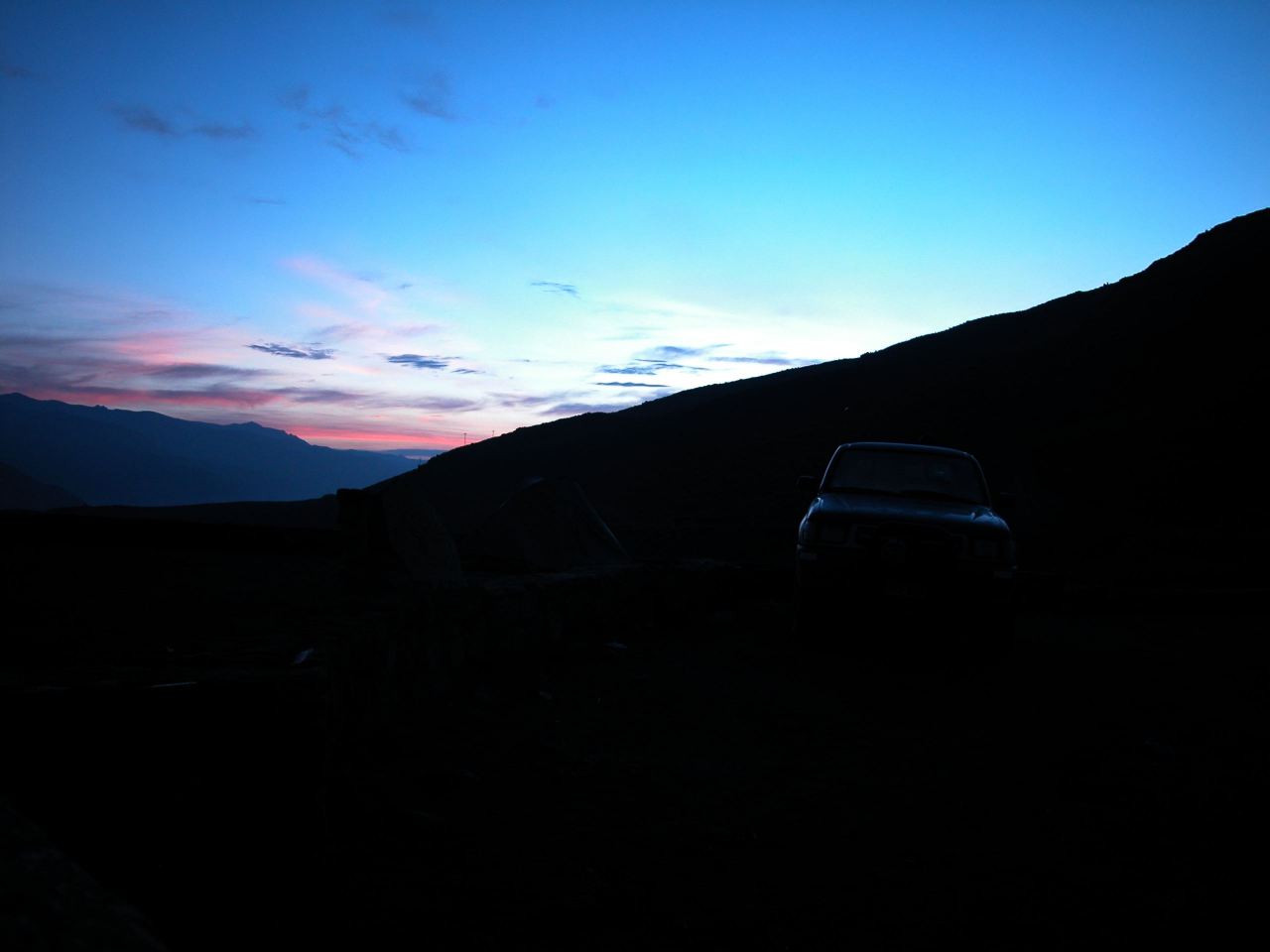

The gorge really is beautiful. Under us, an almost vertical drop. Twelve hundred metres down to the river, 3,200 across to the other wall. There ought to be a wonderful echo here. We try shouting. No, nothing.

Once it finally began to get light, we discovered we'd pitched our tent under an enormous ‘NO CAMPING’ sign. So much for our freedom. It was a good thing we'd come in at night and hadn't seen the sign. It was too late now. We had to put the tent away fast before the eagle-eyed local wardens caught us. Wardens of what, by the way? The gorge doesn't seem to have national park status, so very likely the prohibitions have no legal basis.
Right, we sit and wait. The sun comes up, but no birds, or crowds of tourists for that matter. The first scheduled bus only arrived at eight. Out poured a crowd of souvenir vendors with their bundles, a few independent travellers and, most importantly, several people selling tickets. They were very surprised we were there, and still more that we hadn't got tickets yet. We asked the price: six US dollars per person. That sum wasn't going to impoverish us, of course, but it got under my skin. We told them it was too much, daylight robbery in fact, and that we'd watch the birds from the next cliff.

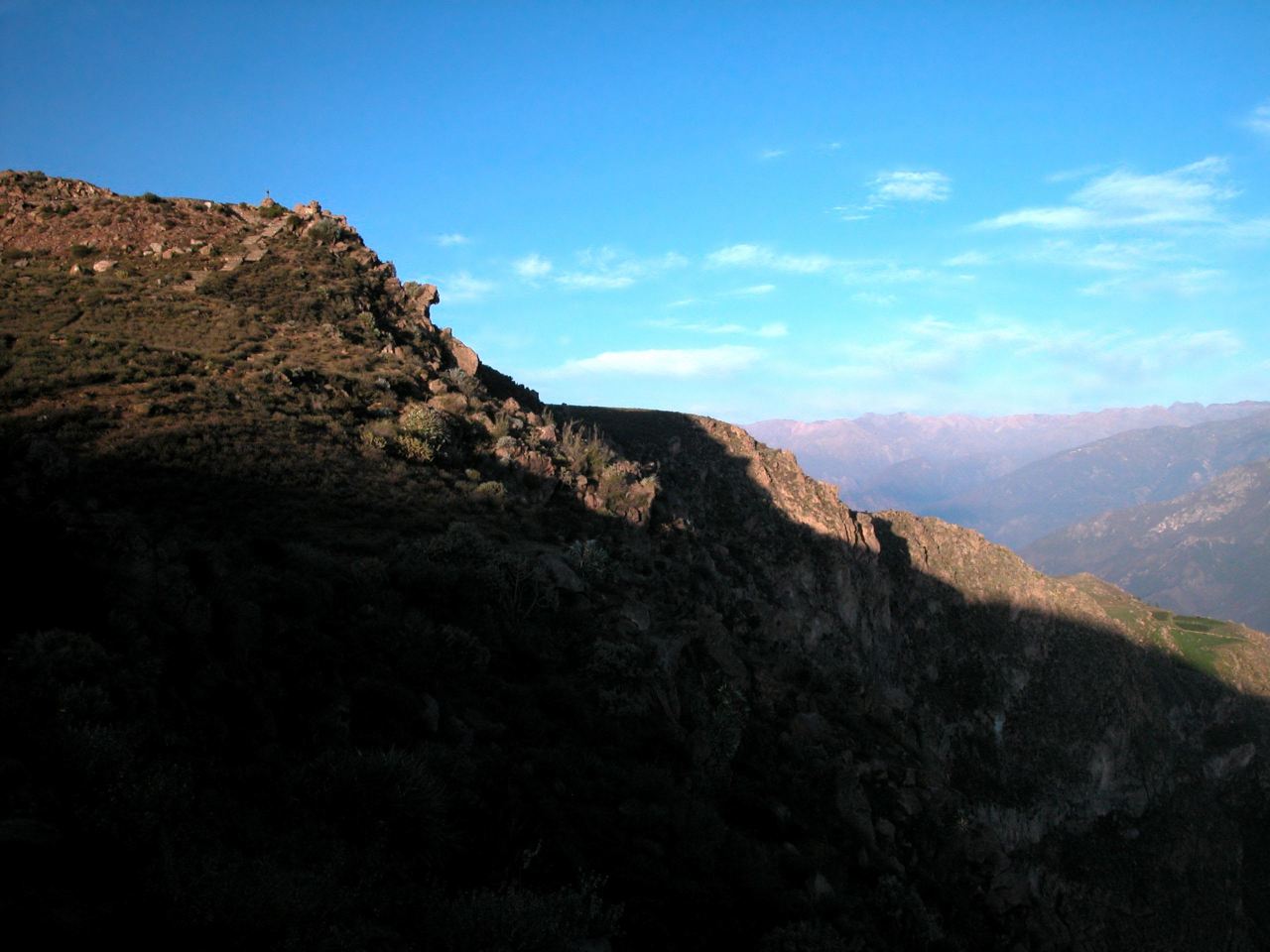
We got into the car. This was our moment to drive off with our heads held high, except that it wouldn't start. The higher we went, the worse it got. Not enough air, or too cold? Who can fathom the soul of a diesel? I had no idea what to do to the engine in those circumstances. The one consolation was that we'd parked on the side of a mountain. Push it ten metres and there was a descent several kilometres long ahead. That's what we did. It rolled a long way. Only after a few kilometres did the engine warm up and begin to rattle unevenly on half its cylinders. Hooray, no more trouble until evening.
We stopped at the next cliff (15°36.585′S, 071°53.796′W, elevation 3,726 m). It was lovely. Green grass, nobody about, and vizcachas flitting through the nearby bushes. They're shy, unlike the Bolivian ones, but you can still see them. If you want to stay the night, this is where I'd do it. The road used to pass here, but they straightened it, leaving a lovely flat spot you can drive to.
The sun climbed higher. A dozen buses of tourists arrived at the viewpoint. Even the hummingbirds had warmed up and flown out, but still no condors.
We'd just started making a second breakfast that was turning into lunch when suddenly, one after another, five real condors took off from the cliff right below the viewpoint. A long way from us, granted. There was a reason people watched them from the appointed place.
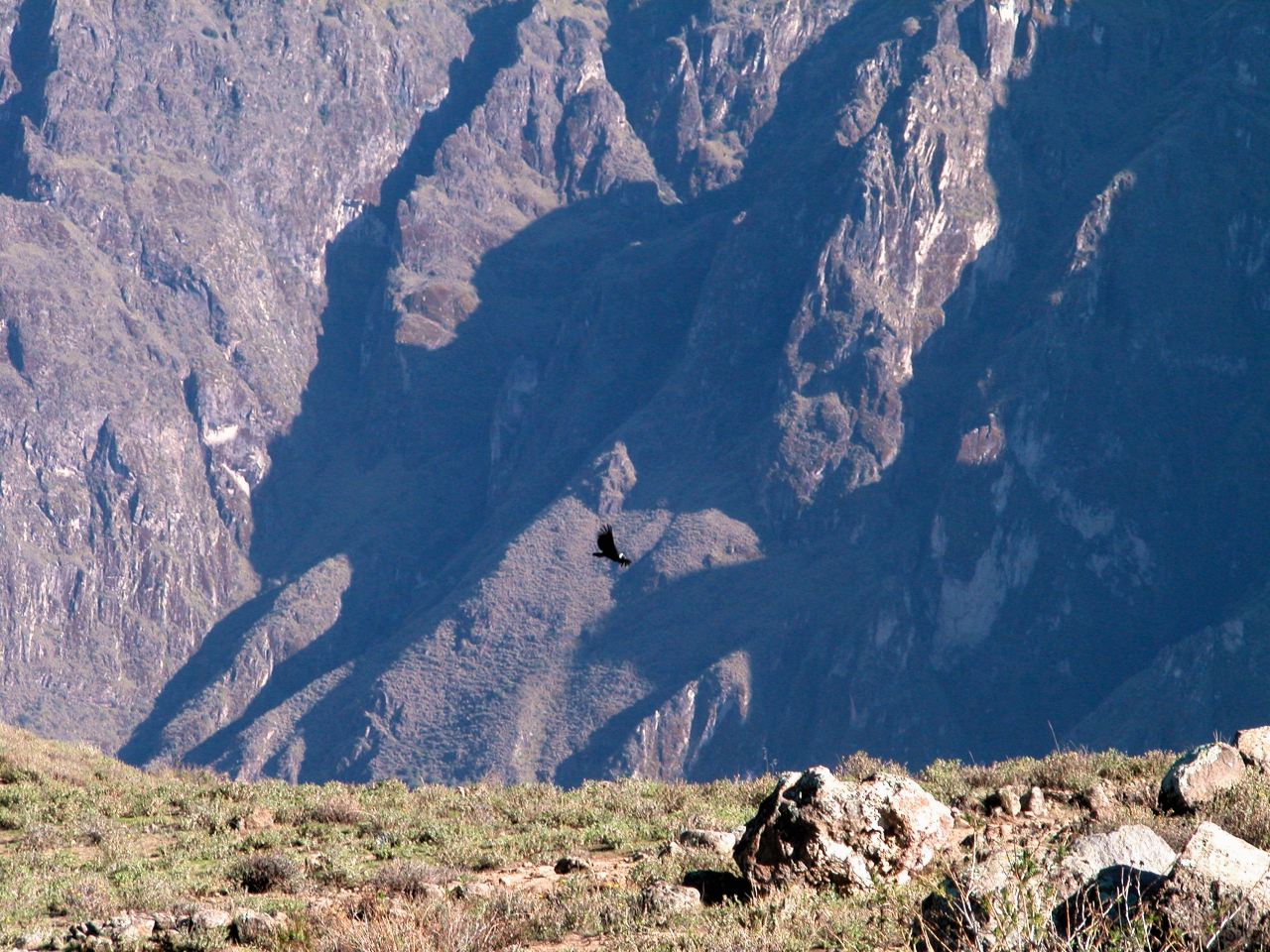


That was a pity, but there was nothing to stop us driving closer. The car started without a fuss this time and we drove right to the spot where the condors circled. We were closer than the tour groups. Once that bird, with its three-metre wingspan and what looked like fifty kilos of muscle, flew only ten metres above us. A shame I didn't get a photo. Digital cameras are slow things. By the time it's powered up and has found its focus, the moment's gone.
Having circled round their take-off site, the birds gained height and went off high into the mountains.
One thing bothers me. Why did they take off at ten, about ten minutes after the coach parties turned up? A seditious thought is creeping in: the condors work for the tour agency and take off when told. I'm tempted to climb down the cliff and see if there's a cage with a condor keeper.
Pleased that we'd seen the condors after all, and even more pleased not to have paid six bucks, we drove on. We'd planned a hike up Nevado Hualca Hualca for that day. It has a geothermal area and a geyser. Lonely Planet says that some tourists report it hasn't worked since the 1998 earthquake, while others say it's fine.

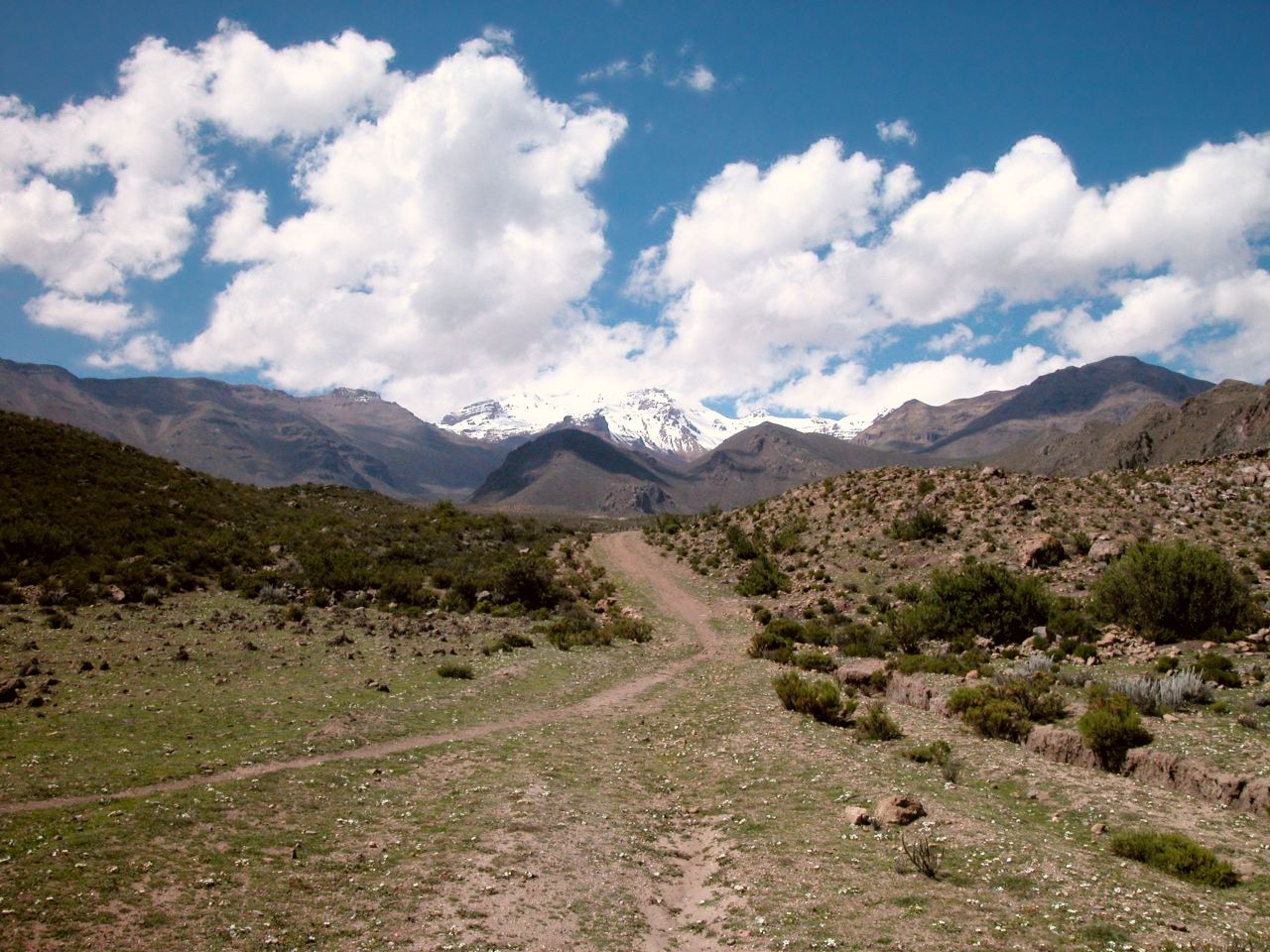
Tanya and I went up on our own. Lena had been ill for three days by then. Her altitude sickness had turned into a persistent bronchitis, with a high fever of 39°C and signs of pneumonia. We even read the medical section in Lonely Planet. The symptoms fit any number of things. By majority vote we decided that if it wasn't bronchitis, it would do for typhoid at least.
An abandoned road leads to the geyser, turning off the main road a kilometre downstream from Pinchollo (15°37.156′S, 71°51.245′W, elevation 3,711 m). With a good four-wheel drive you can drive most of the way up it. Not knowing this, we set off on foot. The book says the walk to the geyser takes four hours. We did it in two hours ten minutes one way. Unfortunately the geyser was indeed out of action. There were only a few mud pots, warm springs and fumaroles left in the large geothermal area (15°40.440′S, 71°51.735′W, elevation 4,379 m). From the expanse of eroded ground you can see that it used to be much more active in earlier days. Having made sure there was little to see, and still having some time, we ran a little farther up the mountain to the snow line. Here we were at the height of Elbrus. Great! We'd stopped expecting ourselves to manage that sort of pace. In the end we'd climbed an average of five hundred metres an hour.

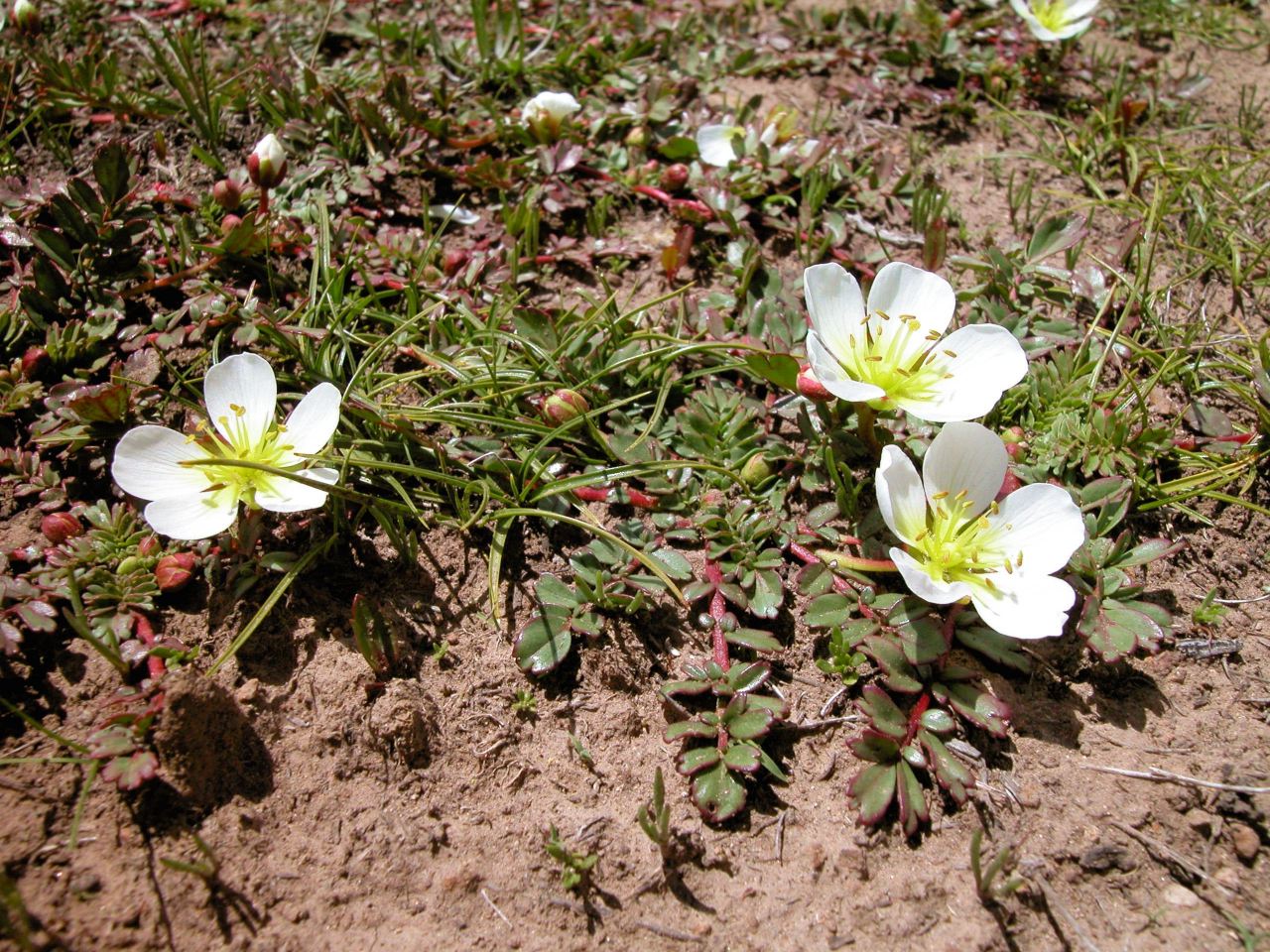


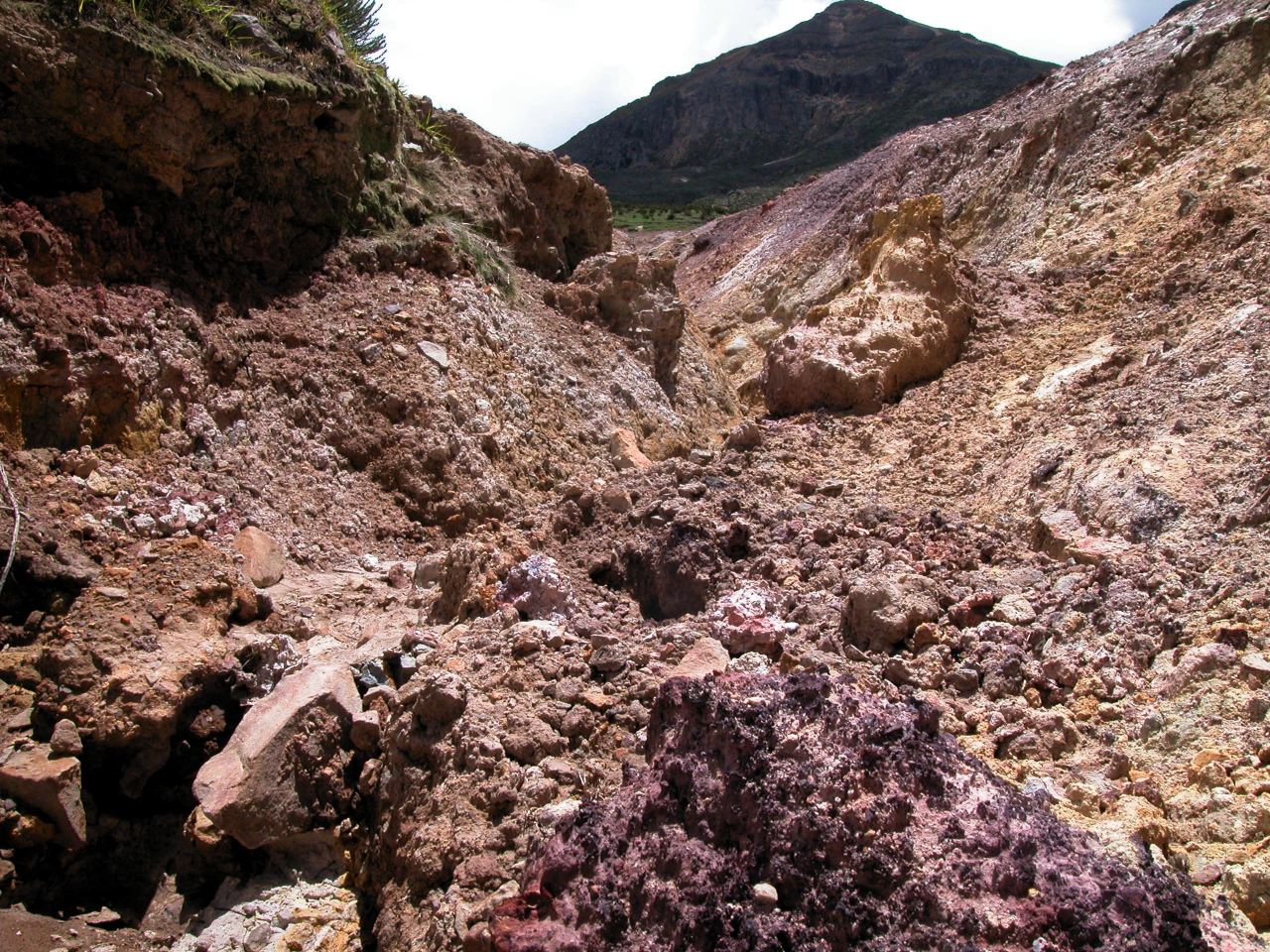
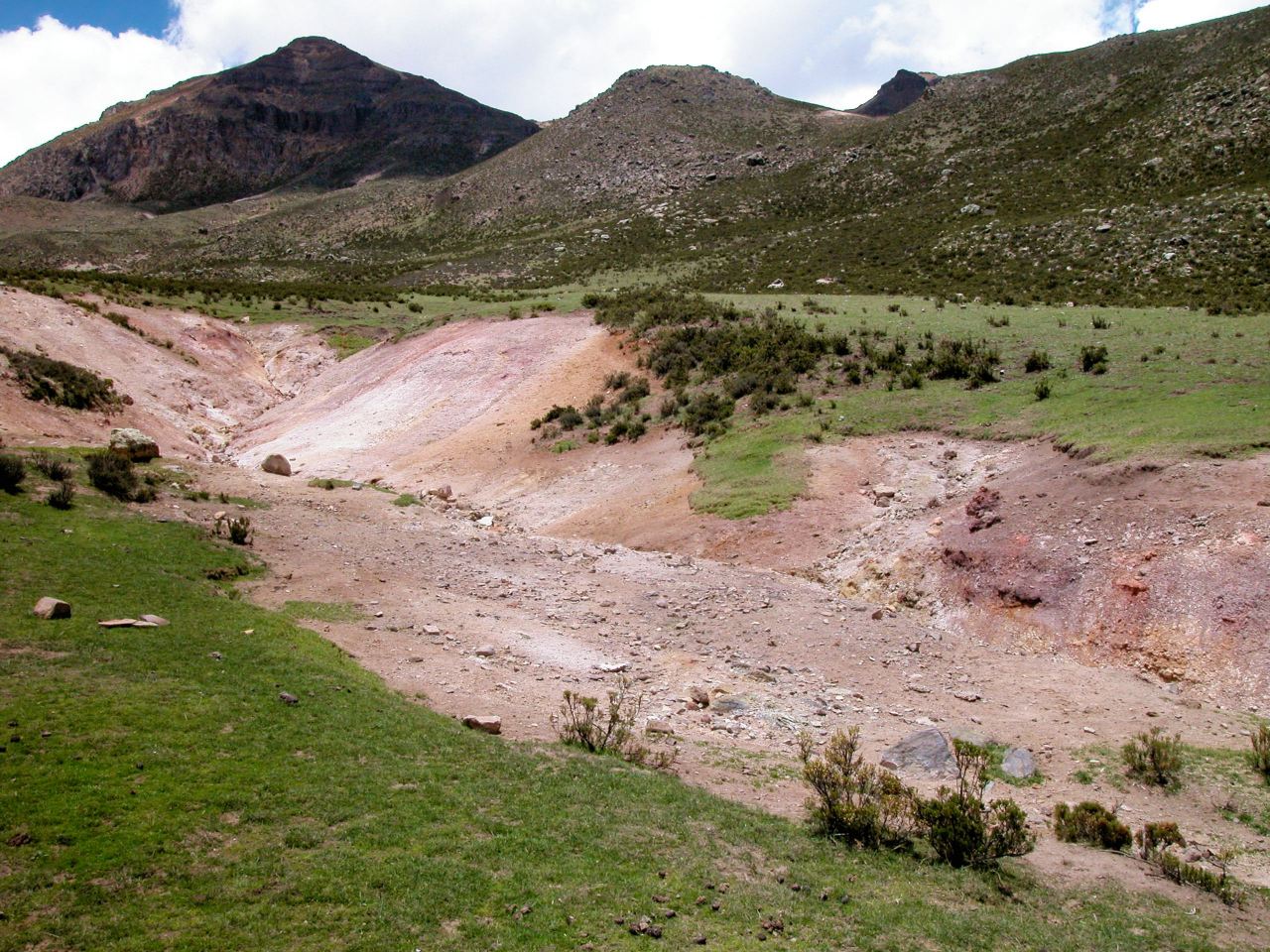
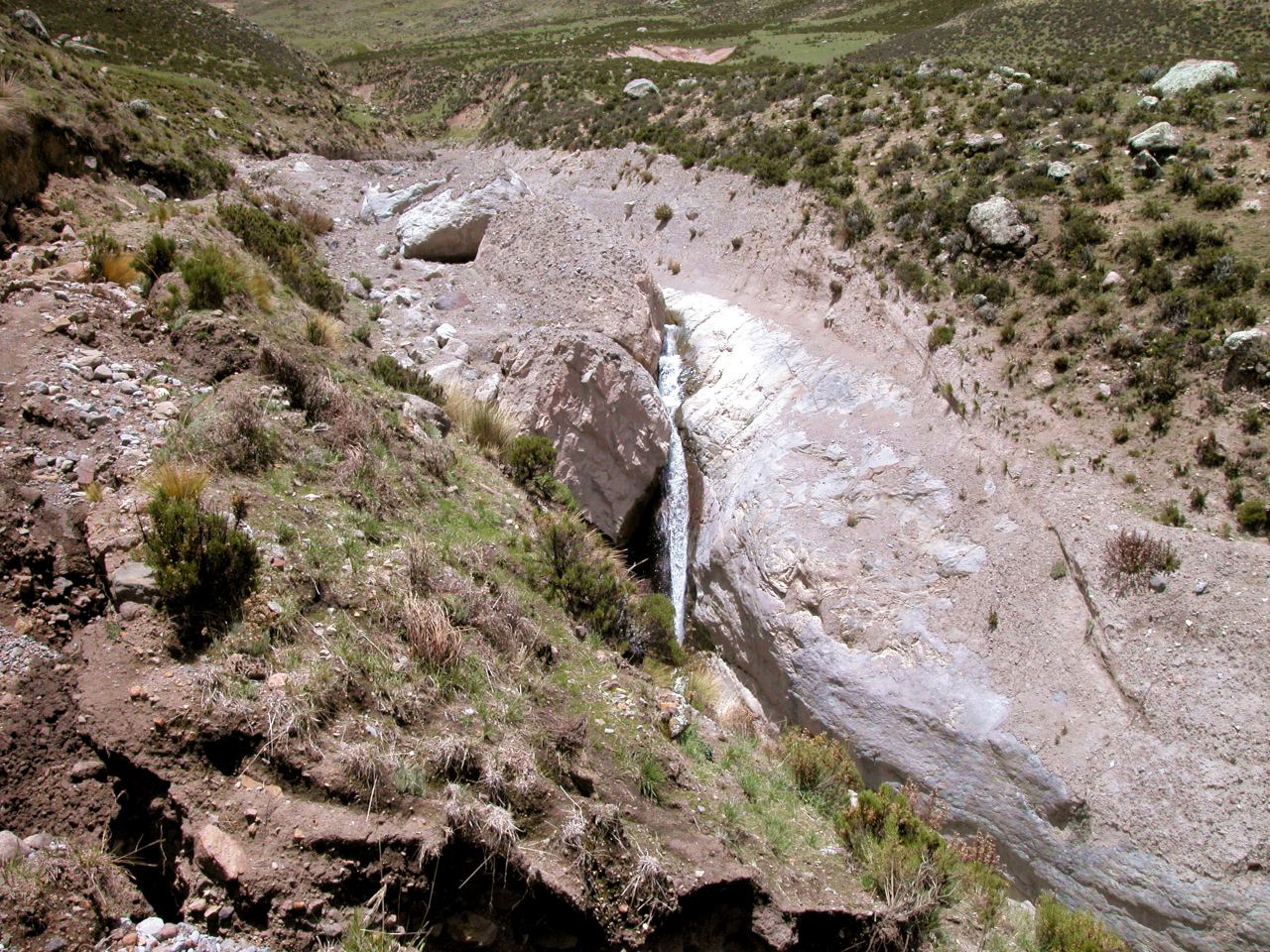
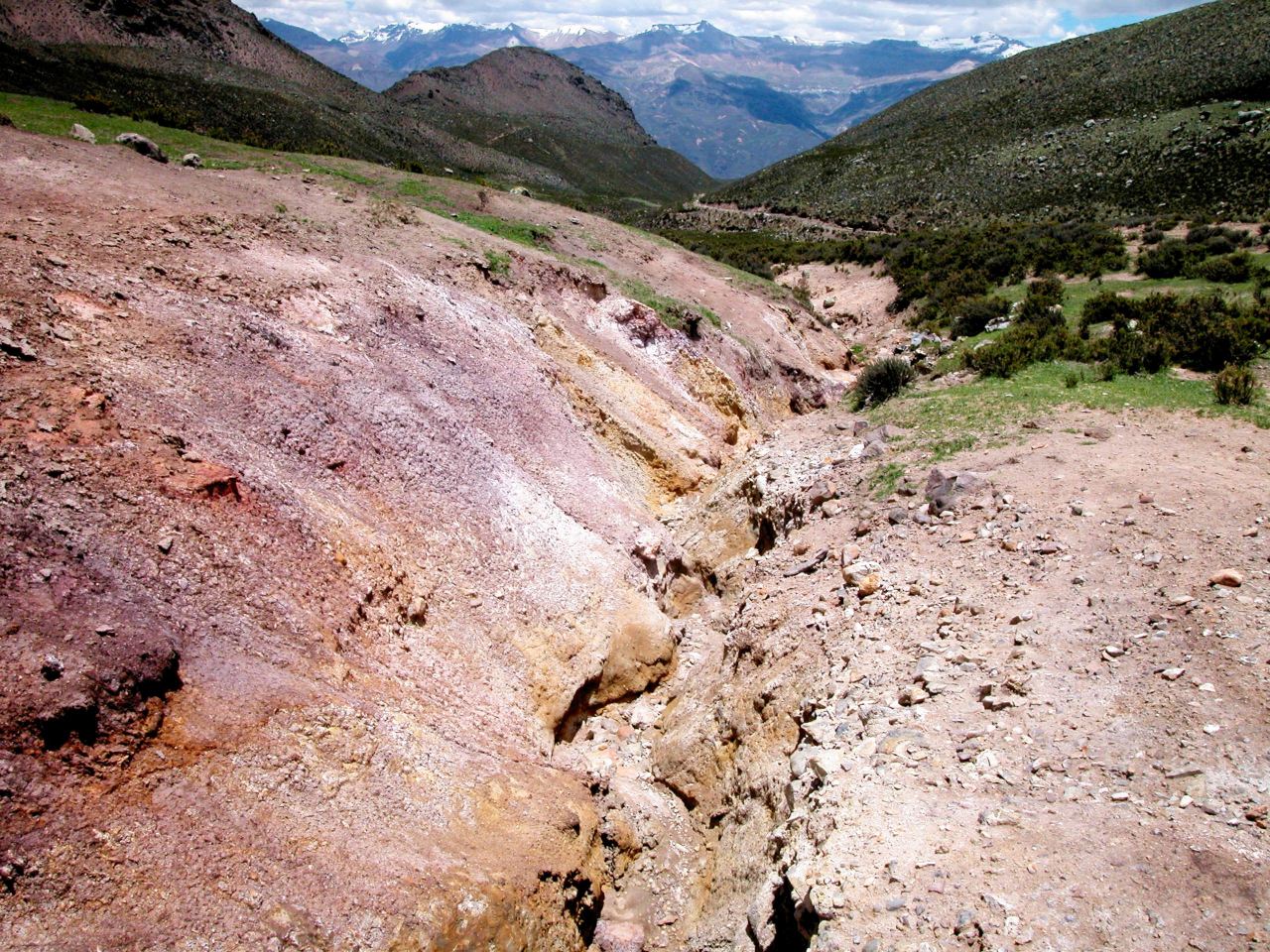

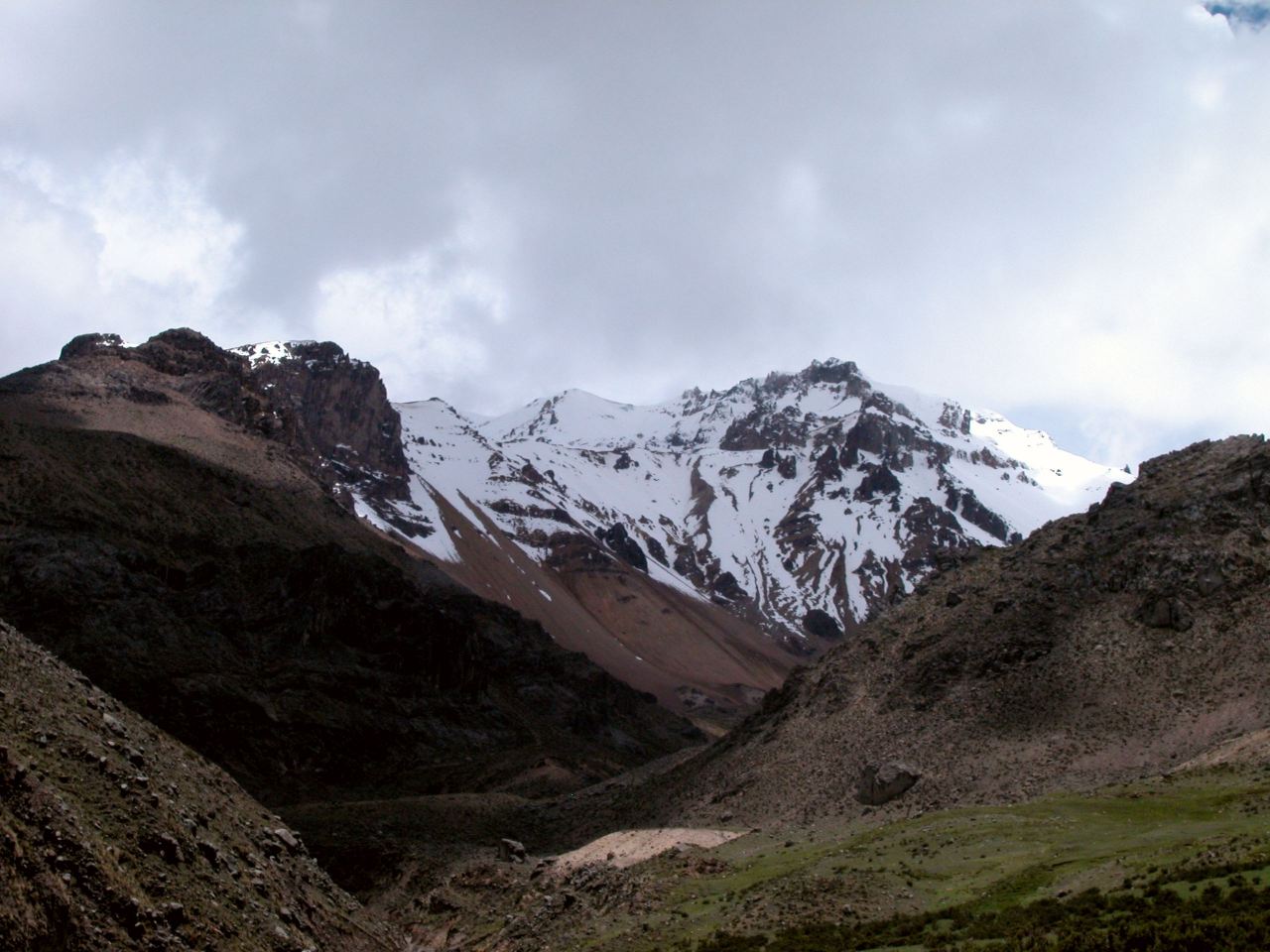
The volcano itself rises to 6,025 metres. By then we were out of time and we had neither crampons nor ice axes.
While we ran about the mountains, Lena warmed up in the sun and went for a drive along the mountain slopes. She went to the village next door for supplies, but the shops there turned out to sell only the bare essentials.
A thunderstorm was gathering in the mountains and we got back just in time. A few minutes after we got into the car, the rain came down in sheets.
Besides the condors, there are several colourful little villages with old seventeenth-century churches worth seeing in the gorge. Unfortunately they suffered severe damage in the 1998 earthquake, when almost every building in these parts collapsed. I don't know how powerful it was. For an idea of how people judge such things, one of magnitude six struck while we were there. The local papers didn't even bother to mention it and the only reason we found out was that relatives rang anxiously from Russia. They take everything calmly here. While we were there a meteorite fell near Cusco and made an enormous crater, and we only heard about that from Russia too.
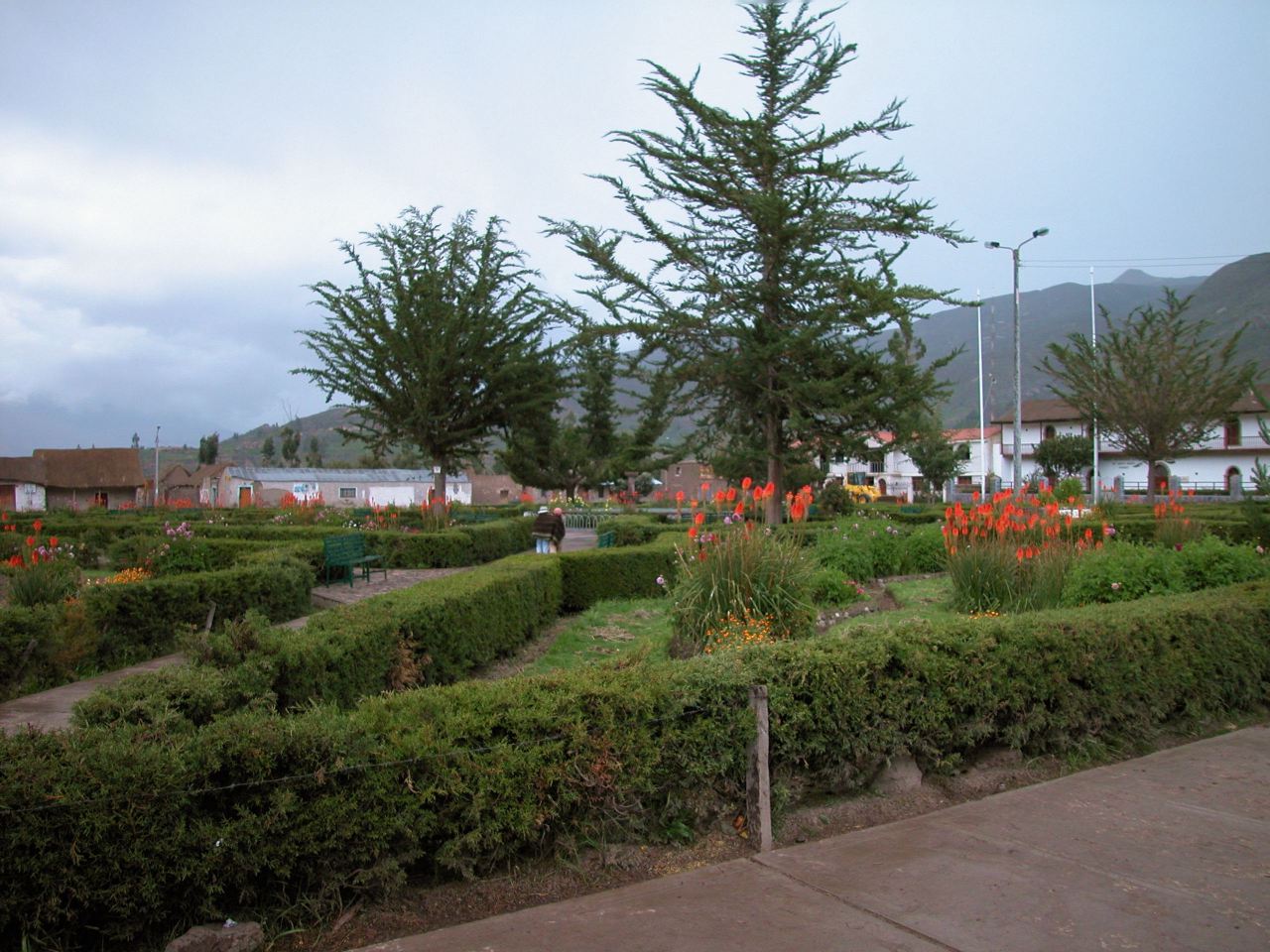
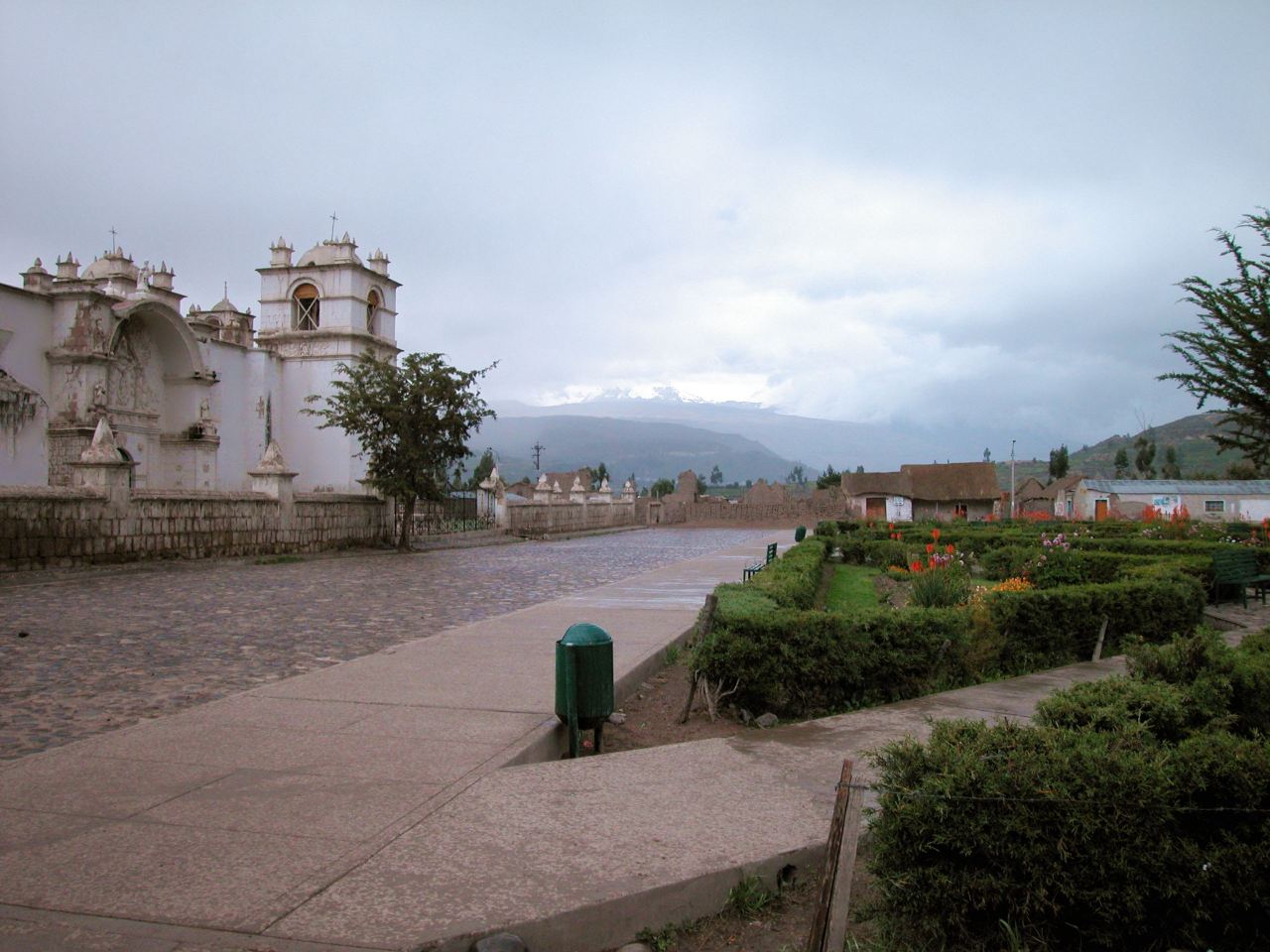
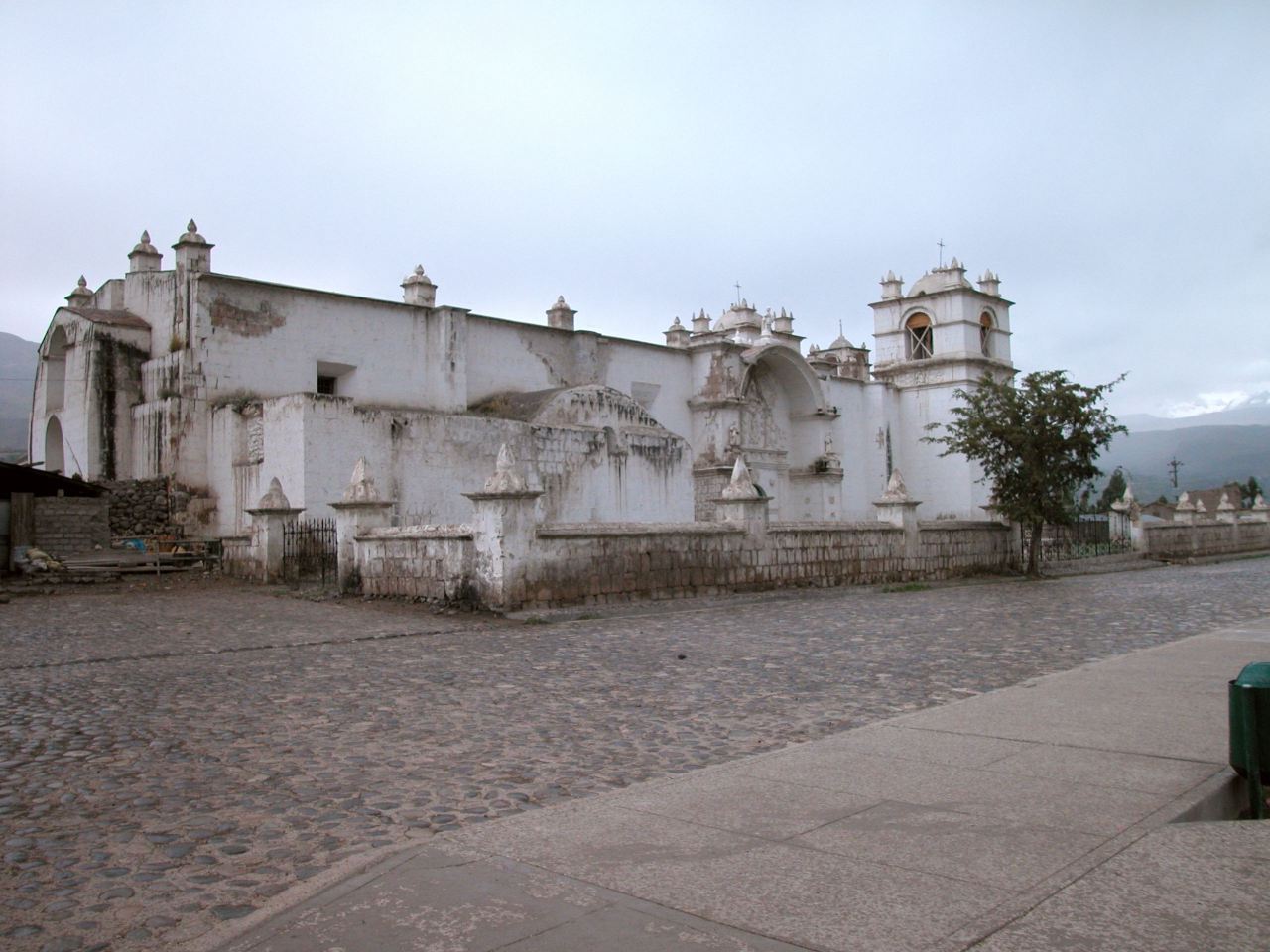
It was dark again by the time we left the gorge and drove back towards Arequipa. To the north lies the Valley of the Volcanoes. The area is now protected in the Salinas y Aguada Blanca reserve. We found somewhere to stop before the Arequipa–Puno highway, but the GPS put it at four thousand metres. Lena was ill and said she'd certainly be dead by morning at that altitude. The car certainly wouldn't start, and we were out in the wilderness with no obvious way to recover it. We decided to drive on. We got onto the new highway to Puno. It had only just been built. Excellent tarmac. It hadn't even made it onto the maps. In Peru you can usually find a room in almost any small town and we pinned our hopes on a village called Imata. In vain, as it turned out. By then it was eleven at night. Freezing outside. After a sleepless night I was inattentive at the wheel. I don't like driving at night anyway. It's always better to get up earlier. Darkness usually lasts ten hours, just right for eight hours' sleep and an hour apiece for two meals. All very well, but Lena wanted to spend the night below three thousand metres, and we never got below four and a half. At midnight I made the decision: we stop here, in this lifeless high-altitude desert at 4,429 metres (15°52.788′S, 071°08.897′W). We kept the engine running often enough to keep the heat on. Lena slept in the car and was in charge of keeping it warm. We slept in the tent.
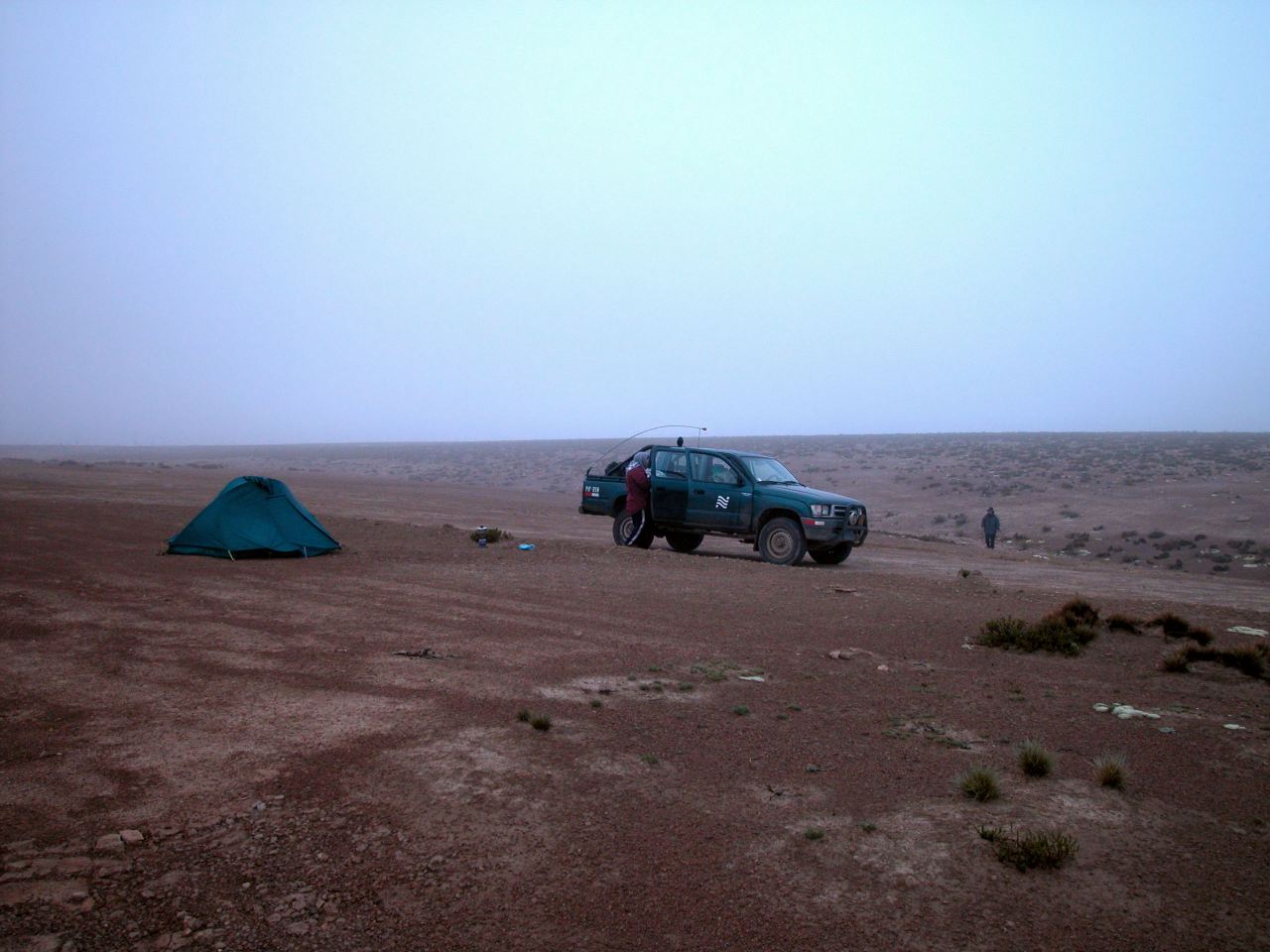
It was unusually cold that night and snow fell towards morning. We had the heater on for fifteen minutes every hour.
We woke early to a horrible noise. In the dark we hadn't noticed we'd camped ten metres from a railway line, and a train had come through early in the morning.
When the tropical sun finally warmed those icy rocks, we drove on to explore the national reserve. Scores of birds sat in the pools along the roadside. Now and then there were vizcachas and some small rodents. Lots of vicuñas and alpacas grazed out on the limitless plains. We saw an alpaca calf being born. Its mother diligently licked it clean. It tried to get to its feet for the first time. Seeing us, the proud mother did her best to look frightening and dangerous, stamping a hoof for good measure. She wouldn't really attack a person, but she does know how to kick and, especially, how to bite. Trying to stroke her isn't a particularly safe idea.

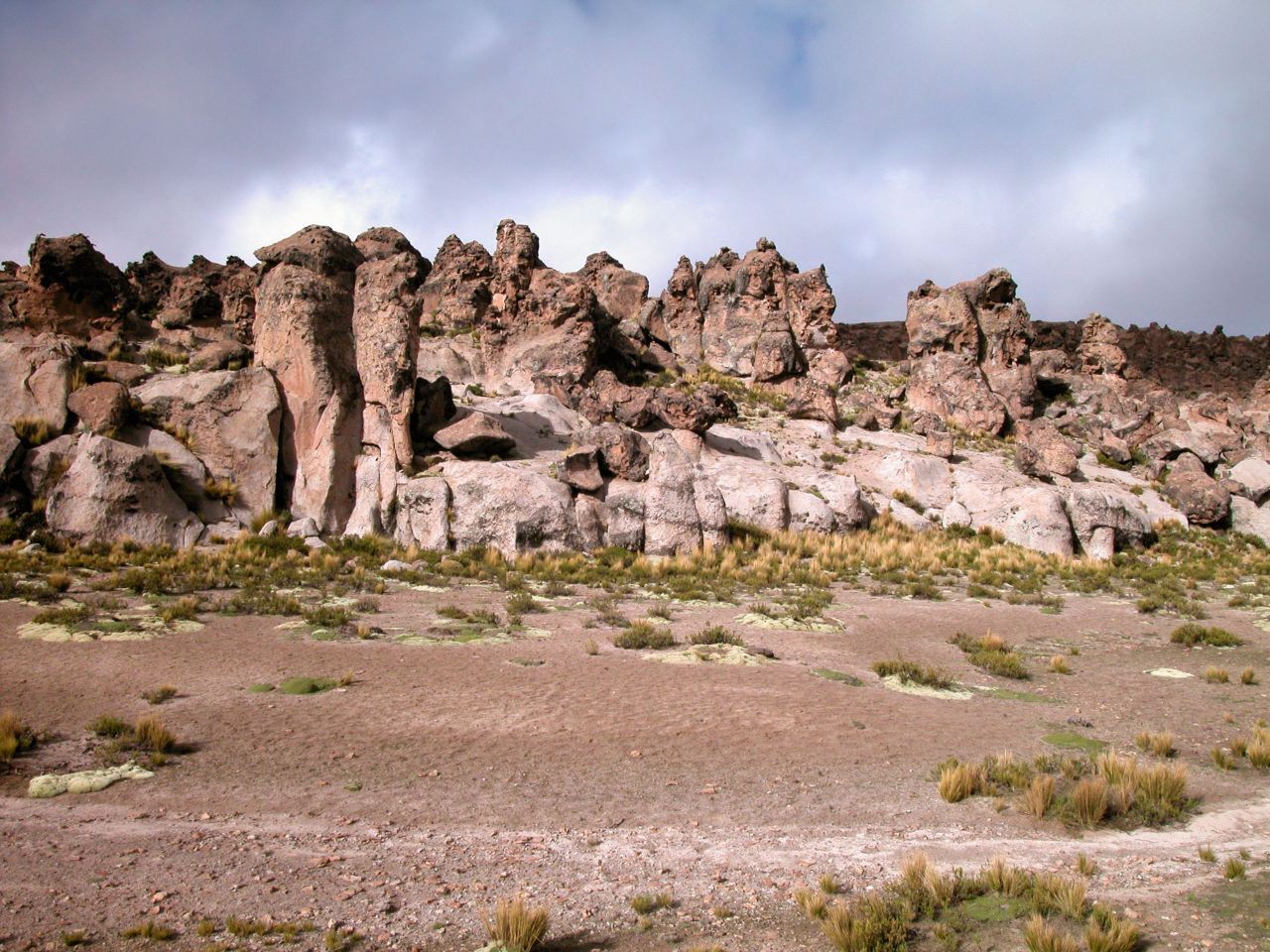
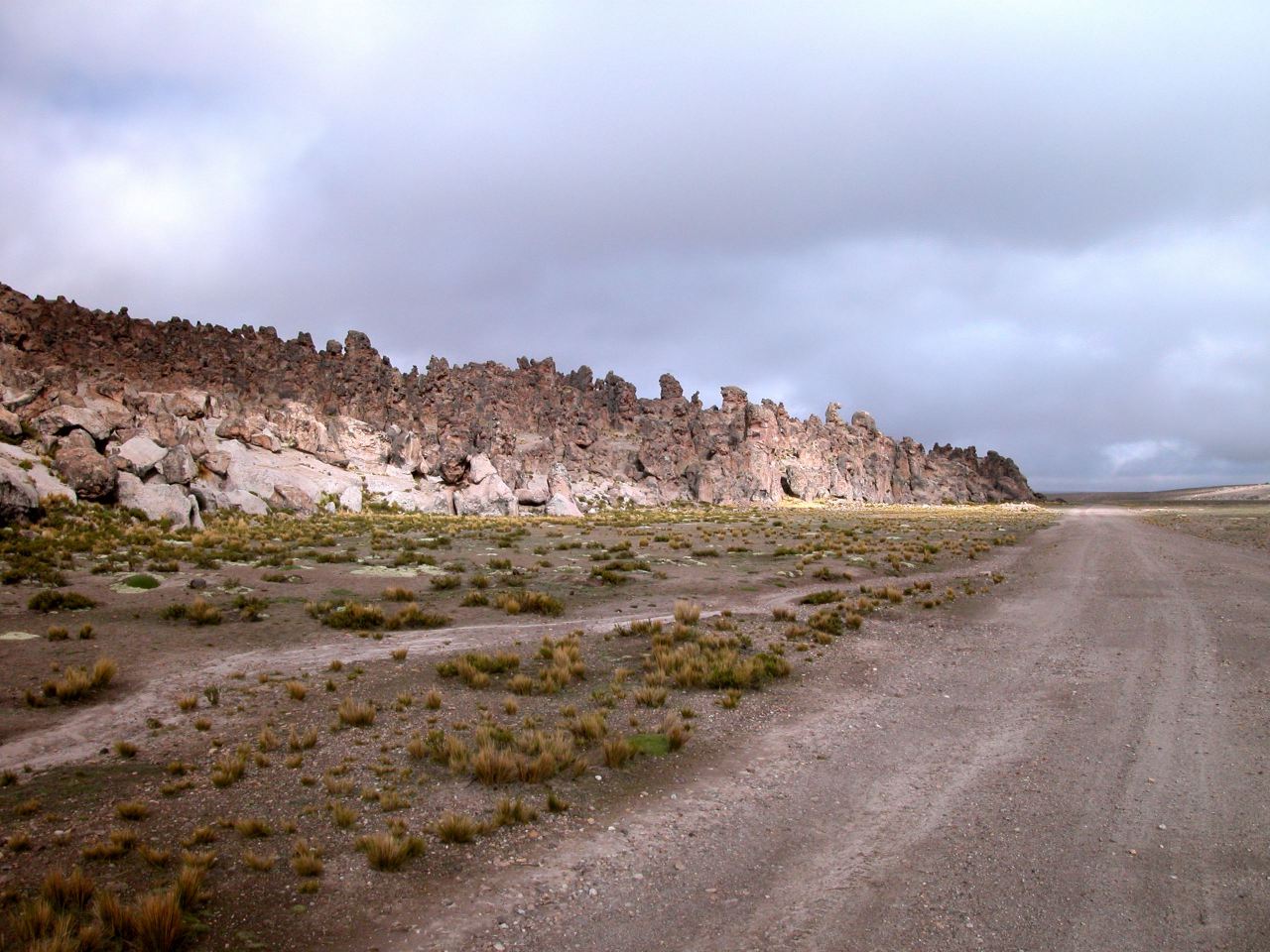
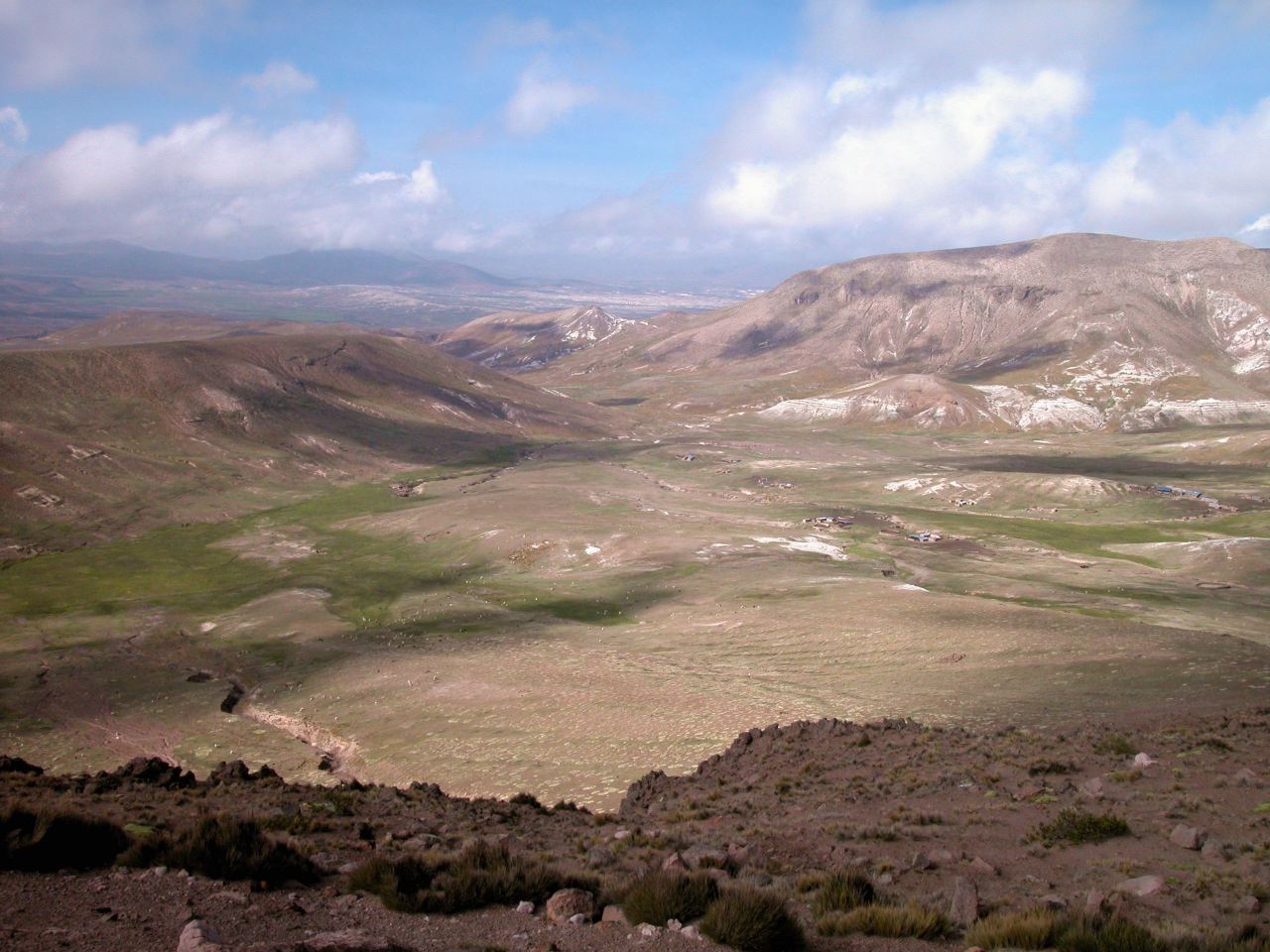
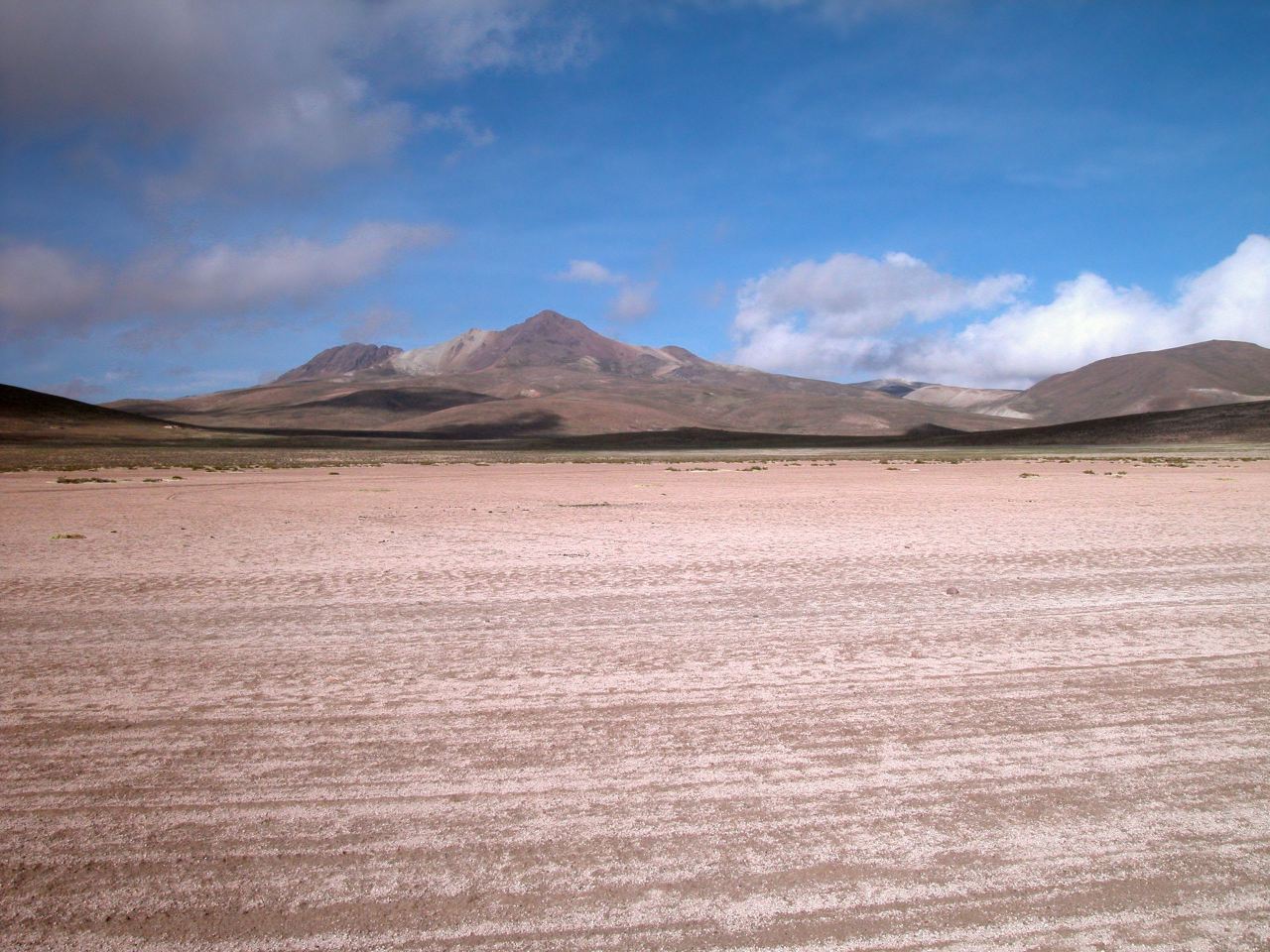
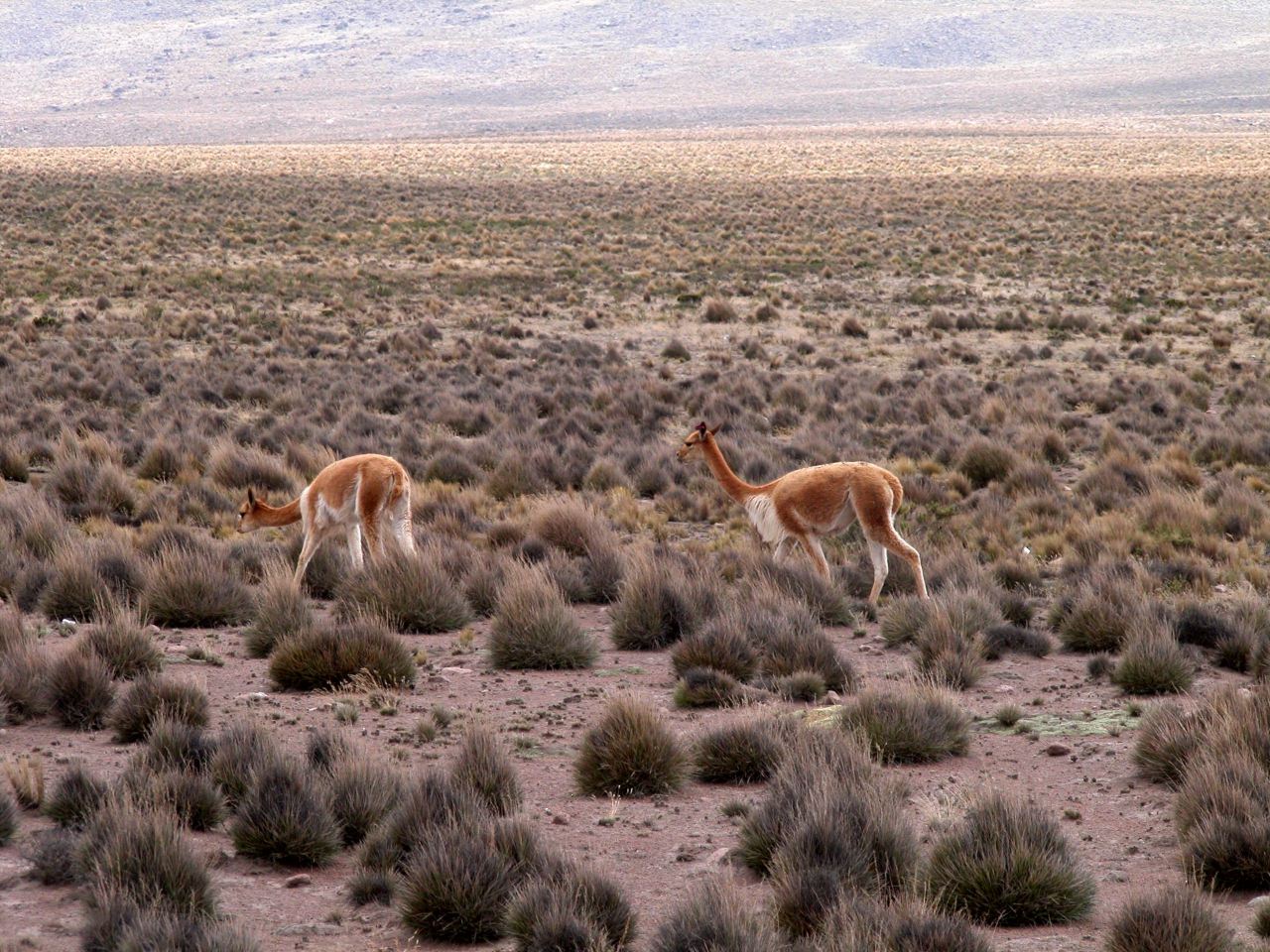


The main attraction of the national reserve is the salt lake, Laguna Salinas, with its flocks of flamingos. They put their heads beneath the surface, filtering the brine and feeding on any little shrimp they catch.

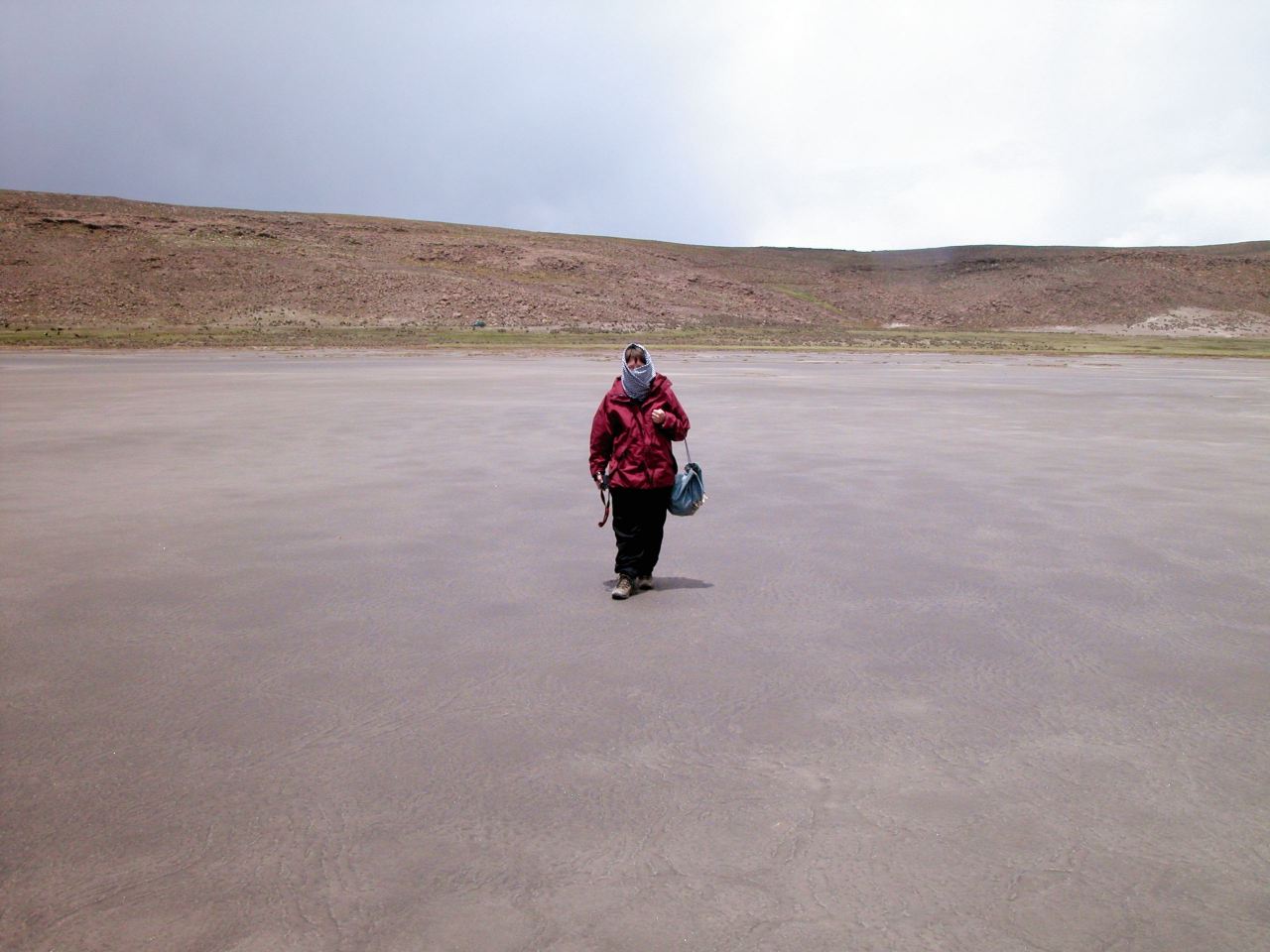


Several hundred were feeding when we got there. Like the vizcachas here, unlike the ones in Bolivia, they were shy and wouldn't let us get within three hundred metres.
Seven volcanic cones surround the lake. Their peaks rise over six thousand metres and are covered with permanent snow. Alas, we were here in the middle of the wet season and only now and then did the peaks appear, one at a time, from behind the thunder clouds.
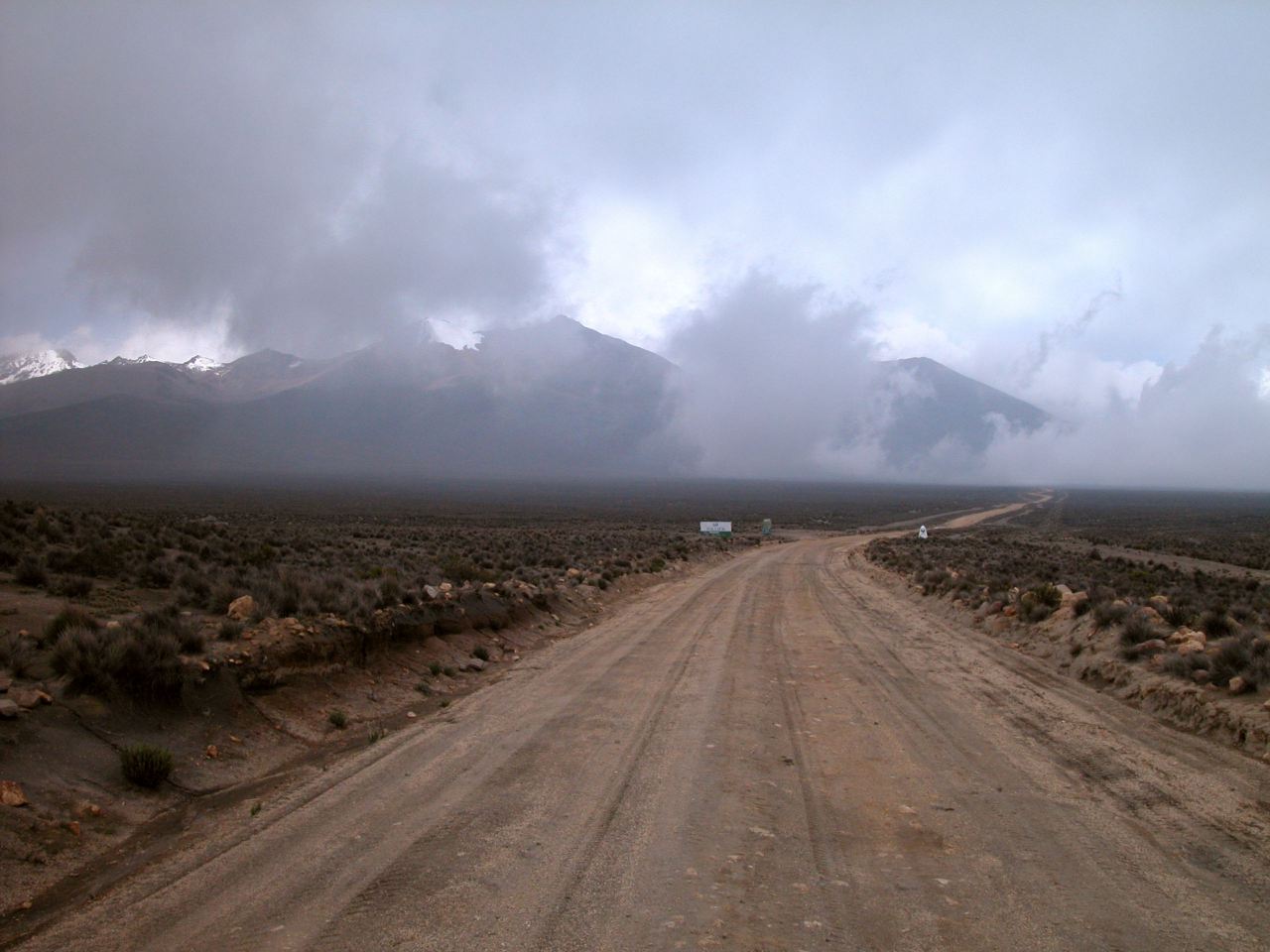
We drove the whole way from the high valley down to Arequipa in thick fog and pouring rain. Muddy hairpin bends with a great many puddles. There were even some tunnels. Crosses everywhere beside the road. It's probably one of the hardest mountain roads in the world. In Peru there are many crosses right beside the roads anywhere you go. That's not only because the roads are so dangerous, but also because the custom goes back so far. Sometimes you see a little grave half a century old.


After dropping two thousand metres, we finally emerged below the clouds. There was no rain in Arequipa. The city stands on the very edge of the desert.
Finally we were warm. We had lunch on the way out of Arequipa. We ordered mariscos, a mixture of shellfish and fish. They gave us an absolutely fantastic portion. It might have been made for a long-distance lorry driver who hadn't eaten for days, and there were two women's leftovers for me to finish as well. It had been a long time since I'd made such a pig of myself.
After a few more hours, the road reached the sea. Not long ago we'd been driving across snowy wastes. Now the damp tropical heat was all around us.


We needed to cover as much ground as possible towards Lima. We still had three days and wanted to fit so much in.
We stopped for the night at the ocean's edge (16°15.631′S, 073°31.677′W, elevation 4 m). Here you can get down to the sea on a steep, rocky little road and camp on a small stony beach right on the surf line. There had once been a village here. It's now completely ruined, whether by an earthquake or the communist ideas of some past government.
It was a glorious night under canvas. A full moon directly overhead, the sea there to swim in and, above all, warmth. The night before we'd put on everything we had before getting into our sleeping bags. Now we lay naked on top of everything and were still hot. We didn't bother with the fly. It couldn't conceivably rain here. Through the mesh in the roof of the tent we could see the southern stars. Most importantly, there it was, the Southern Cross. I'd dreamt of seeing it all through my childhood. So many nights it came to me in dreams, and now I simply had to open my eyes and there it was in real life. To sleep on a night like that felt a waste, especially given that it was our last night in a tent on the trip and nobody knew when we'd have another like it. So we lay there in each other's arms, looking at the stars.
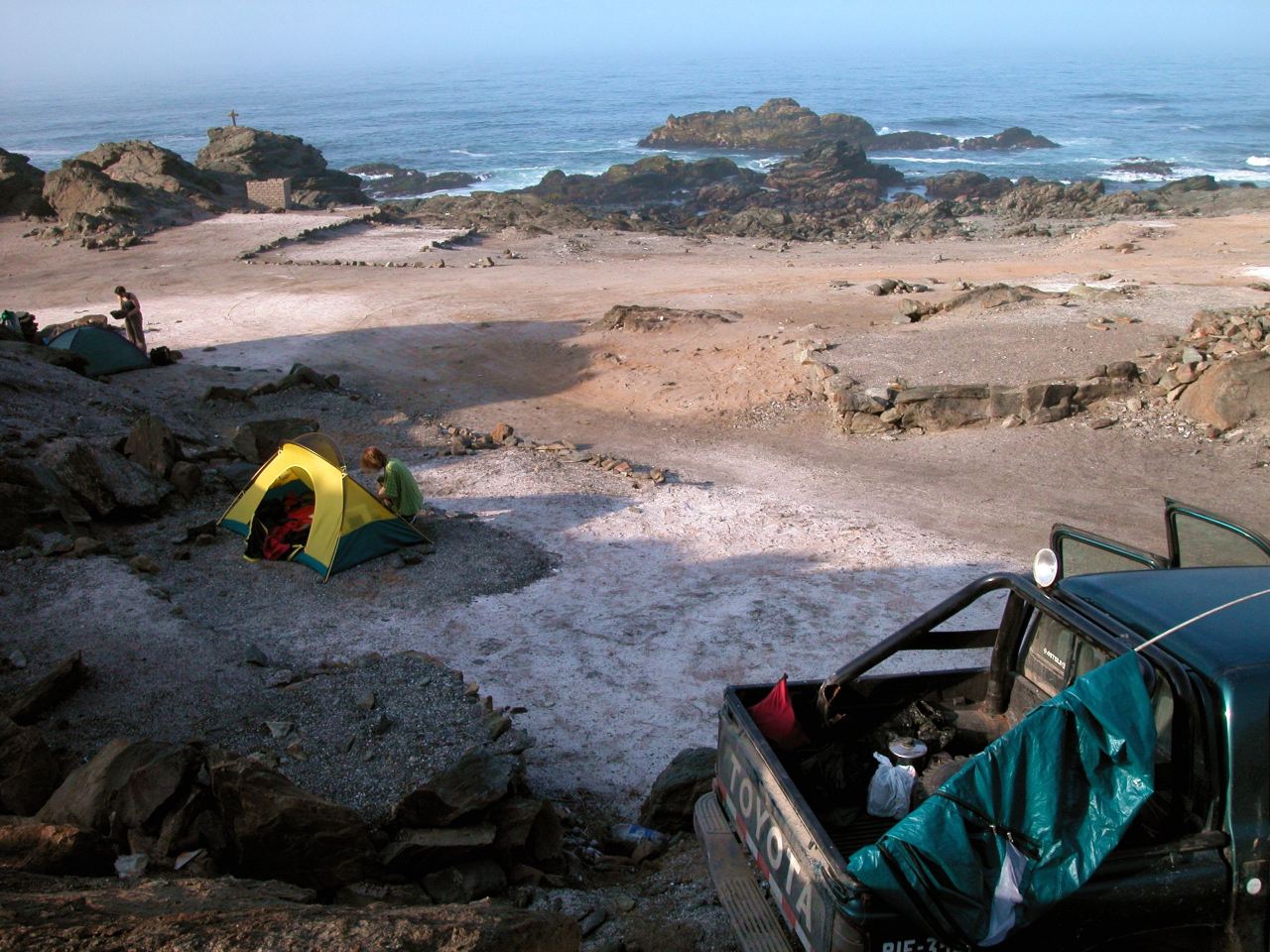
In the morning we went swimming. Even Lena was well enough to get into the cold water.

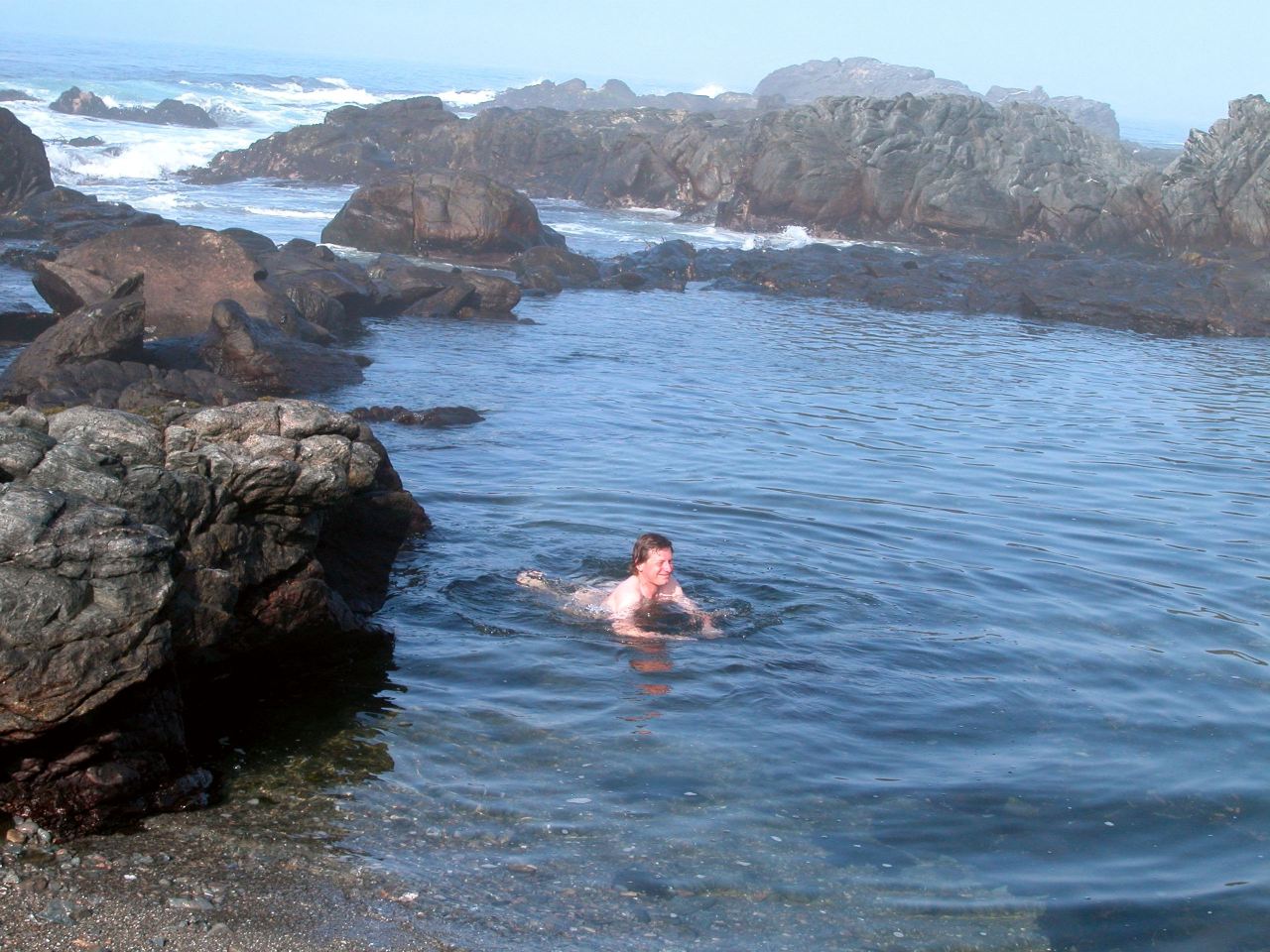
Afterwards we walked for a long time along the shore, collecting shells and remains of other sea creatures. The four-wheel drive started successfully, though I immediately got stuck in the shingle and it was a great struggle to get out. It's true what they say: a four-wheel drive is a car that gets stuck in places other cars can't even reach.

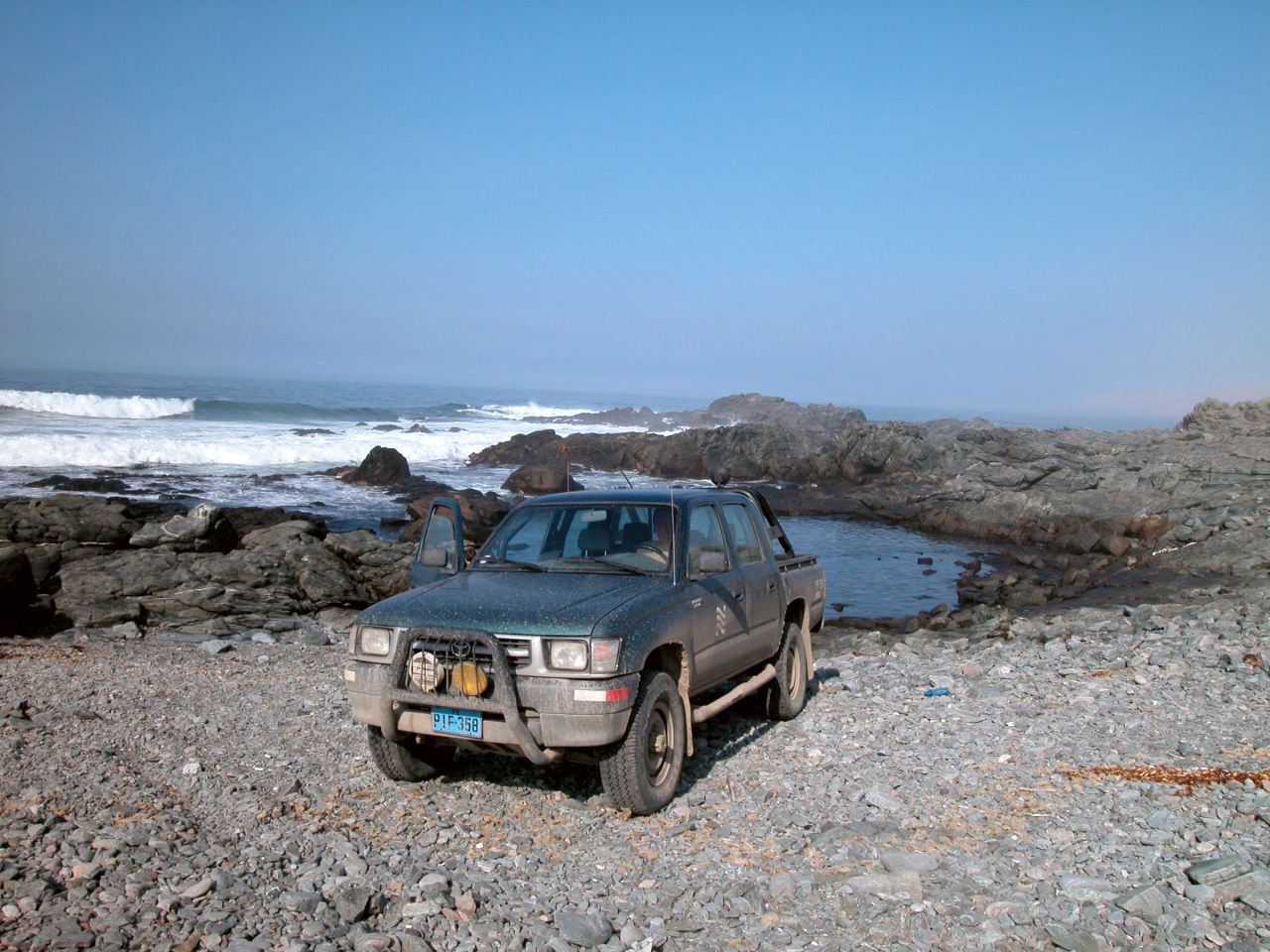
A long drive ahead. Our first stop was near the Nazca Lines, where we saw them up close instead of from a plane. Then we turned off into the Huacachina oasis near Ica. Five kilometres south of the Pan-American Highway, among hundred-metre dunes, there's a little lake with palm trees on its shores. A decidedly un-South-American picture. You might expect it in northern Africa. The thing to do is swim in the lake, and the water is supposed to be good for you. Perhaps it is, but I'd have said it was simply dirty, muddied by the scores of children who splash in the pool from morning to night. We walked around and left. Another reason for leaving was that a café owner had shown us a place to park outside his door and now insisted we have lunch with him.
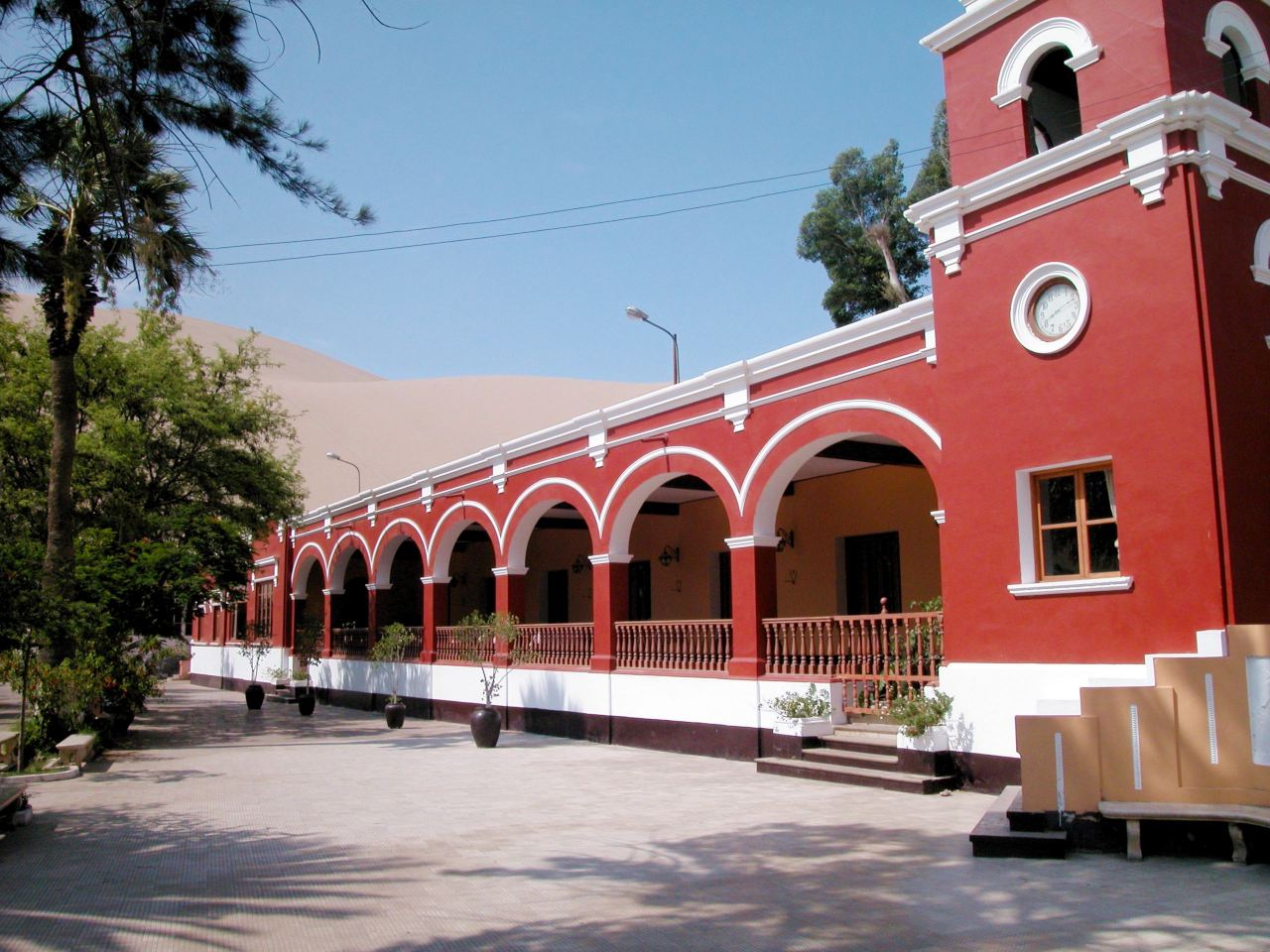



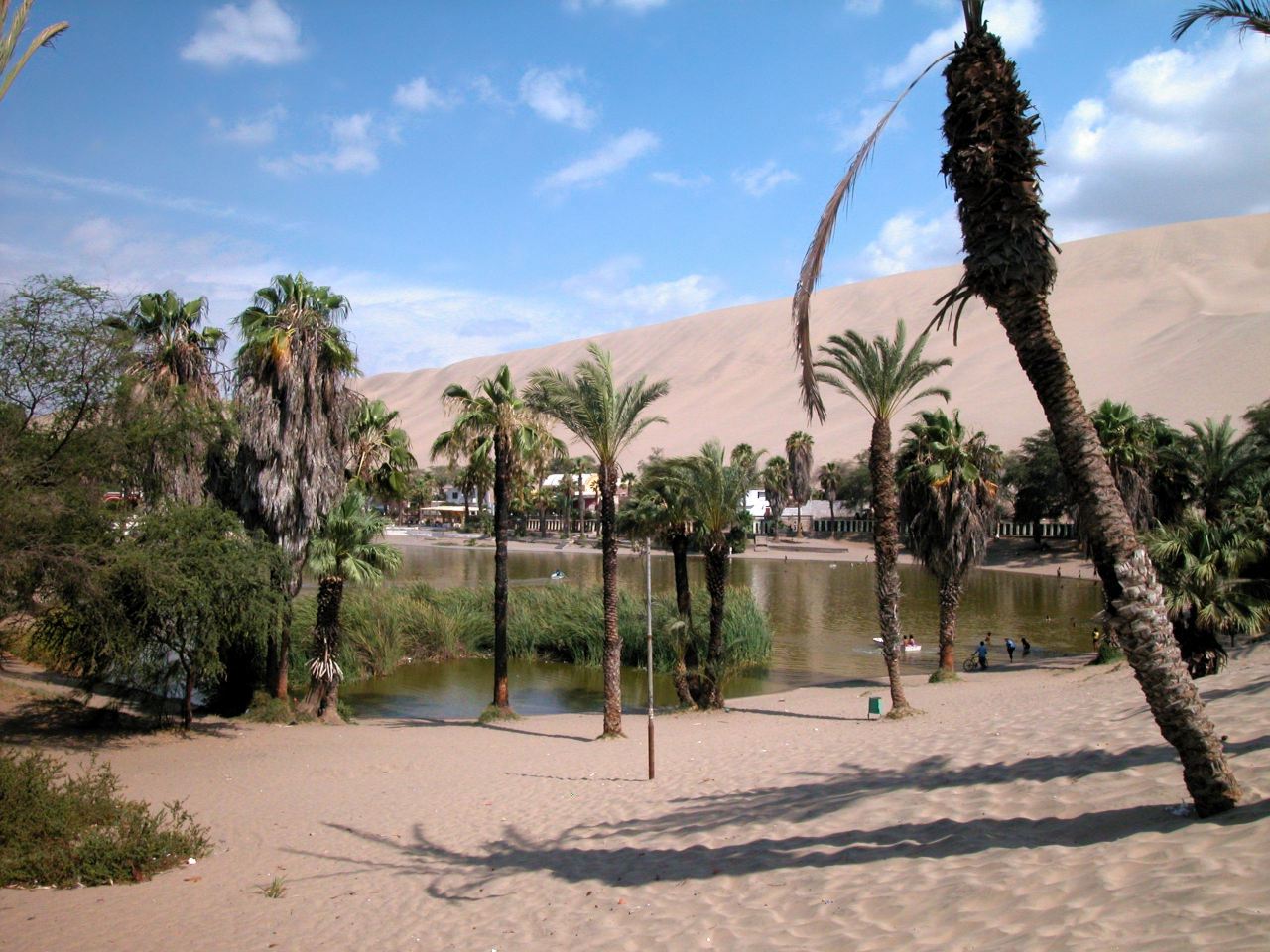
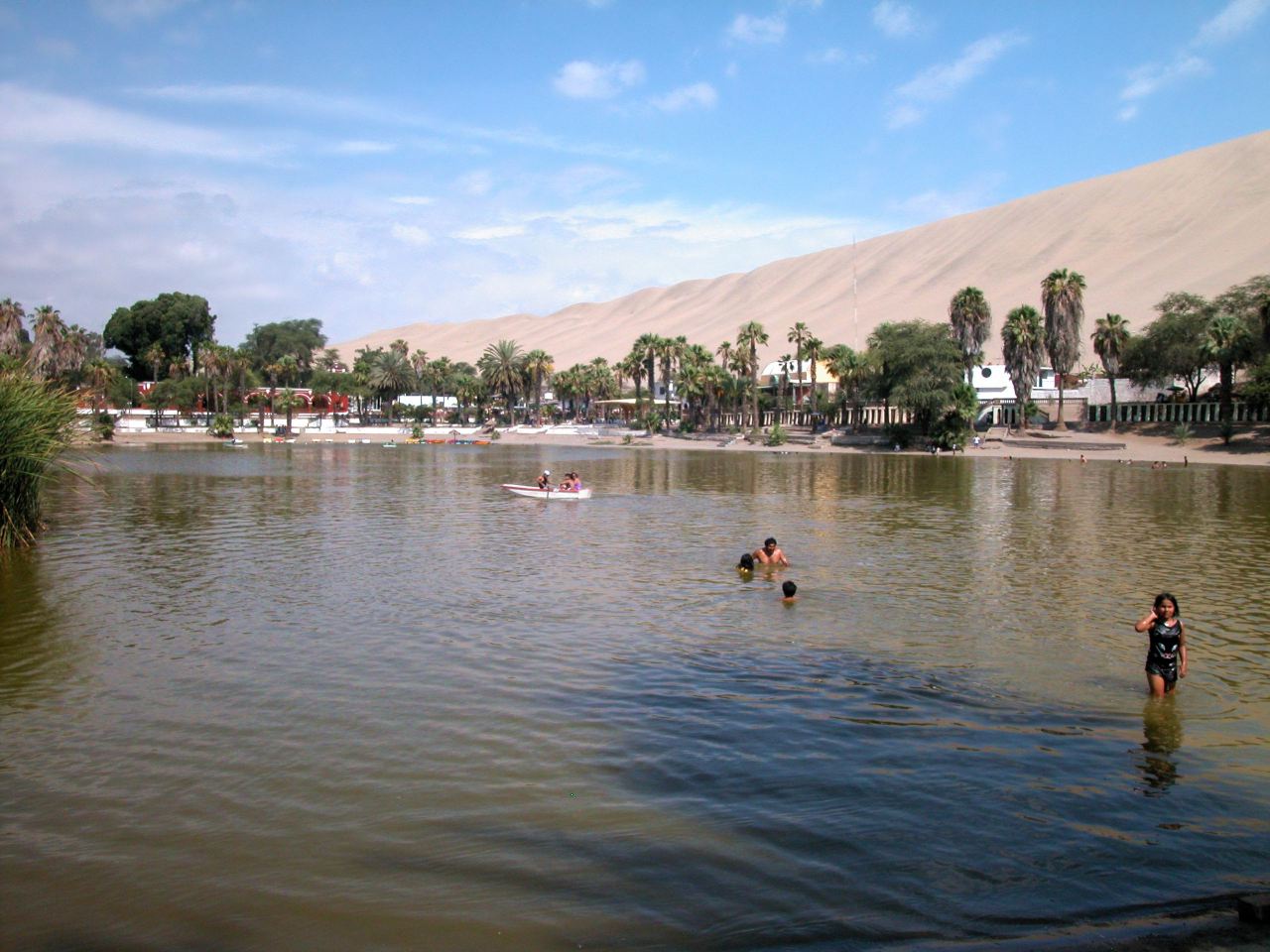
The next drive was long. We'd meant to stop for lunch before Lima. Then without noticing we'd entered the city, got lost among the perpetually clogged streets of a city of ten million, and spent ages looking for the motorway and its longed-for sign, ‘Panamericana Norte’. Even after finding it we drove through one outlying suburb after another for a long time. Half mad with hunger, I stopped at a McDonald's where we had three Big Macs for lunch. Lena, upholding her anti-globalisation principles, declined to eat.
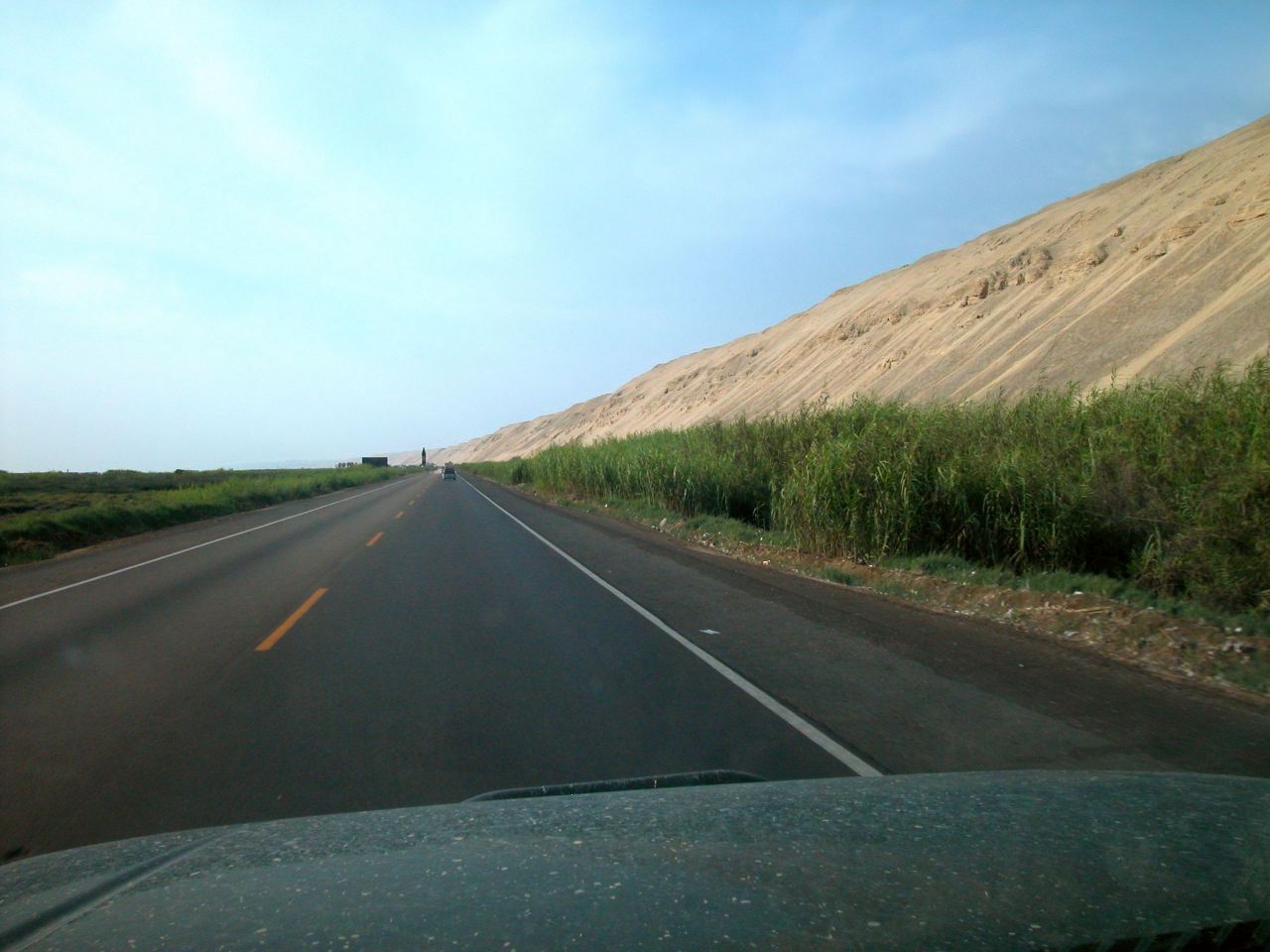

We stopped the night at a roadside hotel in Huaral, after doing more than a thousand kilometres that day (11°36.763′S, 77°13.934′W). Our room had a balcony and next door there was a filling station with a twenty-four-hour café.
We started the next day at Lomas de Lachay National Reserve. It stands in the middle of the desert, but does get rain, so there's grass, scrub and even trees. You ought to visit the reserve in October when there are flowers everywhere, but we didn't have a choice. The entrance fee is five soles, and the wonder starts even before the warden's hut. In the dead, stony desert, here and there suddenly appear spikes of orange lilies. Not a single leaf, just a few flowers on a slender stalk. You can hardly believe your eyes when you see it. I dug up a couple of bulbs after flowering and they're now growing quite happily in a pot in Saint Petersburg next to my mother's pachypodium.

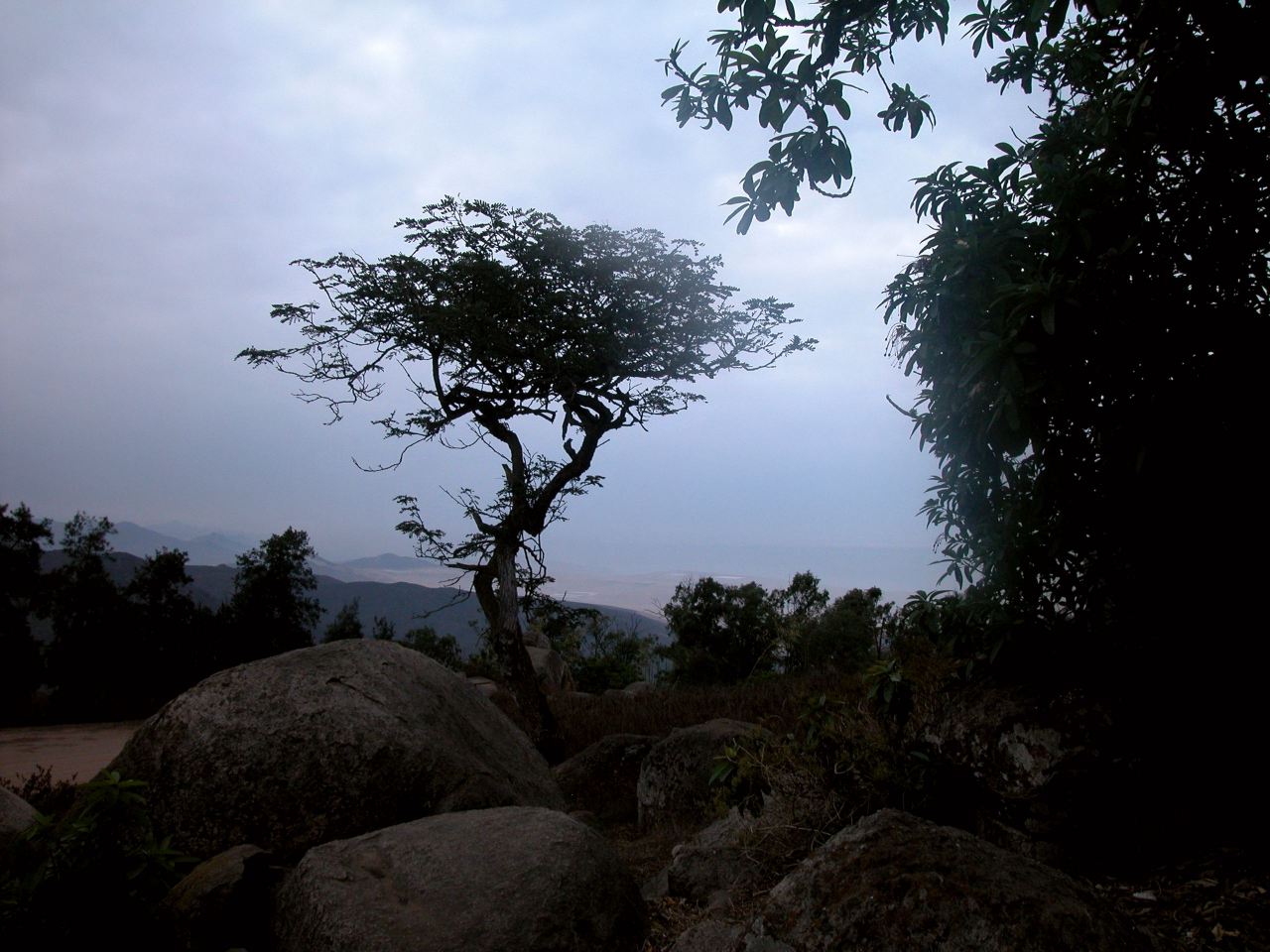
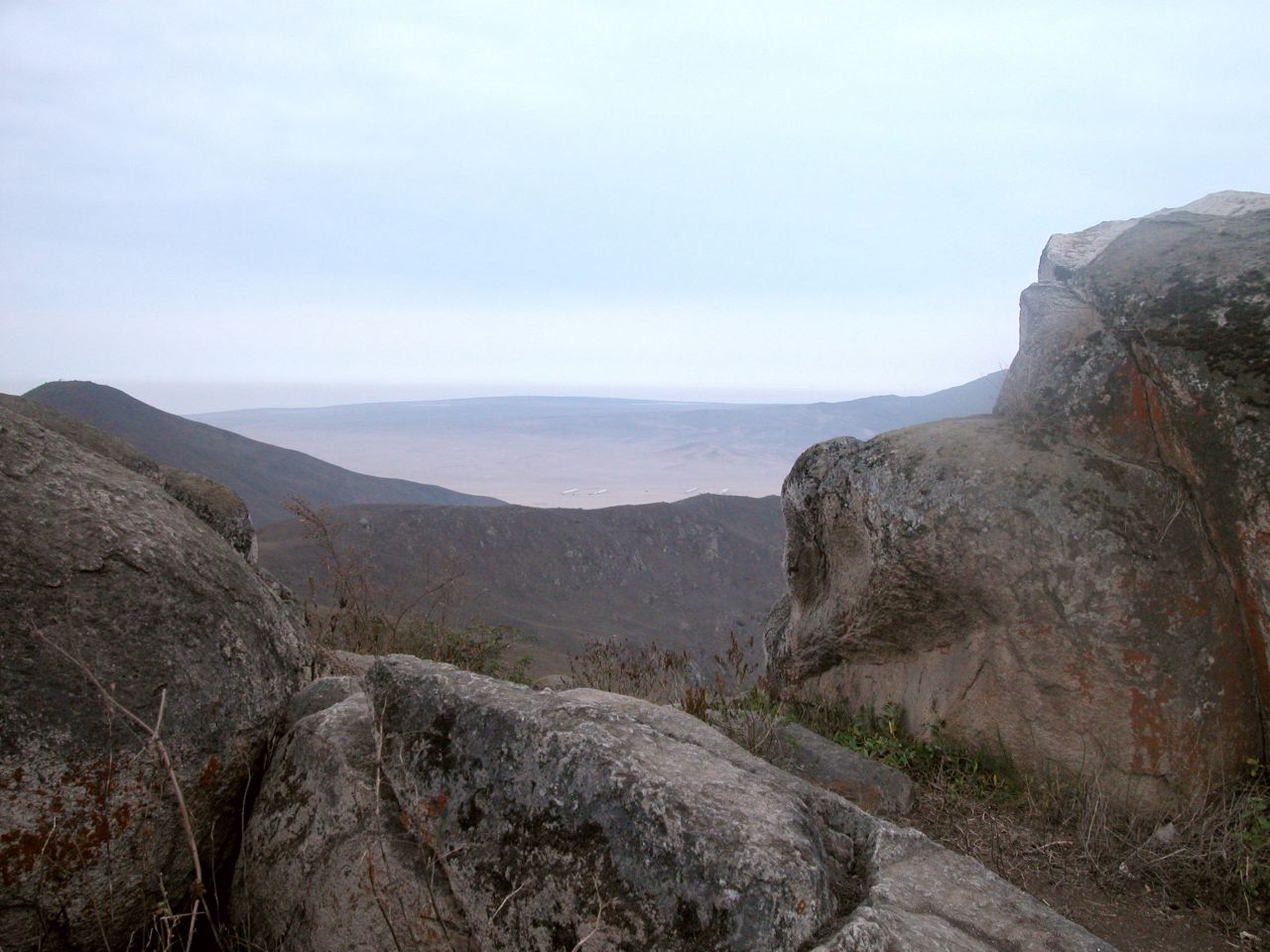

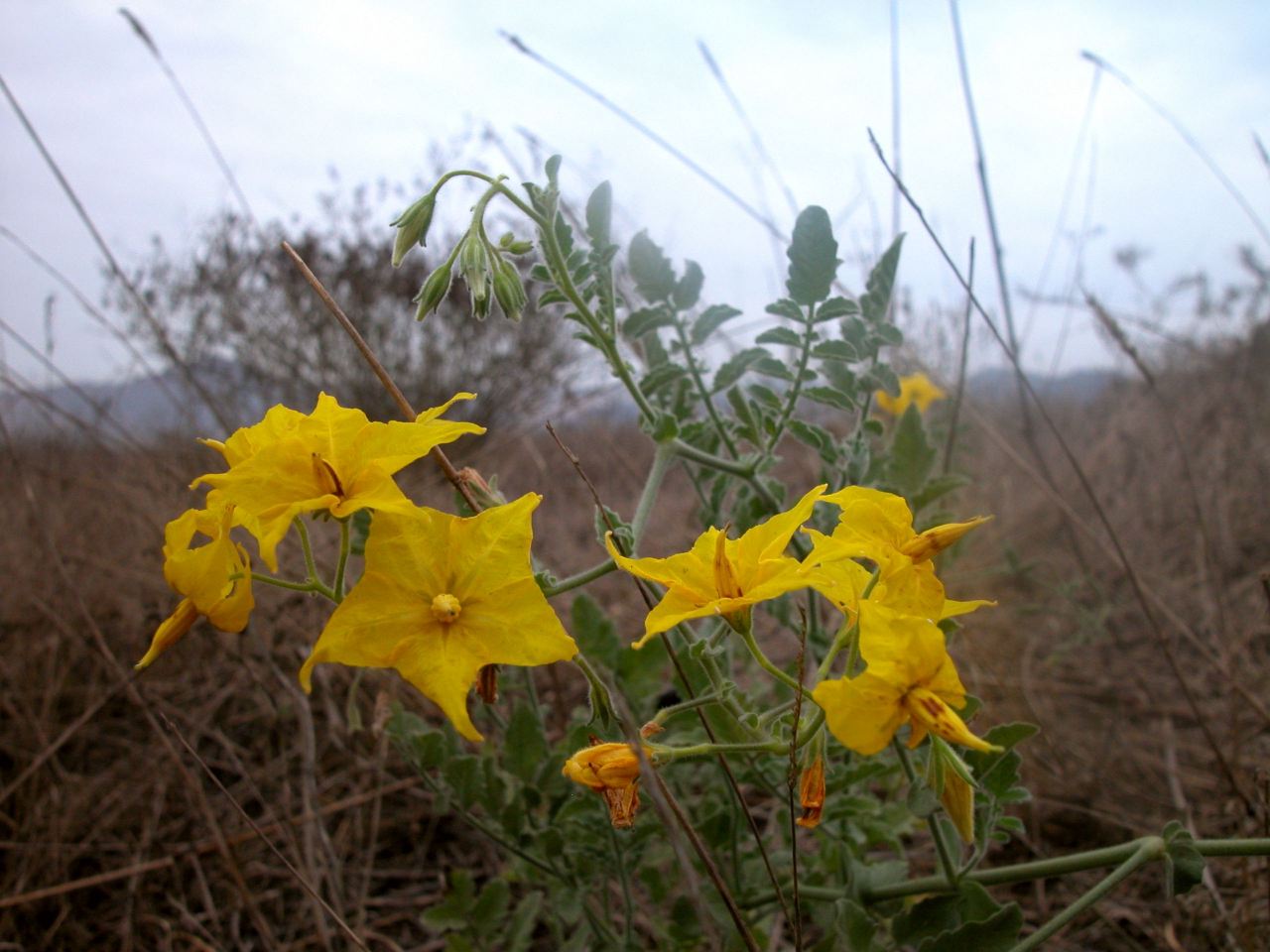
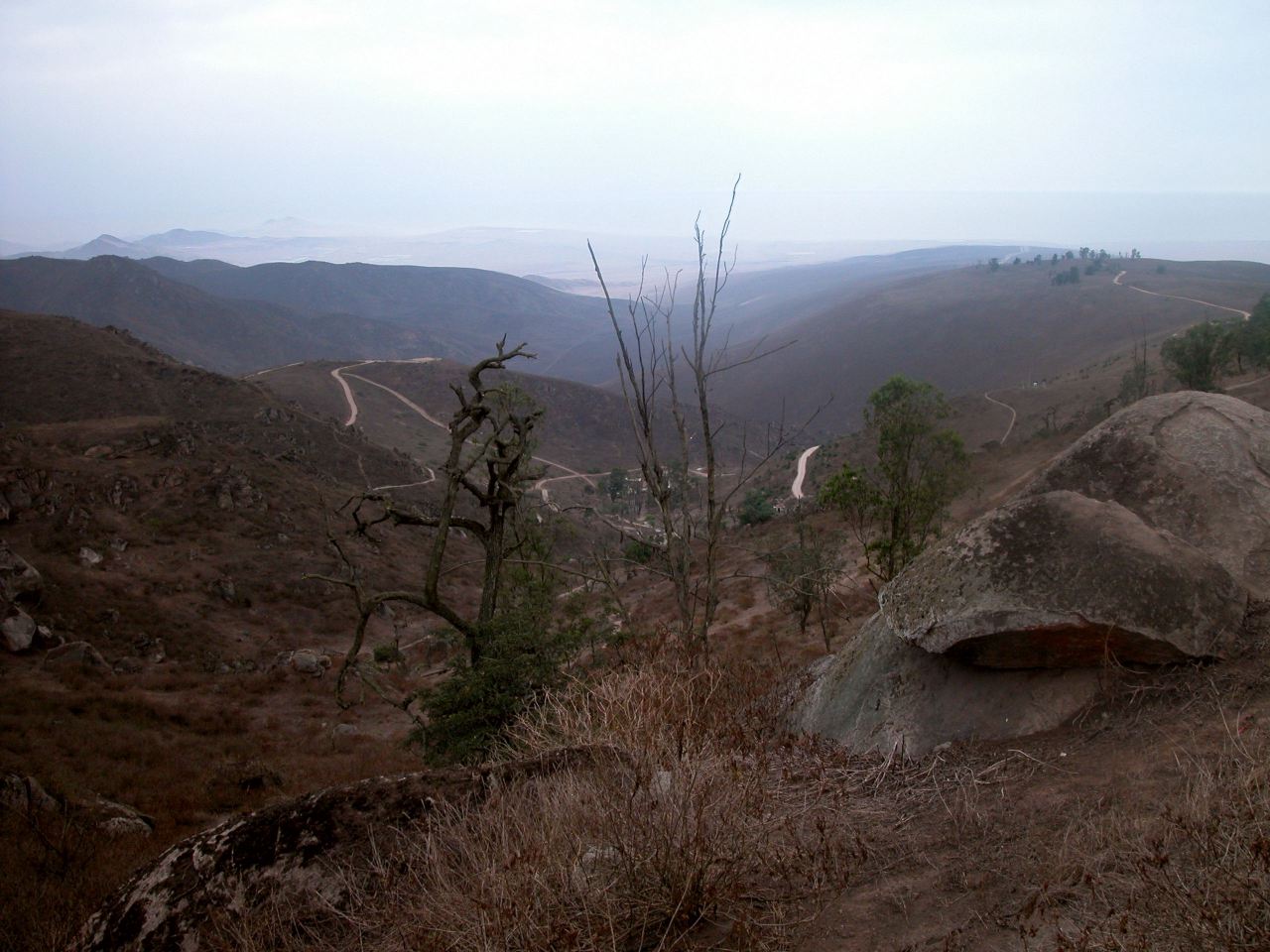

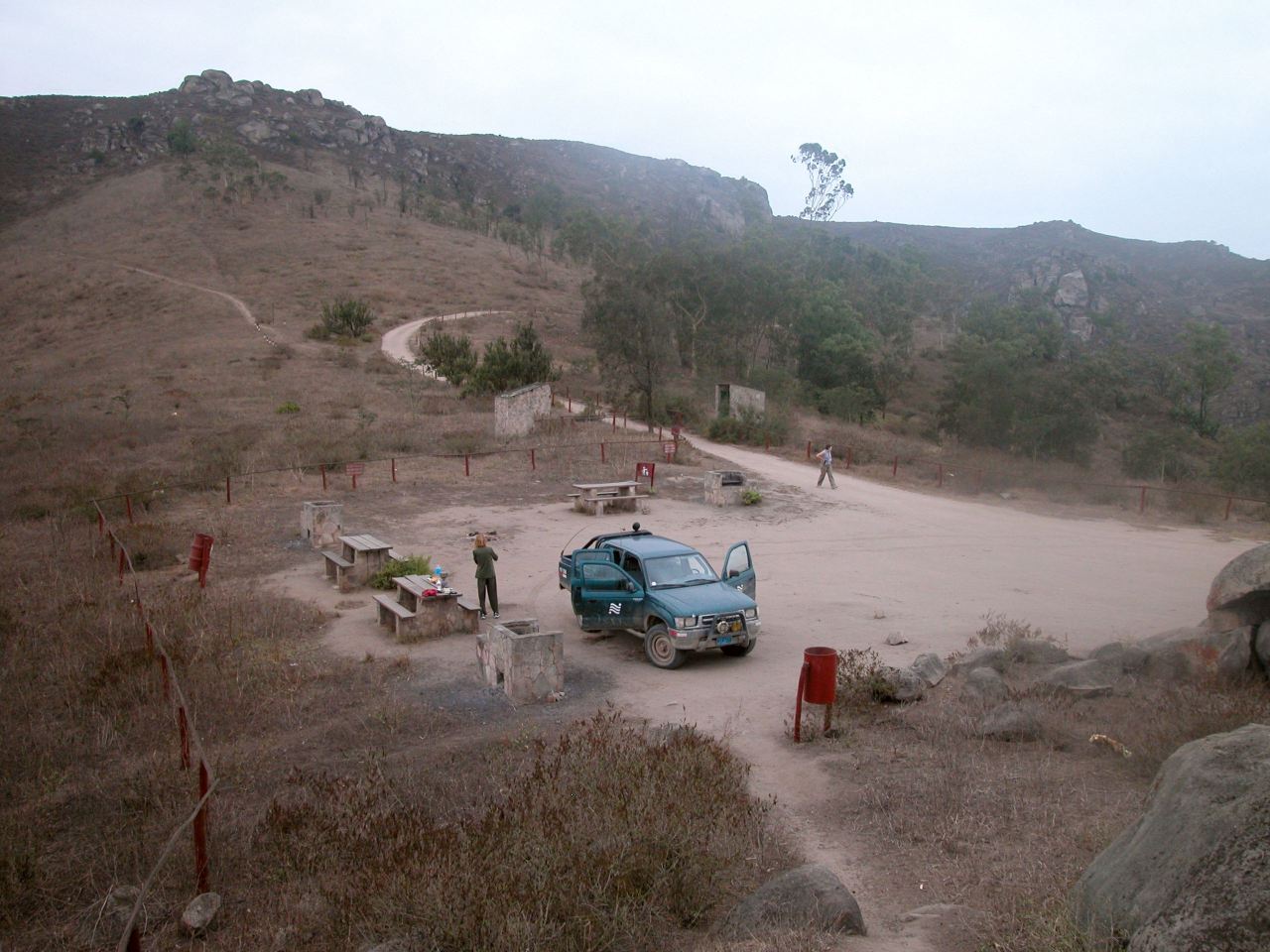
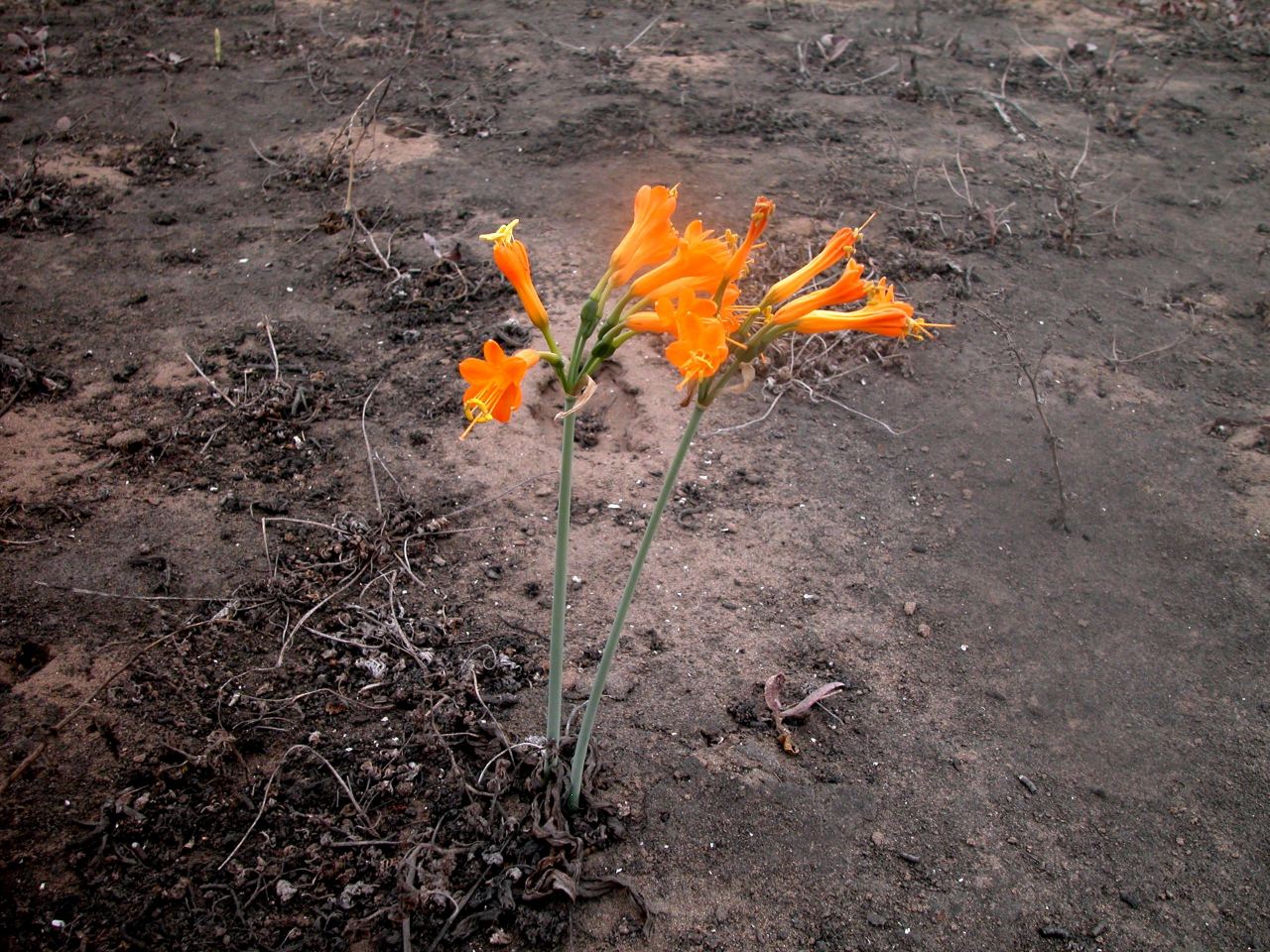

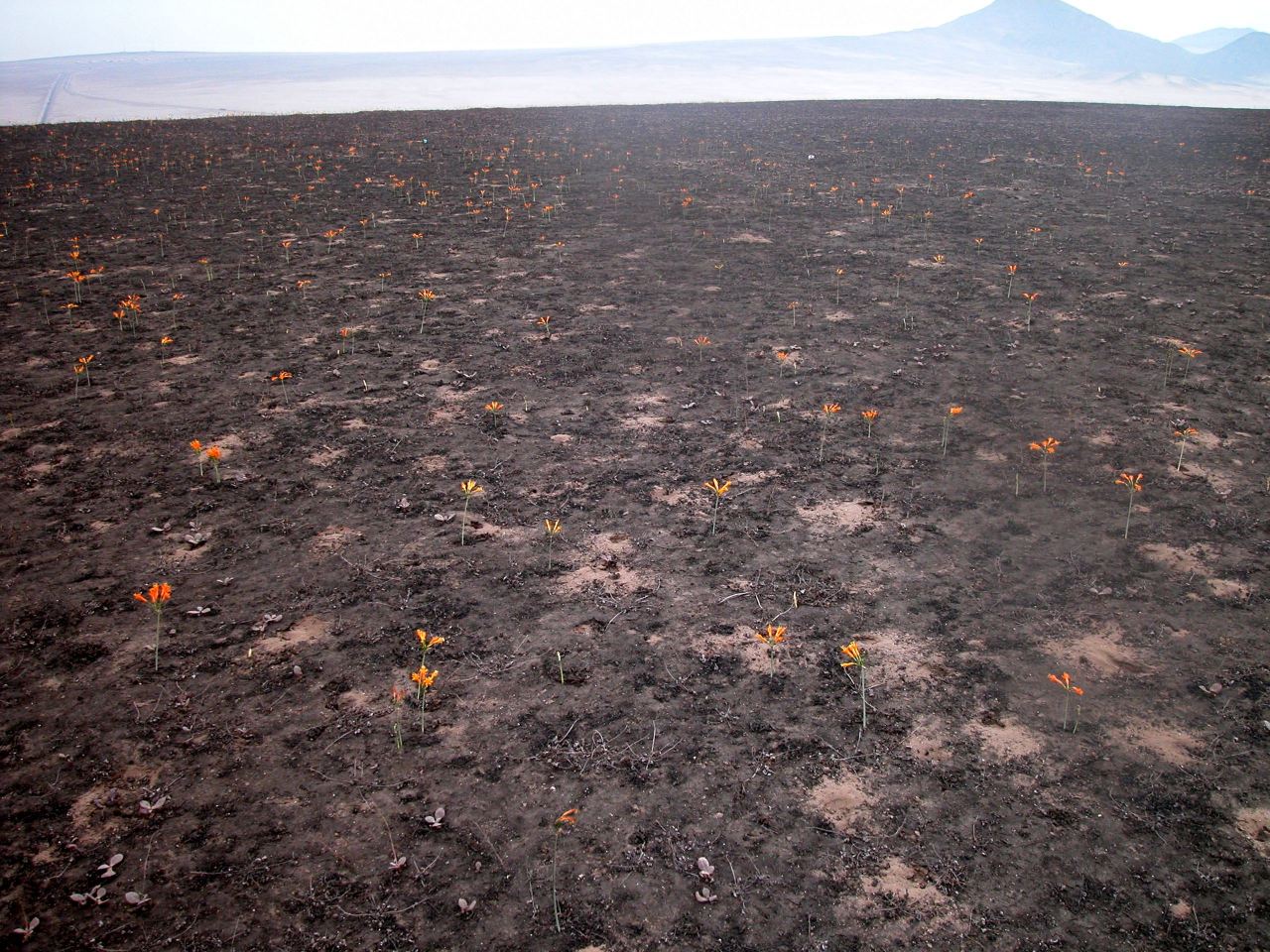
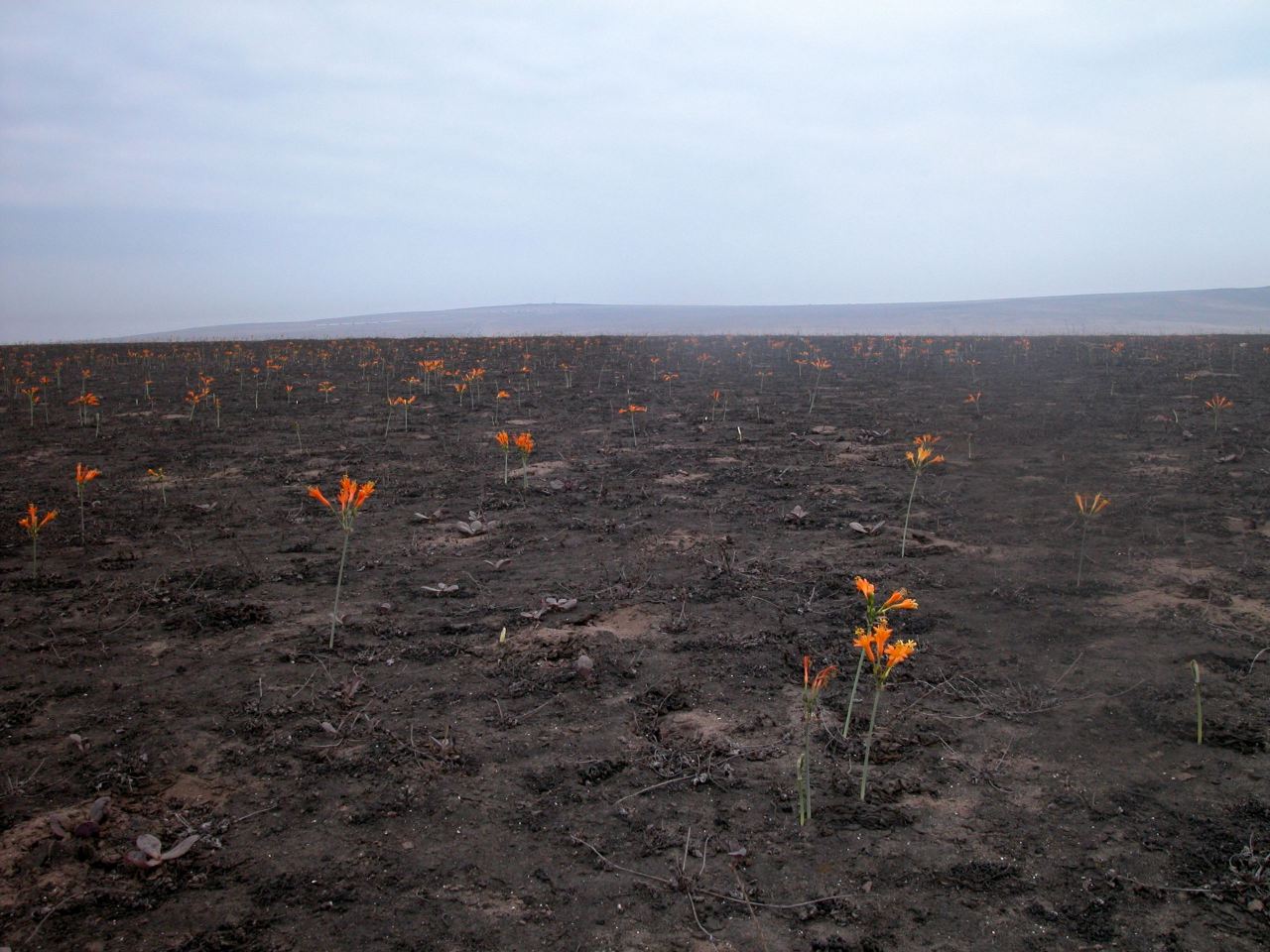
A little higher in the hills, the vegetation gets richer. There are lots of birds, hummingbirds especially. We saw a fox. The reserve has tracks of various lengths and grades. You have to stick to them. Barriers and signs everywhere: ‘Don't go here, don't go there.’ Probably fair enough. The huge capital is only a hundred kilometres away.

North of Lima there's a little more rain in the desert. Some vegetation appears, and along with it houses. There is one town after another. There are no proper bypass roads and you spend a long time threading your way through their narrow streets. People have lived here for a very long time. The earliest archaeological layers go back ten thousand years. Those were quite early cultures, followed by more developed civilisations. They left considerably more impressive historical remains. Often nobody knows what they were for, and the guidebooks simply repeat theories with practically no basis in evidence.



One such mystery is Cerro Sechín. It's five kilometres east of the Pan-American Highway near Casma, beside the road to Huaraz. It's 3,600 years old. The surrounding rocks are full of traces of buildings from the time. Many are visible only from a plane, as raised features in the ground. Most have never been excavated. Dinets writes that untouched mummies can be found in caves here. He doesn't say if he saw them himself, but I can believe you'd find a great deal if you scrambled around long enough. In any case, you could easily dig up a plate two thousand years old.
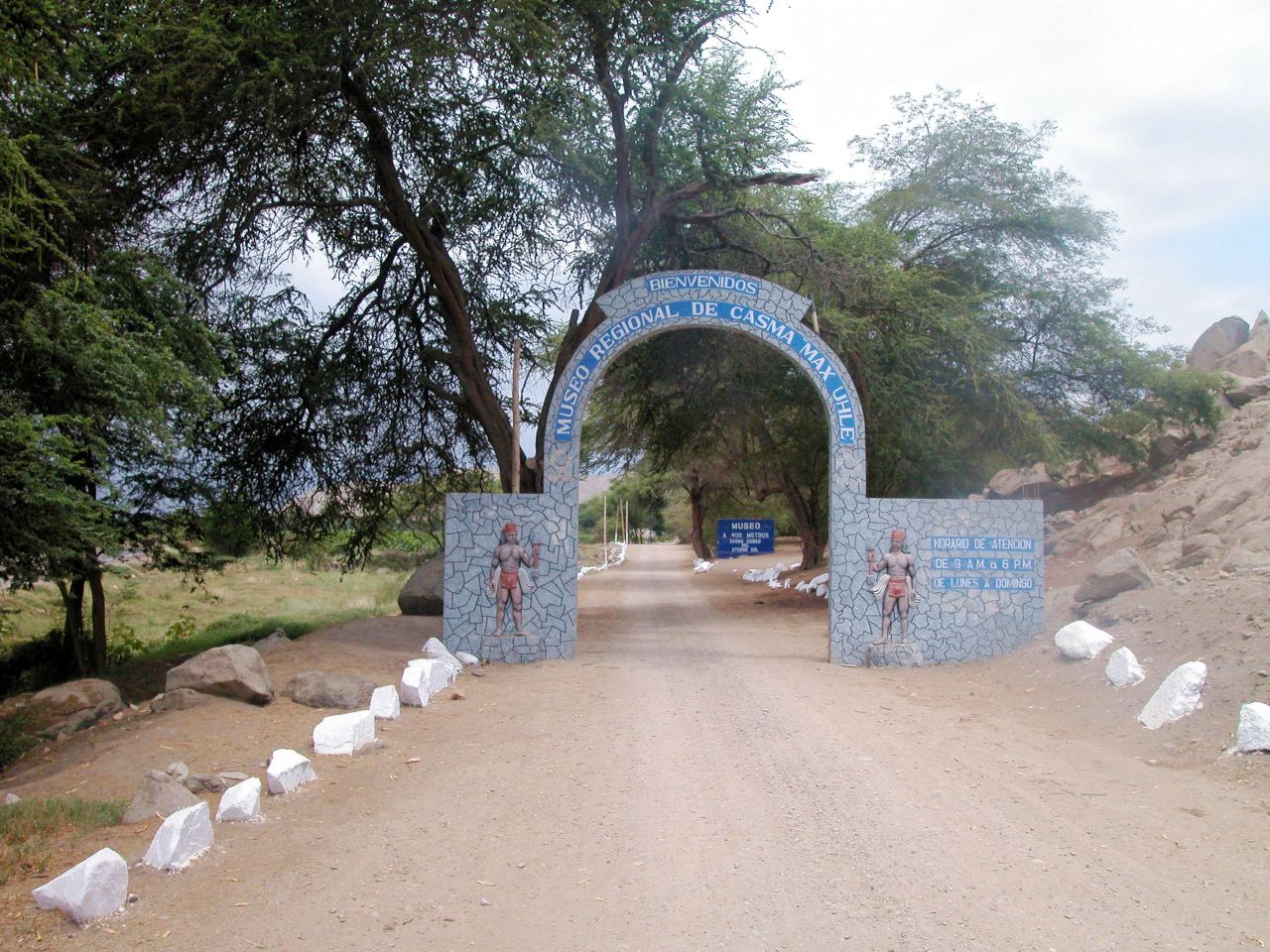

There are many ruins, but visitors are shown the most mysterious, a temple with carvings of severed heads and limbs, gouged-out eyes, cut-open guts and spilled brains. Beside the victims are executioners with axes. What was it? A temple for human sacrifices, a prison? Nobody is entirely sure. What is known is that these were more than pictures intended to frighten people. The excavations turned up numerous skeletons arranged in ways that match the carvings.
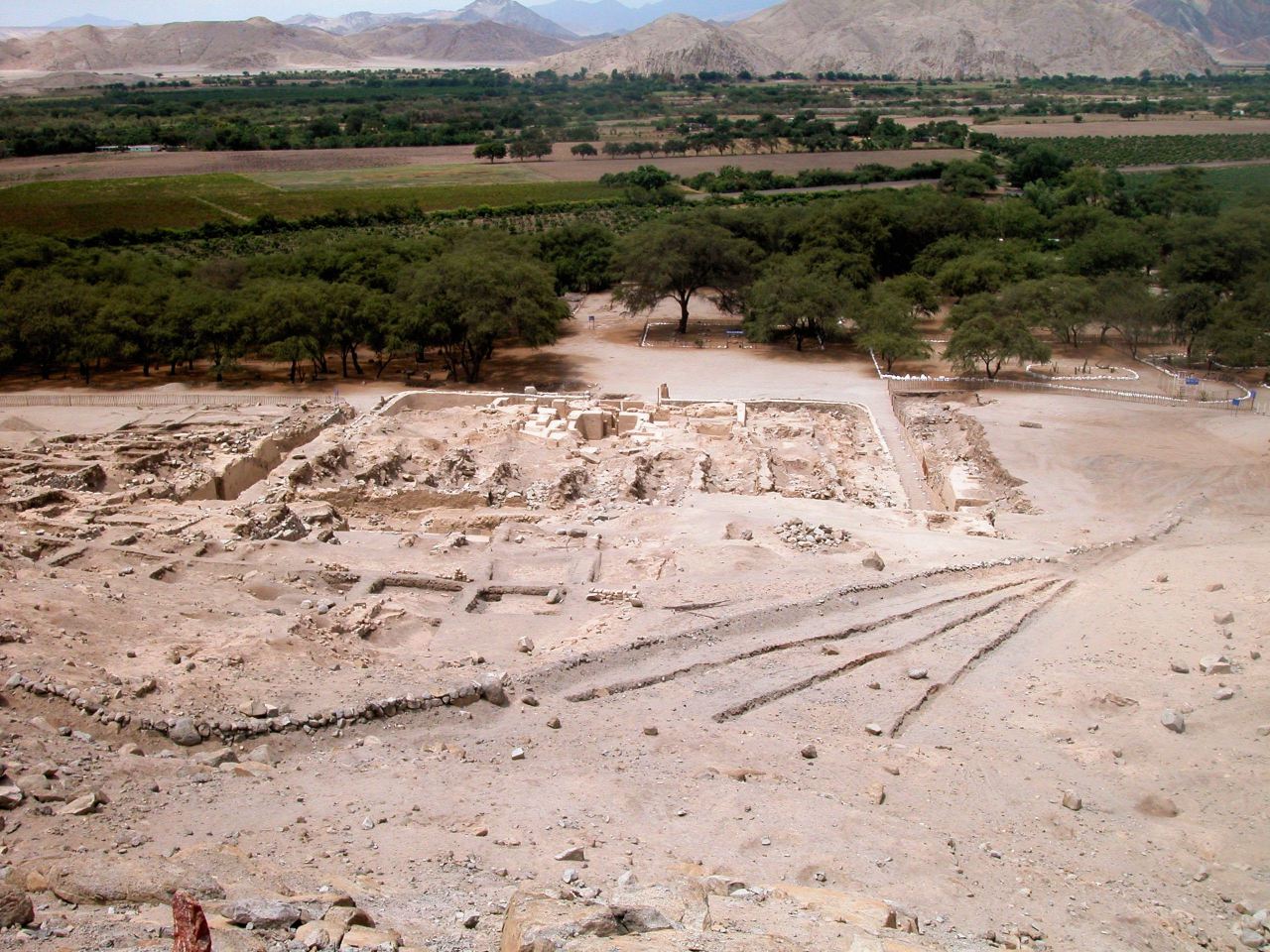
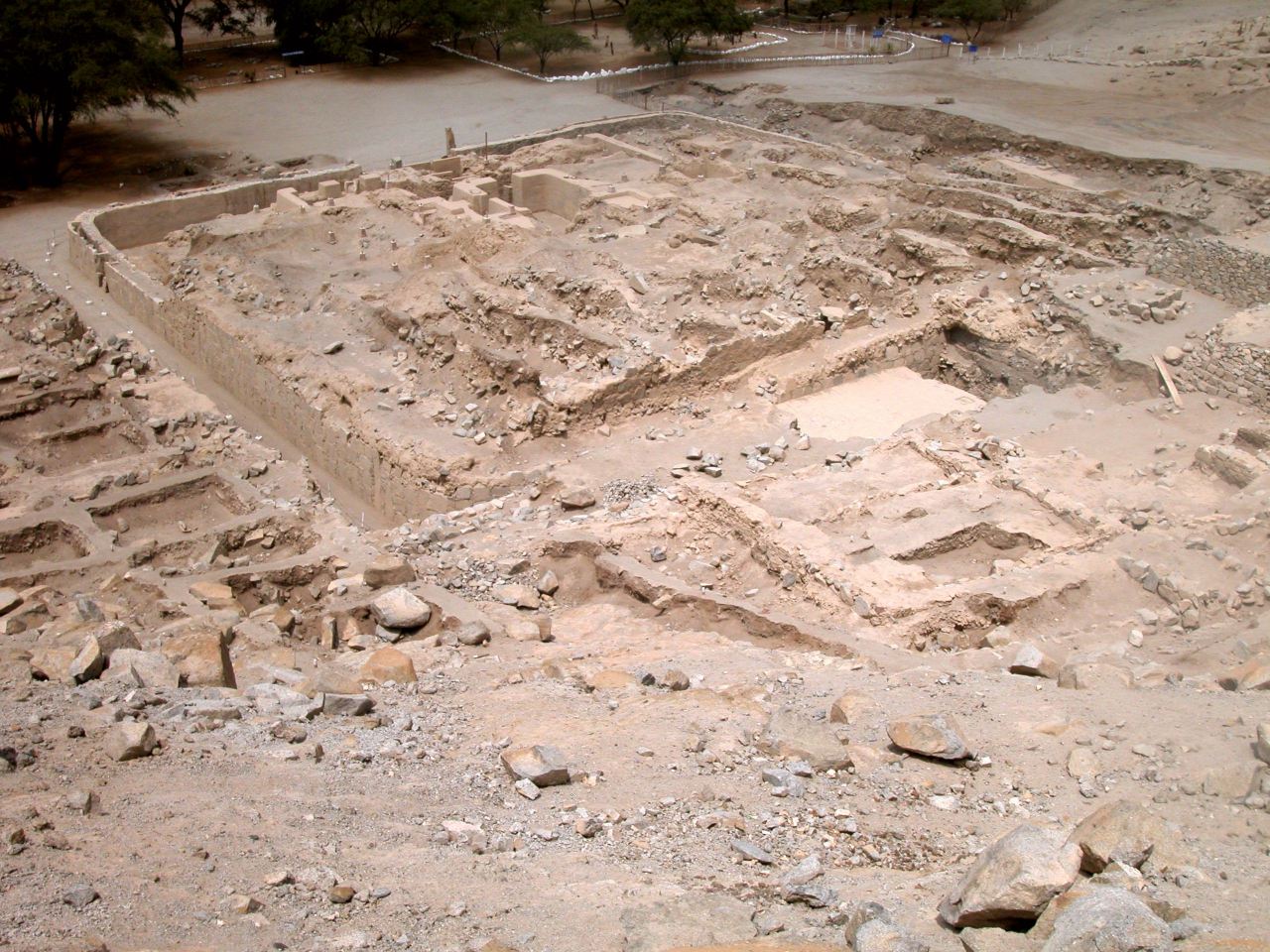
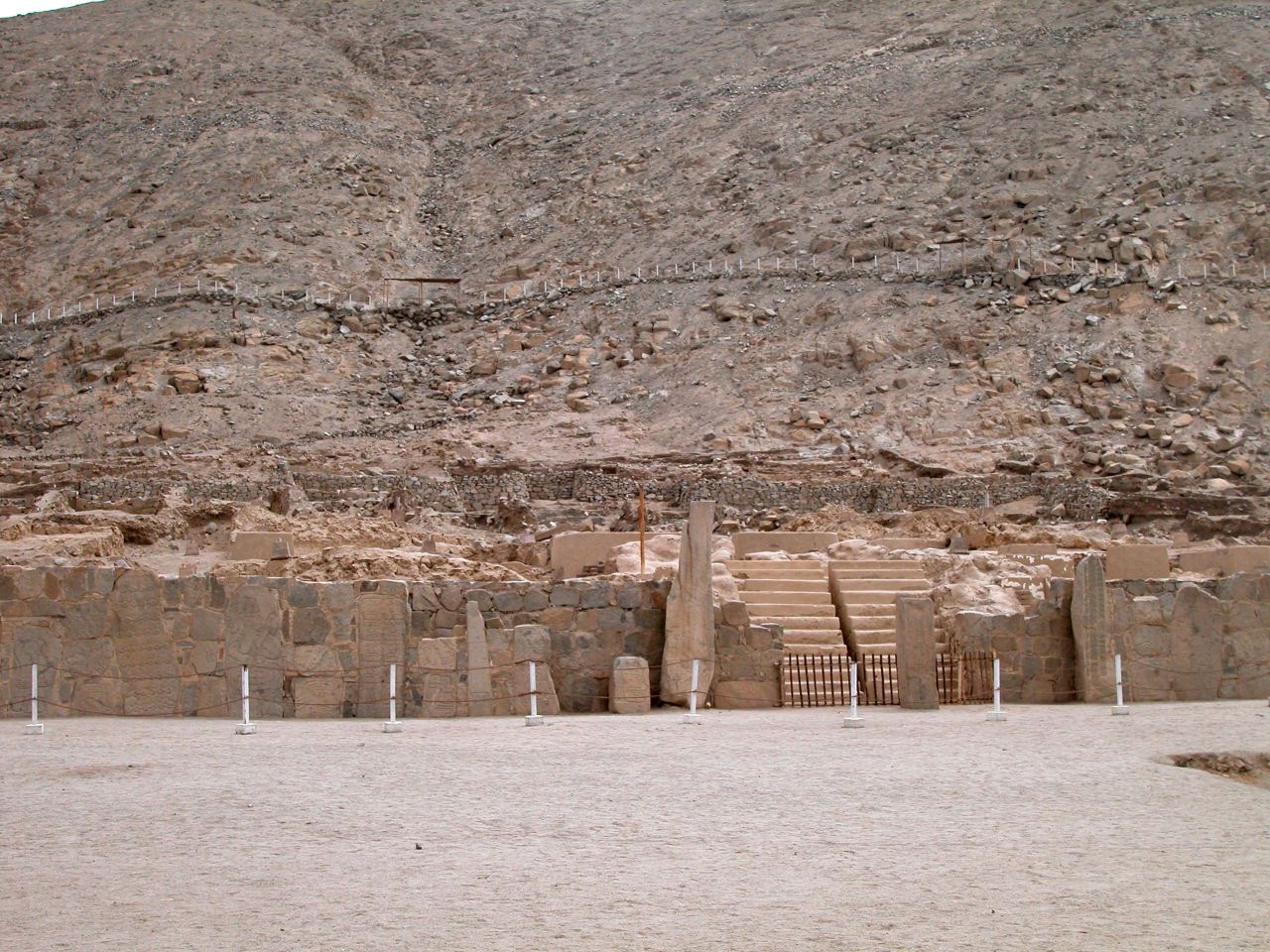
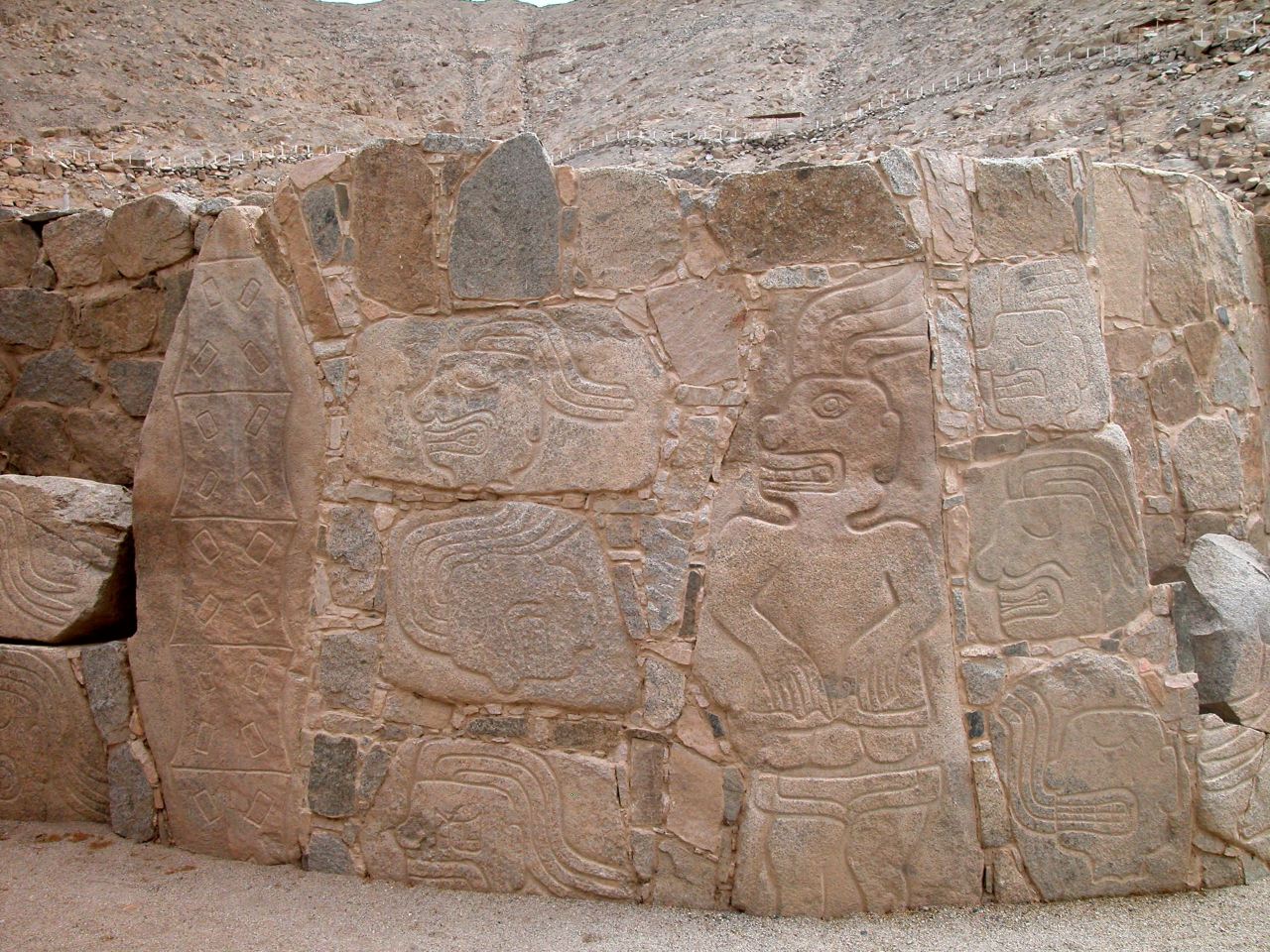
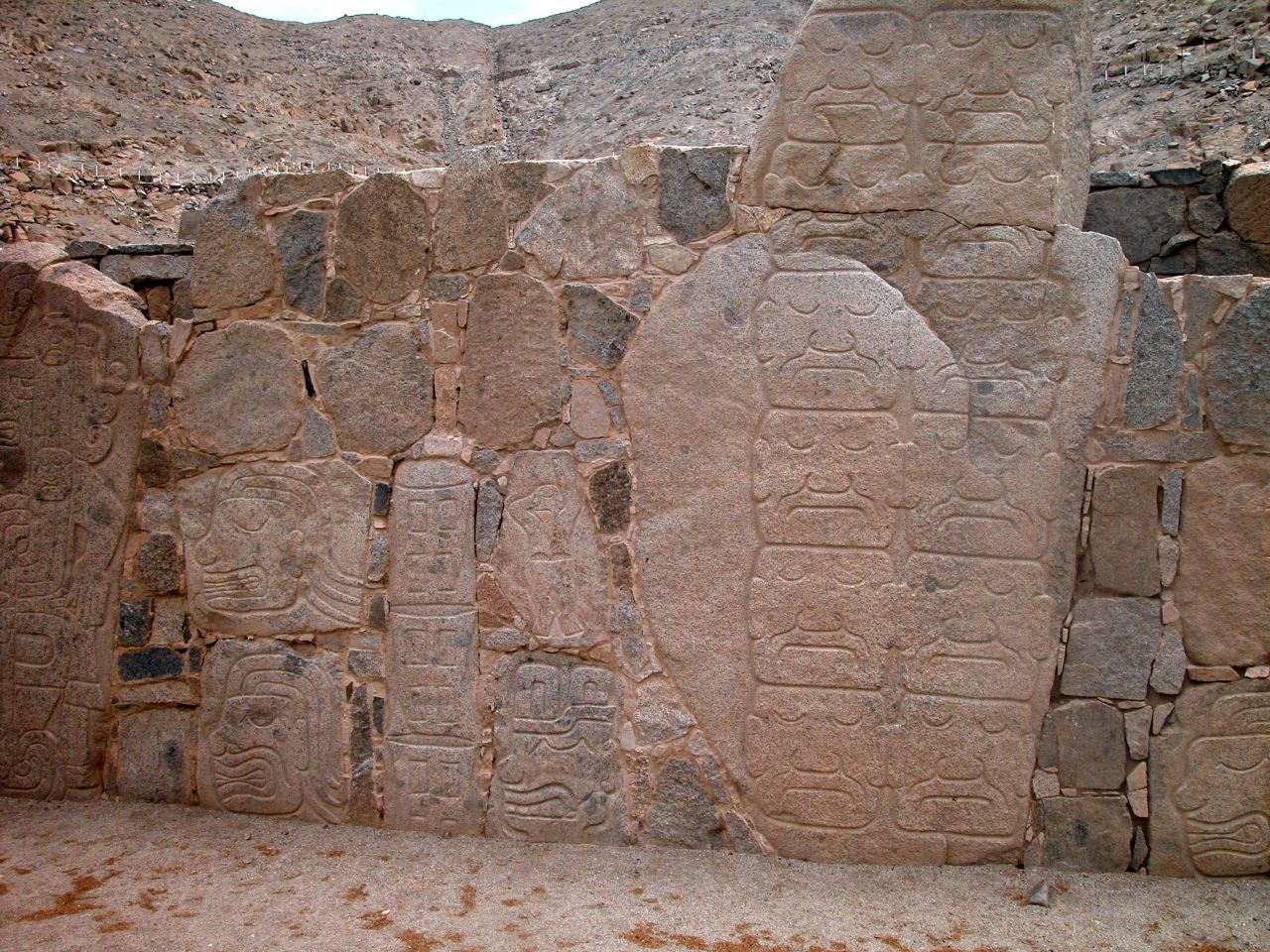
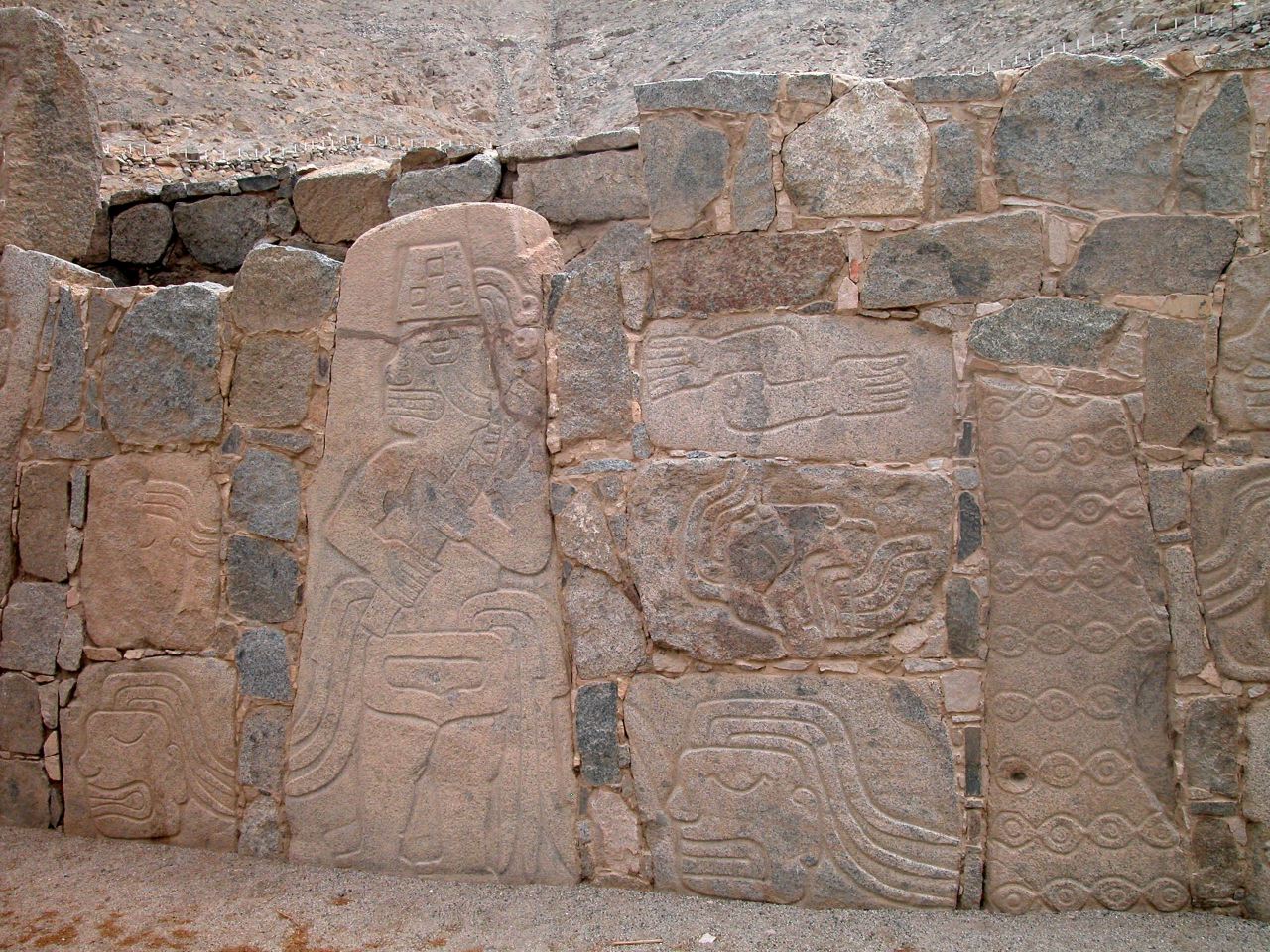
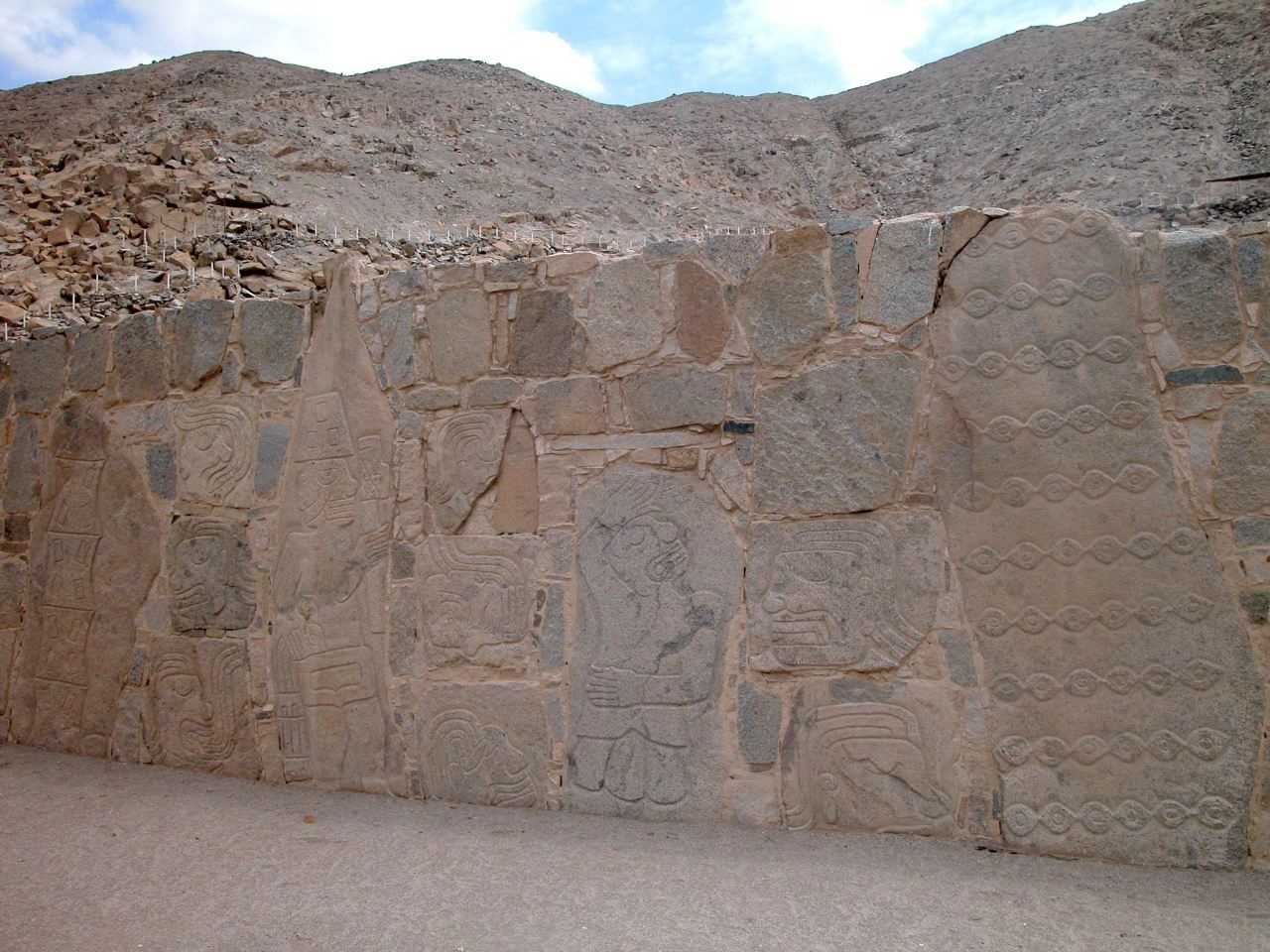
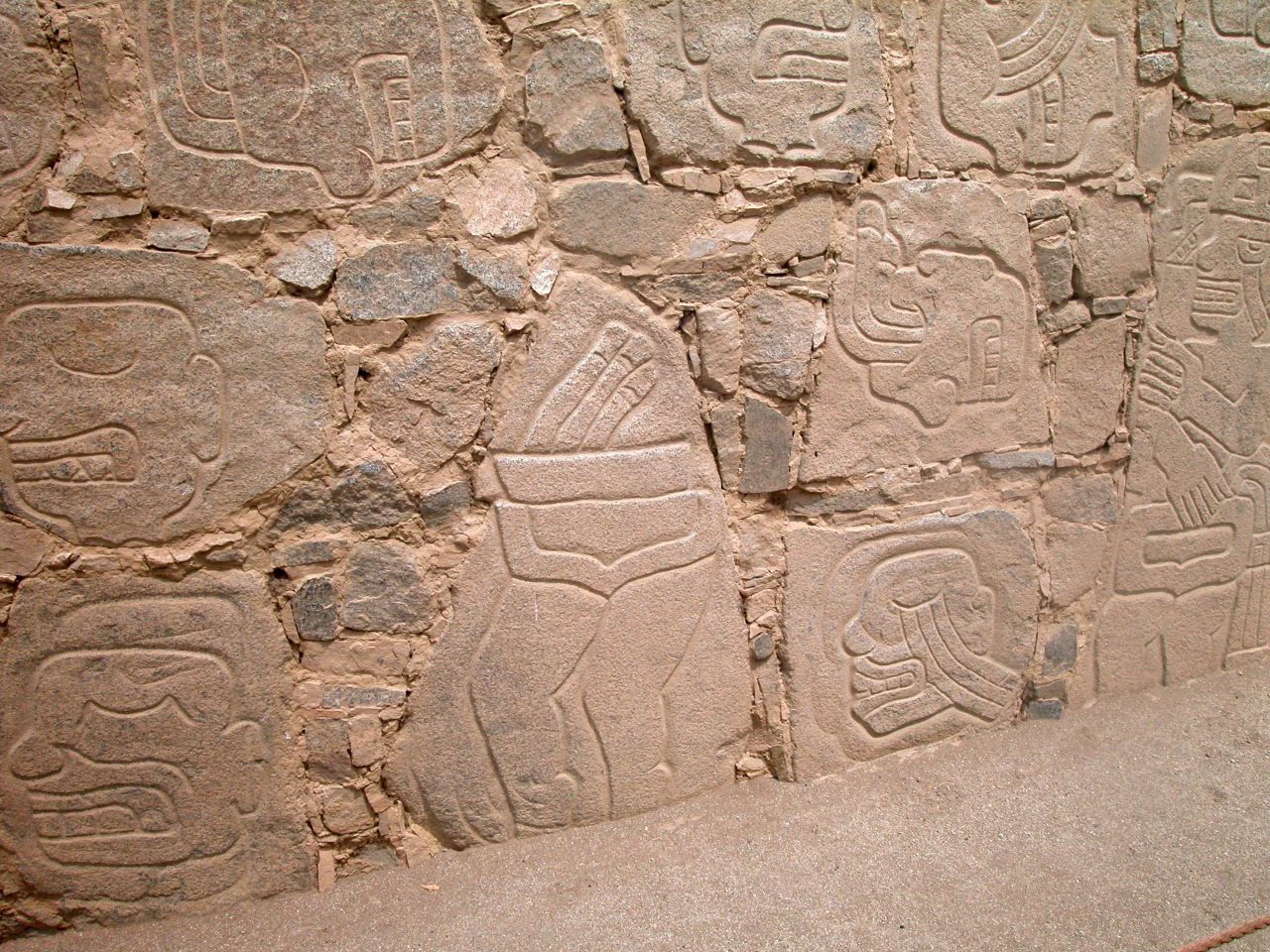
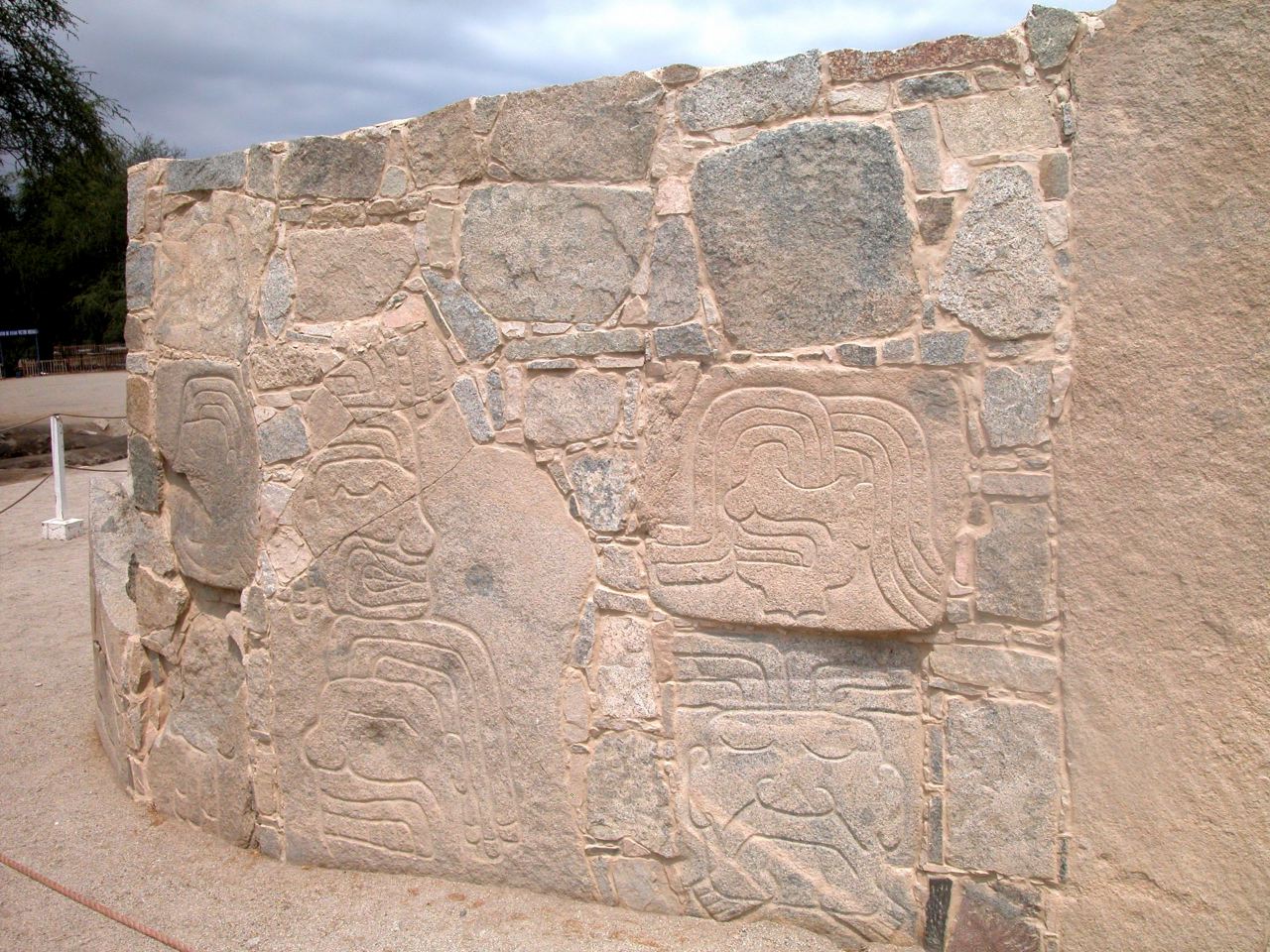
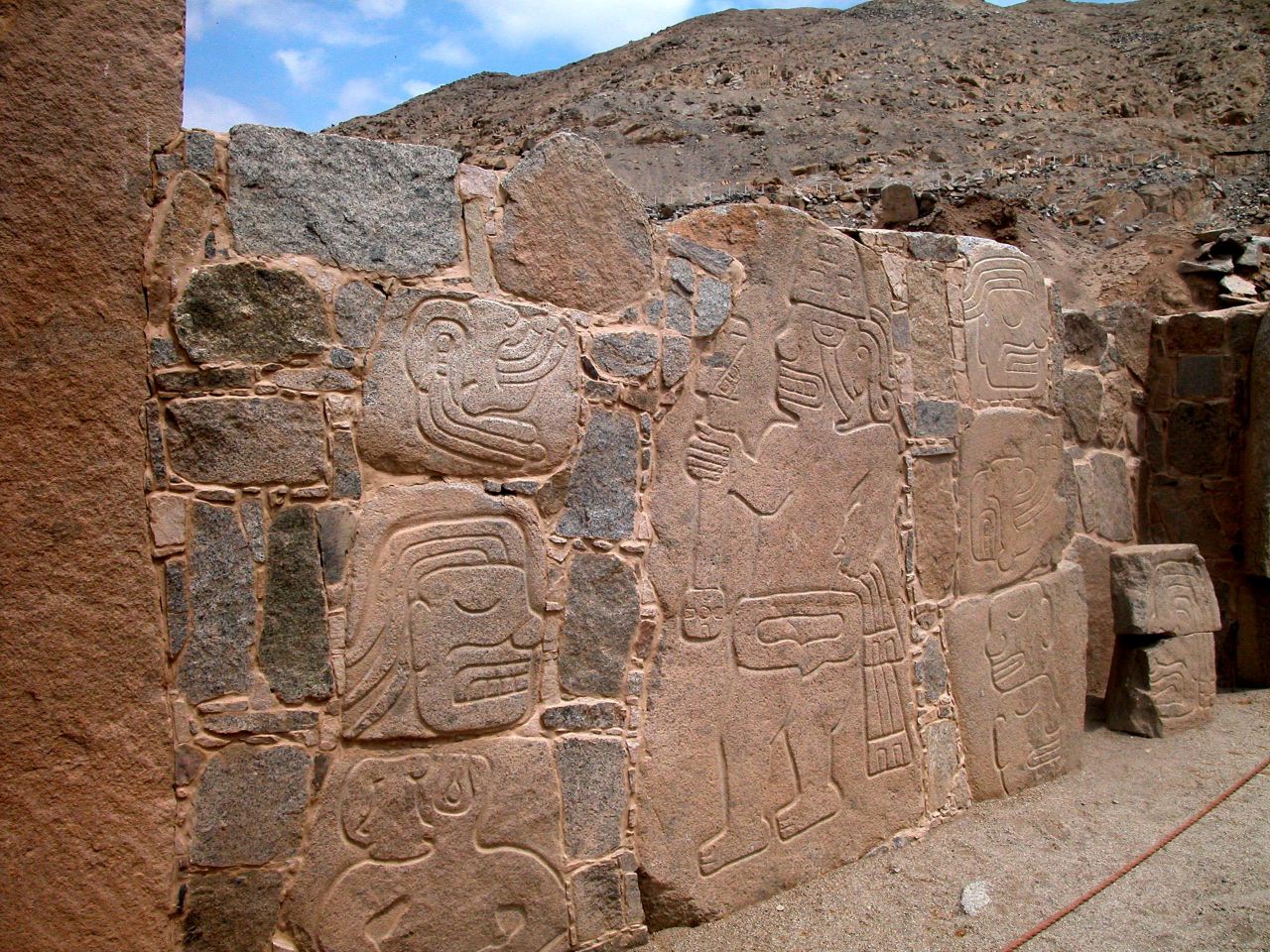
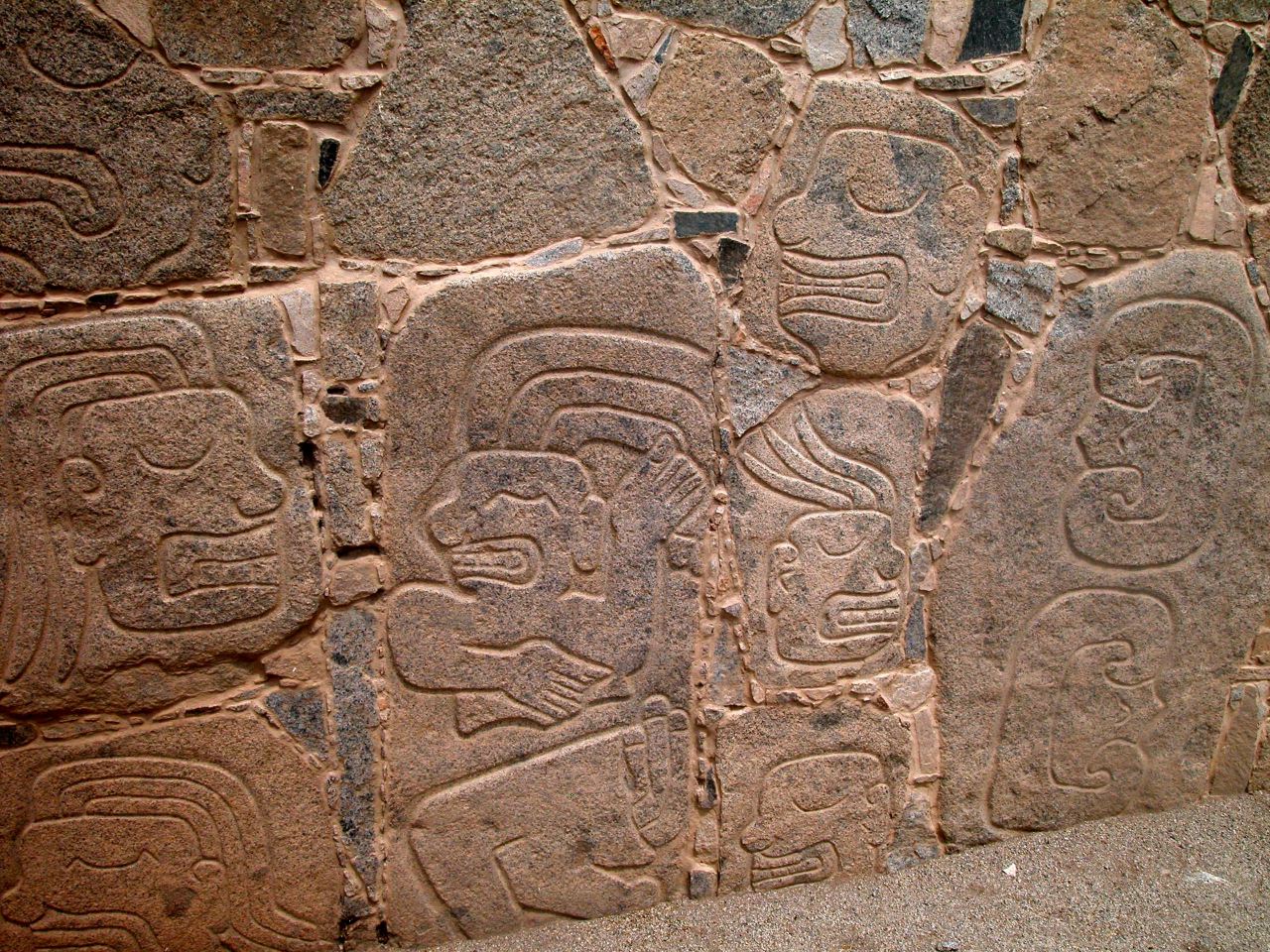
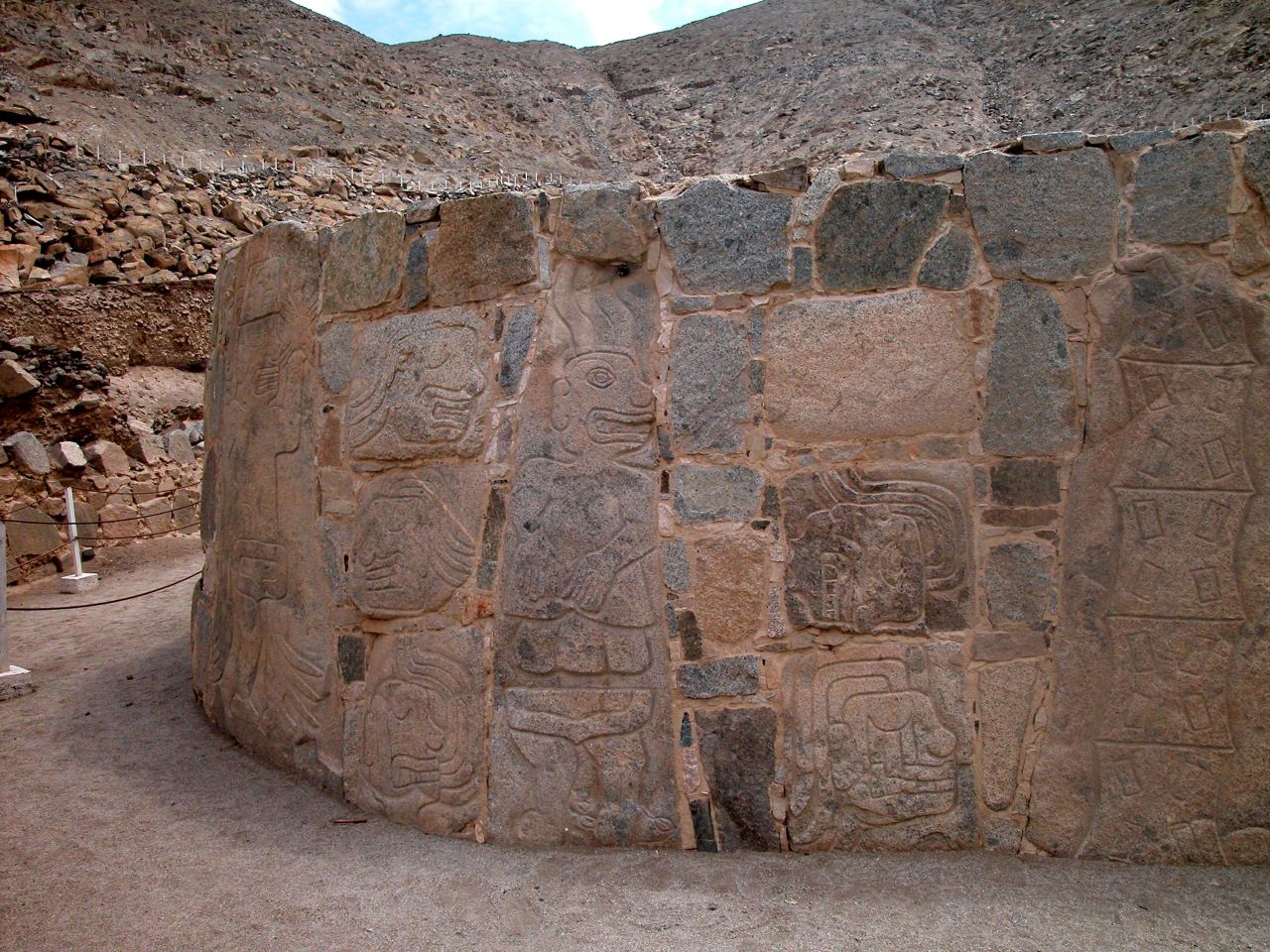

There's a museum nearby where the best finds are exhibited, among them the remarkably preserved mummy of a young girl, and grain taken from the vessels.
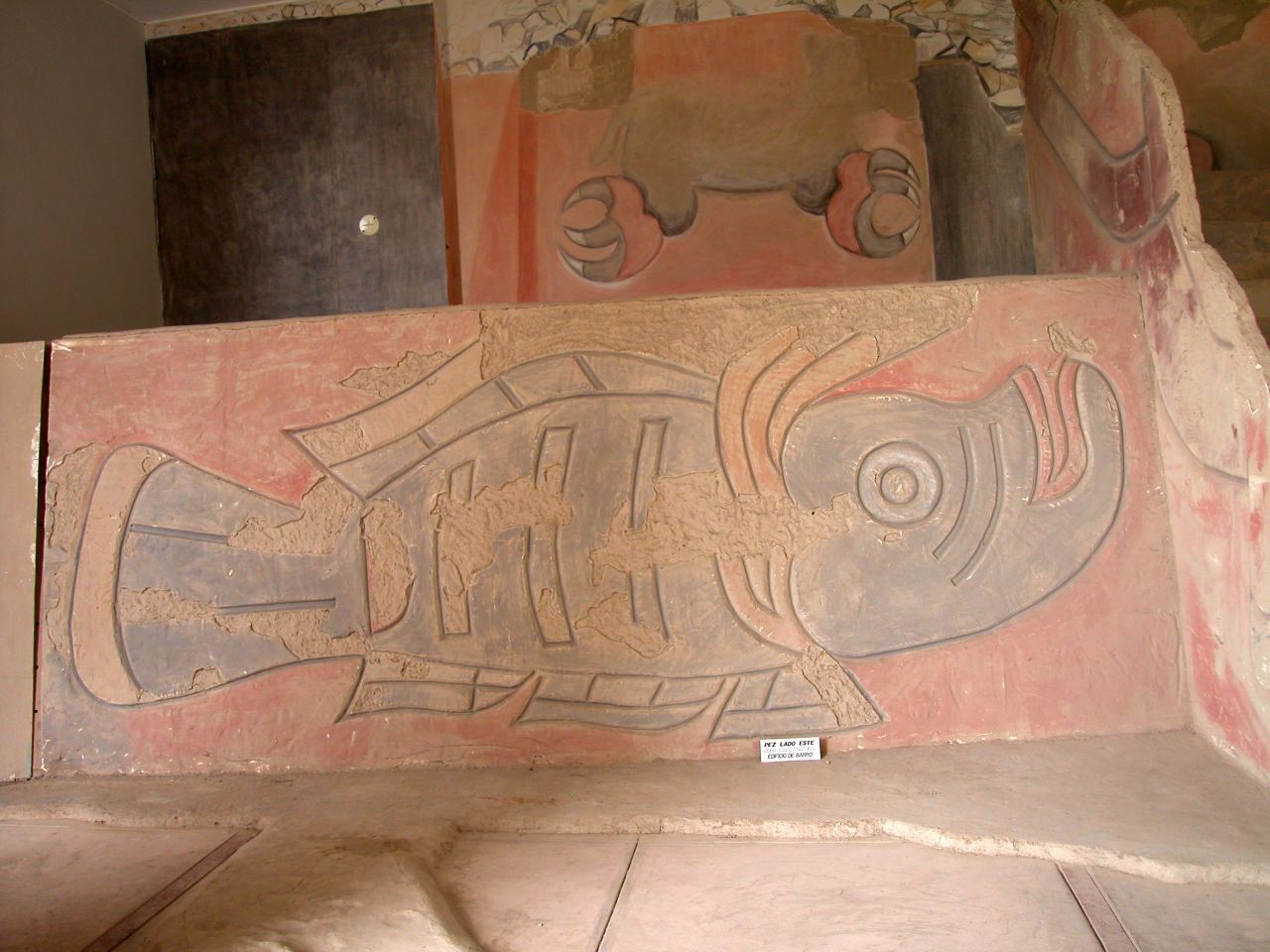
You're supposed to see the ruins themselves from the marked paths, but Dinets had written about tunnels with mummies in them, so I bent low, climbed over the barrier and got into the middle of the structure. The dust showed that nobody had set foot there for a long time. I didn't find much in the way of tunnels. Shallow ones, yes, but nothing interesting in them, just wasps' nests everywhere. No mummies, and the wasps stung me. I had to scramble back out onto the well-worn tourist track.
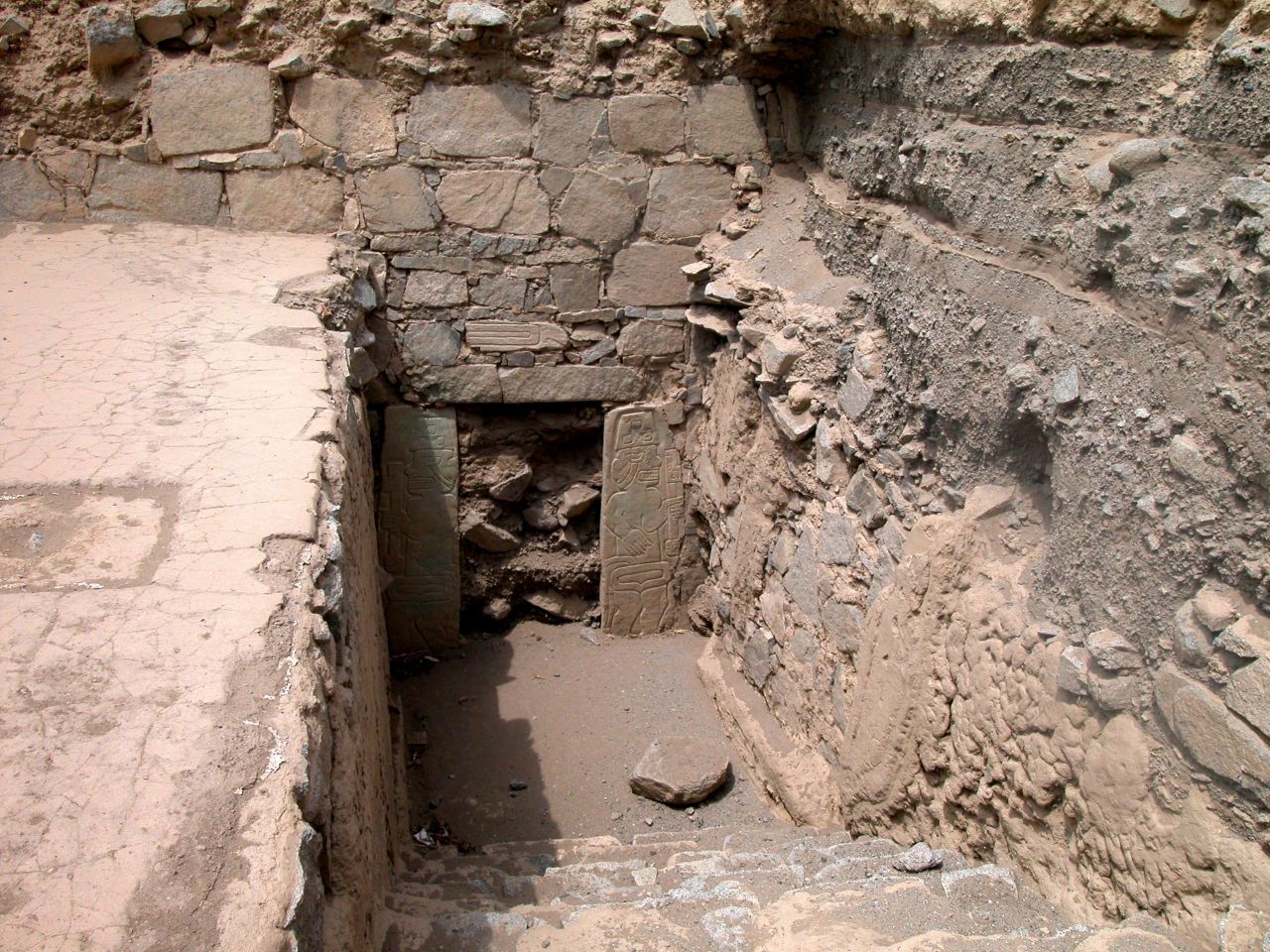
The pyramid at Pañamarca survives north of Sechín. It belongs to an even older culture, the Moche. That's a conventional name and not what they called themselves. In shape it resembles the Aztec pyramids of Mexico. It's built of unbaked brick. Rain is so rare here that you can neglect the risk and class it as a natural disaster, repairing whatever the water washes away once in a century.


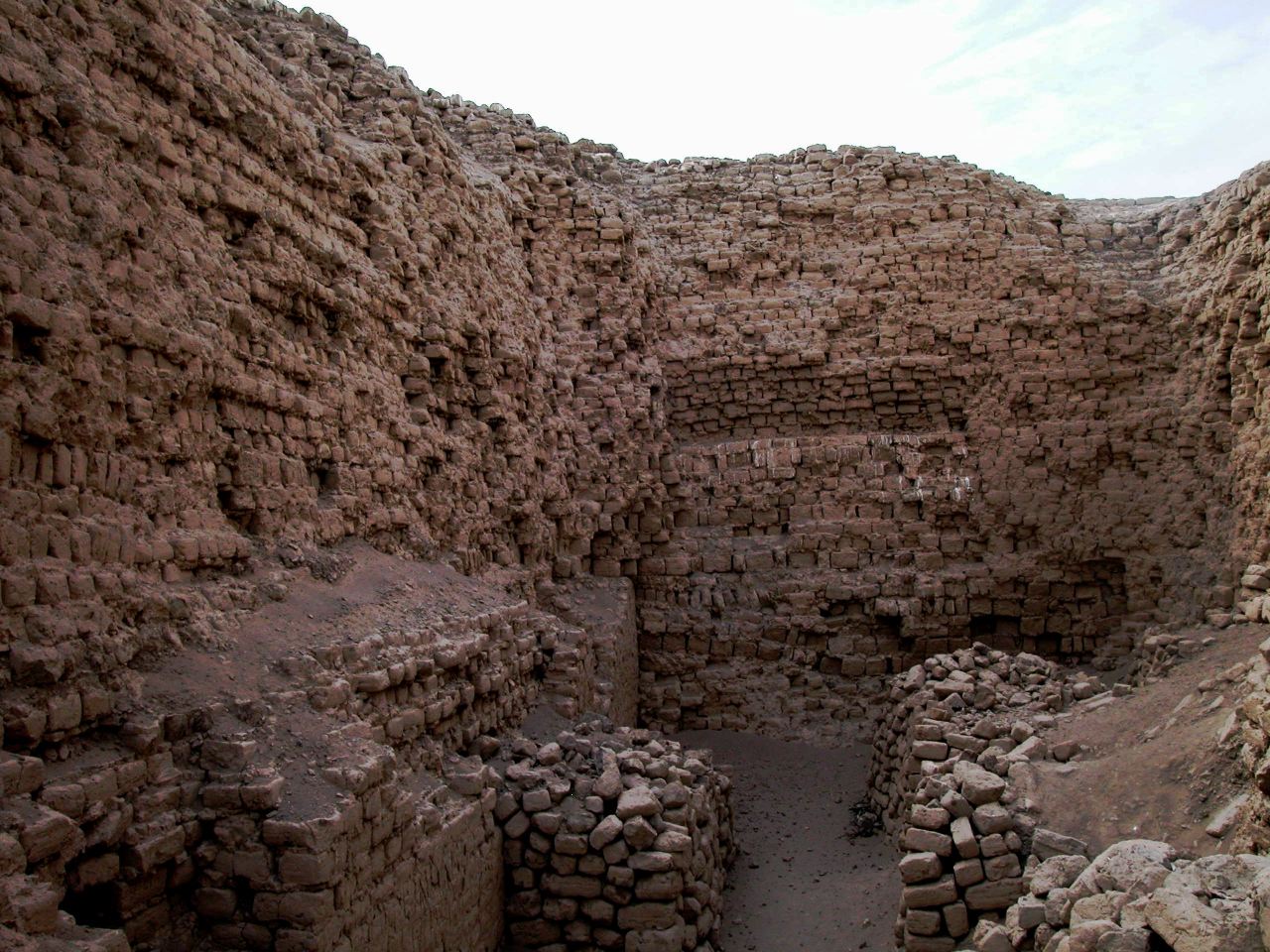
Unfortunately, after a few thousand years the pyramid had been eroded quite badly. From far away you wouldn't immediately distinguish it from a hill.
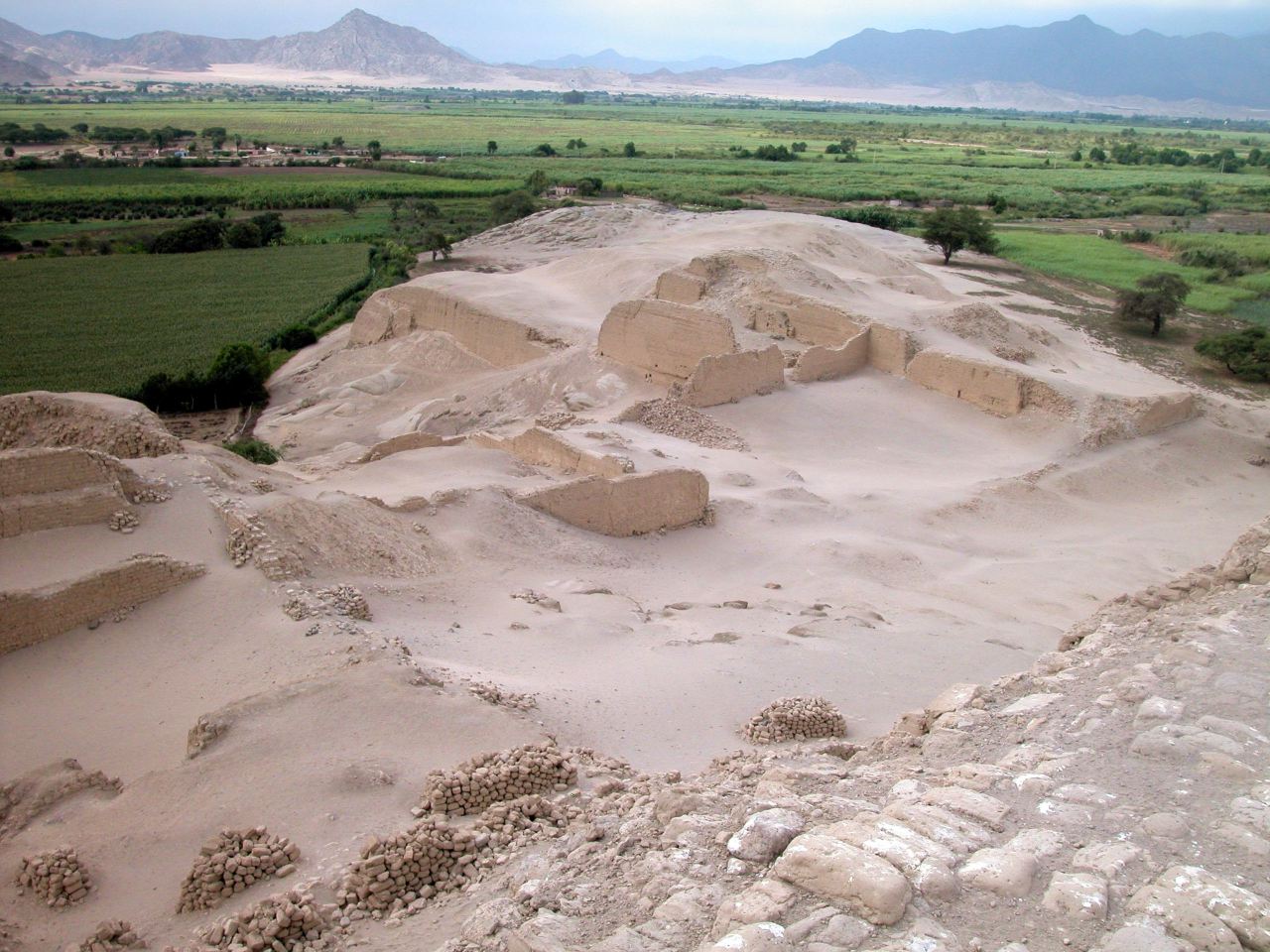
A history student lives next to the pyramid and looks after it. He's the guide and cashier as well. Admission costs three soles, and contrary to what Lonely Planet says, a Sechín ticket is no good here. There aren't visitors every day and he was glad to give a tour. He couldn't speak English at all, so we had to listen in Spanish. I don't think you can refuse his services. We don't generally like guides, but in this particular case he didn't get in the way, and we liked the pyramid.
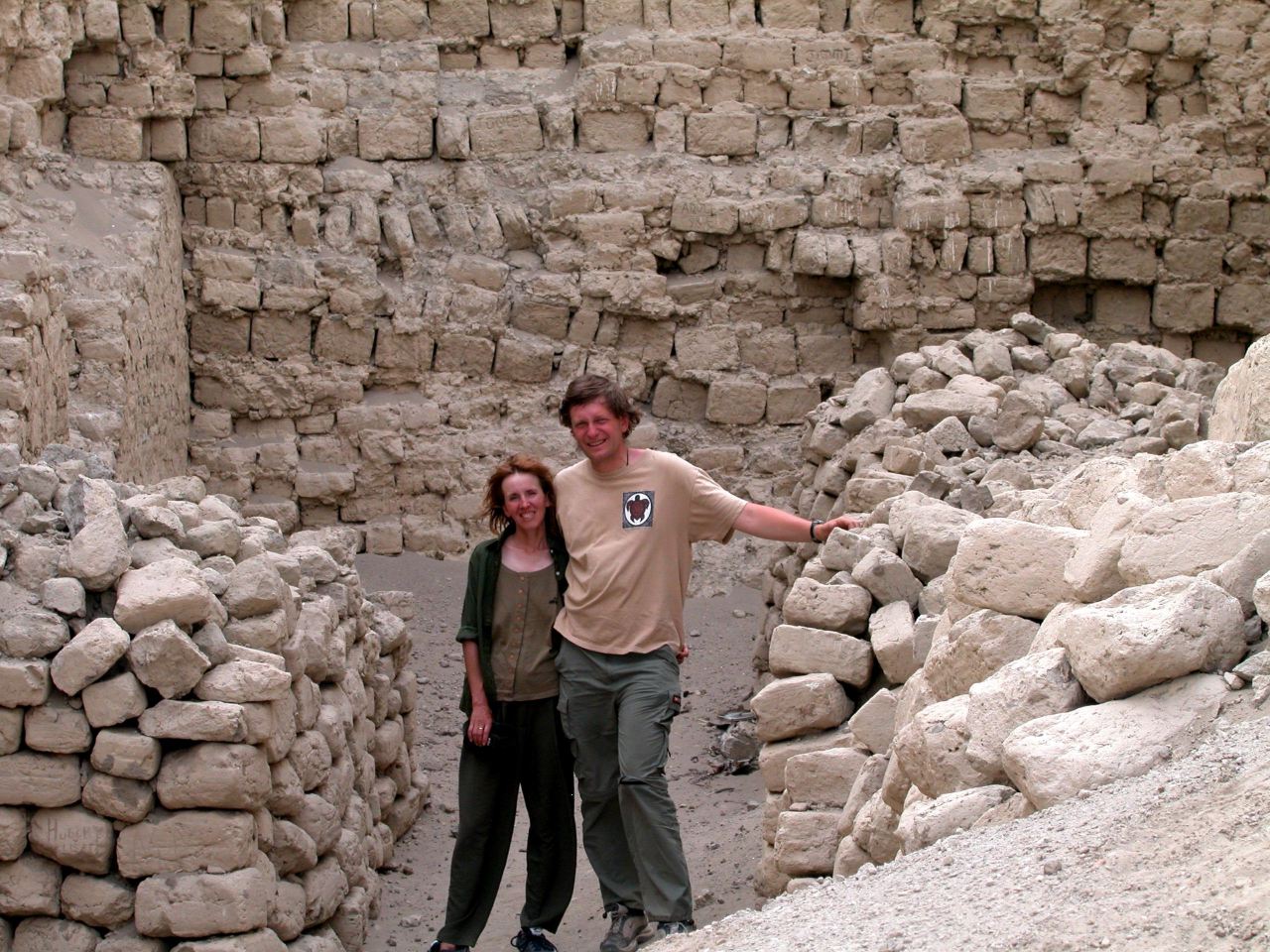
It took the rest of the day to drive to the large city of Trujillo, where after a long search for a quiet spot in the centre, we stayed at a hotel on Júnin Street.
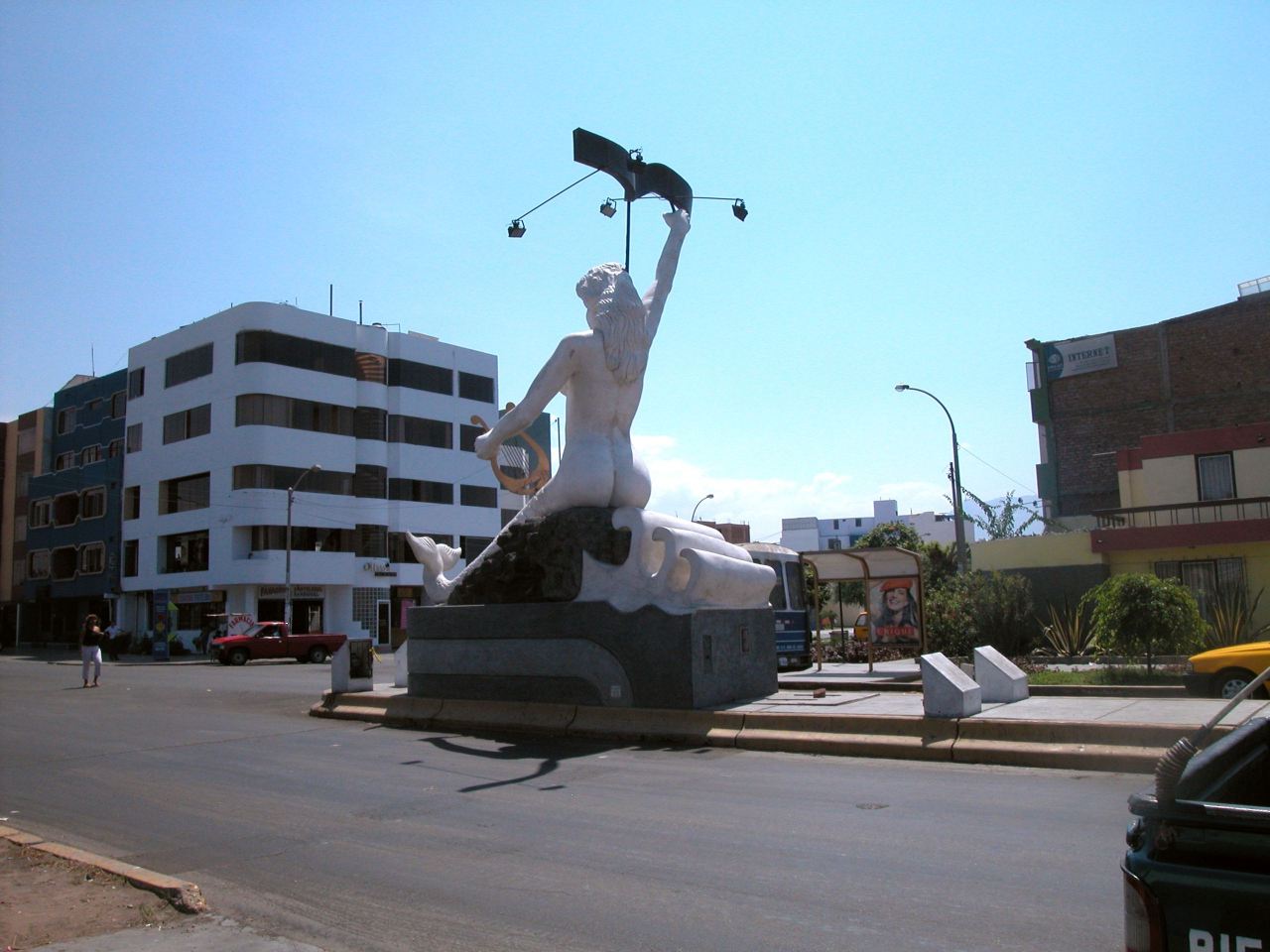
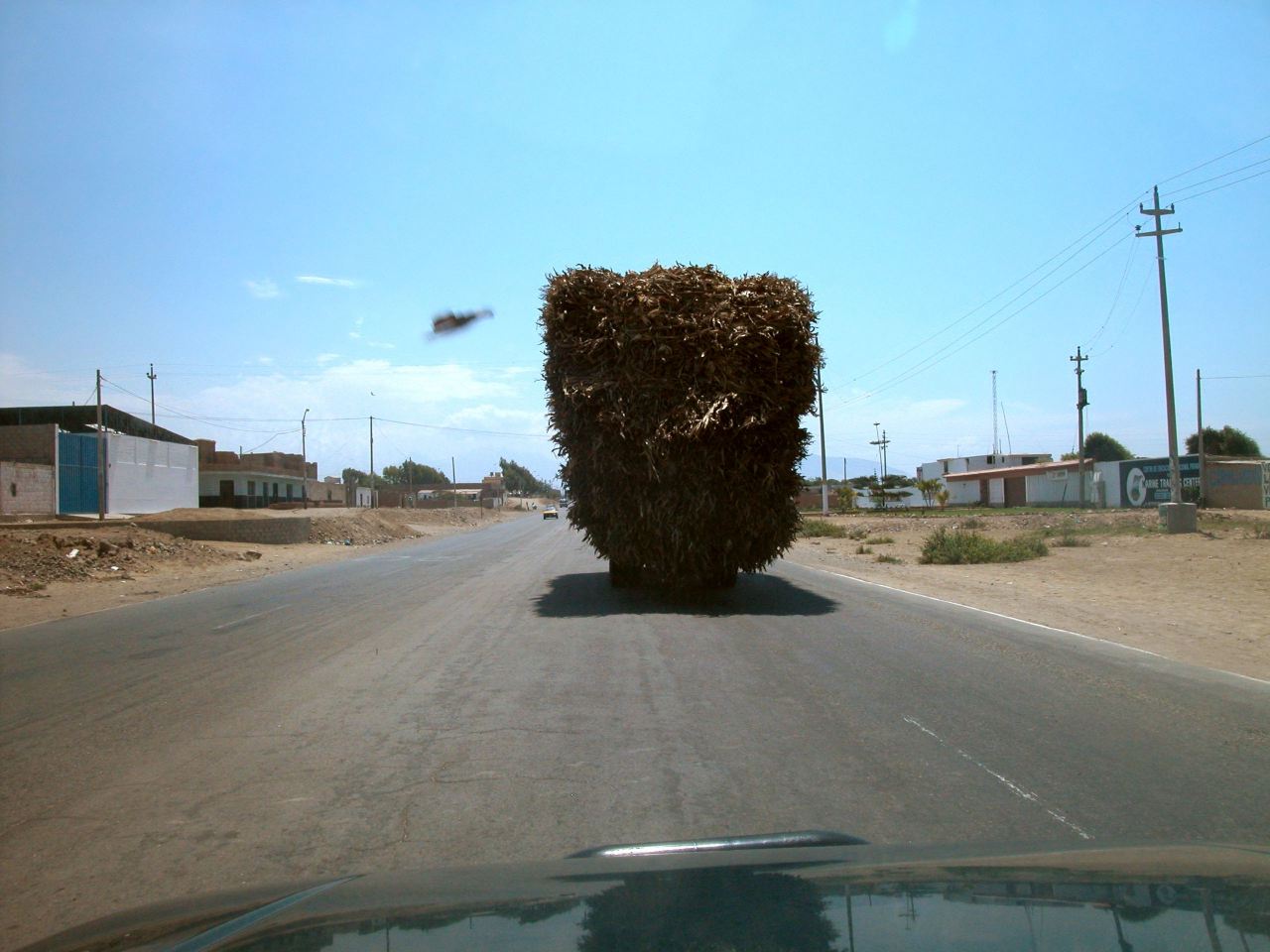


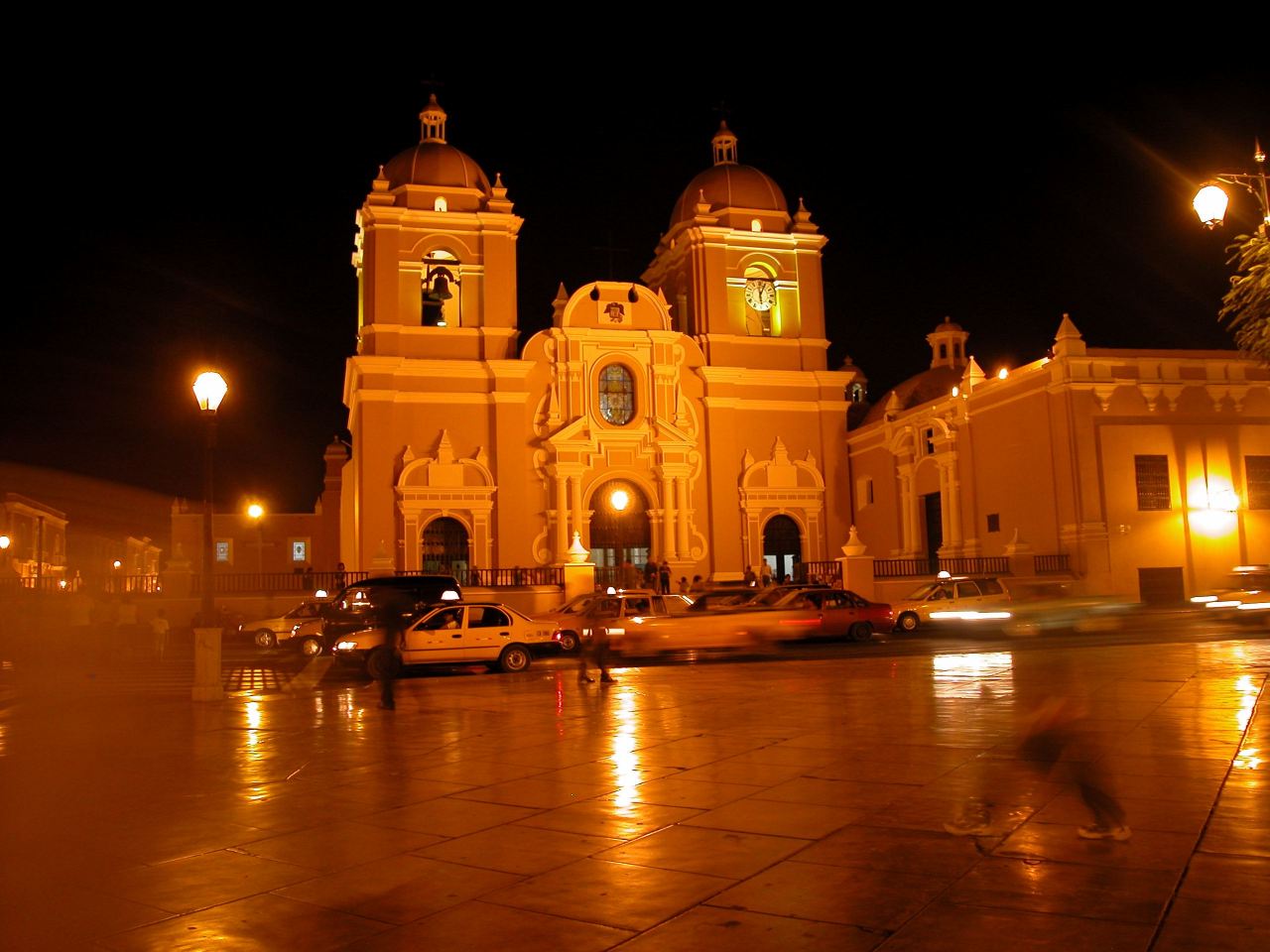
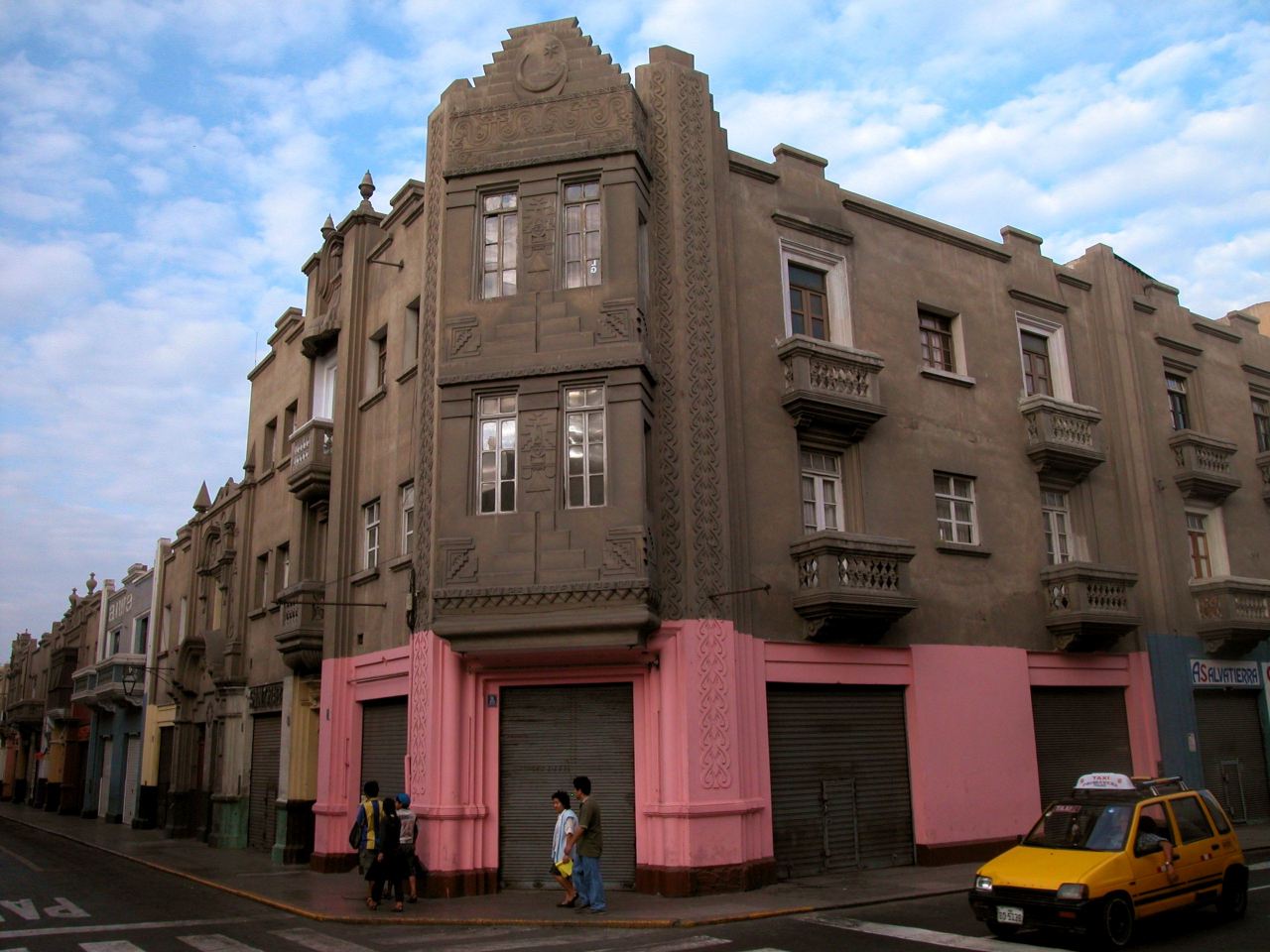


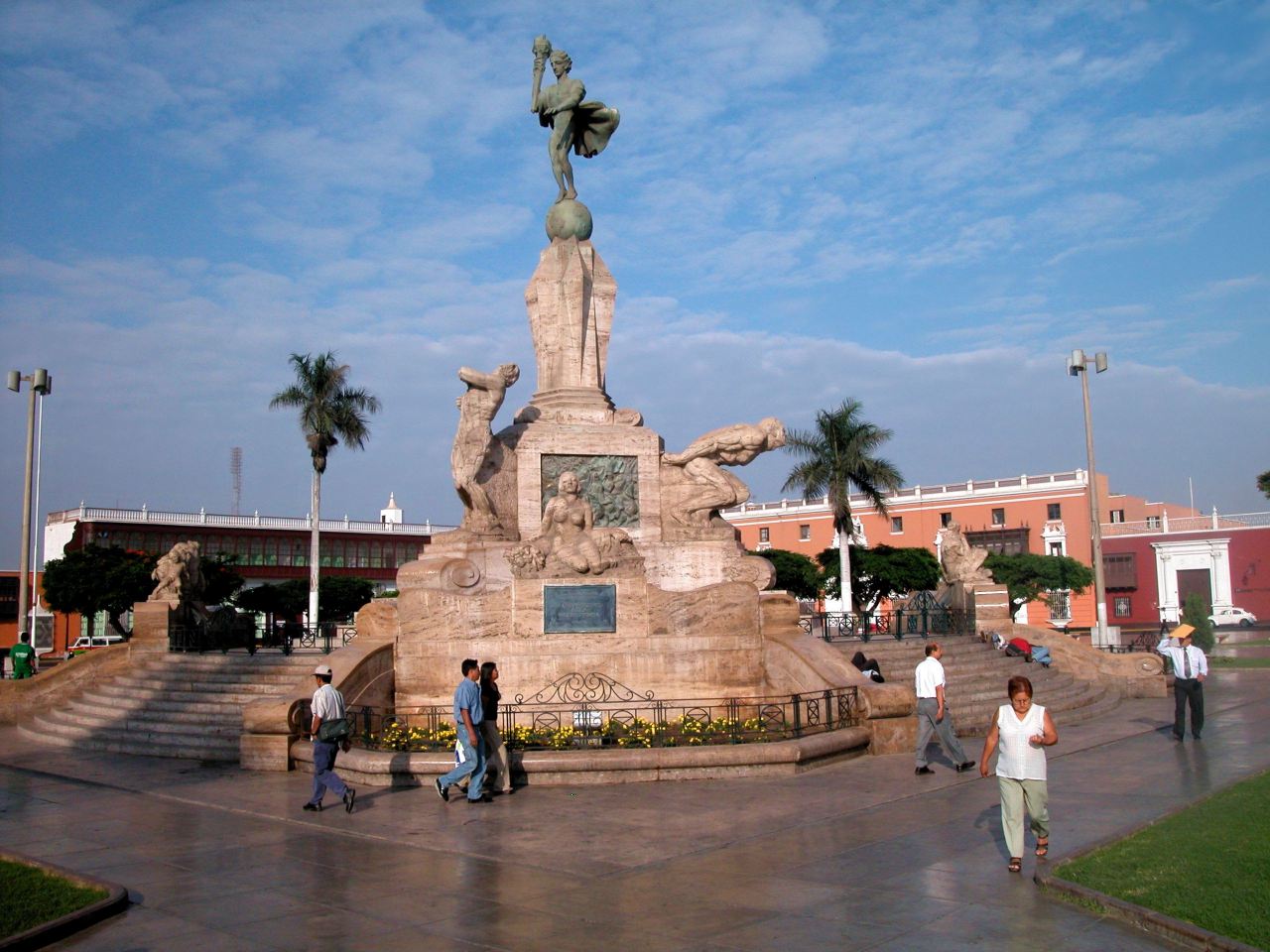
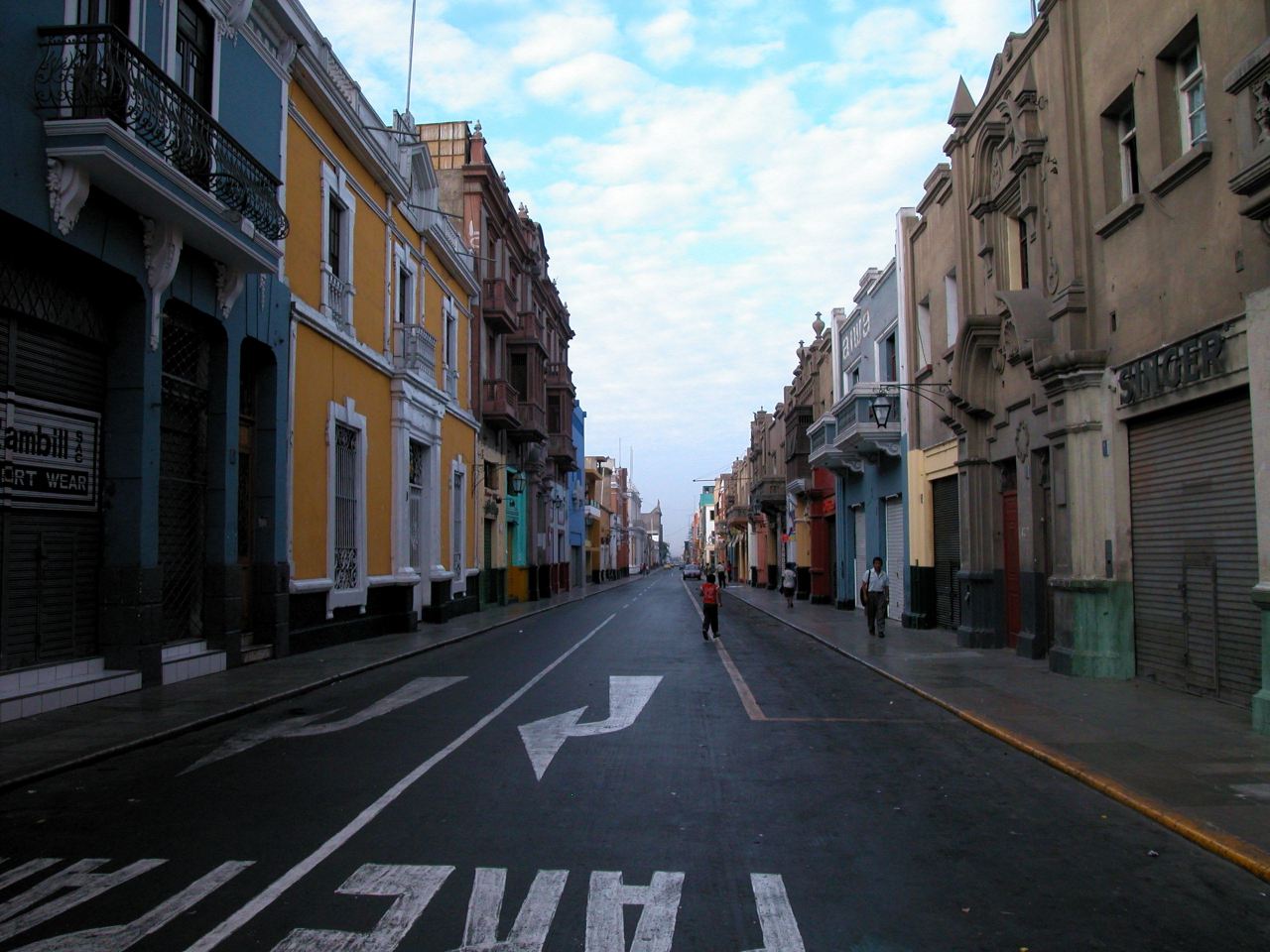


Remembering our unhappy experience in Arequipa, we tried a dozen places before we found a quiet room with windows looking onto a courtyard.

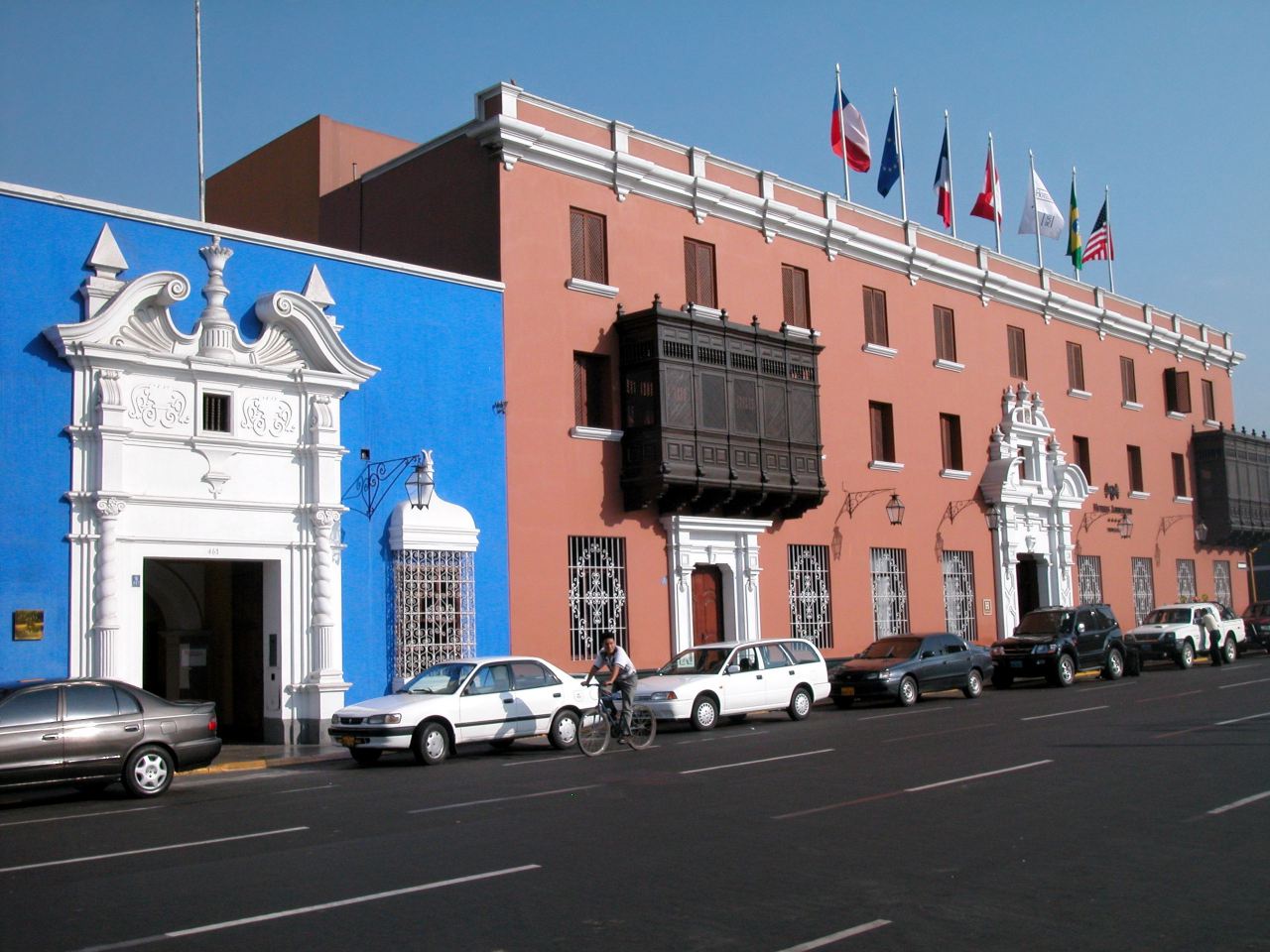
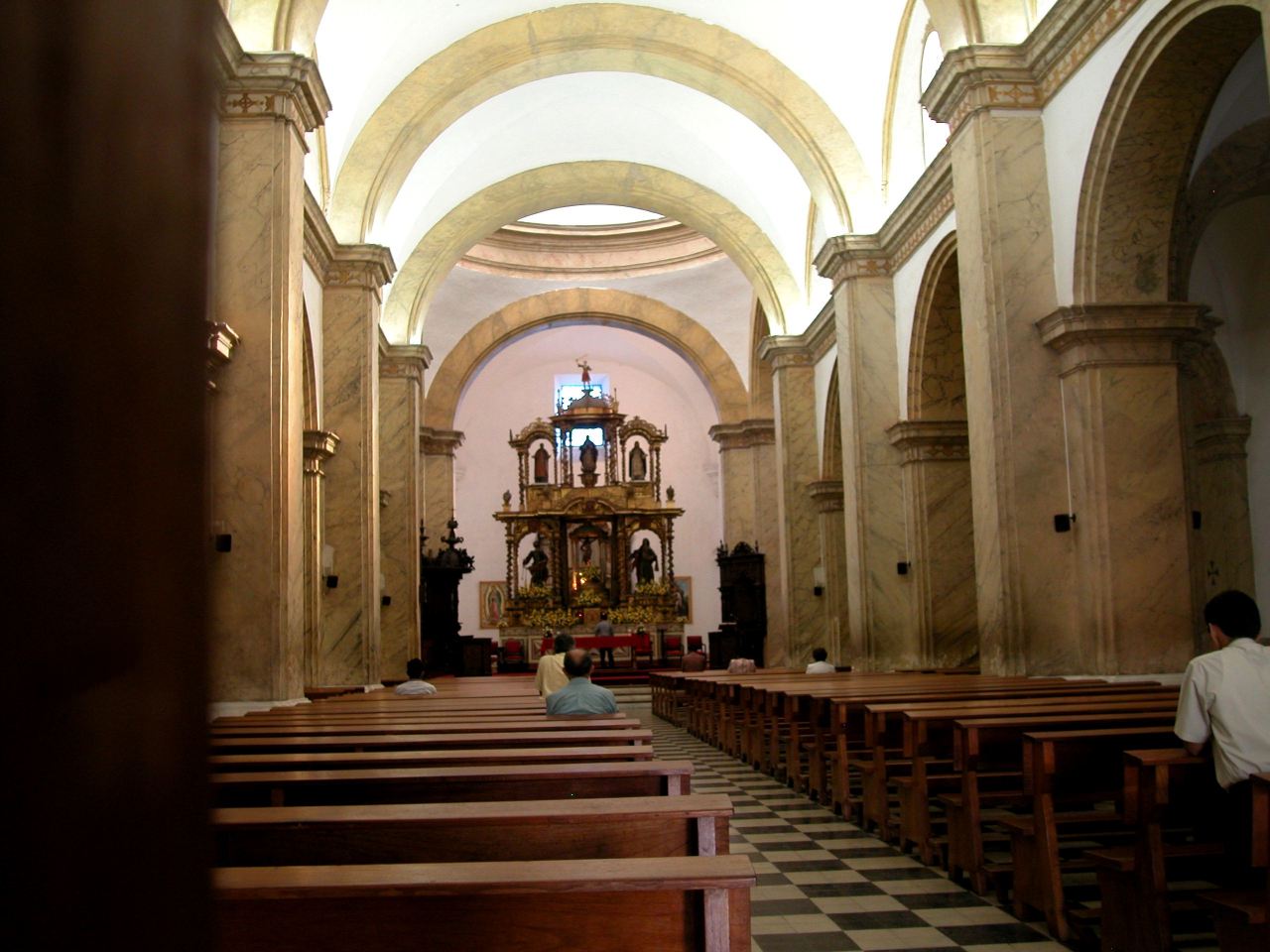
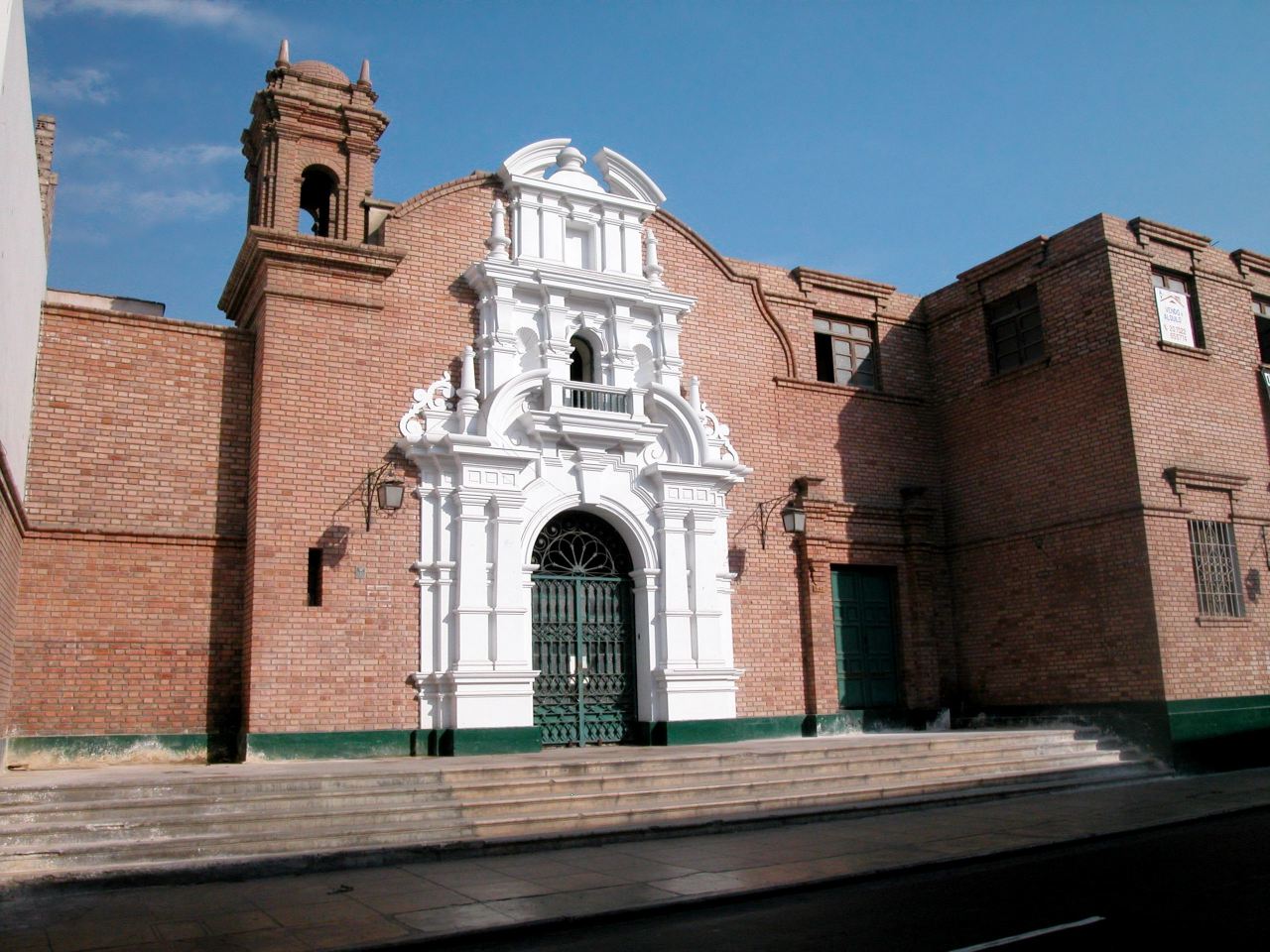
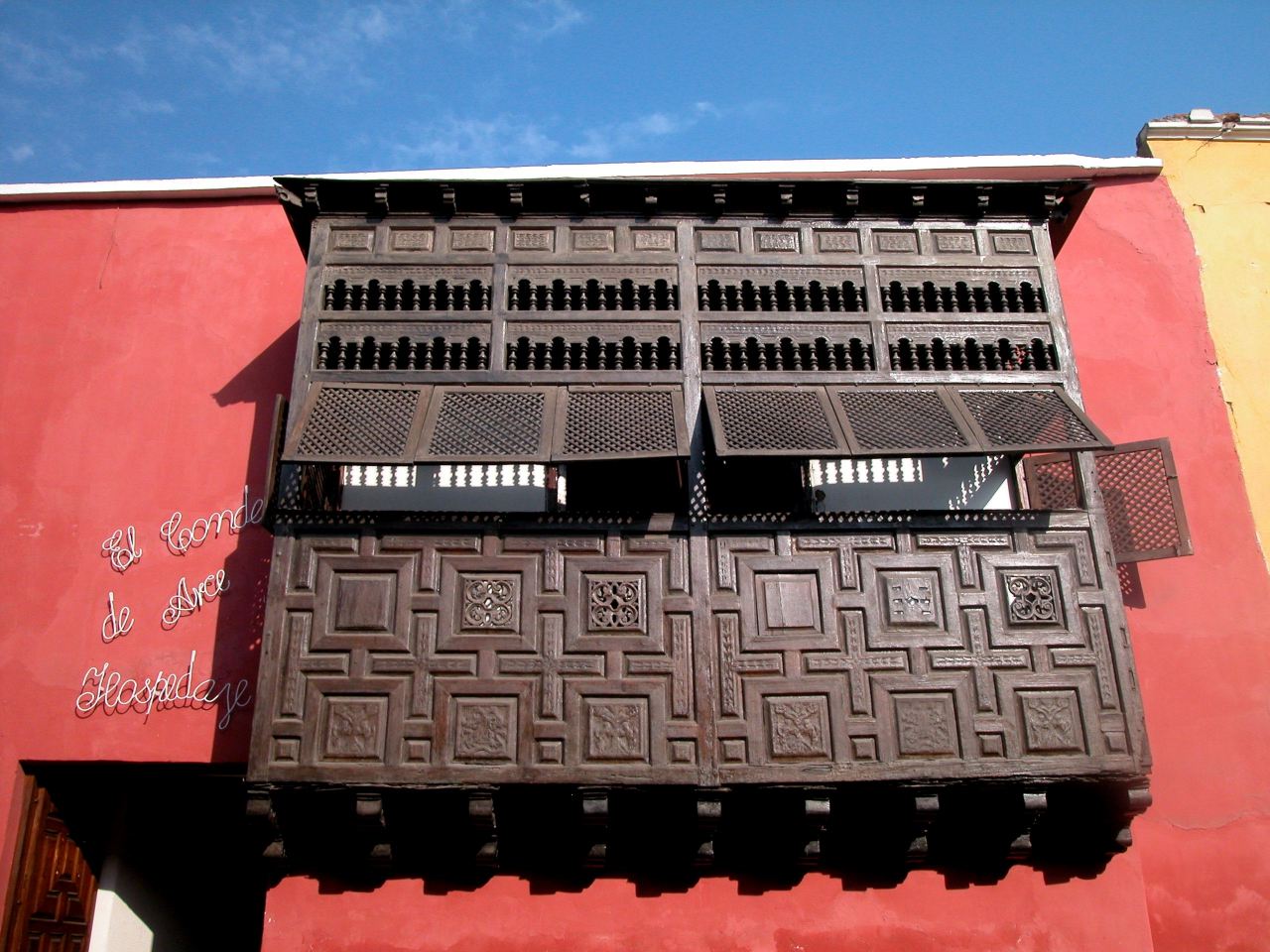

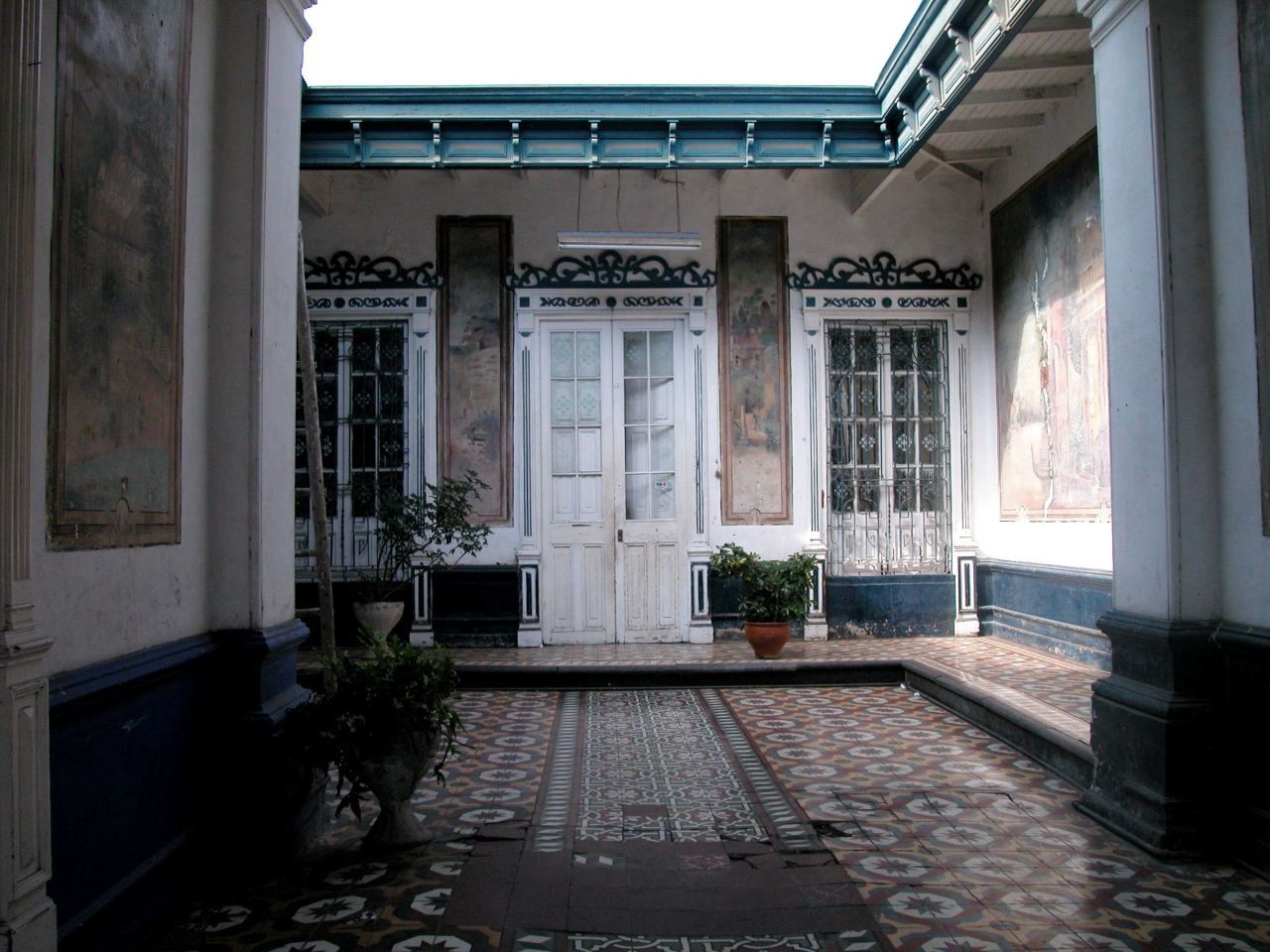

It was 150 soles for the night. Expensive, but parking was included, not to mention a wash for the car. We got a very respectable room. For that money, they'd given us two rooms. They intended Lena to have a separate room and wouldn't put us all in one. There was enough room, though, and Lena decided to stay with us. This made an indelible impression on the staff. They came back again and again to explain that madam was entitled to her own room. They all thought we hadn't understood. Eventually I managed to say that madam would stay here, that she was very happy where she was, that she was in the shower and wouldn't go to another room. The man was deeply embarrassed and didn't come back.

On the morning of our last day we went to see another city, Chan Chan, built by yet another culture, the Chimú. It was built around 1000 to 1200 CE. These, the story goes, were the people who worshipped white gods who came from the sea and brought them all sorts of knowledge. It was very possible, I thought, that they were Europeans on a ship carried across to America by the currents. The stylised patterns and the orderly architecture of their cities made it seem plausible. Unfortunately, all the buildings were also made of unbaked clay, and the rain has been washing them away ever since. Even so, the vastness of the city is astonishing. Admission costs ten soles and is valid at several more sites from the same period. The only thing that spoils the effect of this genuinely interesting and unique place is the number of barriers and ropes across the route. I can't see any common sense in the restrictions, except that they make it quicker to take a tour group round.
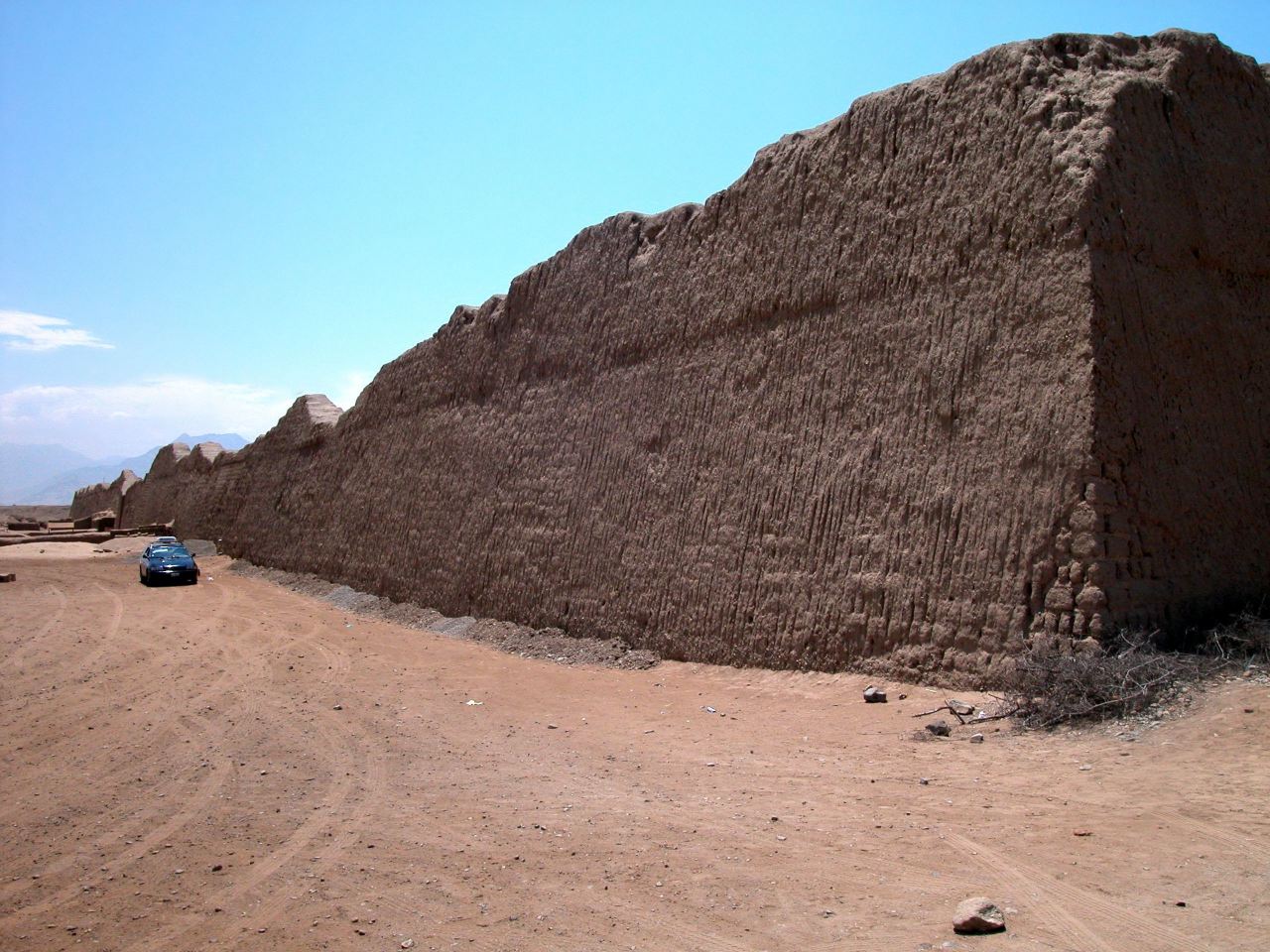
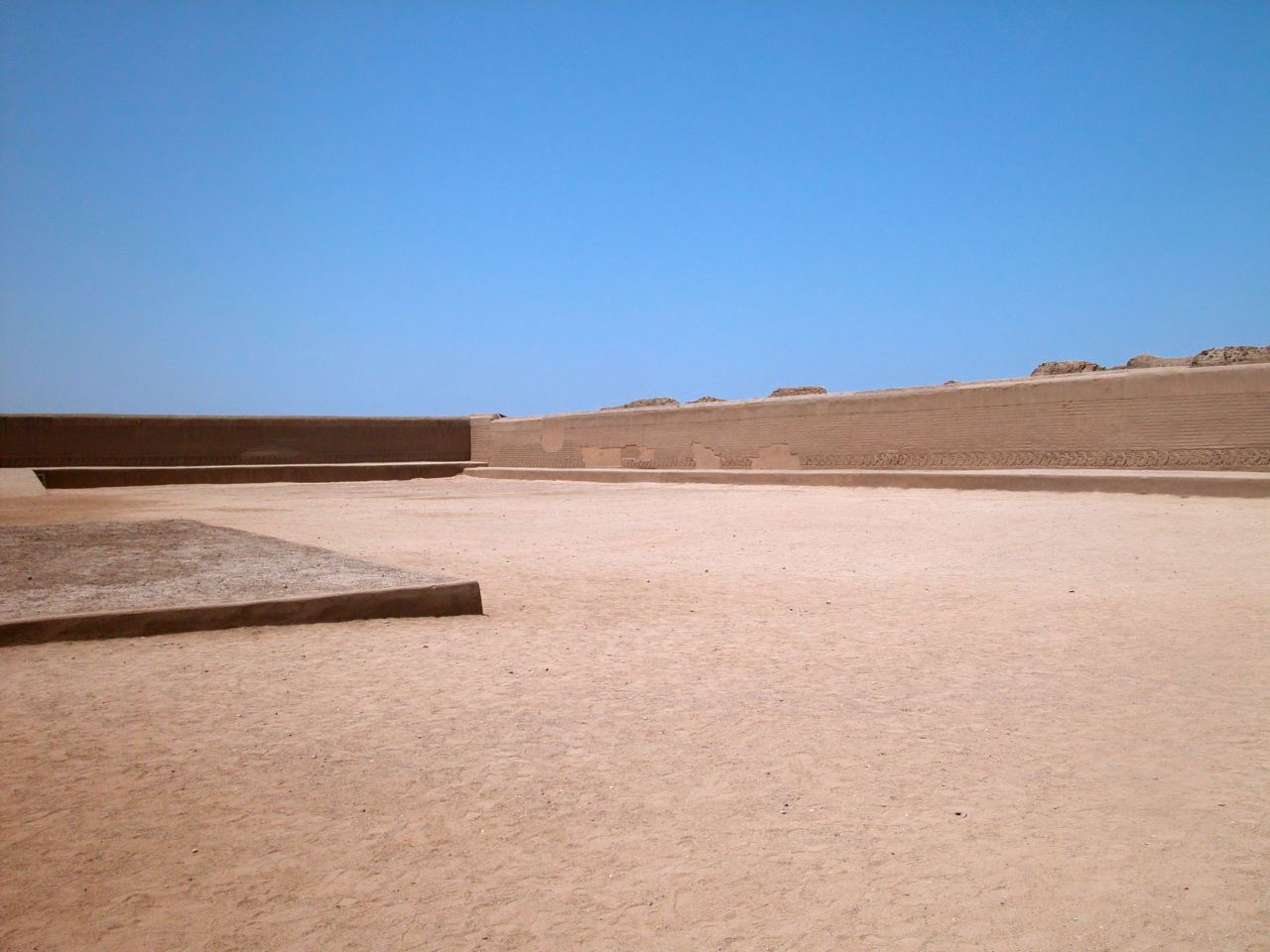


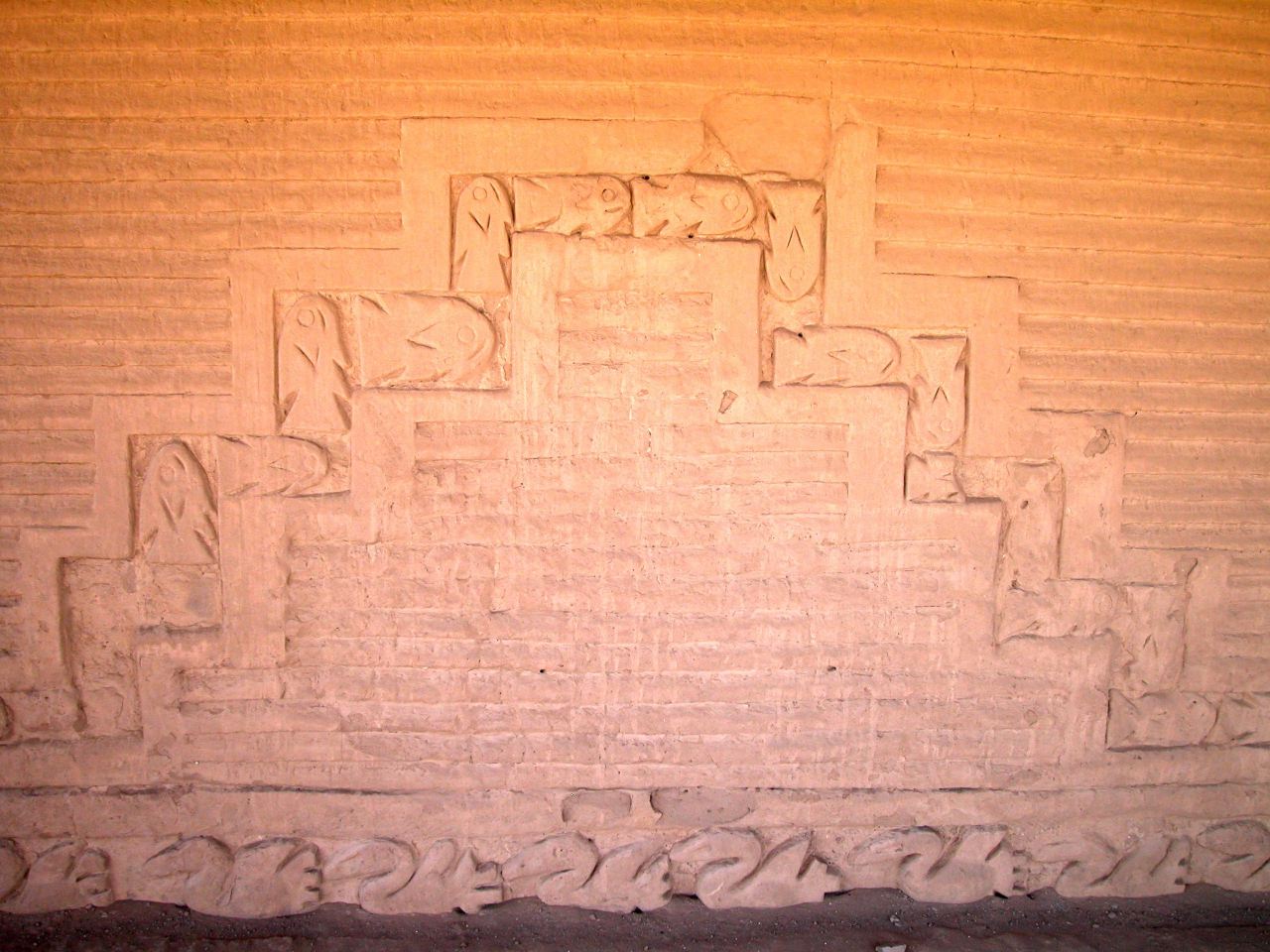
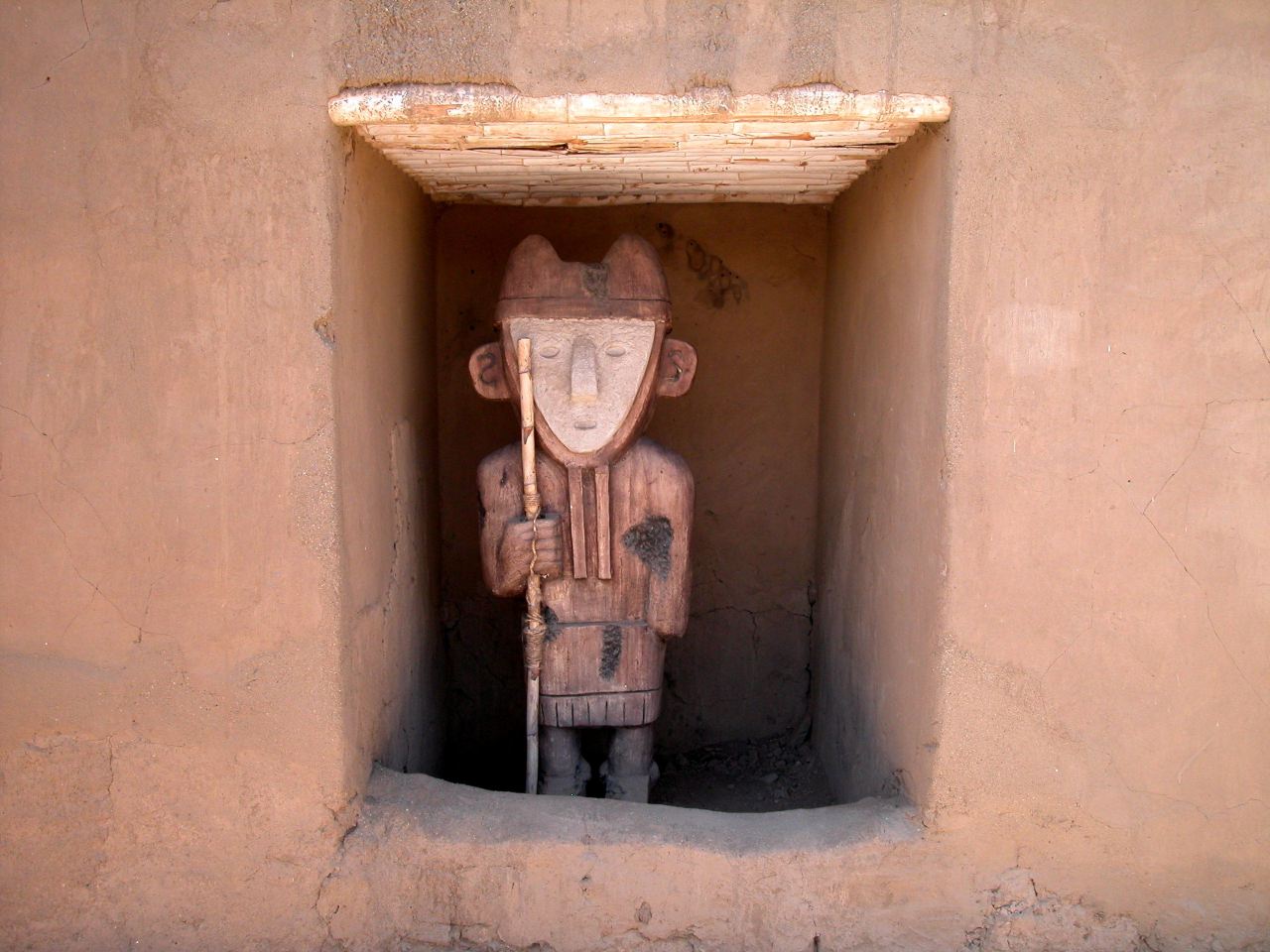


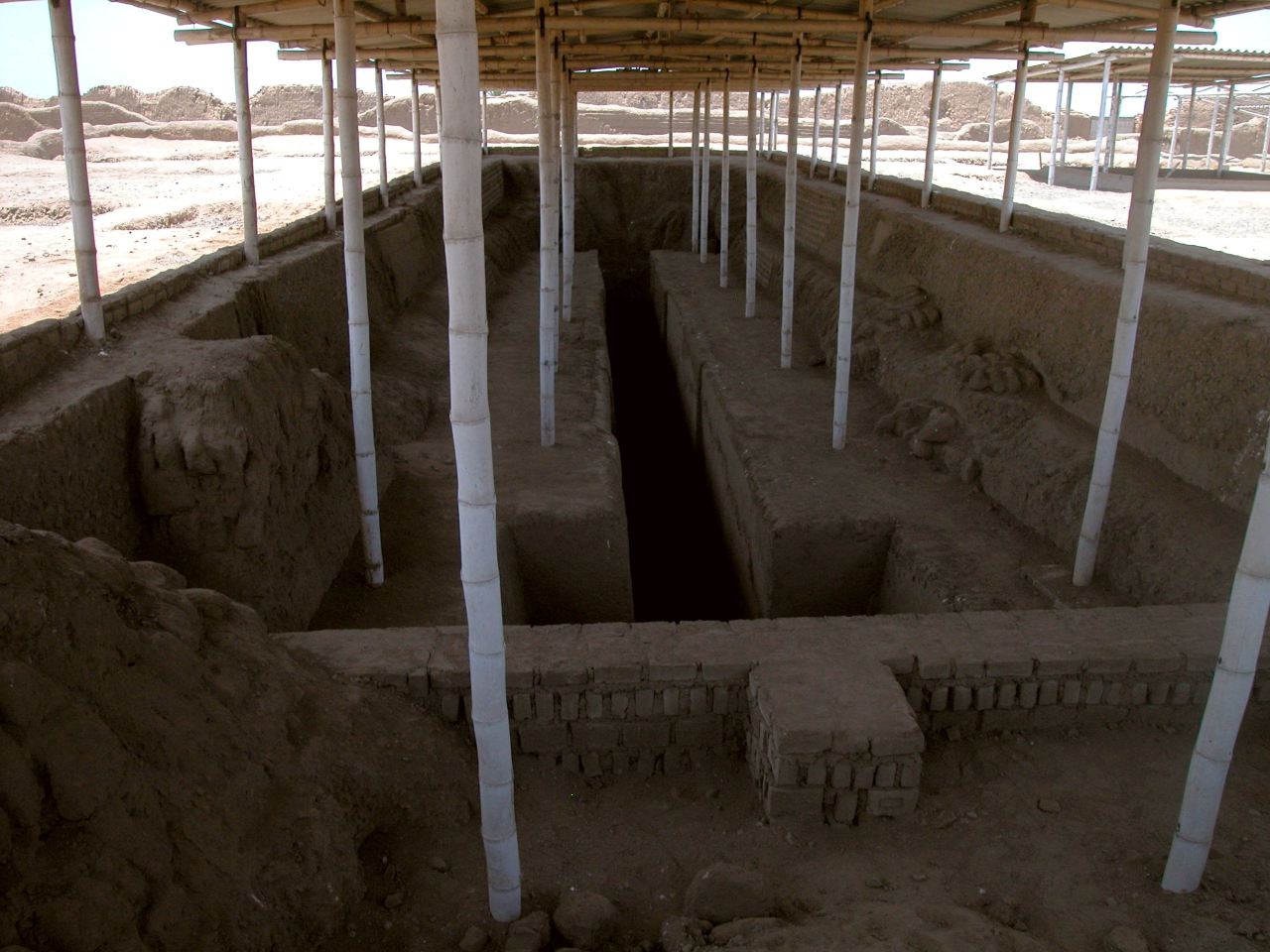
On the other side of Trujillo stand two pyramids, the temples of the Moon and the Sun. The Temple of the Moon is especially well preserved. That's because it was abandoned soon after construction and buried in sand. Now they're slowly digging it out and restoring the walls with new bricks in place of the ones that washed away. They're not even embarrassed to write the date, 2004, on the bricks. Soon the pyramid will be as good as new.


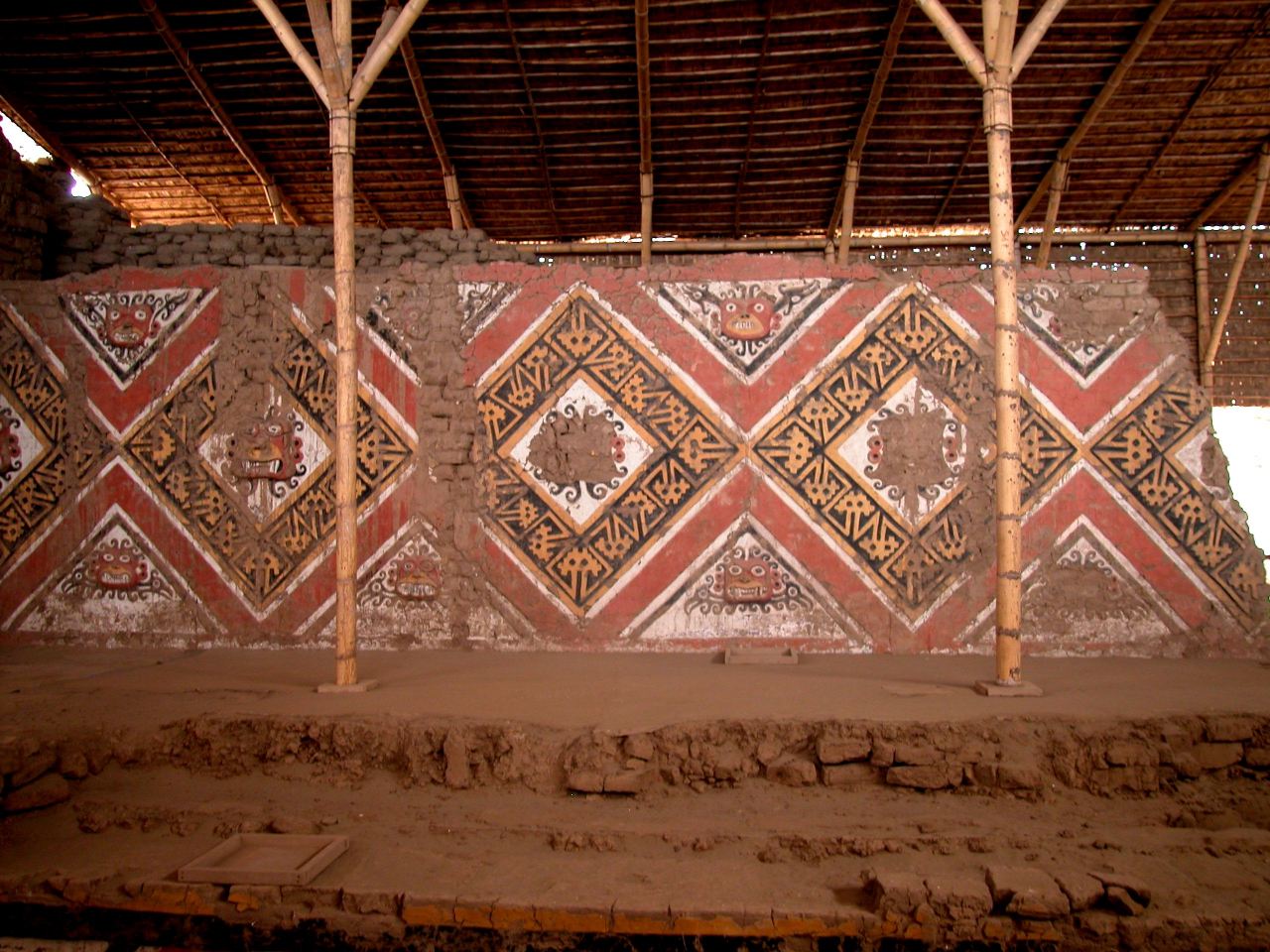
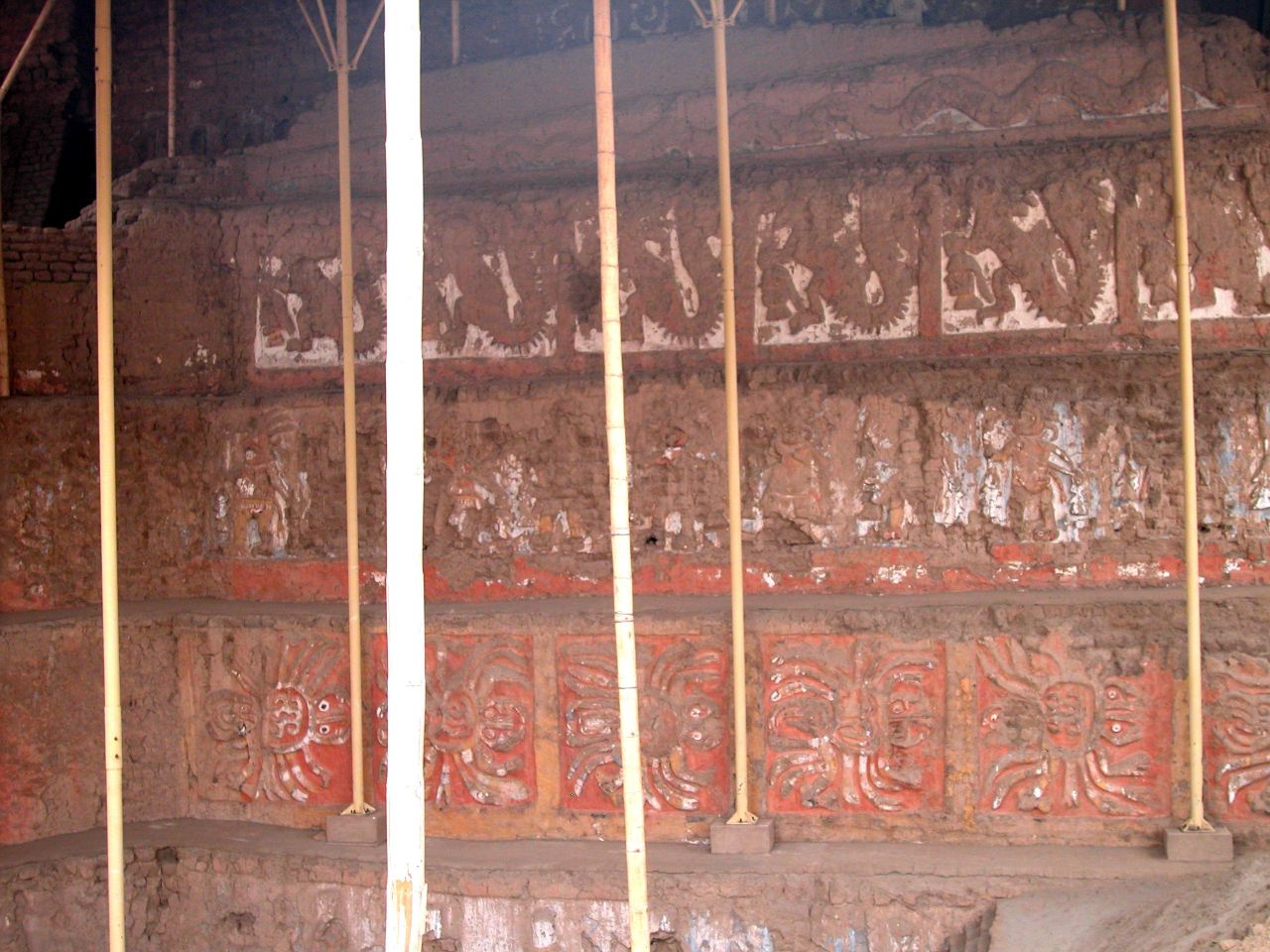
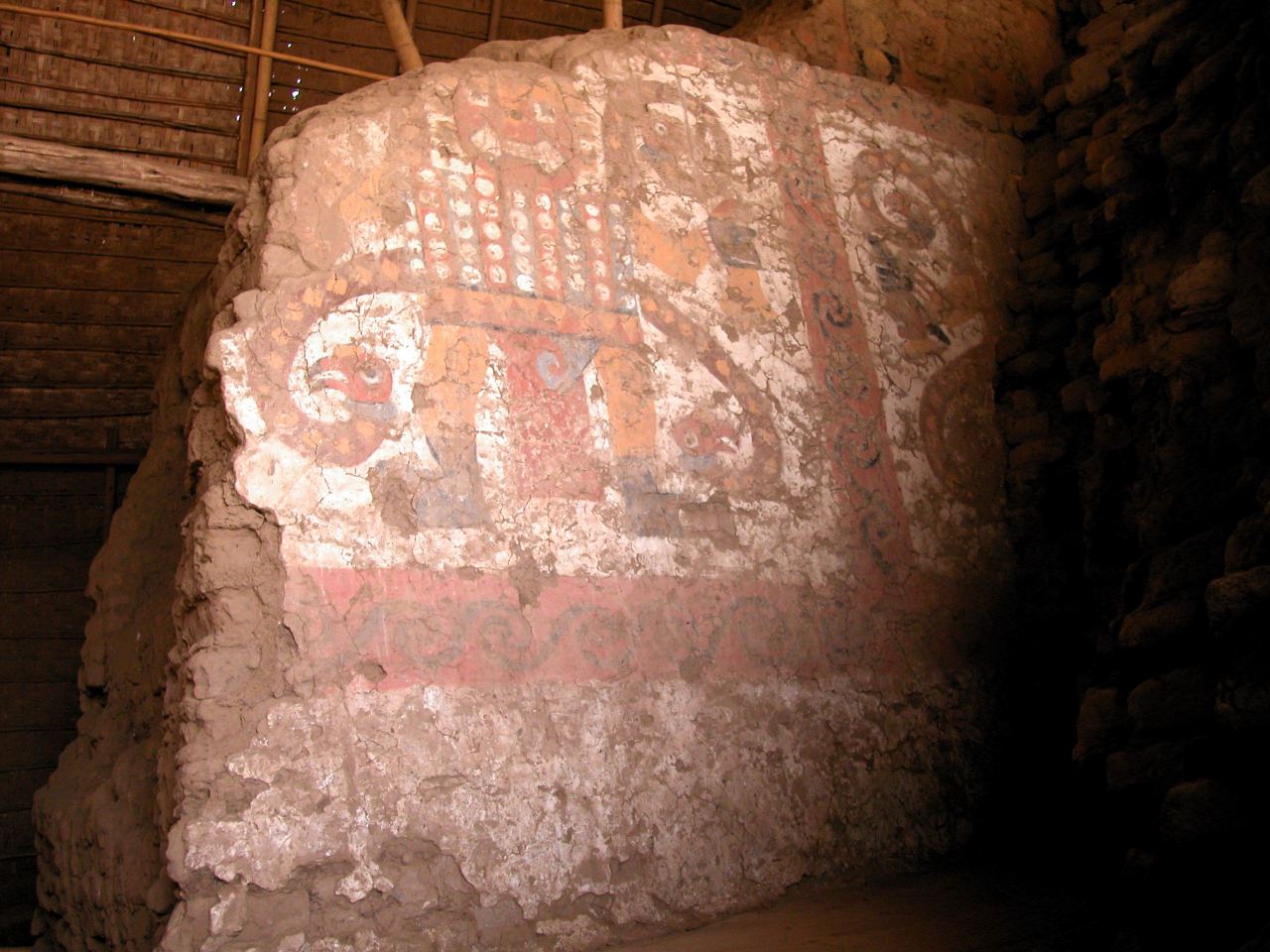


South American pyramids look nothing like the Egyptian ones. I cannot understand how Thor Heyerdahl could bring himself to say that they do. The chief difference is that in America they're temples, not tombs, and there are many painted rooms for temple visitors. Never mind that the base is square instead of a triangle. If you want a comparison, it would be more like the Tower of Babel.
At four in the afternoon, having walked round our last pyramid, we had to end our programme. Our plane left Lima in twelve hours and it was still seven hundred kilometres away. We'd have to do almost the whole drive in darkness. As long as the sun was out we looked around, trying to enjoy the last hours of our trip. The sun sank into the ocean. Its red evening rays lit up the desert. It looked very peculiar here. Small crescent-shaped dunes sat on a stony bed like little half-moons. We stopped to rest and walk about. To our surprise, some desert plants were growing there, even in flower. It rains now and then here, as we were shortly to see for ourselves. A hundred kilometres north of Lima we ran into a heavy downpour. The landscape around us still looked like desert, but the rain was so heavy we got soaked buying all sorts of exotic fruit at the local market to take back to Saint Petersburg.
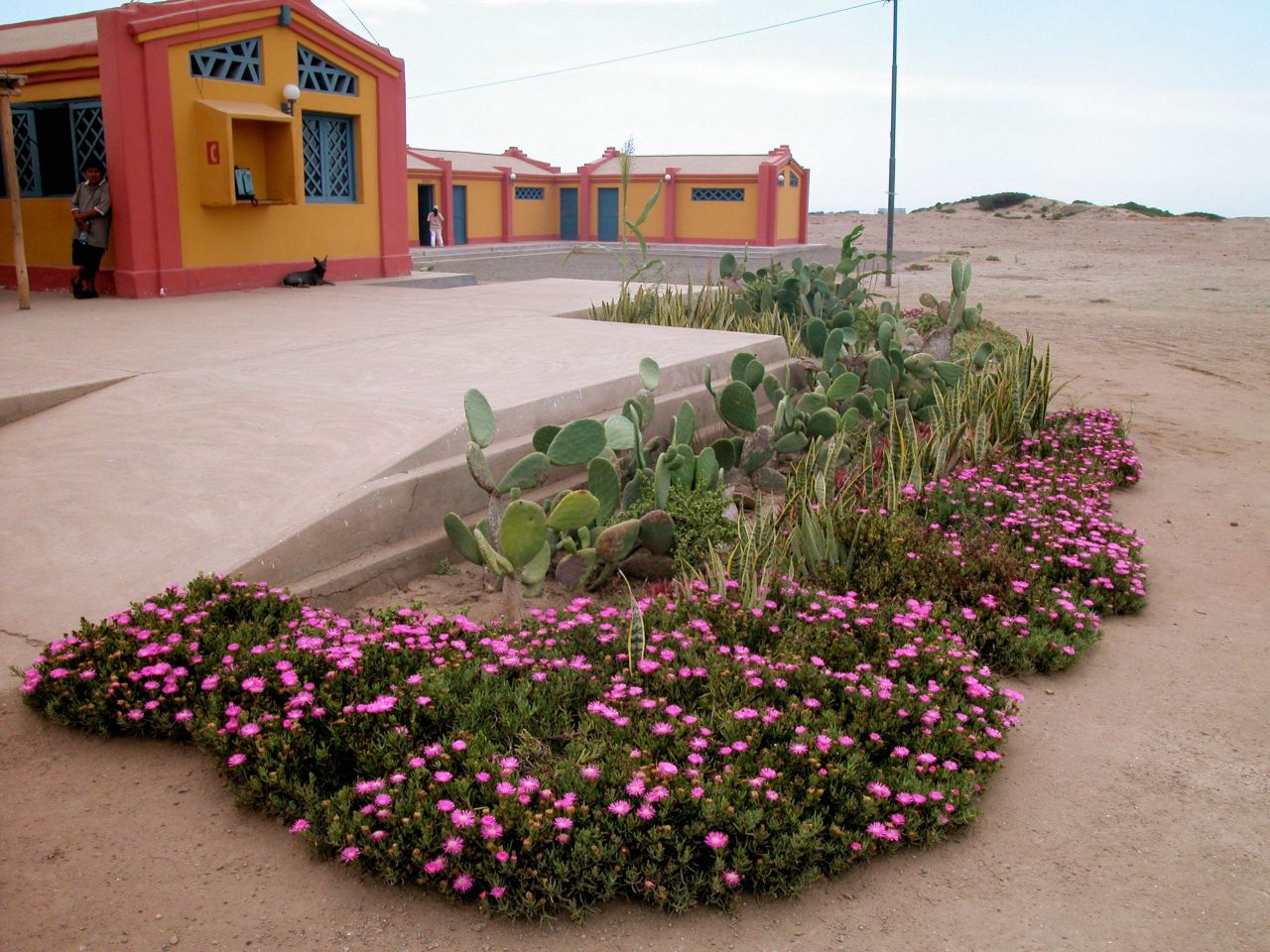
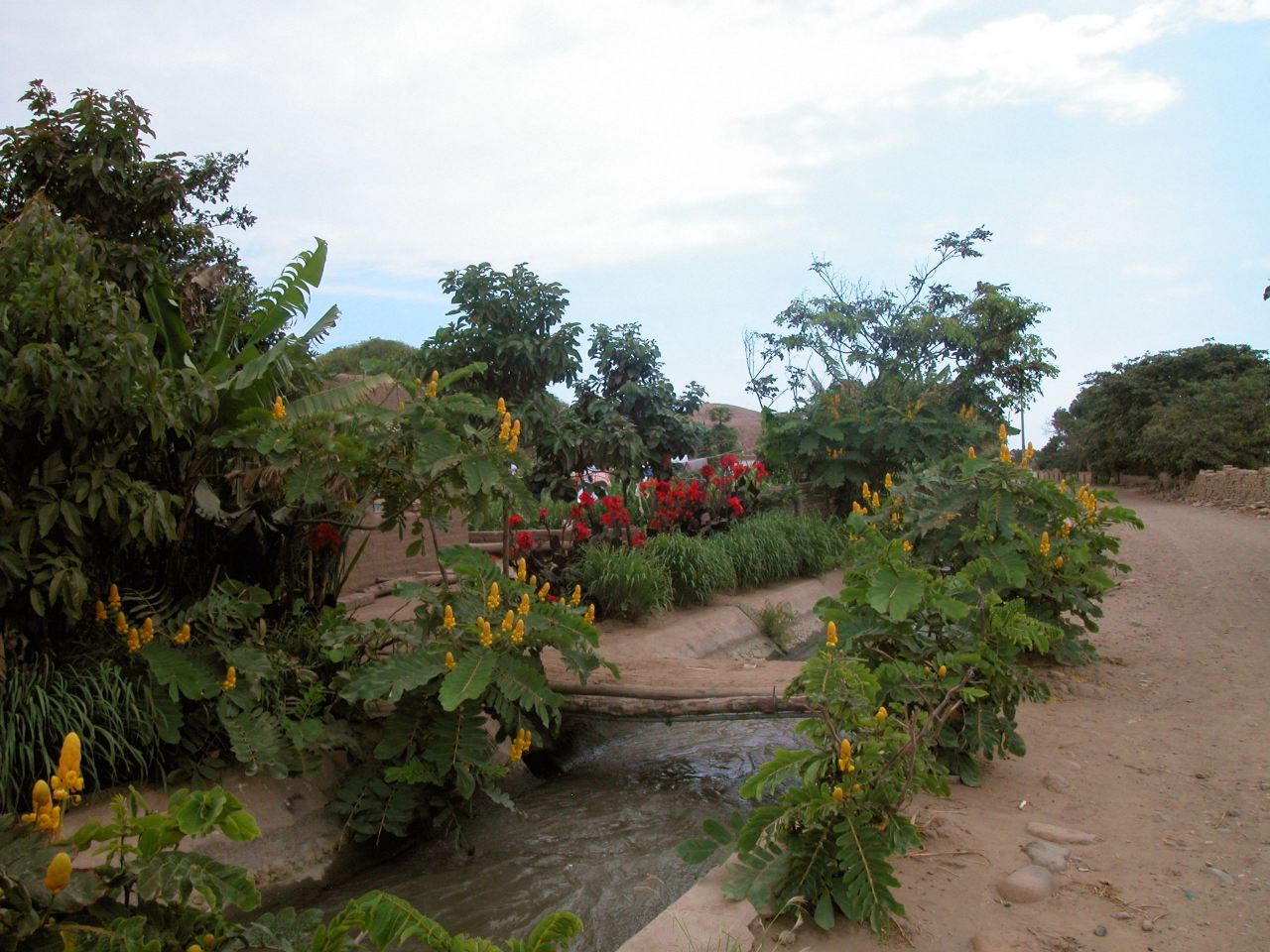
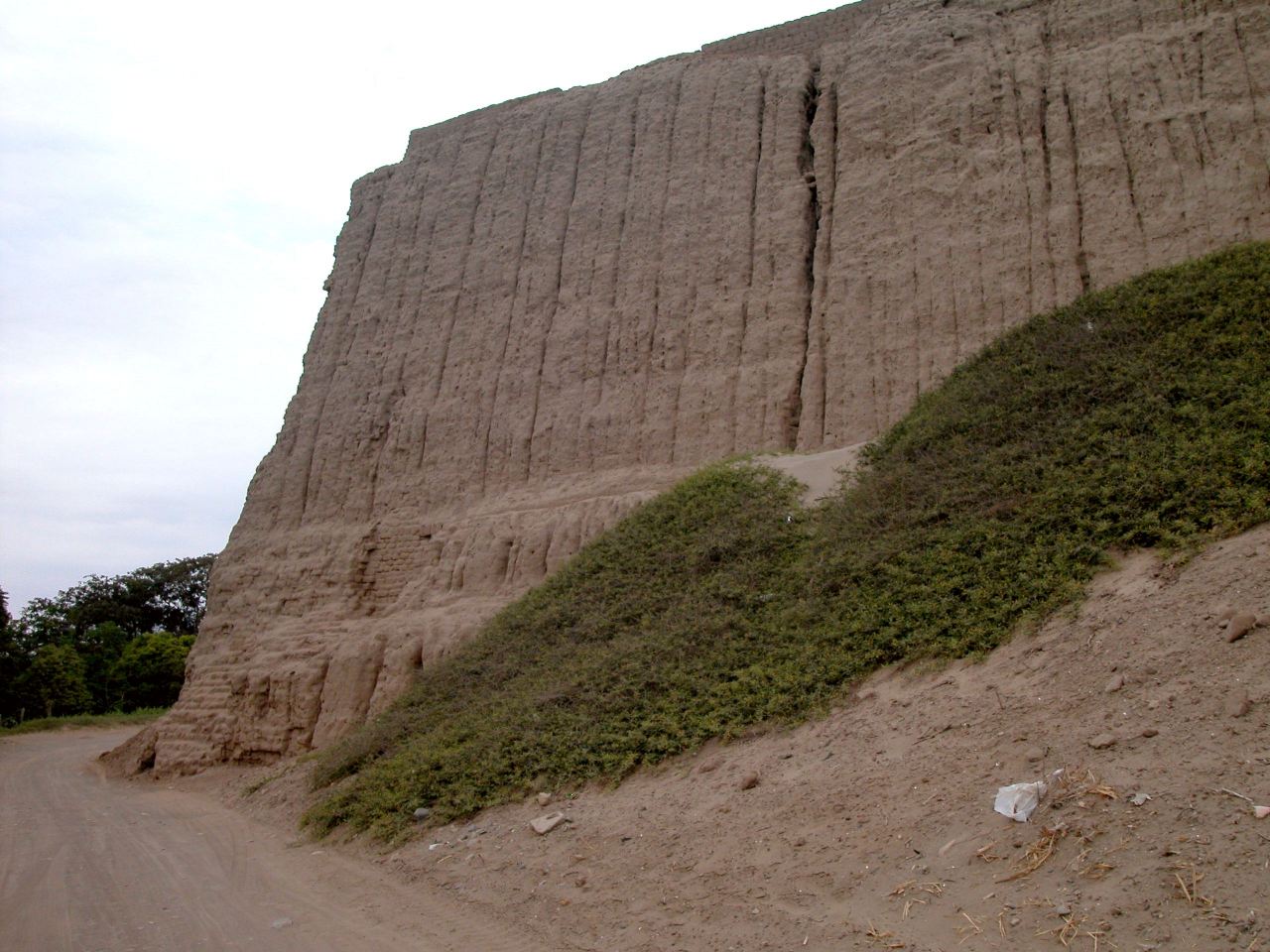
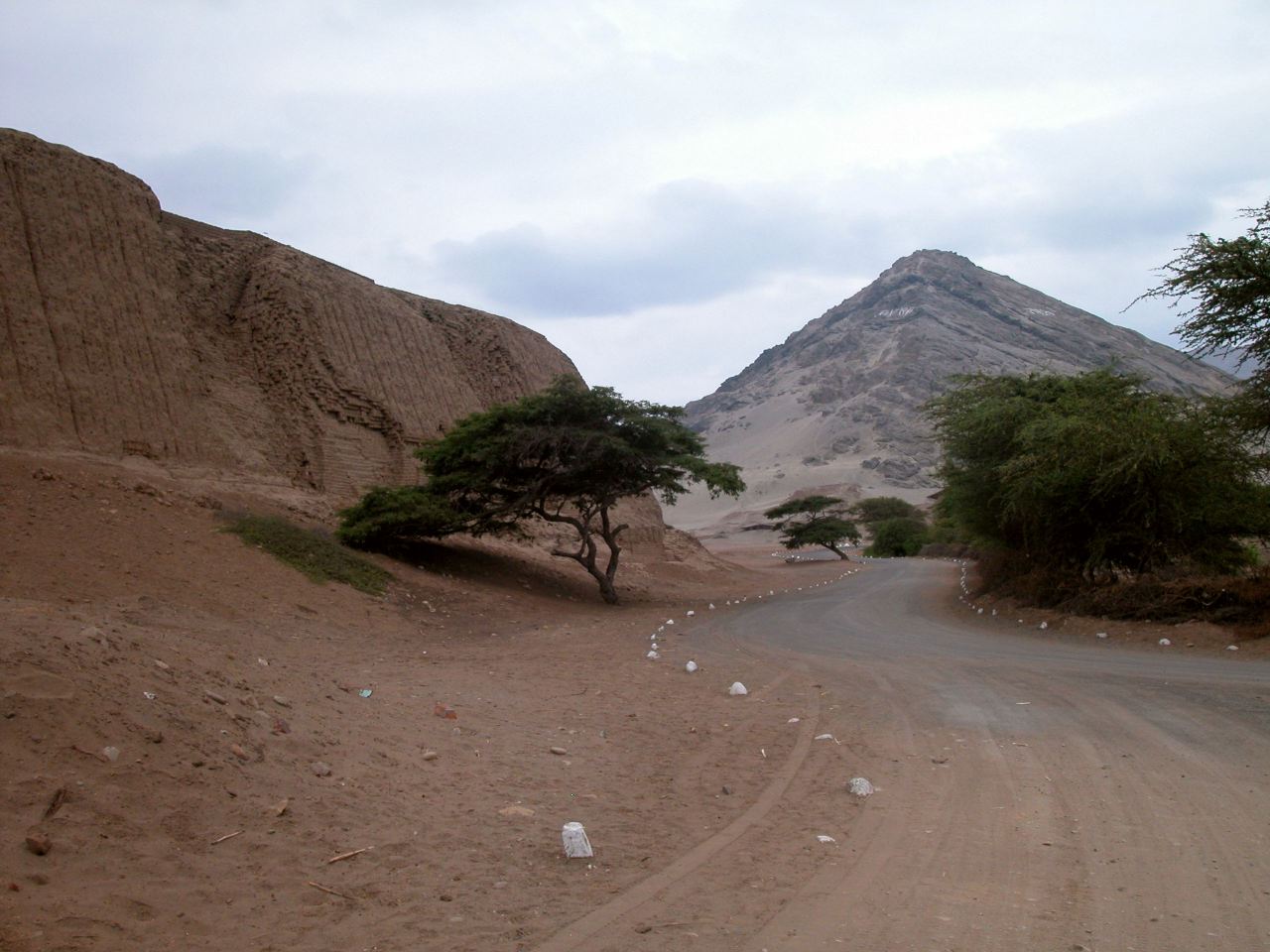
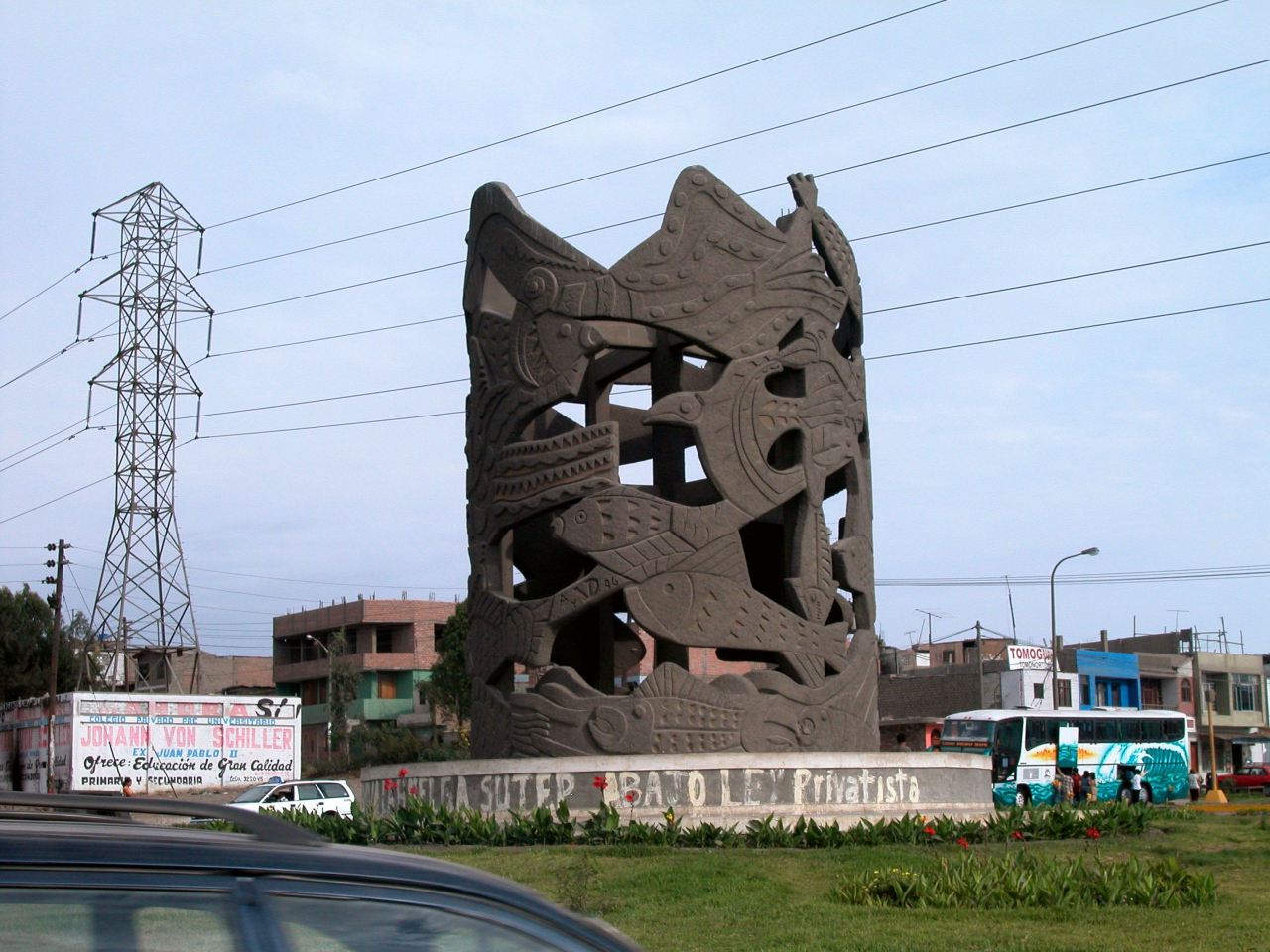


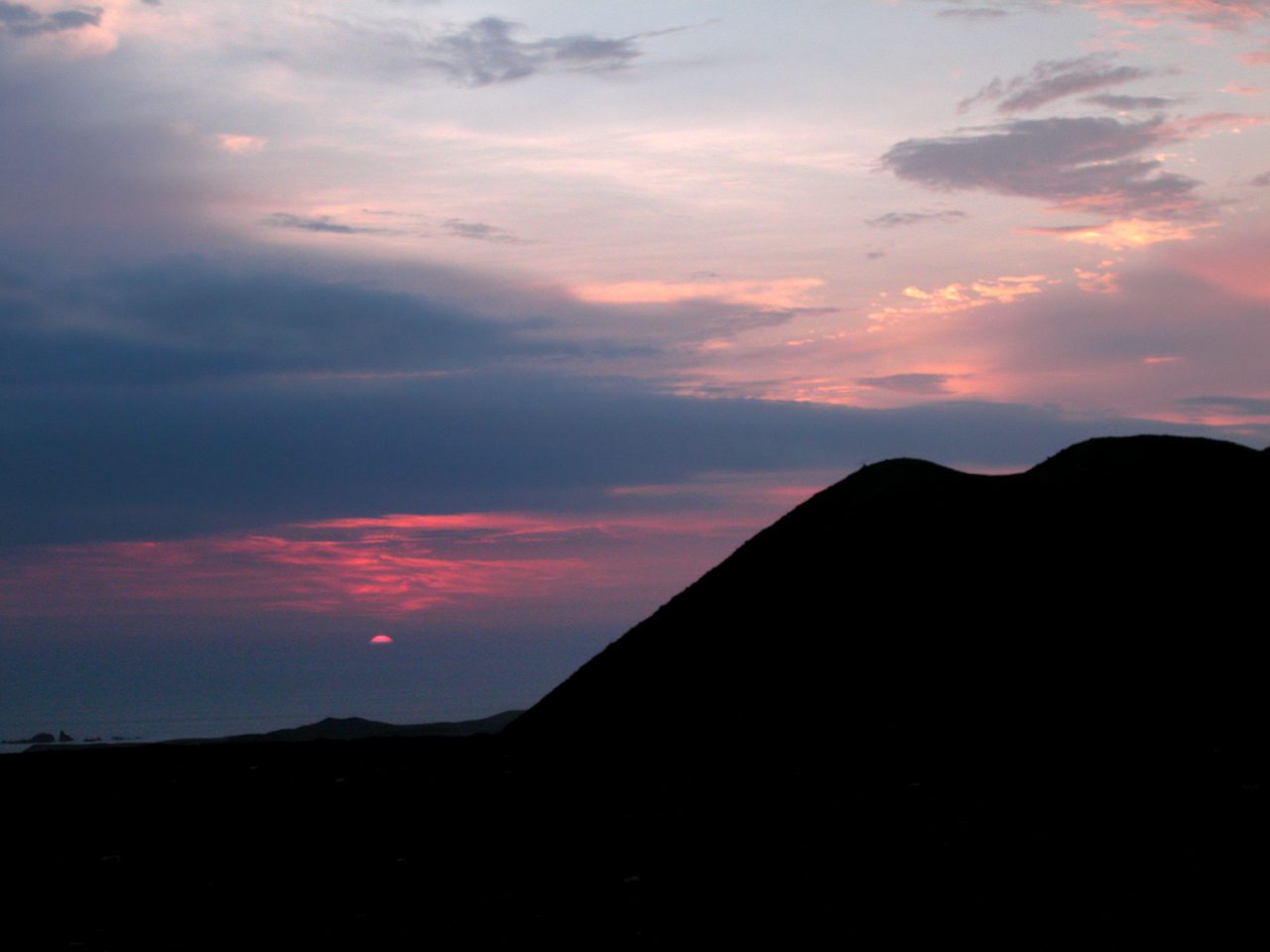
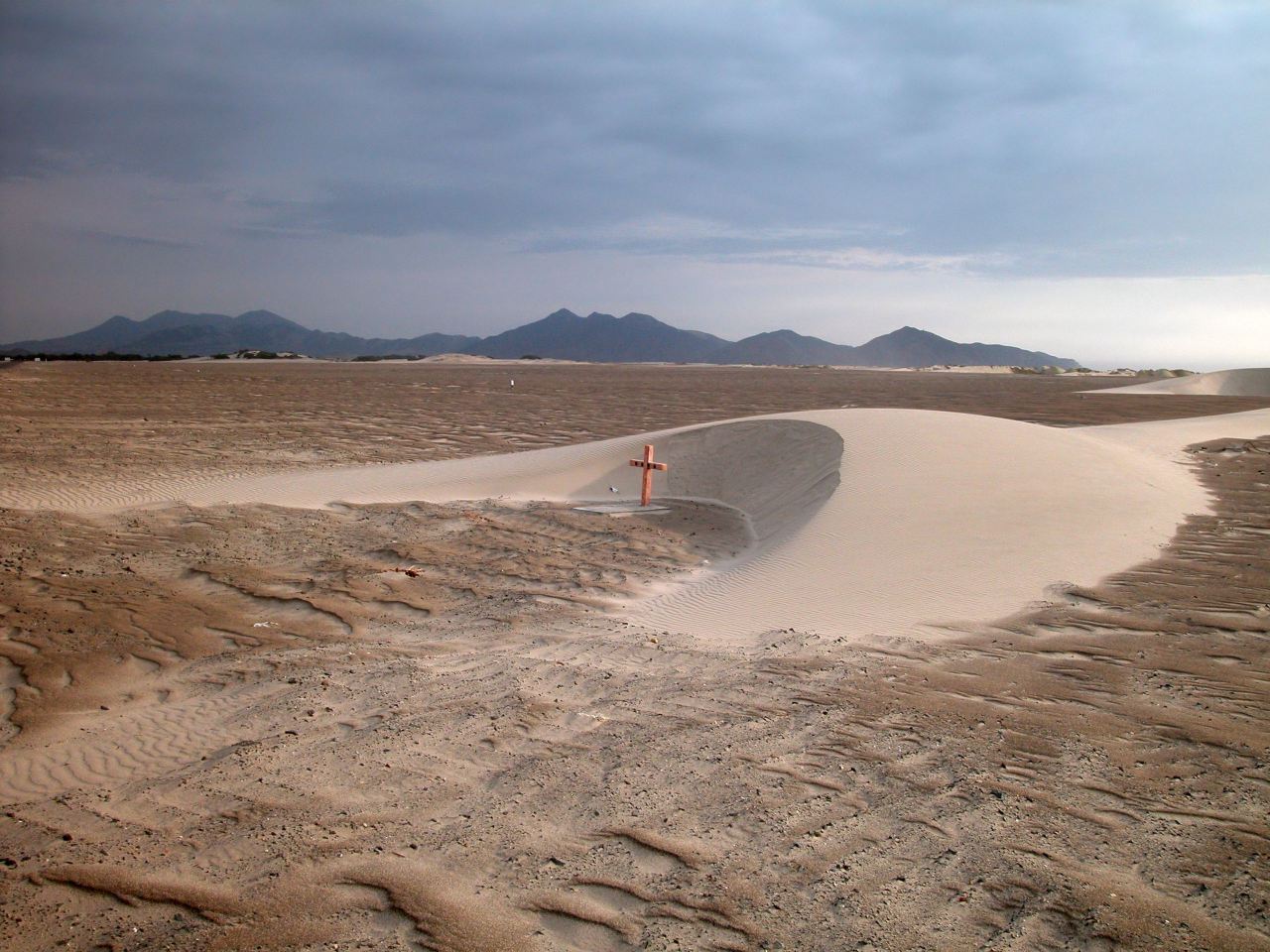


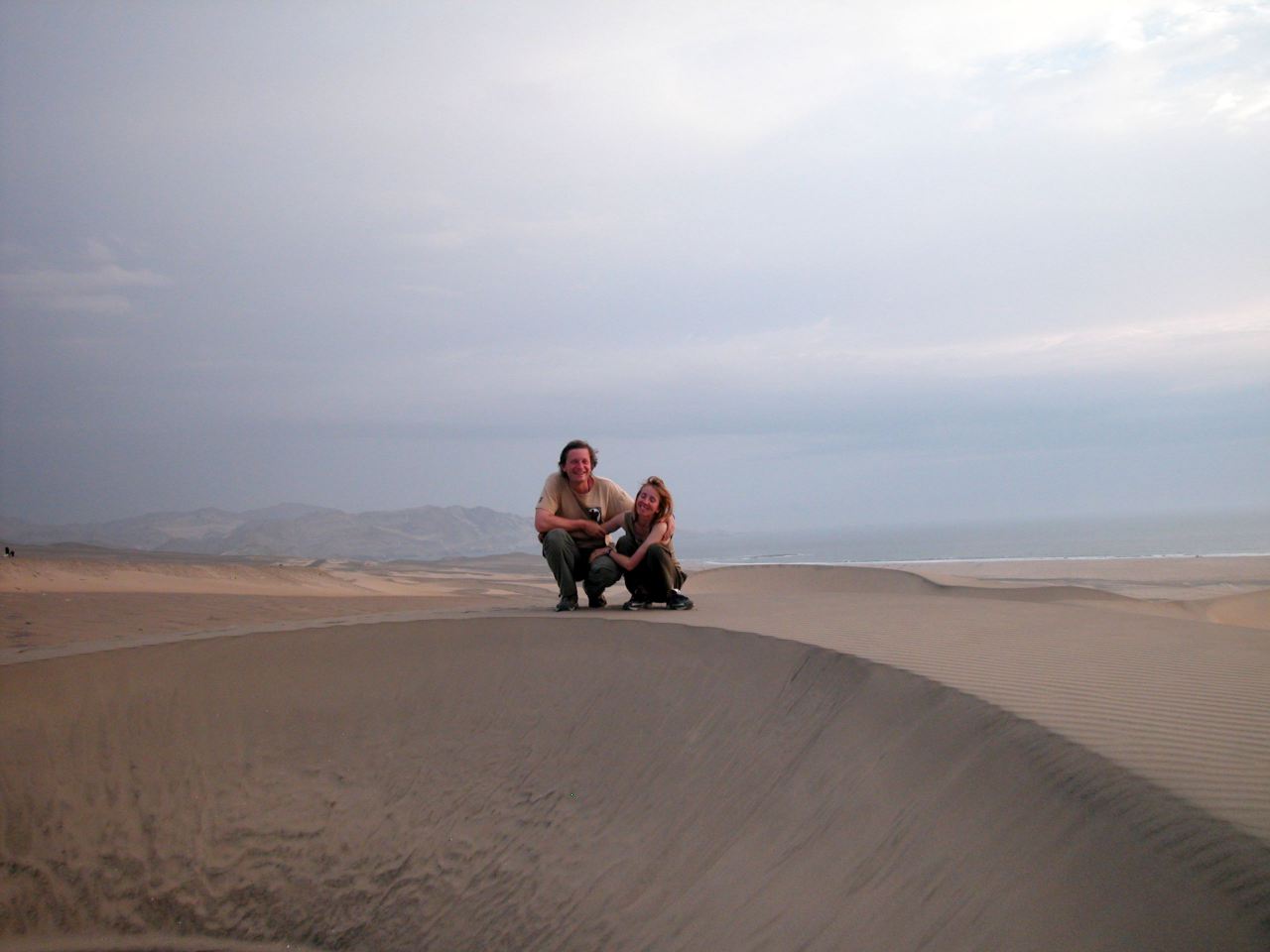
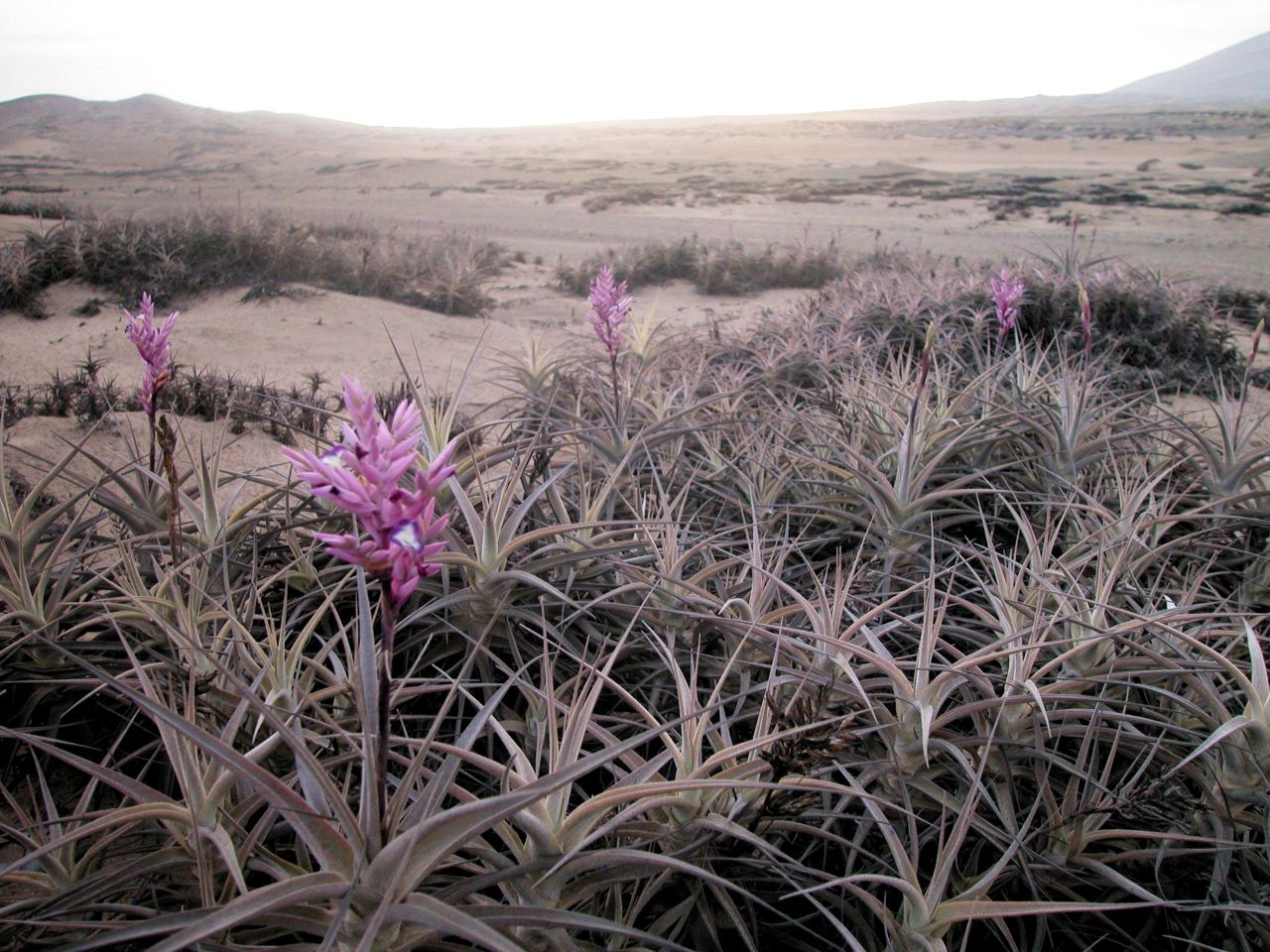

We got to Lima airport three hours before our flight. Off we went to return the four-wheel drive. We'd done five thousand kilometres in eleven days and it had taken its toll. First, the cover had come off one headlamp. Second, we'd lost two dust guards. Most important of all, the car was braced by a solid frame of welded pipes and after all the shaking the welds had failed in three places. Now the whole frame had a life of its own, flapping back and forth and clanging horribly over bumps. It didn't start in the mornings, of course, but they wouldn't notice that now. What happened tomorrow morning was none of our business.
The rental man inspected the car with great care. He checked everything, down to whether we'd stolen a bulb and whether the radio worked. He found the missing headlight cover, accepted that the broken frame wasn't our fault and all would have been fine. Then it turned out he didn't want to return the blank Visa slips we'd signed when we took the car. It was their policy, apparently. A mechanic would inspect the car the following day and then decide what we had done to it and how much it was going to cost us. In effect he could enter any amount and the bank would collect it from us. We were furious and argued for an hour, but it hardly got us anywhere. The slips were in his safe, we couldn't seize them, and it was time to board. We had to back down and fly home uneasy, hoping National was a large enough international company that it wouldn't pull an outright scam. That's how it turned out. They charged us a hundred dollars more than the rental should have been, and the money held on the card came back after the expected six weeks. For Peru, I can only say we got off lightly. I don't mean Peru is a bad country. It just has too many tourists who are much richer than the locals. I wouldn't blame anybody for taking advantage and making some money. That's only right. What is more, people fill tourists' ears with nonsense so often because there's a demand for it. Demand creates plenty of legends and a trade in obvious fakes. People come because the Incas were here and they get sickly-sweet quantities of exactly what they ask for, in line with their own tastes.
Peru's an excellent country for anybody who wants to see the exotic without lifting a finger to do so. They'll take you there, show you the sights, feed you and put you to bed. You really can see a great deal, with as much safety and comfort as circumstances permit. Alas, that excess of attention can get in the way if you like to travel entirely on your own, and the enormous crowds can block out the beauty. There's nothing to be done about that. My advice is to head for Bolivia next door, or at least go to the wild places of Peru, of which there are plenty. It's a big country and ninety per cent is wild and full of character.
In the few minutes left before boarding, we spent the last of our loose change on several bottles of Cusqueña beer.
The first flight was on a DC-9 belonging to the Venezuelan airline Aeropostal.
The route followed the ocean, right over the Pan-American Highway we'd just driven on. On the GPS screen you could see us flying across all the places we'd been walking and driving and looking at pyramids only a short while before. Flying turns out to be fifteen times as fast as driving. Beyond Trujillo I couldn't resist any longer and fell asleep. Our first stop was the Ecuadorian port of Guayaquil. The coastal deserts end in Ecuador, and it's tropical here. That's because the cold Humboldt Current, which determines the climate to the south, leaves the coast and the ocean gets warm.
It was raining at Guayaquil. The plane picked its way through ragged clouds, coming in to land over numerous coastal inlets overgrown with mangroves. Dawn had broken, and we saw a little bit of Ecuadorian life from the window. I'd say it seemed better off than Peru.
We were going on in the same plane, so we weren't let out. There were no GSM networks in Ecuador then, so I couldn't send a text.
Our flight continued to Caracas, the capital of Venezuela. The route kept to the coast, so we didn't fly over the snowy Andean summits, but we did get a look at Medellín, the famous Colombian city.
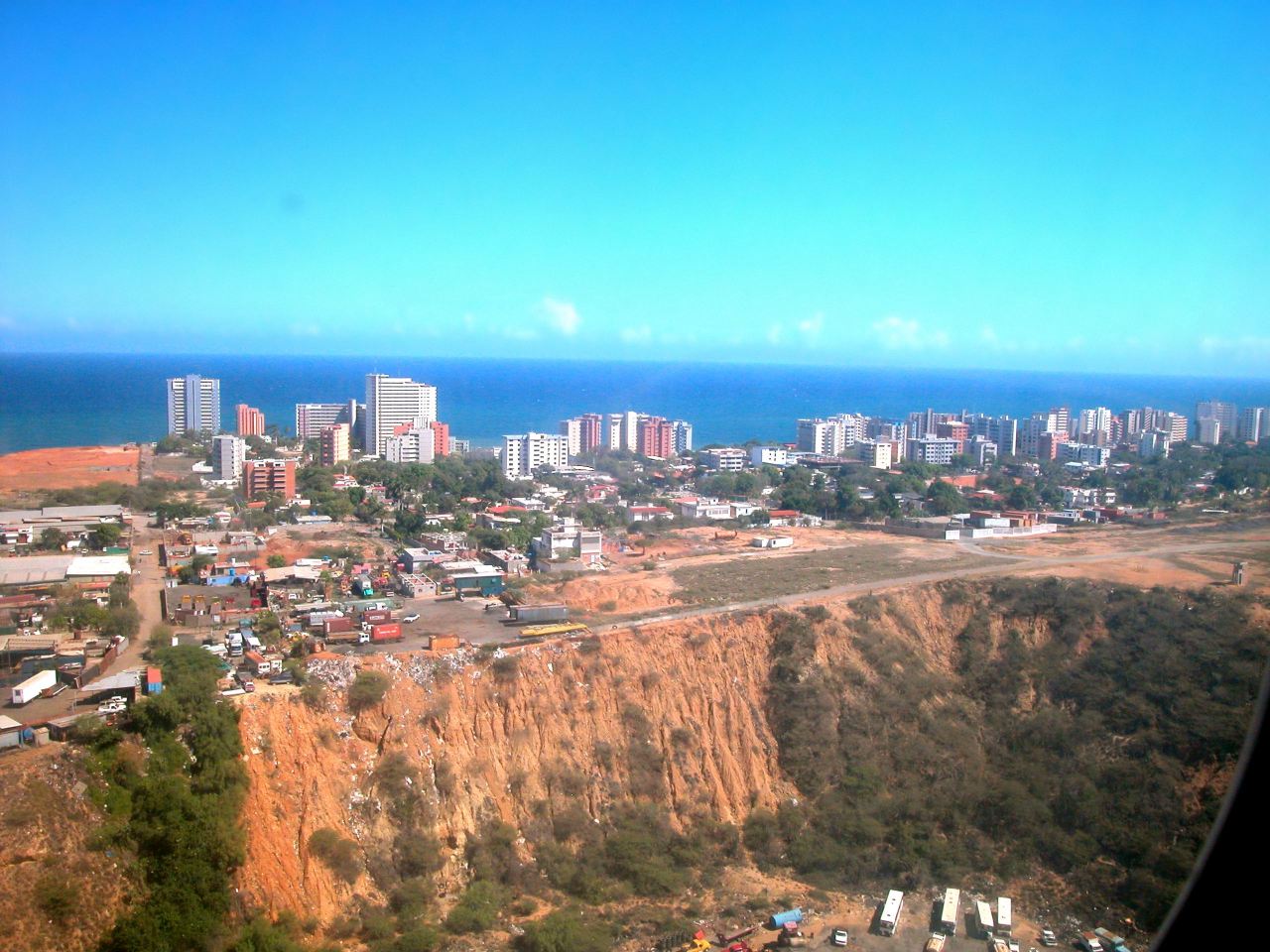
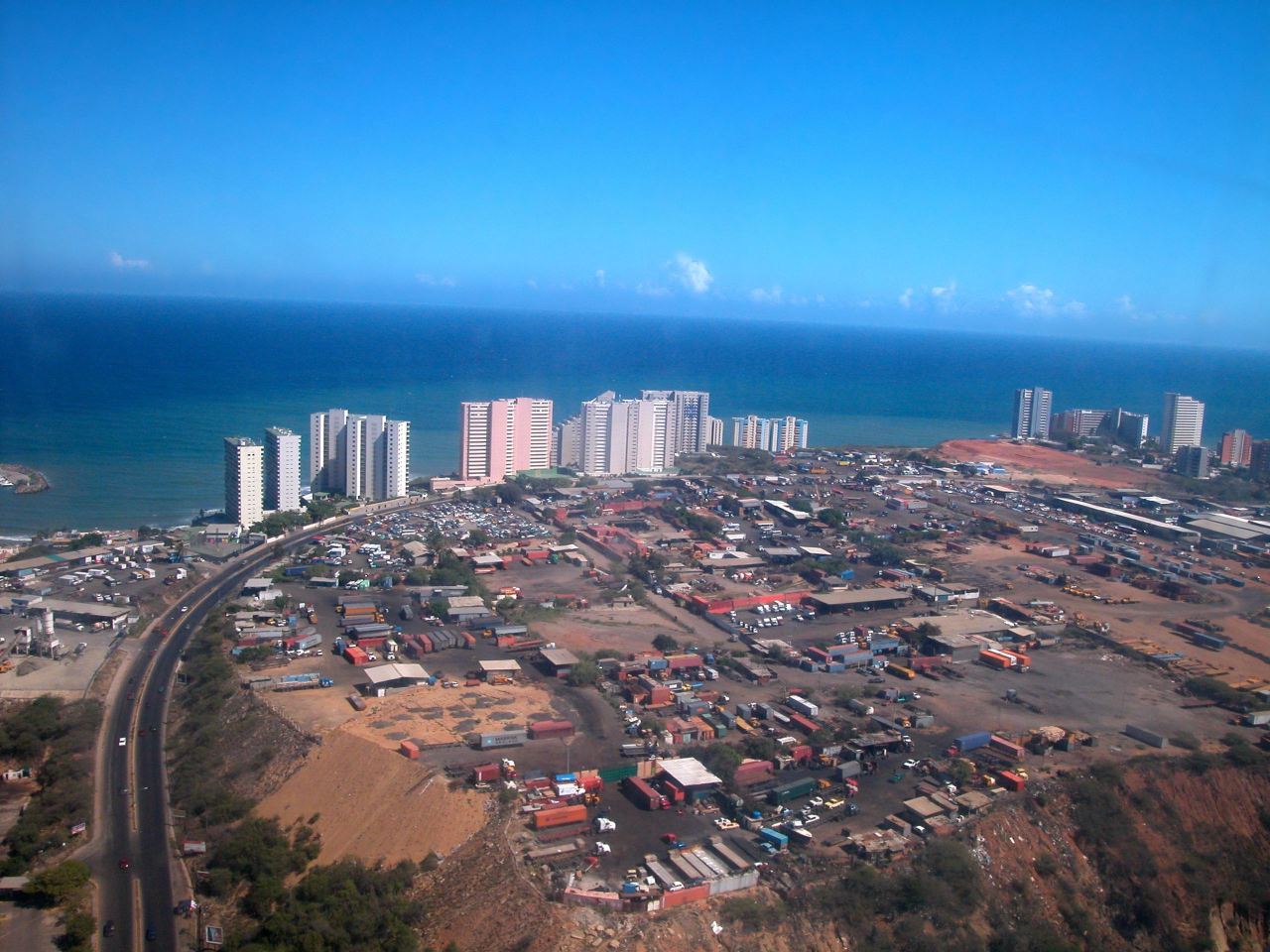
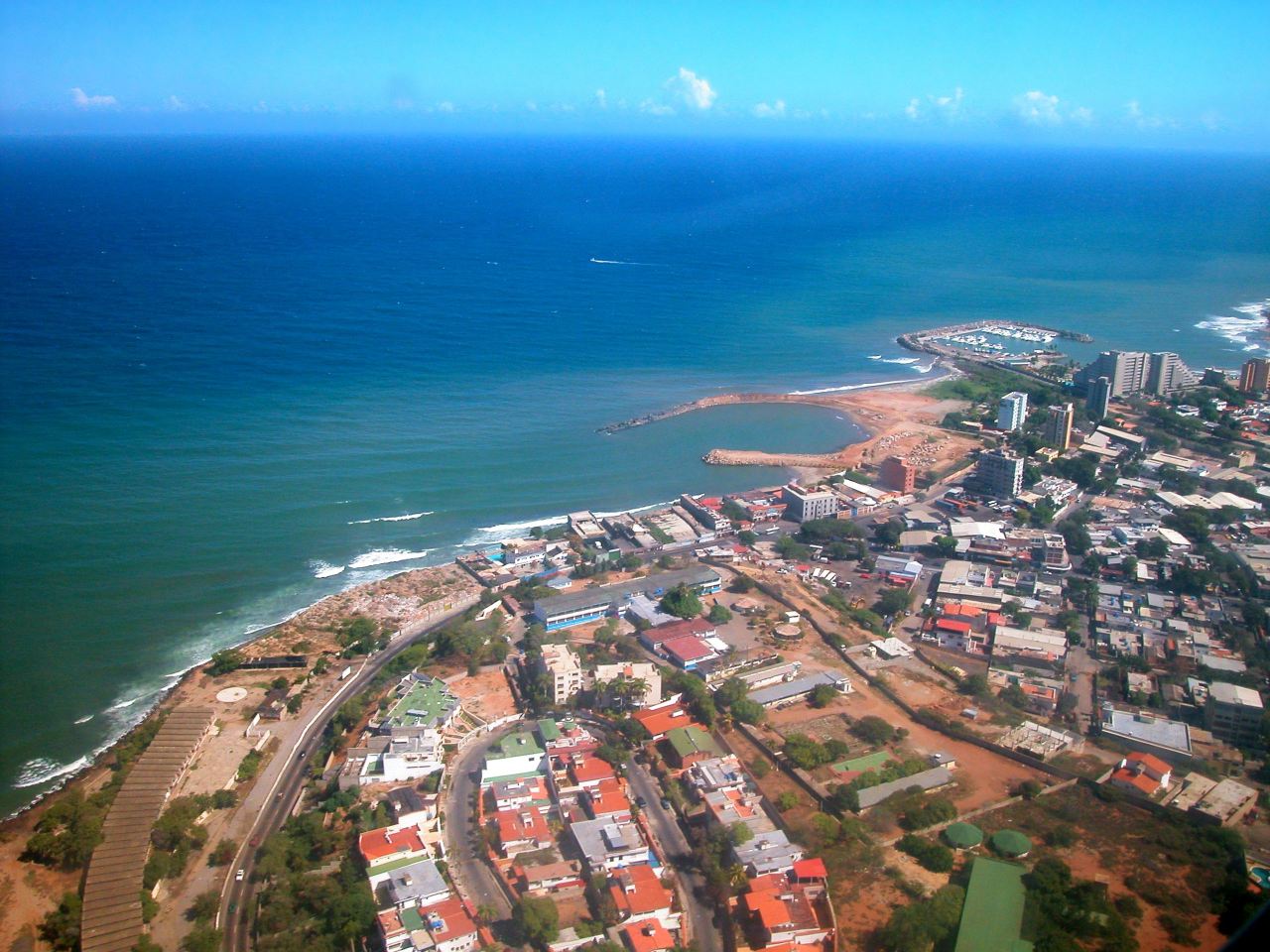
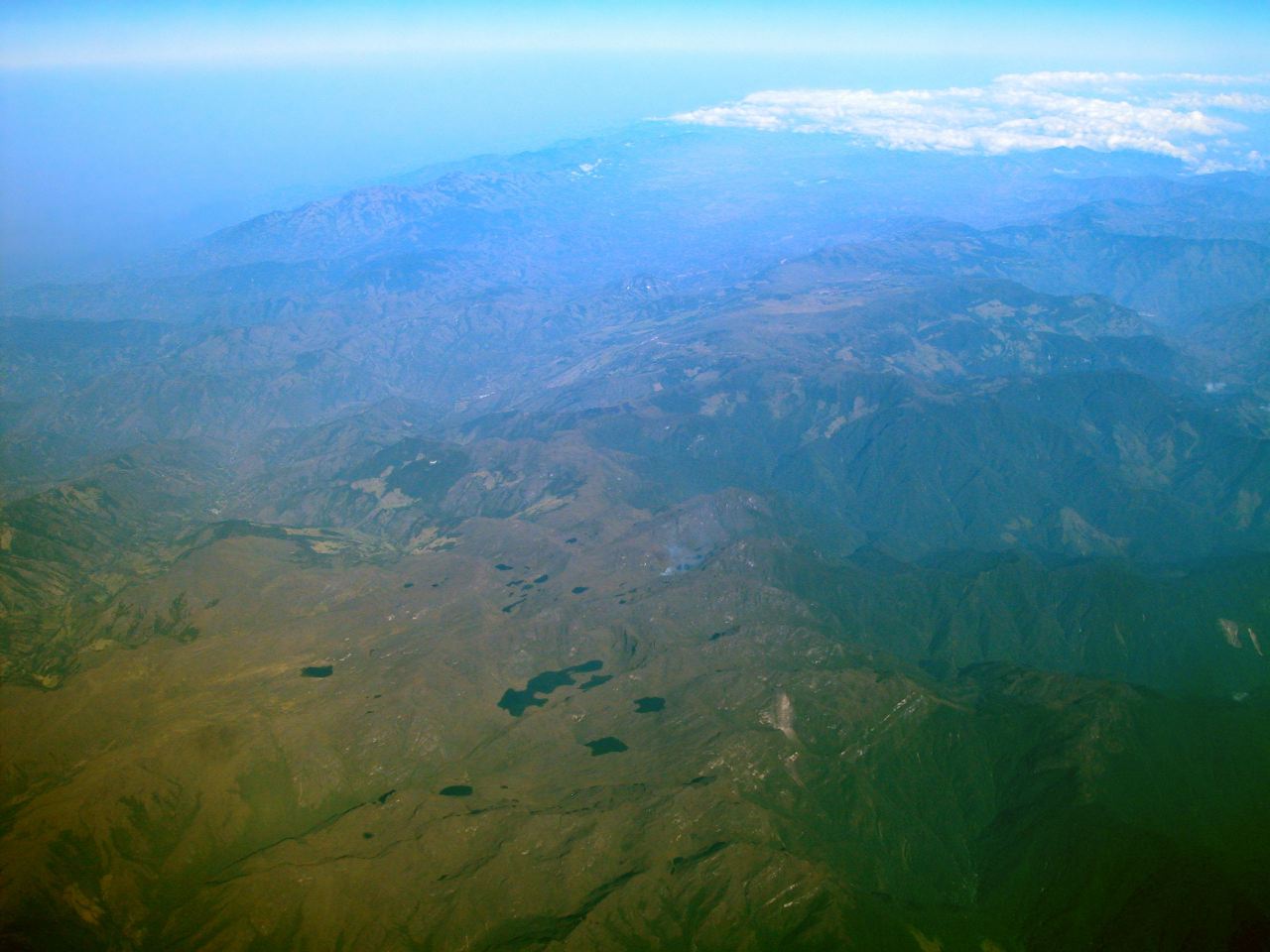
Before landing the plane made a wide circle over the Caribbean and the suburbs. Alas, that's all we saw of the country. They wouldn't let us out to look round the city. Wrong passport in our pockets. They gave us hope at first, then a watchful official jabbed contemptuously at our passport and said, ‘That's not the European Union.’ So we had to sit in the airport for eight hours.
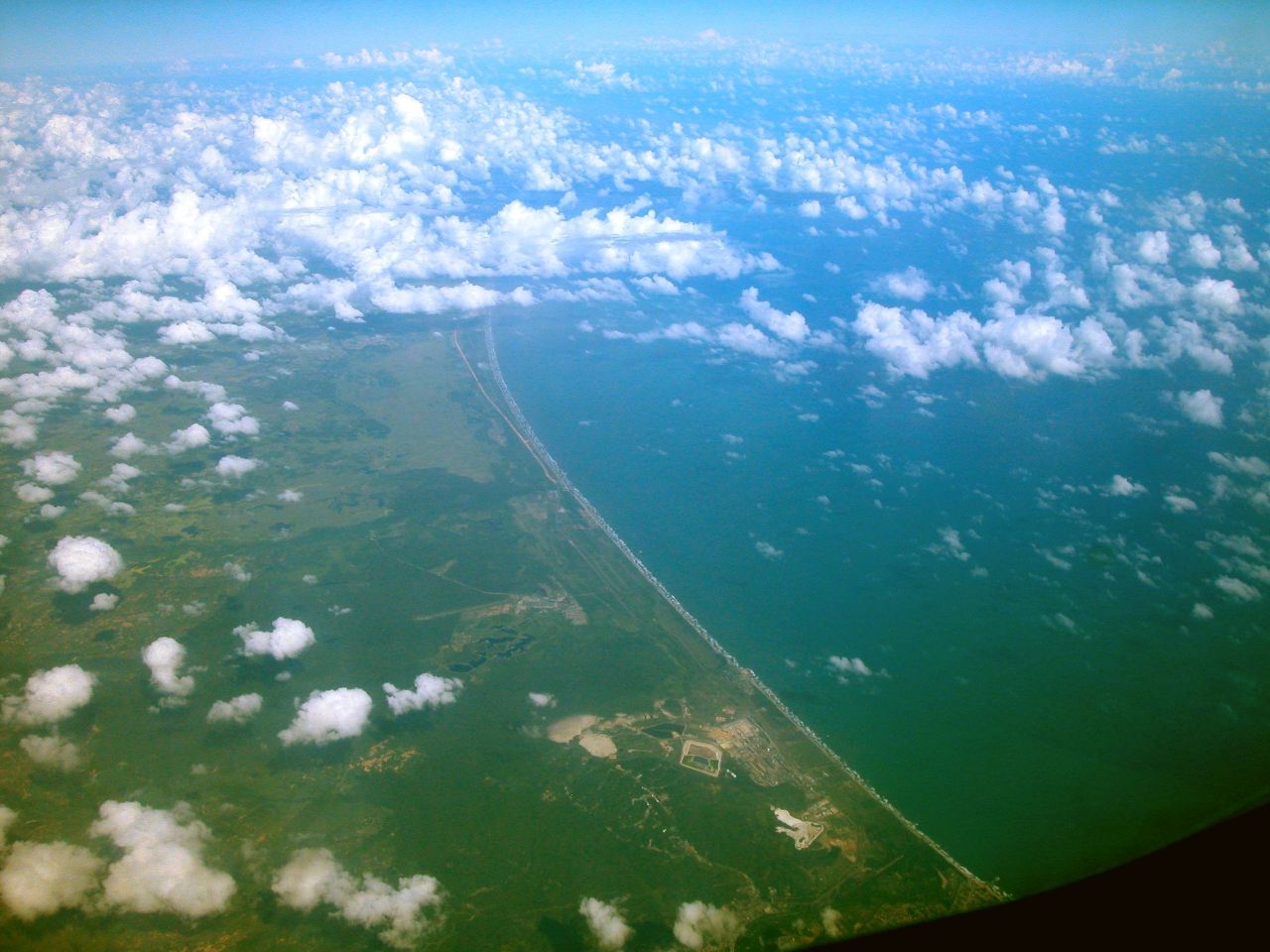
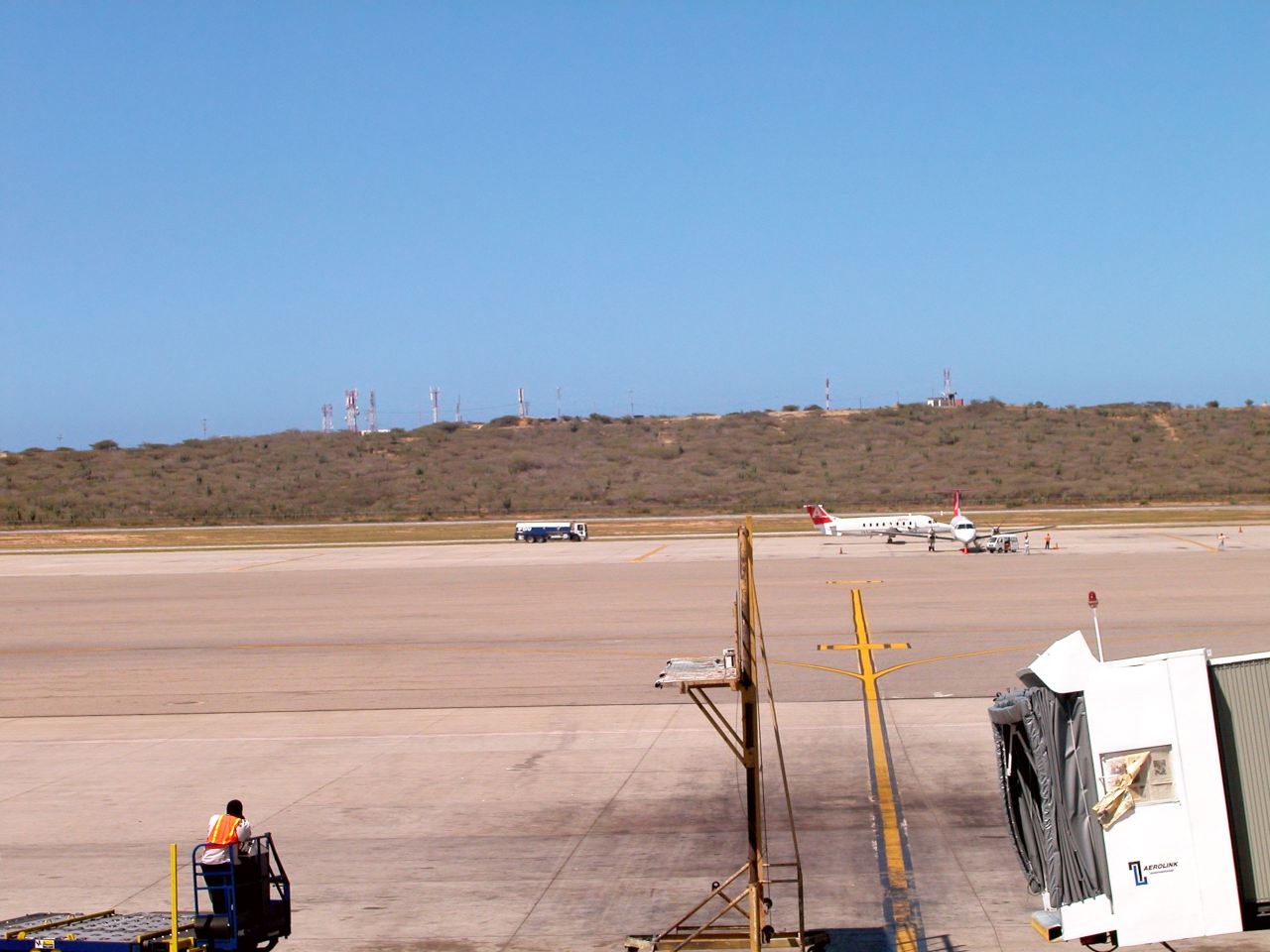
A miserable place. The service in Venezuela was on a Soviet level, built on the principle ‘There are lots of you and only one of me.’ They didn't take cards, though there was a Visa logo by every till. Pay in foreign money and the rate is double what it should be. Pay in local bolívares and you get no change. Must be a result of the oil reserves. Nobody wants to work. It seems to be a law: oil inevitably spoils a country. There's only one exception, Norway.
I did send about two hundred texts from Venezuela. There was nothing to do so I kept pressing buttons on my phone. The rate from the only local carrier, Digitel, was $0.43. I was ready to go broke, but owing to the general local absent-mindedness they only charged me for one text. A minute's call, by the way, costs $2 outgoing and $4 incoming. Unlike the rest of the Americas, Venezuela used the European 900 MHz standard.
Next, we crossed the Atlantic on an A340 from our old friends Lufthansa. Most of the flight was in darkness. The only things we managed to see from the window were a few of the Antilles, including Martinique. Then the plane turned east and hit severe turbulence. It shook hard and for a long time. They even had to stop serving lunch midway through. Some people were scared. I went to sleep and woke up nearer the coast of Africa. The route was over the ocean almost to the end. We brushed the Spanish coast and didn't go over land for good until we were close to Paris. The city was wonderfully clear from the window.
There was snow on the ground already in Frankfurt. The last little leg to Saint Petersburg felt very short. We flew almost in a straight line over the Curonian Spit, Šiauliai and ice-covered Lake Peipus.
Saint Petersburg was dark and cold and snowy, and above all nerve-racking. Tanya and Lena had brought coca leaves. In Peru they serve them instead of fruit punch at children's parties. In Russia it could fall under Article 228 of the criminal code, with up to three years in prison. I'd warned them, but they hadn't listened, and now the two women were carrying their packs through the green channel. Fortunately they got through. Two people who tried it in Moscow weren't so lucky. They were shown on national television and it was announced as a great victory over the drug trade.
Lena's daughter Polina met us at the airport with her husband, who drove us all home. Our eyes weren't used to the darkness yet, and if you shut them you could still see the tropical sunlight pouring over the desert. It will pass, and the day-to-day job will come to seem the only possible way to spend our time. I don't think we'll go anywhere for a while now. But I believe the day will come…